Quick Navigation
Report Overview
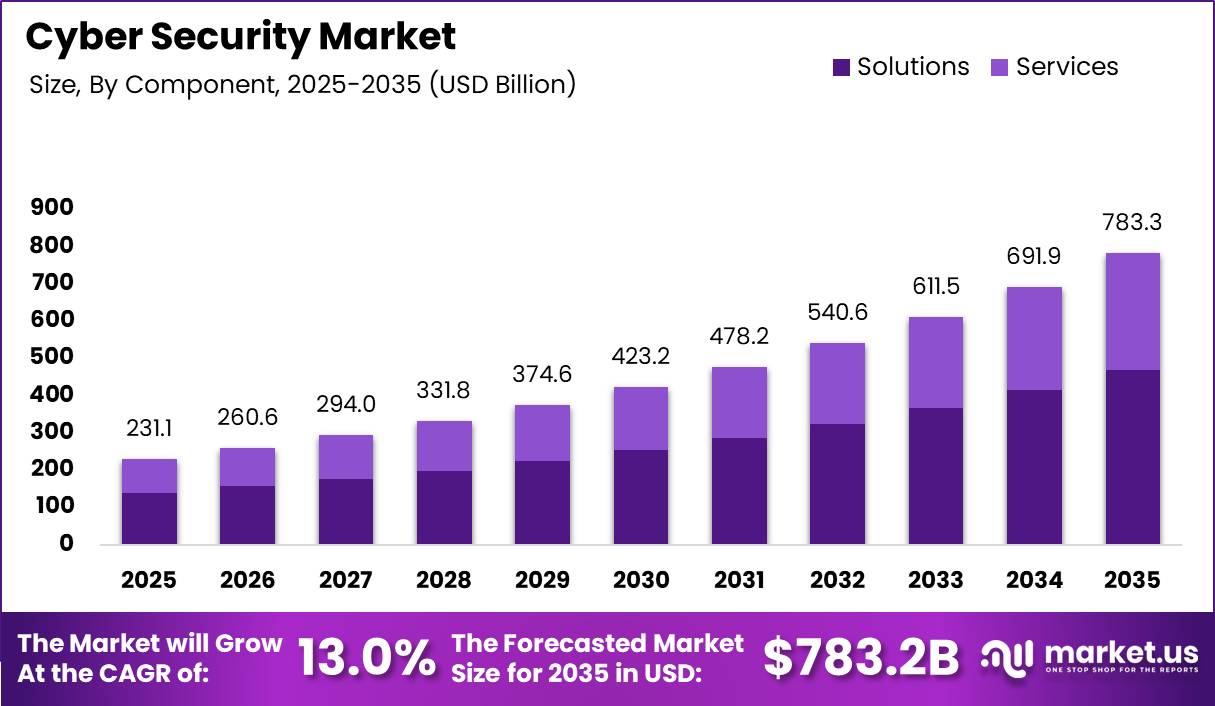
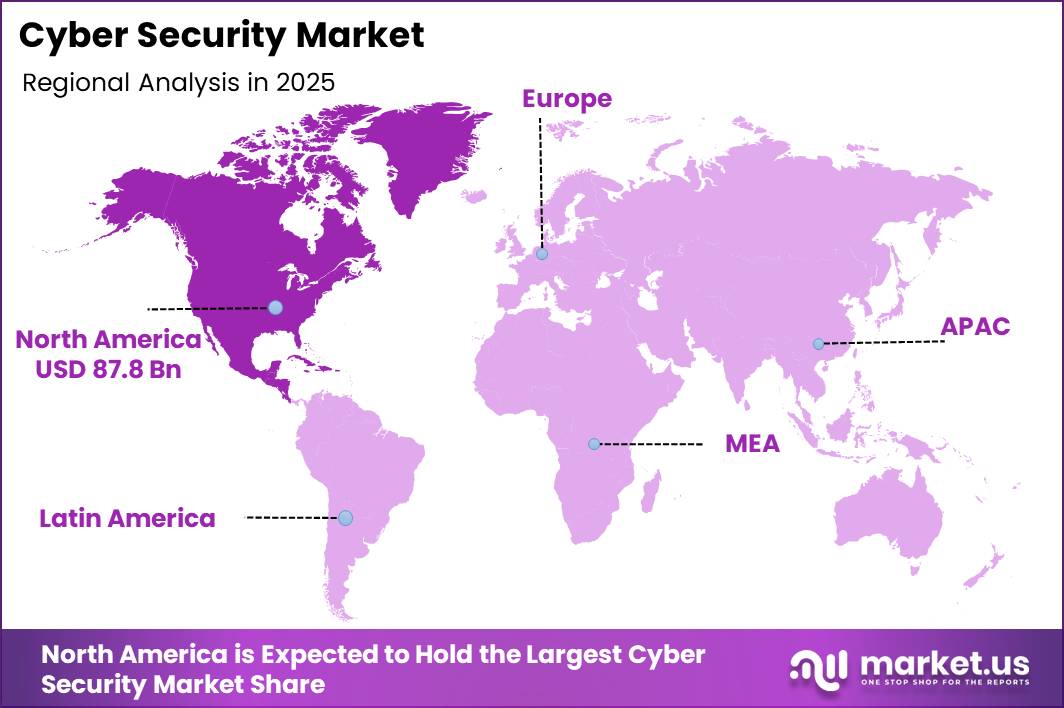
In 2025, the Global Cyber Security Market was valued at USD 231.1 billion. The market is projected to grow at a CAGR of 13.0% during 2026–2035, reaching approximately USD 783.2 billion by 2035. North America dominated the global market in 2025, accounting for more than 38.0% of the total market share and generating approximately USD 87.8 billion in revenue.
In November 2025, according to the International Telecommunication Union, 6.0 billion people, representing 74% of the global population, were using the internet, compared with a revised 5.8 billion in 2024. More than 240 million people came online during 2025, while the number of internet users increased by 1.3 billion between 2020 and 2025. The ITU also reported that 5G networks covered 55% of the global population and accounted for around 3 billion mobile broadband subscriptions, creating more connected devices, data flows, and security risks.
North America’s leadership is supported by a highly digital economy and strong security demand across banking, healthcare, government, cloud services, and critical infrastructure. In April 2025, according to the FBI, the Internet Crime Complaint Center received 859,532 complaints for 2024 and recorded USD 16.6 billion in reported losses, representing a 33% annual increase. Investment fraud caused approximately USD 6.5 billion in losses, while business email compromise accounted for USD 2.7 billion.
Key Takeaway
- The Cybersecurity Market is expected to rise from USD 231.1 billion in 2025 to USD 783.2 billion by 2035, at a 13.0% CAGR.
- The solutions segment dominated with around a 60.0% share, driven by demand for advanced cyberattack prevention and detection technologies.
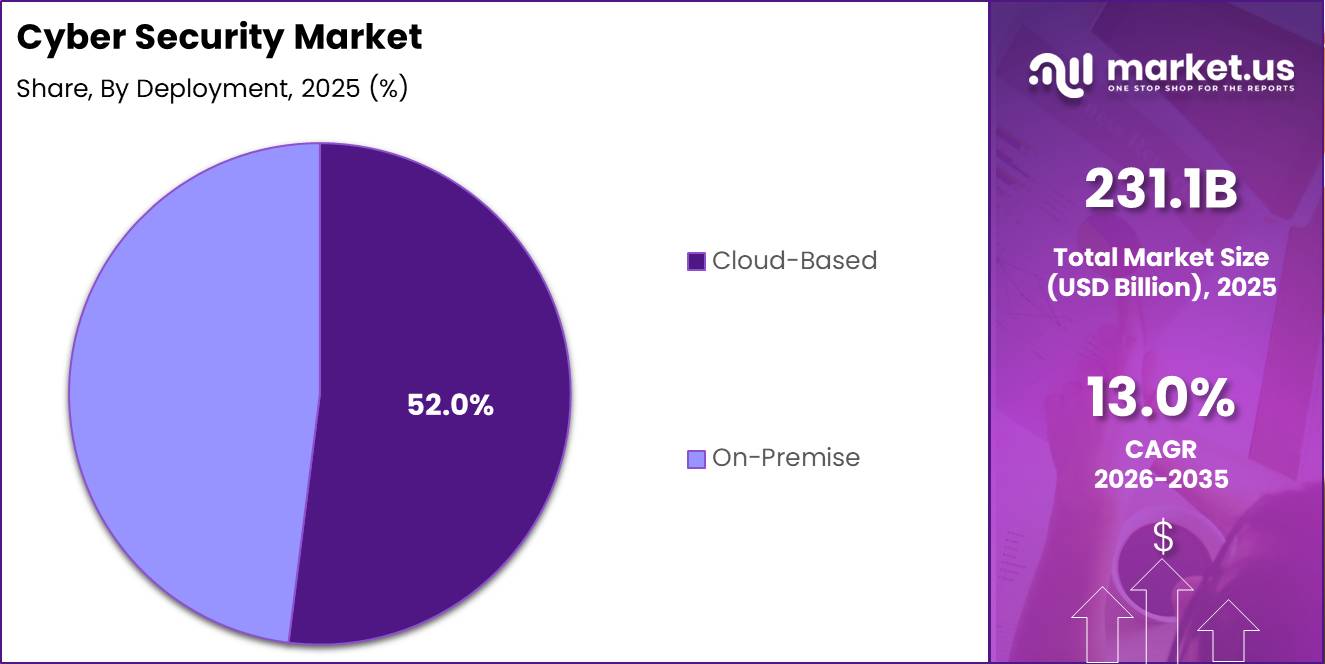
- Cloud-based deployment held nearly a 52.0% share, supported by the rapid migration of applications and data to cloud platforms.
- Network security accounted for around a 28.0% share, reflecting the growing need to protect connected systems and data traffic.
- BFSI led the end-use market with approximately 23.0% share, due to its high exposure to financial fraud and sensitive data breaches.
- North America led the market with over 38.0% share, generating approximately USD 87.8 billion in 2025.
By Component
The solutions segment held around 60.0% of the cybersecurity market by component, supported by strong demand for technologies that prevent, detect, and control cyberattacks. Organizations are increasing spending on firewalls, endpoint security, encryption, identity and access management, network protection, and cloud security platforms.
These solutions have become essential parts of modern IT systems as businesses move more data, applications, and operations online. According to the U.S. Office of Management and Budget, federal civilian agencies planned to spend more than USD 10 billion on information security and cybersecurity during fiscal year 2025.
By Deployment
The cloud–based deployment segment accounted for around 52.0% of the cybersecurity market, supported by the rapid movement of business applications, data, and workloads to cloud platforms. Organizations prefer cloud security because it can expand quickly as their digital operations grow. According to OECD analysis, cloud services represent nearly 30% of global IT spending and could approach almost 50% by 2027, showing that cloud infrastructure is becoming a standard part of enterprise technology systems.
Eurostat data also indicates that more than 60% of large enterprises in several European Union economies purchase cloud computing services, with particularly strong adoption across information and communication, financial services, and professional services. As companies move away from traditional on-premise systems, fixed perimeter security is no longer sufficient.
By Security Type
The network security segment held around 28.0% of the cybersecurity market, supported by the need to protect data moving between users, devices, data centres, branch offices, and cloud platforms. Firewalls, secure gateways, intrusion detection and prevention systems, virtual private networks, and network segmentation help organizations identify and block attacks before they reach multiple applications or endpoints.
In June 2026, according to Ericsson, global 5G subscriptions reached approximately 2.9 billion at the end of 2025, representing nearly one-third of all mobile subscriptions, after around 660 million new subscriptions were added during the year. In October 2025, according to ENISA, its latest threat assessment examined 4,875 cyber incidents recorded between July 2024 and June 2025, with availability attacks and distributed denial-of-service incidents remaining major network threats.
Cloud security is the fastest-growing security type as companies transfer more applications, databases, and computing workloads to public, private, and hybrid cloud environments. In February 2026, according to Eurostat, 52.7% of EU enterprises used paid cloud services in 2025. Among these users, 65.5% purchased cloud-based security software.
By End User
The BFSI segment held around 23.0% of the cybersecurity market, making it the leading end-use industry. Banks, insurers, payment companies, and other financial institutions manage large volumes of digital transactions and confidential customer information, making them valuable targets for cybercriminals.
In 2024, according to the World Bank, monetary-sector credit provided to the private sector was equal to approximately 91% of global GDP, highlighting the scale of financial systems that require continuous protection. Financial institutions therefore invest heavily in fraud detection, identity and access management, encryption, network monitoring, and incident-response solutions.
Healthcare is expected to be the fastest-growing end-use segment as hospitals, insurers, laboratories, and clinics increasingly adopt electronic records, telemedicine, connected medical devices, and digital claims systems. In 2024, according to the World Health Organization, global healthcare spending reached approximately USD 9.8 trillion in 2022, representing 9.9% of global GDP.
In 2023, according to the OECD, healthcare-related data breaches were estimated to have caused more than USD 21 billion in losses during 2020. The U.S. Department of Health and Human Services also received 663 notifications of major healthcare data breaches affecting 500 or more people during 2024. These risks are accelerating healthcare investment in identity protection, encryption, cloud security, and secure medical networks.
Key Market Segments
By Component
- Solutions
- Network Security
- Firewalls
- Intrusion Detection / Prevention
- Cloud Security
- CASB
- Cloud Security Posture Mgmt.
- Endpoint Security
- Identity & Access Management
- Network Security
- Services
- Managed Security Services
- Professional Services
By Deployment
- Cloud-Based
- SaaS Security
- Cloud-Native
- On-Premise
By Security Type
- Network Security
- Cloud Security
- Application Security
- Endpoint Security
- Identity Security (IAM)
- Data Security
By End User
- BFSI
- IT & Telecom
- Government & Defense
- Healthcare
- Hospital Networks
- Medical Device Security
- Retail & E-commerce
- Manufacturing
- Energy & Utilities
Geopolitical Impact Analysis
Geopolitical tensions are changing the cybersecurity market by increasing hardware costs, disrupting technology supply chains, and encouraging companies to reconsider where security systems and data are hosted. In November 2024, according to the World Trade Organization, G20 import restrictions still in force covered USD 2.3 trillion of trade, equal to 12.7% of G20 imports and 9.4% of global imports.
These restrictions can increase the cost and delivery time of semiconductors, secure routers, firewalls, and other network-security equipment. In April 2024, according to UNCTAD, Red Sea disruptions increased average delivery times by 10 days or more, while the Suez Canal normally carries around 15% of global maritime trade. Longer routes raise freight, insurance, and inventory costs for cybersecurity hardware suppliers.
Geopolitical risk also affects cloud-based cybersecurity operating costs and vendor selection. In April 2025, according to the International Energy Agency, data centres consumed around 415 TWh of electricity in 2024, representing about 1.5% of global electricity use, after demand increased by an average of 12% annually over the previous 5 years. Rising power requirements can increase the cost of hosting security analytics, SIEM, and security operations centre platforms.
In January 2025, according to the World Economic Forum, nearly 60% of organizations said geopolitical tensions influenced their cybersecurity strategies. Around 18% changed trading or operating policies, 17% stopped operations in certain markets, and 16% changed vendors. These shifts are increasing demand for regional cloud infrastructure, diversified suppliers, data-sovereignty controls, and locally managed cybersecurity services.
Regional Analysis
North America led the global cybersecurity market with approximately a 38.0% share and revenue of about USD 87.8 billion in 2025. The region benefits from a highly digital economy, strong cloud adoption, strict data-protection rules, and a large concentration of banks, technology companies, healthcare providers, and critical infrastructure operators. In April 2026, according to the FBI, the Internet Crime Complaint Center received 1,008,597 complaints in 2025, compared with 859,532 in 2024.
Reported losses reached USD 20.8 billion, increasing by 26%, with an average loss of USD 20,699 per complaint. In August 2024, according to Statistics Canada, 22.2% of Canadian businesses planned additional cybersecurity measures, rising to 38.3% among finance and insurance companies. These risks continue to support spending on zero-trust security, endpoint protection, identity management, and cloud-based threat monitoring.
Asia Pacific is expected to be the fastest-growing regional market, driven by expanding internet access, mobile connectivity, digital payments, e-commerce, and cloud infrastructure. In October 2025, according to the ITU, around 77% of the region’s population used the internet. The ITU also reported that 5G networks covered 70% of the Asia-Pacific population in 2025, while 4G coverage reached approximately 96.8%.
Key Regions and Countries
North America
- US
- Canada
Europe
- Germany
- France
- The UK
- Spain
- Italy
- Rest of Europe
Asia Pacific
- China
- Japan
- South Korea
- India
- Australia
- Rest of APAC
Latin America
- Brazil
- Mexico
- Rest of Latin America
Middle East & Africa
- GCC
- South Africa
- Rest of MEA
Market Dynamics
Drivers
| Driver | (~) % CAGR | Geographic Relevance | Impact Timeline |
|---|---|---|---|
| Regulatory Compliance Mandates (NIS2, DORA, CMMC) | +2.8% | Europe, North America, Global supply chains | Short term (≤ 2 years) |
| Escalating AI-Powered Threat Landscape | +2.4% | Global | Short term (≤ 2 years) |
| Cloud & Hybrid Infrastructure Expansion | +1.9% | North America, Asia-Pacific, Europe | Short term (≤ 2 years) |
| Zero Trust Architecture Adoption | +1.6% | North America, Western Europe | Medium term (2–4 years) |
| Critical Infrastructure Digitisation & OT/IT Convergence | +1.4% | Global, led by North America & APAC industrials | Medium term (2–4 years) |
| Surge in Cyber Insurance Procurement | +0.9% | North America, Europe | Short term (≤ 2 years) |
Regulatory Compliance Mandates (NIS2, DORA, CMMC)
The simultaneous activation of multiple binding cybersecurity frameworks is generating the most immediate and non-discretionary demand catalyst in the market today. The EU’s NIS2 Directive (Directive (EU) 2022/2555) expanded coverage from 7 to 18 critical sectors and became transposable national law across Member States by October 17, 2024, with full enterprise compliance expected by October 2026, creating a two-year mandatory remediation sprint for hundreds of thousands of “essential” and “important” entities.
In parallel, DORA (Regulation (EU) 2022/2554) became directly applicable on January 17, 2025 across 20 categories of financial entities, mandating major incident reporting within 4 hours of classification, mandatory Threat-Led Penetration Testing (TLPT) at least every 3 years, and Register of Information (RoI) submissions to national competent authorities with BaFin requiring submissions between 9–30 March 2026 and the AFM (Netherlands) by 22 March 2026.
Non-compliance penalties under NIS2 reach up to €10 million or 2% of global annual turnover for essential entities, while DORA exposes individual senior managers to personal fines of up to €1 million, making this a boardroom-level spend trigger rather than a discretionary IT line item. This enforcement architecture structurally compresses procurement timelines across endpoint detection, SIEM, third-party risk management, and incident response tooling, directly inflating addressable demand across the vendor stack inside a 24-month execution window.
Restraints
| Restraint | (~) % CAGR | Geographic Relevance | Impact Timeline |
|---|---|---|---|
| Cybersecurity Budget Compression in SME & Mid-Market Segments | −2.3% | Global, most acute in emerging markets & Europe | Short term (≤ 2 years) |
| Macroeconomic-Driven Enterprise IT Spending Freeze | −1.7% | North America, Western Europe | Short term (≤ 2 years) |
| Geopolitical Fragmentation & Data Sovereignty Laws | −1.2% | EU, China, India, Middle East | Medium term (2–4 years) |
| Vendor Lock-In & Integration Complexity Blocking Platform Consolidation | −0.9% | Global enterprise segment | Medium term (2–4 years) |
| Legal Liability Ambiguity Stalling Threat Intelligence Sharing | −0.6% | North America, EU | Short term (≤ 2 years) |
Cybersecurity Budget Compression in SME & Mid-Market Segments
Budget constraint is the most structurally pervasive demand suppressor active in the market today, operating as a hard ceiling on total addressable conversion rather than merely slowing adoption velocity. Across organizations with fewer than 500 employees, annual cybersecurity expenditure ranges from approximately $8,500 (1–10 staff) to $285,000 (101–500 staff), with security spending absorbing between 5% and 25% of total IT budgets yet even at those proportions, coverage remains materially incomplete against modern threat vectors.
At the CISO tier, only 47% reported security budget increases in 2025, a sharp deterioration from 62% in 2024 and 78% in 2022, meaning a majority 54% are operating on flat or contracting budgets during a period of escalating attack surface complexity. For SMEs specifically, 37% cite budget as the primary barrier to security investment, a dynamic that suppresses conversion of the large but financially thin long tail of the addressable market.
Challenges
| Challenge | (~) % CAGR | Geographic Relevance | Mitigation Horizon |
|---|---|---|---|
| Global Cybersecurity Talent Deficit | −2.1% | Global, most severe in APAC & Latin America | Long term (≥ 4 years) |
| Software Supply Chain Attack Proliferation | −1.5% | Global, concentrated in manufacturing & technology sectors | Medium term (2–4 years) |
| OT/ICS Legacy Patch & Vulnerability Lag | −1.3% | Global industrial and critical infrastructure sectors | Long term (≥ 4 years) |
| Agentic AI Attack Surface Expansion | −1.1% | Global | Medium term (2–4 years) |
| Security Tooling Sprawl & Alert Fatigue | −0.8% | Global enterprise segment | Medium term (2–4 years) |
Global Cybersecurity Talent Deficit
The shortage of skilled cybersecurity professionals remains one of the largest barriers to market growth across all regions and industry segments. In 2024, the global cybersecurity workforce gap reached approximately 4.8 million positions, increasing by 19% year over year. The United States alone had more than 500,000 unfilled roles, compared with an employed cybersecurity workforce of just over 1.3 million, indicating that only around 72% of required capacity was available.
The 2025 ISC2 Cybersecurity Workforce Study found that 88% of respondents experienced at least 1 serious security consequence linked to workforce or skills shortages during the previous year. Around 69% reported more than 1 such consequence. Limited staff availability can slow the deployment of SIEM, SOAR, and XDR platforms, reduce the effectiveness of purchased tools, and weaken the return on cybersecurity investments.
The talent gap also increases implementation and service costs. Professional services may represent an additional 20–35% of contract value for complex security deployments, while greater reliance on managed detection and response services can reduce vendor margins. AI-based security tools may help address this challenge, with some systems identifying breaches 108 days faster than conventional methods. Without stronger education, training, and certification programs, the workforce shortage may continue restricting market growth for at least the next 4 years.
Opportunities
| Opportunity | (~) % CAGR | Geographic Relevance | Execution Window |
|---|---|---|---|
| Post-Quantum Cryptography (PQC) Migration Services | +2.6% | Global, led by EU, North America, and financial sector | Medium term (2–4 years) |
| Cyber Insurance-Embedded Security-as-a-Service | +1.8% | North America, Europe, expanding in APAC | Medium term (2–4 years) |
| AI-Native Security Platform Monetisation | +1.6% | Global enterprise & cloud-native segments | Short term (≤ 2 years) |
| Emerging Market & SME Managed Security Services (MSSP) Expansion | +1.3% | South & Southeast Asia, Middle East, Latin America | Medium term (2–4 years) |
| OT/ICS Industrial Cybersecurity Greenfield Buildout | +1.1% | Global, highest density in North America & APAC manufacturing | Long term (≥ 4 years) |
| Privacy-Enhancing Technology (PET) Commercialisation | +0.7% | EU, North America, data-intensive verticals | Long term (≥ 4 years) |
Post-Quantum Cryptography (PQC) Migration Services
Post-quantum cryptography remains a largely untapped cybersecurity opportunity because commercial adoption is still at an early stage and revenue has not yet reached scale. In August 2024, NIST published its first 3 final PQC standards: ML-KEM, ML-DSA, and SLH-DSA. Under NIST IR 8547, quantum-vulnerable algorithms such as RSA and ECC are expected to be removed from NIST standards by 2035, while high-risk systems may need to migrate much earlier.
The commercial opportunity is significant because most enterprises have not yet completed cryptographic inventories or formal migration plans. A full transition may take 3–7 years for each organization, creating a long-term revenue pipeline for assessment, implementation, and managed security services. Hardware-based PQC appliances may achieve prices around 30–50% above comparable classical cryptography products, giving vendors opportunities to increase both average selling prices and service revenue.
Key Players Analysis
The cybersecurity market has a two-tier competitive structure, led by large vendors with broad enterprise platforms. Palo Alto Networks remained a major Tier-1 company in FY2025, generating USD 9.2 billion in revenue, up 15%, while Next-Generation Security ARR reached USD 5.6 billion, up 32%, and remaining performance obligations increased to USD 15.8 billion.
Cisco reported FY2025 security product revenue of USD 8.0 billion, rising 59%, while total revenue reached USD 56.6 billion. Microsoft supported its position with nearly 1.5 million security customers and Microsoft Cloud revenue of USD 168.9 billion, up 23%.
Tier-2 companies compete through cloud-native platforms, identity protection, zero-trust security, and AI-based threat detection. CrowdStrike ended FY2025 with USD 4.2 billion in ARR, up 23%, subscription revenue of USD 3.7 billion, up 31%, and free cash flow of USD 1.0 billion. Fortinet generated USD 6.8 billion in 2025 revenue, up 14%, while Unified SASE ARR reached USD 1.2 billion, up 11%, and Security Operations ARR reached USD 491 million, up 21%.
Check Point recorded USD 2.7 billion in revenue, up 6%, while Zscaler generated USD 2.6 billion, up 23%, and reached USD 3.02 billion in ARR. Rapid7 reported USD 860 million in revenue and USD 840 million in ARR.
Top Key Players in the Market
- Palo Alto Networks
- Fortinet
- CrowdStrike Holdings
- Check Point Software
- Cisco Systems
- Microsoft Security
- IBM Security
- SentinelOne
- Zscaler
- Okta
- Qualys
- Rapid7
Recent Developments
- In 2026, Google completed its USD 32 billion acquisition of Wiz, strengthening Google Cloud’s cloud and AI security portfolio. Wiz continued operating across major cloud platforms and was used by 50% of Fortune 100 companies, supporting Google’s strategy to provide unified security across code, cloud, and runtime environments.
- In 2025, Palo Alto Networks signed an approximately USD 25 billion agreement to acquire CyberArk. The transaction offered CyberArk shareholders USD 45.0 in cash and 2.20 Palo Alto Networks shares for each share, representing a 26% premium to CyberArk’s unaffected 10-day average price. The acquisition strengthened Palo Alto Networks’ position in human, machine, and AI identity security.
- In 2025, CrowdStrike agreed to acquire Pangea to add AI Detection and Response capabilities to its Falcon platform. Pangea’s technology can block prompt-injection attacks with up to 99% effectiveness and latency below 30 milliseconds, helping enterprises protect AI models, prompts, agents, identities, and data.
Report Scope
| Report Features | Description |
|---|---|
| Market Value (2025) | USD 231.1 Billion |
| Forecast Revenue (2035) | USD 783.2 Billion |
| CAGR (2026-2035) | 13.0% |
| Base Year for Estimation | 2025 |
| Historic Period | 2020-2024 |
| Forecast Period | 2026-2035 |
| Report Coverage | Revenue Forecast, Market Dynamics, Competitive Landscape, Recent Developments |
| Segments Covered | By Component (Solutions – Network Security, Cloud Security, Endpoint Security, Identity & Access Management; Services – Managed Security Services, Professional Services); By Deployment (Cloud-Based, On-Premise); By Security Type (Network Security, Cloud Security, Application Security, Endpoint Security, Identity Security (IAM), Data Security); By End User (BFSI, IT & Telecom, Government & Defense, Healthcare, Retail & E-commerce, Manufacturing, Energy & Utilities) |
| Regional Analysis | North America – US, Canada; Europe – Germany, France, The UK, Spain, Italy, Rest of Europe; Asia Pacific – China, Japan, South Korea, India, Australia, Singapore, Rest of APAC; Latin America – Brazil, Mexico, Rest of Latin America; Middle East & Africa – GCC, South Africa, Rest of MEA |
| Competitive Landscape | Palo Alto Networks, Fortinet, CrowdStrike Holdings, Check Point Software, Cisco Systems, Microsoft Security, IBM Security, SentinelOne, Zscaler, Okta, Qualys, Rapid7 |
| Customization Scope | Customization for segments, region/country-level will be provided. Moreover, additional customization can be done based on the requirements. |
| Purchase Options | We have three licenses to opt for: Single User License, Multi-User License (Up to 5 Users), Corporate Use License (Unlimited Users and Printable PDF) |