



Overview
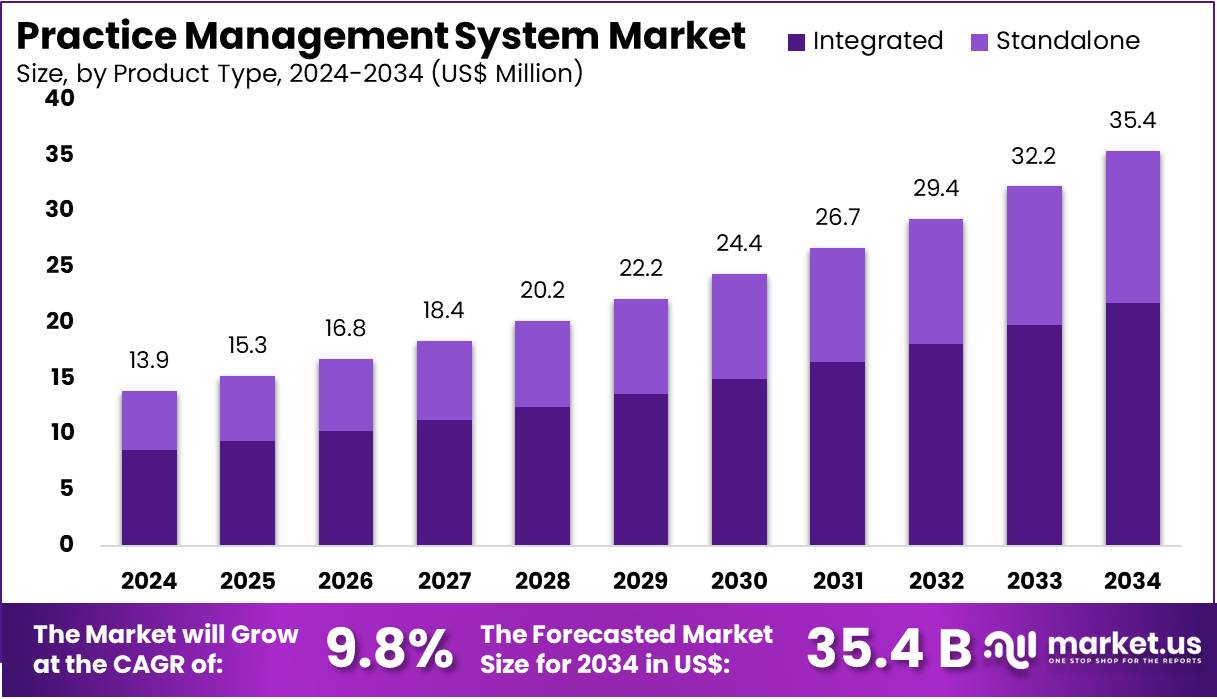
The Practice Management System Market size is expected to be worth around US$ 35.4 Billion by 2034 from US$ 13.9 Billion in 2024, growing at a CAGR of 9.8% during the forecast period 2025 to 2034.
The Practice Management System Market is gaining momentum as healthcare providers increasingly prioritize digital tools that streamline scheduling, billing, documentation, patient communication, and administrative workflows. Practice management platforms are becoming more closely integrated with electronic health records (EHRs), payer systems, and interoperability frameworks, enabling practices to improve operations and information exchange.
The U.S. healthcare technology environment is moving toward greater automation. The Centers for Medicare & Medicaid Services (CMS) has established interoperability requirements designed to improve electronic health information exchange and reduce administrative burden. Under the CMS Interoperability and Prior Authorization Final Rule, impacted payers must implement APIs supporting provider access, payer-to-payer exchange, and electronic prior authorization. CMS notes that these APIs can exchange information with an EHR or practice management system, creating opportunities for connected workflows.
CMS also requires impacted payers to provide prior authorization decisions within 72 hours for expedited requests and seven calendar days for standard requests. These requirements are encouraging healthcare organizations to strengthen automation. As interoperability standards, electronic transactions, cloud-based workflows, and patient-facing digital services advance, practice management systems are expected to improve efficiency, support revenue-cycle activities, and reduce administrative friction across healthcare practices.
Key Takeaways
- In 2024, the Practice Management System Market generated US$ 13.9 billion in revenue and is projected to reach US$ 35.4 billion by 2034, expanding at a 9.8% CAGR during 2025–2034.
- By product type, the market is segmented into integrated and standalone systems. The integrated segment dominated in 2024, accounting for a 61.5% market share.
- Based on components, the market is categorized into software and services. The software segment held the leading position in 2024, capturing a significant 72.8% market share.
- By delivery mode, the market includes web-based, cloud-based, and on-premise solutions. The web-based segment dominated the market in 2024, accounting for the largest 56.7% revenue share.
- By end user, the market is segmented into physician back offices, pharmacies, diagnostic laboratories, and others. The physician back office segment led the market in 2024, holding a 53.9% revenue share.
- Regionally, North America maintained its leadership in the Practice Management System Market in 2024. The region accounted for a substantial 44.3% market share, supported by strong adoption of healthcare technology.
Statistical Information
- 68% of U.S. medical groups reported adding or expanding their use of AI tools in 2025, with scheduling, patient communications, coding, revenue-cycle management, and prior authorization among the targeted workflows.
- 71% of medical practices reported that less than 25% of their patients were using digital self-scheduling tools in 2025, indicating substantial room for growth in automated scheduling and digital front-office solutions.
- 89% of patients who were offered online medical-record access in 2024 said their healthcare provider encouraged them to use the portal. Among those encouraged, 87% accessed their portal, compared with 57% of those who were not encouraged.
- 57% of individuals used an app to access their online medical records in 2024, up from 38% in 2020. This supports demand for mobile-enabled practice-management and patient-engagement platforms.
- 79% of individuals who accessed their online medical records in 2024 used their portal to message healthcare providers, while 77% used it to schedule appointments, highlighting strong consumer demand for digital communication and scheduling capabilities.
- 59% of individuals had multiple online medical records or patient portals in 2024, while only 7% used a portal-organizing app to combine information from different portals. This points to a major interoperability and data-aggregation opportunity.
- 66% of physicians surveyed by the AMA in 2024 reported currently using AI in their practices, compared with 38% in 2023. The rapid increase reinforces opportunities for AI-enabled administrative and practice-management functions.
- 84% of physicians identified EHR integration as an important attribute for advancing AI adoption. This makes seamless integration a key opportunity for practice-management platforms rather than standalone AI tools.
- 80% of physicians said AI applications involving billing codes, medical charts, or visit notes would be relevant to their practices, while 71% identified insurance prior-authorization automation as relevant.
- Physicians reported completing an average of 39 prior authorizations per week, while 89% said prior authorization increases physician burnout. This creates a strong opportunity for automated authorization, workflow management, and payer-integration capabilities.
Market Segmentation Analysis
Product Type Analysis
The integrated segment dominated the Practice Management System Market in 2024, accounting for a 61.5% market share. Its leading position is supported by the growing adoption of comprehensive healthcare platforms that combine multiple functions, including patient engagement, electronic prescribing, EHR/EMR integration, scheduling, billing, and administrative management.
By consolidating these capabilities into a single system, integrated solutions can help healthcare providers streamline workflows, improve coordination, and facilitate efficient data exchange. Increasing efforts to reduce administrative workloads and enhance patient experiences are expected to further support adoption.
In addition, growing interoperability requirements and data-sharing standards are encouraging providers to select connected platforms. The ability to deliver multiple functionalities through one solution can also improve usability, operational efficiency, and cost management across healthcare practices.
Component Analysis
The software segment accounted for a significant 72.8% share of the Practice Management System Market in 2024, maintaining its leading position as healthcare organizations increasingly digitize clinical and administrative activities. Practice management software supports essential functions such as appointment scheduling, billing, coding, patient records, reporting, and workflow management, helping providers improve operational efficiency and reduce manual processes.
Growing demand for accurate data management and streamlined administrative workflows is expected to sustain software adoption. The expansion of value-based care is also increasing the need for organized patient information, reporting capabilities, and performance tracking.
Furthermore, evolving platforms increasingly incorporate technologies such as artificial intelligence, automation, and predictive analytics. These capabilities can help practices enhance productivity, minimize errors, improve decision-making, and strengthen overall patient service delivery.
Delivery Mode Analysis
The web-based segment held the largest position in the Practice Management System Market in 2024, capturing a 56.7% revenue share. Its dominance reflects increasing demand for flexible digital platforms that allow healthcare providers to access practice management functions through internet-connected devices. Web-based systems can support remote access to scheduling, billing, patient information, and administrative workflows, making them particularly useful for multi-location practices and distributed healthcare operations.
The growing requirement for real-time information exchange and synchronized updates is expected to encourage further adoption. Increased use of smartphones, tablets, and other connected devices is also supporting demand for accessible healthcare platforms. As providers focus on scalability, operational flexibility, security, and cost efficiency, web-based practice management solutions are expected to remain an important delivery model.
End-user Analysis
The physician back office segment led the Practice Management System Market in 2024, accounting for a 53.9% revenue share. This leading position is attributed to the growing need for efficient management of essential administrative and operational activities within physician practices. Practice management systems can support back-office functions such as appointment scheduling, medical billing, insurance claims processing, coding, patient records, and revenue-cycle activities.
As healthcare providers seek to reduce administrative workloads and improve productivity, digital solutions are becoming increasingly important for optimizing these processes. The transition toward value-based care is also increasing the need for better coordination between clinical and administrative functions. Additionally, practices are focusing on reducing operational costs, improving patient services, and minimizing manual work, which is expected to sustain demand for practice management systems across physician back offices.
Regional Analysis
North America dominated the Practice Management System Market in 2024, accounting for a 44.3% revenue share. The region’s strong position is supported by the widespread adoption of digital healthcare technologies, established healthcare infrastructure, and increasing use of electronic health records and integrated practice-management solutions.
Healthcare providers are increasingly focusing on streamlining administrative workflows, improving billing and scheduling processes, and enhancing patient engagement. The growing emphasis on interoperability and secure health information exchange is also encouraging healthcare organizations to adopt connected practice management platforms. In addition, the presence of established technology providers and favorable healthcare digitization initiatives continues to support regional demand.
Asia Pacific is expected to register the highest CAGR during the forecast period. Growth is being supported by expanding healthcare infrastructure, increasing digitalization, rising healthcare demand, and greater adoption of electronic healthcare solutions. Governments and healthcare organizations across the region are increasingly investing in digital systems to improve operational efficiency and access to healthcare services. Growing awareness of practice automation and the need to manage expanding patient volumes are also expected to create opportunities for practice management system providers.
Business Opportunities
The Practice Management System Market presents significant business opportunities as healthcare organizations increasingly seek technologies that simplify administrative workflows, improve interoperability, and enhance operational efficiency.
CMS is advancing policies that encourage secure electronic data exchange through APIs and FHIR-based standards, creating opportunities for vendors to develop practice management platforms with stronger interoperability capabilities. Artificial intelligence and automation represent another important opportunity. Healthcare providers are seeking tools that can automate scheduling, billing, documentation, claims processing, and other repetitive activities.
Cloud-based and web-enabled platforms also offer growth opportunities by supporting scalable access across multi-location practices. Vendors can differentiate through integrated patient engagement, electronic prescribing, revenue-cycle management, analytics, cybersecurity, and automated workflows.
Additionally, solutions designed for smaller physician practices and emerging healthcare markets can address demand for cost-effective digital infrastructure. As CMS continues emphasizing administrative simplification and interoperability, providers that combine usability, automation, secure data exchange, and flexible deployment models are positioned to capture expanding demand.
Emerging Trends
- AI-powered workflow automation: Practice management platforms are increasingly moving beyond basic scheduling and billing toward AI-assisted administrative work. The AMA found 57% of physicians see reducing administrative burden through automation as AI’s biggest opportunity, supporting greater adoption of intelligent workflow tools.
- FHIR-first interoperability: Healthcare software is increasingly being designed around standardized FHIR APIs rather than isolated data connections. CMS identifies HL7 FHIR Release 4.0.1 and related implementation guides as key standards, encouraging practice-management vendors to build more interoperable platforms.
- Nationwide health-data connectivity: TEFCA is creating a broader framework for exchanging health information across organizations and proprietary networks. This trend can encourage practice-management systems to support secure information exchange for treatment, payment, healthcare operations, and patient access.
- AI-assisted clinical documentation: Ambient AI is emerging as a practical extension of healthcare software. The Permanente Medical Group reported more than 2.5 million patient encounters using ambient AI scribes in one year, showing how automated documentation can become part of routine digital workflows.
- Cybersecurity-by-design: Security is becoming a core requirement for healthcare management software as cyber threats increasingly target healthcare operations. HHS emphasizes safeguards such as multifactor authentication, network separation, tested backups, asset inventories, and incident-response procedures for healthcare organizations.
Use Cases
- Automated prior authorization: Practice-management platforms can connect directly with payer APIs to identify authorization requirements, submit requests, receive decisions, and track status. CMS is promoting FHIR-based electronic prior authorization to reduce manual portal, fax, and paperwork workflows.
- AI-based patient-message triage: AI can analyze large volumes of patient communications and identify important information for care teams. The AMA highlights real-world use where AI helps flag critical information buried within lengthy patient messages, supporting faster communication management.
- Automated clinical note creation: Ambient AI can listen during patient encounters and generate structured clinical documentation, reducing the amount of manual keyboard work required from physicians. AMA reported that participating physicians using ambient AI scribes saved approximately one hour per day at the keyboard.
- Cross-organization patient-data exchange: Practice-management systems can use nationwide interoperability frameworks to securely obtain information from outside organizations. TEFCA supports exchange among providers, payers, patients, and public-health organizations, creating opportunities for more connected practice workflows.
- Electronic administrative transaction management: Systems can increasingly automate standardized healthcare transactions involving claims, payments, authorizations, and other administrative processes. CMS’s Administrative Simplification program focuses on uniform electronic transaction standards to reduce paperwork and administrative workload for healthcare organizations.
Recent Developments
- In May 2026, eClinicalWorks expanded its AI-enabled practice technology with Sunoh.ai, healow Genie, and its no-show prediction capabilities, while continuing to integrate these tools with its EHR and practice-management environment. The company is positioning the combined platform to reduce administrative workload and improve patient access and operational efficiency.
- In April 2026, GE HealthCare reported that it had completed its $2.3 billion acquisition of Intelerad, strengthening its cloud-enabled enterprise imaging software portfolio. The transaction is intended to expand connected workflows across hospital and ambulatory care settings and advance GE HealthCare’s cloud-first strategy.
- In January 2026, McKesson’s Practice Insights was designated by CMS as a 2026 Qualified Clinical Data Registry, with nine oncology-specific QCDR measures supporting quality and cost-of-care improvement. The designation strengthens McKesson’s technology offering for oncology practices and MIPS-related reporting.
- In August 2025, Epic highlighted the expansion of AI Charting within its healthcare software ecosystem, with the technology designed to reduce documentation, administrative work, and chart-navigation time. The development demonstrates Epic’s increasing integration of AI directly into its core clinical software rather than relying solely on separate applications.
Conclusion
The Practice Management System Market is positioned for sustained growth as healthcare providers increasingly adopt digital platforms to streamline administrative and operational workflows. Integrated solutions, software platforms, web-based delivery, and physician back-office applications remain important market areas, while North America continues to lead adoption.
At the same time, rising demand for AI automation, interoperability, electronic prior authorization, patient engagement, and secure data exchange is creating new opportunities for technology providers. Emerging innovations in AI-enabled documentation, scheduling, communication, and revenue-cycle management are expected to further improve practice efficiency. Overall, vendors offering scalable, interoperable, secure, and user-friendly solutions are well positioned to benefit from ongoing healthcare digital transformation.




















