


Quick Navigation
Overview
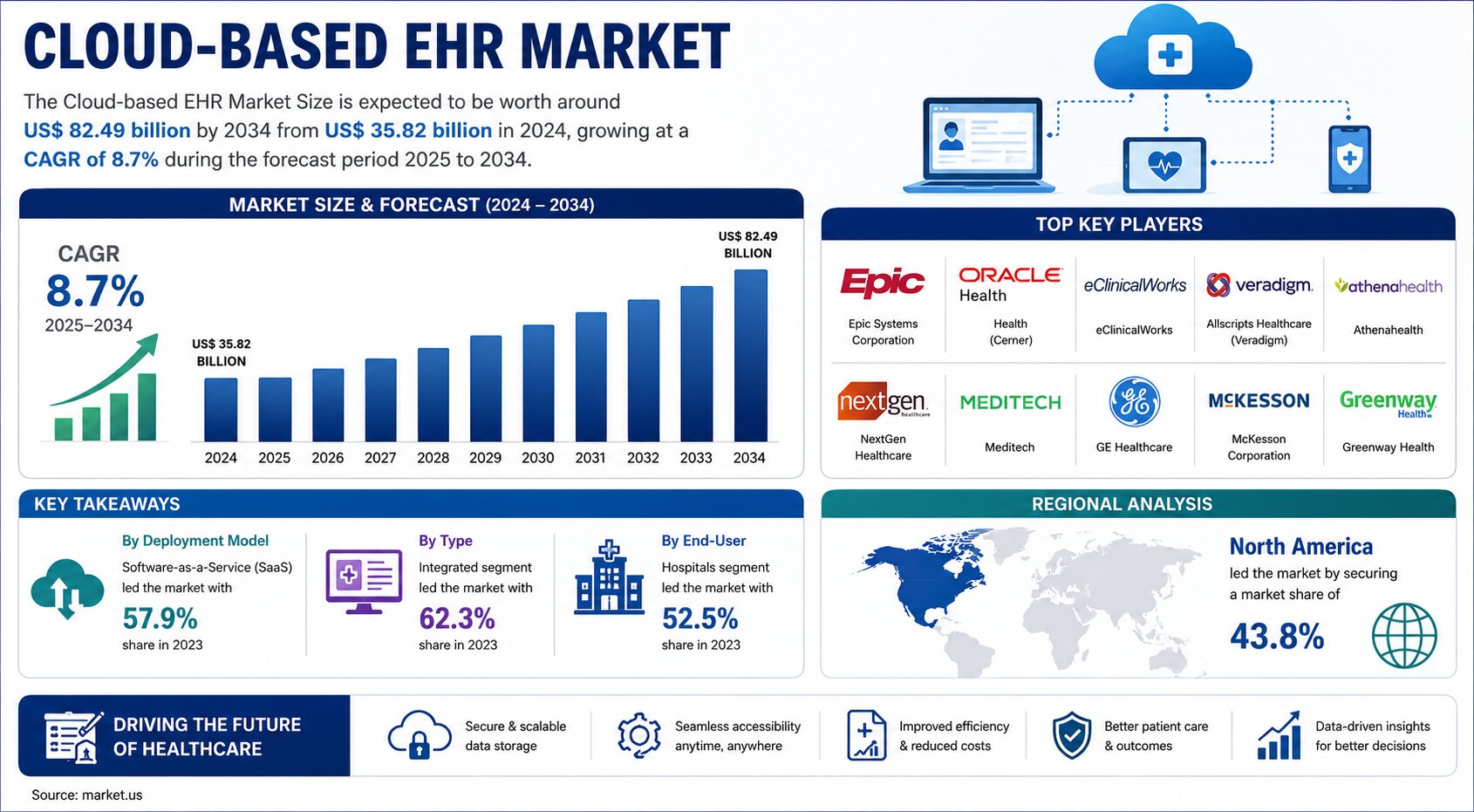
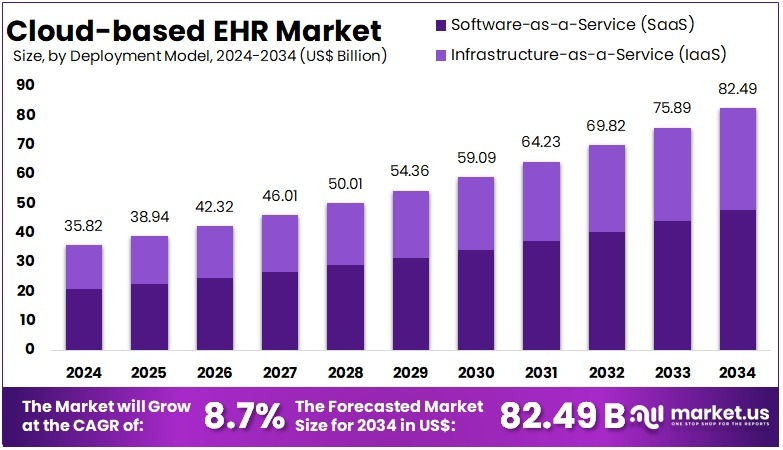
The Cloud-based EHR Market Size is expected to be worth around US$ 82.49 Billion by 2034 from US$ 35.82 Billion in 2024, growing at a CAGR of 8.7% during the forecast period 2025 to 2034.
Cloud-based electronic health records (EHRs) are becoming a cornerstone of digital healthcare transformation as hospitals, clinics, and physician practices seek secure, scalable, and interoperable platforms for managing patient information.
Unlike traditional on-premise systems, cloud-based EHRs enable healthcare providers to access clinical records remotely, improve care coordination, and streamline workflows while reducing IT infrastructure burdens. Governments and healthcare organizations worldwide are prioritizing interoperable digital health ecosystems, encouraging wider adoption of cloud-enabled health information technologies.
The growing emphasis on seamless data exchange is strengthening demand for cloud-based EHR solutions. In 2025, the U.S. Centers for Medicare & Medicaid Services (CMS) introduced its Interoperability Framework, encouraging health networks, EHR vendors, and healthcare organizations to adopt standardized, secure health data exchange that improves patient access to electronic medical information and reduces administrative complexity. The initiative supports modern digital identity, standardized APIs, and nationwide interoperability while maintaining HIPAA privacy and security requirements.
Healthcare digitization continues to accelerate across clinical settings. According to the National Electronic Health Records Survey (NEHRS) conducted by the U.S. Centers for Disease Control and Prevention (CDC), the survey annually monitors EHR adoption and interoperability among office-based physicians, providing critical national data on electronic record usage and health information exchange.
Another important industry driver is the advancement of interoperability standards. In July 2025, the U.S. Assistant Secretary for Technology Policy (ASTP/ONC) released United States Core Data for Interoperability (USCDI) Version 6, adding six new data elements to strengthen standardized electronic health information exchange and improve interoperability across certified health IT systems.
Key Takeaways
- In 2024, the global Cloud-based EHR market generated US$ 35.82 billion in revenue and is projected to reach US$ 82.49 billion by 2034, expanding at a CAGR of 8.7% during the forecast period.
- Based on deployment model, the market is segmented into Software-as-a-Service (SaaS) and Infrastructure-as-a-Service (IaaS). Among these, the Software-as-a-Service (SaaS) segment dominated the market in 2023, accounting for a 57.9% share.
- By type, the market is categorized into Standalone and Integrated solutions. The Integrated segment held the leading position in 2023, capturing 62.3% of the total market share.
- In terms of end users, the market is classified into Hospitals, Ambulatory Surgical Centers, and Clinics and Specialty Centers. The Hospitals segment emerged as the largest contributor, representing 52.5% of the Cloud-based EHR market revenue in 2023.
- Regionally, North America maintained its leading position in 2023, accounting for 43.8% of the global Cloud-based EHR market share.
Statistical Information
- 95% of U.S. office-based physicians adopted any type of EHR system in 2024, while 91% used certified EHR systems, demonstrating that the U.S. healthcare system has reached widespread electronic record adoption and is shifting focus toward advanced cloud capabilities, interoperability, and workflow optimization.
- Certified EHR adoption increased from 74% in 2014 to 91% in 2024 among U.S. office-based physicians, reflecting the impact of federal health IT initiatives and growing demand for secure, standardized digital health platforms.
- More than 99% of non-federal acute care hospitals in the U.S. had adopted certified EHR systems by 2024, creating strong opportunities for cloud-based platforms supporting large-scale hospital operations, interoperability, analytics, and patient engagement.
- Physicians in large healthcare groups showed higher EHR adoption rates, with 99.1% of physicians in practices with 51+ physicians using any EHR system in 2024, highlighting demand among enterprise healthcare organizations for scalable and integrated cloud solutions.
- In 2024, 98.8% of physicians working with Federally Qualified Health Centers (FQHCs) reported using certified EHR systems, showing continued demand for secure, accessible digital health infrastructure across community healthcare providers.
- The CMS Interoperability Framework requires healthcare technology ecosystems to support patient access to electronic medical information, including structured and unstructured health data, through applications selected by patients, creating opportunities for API-based cloud EHR platforms and data exchange solutions.
- CMS requires reporting of Patient Access API usage metrics, including the number of unique patients whose health data is transferred to patient-selected health applications and the number of patients receiving data transfers more than once, increasing demand for interoperable EHR systems with strong API capabilities.
- In 2024, 90% of physicians in healthcare groups with more than 50 physicians used an EHR from one of the five leading EHR developers, indicating strong concentration among enterprise providers and opportunities for cloud vendors to compete through interoperability, AI integration, cybersecurity, and specialized healthcare workflows.
Market Segmentation Analysis
Deployment Model Analysis
The Software-as-a-Service (SaaS) segment accounted for 57.9% of the cloud-based EHR market, making it the leading deployment model. SaaS platforms are widely adopted because they eliminate the need for extensive on-site infrastructure while offering lower upfront costs, automatic software updates, and subscription-based pricing.
These solutions improve scalability, simplify IT management, and enable secure remote access to patient records. Small and mid-sized healthcare providers particularly benefit from the flexibility and affordability of SaaS, while larger organizations leverage its interoperability and compliance capabilities.
As healthcare providers continue shifting toward cloud-first strategies, the SaaS model is expected to retain its dominant position by supporting efficient clinical workflows, regulatory compliance, and seamless access to health information across multiple care settings.
Type Analysis
The Integrated segment held the largest market share at 62.3%, reflecting strong demand for unified healthcare management platforms. Integrated cloud-based EHR systems combine electronic health records with practice management, billing, scheduling, and patient engagement tools within a single platform.
This integration streamlines administrative and clinical workflows, reduces duplicate data entry, and improves coordination among healthcare teams. Hospitals and multi-specialty healthcare organizations increasingly prefer integrated solutions because they enhance interoperability, enable secure information exchange, and support data-driven decision-making.
As healthcare providers continue to prioritize operational efficiency and coordinated patient care, integrated cloud-based EHR platforms are expected to remain the preferred choice across the global healthcare industry.
End-User Analysis
The Hospitals segment dominated the cloud-based EHR market with a 52.5% share, driven by the growing need to manage large volumes of patient information across multiple departments. Hospitals rely on cloud-based EHR platforms to improve clinical documentation, support real-time data access, strengthen interoperability, and enhance care coordination.
These solutions also reduce dependence on on-premise IT infrastructure, improve cybersecurity capabilities, and provide scalability for expanding healthcare networks. Increasing digital transformation initiatives, regulatory support for electronic health records, and the need for efficient clinical workflows continue to accelerate adoption among hospitals. As healthcare systems modernize, hospitals are expected to remain the leading end users of cloud-based EHR solutions.
Regional Analysis
North America held the leading position in the Cloud-based EHR market, supported by strong healthcare digitization initiatives, advanced IT infrastructure, and favorable government policies promoting electronic health information exchange. In the United States, organizations such as the Office of the National Coordinator for Health Information Technology (ONC) continue to advance nationwide health IT adoption by promoting interoperability, standardized data exchange, and certified health information technologies.
The region’s growth is driven by increasing demand for scalable cloud solutions that improve clinical workflows, enhance patient data accessibility, and reduce dependence on traditional IT infrastructure. The adoption of interoperability frameworks, including standards such as USCDI, supports secure exchange of electronic health information among healthcare providers.
Additionally, hospitals and healthcare networks are increasingly investing in cloud-based EHR platforms to improve care coordination, operational efficiency, and data management capabilities. Despite challenges related to cybersecurity, privacy compliance, and integration with legacy systems, continuous advancements in health IT infrastructure are expected to strengthen North America’s dominance in the cloud-based EHR market.
Business Opportunities
The Cloud-based EHR market presents significant business opportunities as healthcare providers increasingly shift toward scalable, interoperable, and secure digital health platforms. Companies can capitalize on growing demand for cloud-native EHR solutions, interoperability services, cybersecurity tools, and data integration platforms that enable seamless exchange of patient information across healthcare networks.
The U.S. healthcare ecosystem is placing greater emphasis on standardized data exchange, with the CMS Interoperability Framework encouraging EHRs, providers, payers, and digital health platforms to support secure and efficient health information sharing.
Vendors have opportunities to develop solutions based on FHIR APIs, patient engagement tools, AI-enabled clinical workflows, and analytics capabilities to improve care coordination and reduce administrative workloads. CMS has also highlighted participation from leading EHR organizations in initiatives focused on improving patient access to electronic health information and reducing manual processes through interoperable technologies.
Small and medium-sized healthcare practices represent another growth opportunity, as subscription-based SaaS EHR platforms provide affordable access to advanced clinical systems without major infrastructure investments. Additionally, healthcare organizations require advanced security, compliance, and cloud migration services to protect sensitive patient data while modernizing legacy systems.
As governments and healthcare providers continue advancing nationwide interoperable health IT ecosystems, cloud-based EHR companies are positioned to expand through innovation, partnerships, and specialized healthcare solutions.
Emerging Trends
- Generative AI integration is becoming a major cloud EHR trend, helping healthcare providers automate documentation, summarize patient histories, and support clinical decisions. A 2026 analysis of U.S. hospital IT adoption found that 31.5% of hospitals had already integrated generative AI into EHR workflows, while predictive AI adoption reached higher levels for clinical and operational use cases.
- Interoperability and API-based data exchange are becoming essential priorities for cloud EHR providers. The CDC’s National Electronic Health Records Survey (NEHRS) continues tracking EHR adoption, health information exchange, and interoperability among U.S. physicians, highlighting the industry shift toward connected healthcare ecosystems rather than isolated record systems.
- Healthcare cybersecurity is becoming a critical cloud EHR investment area as digital records expand. The U.S. Government Accountability Office reported that increasing cyberattacks are creating risks for electronic health record systems, increasing demand for stronger cloud security, access controls, monitoring, and data protection solutions.
- Cloud EHR platforms are evolving into intelligent healthcare platforms by combining AI, analytics, and automation. Healthcare organizations are increasingly adopting solutions that analyze clinical information, reduce administrative burden, and improve workflow efficiency. AI-enabled EHR use cases include predictive risk identification, treatment recommendations, scheduling support, and operational optimization.
- Patient-centered digital health access is becoming a key trend in cloud EHR development. Government interoperability initiatives are encouraging healthcare systems to provide patients with easier access to electronic health information through secure digital applications, creating opportunities for cloud platforms with advanced APIs and data-sharing capabilities.
Use Cases
- AI-assisted clinical documentation is one of the fastest-growing use cases for cloud EHR systems. Healthcare organizations are using AI tools to extract information from medical notes, summarize records, and reduce manual documentation workload. In one oncology data initiative, AI-supported documentation workflows helped achieve 98% data completeness for submitted clinical information.
- Remote patient monitoring (RPM) integration is expanding cloud EHR capabilities by connecting wearable devices, digital health tools, and patient-generated data with electronic records. These integrations help clinicians monitor health conditions continuously and support proactive care management through real-time information exchange.
- Clinical decision support is becoming a major cloud EHR application, allowing providers to use patient history, laboratory results, and clinical guidelines to support better treatment decisions. AI-enabled EHR systems are increasingly being tested for risk prediction, diagnosis assistance, and personalized care recommendations.
- Healthcare analytics and population health management are expanding cloud EHR use cases. Cloud platforms allow healthcare organizations to combine large volumes of clinical data for identifying high-risk patients, improving care coordination, and supporting value-based healthcare models.
- Cross-provider health information exchange is becoming a core cloud EHR application. Hospitals, clinics, and healthcare networks are using interoperable cloud systems to securely exchange patient records, reduce duplicate testing, and improve continuity of care across different healthcare settings.
Recent Developments
- In August 2025, Oracle introduced its next-generation Oracle Health EHR designed on a modern cloud architecture with embedded AI capabilities. The platform introduced voice-based interactions, conversational assistance, and intelligent workflows to help U.S. ambulatory providers reduce administrative workload and improve clinical efficiency.
- In March 2025, eClinicalWorks announced that Contentnea Health selected its cloud-based EHR platform to improve operations across its North Carolina healthcare centers. The 35-provider Federally Qualified Health Center adopted eClinicalWorks’ unified cloud EHR solution to support medical, dental, behavioral health, vision, and UDS+ workflows through a single integrated platform.
- In February 2025, athenahealth partnered with Abridge to integrate generative AI-powered ambient clinical documentation into athenaOne. The collaboration expanded access to AI documentation capabilities for ambulatory providers, with Ambient Notes available in limited release to more than 160,000 clinicians on the athenahealth network.
- In January 2025, Duke Health partnered with Abridge to deploy AI-powered clinical documentation technology across key clinical teams. The partnership expanded access to ambient AI capabilities for approximately 5,000 Duke Health clinicians across more than 150 primary and specialty clinics to improve documentation efficiency.
Conclusion
The Cloud-based EHR market is experiencing significant transformation as healthcare organizations increasingly prioritize interoperability, scalability, cybersecurity, and intelligent digital solutions. Growing adoption of SaaS-based platforms, integrated EHR systems, and AI-enabled healthcare technologies is improving clinical workflows, patient engagement, and data accessibility across healthcare settings.
Government initiatives supporting standardized health information exchange and secure digital ecosystems are further accelerating market opportunities. As hospitals, clinics, and healthcare networks continue modernizing their IT infrastructure, cloud-based EHR solutions are expected to play a critical role in advancing connected, efficient, and patient-centered healthcare delivery worldwide.




















