


Report Overview
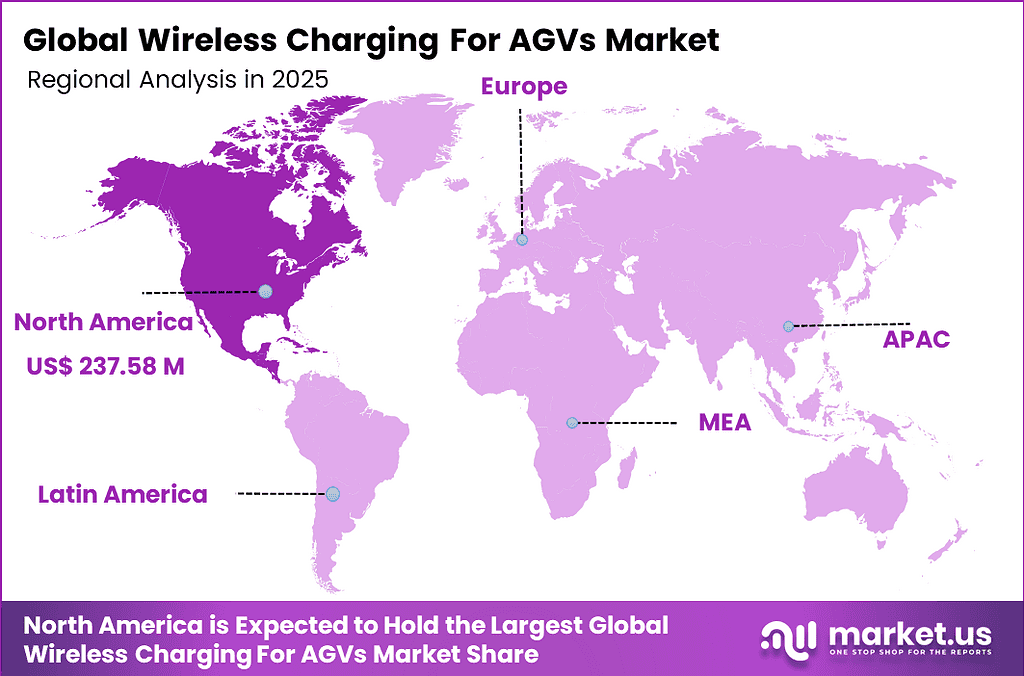
The Global Wireless Charging For AGVs Market generated USD 610.8 million in 2025 and is predicted to register growth from USD 714.6 million in 2026 to about USD 2,935.8 million by 2035, recording a CAGR of 17.0% throughout the forecast span. In 2025, North America held a dominant market position, capturing more than a 38.9% share, with USD 237.58 million in revenue.
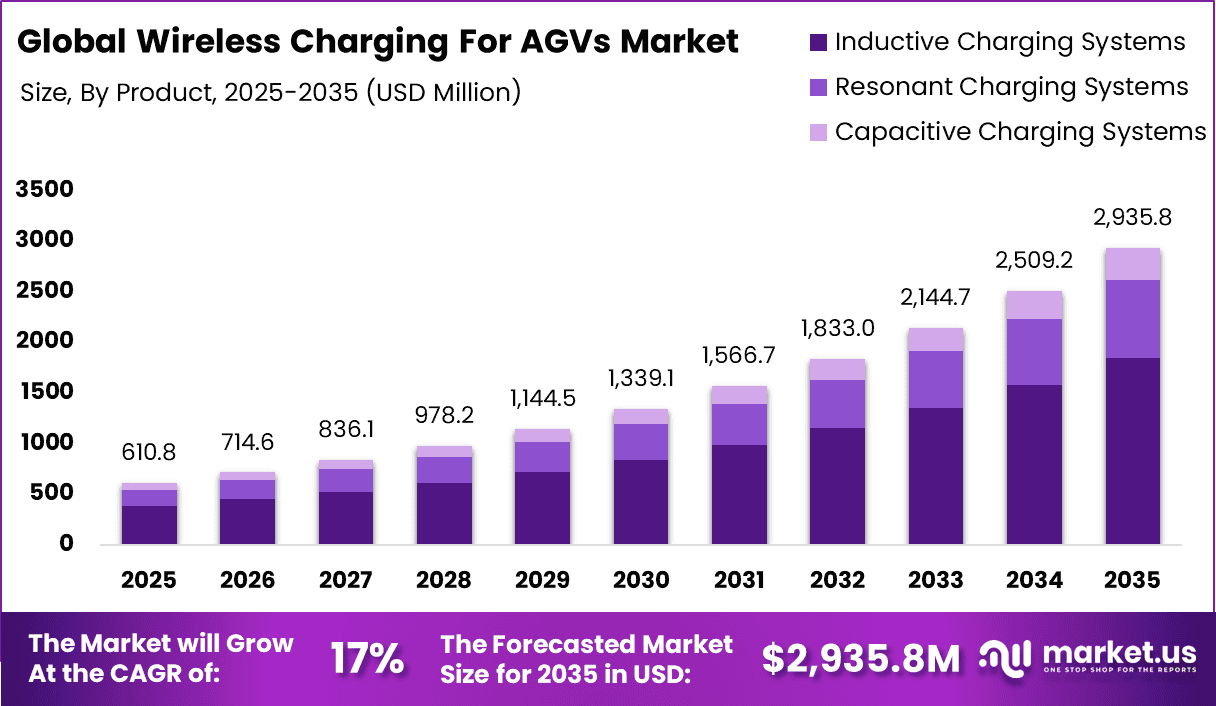
Wireless Charging for AGVs market refers to contactless charging systems designed to power automated guided vehicles without using physical plugs or connector-based charging points. These systems usually rely on inductive charging technology and are used in warehouses, factories, distribution centers, and other automated material handling environments where AGVs operate across fixed or semi-fixed routes.
Demand for wireless charging for AGVs is increasing among manufacturers, warehouse operators, and logistics companies that want more efficient fleet management and less manual involvement in charging operations. These users prefer systems that can fit into daily vehicle routes without requiring long charging breaks or large charging stations.
Top Market Takeaways
- Inductive charging systems command 62.8% market share, delivering contactless power transfer via embedded pad technology for seamless AGV fleet recharging without manual intervention.
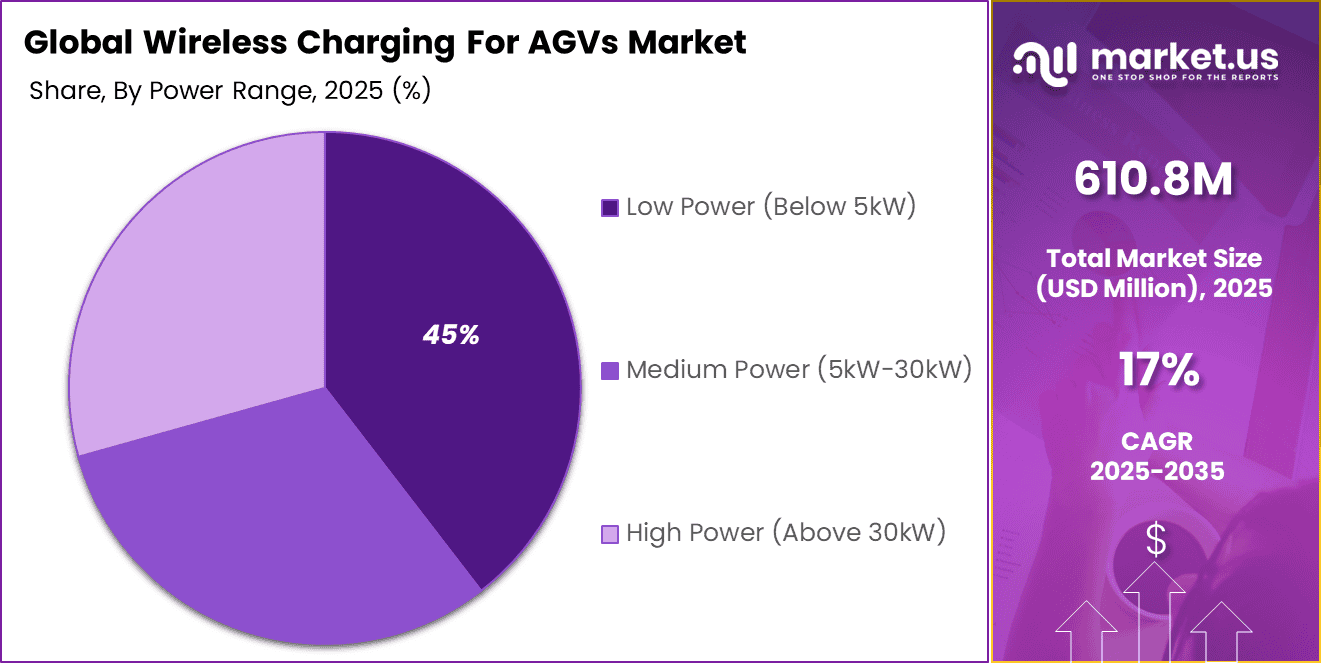
- Low power range (below 5kW) captures 44.5%, enabling lightweight AGVs for intralogistics with opportunity charging during brief pauses in material transport cycles.
- Manufacturing applications claim 32.5%, powering assembly line tuggers, parts delivery robots, and warehouse shuttles with continuous 24/7 operation capabilities.
- North America drives 38.9% global value, with the U.S. market at USD 207.8 million and 15.3% CAGR, fueled by Industry 4.0 adoption and labor-neutral automation investments.
By Product Analysis
Inductive charging systems accounted for 62.8% of the Wireless Charging for AGVs Market. This segment leads because inductive systems allow contactless power transfer, which reduces wear and tear compared to plug-in charging methods. These systems enable continuous operation of automated guided vehicles without manual intervention.
The segment is also supported by the need for efficient and safe charging in industrial environments. Inductive charging improves operational uptime by allowing AGVs to charge during idle moments, which enhances productivity and supports smoother workflow automation.
By Power Range Analysis
Low power below 5 kW represented 45% of the market. This segment dominates because many AGV applications involve light to moderate duty operations that do not require high power output. Low power systems are cost-effective and suitable for smaller vehicles used in controlled environments.
The segment is driven by widespread use of AGVs in tasks such as material movement and order handling. These operations require consistent but moderate energy supply, which keeps demand strong for low power wireless charging solutions.
By Application Analysis
Manufacturing accounted for 32.5% of the market. This segment leads because manufacturing facilities use AGVs extensively for transporting materials, components, and finished goods across production lines. Wireless charging systems help maintain uninterrupted operations in these environments.
The segment is supported by increasing automation in production processes. Manufacturers adopt wireless charging to improve efficiency, reduce downtime, and support continuous AGV operation, which strengthens demand within industrial settings.
Key Market Segments
By Product
- Inductive Charging Systems
- Resonant Charging Systems
- Capacitive Charging Systems
By Power Range
- Low Power (Below 5kW)
- Medium Power (5kW-30kW)
- High Power (Above 30kW)
By Application
- Manufacturing
- Warehousing & Distribution
- Healthcare
- Retail
- Automotive
- Food & Beverage
- Others
Regional Analysis
North America accounted for 38.9% of the Wireless Charging for AGVs Market, reflecting strong adoption of automation and smart material handling systems across manufacturing and logistics sectors. Companies across the region increasingly deploy automated guided vehicles supported by wireless charging to enable continuous operations without manual battery replacement.
The growing focus on efficiency, reduced downtime, and streamlined warehouse processes continues to drive demand for contactless charging solutions across North America.
Key Regions and Countries
- North America
- US
- Canada
- Europe
- Germany
- France
- The UK
- Spain
- Italy
- Russia
- Netherlands
- Rest of Europe
- Asia Pacific
- China
- Japan
- South Korea
- India
- Australia
- Singapore
- Thailand
- Vietnam
- Rest of APAC
- Latin America
- Brazil
- Mexico
- Rest of Latin America
- Middle East & Africa
- South Africa
- Saudi Arabia
- UAE
- Rest of MEA
Drivers Impact Analysis
| Key Driver | Impact on CAGR Forecast (~%) | Geographic Relevance | Impact Timeline | Strategic Effect |
|---|---|---|---|---|
| Increasing adoption of automated guided vehicles in warehouses and manufacturing | +3.4% | North America, Europe, Asia Pacific | Short to Mid Term (2025–2031) | Expands demand for efficient charging solutions |
| Rising need for continuous and uninterrupted AGV operations | +3.1% | Global | Mid Term (2026–2032) | Reduces downtime with wireless charging |
| Growth of e-commerce and logistics automation | +2.8% | North America, Asia Pacific, Europe | Mid Term (2026–2032) | Drives deployment in fulfillment centers |
| Increasing focus on reducing maintenance and operational costs | +2.5% | Global | Mid to Long Term (2026–2035) | Minimizes wear and tear from connectors |
| Expansion of smart factories and Industry 4.0 initiatives | +2.3% | Global | Mid to Long Term (2026–2035) | Supports automated workflows |
Restraints Impact Analysis
| Key Restraint | Impact on CAGR Forecast (~%) | Geographic Relevance | Impact Timeline | Strategic Effect |
|---|---|---|---|---|
| High initial installation cost of wireless charging infrastructure | -2.4% | Global | Mid Term (2026–2032) | Limits adoption among smaller operators |
| Lower energy efficiency compared to wired charging systems | -2.1% | Global | Mid Term (2026–2032) | Affects operational cost |
| Technical challenges in alignment and charging consistency | -1.9% | Global | Mid Term (2026–2032) | Impacts system reliability |
| Lack of standardization across wireless charging technologies | -1.7% | Global | Mid to Long Term (2026–2035) | Creates interoperability issues |
| Limited awareness in emerging markets | -1.5% | Asia Pacific, Latin America | Short to Mid Term (2025–2030) | Slows early adoption |
Investor Type Impact Analysis
| Investor Type | Growth Sensitivity | Risk Exposure | Geographic Focus | Investment Outlook |
|---|---|---|---|---|
| Venture Capital Firms | High | Medium | US, Europe | Growth in industrial automation tech |
| Private Equity Firms | High | Medium | North America, Europe | Expansion in logistics automation |
| Strategic Technology Investors | Very High | Medium | US, China, Japan | Strengthens robotics ecosystem |
| Corporate Venture Arms | High | Medium | Global | Supports partnerships in automation |
| Government and Industrial Funds | Medium | Low | Asia Pacific, Europe | Supports smart manufacturing initiatives |
Technology Enablement Analysis
| Technology Enabler | Impact on CAGR Forecast (~%) | Geographic Relevance | Impact Timeline | Implementation Significance |
|---|---|---|---|---|
| Inductive and resonant wireless charging technologies | +3.5% | Global | Short to Mid Term (2025–2031) | Enables contactless energy transfer |
| Integration with AGV fleet management systems | +3.1% | Global | Mid Term (2026–2032) | Improves operational coordination |
| IoT-enabled monitoring and energy management systems | +2.8% | Global | Mid to Long Term (2026–2035) | Enhances system efficiency |
| AI-based charging optimization and scheduling | +2.5% | Global | Mid to Long Term (2026–2035) | Reduces energy waste |
| Advanced battery technologies supporting fast wireless charging | +2.3% | Global | Mid Term (2026–2032) | Improves charging speed |
Key Challenges
- High installation cost is a major challenge because wireless charging systems for AGVs need charging pads, power electronics, control software, and infrastructure changes.
- Charging efficiency can be affected by alignment issues because the AGV and charging unit must stay properly positioned for stable power transfer.
- Integration with existing AGV fleets and warehouse systems can be difficult, especially when facilities use older vehicles, mixed brands, or different control platforms.
- Heat management and power loss remain important concerns because wireless charging systems must operate safely during repeated charging cycles and heavy use.
- Maintenance and system reliability are also challenges because any fault in charging components, communication links, or power supply can interrupt AGV operations.
Emerging Trends
A key trend in the Wireless Charging for AGVs market is the increasing adoption of contactless charging systems that allow vehicles to recharge during operation without stopping for manual connection. These systems are being integrated into floors or workstations, enabling continuous movement and reducing downtime in automated facilities.
Operators prefer solutions that support seamless energy transfer while maintaining workflow efficiency. This trend reflects a move toward fully automated material handling environments where charging becomes part of the operational process rather than a separate activity.
Growth Factors
The growing use of automated guided vehicles in manufacturing and logistics is supporting the expansion of wireless charging solutions. Facilities aim to improve productivity by keeping vehicles active for longer periods without interruption. Wireless charging helps reduce maintenance efforts and eliminates issues related to physical connectors.
At the same time, the need for efficient and flexible automation systems encourages the adoption of technologies that support continuous operation and better energy management across automated transport networks.
Competitive Analysis
The competitive landscape of the Wireless Charging for AGVs market includes companies that specialize in industrial automation, wireless power transfer, and material handling systems. Daifuku, Wiferion, B&PLUS KK, DAIHEN Corporation, and Conductix-Wampfler reduce manual charging needs and support smoother warehouse and factory operations.
Other players such as HUBTEX, Spark Connected, WiPowerOne, Titans Intelligent Power, TZBOT, and ZhongHuiChuangZhi add competition by focusing on flexible wireless charging designs and solutions for different industrial use cases.
The market is shaped by charging speed, safety, installation ease, and the ability to support continuous AGV movement in busy facilities. Overall, competition remains strong as industries look for more efficient and low-maintenance charging systems.
Top Key Players in the Market
- Daifuku
- Wiferion
- B&PLUS KK
- DAIHEN Corporation
- Conductix-Wampfler
- Delta Electronics
- Enersys
- ENRX
- HUBTEX
- Spark Connected
- WiPowerOne
- Titans Intelligent Power
- TZBOT
- ZhongHuiChuangZhi
- Others
Future Outlook
The future outlook for the Wireless Charging for AGVs Market looks strong as warehouses and factories seek easier ways to keep automated vehicles running with less downtime. Current industry guidance shows that wireless inductive charging supports in-process or opportunity charging, which helps AGVs recharge during normal workflow instead of stopping for long charging breaks, while newer certified systems are also improving safety and standard compliance for wider industrial use.
As automation expands and operators focus more on productivity, fleet uptime, and low-maintenance energy systems, demand for wireless charging for AGVs is expected to grow steadily in the coming years.
Recent Developments
- In January 2026, Daifuku D-PAD v3.0 compact wireless charger doubled transmission distance to 6cm for low-profile AGVs processing 100A continuous power across 500+ automotive assembly lines with seamless integration into SmartCart systems. US Navy Medical Center AGV infrastructure upgrade featured 6 wireless charging stations supporting 30+ daily routes.
- In February 2026, B&PLUS wireless charging modules integrated with 78% of existing lead-acid AGV fleets via retrofit kits serving Japanese automotive OEMs with 90% efficiency at a 100 mm gap. Modular design supported 3-20kW scaling.
Report Scope
| Report Features | Description |
|---|---|
| Market Value (2025) | USD 610.8 Million |
| Forecast Revenue (2035) | USD 2,935.8 Million |
| CAGR(2025-2035) | 17.0% |
| Base Year for Estimation | 2024 |
| Historic Period | 2020-2024 |
| Forecast Period | 2025-2035 |
| Report Coverage | Revenue forecast, AI impact on Market trends, Share Insights, Company ranking, competitive landscape, Recent Developments, Market Dynamics and Emerging Trends |
| Segments Covered | By Product (Inductive Charging Systems, Resonant Charging Systems, Capacitive Charging Systems), By Power Range (Low Power (Below 5kW), Medium Power (5kW-30kW), High Power (Above 30kW)), By Application (Manufacturing, Warehousing & Distribution, Healthcare, Retail, Automotive, Food & Beverage, Others) |
| Regional Analysis | North America – US, Canada; Europe – Germany, France, The UK, Spain, Italy, Russia, Netherlands, Rest of Europe; Asia Pacific – China, Japan, South Korea, India, New Zealand, Singapore, Thailand, Vietnam, Rest of Latin America; Latin America – Brazil, Mexico, Rest of Latin America; Middle East & Africa – South Africa, Saudi Arabia, UAE, Rest of MEA |
| Competitive Landscape | Daifuku, Wiferion, B&PLUS KK, DAIHEN Corporation, Conductix-Wampfler, Delta Electronics, Enersys, ENRX, HUBTEX, Spark Connected, WiPowerOne, Titans Intelligent Power, TZBOT, ZhongHuiChuangZhi, Others |
| Customization Scope | Customization for segments, region/country-level will be provided. Moreover, additional customization can be done based on the requirements. |
| Purchase Options | We have three licenses to opt for: Single User License, Multi-User License (Up to 5 Users), Corporate Use License (Unlimited Users and Printable PDF) |





































