Voyage Management Software Market By Component (Software (On-Premises, Cloud-based), Services), By Application (Route Planning, Fuel Management, Weather Routing, Fleet Management, Compliance and Reporting, Others), By Location (Onboard, Onshore), By End-User (Commercial, Defense, Others), By Regional Analysis, Global Trends and Opportunity, Future Outlook By 2026-2035
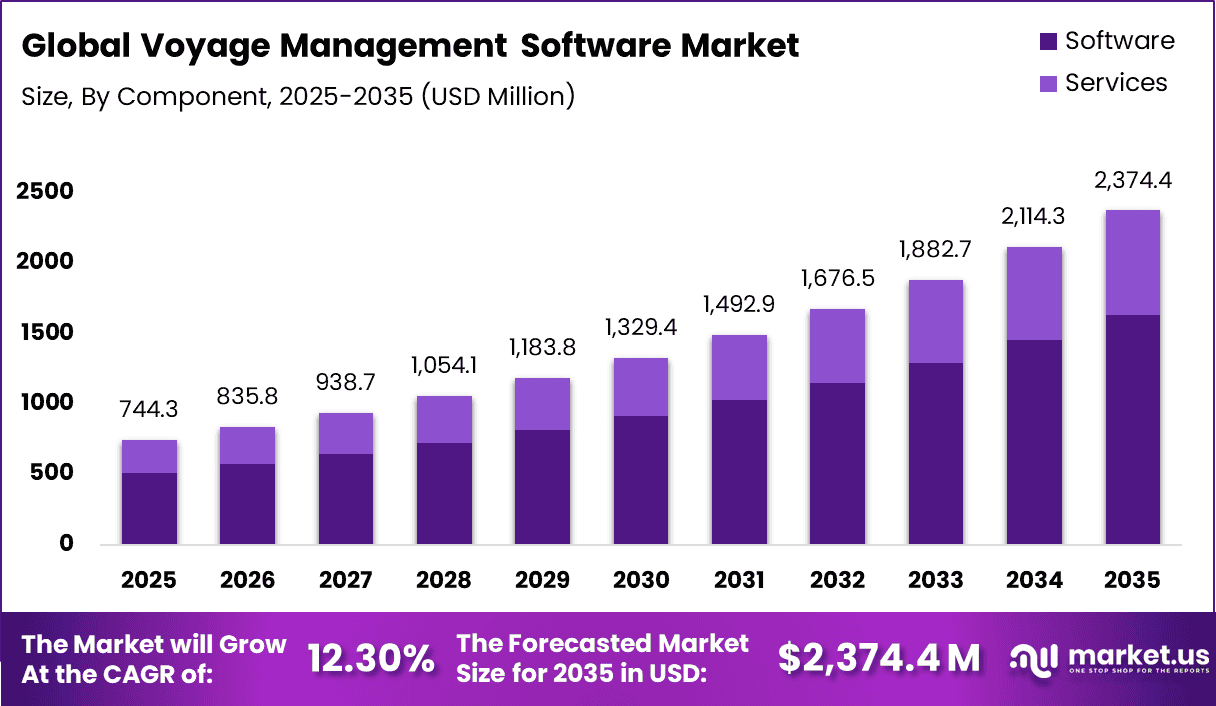
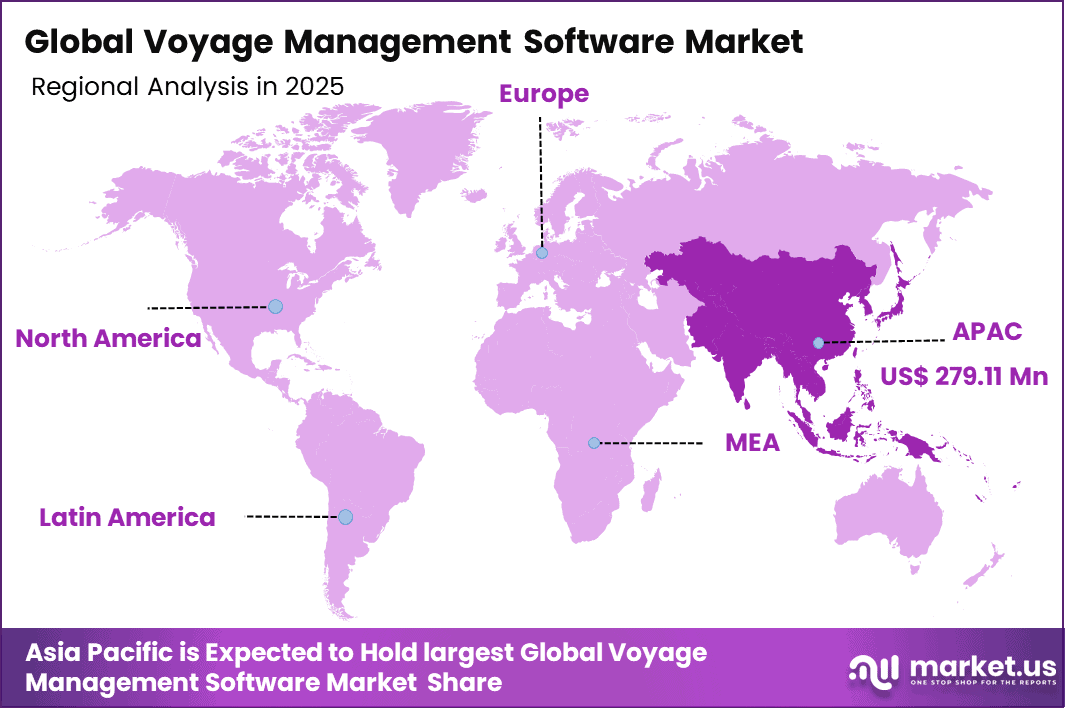
The Global Voyage Management Software Market generated USD 744.3 million in 2025 and is predicted to register growth from USD 835.8 million in 2026 to about USD 2,374.4 million by 2035, recording a CAGR of 12.30% throughout the forecast span. In 2025, Asia Pacific held a dominant market position, capturing more than a 37.5% share, holding USD 279.11 Million revenue.
Top Market Takeaways
Software commands 68.7% market share, delivering real-time voyage planning, fuel optimization, and automated reporting for vessel performance monitoring.
Fleet management applications capture 34.5%, enabling route optimization, cargo tracking, and compliance with IMO emissions regulations across global operations.
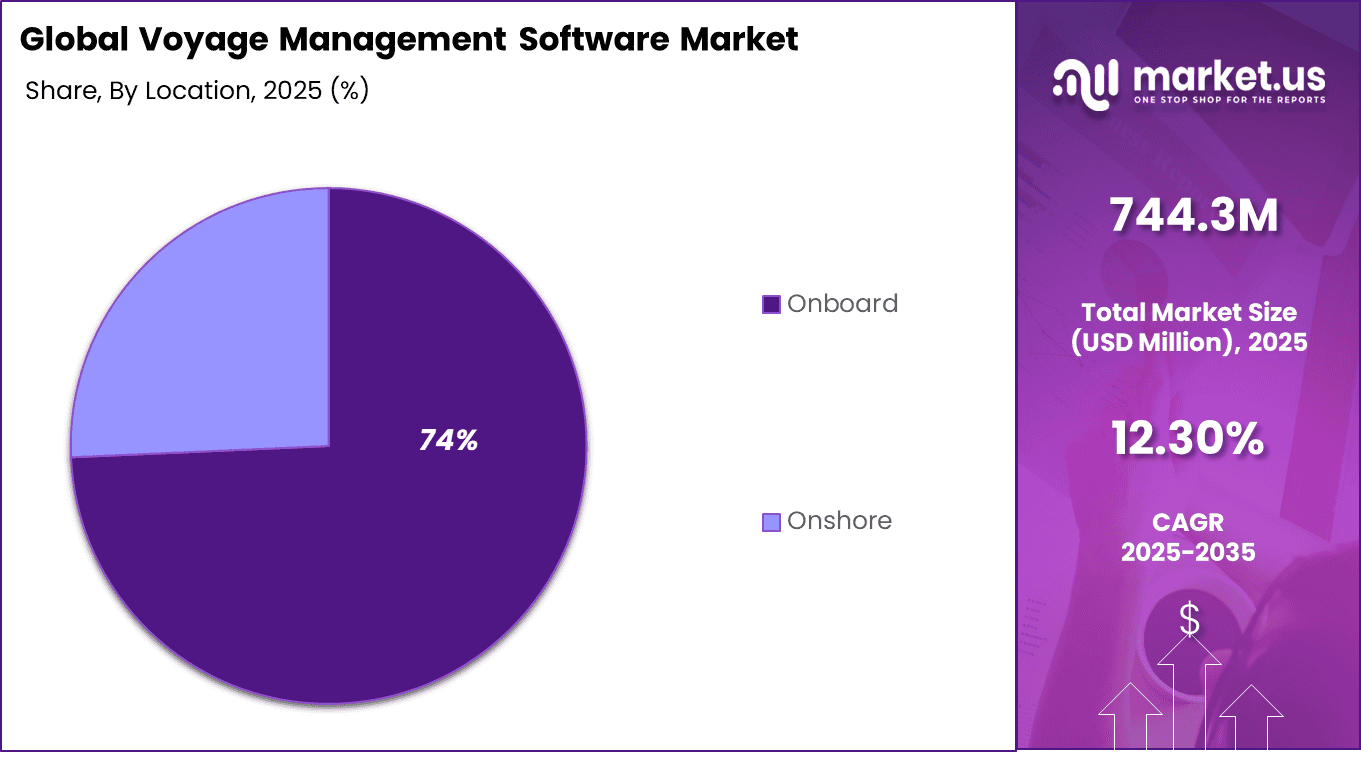
Onboard location dominates at 74.3%, providing offline-capable systems with satellite connectivity for bridge team decision-making and port call coordination.
Commercial end-users hold 70.8%, leveraging voyage software for bulk carriers, tankers, and container ships with integrated weather routing and demurrage calculations.
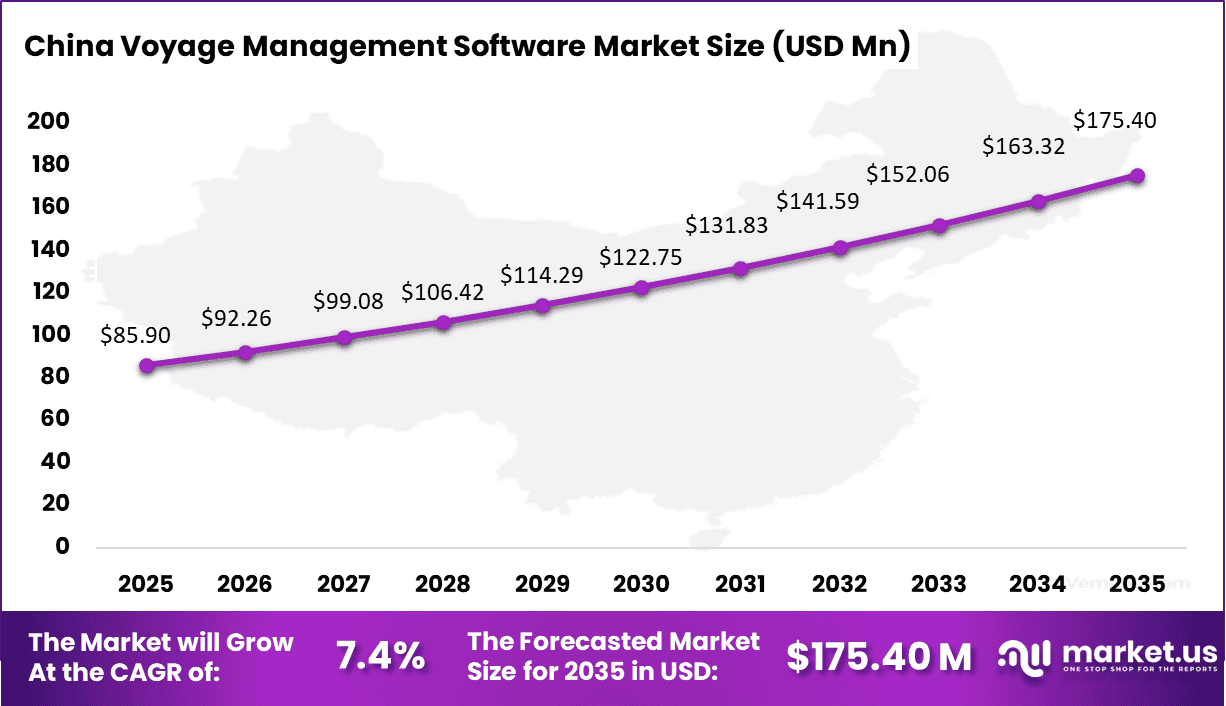
APAC drives 37.5% global value, with China’s market at USD 85.9 million and 7.4% CAGR, fueled by Belt and Road shipping routes and smart port integrations.
Voyage management software is becoming an important digital tool in the maritime industry as shipping operations grow more complex and time sensitive. It is used to plan routes, manage fuel usage, track vessel performance, and handle compliance requirements across global trade routes.
Shipping companies are moving away from manual processes and fragmented systems toward integrated platforms that can provide real time visibility and better control over voyages. This shift is helping operators improve efficiency, reduce operational risks, and respond quickly to changing conditions at sea and in ports.
One of the key driving factors is the increasing focus on cost optimization and fuel efficiency in shipping operations. Fuel remains a major expense for vessel operators, and software solutions that can optimize routes and monitor consumption are gaining strong attention. At the same time, stricter environmental regulations are pushing companies to track emissions and operate more responsibly, which is encouraging the use of digital tools for compliance and reporting.
The growing complexity of global trade routes, along with frequent disruptions such as port congestion and weather changes, is also driving the need for systems that can support better planning and decision making. In addition, the adoption of digital technologies across the maritime sector is encouraging companies to invest in smarter and more connected operational systems.
Demand for voyage management software is rising as shipping companies look for greater visibility and control over their operations. There is a clear preference for solutions that can provide real time data, predictive insights, and automated reporting to support faster decisions. Operators are also seeking platforms that can integrate with existing systems such as fleet management and port operations, creating a more connected workflow.
The need to improve safety and reduce human error is further supporting demand, as software tools can standardize processes and provide alerts for potential risks. As the maritime industry continues to modernize, the demand for efficient, user friendly, and scalable voyage management solutions is expected to strengthen.
Drivers Impact Analysis
Key Driver
Impact on CAGR Forecast (~%)
Geographic Relevance
Impact Timeline
Additional Insight
Increasing digitalization in maritime operations
+3.6%
North America and Europe, expanding in Asia Pacific
Short to medium term
Shipping companies are adopting software to improve operational efficiency
Growing need for fuel optimization and cost control
+3.3%
Global
Medium term
Software helps reduce fuel consumption and operational costs
Rising regulatory compliance requirements in shipping
+2.9%
Europe and North America leading
Medium to long term
Compliance tools are driving adoption of voyage management systems
Integration of real-time data analytics in navigation
+2.7%
Developed maritime markets
Medium term
Real-time insights improve route planning and safety
Restraints Impact Analysis
Key Restraint
Impact on CAGR Forecast (~%)
Geographic Relevance
Impact Timeline
Additional Insight
High implementation and maintenance costs
-2.8%
Developing maritime regions
Short to medium term
Cost concerns limit adoption among smaller operators
Resistance to digital transformation in traditional shipping
-2.3%
Emerging markets
Medium term
Legacy practices slow technology adoption
Integration challenges with existing onboard systems
-1.9%
Global
Medium term
Compatibility issues affect smooth deployment
Limited skilled workforce for advanced software usage
-1.6%
Global
Medium to long term
Lack of expertise delays effective utilization
Data security concerns in maritime IT systems
-1.4%
North America and Europe
Medium to long term
Cyber risks create hesitation in adoption
By Component Analysis
The software segment accounted for 68.7% of the market share, reflecting its strong role in enabling efficient voyage planning and operational control. This dominance is supported by the growing need for digital solutions that can manage routing, fuel consumption, compliance, and real-time monitoring. Software platforms provide centralized visibility and analytics, helping operators improve decision-making and reduce operational risks across maritime activities.
Another factor supporting this segment is the increasing shift toward automation and data-driven operations in the shipping industry. Software solutions can be updated and scaled easily, allowing companies to adapt to changing regulations and operational demands. Their ability to integrate with existing systems further enhances their value, making them essential for modern voyage management practices.
By Application Analysis
The fleet management segment held 34.5% share, driven by the need to efficiently oversee multiple vessels and optimize their performance. Fleet management applications enable operators to monitor vessel locations, fuel usage, maintenance schedules, and operational efficiency from a single interface. This capability is critical for reducing costs and ensuring smooth coordination across large fleets.
In addition, the rise in global maritime trade has increased the complexity of fleet operations. Companies are adopting advanced management tools to improve visibility and maintain control over dispersed assets. These solutions help in minimizing delays, improving route planning, and enhancing overall fleet productivity, which supports their continued adoption.
By Location Analysis
The onboard segment captured 74% of the market, reflecting the importance of real-time data access and decision-making directly on vessels. Onboard systems allow crew members to monitor navigation, weather conditions, and operational parameters without relying on external systems. This immediate access to information improves safety and operational efficiency during voyages.
Furthermore, onboard deployment ensures continuous functionality even in areas with limited connectivity. These systems are designed to operate independently while still syncing with shore-based platforms when connections are available. This reliability makes onboard solutions essential for maintaining consistent performance and ensuring compliance with maritime standards.
By End-User Analysis
The commercial segment dominated with a 70.8% share, driven by the extensive use of voyage management software in shipping, logistics, and transportation industries. Commercial operators require advanced tools to manage complex routes, reduce fuel costs, and comply with international regulations. The need to improve operational efficiency and maintain competitiveness has accelerated the adoption of such solutions.
Additionally, the increasing volume of global trade has placed greater pressure on commercial operators to optimize their operations. Voyage management software helps in streamlining workflows, improving coordination, and reducing human error. This has made it a critical component for commercial entities aiming to enhance productivity and ensure reliable service delivery.
Investor Type Impact Analysis
Investor Type
Growth Sensitivity
Risk Exposure
Geographic Focus
Investment Outlook
Venture capital firms
High
High
US, Europe
Investing in maritime tech and digital logistics startups
Private equity firms
Moderate to high
Moderate
North America and Europe
Focus on scaling established maritime software providers
Corporate investors
High
Moderate
Global
Strategic investments in shipping and logistics digitalization
Institutional investors
Moderate
Low to moderate
Developed maritime markets
Prefer stable firms with long-term contracts in shipping sector
Government and public funding bodies
Moderate
Low
Europe and Asia Pacific
Supporting digital maritime infrastructure and smart ports
Technology Enablement Analysis
Technology
Impact on CAGR Forecast (~%)
Geographic Relevance
Impact Timeline
Additional Insight
AI-based route optimization
+3.8%
US, Europe, Japan
Medium to long term
Improves fuel efficiency and voyage planning
Cloud-based maritime software platforms
+3.2%
North America and Europe
Short to medium term
Enables remote access and centralized management
Integration with IoT-enabled ship systems
+3.0%
Global
Medium term
Enhances real-time vessel monitoring
Big data analytics for predictive decision-making
+2.7%
Developed markets
Medium to long term
Supports better forecasting and risk management
Satellite communication and connectivity improvements
+2.5%
Global
Long term
Ensures continuous data flow and operational visibility
Key Challenges
High cost of software and setup makes it difficult for small shipping companies to adopt.
Complex integration with existing systems like navigation, fleet management, and ERP tools.
Lack of skilled professionals to operate and manage advanced software systems.
Data accuracy issues due to manual inputs or inconsistent reporting from vessels.
Cybersecurity risks as ships and systems become more connected.
Dependence on stable internet connectivity, which is limited at sea.
Resistance to change from traditional manual processes to digital systems.
Frequent software updates and maintenance requirements causing operational delays.
Compliance challenges with changing maritime regulations and standards.
Difficulty in real-time data tracking across global shipping routes.
Emerging Trends
The voyage management software market is evolving with a strong focus on digital navigation, real time decision making, and operational transparency. One key emerging trend is the integration of advanced analytics and predictive routing within voyage planning systems. These tools help operators optimize routes based on weather patterns, fuel efficiency, and port conditions, leading to more efficient voyages.
Another important trend is the shift toward cloud based platforms that allow fleet managers to monitor vessel performance remotely and access voyage data from centralized dashboards. There is also growing adoption of automation in reporting and compliance processes, reducing manual workload and improving accuracy in documentation. In addition, integration with onboard sensors and satellite communication systems is enhancing real time visibility of vessel operations, allowing quicker response to changing maritime conditions. The increasing use of digital twins for voyage simulation is further supporting better planning and risk assessment before actual deployment.
Growth Factors
The growth of this market is driven by the need for improved operational efficiency and cost control in maritime operations. Rising pressure to reduce fuel consumption and emissions is encouraging shipping operators to adopt software solutions that provide optimized routing and performance monitoring. Regulatory requirements related to safety, environmental compliance, and reporting are also pushing the adoption of digital voyage management systems.
The expansion of global trade and maritime logistics is increasing the complexity of fleet operations, which is creating demand for advanced software that can handle scheduling, tracking, and coordination effectively. Another major factor is the need for better risk management, as unpredictable weather and port congestion require real time insights for informed decision making. Furthermore, the shift toward digital transformation in the shipping industry is encouraging stakeholders to move away from traditional manual processes and adopt integrated software platforms that improve visibility, coordination, and overall operational control.
Key Market Segments
By Component
Software
On-Premises
Cloud-based
Services
By Application
Route Planning
Fuel Management
Weather Routing
Fleet Management
Compliance and Reporting
Others
By Location
Onboard
Onshore
By End-User
Commercial
Defense
Others
Regional Analysis
Asia Pacific accounted for 37.5% of the Voyage Management Software market, reflecting strong maritime trade activity and rapid digitalization across shipping operations. The region benefits from the presence of some of the world’s busiest ports and shipping routes, which has increased the need for efficient voyage planning, fuel optimization, and real-time fleet monitoring.
Shipping companies are increasingly adopting software solutions to improve operational visibility, reduce costs, and comply with evolving environmental regulations. The rise in cross-border trade, along with growing investments in port infrastructure and smart shipping technologies, has further supported the adoption of voyage management platforms across the region.
China market reached USD 85.9 Million and is projected to grow at a CAGR of 7.4%, driven by its dominant position in global shipbuilding and maritime logistics. The country’s large commercial fleet and expanding export activities are encouraging shipping operators to adopt advanced digital tools for route optimization and performance tracking.
Regulatory focus on emission control and fuel efficiency is also pushing companies toward software-based voyage planning solutions. In addition, increasing integration of data analytics and automation in maritime operations is expected to support steady growth in China, as operators aim to enhance efficiency and maintain competitiveness in global trade.
Key Regions and Countries
North America
US
Canada
Europe
Germany
France
The UK
Spain
Italy
Russia
Netherlands
Rest of Europe
Asia Pacific
China
Japan
South Korea
India
Australia
Singapore
Thailand
Vietnam
Rest of APAC
Latin America
Brazil
Mexico
Rest of Latin America
Middle East & Africa
South Africa
Saudi Arabia
UAE
Rest of MEA
Competitive Analysis
The competitive landscape of the Voyage Management Software Market is shaped by a mix of established maritime technology providers and specialized software firms focusing on digital shipping operations. Companies such as Wärtsilä, Veson Nautical, DANAOS, and Dataloy Systems AS hold a strong position by offering comprehensive voyage planning, fleet optimization, and chartering solutions. These players focus on improving operational efficiency, reducing fuel consumption, and ensuring regulatory compliance for shipping companies.
Their platforms often include integrated analytics, real-time tracking, and decision support tools, which are increasingly important for modern fleet management. At the same time, firms like MariApps Marine Solutions, Maritech Services Limited, and Q88 LLC provide flexible and user-friendly software tailored to mid-sized shipping operators, helping them digitize routine operations and improve voyage visibility.
In addition, emerging and niche players such as ONEOCEAN, OrbitMI, Inc., The Ark Marine Solutions Pte. Ltd. (TAMS), and Marine Digital GmbH are focusing on cloud-based platforms and data-driven insights to enhance voyage performance and sustainability. Companies like ION Group and Herberg Systems GmbH are strengthening their presence by offering advanced chartering and trading solutions integrated with voyage management tools.
Meanwhile, Vasco Systems Pte. Ltd. and Nextvoyage Maritime Software Pte. Ltd. are expanding in regional markets by providing cost-effective and scalable solutions. Overall, competition in this market is driven by the need for digital transformation in shipping, with companies focusing on automation, real-time data integration, and improved decision-making capabilities to gain a competitive edge.
The future outlook for the Voyage Management Software Market looks positive as shipping companies continue to focus on improving efficiency, cost control, and real-time decision making. The market is expected to grow with the increasing use of digital tools that help in route planning, fuel optimization, and regulatory compliance.
Cloud-based platforms and AI-driven analytics are anticipated to become more common, allowing better visibility and faster operations across fleets. In addition, rising global trade and the need for sustainable shipping practices are expected to push companies to adopt advanced voyage management solutions, making this market more important in the coming years.
Recent Developments
March, 2026 – Wärtsilä Fleet Operations Solution adds AI weather routing for 500 ships and cuts fuel 12%. Integrates Just-In-Time arrivals and tops Norway tanker fleets. Partners Maersk for methanol route planning.
February, 2026 – Veson IMOS Platform tops rankings at 9.6/10 for end-to-end chartering and real-time P&L tracking. 2,000+ vessels live and dry bulk leader. Claims management module included.
Report Scope
Report Features
Description
Market Value (2025)
USD 744.3 Million
Forecast Revenue (2035)
USD 2,374.4 Million
CAGR(2025-2035)
12.30%
Base Year for Estimation
2024
Historic Period
2020-2024
Forecast Period
2026-2035
Report Coverage
Revenue forecast, AI impact on Market trends, Share Insights, Company ranking, competitive landscape, Recent Developments, Market Dynamics and Emerging Trends
Segments Covered
By Component (Software (On-Premises, Cloud-based), Services), By Application (Route Planning, Fuel Management, Weather Routing, Fleet Management, Compliance and Reporting, Others), By Location (Onboard, Onshore), By End-User (Commercial, Defense, Others)
Regional Analysis
North America – US, Canada; Europe – Germany, France, The UK, Spain, Italy, Russia, Netherlands, Rest of Europe; Asia Pacific – China, Japan, South Korea, India, New Zealand, Singapore, Thailand, Vietnam, Rest of Latin America; Latin America – Brazil, Mexico, Rest of Latin America; Middle East & Africa – South Africa, Saudi Arabia, UAE, Rest of MEA
Competitive Landscape
Wärtsilä, Veson Nautical, DANAOS, MariApps Marine Solutions, Blue Water Trade Winds Pvt. Ltd., Maritech Services Limited, Q88 LLC, ONEOCEAN, Dataloy Systems AS, OrbitMI, Inc., The Ark Marine Solutions Pte. Ltd. (TAMS), ION Group, Herberg Systems GmbH, Vasco Systems Pte. Ltd., Marine Digital GmbH, Nextvoyage Maritime Software Pte. Ltd., Others
Customization Scope
Customization for segments, region/country-level will be provided. Moreover, additional customization can be done based on the requirements.
Purchase Options
We have three license to opt for: Single User License, Multi-User License (Up to 5 Users), Corporate Use License (Unlimited User and Printable PDF)