Report Overview
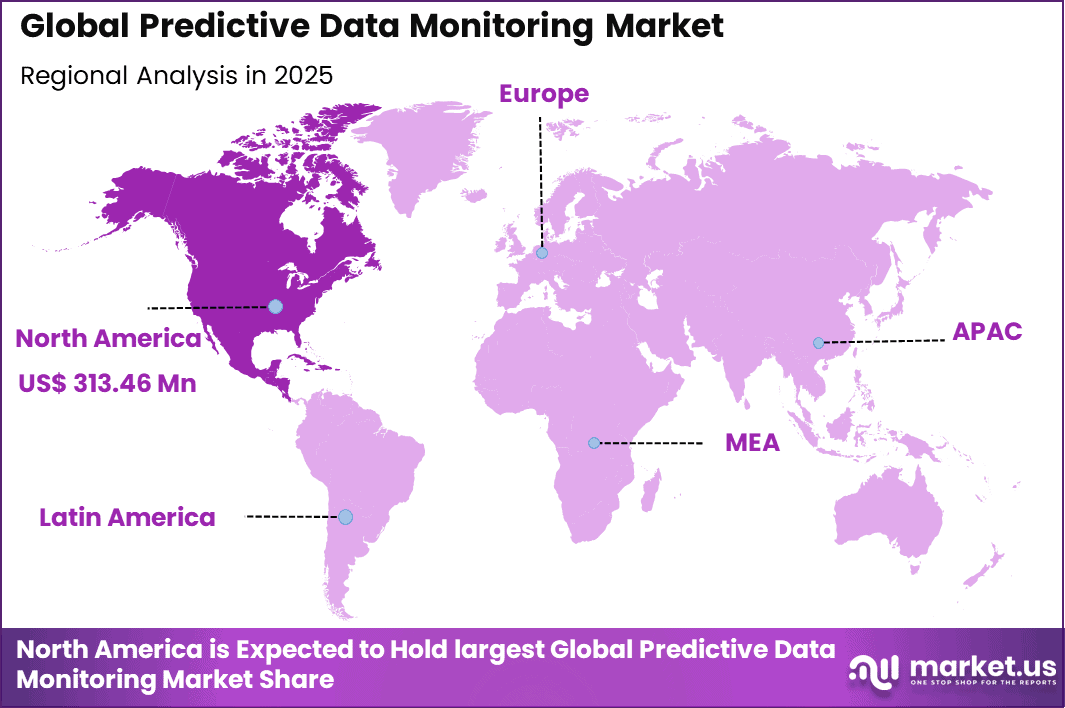
The Global Predictive Data Monitoring Market generated USD 814.2 million in 2025 and is predicted to register growth from USD 965.6 million in 2026 to about USD 4,483.1 million by 2035, recording a CAGR of 18.60% throughout the forecast span. In 2025, North America held a dominan market position, capturing more than a 38.5% share, holding USD 313.46 Million revenue.
The predictive data monitoring market focuses on technologies and practices that assess data quality and system performance before issues arise. These solutions analyze operational signals from data pipelines, detect patterns that lead to degradation, and alert stakeholders so that corrective action can be taken proactively. The goal is to reduce downstream failures, improve trust in analytical outcomes, and enable continuous data operations that align with business needs.
In digital environments where data drives core business processes such as analytics, reporting, and automation, undiscovered quality issues can produce flawed results or disrupt operations. Predictive monitoring extends basic validation by incorporating trend analysis and pattern recognition to forecast potential issues rather than only reacting after they occur. This anticipatory capability improves both operational stability and decision confidence.
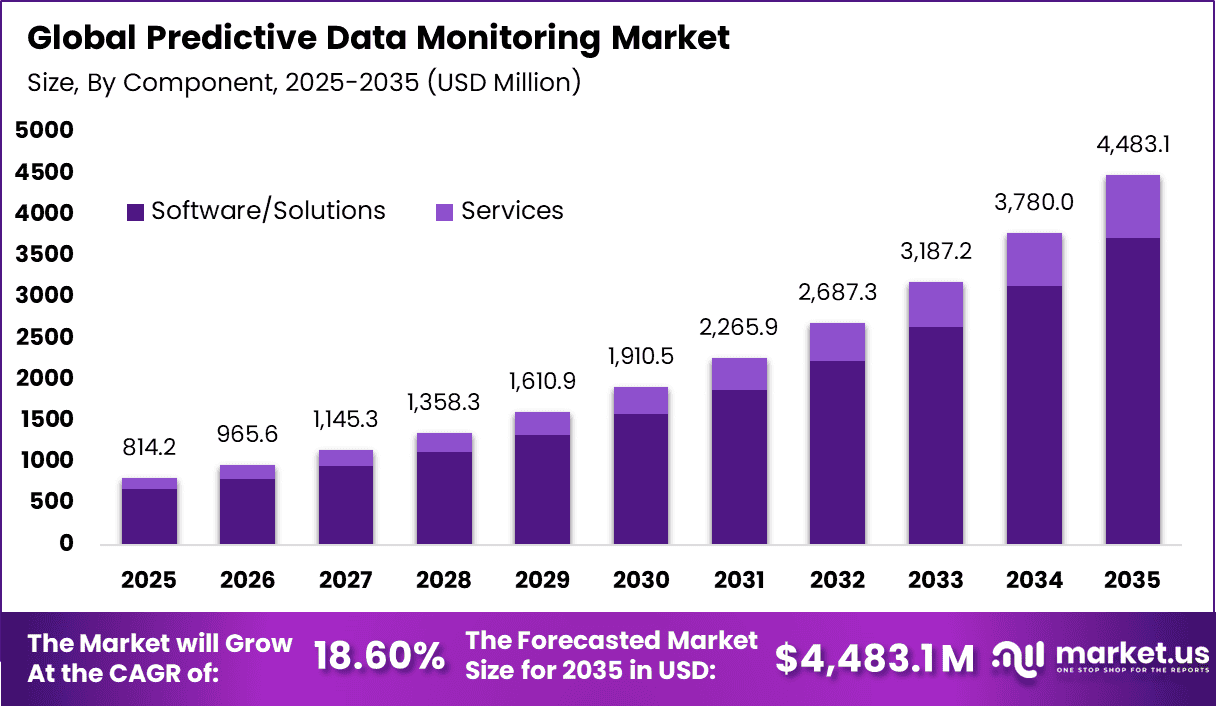
Demand for predictive data monitoring is strongest among large enterprises with extensive data infrastructures. These organizations operate multiple data platforms, third party integrations, and intensive analytical workloads that require early detection of data disruptions. High volume and high velocity data flows further increase the need for systems that can predict quality issues rather than react to them. Data teams report that predictive alerts reduce incident resolution time and improve operational stability.
Machine learning models are central to predictive monitoring because they learn normal data behavior and flag deviations that suggest future issues. These models can identify patterns associated with missing values, unexpected latencies, or structural changes in datasets. Over time, model accuracy improves as more data is observed, enabling better forecasting of issues. This continuous learning capability strengthens early warning signals, allowing proactive intervention.
Top Market Takeaways
- By component, software/solutions account for 82.9% of the market, leveraging AI/ML for proactive anomaly detection, trend forecasting, and automated remediation.
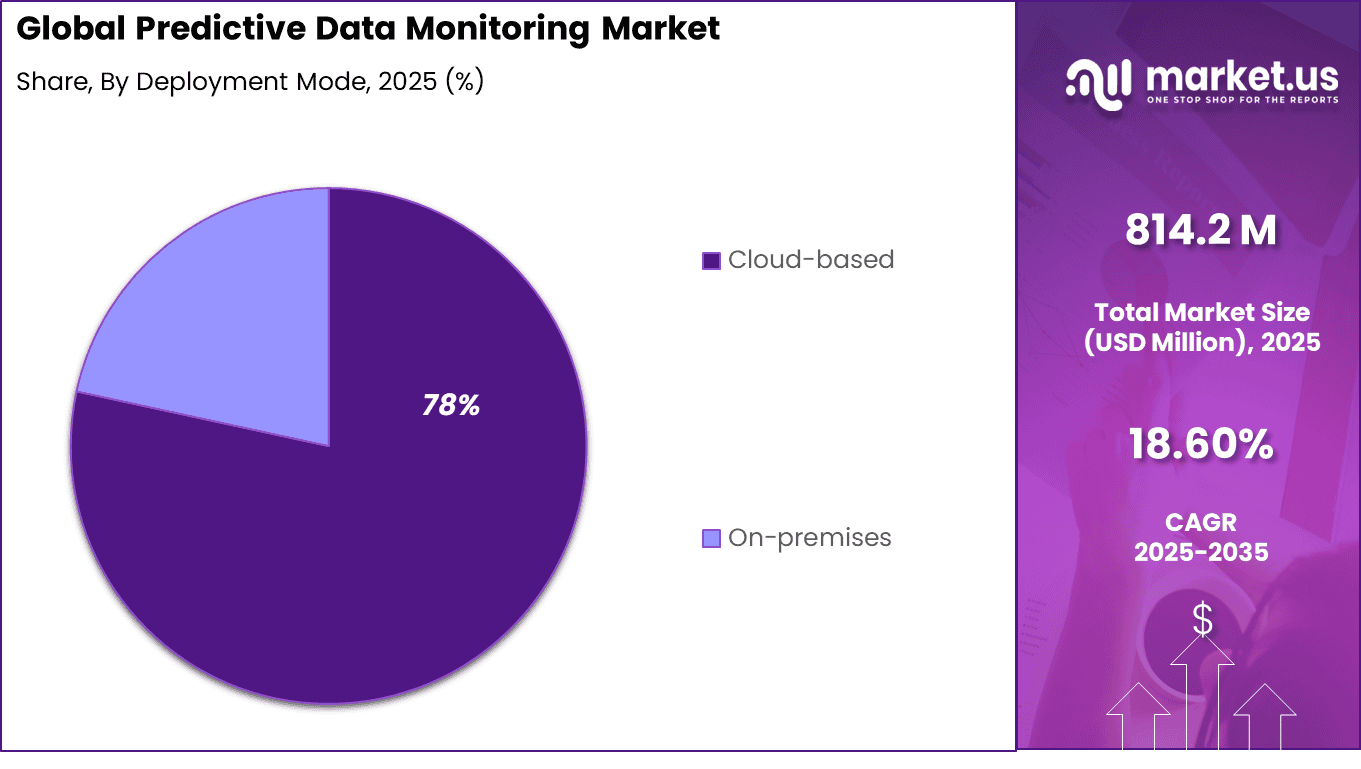
- By deployment mode, cloud-based platforms represent 78.4%, enabling scalable processing of streaming data pipelines and real-time alerting.
- By organization size, large enterprises hold 76.3% share, addressing mission-critical data pipelines in high-stakes environments.
- By application, predictive data quality monitoring captures 51.6%, anticipating issues like drift, corruption, and completeness failures before business impact.
- By end-user industry, financial services command 43.8%, using monitoring for transaction data integrity, model validation, and compliance reporting.
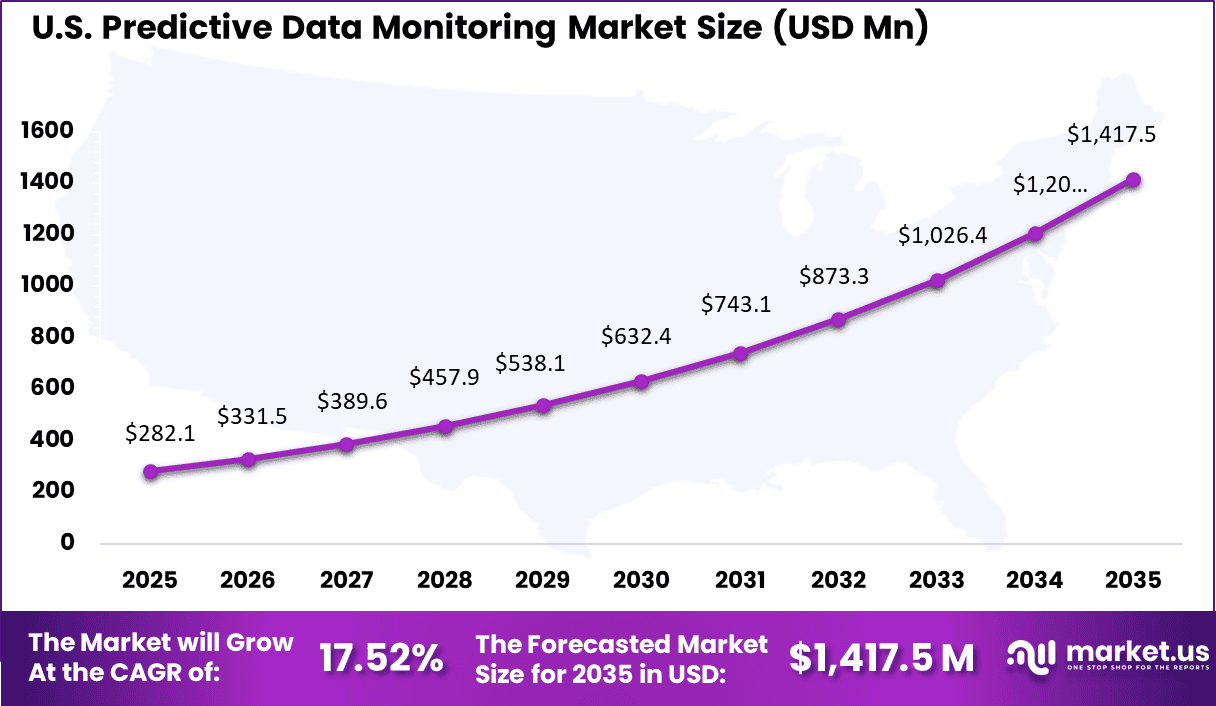
- By region, North America leads with 38.5% of the global market, where the U.S. is valued at USD 282.1 million with a projected CAGR of 17.52%, driven by data-driven decisioning and regulatory scrutiny.
Key Industry Statistics and Adoption
- 64% of surveyed organizations report measurable efficiency and productivity improvements after adopting predictive analytics, indicating strong operational value across industries.
- Businesses using predictive analytics are 2.9x more likely to outperform competitors in revenue growth, showing that forecasting capabilities are increasingly tied to financial performance.
- In healthcare, 72% of leaders believe predictive analytics improves patient outcomes, while 69% expect it to reduce the cost of care through earlier intervention and better resource planning.
- In manufacturing and Industrial IoT environments, predictive monitoring is widely used to reduce downtime by identifying early equipment failure signals using continuous sensor data.
- By 2025, more than 55% of businesses are expected to adopt AI powered predictive analytics, driven by rising data volumes and the need for faster decision support.
- By 2026, automated predictive analytics platforms are projected to represent 35% of demand, supported by growing interest in self service analytics and reduced dependence on specialist teams.
Driver Impact Analysis
| Key Driver | Impact on CAGR Forecast (~%) | Geographic Relevance | Impact Timeline |
|---|---|---|---|
| Increasing reliance on AI-driven decision systems across enterprises | +4.8% | North America, Europe | Short to medium term |
| Rapid expansion of real-time analytics and streaming data environments | +4.1% | Global | Medium term |
| Growing need to prevent operational disruptions and system failures | +3.6% | Global | Short to medium term |
| Adoption of cloud-native data platforms and observability tools | +3.2% | North America, Asia Pacific | Medium term |
| Regulatory and compliance requirements for continuous monitoring | +2.9% | Europe, North America | Medium to long term |
Restraints Impact Analysis
| Key Restraint | Impact on CAGR Forecast (~%) | Geographic Relevance | Impact Timeline |
|---|---|---|---|
| High implementation and model training complexity | -3.3% | Global | Short to medium term |
| Integration challenges across multi-cloud and hybrid environments | -2.9% | North America, Europe | Medium term |
| Limited data quality and inconsistent metadata governance | -2.5% | Global | Medium term |
| Budget constraints among mid-sized enterprises | -2.1% | Asia Pacific, Latin America | Medium term |
| Skills shortage in advanced data science and DataOps | -1.8% | Global | Medium to long term |
By Component
Software and solution based offerings account for 82.9% of adoption in the predictive data monitoring market, as organizations rely on advanced analytics engines to anticipate data failures and inconsistencies. These platforms use machine learning models to detect anomalies before they impact reporting or operations. Early detection reduces operational disruption and improves trust in enterprise data.
Centralized software tools also enable automated alerts and root cause analysis. By shifting from reactive monitoring to predictive insights, organizations strengthen data governance frameworks. This functionality continues to position software solutions as the dominant component.
By Deployment Mode
Cloud based deployment holds 78% reflecting the need for scalable processing and real time analytics. Predictive monitoring requires continuous evaluation of large and dynamic data streams. Cloud environments provide the computational flexibility required for such workloads.
Cloud deployment also enables faster integration with data warehouses and analytics platforms. Organizations benefit from reduced infrastructure management and quicker feature updates. These operational advantages continue to reinforce cloud adoption.
By Organization Size
Large enterprises represent 76.3% of adoption due to their complex and distributed data ecosystems. These organizations manage vast data pipelines across multiple systems and regions. Predictive monitoring tools help maintain data accuracy and consistency at scale.
Large firms also face strict compliance and reporting obligations. Proactive data quality monitoring reduces the risk of regulatory penalties and reputational damage. This sustains strong uptake among large scale enterprises.
By Application
Predictive data quality monitoring accounts for 51.6% of application usage, as organizations prioritize reliable analytics and reporting. These solutions identify potential data gaps, schema changes, and processing delays before they affect business decisions. This proactive approach enhances operational resilience.
Improved data quality directly supports better forecasting and risk management. Automated monitoring reduces manual validation efforts. This makes predictive data quality a leading application within the market.
By End User Industry
Financial services hold 43.8% of end user adoption, as accurate and timely data is central to risk management and compliance. Banks and financial institutions depend on consistent data feeds for transaction monitoring, reporting, and customer analytics. Predictive monitoring platforms strengthen data integrity across these processes.
The sector also operates under strict regulatory scrutiny. Proactive detection of data issues improves audit readiness and governance. This structural requirement continues to drive adoption within financial services.
Investor Type Impact Matrix
| Investor Type | Growth Sensitivity | Risk Exposure | Geographic Focus | Investment Outlook |
|---|---|---|---|---|
| Predictive analytics and observability platform providers | Very High | Medium | North America, Europe | Strong SaaS scalability |
| Cloud service and infrastructure vendors | High | Medium | Global | Embedded monitoring expansion |
| Enterprise AI and BI vendors | High | Medium | Global | Platform integration opportunity |
| Private equity firms | Medium | Medium | North America, Europe | Consolidation of niche analytics vendors |
| Venture capital investors | High | High | North America | Innovation in AI-driven predictive monitoring |
Technology Enablement Analysis
| Technology Enabler | Impact on CAGR Forecast (~%) | Primary Function | Geographic Relevance | Adoption Timeline |
|---|---|---|---|---|
| Machine learning-based predictive anomaly detection | +5.0% | Proactive risk identification | Global | Short to medium term |
| Real-time streaming data analytics engines | +4.3% | Continuous monitoring | Global | Medium term |
| Cloud-native monitoring platforms | +3.7% | Elastic scalability | Global | Medium term |
| Automated root cause and remediation engines | +3.1% | Faster issue resolution | North America, Europe | Medium to long term |
| Integration with DataOps and DevOps workflows | +2.6% | Operational efficiency | Global | Long term |
Key Challenges
- Dependence on high quality historical data for accurate predictions
- Difficulty in integrating predictive tools with existing monitoring systems
- High rate of false alerts reducing trust in predictive models
- Limited in house expertise to manage advanced analytics platforms
- Concerns around data privacy when analyzing large operational datasets
Emerging Trends
In the Predictive Data Monitoring market, a key trend is the move toward integrated anomaly detection that anticipates issues before they impact business operations. Rather than identifying problems only after thresholds are breached, systems are being designed to analyse historical patterns, seasonal variations, and real-time signals to forecast potential data quality or performance degradation.
This trend supports a shift from reactive troubleshooting to proactive maintenance, where alerts are issued with enough lead time for teams to investigate and resolve concerns. Another emerging pattern is the use of intuitive visualisation tools that highlight predicted risk zones and data health scores in plain language, enabling stakeholders across technical and non-technical roles to understand and act on insights.
Growth Factors
A central growth driver in this market is the increasing reliance on data for mission-critical decisions, where undetected anomalies can lead to flawed strategies or operational disruption. As organisations expand their use of analytics, artificial intelligence, and automated workflows, confidence in the underlying data becomes essential. Predictive monitoring helps ensure that data pipelines remain healthy, reducing costly rework and enhancing trust in data-driven outcomes.
Another important driver is the need to streamline operational efficiency and reduce time spent on manual data checks. Data teams are often stretched thin addressing recurring issues; predictive capabilities allow them to prioritise resources on high-impact risks and focus more on strategic improvements rather than repetitive error fixes. This balance between vigilance and efficiency is fuelling broader interest in predictive data monitoring solutions.
Key Market Segments
By Component
- Software/Solutions
- Services
By Deployment Mode
- Cloud-based
- On-premises
By Organization Size
- Large Enterprises
- Small and Medium-sized Enterprises
By Application
- Predictive Data Quality Monitoring
- Infrastructure Failure Prediction
- Business Metric Anomaly Forecasting
- Compliance Risk Prediction
- Others
By End-User Industry
- Financial Services
- Technology and Software
- Retail and E-commerce
- Telecommunications
- Others
Regional Analysis
North America holds a 38.5% share of the predictive data monitoring market, supported by strong enterprise investment in advanced analytics and real-time data infrastructure. Organizations across finance, healthcare, retail, and technology sectors are deploying predictive monitoring tools to detect anomalies, prevent system failures, and improve operational resilience. Demand is driven by increasing data volumes, the need for early risk detection, and growing reliance on data-driven decision environments.
The United States market is valued at USD 282.1 Mn and is expanding at a CAGR of 17.52%, reflecting rapid integration of machine learning models within monitoring systems. Adoption is influenced by rising cloud workloads, complex IT ecosystems, and the need to reduce downtime and performance disruptions. Growth is further supported by increasing focus on proactive incident management, regulatory compliance in data handling, and the shift toward automated intelligence in enterprise monitoring frameworks.
Key Regions and Countries
- North America
- US
- Canada
- Europe
- Germany
- France
- The UK
- Spain
- Italy
- Russia
- Netherlands
- Rest of Europe
- Asia Pacific
- China
- Japan
- South Korea
- India
- Australia
- Singapore
- Thailand
- Vietnam
- Rest of APAC
- Latin America
- Brazil
- Mexico
- Rest of Latin America
- Middle East & Africa
- South Africa
- Saudi Arabia
- UAE
- Rest of MEA
Competitive Analysis
AI-driven monitoring and observability vendors such as Anodot, Dynatrace, Datadog, and Splunk lead the predictive data monitoring market. Their platforms use machine learning to forecast system anomalies and performance degradation. Predictive alerts help reduce downtime and improve operational resilience. These vendors benefit from strong enterprise penetration across IT and digital services. Demand is driven by rising complexity in hybrid and multi-cloud environments.
Data observability and quality-focused providers such as Monte Carlo, Bigeye, Acceldata, and Soda extend predictive monitoring into analytics pipelines. New Relic, LogicMonitor, and ScienceLogic enhance infrastructure-level forecasting. Adoption is strong among enterprises relying on real-time dashboards and automated decision systems.
Cloud and enterprise platform providers such as IBM, Microsoft, Google, and Amazon Web Services embed predictive capabilities within native monitoring services. Their scalable architectures support automated remediation and policy enforcement. Other vendors expand innovation and regional reach. This competitive landscape supports continued growth in predictive data monitoring across enterprise environments.
Top Key Players in the Market
- Anodot
- Dynatrace
- Datadog
- Splunk
- IBM
- Microsoft
- Amazon Web Services
- Bigeye
- Acceldata
- Monte Carlo
- Soda
- New Relic
- LogicMonitor
- ScienceLogic
- Others
Future Outlook
The future outlook for the Predictive Data Monitoring Market is positive as organizations seek more effective ways to anticipate issues and ensure data quality. Demand for predictive data monitoring solutions is expected to grow because these tools help detect anomalies, prevent errors, and support proactive decision making.
Adoption of advanced analytics, machine learning, and real-time alerts will improve accuracy and operational performance. Growth can be attributed to rising data volumes, stronger focus on data integrity, and the need to reduce downtime and risk. Overall, the market is expected to expand as businesses prioritize reliable and forward-looking data monitoring.
Recent Developments
- April, 2025: Datadog snapped up Metaplane, an AI data observability startup, to beef up proactive data quality checks, especially for AI workloads on platforms like Snowflake.
- November, 2025: New Relic debuted Agentic AI Monitoring and its MCP Server, helping teams observe interconnected AI agents and cut through workflow complexity.
Report Scope
| Report Features | Description |
|---|---|
| Market Value (2025) | USD 814.2 Million |
| Forecast Revenue (2035) | USD 4,483.1 Million |
| CAGR(2025-2035) | 18.60% |
| Base Year for Estimation | 2024 |
| Historic Period | 2020-2024 |
| Forecast Period | 2025-2035 |
| Report Coverage | Revenue forecast, AI impact on Market trends, Share Insights, Company ranking, competitive landscape, Recent Developments, Market Dynamics and Emerging Trends |
| Segments Covered | By Component (Software/Solutions, Services), By Deployment Mode (Cloud-based, On-premises), By Organization Size (Large Enterprises, Small and Medium-sized Enterprises), By Application (Predictive Data Quality Monitoring, Infrastructure Failure Prediction, Others), By End-User Industry (Financial Services, Technology and Software, Others) |
| Regional Analysis | North America – US, Canada; Europe – Germany, France, The UK, Spain, Italy, Russia, Netherlands, Rest of Europe; Asia Pacific – China, Japan, South Korea, India, New Zealand, Singapore, Thailand, Vietnam, Rest of Latin America; Latin America – Brazil, Mexico, Rest of Latin America; Middle East & Africa – South Africa, Saudi Arabia, UAE, Rest of MEA |
| Competitive Landscape | Anodot, Dynatrace, Datadog, Splunk, IBM, Microsoft, Google, Amazon Web Services, Bigeye, Acceldata, Monte Carlo, Soda, New Relic, LogicMonitor, ScienceLogic, Others |
| Customization Scope | Customization for segments, region/country-level will be provided. Moreover, additional customization can be done based on the requirements. |
| Purchase Options | We have three license to opt for: Single User License, Multi-User License (Up to 5 Users), Corporate Use License (Unlimited User and Printable PDF) |