


Market Overview
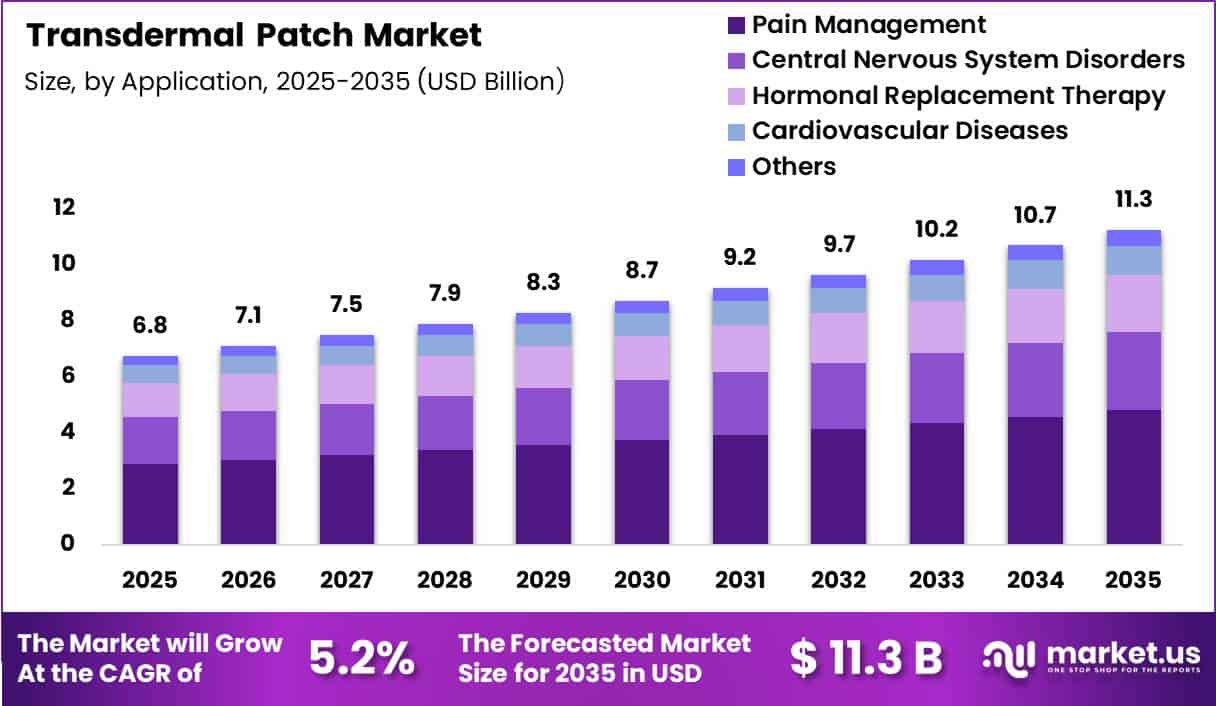
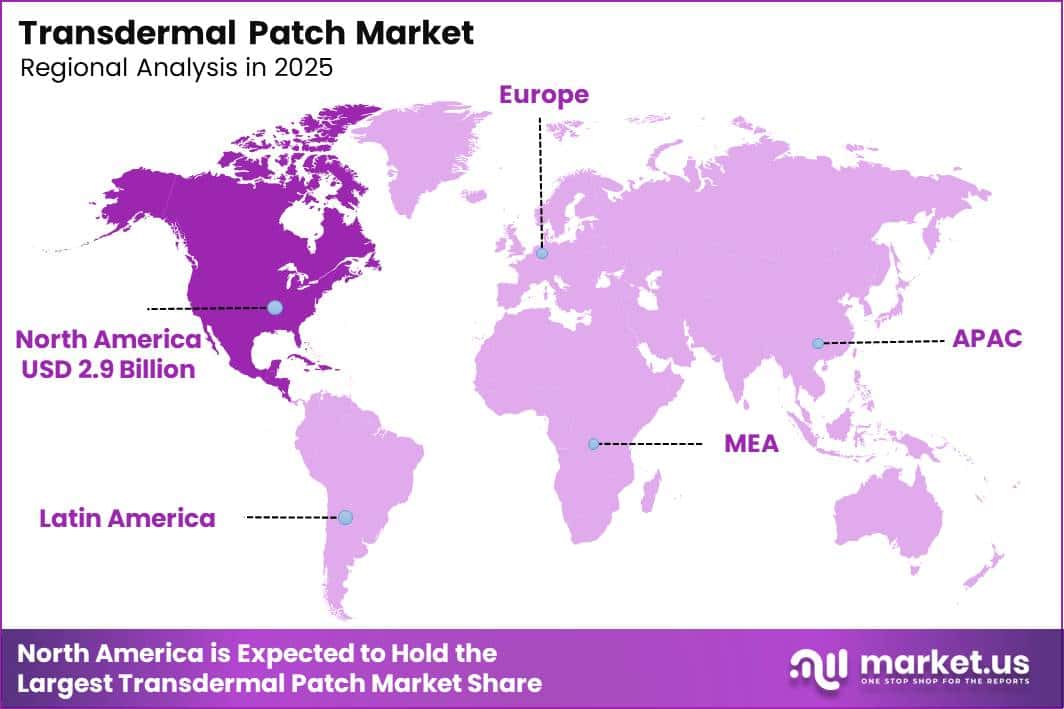
Global Transdermal Patch Market size is expected to be worth around US$ 11.3 Billion by 2035 from US$ 6.8 Billion in 2025, growing at a CAGR of 5.2% during the forecast period from 2026 to 2035. In 2025, North America led the market, achieving over 42.5% share with a revenue of US$ 2.9 Billion.
Transdermal patches have become an important drug delivery option because they provide controlled and sustained release of medicines through the skin, helping improve patient convenience and treatment adherence.
These systems are widely used for pain management, smoking cessation, hormonal therapies, neurological disorders, and cardiovascular diseases. Increasing preference for non-invasive therapies and self-administration is supporting wider adoption of transdermal technologies in healthcare settings.
According to the U.S. Food and Drug Administration (FDA), transdermal systems are approved for several therapeutic applications, including fentanyl patches for chronic pain management and nicotine patches for smoking cessation.
The Centers for Disease Control and Prevention (CDC) notes that nicotine patches are among seven FDA-approved medications used to support smoking cessation and are available in three strengths 7 mg, 14 mg, and 21 mg to help individuals gradually reduce nicotine dependence. The therapy is generally recommended for 8 to 12 weeks depending on patient requirements.
Technological advancements in adhesive materials, permeation enhancers, and wearable drug delivery systems are further improving patch performance and patient comfort. Growing prevalence of chronic diseases and an expanding elderly population are also creating opportunities for long-term medication delivery solutions.
In addition, pharmaceutical companies continue to invest in innovative formulations designed to deliver larger molecules and improve bioavailability, contributing to the ongoing development of the transdermal patch industry worldwide.
Key Takeaways
- Market Size : Transdermal Patch Market size is expected to be worth around US$ 11.3 Billion by 2035 from US$ 6.8 Billion in 2025.
- Market Share : The Market is growing at a CAGR of 5.2% during the forecast period from 2026 to 2035.
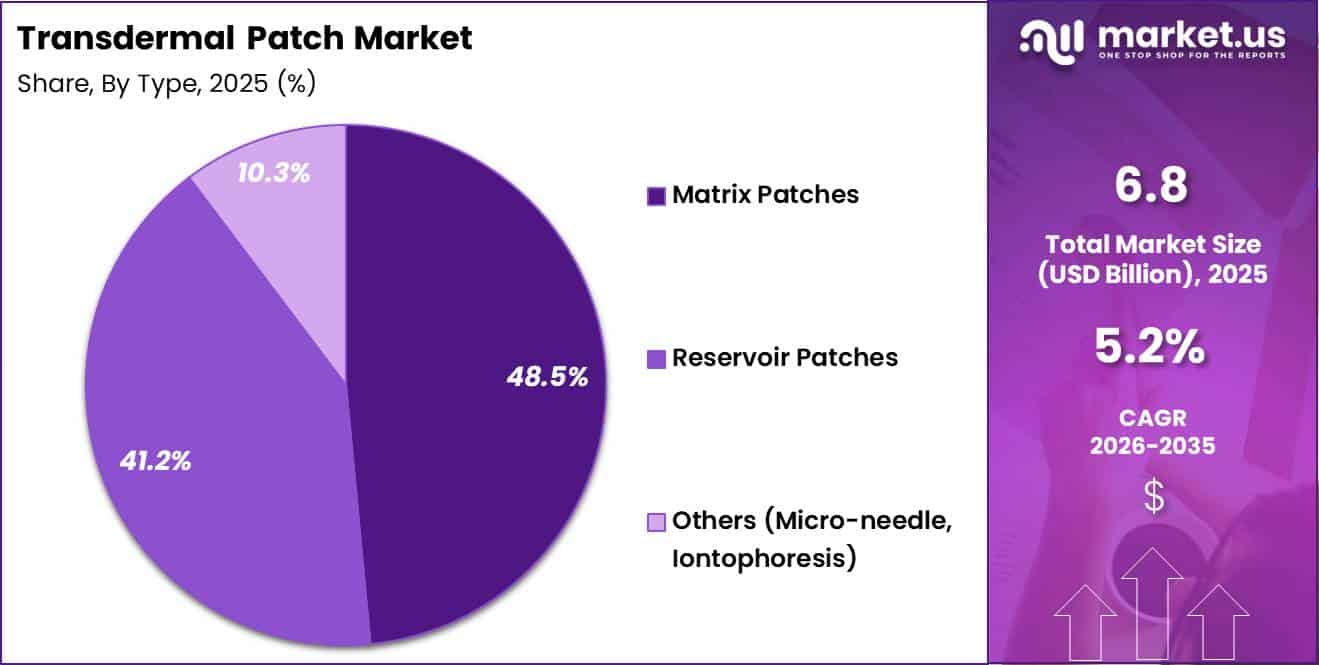
- Type Analysis : The Matrix Patches segment dominated the Transdermal Patch Market in 2025, accounting for 48.5% of the total market share.
- Application Analysis : The Pain Management segment held the largest share of the Transdermal Patch Market in 2025, capturing 42.8% of total revenue.
- End User Analysis : The Hospitals & Clinics segment dominated the Transdermal Patch Market in 2025, accounting for 48.5% of the overall market share.
- Regional Analysis : In 2025, North America led the market, achieving over 42.5% share with a revenue of US$ 2.9 Billion.
Type Analysis
The Matrix Patches segment dominated the Transdermal Patch Market in 2025, accounting for 48.5% of the total market share. The widespread adoption of matrix patches is attributed to their simple design, improved patient comfort, and controlled drug release characteristics.
In these systems, the drug is uniformly dispersed within the polymer matrix, reducing the risk of dose dumping and enhancing safety. Matrix patches are extensively used in pain management, smoking cessation, and hormone replacement therapies because they provide sustained medication delivery over an extended period. Their ease of manufacturing and lower production costs further support their growing demand among pharmaceutical companies.
Reservoir Patches represented 41.2% of the market share in 2025. These patches contain a drug reservoir separated from the skin by a rate-controlling membrane, enabling precise control over medication release. They are commonly utilized for therapies requiring consistent dosing, particularly in chronic disease management.
The Others segment, including micro-needle and iontophoresis patches, accounted for 10.3% of the market. These advanced technologies are gaining attention due to their ability to improve skin permeability, enhance drug absorption, and facilitate the delivery of larger molecules, creating opportunities for next-generation transdermal drug delivery systems.
Application Analysis
The Pain Management segment held the largest share of the Transdermal Patch Market in 2025, capturing 42.8% of total revenue. The dominance of this segment is driven by the increasing prevalence of chronic pain conditions, musculoskeletal disorders, and cancer-related pain.
Transdermal patches offer continuous drug administration, reduce gastrointestinal side effects associated with oral medications, and improve patient compliance. Their convenience and long-lasting therapeutic effects have encouraged widespread adoption among healthcare providers and patients seeking non-invasive treatment alternatives.
The Central Nervous System Disorders segment accounted for 24.6% of the market share in 2025, supported by growing use of transdermal therapies for Parkinson’s disease, Alzheimer’s disease, and other neurological conditions.
Hormonal Replacement Therapy represented 18.2% of the market, benefiting from increasing demand for estrogen and testosterone patches that provide stable hormone delivery. Cardiovascular Diseases contributed 9.4% of market revenue, driven by the use of transdermal systems for hypertension and angina management.
The Others category, comprising dermatological treatments and smoking cessation therapies, captured 5.0% of the market, reflecting the expanding applications of transdermal technologies across diverse therapeutic areas.
End User Analysis
The Hospitals & Clinics segment dominated the Transdermal Patch Market in 2025, accounting for 48.5% of the overall market share. This leadership is primarily attributed to the high volume of patients receiving treatment for chronic diseases, postoperative pain, and long-term medical conditions within healthcare facilities.
Hospitals and clinics are major users of transdermal patches due to their ability to ensure controlled medication delivery, reduce dosing frequency, and improve patient adherence to treatment regimens. The availability of skilled healthcare professionals and access to advanced therapeutic options further contribute to the segment’s substantial market presence.
Homecare Settings emerged as a significant segment, supported by the growing preference for self-administered therapies and increasing demand for convenient treatment solutions among elderly patients. The expansion of home-based healthcare services and rising awareness regarding non-invasive drug delivery methods continue to support market growth in this segment.
Ambulatory Surgical Centers also represent an important end-user category, utilizing transdermal patches for pain management and postoperative care. Meanwhile, the Others segment, including rehabilitation centers and specialty care facilities, contributes to market expansion through the adoption of innovative patch technologies for long-term disease management and patient-centered care.
Market Segmentations
By Type
- Matrix Patches
- Reservoir Patches
- Others (Micro-needle, Iontophoresis)
By Application
- Pain Management
- Central Nervous System Disorders
- Hormonal Replacement Therapy
- Cardiovascular Diseases
- Others
By End User
- Hospitals & Clinics
- Homecare Settings
- Ambulatory Surgical Centers
- Others
Drivers
Smoking Cessation Policy and OTC Nicotine Patch Access Driving Retail Demand
Nicotine patches represent one of the clearest examples of transdermal technology scaling through public health policy, OTC access, and retail distribution. Smoking significantly increases the risk of type 2 diabetes by 30–40% (CDC), while FDA-approved smoking cessation therapies, including nicotine patches, can double the likelihood of quitting successfully and are available OTC for adults.
Because nicotine patches do not require a prescription, they are widely distributed through pharmacies, e-commerce platforms, employer wellness programs, and quitline-linked initiatives. This reduces dependence on physician prescribing cycles and enables faster consumer adoption.
As a result, the market increasingly shifts from a prescription-driven model to a hybrid public-health and retail-driven ecosystem, where demand is influenced more by awareness campaigns, insurance-covered cessation programs, and consumer conversion rates.
This positions nicotine patches as a high-volume, short-cycle growth segment within transdermal therapeutics, supporting steady demand for manufacturers, adhesive technology suppliers, and contract production capacity.
| Driver | () % Impact on CAGR Forecast | Geographic Relevance | Impact Timeline |
|---|---|---|---|
| Chronic disease load expanding long-wear drug delivery demand | +1.9% | North America core, EU, East Asia, India, broader LMIC catch-up | Medium term (2-4 years) |
| Smoking cessation policy and OTC nicotine patch access supporting retail volumes | +1.2% | U.S. core, Canada, EU, ANZ, selective APAC urban markets | Short term (≤ 2 years) |
| FDA quality tightening and combination-product compliance favoring scaled manufacturers | +1.0% | U.S. core, EU export-linked suppliers, Japan, South Korea | Medium term (2-4 years) |
| Better adhesion, matrix design, and skin-compatible materials improving real-world performance | +1.4% | U.S., EU, Japan, South Korea, premium APAC markets | Medium term (2-4 years) |
| Diabetes care expansion and high medication under-treatment opening adjunct patch opportunities | +1.1% | U.S., MENA, India, China, Latin America, Southeast Asia | Long term (≥ 4 years) |
| Home-based care and patient preference shifting therapy toward low-burden dosing formats | +1.3% | North America, EU, Japan, urban China, GCC | Short term (≤ 2 years) |
Challenge
Complex Combination Product Compliance in Transdermal Patches
Transdermal patches fall under combination product regulation in the US, requiring coordination between drug and device compliance frameworks. With evolving ISO aligned quality system standards being phased in from 2026, manufacturers face higher documentation, validation, and post market surveillance requirements.
Development involves integrating chemistry, manufacturing, and controls (CMC) with device level testing such as extractables and leachables, in vitro permeation testing (including stress conditions), and human factors studies.
This often adds multiple validation cycles and extends development timelines by 12–18 months compared with standard oral generics. For mid sized firms, regulatory and quality compliance can account for 8–12% of development costs per product. First cycle approval challenges remain in the high single digits, contributing to delayed or staggered product launches.
Overall, this regulatory complexity reduces market expansion efficiency, trimming potential CAGR by an estimated 1.4 % points. In response, companies are building standardized patch platforms and engaging regulators earlier, but global harmonization across FDA, EMA, PMDA, and NMPA remains a long term challenge.
| Challenge | () % CAGR Friction Drag | Geographic Relevance | Mitigation Horizon |
|---|---|---|---|
| Complex combo-product compliance | -1.4% | US, EU, Japan core | Long term (≥ 4 years) |
| Skin variability & dose precision | -1.1% | Global; high in geriatrics | Medium term (2-4 years) |
| Advanced materials & adhesion scale-up | -0.9% | US, EU, APAC manufacturing hubs | Medium term (2-4 years) |
| Sensor-enabled smart patch integration | -0.8% | North America, EU digital health | Long term (≥ 4 years) |
| GMP capacity & skilled workforce gaps | -1.0% | Emerging APAC, LATAM corridors | Long term (≥ 4 years) |
| Controlled substances diversion & misuse risk | -0.7% | US, EU, selected APAC | Medium term (2-4 years) |
Restraints
Stricter Transdermal System (TDS) Regulatory Requirements
Stricter regulatory expectations for transdermal and topical delivery systems (TDS) in the US, EU, and increasingly India are creating structural development delays and raising costs across the industry. Updated FDA guidance emphasizes full quality target product profiles, critical quality attribute mapping, and comprehensive irritation and sensitization studies, often requiring around 200 evaluable subjects and complex bioequivalence designs.
For mid sized pharmaceutical companies, these requirements add 18–24 months of development time and increase clinical and CMC costs by roughly USD 8–15 million per asset, pushing total development costs for complex TDS products to around USD 40–60 million. As a result, fewer patch programs advance into early clinical phases, particularly in non opioid and non hormonal categories.
Program attrition has increased by an estimated 10–15% compared with earlier regulatory baselines, slowing product pipelines and reducing competitive entry. Overall, this regulatory burden contributes to an estimated 2.0 % point reduction in global TDS market CAGR by delaying launches, increasing capital intensity, and limiting participation from smaller developers while shifting investment toward less complex oral and injectable platforms.
| Restraint | () % Impact on CAGR Forecast | Geographic Relevance | Impact Timeline |
|---|---|---|---|
| Stricter TDS regulatory requirements | -2.0% | North America core, EU, India | Medium term (2-4 years) |
| Complex adhesion / irritation performance standards | -1.3% | North America core, EU | Short to medium term (≤ 4 years) |
| Limited formulary / essential medicines uptake | -1.1% | Emerging APAC, LATAM, Africa | Long term (≥ 4 years) |
| Manufacturing and laminate quality complexity | -1.5% | North America, EU, APAC corridors | Medium term (2-4 years) |
| API and excipient supply volatility | -1.0% | Global, especially APAC–EU lanes | Short term (≤ 2 years) |
Opportunity
Consumer Grade Wellness and Behavioral Transdermal Patches
Consumer wellness patches targeting sleep, stress, smoking cessation, appetite control, and micronutrient delivery represent an emerging adjacent market outside traditional prescription driven transdermal systems.
With global wellness spending exceeding USD 4 trillion, even a small 0.3–0.5% penetration could translate into a USD 12–20 billion opportunity by 2030.These products benefit from high gross margins (60–75%) and subscription based models, typically generating monthly ARPU of USD 15–30.
Digital first distribution through influencers, telehealth platforms, and e commerce also helps reduce customer acquisition costs compared to conventional OTC channels. If only 3–4% of global fitness or wellness app users convert into recurring patch users, the category could add meaningful incremental growth, particularly in North America and Europe where regulatory barriers for non pharmaceutical wellness products are lower.
Unlike prescription transdermal therapies, this segment relies on brand driven demand, digital engagement, and behavioral health positioning rather than clinical reimbursement pathways. With relatively light regulatory requirements and short development cycles (often under 2 years), wellness patches could contribute an estimated 1–1.5 % points of additional CAGR for the broader transdermal market.
| Opportunity | () % Potential CAGR Upside | Geographic Relevance | Execution Window |
|---|---|---|---|
| Integrated chronic disease management patches | +2.2% | North America, EU, India, China | Medium term (2-4 years) |
| Consumer-grade wellness and behavioral patches | +1.5% | North America core, EU, APAC urban | Short term (≤ 2 years) |
| Value-based care and risk-sharing patch models | +1.8% | US, EU-5, select APAC | Medium term (2-4 years) |
| Emerging-market primary care substitution | +2.6% | India, Southeast Asia, LATAM | Long term (≥ 4 years) |
| Advanced multifunctional and smart patches | +2.0% | Global early adopters, APAC tech hubs | Long term (≥ 4 years) |
| M&A roll-up of fragmented patch IP and brands | +1.3% | Global, with NA/EU consolidation | Medium term (2-4 years) |
Regional Analysis
North America dominated the Transdermal Patch Market in 2025, accounting for more than 42.5% of the global revenue. The region’s leadership is supported by a highly developed healthcare infrastructure, strong pharmaceutical manufacturing capabilities, and widespread adoption of advanced drug delivery technologies.
The United States represents the largest contributor within the region due to high demand for non-invasive therapies used in pain management, smoking cessation, hormone replacement therapy, and neurological disorders.
The presence of well-established regulatory pathways through the U.S. Food and Drug Administration (FDA) has encouraged the development and commercialization of innovative transdermal systems. In addition, growing awareness regarding patient-friendly treatment methods and increasing preference for self-administered therapies continue to support market expansion.
Rising incidences of chronic diseases, including cardiovascular disorders, diabetes, and chronic pain conditions, have also accelerated the use of long-acting drug delivery solutions across hospitals, clinics, and homecare settings.
Europe represents the second-largest regional market, benefiting from increasing adoption of hormone replacement patches and favorable reimbursement systems in several countries. Meanwhile, Asia-Pacific is expected to witness the fastest growth during the forecast period due to expanding healthcare expenditure, a rapidly aging population, and improving access to modern healthcare services.
Emerging economies such as China and India are investing significantly in pharmaceutical production and innovative drug delivery technologies, creating substantial growth opportunities for market participants.
Key Regions and Countries
North America
- The US
- Canada
Europe
- Germany
- France
- The U.K.
- Italy
- Spain
- Russia & CIS
- Rest of Europe
Asia Pacific
- China
- India
- Japan
- South Korea
- ASEAN
- Australia & New Zealand
- Rest of Asia Pacific
Middle East & Africa
- GCC
- South Africa
- Rest of Middle East & Africa
Latin America
- Brazil
- Mexico
- Rest of Latin America
Key Player Analysis
The transdermal patch market is characterized by the presence of established pharmaceutical and healthcare companies focusing on product innovation, therapeutic expansion, and advanced drug delivery technologies.
Hisamitsu Pharmaceutical Co. Inc. remains a leading participant with strong expertise in pain relief patches and continuous investments in next-generation transdermal platforms. Mylan N.V. (Viatris Inc.) maintains a significant position through its contraceptive and hormone therapy patch portfolio, supported by ongoing clinical development activities.
Teva Pharmaceutical Industries Ltd. leverages its broad specialty medicine capabilities to strengthen its presence in transdermal therapies, while Johnson & Johnson benefits from its diversified healthcare business and extensive consumer health distribution network.
Novartis AG and Bayer AG continue to explore innovative delivery approaches to improve patient compliance and therapeutic outcomes across chronic disease treatments. Pfizer Inc. contributes through its strong pharmaceutical research capabilities and focus on patient-centered drug delivery systems.
Meanwhile, 3M Company plays an important role by supplying advanced adhesive technologies and transdermal delivery materials, supporting pharmaceutical manufacturers in developing efficient, comfortable, and long-lasting patch-based treatment solutions.
Top Key Players
- Hisamitsu Pharmaceutical Co. Inc.
- Mylan N.V. (Viatris Inc.)
- Teva Pharmaceutical Industries Ltd.
- Johnson & Johnson
- Novartis AG
- Bayer AG
- Pfizer Inc.
- 3M Company
- Luye Pharma Group
- Nitto Denko Corporation
- UCB S.A.
- Amneal Pharmaceuticals Inc.
- Endo International plc
- Purdue Pharma L.P.
- AdhexPharma
- Others
Recent Developments
- In May 2026, Hisamitsu Pharmaceutical Co., Inc. announced that Salonpas® was recognized as the world’s No. 1 OTC topical analgesic patch brand for the tenth consecutive year, reinforcing the company’s leadership in the global transdermal pain patch segment and strengthening its footprint across North America and Asia-Pacific.
- In January 2026, Teva Pharmaceutical Industries Ltd. signed an agreement with Royalty Pharma, under which Royalty Pharma committed up to US$500 million to support the development of TEV-‘408 for vitiligo, including US$75 million for Phase 2b activities and a potential US$425 million commitment for Phase 3 studies.
- In May 2025, Viatris Inc. reported positive Phase III results for its investigational XULANE LO™ low-dose contraceptive patch, evaluated in 1,272 women, demonstrating favorable efficacy, safety, and potential best-in-class adhesion performance. The company indicated plans to submit an NDA to the U.S. FDA during the second half of 2025.
Report Scope
| Report Features | Description |
|---|---|
| Market Value (2025) | US$ 6.8 Billion |
| Forecast Revenue (2035) | US$ 11.3 Billion |
| CAGR (2026-2035) | 5.2% |
| Base Year for Estimation | 2025 |
| Historic Period | 2020-2024 |
| Forecast Period | 2026-2035 |
| Report Coverage | Revenue Forecast, Market Dynamics, Competitive Landscape, Recent Developments |
| Segments Covered | By Type (Matrix Patches, Reservoir Patches, Others (Micro-needle, Iontophoresis)), By Application (Pain Management, Central Nervous System Disorders, Hormonal Replacement Therapy, Cardiovascular Diseases, Others), By End User (Hospitals & Clinics, Homecare Settings, Ambulatory Surgical Centers, Others) |
| Regional Analysis | North America – The US, Canada; Europe – Germany, France, U.K., Italy, Spain, Russia & CIS, Rest of Europe; Asia Pacific – China, India, Japan, South Korea, ASEAN, Australia & New Zealand, Rest of Asia Pacific; Middle East & Africa – GCC, South Africa, Rest of Middle East & Africa; Latin America – Brazil, Mexico, Rest of Latin America |
| Competitive Landscape | Hisamitsu Pharmaceutical Co. Inc., Mylan N.V. (Viatris Inc.), Teva Pharmaceutical Industries Ltd., Johnson & Johnson, Novartis AG, Bayer AG, Pfizer Inc., 3M Company, Luye Pharma Group, Nitto Denko Corporation, UCB S.A., Amneal Pharmaceuticals Inc., Endo International plc, Purdue Pharma L.P., AdhexPharma, Others |
| Customization Scope | Customization for segments, region/country-level will be provided. Moreover, additional customization can be done based on the requirements. |
| Purchase Options | We have three licenses to opt for: Single User License, Multi-User License (Up to 5 Users), Corporate Use License (Unlimited User and Printable PDF) |





































