Report Overview
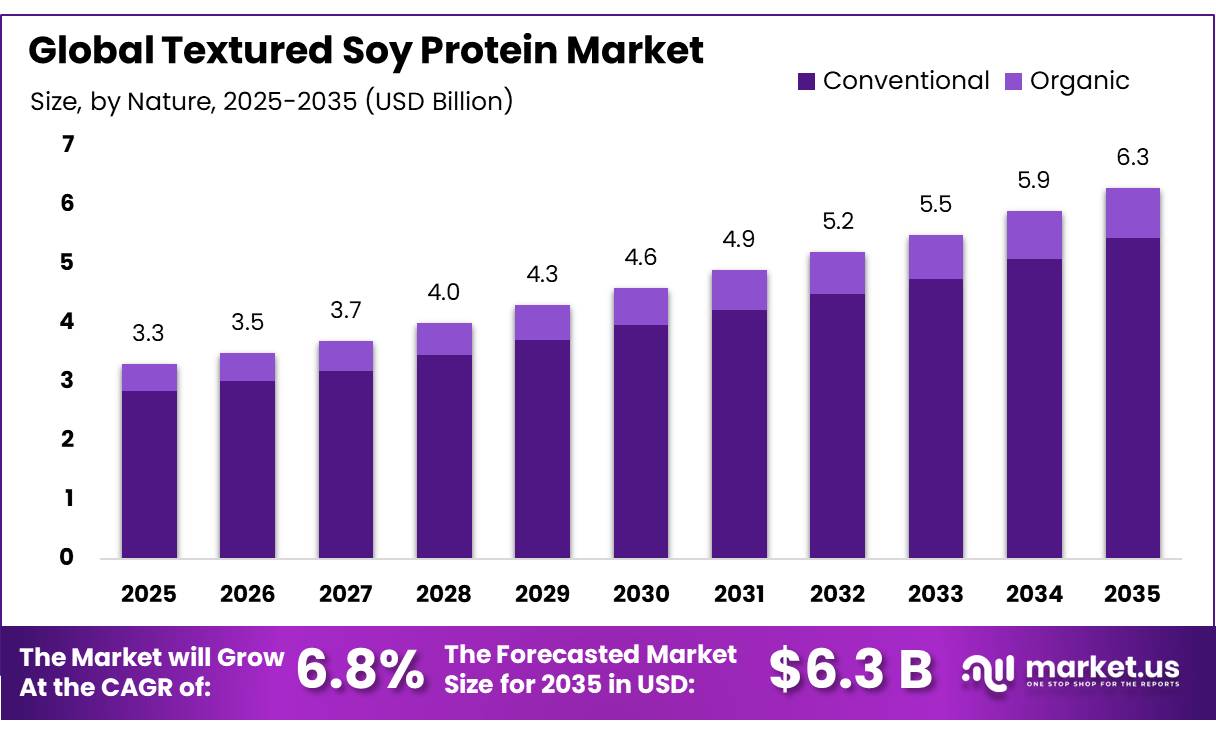
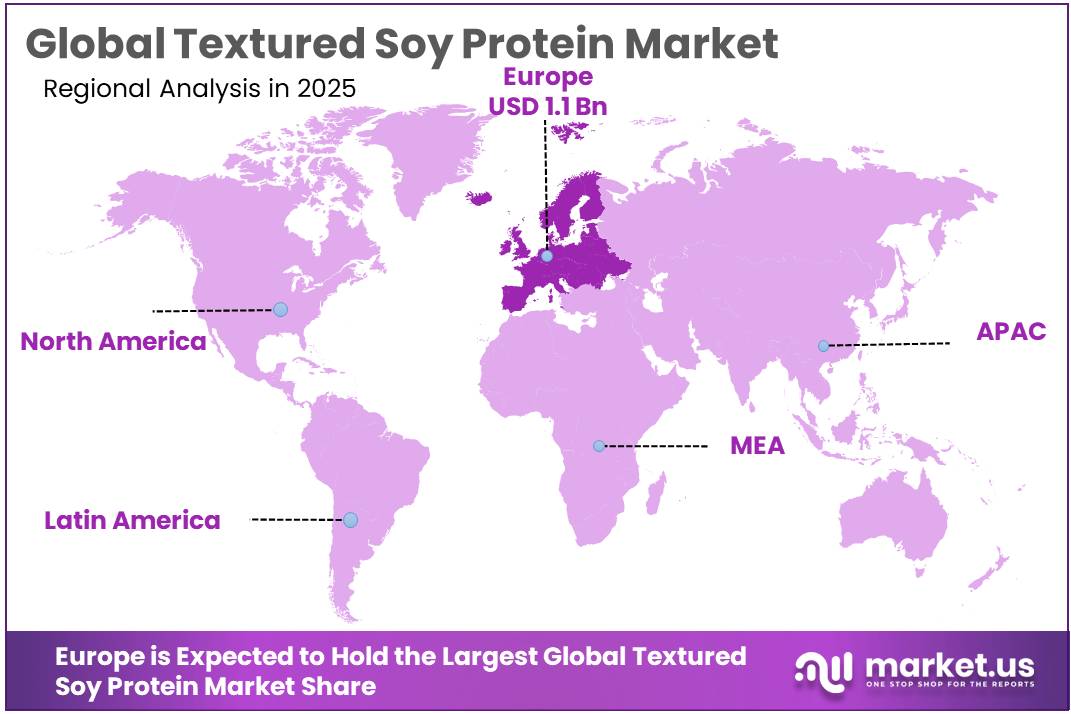
The Global Textured Soy Protein Market size is expected to be worth around USD 6.3 Billion by 2035, from USD 3.3 Billion in 2025, growing at a CAGR of 6.8% during the forecast period from 2026 to 2035. In 2025, Europe held a dominant market position, capturing more than a 36.33% share, holding USD 1.1 Billion revenue.
- The industrial scenario is closely connected to soybean cultivation, oilseed crushing, protein concentration, and food extrusion technologies. The United States Department of Agriculture (USDA) reported that US soybean production reached 4.37 billion bushels in 2024, representing a 5% increase compared with 2023. This large agricultural supply supports the availability of raw materials for soybean meal, protein concentrates, and value-added food ingredients.
- According to the Commission, the European Union produces 67 million tonnes of plant-based protein annually but uses approximately 80 million tonnes for feed, food, and industrial purposes. In addition, only 25% of the protein from oilseeds and protein crops used in the EU in 2025 was sourced domestically. These figures highlight opportunities for regional soybean processing, food-grade protein production, and investment in value-added plant protein ingredients.
Key Takeaways
- Textured Soy Protein Market size is expected to be worth around USD 6.3 Billion by 2035, from USD 3.3 Billion in 2025, growing at a CAGR of 6.8%.
- Conventional held a dominant market position, capturing more than a 86.34% share.
- Food and Beverages held a dominant market position, capturing more than a 78.33% share.
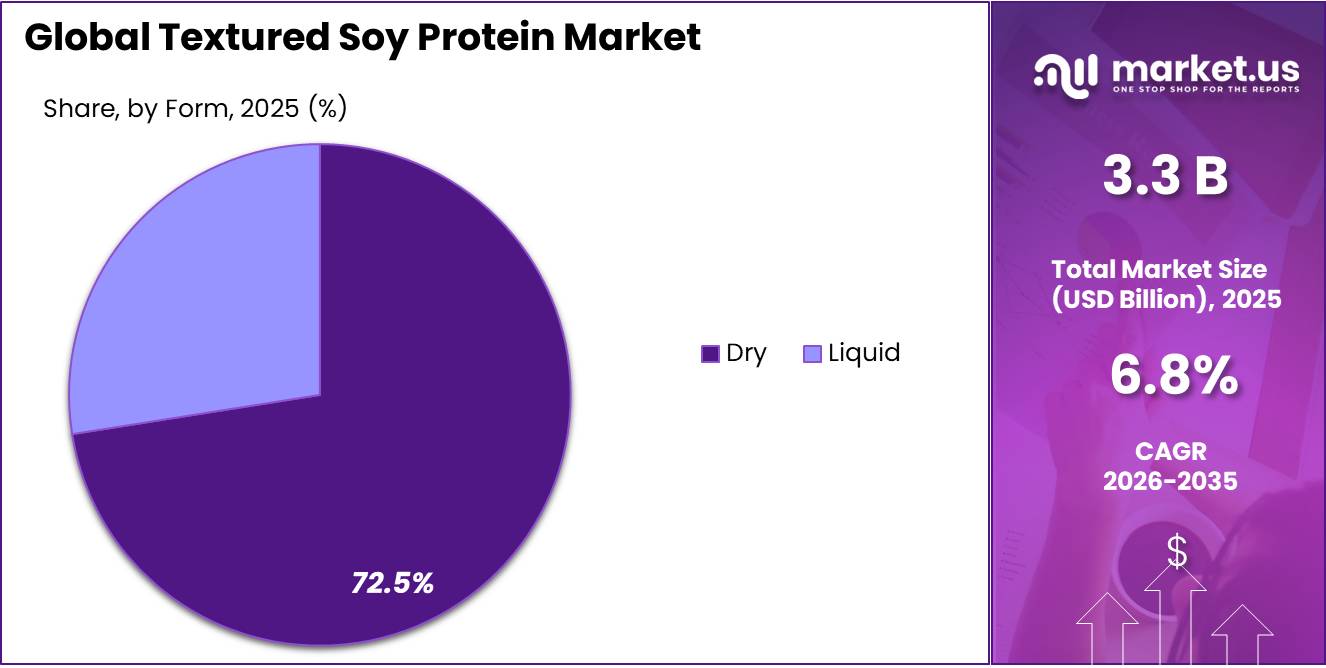
- Dry held a dominant market position, capturing more than a 72.56% share of the Textured Soy Protein Market.
- Distributors/Retailers held a dominant market position, capturing more than a 67.32% share.
- Europe held a dominant position in the Textured Soy Protein Market in 2025, accounting for 36.33% of the global market, with a market value of USD 1.1 billion.
By Nature Analysis
By Application Analysis
By Form Analysis
By Distribution Channel Analysis
Key Market Segments
By Nature
- Conventional
- Organic
By Application
- Food and Beverages
- Meat Substitutes
- Dairy Alternatives
- Infant Nutrition
- Bakery Products
- Cereal and Snacks
- Other Food Applications
- Animal Feed
By Form
- Dry
- Liquid
By Disribution Channel
- B2B
- Distributors/Retailers
- E-commerce
Driver Analysis
Drivers Impact Analysis
| Driver | (~) % Impact on CAGR Forecast | Geographic Relevance | Impact Timeline |
|---|---|---|---|
| Affordable meat-extension formulations | +1.0 pp | Latin America, India, Southeast Asia | Short term (≤ 2 years) |
| Improved meat-alternative textures | +0.8 pp | EU, UK, US, Japan | Medium term (2–4 years) |
| Protein-rich snacks and bars | +0.6 pp | North America, EU, APAC | Short term (≤ 2 years) |
| Institutional meal formulation | +0.6 pp | US core; selected export programs | Medium term (2–4 years) |
| Regional ingredient availability | +0.5 pp | Europe core; global processors | Medium term (2–4 years) |
Restraint Analysis
Restraint Impact Analysis
| Restraint | (~) % Impact on CAGR | Geographic Relevance | Impact Timeline |
|---|---|---|---|
| Meat-alternative demand weakness | −0.5 pp | US, UK, Western Europe | Short term (≤ 2 years) |
| Sensory-driven formulation rejection | −0.4 pp | North America, EU, Japan | Medium term (2–4 years) |
| Soy-allergen exclusions | −0.3 pp | US, EU, UK | Long term (≥ 4 years) |
| Identity-preserved sourcing premiums | −0.3 pp | EU, UK; export suppliers | Medium term (2–4 years) |
| Unsuitable texture economics | −0.3 pp | North America, EU, APAC | Medium term (2–4 years) |
Opportunity Analysis
Opportunity Impact Analysis
| Opportunity | (~) % Potential CAGR Upside | Geographic Relevance | Execution Window |
|---|---|---|---|
| Fermented textured-soy platforms | +0.30 pp | EU, UK, US, Japan | Medium term (2–4 years) |
| Flavour-integrated protein matrices | +0.25 pp | North America, EU, East Asia | Medium term (2–4 years) |
| Data-qualified custom grades | +0.25 pp | US, EU, Japan | Medium term (2–4 years) |
| Small-processor application hubs | +0.20 pp | India, Southeast Asia, Latin America | Short term (≤ 2 years) |
| Performance-linked supply contracts | +0.20 pp | US, EU, UK, Brazil | Short term (≤ 2 years) |
Challenges Analysis
Challenges Impact Analysis
| Challenge | (~) % CAGR Friction Drag | Geographic Relevance | Mitigation Horizon |
|---|---|---|---|
| Feedstock functionality consistency | −0.30 pp | US, Brazil, EU, India | Medium term (2–4 years) |
| Extrusion scale-up reproducibility | −0.30 pp | EU, US, China, India | Medium term (2–4 years) |
| Hydration and dosing control | −0.25 pp | North America, EU, Southeast Asia | Medium term (2–4 years) |
| Factory-to-factory performance transfer | −0.20 pp | EU, US, Japan, Latin America | Medium term (2–4 years) |
| Storage and flavour stability | −0.20 pp | Tropical APAC, Brazil, export corridors | Long term (≥ 4 years) |
Geopolitical Impact Analysis
Geopolitical Impact of the 2026 Middle East Conflict and Russia-Ukraine War on the Textured Soy Protein Market
The ongoing Middle East conflict and Russia-Ukraine war are creating additional pressure on the global Textured Soy Protein Market through higher energy costs, shipping disruptions, and agricultural supply uncertainty. The closure of the Strait of Hormuz and security risks across the Black Sea and Red Sea have affected important trade routes, increasing transportation expenses and delivery uncertainty for food ingredient manufacturers.
These developments can raise the cost of soybean processing, extrusion, packaging, and international distribution. According to the World Bank’s October 2026 Commodity Markets Outlook, global energy prices are projected to increase by 32% in 2026, while fertilizer prices are expected to rise by 14%. These increases can indirectly affect soybean cultivation and food-grade protein production costs.
Higher logistics expenses may also encourage manufacturers to review sourcing arrangements, maintain additional inventories, and diversify suppliers. For textured soy protein producers, these conditions create pressure on profit margins, particularly when long-term customer contracts limit immediate price adjustments. However, the situation also creates opportunities for regional processing facilities, alternative shipping routes, and diversified soybean procurement.
Regional Insights
Europe – Dominating Region (36.33% Share, USD 1.1 Billion)
Europe held a dominant position in the Textured Soy Protein Market in 2025, accounting for 36.33% of the global market, with a market value of USD 1.1 billion. The region’s position is supported by established food processing industries, growing interest in plant-based meat alternatives, and increasing use of soy protein in processed foods. Germany, France, the Netherlands, and the United Kingdom are important markets for plant-based food products.
According to the European Commission, the European Union produced approximately 67 million tonnes of plant-based protein in the 2025–2026 marketing year. However, it imported around 13.4 million tonnes of soybean and soy meal protein in 2024–2025, highlighting the importance of international sourcing for its protein supply. Investments in food innovation, ingredient processing, and alternative protein development are expected to support regional demand.
North America represents an important growth opportunity for textured soy protein, supported by its established soybean processing infrastructure, strong food manufacturing base, and expanding range of plant-based food products. The United States plays a major role through soybean cultivation, protein ingredient manufacturing, and the supply of textured ingredients to food processors.
Demand from manufacturers of plant-based burgers, meat alternatives, frozen meals, and protein-enriched convenience foods is supporting the use of textured soy protein. According to the USDA, the United States produced approximately 4.26 billion bushels of soybeans in 2025, providing a substantial agricultural raw material base for soy-based ingredient production. Further investment in extrusion technology, food formulation, and protein processing is expected to create additional opportunities across the region.
Key Regions and Countries Insights
- North America
- US
- Canada
- Europe
- Germany
- France
- The UK
- Spain
- Italy
- Rest of Europe
- Asia Pacific
- China
- Japan
- South Korea
- India
- Australia
- Rest of APAC
- Latin America
- Brazil
- Mexico
- Rest of Latin America
- Middle East & Africa
- GCC
- South Africa
- Rest of MEA
Key Players Analysis
ADM maintains a strong position in the soy protein industry through its agricultural processing, protein ingredients, and human nutrition businesses. The company reported USD 80.27 billion in total revenue in FY2025, while its Human Nutrition segment generated USD 4.19 billion. ADM also processed approximately 36.32 million metric tons of oilseeds during 2025.
Cargill strengthens its position in the textured soy protein industry through its plant protein portfolio, soy flour products, and food texturizing solutions. The company reported USD 154 billion in revenue during fiscal year 2025 and operates across 70 countries, serving approximately 125 markets with a global workforce of more than 155,000 employees. Its soy protein portfolio includes Prolia soy flour and Prosante textured flour, which support protein enrichment, water absorption, and texture improvement in food formulations.
Wilmar International Limited participates in the soy protein industry through its agricultural processing, food ingredient manufacturing, and research activities. In FY2025, the company recorded revenue of USD 70.42 billion, net profit of USD 1.41 billion, and EBITDA of USD 4.27 billion. It operated more than 1,000 manufacturing plants across 36 countries and regions, supported by approximately 100,000 employees. In 2025, its YKA Research and Development Centre received recognition from the Chinese Nutrition Society for research on soy protein and phytosterol industrialisation, supporting its focus on nutritional soy-based ingredients and processing innovation.
Top Key Players Outlook
- Archer-Daniels-Midland Company
- Cargill, Incorporated
- Wilmar International Limited
- Bunge Global SA
- CHS Inc.
- Crown Soya Protein Group
- Sonic Biochem
- Victoria Group
- Bremil Group
- International Flavors & Fragrances Inc.
- Shandong Yuxin Biotechnology
- Sojaprotein Novi Sad
- Gushen Biological Technology
- Fuji Oil Co., Ltd.
- Other Key Players
Recent Developments
- In February 2026, CHS completed the sale of its 50% ownership stake in Crestline Crop Nutrients LLC to Sunrise Cooperative and established a new long-term supply agreement to expand crop nutrient distribution.
- In 2026, Bunge introduced its next-generation soy protein concentrate portfolio, offering approximately 70% protein and 17% fiber on a dry basis, with conventional and non-genetically modified options.
Report Scope
| Report Features | Description |
|---|---|
| Market Value (2025) | USD 3.3 Bn |
| Forecast Revenue (2035) | USD 6.3 Bn |
| CAGR (2026-2035) | 6.8% |
| Base Year for Estimation | 2025 |
| Historic Period | 2020-2024 |
| Forecast Period | 2026-2035 |
| Report Coverage | Revenue Forecast, Market Dynamics, Competitive Landscape, Recent Developments |
| Segments Covered | By Nature (Conventional, Organic), By Application (Food and Beverages, Meat Substitutes, Dairy Alternatives, Infant Nutrition, Bakery Products, Cereal and Snacks, Other Food Applications, Animal Feed), By Form (Dry, Liquid), By Disribution Channel (B2B, Distributors/Retailers, E-commerce) |
| Regional Analysis | North America – US, Canada; Europe – Germany, France, The UK, Spain, Italy, Rest of Europe; Asia Pacific – China, Japan, South Korea, India, Australia, Singapore, Rest of APAC; Latin America – Brazil, Mexico, Rest of Latin America; Middle East & Africa – GCC, South Africa, Rest of MEA |
| Competitive Landscape | Archer-Daniels-Midland Company, Cargill, Incorporated, Wilmar International Limited, Bunge Global SA, CHS Inc., Crown Soya Protein Group, Sonic Biochem, Victoria Group, Bremil Group, International Flavors & Fragrances Inc., Shandong Yuxin Biotechnology, Sojaprotein Novi Sad, Gushen Biological Technology, Fuji Oil Co., Ltd., Other Key Players |
| Customization Scope | Customization for segments, region/country-level will be provided. Moreover, additional customization can be done based on the requirements. |
| Purchase Options | We have three licenses to opt for: Single User License, Multi-User License (Up to 5 Users), Corporate Use License (Unlimited User and Printable PDF) |