Telecom Mobile Network Optimization (MNO) Market By Component (Solutions/Platforms, Services (Managed Services, Professional Services)), By Deployment Mode (Cloud-based, On-Premises), By Optimization Type (Radio Access Network (RAN) Optimization, Core Network Optimization, Transport Network Optimization, Others), By Network Technology (2G/3G, 4G/LTE, 5G), By Regional Analysis, Global Trends and Opportunity, Future Outlook By 2026-2035
The Global Telecom Mobile Network Optimization (MNO) Market generated USD 9.6 billion in 2025 and is predicted to register growth from USD 10.5 billion in 2026 to about USD 23.2 billion by 2035, recording a CAGR of 9.2% throughout the forecast span. In 2025, Asia Pacific held a dominant market position, capturing more than a 40.2% share, holding USD 3.87 Billion revenue.
Top Keytake away
Component Services account for 54.3% of the Telecom Mobile Network Optimization (MNO) market, as operators rely heavily on expert service providers for planning, optimization, and performance tuning of their networks.
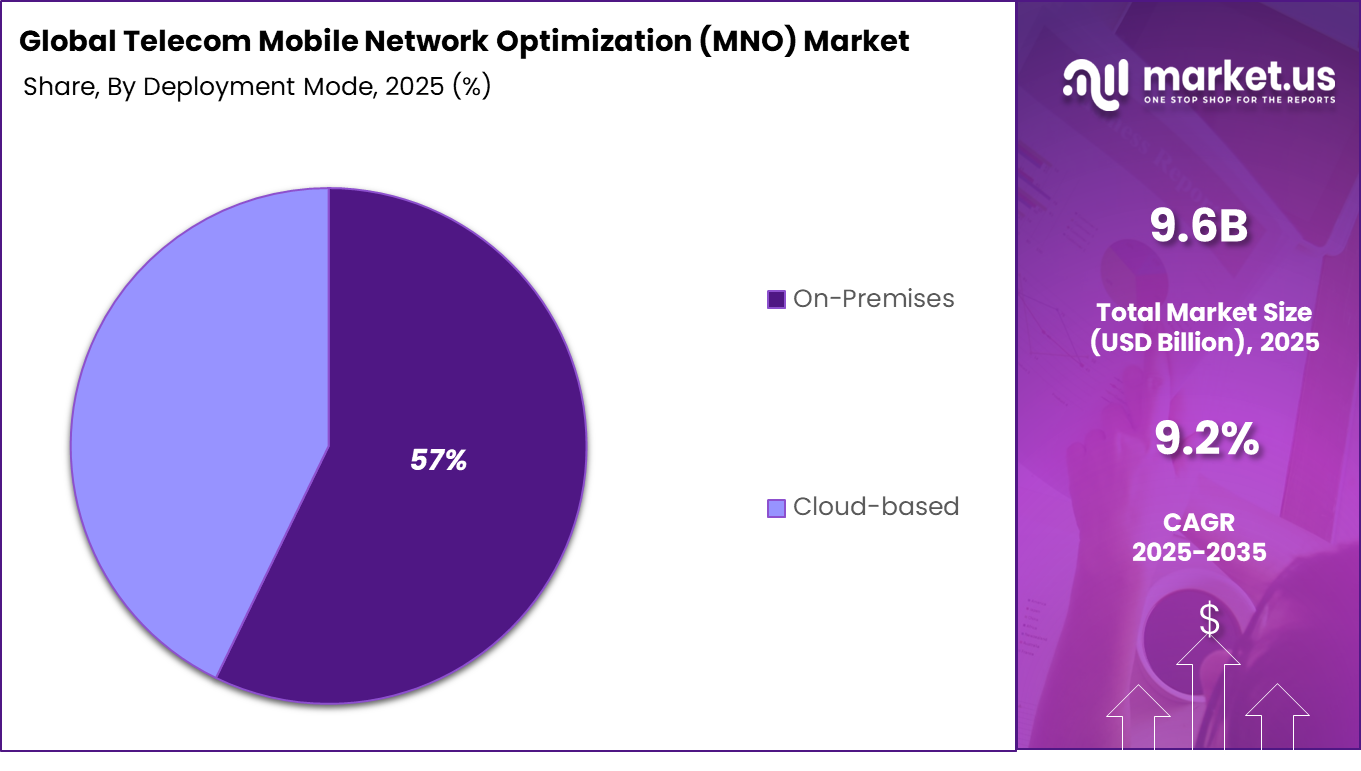
Deployment Mode On-premises holds 57.2% of the market, because many telecom operators prefer to keep optimization tools and analytics platforms within their own infrastructure for better control and data security.
Optimization Type Radio Access Network (RAN) optimization represents 62.4%, reflecting the strong focus on improving coverage, capacity, and user experience at the radio layer where most performance issues arise.
Network Technology 4G/LTE accounts for 56.3% of the market, since 4G networks still carry a large share of global mobile traffic and require ongoing optimization alongside newer 5G deployments.
Region Asia-Pacific represents 40.2% of the global market, driven by high mobile data usage, dense urban deployments, and continuous network upgrades in major countries.
Country China’s market is valued at 1.18 billion and is expected to grow at a CAGR of 5.3%, supported by large-scale operator investments in optimizing nationwide 4G/LTE and evolving 5G networks.
Telecom mobile network optimization focuses on improving the performance, capacity, and efficiency of mobile networks to deliver better service quality to users. It involves analyzing network data, adjusting configurations, and managing traffic to ensure stable connectivity, faster data speeds, and reduced congestion. As mobile networks become more complex with multiple technologies and dense deployments, optimization has become an ongoing process rather than a one time setup. Operators rely on these solutions to maintain consistent performance across urban, suburban, and rural environments.
One of the main driving factors is the rapid growth in mobile data usage driven by video streaming, cloud applications, online gaming, and connected devices. This increase in traffic creates pressure on networks to deliver high performance without interruptions. In addition, the rollout of advanced mobile technologies is increasing network complexity, requiring continuous tuning and monitoring. Operators are also focusing on improving user experience by reducing dropped calls, improving coverage, and maintaining consistent speeds. The shift toward automated and data driven network management is further supporting the use of advanced optimization tools.
Demand for mobile network optimization solutions is rising as telecom operators seek to improve efficiency while managing expanding network infrastructure. There is a strong preference for solutions that provide real time insights, predictive analysis, and automated adjustments to network parameters.
Operators are also looking for systems that can integrate with existing network management platforms and support multiple technologies. The demand is particularly strong in regions with high smartphone usage and dense network deployments where performance expectations are higher. As mobile connectivity continues to grow in importance, the need for reliable and intelligent network optimization solutions is expected to increase steadily.
Drivers Impact Analysis
Key Driver
Impact on CAGR Forecast (~%)
Geographic Relevance
Impact Timeline
Additional Insight
Rapid growth in mobile data traffic and network congestion
+3.3%
Asia Pacific, North America, Europe
Short to medium term
Higher traffic drives need for optimization
Expansion of 4G and 5G network deployments
+3.0%
Asia Pacific, Europe, North America
Medium term
New networks require continuous tuning
Increasing demand for improved network quality and user experience
+2.7%
Global
Medium term
Operators focus on reducing latency and drops
Rising adoption of cloud-native and virtualized network functions
+2.4%
Global
Medium to long term
Virtual networks need advanced optimization tools
Growth of smart devices and IoT connectivity
+2.1%
Global
Medium to long term
More connected devices increase network load
Restraints Impact Analysis
Key Restraint
Impact on CAGR Forecast (~%)
Geographic Relevance
Impact Timeline
Additional Insight
High cost of network optimization tools and deployment
-2.6%
Emerging markets
Short to medium term
Cost limits adoption for smaller operators
Complexity in managing multi-vendor network environments
-2.3%
Global
Medium term
Integration challenges slow implementation
Data privacy and regulatory constraints
-2.0%
Europe, Asia Pacific
Medium to long term
Regulations restrict data-driven optimization
Dependence on telecom operator investment cycles
-1.7%
Global
Medium term
Budget constraints delay upgrades
Limited skilled workforce for advanced network analytics
-1.5%
Global
Long term
Skill gaps affect effective use
By Component Analysis
The services segment accounted for 54.3% of the market share, reflecting its strong role in supporting network assessment, deployment, tuning, and continuous optimization activities. This dominance is supported by the need for specialized expertise to manage complex mobile networks and ensure consistent performance. Operators rely on service providers to improve coverage, reduce congestion, and maintain service quality across evolving network environments.
Another factor driving this segment is the increasing complexity of telecom infrastructure with multi-layered technologies and high data traffic. Service-based models help operators adapt quickly to changing network conditions and implement optimization strategies without large internal resource investments. This continues to strengthen demand for optimization services.
By Deployment Mode Analysis
The on-premises segment held 57% share, driven by the need for greater control over network data, performance monitoring, and system customization. Telecom operators prefer on-premises deployment to manage sensitive operational data within their own infrastructure and ensure low-latency processing. This approach supports real-time decision-making and stable system performance.
In addition, on-premises solutions allow deeper integration with existing network management systems and infrastructure. Operators benefit from enhanced security, reliability, and direct control over updates and configurations. These advantages have supported continued adoption of on-premises deployment models.
By Optimization Type Analysis
The radio access network optimization segment captured 62.4% of the market, reflecting its critical role in improving signal quality, coverage, and user experience at the network edge. RAN optimization focuses on enhancing performance between user devices and base stations, which directly impacts service reliability and speed. This makes it a key priority for telecom operators.
Furthermore, the rapid growth in mobile data usage and connected devices has increased pressure on access networks. Operators are investing in advanced RAN optimization tools to manage traffic loads, reduce interference, and maintain network efficiency. This has reinforced the leading position of this segment.
By Network Technology Analysis
The 4G LTE segment accounted for 56.3% of the market share, driven by its widespread deployment and continued reliance for mobile connectivity. Despite the emergence of newer technologies, 4G networks still carry a large portion of global mobile traffic. Optimization efforts remain focused on maintaining and enhancing performance within these networks.
Moreover, many regions continue to expand and upgrade existing 4G infrastructure to meet growing demand. Telecom operators are prioritizing optimization solutions to improve network capacity, reduce latency, and ensure consistent service delivery. This ongoing reliance has strengthened the position of 4G LTE in the market.
Investor Type Impact Analysis
Investor Type
Growth Sensitivity
Risk Exposure
Geographic Focus
Investment Outlook
Venture capital firms
Moderate to high
High
Asia Pacific, US
Investing in network analytics startups
Private equity firms
Moderate
Moderate
North America and Asia Pacific
Scaling telecom software providers
Corporate investors
High
Moderate
Global
Strategic investments in telecom infrastructure
Institutional investors
Moderate
Low to moderate
Developed markets
Prefer stable telecom technology firms
Government and public funding bodies
Moderate to high
Low
Global
Supporting digital connectivity expansion
Technology Enablement Analysis
Technology
Impact on CAGR Forecast (~%)
Geographic Relevance
Impact Timeline
Additional Insight
AI-driven network optimization and self-organizing networks
+3.6%
Asia Pacific, US, Europe
Medium to long term
Automates performance tuning
Cloud-native network optimization platforms
+3.1%
Global
Medium term
Enables scalable operations
Big data analytics for network performance monitoring
+2.8%
Global
Medium term
Improves decision-making
Edge computing integration for real-time optimization
+2.5%
Global
Medium to long term
Reduces latency at the edge
Automation and orchestration tools for network management
+2.2%
Global
Medium term
Simplifies network operations
Key Challeneges
High cost of network optimization tools and services.
Complex integration with existing telecom network systems.
Managing large volumes of network data is difficult.
Need for skilled professionals for analysis and optimization.
Performance issues in dense and high-traffic network areas.
Compatibility issues across different network equipment vendors.
Security risks in handling network data and operations.
Dependence on accurate real-time data for better optimization.
Regulatory requirements can slow network improvements.
Emerging Trends
The telecom mobile network optimization market is evolving toward more intelligent and automated performance management systems that can handle increasing network complexity. One of the key emerging trends is the use of AI driven self optimizing networks that continuously monitor traffic patterns, detect issues, and adjust network parameters in real time without manual intervention. This is helping improve service quality and reduce operational effort.
Another important trend is the integration of analytics platforms that provide deep insights into user behavior, network congestion, and service performance, allowing operators to make faster and more accurate decisions. There is also growing adoption of cloud native optimization tools that support flexible deployment and easier scaling across different network environments. In addition, the expansion of edge computing is influencing optimization strategies, as data processing moves closer to end users to reduce latency. Automation in fault detection and predictive maintenance is also gaining traction, helping prevent network disruptions before they impact users.
Growth Factors
The growth of this market is driven by the rapid increase in mobile data consumption and the need to deliver consistent network performance. As users demand faster speeds and reliable connectivity for applications such as streaming, gaming, and remote work, operators are focusing on optimizing network efficiency. The rollout of advanced mobile technologies is also increasing the complexity of network management, creating demand for sophisticated optimization solutions.
Another major factor is the need to reduce operational costs while maintaining high service standards, which is encouraging the use of automated tools. Operators are also aiming to improve customer experience and reduce service complaints, further supporting adoption. Additionally, the growing number of connected devices and applications is putting pressure on network capacity, making optimization solutions essential for maintaining smooth and efficient communication services.
Key Market Segments
By Component
Solutions/Platforms
Services
Managed Services
Professional Services
By Deployment Mode
Cloud-based
On-Premises
By Optimization Type
Radio Access Network (RAN) Optimization
Core Network Optimization
Transport Network Optimization
Others
By Network Technology
2G/3G
4G/LTE
5G
Regional Analysis
Asia Pacific accounted for 40.2% of the Telecom Mobile Network Optimization (MNO) market, supported by rapid expansion of mobile networks and increasing data traffic across the region. The growing number of smartphone users and rising consumption of video, gaming, and digital services are pushing telecom operators to improve network performance and efficiency. Optimization solutions are widely adopted to enhance coverage, reduce latency, and manage network congestion. In addition, continuous rollout of advanced wireless technologies and expansion of telecom infrastructure are strengthening demand for network optimization tools across the region.
China market reached USD 1.18 Billion and is projected to grow at a CAGR of 5.3%, driven by large-scale telecom operations and ongoing network upgrades. Operators are investing in optimization solutions to improve service quality, support high user density, and manage increasing data usage. The demand is also supported by the need to maintain stable connectivity across urban and rural areas. In addition, increasing focus on efficient spectrum utilization and network performance improvement is expected to support steady growth of the market in China over the coming years.
Key Regions and Countries
North America
US
Canada
Europe
Germany
France
The UK
Spain
Italy
Russia
Netherlands
Rest of Europe
Asia Pacific
China
Japan
South Korea
India
Australia
Singapore
Thailand
Vietnam
Rest of APAC
Latin America
Brazil
Mexico
Rest of Latin America
Middle East & Africa
South Africa
Saudi Arabia
UAE
Rest of MEA
Competitive Analysis
The competitive landscape of the 5G Smartphone Antenna Tuner Market is driven by leading semiconductor and RF component manufacturers. Companies such as Qorvo, Skyworks Solutions, Murata Manufacturing, TDK Corporation, STMicroelectronics, Analog Devices, Infineon Technologies, and NXP Semiconductors focus on advanced RF tuning solutions that improve signal performance and power efficiency in 5G smartphones.
These players invest in miniaturization, integration of multiple frequency bands, and high-speed switching technologies to support complex 5G network requirements. Their strong relationships with smartphone manufacturers and global supply chains help them maintain a leading position in the market.
At the same time, companies such as Johanson Technology, Psemi (formerly Peregrine Semiconductor), Taoglas, TE Connectivity, Amphenol Corporation, Antenova, Yageo Corporation, AVX Corporation, Vishay Intertechnology, Molex (a Koch company), Sunlord Electronics, and Pulse Electronics compete by offering specialized antenna components, passive devices, and customized RF solutions.
These players focus on compact designs, cost efficiency, and support for multi-band connectivity. Competition in this market is driven by demand for better signal quality, reduced power consumption, and the ability to deliver high-performance antenna tuning solutions for next-generation mobile devices.
The future outlook for the Telecom Mobile Network Optimization (MNO) Market looks strong as telecom operators continue to focus on improving network performance and user experience. The market is expected to grow with rising data traffic, increasing smartphone usage, and the expansion of 5G networks. Operators are anticipated to invest in advanced optimization tools to manage network congestion, improve coverage, and reduce latency. In the coming years, the use of AI, automation, and cloud-based solutions is expected to enhance real-time network management, making mobile network optimization more efficient and essential for modern telecom systems.
Recent Developments
February 2026, AT&T – AT&T is highlighted in MNO market reports as one of the largest global operators investing heavily in 5G RAN optimization, self‑optimizing networks (SON), and traffic‑management tools to keep QoE high as mobile‑data use soars.
February 2026, Vodafone – Vodafone is cited as a major European MNO focusing on RAN sharing, Open RAN, and AI‑driven optimization to cut costs and improve coverage and capacity across Europe and emerging markets.
Report Scope
Report Features
Description
Market Value (2025)
USD 9.6 Billion
Forecast Revenue (2035)
USD 23.2 Billion
CAGR(2025-2035)
9.2%
Base Year for Estimation
2024
Historic Period
2020-2024
Forecast Period
2026-2035
Report Coverage
Revenue forecast, AI impact on Market trends, Share Insights, Company ranking, competitive landscape, Recent Developments, Market Dynamics and Emerging Trends
Segments Covered
By Component (Solutions/Platforms, Services (Managed Services, Professional Services)), By Deployment Mode (Cloud-based, On-Premises), By Optimization Type (Radio Access Network (RAN) Optimization, Core Network Optimization, Transport Network Optimization, Others), By Network Technology (2G/3G, 4G/LTE, 5G)
Regional Analysis
North America – US, Canada; Europe – Germany, France, The UK, Spain, Italy, Russia, Netherlands, Rest of Europe; Asia Pacific – China, Japan, South Korea, India, New Zealand, Singapore, Thailand, Vietnam, Rest of Latin America; Latin America – Brazil, Mexico, Rest of Latin America; Middle East & Africa – South Africa, Saudi Arabia, UAE, Rest of MEA
Competitive Landscape
Siemens AG, Rockwell Automation Inc., Schneider Electric SE, Mitsubishi Electric Corporation, ABB Ltd., Omron Corporation, Emerson Electric Co., Honeywell International Inc., Beckhoff Automation GmbH & Co. KG, Delta Electronics Inc., Bosch Rexroth AG, Panasonic Holdings Corporation, Fuji Electric Co. Ltd., Hitachi Ltd., IDEC Corporation, Keyence Corporation, Toshiba Corporation, General Electric Company, Parker Hannifin Corporation, Eaton Corporation plc, Yokogawa Electric Corporation, Inovance Technology Co. Ltd., Hollysys Automation Technologies Ltd., WAGO Kontakttechnik GmbH & Co. KG, B&R Industrial Automation GmbH, Others
Customization Scope
Customization for segments, region/country-level will be provided. Moreover, additional customization can be done based on the requirements.
Purchase Options
We have three license to opt for: Single User License, Multi-User License (Up to 5 Users), Corporate Use License (Unlimited User and Printable PDF)