


Global RTLS in Healthcare Market By Component (Hardware, Software and Services), By Technology (Bluetooth Low Energy (BLE), Wi-Fi, Active RFID, Infrared (IR), Ultra-Wideband (UWB) and Others), By Application (Asset Tracking and Management, Patient Tracking and Safety, Staff Safety and Efficiency, Infection Control, Workflow Optimization, Environmental Monitoring and Others), By End User (Hospitals, Long-term Care Facilities, Ambulatory Care Centers and Others), Region and Companies – Industry Segment Outlook, Market Assessment, Competition Scenario, Trends and Forecast 2026-2035
- Published date: March 2026
- Report ID: 181714
- Number of Pages: 393
- Format:
-
keyboard_arrow_up
Quick Navigation
Report Overview
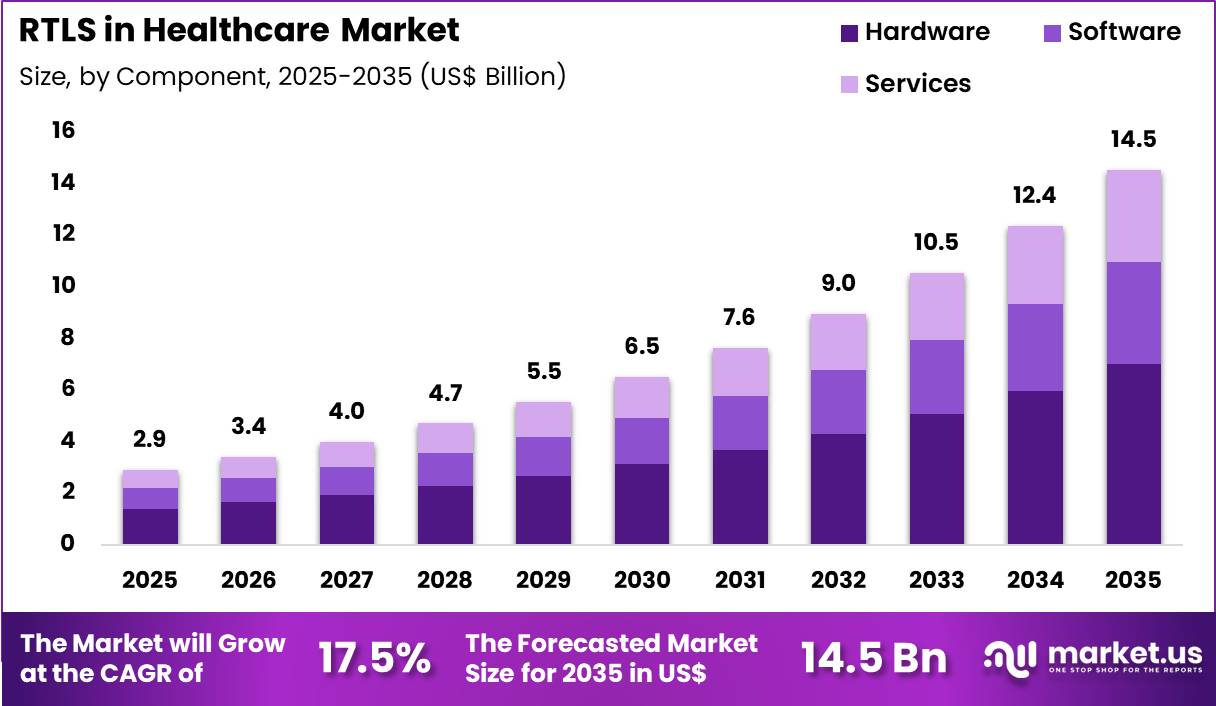
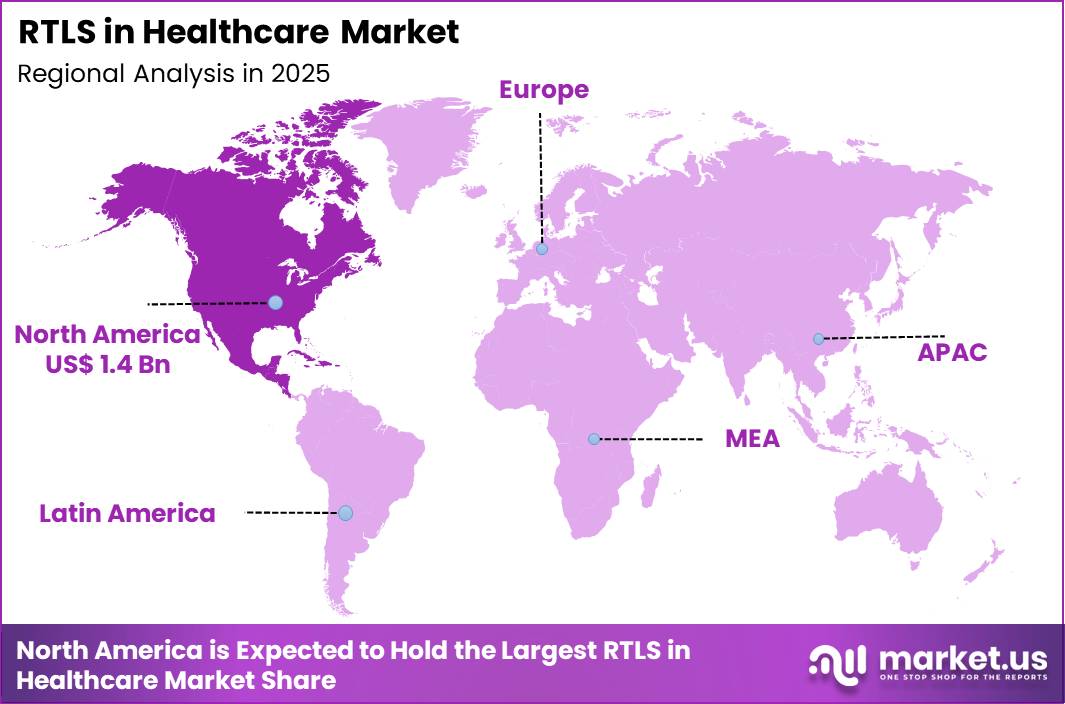
The Global RTLS in Healthcare Market size is expected to be worth around US$ 14.5 Billion by 2035 from US$ 2.9 Billion in 2025, growing at a CAGR of 17.5% during the forecast period 2026-2035. In 2025, North America led the market, achieving over 47.5% share with a revenue of US$ 1.4 Billion.
Increasing emphasis on operational efficiency and patient safety propels the RTLS in Healthcare market as hospitals and healthcare systems deploy real-time location systems to track assets, staff, and patients with high accuracy and immediacy.
Facility managers increasingly use RTLS to locate critical medical equipment such as infusion pumps, wheelchairs, and portable ultrasound machines, reducing search time and ensuring availability during urgent procedures in emergency departments and operating rooms.
These systems support staff duress and workflow applications, where clinicians activate alerts or badges to summon assistance in high-acuity areas, improving response times in intensive care and behavioral health units. RTLS enables patient flow optimization by monitoring wait times, room turnover, and movement patterns in outpatient clinics and oncology infusion centers, allowing administrators to identify bottlenecks and enhance throughput.
Infection control teams apply RTLS data to track hand hygiene compliance and patient isolation adherence, enforcing protocols that limit pathogen transmission in infectious disease wards. In perioperative settings, RTLS monitors instrument trays and surgical team movements, ensuring compliance with time-out procedures and reducing retained surgical item risks.
Technology providers pursue opportunities to expand RTLS into predictive analytics and workflow orchestration, broadening applications in value-based care models where real-time data informs resource allocation and length-of-stay reduction. Developers advance battery-efficient, low-infrastructure tags and hybrid indoor-outdoor tracking, facilitating seamless monitoring across hospital campuses and hospital-at-home programs.
These advancements support integration with electronic health records and nurse communication systems for automated status updates. During 2025, Cognosos expanded adoption of its Pro-Lease deployment model, which allows hospitals to implement RTLS infrastructure as an operational expense instead of a large upfront capital investment.
The company also broadened its presence in operating room workflow management, contributing to stronger adoption heading into 2026. In September 2025, Midmark enhanced its CareFlow digital workflow platform with new Time-to-Treatment analytics capabilities.
The update helps healthcare providers, particularly oncology centers, coordinate patient flow more effectively by tracking room availability and treatment readiness in real time. Recent trends emphasize subscription-based deployment, AI-driven insights, and cross-departmental integration, positioning RTLS as a foundational technology for efficient, safe, and responsive healthcare delivery focused on measurable operational and clinical improvements.
Key Takeaways
- In 2025, the market generated a revenue of US$ 2.9 Billion, with a CAGR of 17.5%, and is expected to reach US$ 14.5 Billion by the year 2035.
- The component segment is divided into hardware, software and services, with hardware taking the lead with a market share of 48.1%.
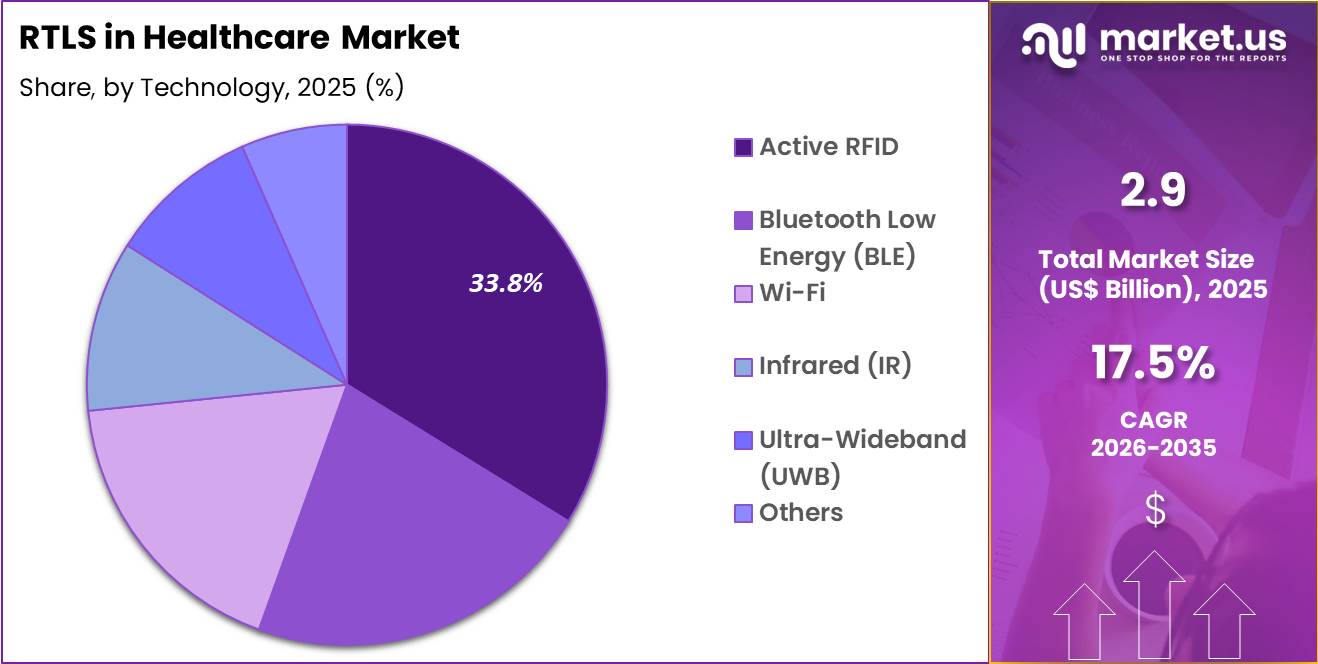
- Considering technology, the market is divided into bluetooth low energy (BLE), wi-fi, active RFID, infrared (IR), ultra-wideband (UWB) and others. Among these, active rfid held a significant share of 33.8%.
- Furthermore, concerning the application segment, the market is segregated into asset tracking and management, patient tracking and safety, staff safety and efficiency, infection control, workflow optimization, environmental monitoring and others. The asset tracking and management sector stands out as the dominant player, holding the largest revenue share of 38.2% in the market.
- The end user segment is segregated into hospitals, long-term care facilities, ambulatory care centers and others, with the Hospitals segment leading the market, holding a revenue share of 51.6%.
- North America led the market by securing a market share of 47.5%.
Component Analysis
Hardware accounted for 48.1% of growth within component and dominate the RTLS in healthcare market because real-time locating systems depend first on physical infrastructure such as tags, readers, sensors, gateways, and badges. Hospitals and healthcare facilities increasingly invest in these assets to create the base layer for locating equipment, staff, and patients across complex care environments.
Published healthcare reviews describe RTLS as systems that identify the physical locations of personnel and equipment in real time, which directly explains why hardware remains the most visible and capital-intensive part of deployment.
Asset-heavy hospital environments also require continuous refresh of tags and location anchors as facilities expand, which supports recurring hardware demand. This segment is expected to strengthen as health systems continue modernizing asset visibility programs, patient flow monitoring, and safety workflows. The American Hospital Association also notes that RTLS gives health systems a bird’s-eye view of patient care processes, reinforcing the practical importance of robust physical tracking infrastructure.
Technology Analysis
Active RFID accounted for 33.8% of growth within technology and dominate the RTLS in healthcare market due to its strong suitability for continuous real-time tracking of mobile assets, personnel, and patients in dynamic hospital environments. Healthcare facilities prefer active RFID because battery-powered tags transmit signals at regular intervals, which improves visibility for infusion pumps, wheelchairs, monitors, and other movable equipment.
Reviews of RTLS use in healthcare state that these systems are used mainly to track medical staff, patients, and assets, and this matches the operational strength of active RFID in busy clinical settings. Hospitals also adopt active RFID to reduce the time staff spend searching for essential equipment and to improve utilization across departments.
This segment is projected to maintain leadership as care facilities expand enterprise-wide tracking and seek dependable room-level or area-level visibility. Its growth is likely to continue because active RFID balances scalability, real-time responsiveness, and proven healthcare adoption more effectively than many legacy alternatives.
Application Analysis
Asset tracking and management accounted for 38.2% of growth within application and dominate the RTLS in healthcare market because hospitals face constant pressure to locate critical equipment quickly and use it more efficiently. Medical devices, mobile workstations, beds, pumps, and support tools frequently move across departments, and poor visibility creates delays, duplicate rentals, and operational waste.
Healthcare RTLS literature consistently identifies equipment and asset tracking as one of the most common uses of these systems. The American Hospital Association also highlights that RTLS helps health systems track who did what, when, and where across facilities, which supports stronger operational control and asset utilization.
This segment is expected to strengthen as hospitals prioritize workflow efficiency, cost containment, and equipment availability for direct patient care. Growth is likely to remain strong because asset visibility delivers measurable operational value earlier than many other RTLS use cases, making it a practical first deployment area for healthcare providers.
End-User Analysis
Hospitals accounted for 51.6% of growth within end users and dominate the RTLS in healthcare market due to their large-scale infrastructure, high patient volumes, and complex asset management requirements. Hospitals manage thousands of medical devices, beds, infusion pumps, wheelchairs, and other mobile equipment that move frequently across departments.
Real-time location systems help hospital administrators track these assets instantly, reduce equipment search time, and improve operational efficiency. Healthcare staff also rely on RTLS platforms to monitor patient movement, optimize bed utilization, and strengthen staff safety protocols.
Hospitals increasingly deploy RTLS technologies to improve workflow visibility across emergency departments, intensive care units, and surgical areas. The American Hospital Association reports that thousands of hospitals operate in the United States alone, each managing extensive clinical equipment inventories and patient flow operations.
Healthcare systems are expected to expand RTLS adoption as hospitals pursue digital transformation strategies focused on operational efficiency, patient safety, and resource optimization. Continuous investment in hospital automation and smart healthcare infrastructure is projected to strengthen RTLS deployment across hospital environments.
Key Market Segments
By Component
- Hardware
- Software
- Services
By Technology
- Bluetooth Low Energy (BLE)
- Wi-Fi
- Active RFID
- Infrared (IR)
- Ultra-Wideband (UWB)
- Others
By Application
- Asset Tracking and Management
- Patient Tracking and Safety
- Staff Safety and Efficiency
- Infection Control
- Workflow Optimization
- Environmental Monitoring
- Others
By End User
- Hospitals
- Long-term Care Facilities
- Ambulatory Care Centers
- Others
Drivers
Rising adoption of RTLS for asset tracking in hospitals is driving the market.
Healthcare facilities increasingly implement real-time location systems to monitor the precise position of medical equipment such as infusion pumps and wheelchairs across departments. These deployments reduce time spent searching for assets and improve operational workflows in high-volume environments.
The driver corresponds with efforts to minimize equipment loss and enhance utilization rates in inpatient settings. Systems provide continuous visibility through active tags attached to portable devices. The trend supports compliance with accreditation standards requiring effective asset management practices.
Providers achieve faster response times during patient care through immediate location data access. The expansion reflects broader digital transformation initiatives in hospital infrastructure. Integration with existing nurse call and communication platforms amplifies system value.
Facilities report measurable improvements in staff productivity from reduced non-value-added activities. This factor sustains procurement momentum for RTLS hardware and software solutions.
Restraints
High upfront deployment expenses for comprehensive RTLS infrastructure are restraining the market.
Installation of full-scale RTLS networks requires significant capital commitment for infrastructure components including anchors, exciters, and back-end servers. Smaller hospitals and outpatient centers often defer projects due to competing priorities for limited capital budgets. The restraint extends implementation timelines through site surveys, cabling requirements, and system commissioning phases.
Ongoing subscription fees for software maintenance and analytics add to total ownership costs. The factor moderates penetration in non-acute care settings with constrained financial resources. Providers face challenges justifying return on investment without demonstrated long-term savings.
The dynamic influences phased rollouts rather than enterprise-wide deployments. Facilities prioritize essential upgrades over advanced location intelligence features. This constraint limits rapid scaling of RTLS capabilities across diverse care environments. The limitation continues to affect adoption velocity in cost-sensitive market segments.
Opportunities
Integration of RTLS with electronic health record systems is creating growth opportunities.
Advanced platforms now enable bidirectional data flow between RTLS engines and electronic health record applications for contextual patient and staff location awareness. These integrations support automated documentation of care team presence during rounds and procedures.
Opportunities emerge for enhanced clinical decision support through proximity-based alerts and workflow triggers. The framework facilitates development of location-aware applications for patient safety initiatives. Developers gain capacity to offer value-added modules for hand hygiene compliance monitoring.
The development promotes adoption in academic medical centers pursuing precision medicine objectives. Such connectivity attracts health systems seeking unified operational intelligence platforms. The opportunity fosters differentiation through measurable improvements in care coordination metrics. Stakeholders anticipate expanded use cases in ambulatory and post-acute settings. This advancement positions participants for scalable deployment across integrated delivery networks.
Impact of Macroeconomic / Geopolitical Factors
Hospitals increasingly adopt real-time location systems to track equipment, staff, and patients, yet broader economic conditions influence how quickly facilities deploy these platforms. Budget pressure from rising operational costs can slow investment in large-scale tracking infrastructure, especially in smaller hospitals.
Financing constraints also affect expansion of smart hospital initiatives that rely on sensors, tags, and wireless networks. Geopolitical friction disrupts global supply of chips, RFID components, and wireless modules that power RTLS hardware.
US tariffs on imported electronics and tracking equipment increase procurement costs for healthcare systems and solution vendors. These pressures can delay implementation timelines and stretch technology budgets.
At the same time, hospitals continue to prioritize asset visibility, workflow efficiency, and patient safety, which strengthens the long-term value of RTLS. Growing demand for data-driven hospital operations keeps adoption on a steady upward path.
Latest Trends
Increased deployment of UWB-based RTLS solutions in healthcare facilities is driving the market.
Ultra-wideband technology has gained traction for its superior accuracy in indoor positioning applications within complex hospital environments. Systems achieve sub-meter precision for tracking both assets and personnel in real time. The 2024-2025 period reflects accelerated installations leveraging UWB anchors for minimal interference in dense wireless settings.
Facilities benefit from reliable performance in areas with metal shielding and multipath challenges. The advancement supports expanded use cases including patient elopement prevention and staff duress alerting. The trend aligns with regulatory emphasis on patient safety and workflow optimization.
Providers report reduced implementation complexity compared to legacy infrared solutions. The development stimulates upgrades from Wi-Fi or RFID-based legacy systems. Early adopters demonstrate consistent location reliability across multi-floor buildings. Overall, this technological shift elevates performance standards in healthcare location intelligence applications.
Regional Analysis
North America is leading the RTLS in Healthcare Market
North America accounted for 47.5% of the RTLS in healthcare market in 2025 as hospitals and large health systems increasingly deployed real-time location technologies to track medical equipment, staff, and patients across complex clinical environments. Healthcare providers across the United States and Canada are integrating RFID, Wi-Fi, and Bluetooth tracking systems that allow hospitals to monitor the movement of devices and personnel in real time, improving workflow coordination and patient safety.
Studies show that RTLS deployment in hospitals significantly improved operational efficiency, reducing scheduling time for procedures from about 12 minutes to 5 minutes in clinical environments. Hospitals are adopting these systems to address operational challenges such as misplaced equipment, delayed patient transport, and inefficient asset utilization.
In many hospitals, nurses may spend up to 60 minutes per shift searching for equipment, highlighting the need for location-tracking technologies that streamline workflow and reduce productivity losses. Health systems are also implementing staff safety badges and patient tracking systems that enable rapid response during emergencies and improve care coordination.
Integration of RTLS with hospital information systems and electronic health records is enabling advanced analytics for hospital operations. These developments collectively supported strong adoption of real-time hospital tracking technologies across North America in 2025.
The Asia Pacific region is expected to experience the highest CAGR during the forecast period
Asia Pacific is expected to experience strong expansion during the forecast period as healthcare systems modernize and invest in smart hospital technologies. Governments across countries such as China, Japan, South Korea, and Singapore are promoting digital health infrastructure that integrates Internet of Things sensors and real-time data systems within hospitals.
Smart hospital initiatives increasingly rely on location-tracking platforms to monitor medical devices, manage patient flow, and optimize resource utilization. Real-time tracking systems allow hospitals to locate equipment instantly, which reduces delays in patient care and improves clinical efficiency.
Healthcare providers in the region are adopting RTLS to strengthen infection control monitoring, staff safety management, and asset tracking across large hospital campuses. Expanding hospital networks and rising patient volumes are encouraging administrators to adopt automated monitoring technologies that support efficient care delivery.
Technology companies are introducing cloud-based location tracking software that integrates with existing hospital infrastructure. Universities and medical research institutions are also exploring location analytics to improve hospital workflow design and patient management systems. These developments are expected to accelerate the adoption of smart hospital tracking technologies throughout Asia Pacific in the coming years.
Key Regions and Countries
North America
- The US
- Canada
Europe
- Germany
- France
- The U.K.
- Italy
- Spain
- Russia & CIS
- Rest of Europe
Asia Pacific
- China
- India
- Japan
- South Korea
- ASEAN
- Australia & New Zealand
- Rest of Asia Pacific
Middle East & Africa
- GCC
- South Africa
- Rest of Middle East & Africa
Latin America
- Brazil
- Mexico
- Rest of Latin America
Key Players Analysis
Key participants in the RTLS in Healthcare Market expand growth by developing advanced location tracking platforms, integrating wireless technologies such as RFID, Bluetooth Low Energy, and Wi-Fi, and partnering with hospitals to improve asset visibility and patient safety. Companies focus on software analytics and real-time monitoring tools that help healthcare facilities track medical equipment, staff movement, and patient flow across clinical environments.
They also invest in cloud-based dashboards and interoperability features that connect tracking systems with hospital information platforms. Zebra Technologies represents a notable participant in the RTLS in Healthcare Market and operates as a U.S.-based technology company that provides enterprise asset tracking, data capture solutions, and healthcare mobility technologies.
The company develops location intelligence platforms that support equipment tracking, workflow optimization, and clinical asset management. Industry competitors continue to expand wireless tracking technologies, strengthen healthcare collaborations, and enhance analytics capabilities to accelerate adoption of real-time location systems across hospitals and healthcare networks.
Top Key Players
- Zebra Technologies Corp.
- Securitas Healthcare, LLC
- Cognosos, Inc.
- Impinj, Inc.
- TeleTracking Technologies, Inc.
- CenTrak, Inc.
- GE HealthCare
- Ubisense
- Oracle
- AiRISTA
- Sonitor Technologies
- Midmark Corporation
Recent Developments
- In March 2026, Zebra Technologies introduced its Orchestrated Care framework during HIMSS26. The platform connects real-time location systems with mobile computing tools to deliver continuous visibility of patient identity and equipment status. By automating data exchange between devices and care teams, the solution is intended to streamline workflows and reduce administrative burden on clinicians.
- At HIMSS 2026, CenTrak presented updates to its real-time location technology with the introduction of AI-enhanced AssetsRT software and the DuressRT mobile application. The system uses machine learning to analyze equipment utilization patterns and allows healthcare staff to activate emergency alerts from smartphones, extending safety coverage beyond clinical areas to locations such as parking facilities and home care environments.
- In January 2026, GE HealthCare collaborated with NXP Semiconductors to demonstrate edge-based artificial intelligence concepts for RTLS during the CES technology event. The concept technology supports hands-free interaction with medical equipment and enables instant location tracking in sensitive environments such as neonatal care units.
- Securitas Healthcare was recognized as Best in KLAS for RTLS solutions in 2025. Later that year, the company released its 2026 Global Technology Outlook, highlighting increasing adoption of cloud-native security platforms and advanced sensor systems designed to help reduce patient falls in healthcare facilities.
Report Scope
Report Features Description Market Value (2025) US$ 2.9 Billion Forecast Revenue (2035) US$ 14.5 Billion CAGR (2026-2035) 17.5% Base Year for Estimation 2025 Historic Period 2020-2024 Forecast Period 2026-2035 Report Coverage Revenue Forecast, Market Dynamics, COVID-19 Impact, Competitive Landscape, Recent Developments Segments Covered By Component (Hardware, Software and Services), By Technology (Bluetooth Low Energy (BLE), Wi-Fi, Active RFID, Infrared (IR), Ultra-Wideband (UWB) and Others), By Application (Asset Tracking and Management, Patient Tracking and Safety, Staff Safety and Efficiency, Infection Control, Workflow Optimization, Environmental Monitoring and Others), By End User (Hospitals, Long-term Care Facilities, Ambulatory Care Centers and Others) Regional Analysis North America – The US, Canada; Europe – Germany, France, The U.K., Italy, Spain, Russia & CIS, Rest of Europe; Asia Pacific – China, India, Japan, South Korea, ASEAN, Australia & New Zealand, Rest of Asia Pacific; Middle East & Africa – GCC, South Africa, Rest of Middle East & Africa; Latin America – Brazil, Mexico, Rest of Latin America Competitive Landscape Zebra Technologies Corp., Securitas Healthcare, LLC, Cognosos, Inc., Impinj, Inc., TeleTracking Technologies, Inc., CenTrak, Inc., GE HealthCare, Ubisense, Oracle, AiRISTA, Sonitor Technologies, Midmark Corporation. Customization Scope Customization for segments, region/country-level will be provided. Moreover, additional customization can be done based on the requirements. Purchase Options We have three licenses to opt for: Single User License, Multi-User License (Up to 5 Users), Corporate Use License (Unlimited User and Printable PDF)  RTLS in Healthcare MarketPublished date: March 2026add_shopping_cartBuy Now get_appDownload Sample
 -
-
- Zebra Technologies Corp.
- Securitas Healthcare, LLC
- Cognosos, Inc.
- Impinj, Inc.
- TeleTracking Technologies, Inc.
- CenTrak, Inc.
- GE HealthCare
- Ubisense
- Oracle
- AiRISTA
- Sonitor Technologies
- Midmark Corporation
Our Clients

- 181714
- March 2026






