Report Overview
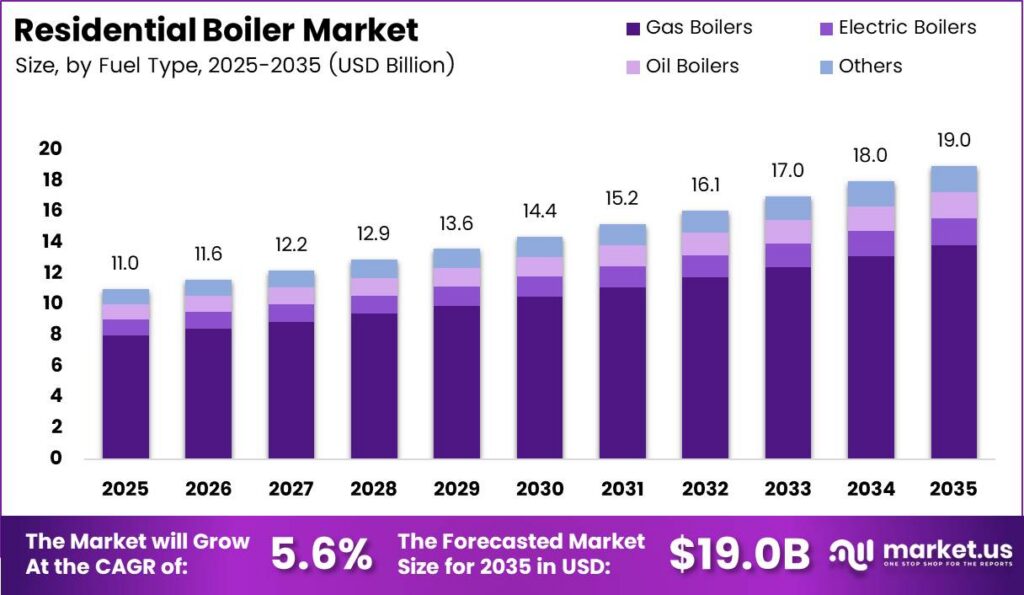
Global Residential Boiler Market size is expected to be worth around USD 19.0 Billion by 2035 from USD 11.0 Billion in 2025, growing at a CAGR of 5.6% during the forecast period 2026 to 2035. A residential boiler is a closed hydronic vessel that heats water or generates steam to warm living spaces through radiators, baseboard convectors, or underfloor pipe loops while supplying domestic hot water.
Single-family homes, urban apartment blocks, and multi-zone residential estates form the core buyer base for hydronic heating manufacturers. According to the International Energy Agency, buildings consume 30% of global energy, with residential properties representing 70% of building demand and heating accounting for 70% of home energy use in advanced economies . Consequently, thermal efficiency upgrades in household boiler rooms directly dictate residential utility expenditure and winter grid stability for institutional property investors.
Key Takeaways
- The global Residential Boiler Market reached a valuation of USD 11.0 Billion in 2025.
- Global market revenue will reach USD 19.0 Billion by 2035 across the forecast period from 2026 to 2035.
- Worldwide residential boiler sales expand at a compound annual growth rate of 5.6% from 2026 to 2035.
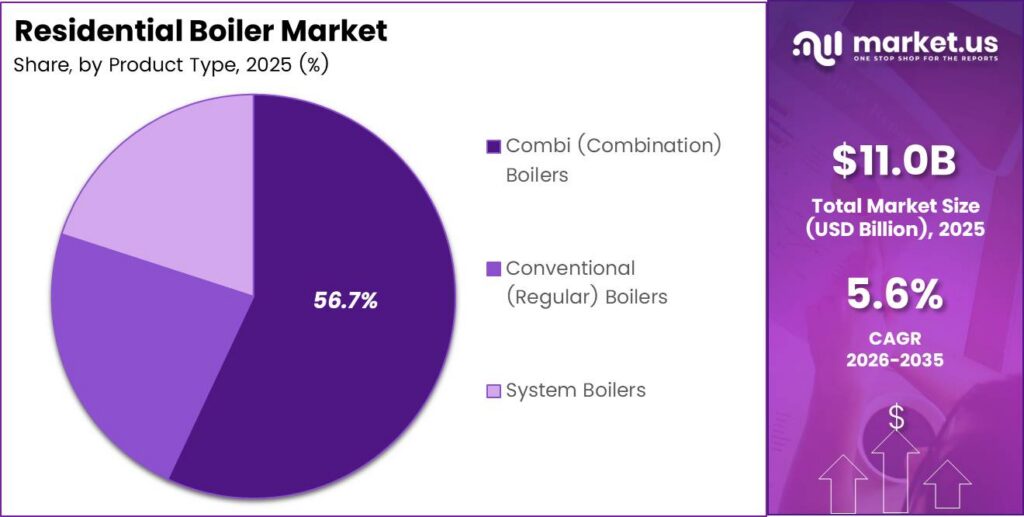
- Combi (Combination) Boilers led the product type segment with a 56.78% share in 2025 and rank as the fastest growing product category.
- Gas Boilers captured a 78.56% revenue share in the fuel type segment in 2025, while Electric Boilers represent the fastest growing fuel category.
- Condensing Boilers held a 74.89% share of the technology segment in 2025 and record the fastest segment expansion.
- Wall Mounted units accounted for a 64.78% share of the installation type segment in 2025 as the fastest growing configuration.
- Others (Space Heating + Water Boiling) secured a 64.67% share in the application segment in 2025 while leading application growth.
- Offline channels generated 67.45% of total revenue in the distribution channel segment in 2025, whereas Online sales expand fastest.
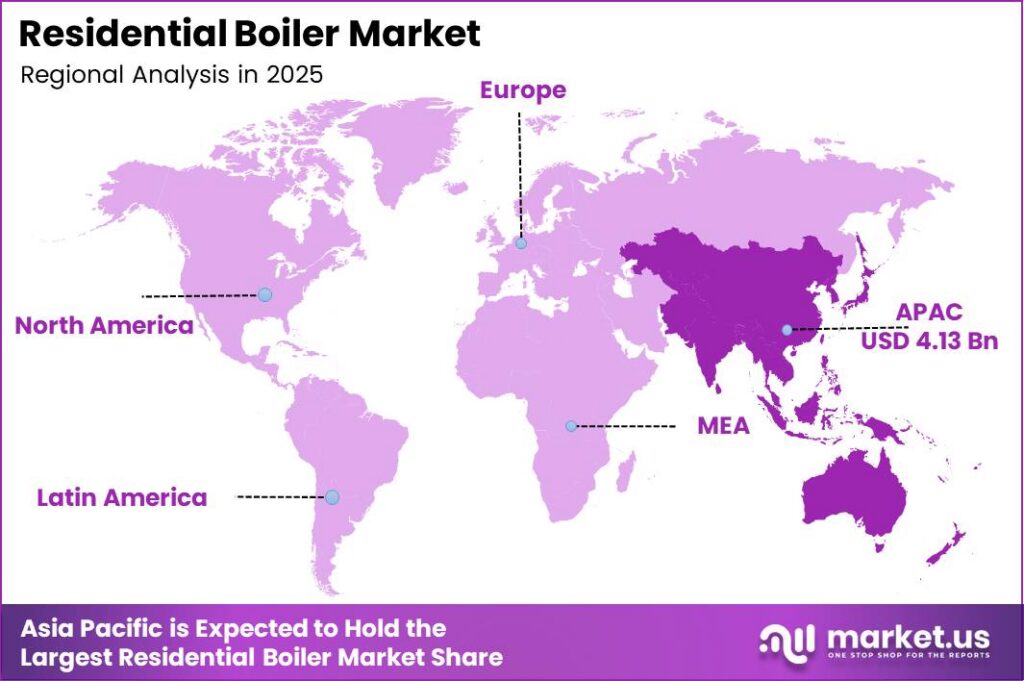
- Europe dominated global revenue with a 37.67% share valued at USD 4.13 Billion in 2025, while North America grows fastest.
Public building decarbonization mandates and municipal retrofit budgets actively reshape residential combustion engineering and capital allocation. As reported by the International Energy Agency, annual global investment in building energy efficiency, electrification, and renewable thermal systems reached USD 380 Billion in 2024. Therefore, heating equipment manufacturers that align burner modulation controls with statutory efficiency thresholds capture higher factory selling prices and protect wholesale gross margins against low-cost import competition.
Strategic consolidation among thermal manufacturers reflects this shift toward integrated combustion and smart hydronic control architectures. In July 2026, heating producer Ariston Group completed the 100% acquisition of burner and boiler specialist Riello Group for EUR 370 Million in cash, reflecting an enterprise value of EUR 289 Million . This transaction consolidates proprietary premix gas burner intellectual property with European wholesale distribution networks, raising entry barriers for smaller regional assemblers.
Europe holds the leading market position with a 37.67% share in 2025, valued at USD 4.13 Billion. Data from Eurostat shows that European Union households represented 26.0% of final energy consumption at 9.54 Million terajoules in 2024, with space and water heating comprising 77.1% of residential demand . Dense radiator-equipped housing stock and cold winters keep European homeowners dependent on rapid break-fix hydronic boiler replacements through established regional plumbing wholesalers.
North American thermal suppliers are simultaneously acquiring electronic flow and temperature control capabilities to raise unit revenue per boiler room. In January 2026, water heating manufacturer A. O. Smith Corporation completed the USD 470 Million cash acquisition of Leonard Valve Company and hydronic control brand Heat-Timer, lifting third-quarter 2026 North American boiler volumes by 13% . This signals that automated boiler controls now drive stronger margin expansion than bare cast-iron heat exchangers.
Product Type Analysis
Combi (Combination) Boilers dominates with 56.78% share in 2025 due to compact tankless dual heating output.
In 2025, Combi (Combination) Boilers held a 56.78% share in the Product Type segment of the Residential Boiler Market. Eurostat found that 48% of European Union residents lived in apartments in 2024, reaching 65% in Spain and 64% in Latvia. Apartment layouts lack attic cisterns and utility closets, requiring single-cabinet boilers with brazed plate heat exchangers for instant hot water. Consequently, manufacturers prioritizing ultra-quiet compact chassis capture urban multi-family renovation tenders.
Conventional (Regular) Boilers serve older multi-story dwellings fitted with open-vented gravity piping, copper hot-water cylinders, and low-pressure cast-iron radiators. Based on U.S. Department of Energy data, federal conservation rules under 10 CFR 430.32 mandate a minimum 84% AFUE for non-condensing gas hot-water boilers and 82% AFUE for gas steam units. Retaining atmospheric draft hoods lets installers use existing masonry chimneys without pressurized pipe retrofits. Therefore, suppliers keep steady replacement margins in historic housing districts.
System Boilers integrate an internal expansion vessel and circulating pump while pairing with a pressurized indirect storage tank for large residences. The U.S. Census Bureau indicates that 42% of the 1,019,000 single-family homes completed in 2024 featured 4 or more bedrooms, and 31% contained 3 or more bathrooms . Simultaneous shower draws exceed tankless flow rates, requiring coiled indirect cylinders to prevent pressure drops. As a result, bundling boilers with matched stainless tanks raises average order values.
Fuel Type Analysis
Gas Boilers dominates with 78.56% share in 2025 due to widespread municipal gas grid access.
In 2025, Gas Boilers held a 78.56% share in the Fuel Type segment of the Residential Boiler Market. Figures from the U.S. Energy Information Administration show that natural gas heated 47% of American homes in 2024, with winter 2026 to 2027 household gas heating bills averaging USD 640, down 9% annually . High fuel energy density and underground utility mains minimize homeowner winter operating costs. Therefore, OEMs standardize premix gas valves across flagship lines to protect core factory utilization.
Electric Boilers emerge as the fastest growing fuel category as municipal building codes restrict fossil fuel hookups in new residential developments. According to the U.S. Energy Information Administration and U.S. Census Bureau, 42% of American households used electricity for primary space heating in 2024, with residential delivered electricity share reaching 53% by 2050 . Zero flue emissions eliminate combustion venting, letting builders cut mechanical installation labor. Consequently, boiler makers adding smart grid-modulating resistance elements win all-electric housing contracts.
Oil Boilers remain vital heating assets across cold rural communities and older suburban properties located beyond municipal natural gas pipelines. As reported by Eurostat, oil and petroleum products supplied 12.7% of European Union residential space heating energy and 11.2% of household water heating demand in 2024 . High flame temperatures from atomized distillate oil heat high-mass cast-iron radiator loops during severe rural freezes. This means burners certified for hydrotreated vegetable oil blends extend rural aftermarket lifespans.
Technology Analysis
Condensing Boilers dominates with 74.89% share in 2025 due to latent flue heat recovery efficiency.
In 2025, Condensing Boilers held a 74.89% share in the Technology segment of the Residential Boiler Market. Data from the U.S. Department of Energy and ENERGY STAR shows certified gas boilers require 90% AFUE and oil units require 87% AFUE, justifying price premiums up to USD 1,150 . Secondary stainless heat exchangers cool exhaust below dew point to capture latent vapor energy. In October 2025, U.S. Boiler Company opened a 45,000 square foot Lancaster condensing plant with USD 2.7 Million PIDA financing, boosting domestic supply .
Non-Condensing Boilers retain a dedicated replacement niche in older multi-story apartments where shared masonry flues block acidic wet exhaust retrofits. The International Renewable Energy Agency found that over 75% of developed-market buildings remain poorly insulated, while annual deep renovation rates sit below 1% ahead of 2% 2030 targets . High return-water temperatures above 60 degrees Celsius prevent flue-gas condensation, making standard cast-iron exchangers mechanically practical. Consequently, manufacturers maintain legacy foundry lines to harvest cash from emergency winter replacements.
Installation Type Analysis
Wall Mounted dominates with 64.78% share in 2025 due to zero floor footprint kitchen integration.
In 2025, Wall Mounted held a 64.78% share in the Installation Type segment of the Residential Boiler Market. Based on U.S. Census Bureau data, average new single-family home floor area fell 11.2% from 2,707 square feet in 2014 to 2,404 square feet in 2024, with 25% under 1,800 square feet . Smaller utility rooms require lightweight aluminum-silicon or stainless heat exchangers hung directly on interior walls by one technician. Therefore, suppliers designing front-serviceable wall chassis lower contractor labor hours and win distributor shelf space.
Floor Standing boilers serve large detached homes and rural estates with heavy thermal loads and existing basement pipework manifolds. The Organisation for Economic Co-operation and Development indicates rural regions across 15 of 26 surveyed nations hold over 9 percentage points more pre-1960 dwellings than towns . Wide water waterways tolerate magnetite sludge in aging steel pipes without clogging. In November 2025, Worcester Bosch launched the 35 kW and 50 kW Greenstar 8000 F floor-standing gas boiler at 94% efficiency to capture premium upgrades.
Application Analysis
Others (Space Heating + Water Boiling) dominates with 64.67% share in 2025 due to unified single burner thermal efficiency.
In 2025, Others (Space Heating + Water Boiling) held a 64.67% share in the Application segment of the Residential Boiler Market. Figures from the American Council for an Energy-Efficient Economy show dual-purpose space heating and hot water thermal controls cut peak electrical loads by 60% to 82% and reduced winter bills by nearly 30% . Three-way diverter valves route heated primary water between radiators and domestic coils from one burner, eliminating standby tank losses. Consequently, integrated control packages command higher homeowner conversion rates.
Space Heating standalone boilers operate in residences where domestic hot water comes from separate electric heat-pump tanks or solar collectors. According to Eurostat, space heating consumed 61.5% of total European Union household energy in 2024, reaching 76.5% in Luxembourg, 73.0% in Estonia, and 71.2% in Belgium . Dedicated heating loops run continuous weather-compensated modulation at lower supply temperatures without sudden domestic hot-water temperature spikes. Therefore, manufacturers offering wide 10 to 1 burner turndown ratios win cold-climate radiant floor specifications.
Domestic Hot Water boilers serve high-occupancy residential properties and multi-family buildings with heavy simultaneous bathing, laundry, and kitchen sanitizing loads. As reported by Eurostat, dedicated water heating accounted for 15.6% of European Union household final energy consumption in 2024, with natural gas supplying 87.3% of residential water heating in the Netherlands . Year-round potable water heating requires scale-resistant heat exchangers and legionella thermal disinfection cycles even during summer months. This creates steady four-season replacement demand that smooths winter manufacturing seasonality.
Distribution Channel Analysis
Offline dominates with 67.45% share in 2025 due to licensed installer wholesale trade counter reliance.
In 2025, Offline held a 67.45% share in the Distribution Channel segment of the Residential Boiler Market. Data from the U.S. Census Bureau shows hardware merchant wholesalers operated 5,967 establishments paying USD 7.8 Billion in annual payroll, while physical building material dealers added 76,000 net jobs through December 2025 . Pressurized gas and hydronic commissioning requires licensed contractors who rely on local trade counters for same-day emergency boilers, flue kits, and warranty parts. Consequently, OEMs prioritizing wholesale branch rebates lock in regional installer loyalty.
Online platforms represent the fastest growing distribution channel as transparent equipment pricing and direct-to-site logistics reshape residential heating procurement. The U.S. Census Bureau found that quarterly building materials and supplies e-commerce sales jumped 33.5% quarter-over-quarter to USD 13,702 Million in second-quarter 2026, while retail e-commerce hit 17.1% share . Digital sizing calculators let homeowners and independent plumbers order boilers with fixed-price installation bundles in minutes. Therefore, brands building direct digital lead-generation portals capture higher retail margins and homeowner telemetry data.
Key Market Segments
By Product Type
- Combi (Combination) Boilers
- Conventional (Regular) Boilers
- System Boilers
By Fuel Type
- Gas Boilers
- Electric Boilers
- Oil Boilers
- Others
By Technology
- Condensing Boilers
- Non-Condensing Boilers
By Installation Type
- Wall Mounted
- Floor Standing
By Application
- Space Heating
- Domestic Hot Water
- Others (Space Heating + Water Boiling)
By Distribution Channel
- Offline
- Online
Regional Analysis
Europe Dominates the Residential Boiler Market with a Market Share of 37.67% in 2025, Valued at USD 4.13 Billion
Europe leads global revenue with a 37.67% market share in 2025, valued at USD 4.13 Billion. Based on Eurostat data, natural gas supplied 29.4% of European Union household energy in 2024 and powered residential space heating in 70.3% of Dutch, 57.8% of Italian, and 53.2% of Hungarian homes . Wet hydronic radiator piping across European apartments makes wall-hung condensing boilers the lowest-cost replacement option. Consequently, European manufacturers protect cash flow through high-margin hybrid-ready condensing swaps.
North America stands as the fastest growing regional market, propelled by cold-climate hydronic replacements across the Northeast, Midwest, and Canada. The U.S. Energy Information Administration indicates that colder 2025 winter temperatures pushed direct residential heating carbon dioxide emissions up 9% by 27 Million metric tons to 331 Million metric tons across 132.5 Million occupied homes . Severe winter thermal stress accelerates cast-iron boiler failures, shifting North American wholesalers toward high-efficiency fire-tube condensing inventory.
Emerging cold-climate corridors across Asia Pacific, Latin America, and Eastern Europe expand long-term hydronic equipment volume. Figures from the International Energy Agency show district and hydronic networks supply 10% of global building heat, with Qingdao adding 49 MW of heat recovery and Argentina using gas for 88% of its 35% space-heating share . According to the World Bank, Romania requires EUR 16 Billion to EUR 18 Billion by 2030 to replace 50,000 heating units . This unlocks tender pipelines for multi-zone boilers.
Key Regions and Countries
North America
- US
- Canada
Europe
- Germany
- France
- The UK
- Spain
- Italy
- Rest of Europe
Asia Pacific
- China
- Japan
- South Korea
- India
- Australia
- Rest of APAC
Latin America
- Brazil
- Mexico
- Rest of Latin America
Middle East and Africa
- GCC
- South Africa
- Rest of MEA
Market Dynamics
Global residential boiler demand operates at the intersection of non-discretionary winter equipment breakdowns, shifting fossil-fuel subsidy bans, and skilled hydronic trade shortages. As reported by the Organisation for Economic Co-operation and Development across 28 surveyed nations, 89% enforce mandatory building energy codes and 86% provide financial incentives, yet only 18% impose Minimum Energy Performance Standards on existing homes . This policy gap keeps homeowners favoring drop-in condensing or hybrid boiler replacements over costly whole-house envelope reconstructions.
Drivers
Legacy cast-iron and non-condensing boilers installed between 2008 and 2012 are now passing their 12 to 15 year mechanical lifespan, anchoring cold-climate replacement shipments. On January 17, 2025, the U.S. Department of Energy withdrew its proposed 95% AFUE condensing mandate and kept the 84% baseline, sparing homeowners USD 1,800 to USD 3,200 in chimney flue retrofits. European rules enacted between May 28, 2024 and May 29, 2026 also exempted broken gas boilers from forced removal, routing over 72% of regional sales into emergency swaps.
This non-discretionary replacement wave reshapes heating equipment distribution by shifting revenue away from volatile new housing starts toward 24 hour emergency wholesale fulfillment. Rapid break-fix demand cuts contractor customer acquisition costs by 18% to 24% because homeowners must replace failed winter heating units immediately. Simultaneously, original equipment manufacturers expand gross margins on aftermarket heat exchangers and circulator pump kits by 350 to 480 basis points, rewarding suppliers that maintain deep regional parts inventory.
| Driver | (~) % Impact on CAGR Forecast | Geographic Relevance | Impact Timeline |
|---|---|---|---|
| Aging Hydronic Installed Base Replacement Cycle | +2.4% | North America & Europe | Short term (≤ 2 years) |
| Condensing Latent-Heat Recovery Migration | +1.8% | Global | Medium term (2–4 years) |
| Cold-Climate Hydronic District Infill Housing | +1.1% | Northern Asia-Pacific & Eastern Europe | Medium term (2–4 years) |
| Modulating Burner & Smart Zoning Retrofits | +0.8% | Western Europe & North America | Short term (≤ 2 years) |
| Combi-Boiler Space Optimization in Multi-Family Dwellings | +0.6% | Urban Europe & East Asia | Medium term (2–4 years) |
| Rural Off-Grid Propane & Biofuel Oil Conversions | +0.4% | North America & Northern Europe | Long term (≥ 4 years) |
Restraints
Article 17(15) of the recast European Energy Performance of Buildings Directive took effect on May 28, 2024 and banned public grants, tax credits, and subsidized loans for standalone fossil boilers starting January 1, 2025 across all 27 Member States. Eliminating state rebates worth EUR 1,200 to EUR 3,500 per home lifts homeowner upfront installation costs by 28% to 42%. Consequently, consumer payback periods on 95% efficiency condensing upgrades stretch from 4.5 years to 8.2 years.
National transposition deadlines on May 29, 2026 and infringement enforcement actions starting July 15, 2026 freeze discretionary proactive boiler upgrades across Europe. Heating manufacturers face a 14% to 19% volume drop in mid-tier standalone gas condensing lines as households defer non-emergency replacements. As a result, producers delay capital spending on dedicated gas-burner tooling and absorb dealer promotional rebates that compress European wholesale operating margins by 220 to 310 basis points.
| Restraint | (~) % Impact on CAGR Forecast | Geographic Relevance | Impact Timeline |
|---|---|---|---|
| Statutory Elimination of Standalone Fossil Boiler Subsidies | -1.6% | European Union & United Kingdom | Short term (≤ 2 years) |
| Municipal Gas Hookup Moratoriums in New Residential Builds | -1.1% | North America & Western Europe | Medium term (2–4 years) |
| Elevated Mortgage & Home-Equity Remodeling Financing Rates | -0.7% | Global | Short term (≤ 2 years) |
| Direct Air-to-Water Heat Pump Rebate Substitution | -0.6% | Europe, North America & East Asia | Medium term (2–4 years) |
| Ultra-Low Nitrogen Oxide Combustion Emission Ceilings | -0.4% | California, Mountain West & Urban China | Short term (≤ 2 years) |
Challenges
Retirements across licensed plumbing and hydronic trades create severe installation bottlenecks, with U.S. projections showing 40,600 annual installer openings from 2025 to 2035. Replacement of retiring workers accounts for 35,780 openings, or 88% of annual hiring, preventing net field workforce expansion. Unqualified commissioning of modulating-condensing gas valves, primary-secondary piping, and sloped flues causes field efficiency drops of 6 to 11 percentage points below rated 95% AFUE laboratory benchmarks.
Installer scarcity extends peak winter homeowner booking waits from 5 days to 21 days while lifting digital recruitment costs to USD 13.41 per applicant alongside 9% to 14% annual wage inflation. High installation labor rates push price-sensitive households toward cheaper space heaters or delayed repairs. Therefore, boiler makers must shift 2.5% to 3.8% of engineering budgets into pre-plumbed manifold skids, self-calibrating combustion valves, and subsidized contractor training academies.
| Challenge | (~) % CAGR Friction Drag | Geographic Relevance | Mitigation Horizon |
|---|---|---|---|
| Certified Hydronic Installer Labor Deficit | -0.9% | North America & Western Europe | Long term (≥ 4 years) |
| Stainless-Steel & Copper Heat-Exchanger Volatility | -0.6% | Global | Short term (≤ 2 years) |
| Acidic Condensate Neutralization & Venting Complexity | -0.5% | North America & Northern Europe | Medium term (2–4 years) |
| Hard-Water Scaling Warranty Claim Escalation | -0.4% | Midwest US, Southern Europe & India | Medium term (2–4 years) |
| Electronic Ignition & Printed-Circuit Supply Bottlenecks | -0.3% | Global | Short term (≤ 2 years) |
Opportunities
Factory-integrated dual-fuel hybrid packages that pair a condensing gas boiler with an electric heat pump or solar collector remain underpenetrated, as fewer than 9% of installers quote bivalent systems today. October 2024 European Commission guidance exempted hybrid systems from the January 1, 2025 fossil-boiler subsidy ban. This unlocks public grants across residential buildings mandated to cut primary energy use by 16% by 2030 and 20% to 22% by 2035 without EUR 12,000 to EUR 18,000 radiator and wall tear-outs.
Early-mover manufacturers that standardize plug-and-play hydraulic modules and smart tariff controls capture outsized revenue per installation. Automated bivalent algorithms fire the condensing boiler only when outdoor temperatures fall below 2 degrees Celsius or peak power prices spike. Standardization lifts factory revenue per shipped system by 65% to 90%, cuts electronic control bill-of-materials costs by 14% via shared circuit boards, and expands gross margins by 450 to 650 basis points.
| Opportunity | (~) % Potential CAGR Upside | Geographic Relevance | Execution Window |
|---|---|---|---|
| Subsidized Dual-Fuel Hybrid Boiler-Heat-Pump Packages | +1.9% | European Union, UK & Northeast US | Short term (≤ 2 years) |
| Heating-as-a-Service Telemetry & Predictive Subscriptions | +1.4% | Western Europe & North America | Medium term (2–4 years) |
| 20% Hydrogen-Blend & Biomethane Conversion Kits | +1.1% | United Kingdom, Germany & Benelux | Long term (≥ 4 years) |
| Grid-Interactive Peak-Load Electric Hydronic Boilers | +0.8% | Nordics, France & Pacific Northwest | Medium term (2–4 years) |
| Multi-Zone Hydronic Modernization in Emerging Cold Cities | +0.7% | Central Asia, Northern China & Anatolia | Medium term (2–4 years) |
Key Company Insights
Robert Bosch GmbH
Robert Bosch GmbH leads the global residential heating sector through its Bosch and Worcester Bosch brands, supplying wall-hung condensing boilers, hydrogen-ready units, and hybrid systems across Europe, North America, and Asia. Data from the Robert Bosch GmbH Annual Report shows group sales reached EUR 91.0 Billion in 2025, with Energy and Building Technology rising 13.0% to EUR 8.5 Billion and Bosch Home Comfort generating EUR 4.4 Billion . Scale manufacturing protects component purchasing margins.
Bosch aggressively expanded its North American and Asian residential thermal footprint through transformative M&A execution. According to Bosch Media Service, in August 2025 Robert Bosch GmbH completed the USD 8.0 Billion, or EUR 7.4 Billion, acquisition of Johnson Controls residential and light commercial HVAC operations and the Hitachi joint venture across 16 plants . Combining ducted North American dealer channels with European hydronic boilers lets Bosch cross-sell dual-fuel hybrid packages globally.
Vaillant Group
Vaillant Group operates as a premier family-owned hydronic specialist headquartered in Remscheid, Germany, marketing ecoTEC gas condensing boilers, electric boilers, and smart controls across more than 60 countries. Based on Vaillant Group official press release figures, the company generated consolidated sales revenue of approximately EUR 3.3 Billion in the 2025 financial year across 16,000 employees . Deep installer training networks across Germany, the United Kingdom, and Eastern Europe defend premium pricing.
Vaillant is localizing pressurized hot-water storage manufacturing to capture system boiler and low-temperature hybrid retrofit demand in right-hand-drive and European markets. Vaillant Group UK found strong installer uptake after opening a GBP 40 Million, 12,200 square meter manufacturing plant in Derby in March 2025, creating 200 jobs to build uniSTOR high-recovery slimline cylinders . Domestic British cylinder production eliminates cross-Channel freight delays and locks in bundled boiler-and-tank specifications.
Key Players
- Robert Bosch GmbH
- Vaillant Group
- BDR Thermea Group
- Ariston Group
- A. O. Smith Corporation
- Navien, Inc.
- Ferroli S.p.A.
- Weil-McLain
- Carrier Corporation
- Daikin Industries Ltd.
- Other Key Players
Recent Developments
2026
- October 2026: Navien, Inc. product launch introduced the NCB700 condensing combi boiler series across 5 models achieving 96% AFUE, 150,000 BTU per hour heating input, 210,000 BTU per hour domestic hot water input, and 5.4 GPM flow according to Navien .
- October 2026: A. O. Smith Corporation agreement signed definitive terms to sell an 81% stake in its China business to CPE at a USD 400 Million valuation while retaining 19% equity and repatriating USD 80 Million cash according to PR Newswire .
- October 2026: Ideal Heating investment opened its GBP 20 Million UK Technology Centre in Hull housing over 100 research specialists within a GBP 60 Million site upgrade backed by GBP 2 Million Freeport funding according to Machinery Market .
- September 2026: Rheem Manufacturing Company product launch expanded its hydronics line with the 95% AFUE FT Series Combi Boiler and 260,000 to 399,000 BTU per hour boilers featuring 10 to 1 turndown and a 15 year warranty according to Rheem .
- July 2026: BDR Thermea Group acquisition completed the 100% purchase of Italian hydronic manufacturer G.I. Industrial Holding S.p.A., up from its 25% 2023 stake, adding 3 Italian plants and 300 employees according to Il Sole 24 Ore .
- June 2026: Daikin Europe N.V. product launch unveiled the residential X Series hybrid system integrating air-to-air climate control, hydronic underfloor heating, and domestic hot water for dwellings up to 150 square meters according to Daikin Europe .
- May 2026: Daikin Industries Ltd. capacity expansion inaugurated a EUR 300 Million residential heating and heat pump manufacturing plant in the Lodz region of Poland to serve European hydronic markets according to Daikin Europe .
- May 2026: Ferroli S.p.A. product launch released Omnia Life M 26T to 35T R290 hydronic units delivering 26 to 35 kW output, 150 kW across 6 cascaded units, and 85 degrees Celsius flow at 4.95 SCOP according to pv magazine .
- April 2026: Rinnai Corporation product launch commissioned the first Canadian residential high-rise RCW750AN floor-standing condensing boiler system delivering 99% thermal efficiency with a 1,600 gallon tank across 204 suites in a 17 story Toronto tower according to Rinnai .
2025
- December 2025: Ariston Group capacity expansion inaugurated a EUR 75 Million, 30,000 square meter factory on a 150,000 square meter site in Nis, Serbia, employing 300 workers to build cylinders and hydronic components according to Development Agency of Serbia .
- February 2025: Weil-McLain product launch introduced the ECO HP dual-fuel hybrid hydronic line delivering up to 54,250 BTU per hour capacity, 4.50 to 5.37 COP, and 65 degrees Celsius water supply for residential boiler pairing according to pv magazine .
Geopolitical Impact Analysis
Tariff frontloading and maritime chokepoint disruptions directly inflate cross-border logistics and component lead times for residential boiler manufacturers. Figures from the World Trade Organization show world merchandise trade volume grew 4.6% in 2025 and reaches 3.9% in 2026, even as reciprocal tariff models signal a 3.5% trade drag . According to UNCTAD, Red Sea rerouting around Africa lifted shipping ton-miles by 5.9% and pushed the Shanghai Containerized Freight Index up 149% to 2,496 points in 2024, while New ConTex charter rates rose 9% to 1,522 points in 2025 . Longer transit times delay Asian printed circuit boards, brass gas valves, and Variable-speed circulator pumps bound for European and North American boiler assembly plants. Consequently, OEMs must hold deeper safety buffer stocks and dual-source electronic ignition modules locally to prevent winter stockouts.
Armed conflict in the Middle East and metal trade barriers simultaneously squeeze boiler raw material costs and household replacement budgets. As reported by the World Bank, global commodity prices jump 23% in 2026 alongside a 50% U.S. tariff on semi-finished copper, pushing copper and aluminum to record highs after European gas rose 12.1% in October 2026 . Data from the International Monetary Fund shows global GDP growth slowing from 3.5% in 2025 to 3.1% in 2026, with euro area growth at 1.1% and global inflation climbing to 4.7% . Expensive copper tubing, brazed plate exchangers, and aluminum-silicon castings raise factory bills of materials while 4.7% inflation curbs discretionary homeowner remodeling. Therefore, manufacturers implement quarterly metal surcharge clauses with wholesale distributors.
Report Scope
| Report Features | Description |
|---|---|
| Market Value (2025) | USD 11.0 Billion |
| Forecast Revenue (2035) | USD 19.0 Billion |
| CAGR (2026-2035) | 5.6% |
| Base Year for Estimation | 2025 |
| Historic Period | 2021-2025 |
| Forecast Period | 2026-2035 |
| Report Coverage | Revenue Forecast, Market Dynamics, Market Opportunity Analysis, Technology and Innovation Landscape, Competitive Landscape, Recent Developments |
| Segments Covered | By Product Type (Combi (Combination) Boilers, Conventional (Regular) Boilers, System Boilers), By Fuel Type (Gas Boilers, Electric Boilers, Oil Boilers, Others), By Technology (Condensing Boilers, Non-Condensing Boilers), By Installation Type (Wall Mounted, Floor Standing), By Application (Others (Space Heating + Water Boiling), Space Heating, Domestic Hot Water), By Distribution Channel (Offline, Online) |
| Regional Analysis | North America (US and Canada), Europe (Germany, France, The UK, Spain, Italy, and Rest of Europe), Asia Pacific (China, Japan, South Korea, India, Australia, and Rest of APAC), Latin America (Brazil, Mexico, and Rest of Latin America), Middle East and Africa (GCC, South Africa, and Rest of MEA) |
| Competitive Landscape | Robert Bosch GmbH, Vaillant Group, BDR Thermea Group, Ariston Group, A. O. Smith Corporation, Navien, Inc., Ferroli S.p.A., Weil-McLain, Carrier Corporation, Daikin Industries Ltd., Other Key Players |
| Customization Scope | Customization for segments, region / country-level will be provided. Additional customization can be done based on requirements. |
| Purchase Options | We have three licenses to opt for: Single User License | Multi-User License (Up to 5 Users) | Corporate Use License (Unlimited User and Printable PDF) |