


Report Overview
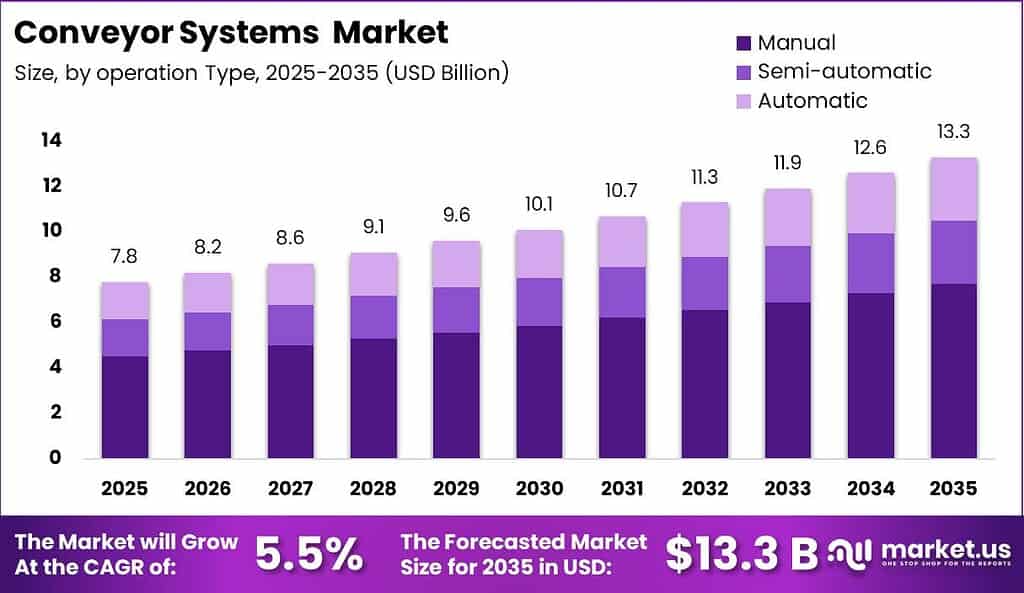
Global Conveyor Systems Market size is expected to be worth around USD 13.30 Billion by 2035 from USD 7.80 Billion in 2025, growing at a CAGR of 5.5% during the forecast period 2026 to 2035. This expansion reflects sustained capital investment in material handling infrastructure. Warehouses and factories are replacing manual movement systems with connected, automated equipment.
Conveyor systems move goods, materials, and components across distribution centers, factories, and airports without manual lifting. The market spans belt, roller, pallet, and overhead conveyors serving logistics, food processing, automotive, and pharmaceutical operations. This means buyers evaluate conveyors not as isolated hardware but as part of integrated automation ecosystems. Vendors that bundle software, sensors, and mechanical equipment secure longer customer relationships than those selling machinery alone.
Governments and large logistics operators are pushing hygienic and safety standards that directly shape conveyor specifications. Food and beverage manufacturers are expanding stainless-steel conveyor installations to meet stricter food safety regulations. Therefore, equipment makers face rising demand for corrosion-resistant, washdown-ready designs. This regulatory pressure raises the entry barrier for low-cost manufacturers lacking hygienic engineering capability.
Key Takeaways
- Global Conveyor Systems Market size is valued at USD 7.80 Billion in 2025 and is projected to reach USD 13.30 Billion by 2035.
- The market is expected to grow at a CAGR of 5.5% between 2026 and 2035.
- Roller Conveyors lead the By Conveyor Type segment with a share of 42.30%.
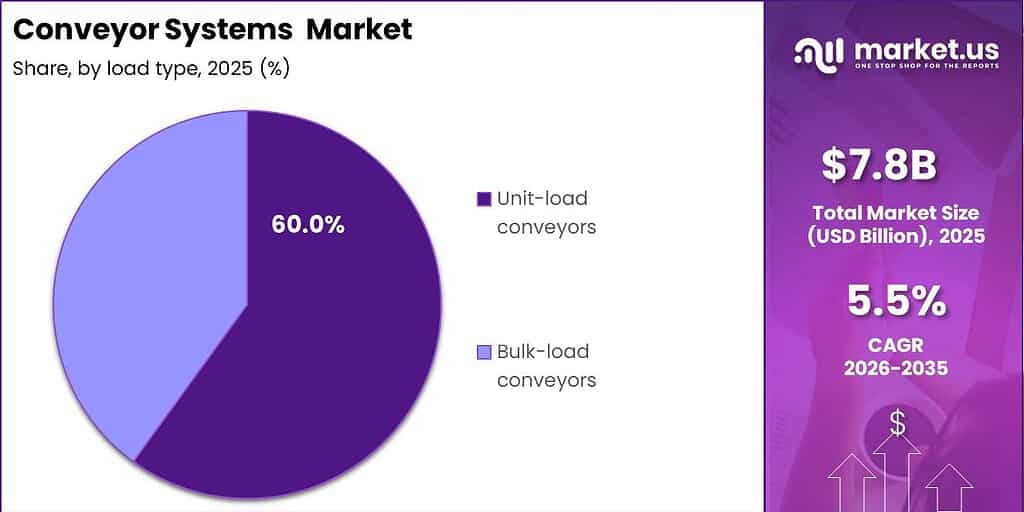
- Unit-Load Conveyors dominate the By Load Type segment with a share of 60.00%.
- Automatic systems hold the largest share of the By Operation segment at 58.60%.
- Supply Chain and Logistics leads the By End-Use Industry segment with a share of 35.60%.
- Distributors dominate the By Sales Channel segment with a share of 57.00%.
- On-Floor Conveyors lead the By Location segment with a share of 50.00%.
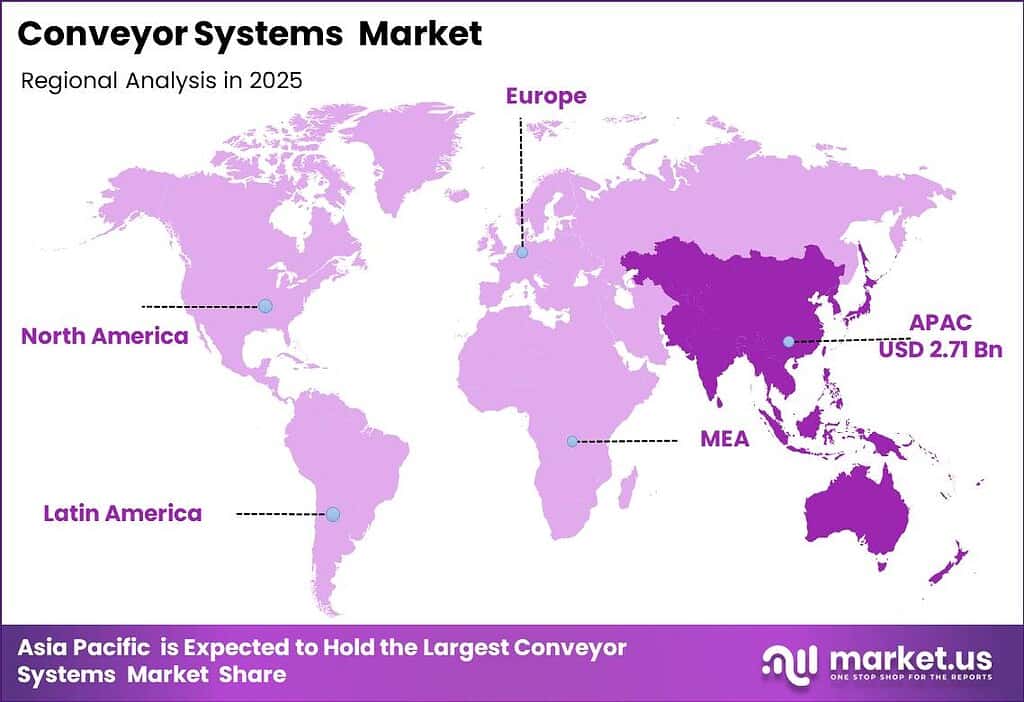
- Asia-Pacific dominates the regional market with a share of 35.00%, valued at USD 2.71 Billion.
As per our research, DHL Supply Chain operates approximately 17.5 million square meters of warehousing across more than 55 countries, supported by around 8,000 collaborative robots working alongside conveyor infrastructure. This scale shows how single logistics operators can influence conveyor demand across multiple regions at once. Siemens introduced enhanced Sinamics drive and automation solutions for conveyor applications in March 2025, improving energy efficiency and digital integration. Consequently, drive-level innovation is becoming a differentiator separate from mechanical conveyor design itself.
As per our research, DHL forecasts that up to 30% of its global material-handling equipment fleet will incorporate robotic automation by 2030. This projection signals rising demand for conveyor-integrated robotic systems among large-scale logistics operators. Smaller third-party logistics providers will likely follow this pattern within a shorter window. Vendors positioning conveyors as robotics-ready platforms stand to capture this transition earlier than competitors offering fixed, non-adaptable systems.
Conveyor Type Analysis
Roller Conveyors dominates with 42.30% due to durability in heavy unit-load handling.
In 2025, Roller Conveyors held a dominant market position in the By Conveyor Type segment of Conveyor Systems Market, with a 42.30% share. UNIDO manufacturing output data shows industrial equipment production supporting heavy-duty material handling has expanded steadily across Asia. This growth reflects factories prioritizing gravity and powered roller lines for palletized goods. Manufacturers investing in modular roller technology gain an advantage in high-throughput warehouse retrofits.
Belt Conveyors serve continuous-flow applications where materials move over long horizontal or inclined distances. According to UN Comtrade, global exports of conveyor belting components have remained a consistent share of material handling trade codes. This steady trade flow signals stable replacement demand rather than rapid expansion. Suppliers focusing on belt durability and low-maintenance designs retain existing industrial accounts more effectively than newer entrants.
Overhead Conveyors support paint lines, assembly plants, and space-constrained facilities by moving loads above floor level. Corporate filings from automotive component suppliers indicate overhead systems are frequently specified for synchronized production lines. This structural role ties overhead conveyor demand directly to vehicle assembly investment cycles. Vendors serving automotive gigafactories benefit from multi-year equipment contracts tied to plant expansion timelines.
Pallet Conveyors and other conveyor formats hold the remaining share of this segment collectively, serving niche bulk transport and specialty industrial applications. Honeywell launched its Intellisort Irregulars sorter in April 2026, capable of handling up to 5,000 parcels per hour, extending automated sortation into formats beyond standard roller and belt lines. This development signals convergence between sorting technology and conventional conveyor categories.
Load Type Analysis
Unit-Load Conveyors dominates with 60.00% due to precision handling of packaged goods.
In 2025, Unit-Load Conveyors held a dominant market position in the By Load Type segment of Conveyor Systems Market, with a 60.00% share. ITC Trade Map data shows packaged goods trade volumes have maintained consistent growth across major logistics corridors. This pattern reflects e-commerce parcel handling requiring individual item tracking. Vendors offering unit-level scanning integration capture premium pricing over basic mechanical transport equipment.
Bulk-Load Conveyors move loose materials such as grain, ore, and aggregates across mining and agricultural facilities. FAO data indicates global grain handling infrastructure continues expanding to support storage and export capacity. This structural demand ties bulk conveyor investment to commodity production cycles rather than consumer retail trends. Suppliers serving agricultural exporters benefit from counter-cyclical demand against e-commerce driven unit-load growth.
Operation Analysis
Automatic dominates with 58.60% due to reduced dependency on manual warehouse labor.
In 2025, Automatic systems held a dominant market position in the By Operation segment of Conveyor Systems Market, with a 58.60% share. International Federation of Robotics data recorded industrial robot installations exceeding 540,000 units globally in 2024. This scale of automated deployment supports fully automatic conveyor adoption inside robotics-integrated facilities. Operators reducing reliance on manual labor gain resilience against regional workforce shortages.
Semi-Automatic conveyors combine manual oversight with powered movement, suiting facilities transitioning away from fully manual operations. National statistical office data from manufacturing hubs shows mid-sized facilities frequently adopt semi-automatic equipment before full automation. This structural role positions semi-automatic systems as a transitional purchase rather than a permanent configuration. Vendors offering upgrade paths retain customers as they scale toward full automation.
Manual conveyors remain in use across smaller facilities and low-volume operations where automation investment is not yet justified. Beumer Group introduced high-capacity conveyor and sortation technologies in January 2025 designed to improve parcel handling efficiency in logistics facilities. This development illustrates the pull toward automated formats even in traditionally manual-heavy environments. Facilities delaying automation risk longer fulfillment times against automated competitors.
End-Use Industry Analysis
Supply Chain & Logistics dominates with 35.60% due to high-volume parcel sortation needs.
In 2025, Supply Chain and Logistics held a dominant market position in the By End-Use Industry segment of Conveyor Systems Market, with a 35.60% share. World Bank logistics performance data shows freight volumes tied to e-commerce distribution have expanded across major trade economies. This volume growth requires sortation systems capable of handling irregular parcel shapes. Operators investing in flexible sortation equipment reduce fulfillment delays during peak shipping periods.
Food and Beverages manufacturing relies on hygienic conveyor design to meet processing safety standards. FAO industry data indicates processed food output has grown steadily across export-oriented economies. This growth ties conveyor replacement cycles to stricter hygiene compliance timelines. Suppliers offering washdown-rated stainless steel systems secure repeat business from regulated food producers.
Automotive manufacturing depends on synchronized pallet and overhead conveyors for just-in-time assembly. UNIDO manufacturing statistics show vehicle production output recovering across major manufacturing regions. This recovery directly increases demand for conveyor systems timed to assembly line cycles. Vendors serving battery gigafactories benefit from long-term contracts tied to electric vehicle production ramp-ups.
Mining and Construction, Pharmaceuticals, and other end-use industries hold the remaining share of this segment collectively, each contributing specialized bulk and cold-chain handling requirements. This combined base signals diversification beyond logistics-driven demand. Suppliers with cross-industry engineering capability reduce dependence on any single end-use cycle.
Sales Channel Analysis
Distributors dominates with 57.00% due to regional inventory and faster delivery access.
In 2025, Distributors held a dominant market position in the By Sales Channel segment of Conveyor Systems Market, with a 57.00% share. Industry trade association benchmarks show distributor networks reduce equipment lead times for mid-sized facility buyers. This structural advantage matters most for operators needing rapid replacement parts. Manufacturers expanding distributor partnerships gain faster market access than those relying solely on direct sales teams.
OEM and Direct Sales channels serve large industrial buyers requiring custom-engineered conveyor systems. Regulatory filing data from major manufacturers shows direct sales agreements often accompany multi-year service contracts. This structural characteristic ties direct sales revenue to long-term customer relationships rather than one-time transactions. Vendors prioritizing direct engineering support retain higher-value industrial accounts.
Aftermarket sales cover replacement parts, maintenance components, and system upgrades for installed conveyor bases. Trade association data indicates aftermarket revenue grows in proportion to the aging industrial equipment base. This pattern signals recurring revenue potential independent of new installation cycles. Suppliers building aftermarket service networks generate steadier cash flow than those focused only on new equipment sales.
Location Analysis
On-Floor Conveyors dominates with 50.00% due to simpler installation across facility types.
In 2025, On-Floor Conveyors held a dominant market position in the By Location segment of Conveyor Systems Market, with a 50.00% share. National statistical office data on industrial construction shows floor-level equipment remains standard across new warehouse builds. This structural preference reflects lower installation complexity compared to elevated systems. Vendors offering flexible floor-level modular designs reduce commissioning time for new facility buildouts.
In-Floor Conveyors embed transport mechanisms beneath the working surface, suiting facilities requiring unobstructed floor space. Regulatory filing data from automotive plants shows in-floor systems remain common in assembly environments needing clear work zones. This structural role ties in-floor adoption to specialized manufacturing layouts rather than general warehousing. Suppliers serving automotive assembly retain steady demand tied to plant retooling cycles.
Overhead Conveyors occupy the remaining share of this segment, transporting loads above the working floor in space-constrained facilities. Corporate filings show overhead systems are frequently specified where floor space carries a premium cost. This positioning matters for facilities in dense industrial zones. Vendors offering overhead solutions capture demand where horizontal expansion is not possible.
Key Market Segments
By Conveyor Type
- Belt Conveyors
- Roller Conveyors
- Pallet Conveyors
- Overhead Conveyors
- Others
By Load Type
- Unit-Load Conveyors
- Bulk-Load Conveyors
By Operation
- Manual
- Semi-Automatic
- Automatic
By End-Use Industry
- Supply Chain & Logistics
- Food And Beverages
- Automotive
- Mining & Construction
- Pharmaceuticals
- Others
By Sales Channel
- OEM/Direct Sales
- Distributors
- Aftermarket
By Location
- In-Floor Conveyors
- On-Floor Conveyors
- Overhead Conveyors
Regional Analysis
Asia-Pacific Dominates the Conveyor Systems Market with a Market Share of 35.00%, Valued at USD 2.71 Billion
Asia-Pacific leads the global conveyor systems market with a share of 35.00%, valued at USD 2.71 Billion in 2025. Manufacturing capacity expansion across China, India, and Southeast Asia drives continuous investment in automated material handling equipment. This concentration of production activity creates dense demand clusters around major industrial corridors. Suppliers with regional manufacturing footprints gain cost and delivery advantages over exporters serving the region remotely.
North America and Europe show accelerated adoption tied to warehouse automation investment and e-commerce fulfillment expansion. Labor shortages are pushing operators toward fully automated conveyor-based material handling systems across distribution networks. This shift reflects urgency rather than gradual replacement of existing equipment. Vendors offering rapid deployment and remote commissioning capture share from operators facing immediate staffing constraints.
Middle East and Africa, along with Latin America, contribute smaller but growing shares tied to airport logistics modernization and emerging cold-chain infrastructure. These regions represent early-stage adoption rather than mature demand. Suppliers entering now establish relationships ahead of broader regional automation cycles.
Key Regions and Countries
North America
- US
- Canada
Europe
- Germany
- France
- The UK
- Spain
- Italy
- Rest of Europe
Asia Pacific
- China
- Japan
- South Korea
- India
- Australia
- Rest of APAC
Latin America
- Brazil
- Mexico
- Rest of Latin America
Middle East and Africa
- GCC
- South Africa
- Rest of MEA
Market Dynamics
Market Opportunity Analysis - Underserved segments and emerging regions offer clear entry points for new automation vendors
Aftermarket sales inside the Distributors-led sales channel remain underexploited relative to new equipment revenue. This means service and spare-parts contracts are available for vendors willing to build regional support networks. Companies entering this space early can lock in maintenance relationships before larger competitors formalize aftermarket divisions.
Manual and Semi-Automatic operation types together hold a meaningful share outside the dominant Automatic segment. This signals unconverted facilities still awaiting automation investment. New entrants offering low-cost upgrade paths from manual to semi-automatic systems can capture this transitional buyer group before full automation vendors do.
Middle East and Africa, alongside Latin America, remain smaller contributors to regional conveyor revenue. This reflects early-stage automation adoption rather than saturated demand. Instead of competing in mature Asia-Pacific and North American markets, new entrants can establish early distributor relationships across these developing regions.
Technology and Innovation Landscape - Automation software and hygienic engineering reshape competitive positioning
Vision-guided conveyor sorting integrated with AI-powered quality inspection is enabling defect detection during material transport rather than after. This capability reduces downstream rework costs for manufacturers. Companies integrating inspection directly into conveyor lines gain quality assurance advantages over separate inspection stations.
Energy-efficient conveyor drives with regenerative braking are gaining adoption inside large distribution centers. This reflects operator focus on reducing electricity costs across continuously running equipment. Vendors offering regenerative drive technology position themselves favorably as energy costs remain a persistent operating expense for logistics operators.
IoT-connected conveyors enabling real-time asset monitoring are shifting maintenance from scheduled intervals to condition-based servicing. This reduces unplanned downtime across distribution hubs. Manufacturers offering cloud-based operational analytics create ongoing software revenue streams beyond the initial equipment sale.
Drivers
Fulfilment-speed pressure and unstable warehouse labor supply shifted conveyor purchasing during 2024 to 2025 from simple equipment swaps toward full automation programs. MHI research found that 55% of supply-chain leaders increased technology budgets, while the International Federation of Robotics logged 542,000 robot installations in 2024, over double the level of a decade earlier, with Asia accounting for 74% of deployments.
The U.S. Census Bureau reported e-commerce represented 16.9% of retail sales in early 2026 and grew 9.8% year over year, reinforcing throughput needs for sortation and routing conveyors. This trend supports an estimated +1.2% incremental CAGR contribution. Suppliers are shifting from stand-alone hardware sales toward controls integration and multiyear service contracts, strengthening recurring revenue while reducing customer reliance on manual labor additions.
| Driver | (~) % Impact on CAGR Forecast | Geographic Relevance | Impact Timeline |
|---|---|---|---|
| Warehouse Automation Investment | +1.2% | Global; strongest in North America, Europe, and East Asia | Short term (2 years or less) |
| Manufacturing Capacity Expansion | +0.9% | China, India, Southeast Asia, Mexico, and Central Europe | Medium term (2 to 4 years) |
| E-Commerce Fulfilment Growth | +0.8% | North America, Europe, China, India, and Southeast Asia | Short term (2 years or less) |
| EV and Battery Production | +0.7% | China, Europe, North America, India, and South Korea | Medium term (2 to 4 years) |
| Airport Logistics Modernization | +0.4% | Middle East, Asia-Pacific, Europe, and North America | Medium term (2 to 4 years) |
Restraints
Conveyor installations demand substantial upfront spending on mechanical equipment, controls, and commissioning, making project approval sensitive to borrowing costs. The World Bank expected global growth of only 2.4% in 2024 and warned real policy rates would stay elevated through 2025, while its commodity outlook projected price declines of just 3% in 2024 and 4% in 2025.
The U.S. administration raised steel and aluminum tariffs from 25% to 50% effective June 4, 2025, increasing cost uncertainty around fabricated frames and components. This combined financing and input-cost burden can extend customer payback periods by 1 to 2 years. Suppliers may sacrifice 100 to 250 basis points of project margin to protect deal volume, producing an estimated -1.0% CAGR deduction.
| Restraint | (~) % Impact on CAGR Forecast | Geographic Relevance | Impact Timeline |
|---|---|---|---|
| Elevated Automation Financing Costs | -1.0% | Global; strongest among mid-sized operators | Short term (2 years or less) |
| Steel and Aluminum Tariffs | -0.8% | United States and import-linked supply chains | Short term (2 years or less) |
| Brownfield Installation Disruption | -0.6% | Europe, North America, and mature East Asian markets | Medium term (2 to 4 years) |
| Cyclical Industrial CapEx Deferrals | -0.5% | Europe, export-oriented Asia, and Latin America | Short term (2 years or less) |
| Fragmented Safety Certification | -0.3% | Europe and cross-border equipment exporters | Medium term (2 to 4 years) |
Challenges
The shift from fixed-speed conveyors to sensor-rich, software-orchestrated material flow is raising demand for programmable-logic-controller engineers and mechatronics technicians faster than local labor pools can supply them. The U.S. Bureau of Labor Statistics projects approximately 608,100 annual openings across installation, maintenance, and repair occupations through 2034, with a median wage of $58,230 in 2024.
MHI workforce analysis identifies talent shortages as a central supply-chain constraint, while the International Federation of Robotics reported 4.664 million operational industrial robots in 2024, up 9% year over year. This shortage can add 4 to 10 weeks to commissioning schedules and raise specialist labor rates by 8% to 15%, creating a -0.7% friction drag on forecast growth.
| Challenge | (~) % CAGR Friction Drag | Geographic Relevance | Mitigation Horizon |
|---|---|---|---|
| Controls Talent Scarcity | -0.7% | North America, Europe, Japan, and Australia | Medium term (2 to 4 years) |
| Legacy System Integration | -0.6% | Global brownfield industrial and logistics sites | Long term (4 years or more) |
| Component Lead-Time Volatility | -0.5% | Global; acute in import-dependent markets | Medium term (2 to 4 years) |
| Cyber-Physical Security Exposure | -0.4% | North America, Europe, and digitally advanced Asia | Long term (4 years or more) |
| Energy-Efficiency Retrofitting Complexity | -0.3% | Europe, Japan, South Korea, and North America | Medium term (2 to 4 years) |
Opportunities
Conveyor-as-a-service represents future white space since most suppliers still sell engineered equipment upfront while customers absorb utilization and maintenance risk. MHI reported 55% of supply-chain leaders increased technology budgets in 2025, showing automation appetite without broad adoption of outcome-priced conveyor capacity yet.
The International Federation of Robotics recorded over 500,000 annual robot installations for a fourth consecutive year in 2024, while IATA identifies roughly $1 billion in annual legacy-messaging costs that digital modernization could remove. A vendor pricing throughput or availability could cut customer upfront spending by 30% to 60%, converting equipment sales into 5 to 10 year contracts and supporting up to +0.9% CAGR upside.
| Opportunity | (~) % Potential CAGR Upside | Geographic Relevance | Execution Window |
|---|---|---|---|
| Conveyor-as-a-Service Models | +0.9% | North America, Europe, and advanced Asia-Pacific | Medium term (2 to 4 years) |
| Predictive Maintenance Monetization | +0.7% | Global installed base | Short term (2 years or less) |
| Emerging-Market Cold Chains | +0.6% | India, Southeast Asia, Africa, and Latin America | Long term (4 years or more) |
| Automated Baggage Ecosystems | +0.5% | Middle East, Asia-Pacific, Africa, and Latin America | Medium term (2 to 4 years) |
| Circular Conveyor Refurbishment | +0.3% | Europe, North America, and Japan | Medium term (2 to 4 years) |
Key Company Insights
Daifuku Co., Ltd. strengthened its factory automation portfolio in July 2026 by completing its acquisition of shares in Germany-based Eisenmann Gmbh. This move expands Daifuku beyond conveyor hardware into broader factory automation engineering. The acquisition creates cross-selling potential across automotive paint and assembly lines but raises integration risk across two distinct engineering cultures.
Dematic operates as part of Kion Group, giving it access to forklift and warehouse robotics distribution channels beyond standalone conveyor sales. This structural link creates bundling advantages inside Kion’s existing customer base. However, dependence on a parent group’s broader strategy could limit Dematic’s independent pricing flexibility in competitive conveyor bids.
Key Players
- Daifuku Co., Ltd.
- Dematic – Kion Group
- Vanderlande Industries – Toyota Industries
- Ssi Schäfer Group
- Beumer Group Gmbh & Co. Kg
- Interroll Holding Ag
- Honeywell Intelligrated
- Continental Ag – Contitech
- Siemens Logistics
- Fives Group
- Swisslog – Kuka Group
- Tgw Logistics Group
- Murata Machinery, Ltd.
- Hytrol Conveyor Company, Inc.
- Dorner Mfg. Corp.
Recent Developments
- April 2026: Honeywell announced the sale of its warehouse and workflow solutions business, including the Intelligrated and Transnorm conveyor brands, to American Industrial Partners.
- March 2026: Interroll showcased its integrated material flow ecosystem and next-generation conveyor automation solutions at Logimat 2026.
- February 2026: Daifuku showcased its latest intralogistics automation, sorting, and conveyor technologies for warehouses at Modex 2026.
- September 2025: Daifuku Intralogistics America completed the expansion of its manufacturing facility to increase production capacity for material handling and conveyor systems.
Report Scope
| Report Features | Description |
|---|---|
| Market Value (2025) | USD 7.80 Billion |
| Forecast Revenue (2035) | USD 13.30 Billion |
| CAGR (2026-2035) | 5.5% |
| Base Year for Estimation | 2025 |
| Historic Period | 2020-2024 |
| Forecast Period | 2026-2035 |
| Report Coverage | Revenue Forecast, Market Dynamics, Market Opportunity Analysis, Technology and Innovation Landscape, Competitive Landscape, Recent Developments |
| Segments Covered | By Conveyor Type (Belt Conveyors, Roller Conveyors, Pallet Conveyors, Overhead Conveyors, Others), By Load Type (Unit-Load Conveyors, Bulk-Load Conveyors), By Operation (Manual, Semi-Automatic, Automatic), By End-Use Industry (Supply Chain & Logistics, Food And Beverages, Automotive, Mining & Construction, Pharmaceuticals, Others), By Sales Channel (OEM/Direct Sales, Distributors, Aftermarket), By Location (In-Floor Conveyors, On-Floor Conveyors, Overhead Conveyors) |
| Regional Analysis | North America (US and Canada), Europe (Germany, France, The UK, Spain, Italy, and Rest of Europe), Asia Pacific (China, Japan, South Korea, India, Australia, and Rest of APAC), Latin America (Brazil, Mexico, and Rest of Latin America), Middle East and Africa (GCC, South Africa, and Rest of MEA) |
| Competitive Landscape | Daifuku Co., Ltd., Dematic – Kion Group, Vanderlande Industries – Toyota Industries, Ssi Schäfer Group, Beumer Group Gmbh & Co. Kg, Interroll Holding Ag, Honeywell Intelligrated, Continental Ag – Contitech, Siemens Logistics, Fives Group, Swisslog – Kuka Group, Tgw Logistics Group, Murata Machinery, Ltd., Hytrol Conveyor Company, Inc., Dorner Mfg. Corp. |
| Customization Scope | Customization for segments, region / country-level will be provided. Additional customization can be done based on requirements. |
| Purchase Options | We have three licenses to opt for: Single User License | Multi-User License (Up to 5 Users) | Corporate Use License (Unlimited User and Printable PDF) |





































