


Report Overview
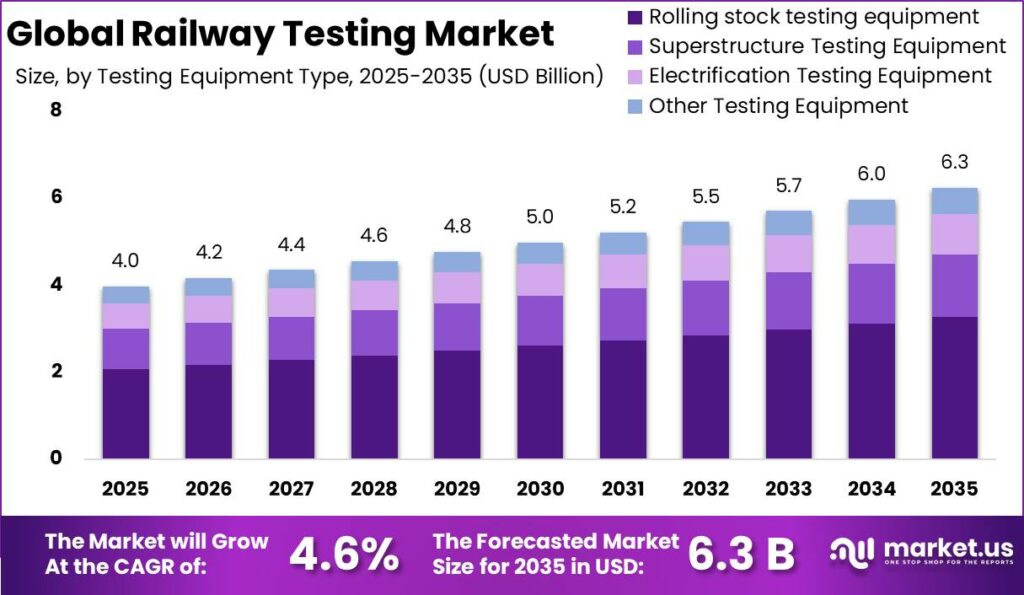
Global Railway Testing Market size is expected to be worth around USD 6.30 Billion by 2035 from USD 4.00 Billion in 2025, growing at a CAGR of 4.6% during the forecast period 2026 to 2035. This growth ties directly to stricter safety mandates and aging rail infrastructure. Operators who invest early in accredited testing capacity will secure long term certification contracts as verification spending becomes structural rather than optional.
The Railway Testing Market covers equipment and services that verify the safety, performance, and compliance of tracks, rolling stock, and electrification systems. This market spans testing equipment types, railway types, applications, service sourcing models, and end users. Providers range from equipment makers to accredited third party labs. This structure means value flows to firms that combine hardware precision with lifecycle certification services across multiple standards.
Key Takeaways
- Global Railway Testing Market will reach USD 6.30 Billion by 2035 from USD 4.00 Billion in 2025 at a CAGR of 4.6%.
- Rolling stock testing equipment leads the equipment segment with a 52.34% share.
- High-speed rail dominates the railway type segment with a 41.23% share.
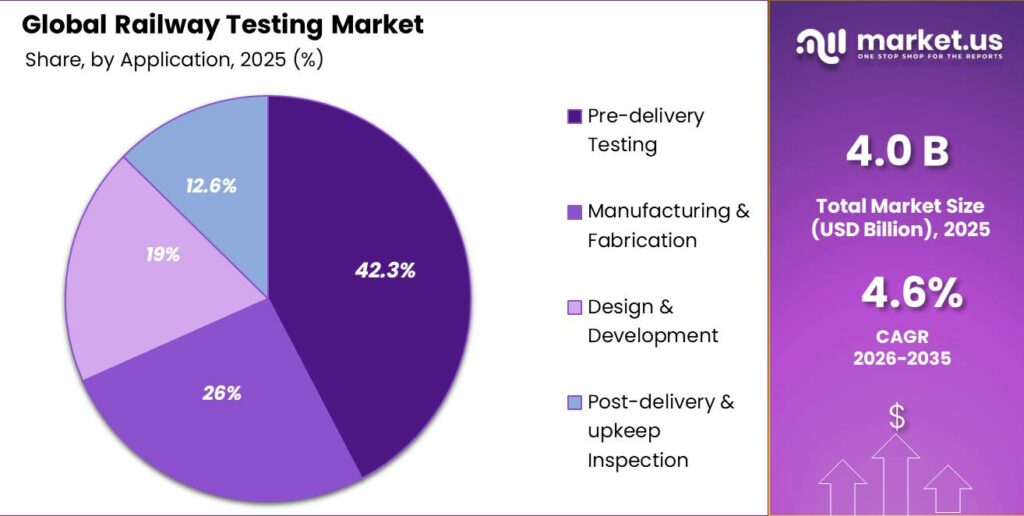
- Pre-delivery testing holds the largest application share at 42.34%.
- In-house testing leads service sourcing with a 62.34% share.
- OEMs dominate the end user segment with a 45.67% share.
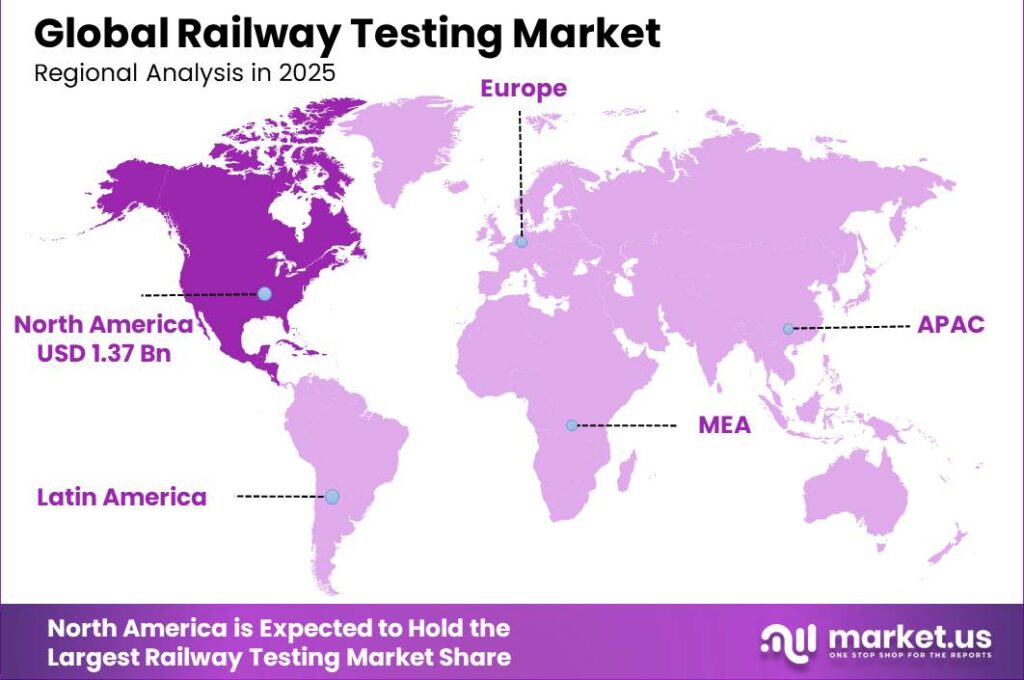
- North America leads all regions with a 34.56% share, valued at USD 1.37 Billion.
Government bodies now anchor demand through funded test infrastructure. Figures from India’s high-speed railway program show a 60 km test track designed to validate rolling stock at speeds up to 230 km/h, scheduled to begin operating in 2025. This state investment expands national testing capacity. Companies that align product validation with such public facilities cut certification lead times and win first mover access to emerging corridors.
Public funding also sets the scale of these commitments. As reported by railway.supply, India’s test facility carries a construction budget of ₹820 crore, signaling firm government intent to localize high-speed validation. This means suppliers gain a regional testing hub that reduces reliance on foreign labs. In June 2025, ENSCO introduced State of Good Repair-aligned solutions combining predictive analytics and full-scale vehicle testing at the Transportation Technology Center. This creates recurring revenue from lifecycle inspection contracts tied to public assets.
Testing Equipment Analysis
Rolling stock testing equipment dominates with 52.34% due to complex EMC and battery validation needs.
In 2025, Rolling stock testing equipment held a dominant market position in the By Testing Equipment Type segment of Railway Testing Market, with a 52.34% share. Data from the Federal Railroad Administration shows the Transportation Technology Center’s electrified test track supports continuous testing of electric locomotives under 25 kV or 50 kV systems. This capability makes rolling stock testing capital intensive. Suppliers offering integrated EMC, material, and battery testing capture the highest value per contract.
Superstructure testing equipment measures track geometry and mechanical integrity, ranking as the fastest growing sub-segment here. According to a manufacturer’s technical specification, high-speed ultrasonic rail-testing systems inspect tracks at up to 40 km/h, raising daily coverage. This speed reduces network downtime during inspection. Operators adopting faster track measurement tools lower inspection labor costs and improve maintenance scheduling across busy corridors.
Electrification testing equipment verifies traction power supply, contact lines, and substation systems as networks electrify. As per our research, expanding electrified corridors force operators to test power supply reliability before commissioning. This shift lifts demand for contact line test equipment. Vendors serving electrification programs gain steady orders as governments prioritize cleaner rail. Other testing equipment fills specialized niche roles, holding the remaining share collectively across the segment.
Railway Type Analysis
High-speed rail dominates with 41.23% due to strict speed and safety validation.
In 2025, High-speed rail held a dominant market position in the By Railway Type segment of Railway Testing Market, with a 41.23% share. Based on railway.supply data, India’s new 60 km test track validates rolling stock at speeds up to 230 km/h. These high speeds demand rigorous type testing before service. This means high-speed programs generate the densest testing spend per kilometer, rewarding labs with dynamic simulation capacity.
Metro and light rail systems serve dense urban corridors and rank as the fastest growing sub-segment. Figures from a 2026 Beijing Metro Line 6 deployment show a rail-transit inspection system achieved 92.7% [email protected] detecting personnel and equipment. This accuracy improves urban safety monitoring. Cities scaling metro networks will demand automated inspection tools, opening steady contracts for vision-based testing suppliers.
Conventional and freight rail carries heavy tonnage across long distances, requiring durable track and defect testing. A 2025 railway-wheel inspection study reported 91% precision and 92% [email protected] for its defect-detection model. This precision reduces derailment risk on freight lines. Operators investing in wheel and rail defect detection cut costly failures and extend asset life across aging freight networks.
Application Analysis
Pre-delivery testing dominates with 42.34% due to mandatory acceptance before fleet handover.
In 2025, Pre-delivery testing held a dominant market position in the By Application segment of Railway Testing Market, with a 42.34% share. A 2025 rail internal-defect study found detection accuracy approached 90% for most defect classes in its B-scan dataset. This accuracy supports confident acceptance decisions. OEMs rely on pre-delivery testing to avoid warranty claims, making it the highest volume application for testing providers.
Post-delivery and upkeep inspection maintains fleets after commissioning and ranks as the fastest growing sub-segment. A 2025 peer-reviewed review reported a drone-based railway inspection system achieved 93.6% accuracy identifying track components. This accuracy enables frequent, low-cost checks. Operators shifting to condition-based upkeep will expand recurring inspection budgets, creating durable service revenue for analytics providers.
Design and development testing validates concepts before production, while manufacturing and fabrication testing checks components during assembly. The same 2025 review found the drone system identified 81.8% of potential railway safety hazards during inspection. This coverage strengthens early defect capture. Firms embedding testing across design and manufacturing stages reduce downstream failures, and these two applications hold the remaining share collectively.
Service Sourcing Analysis
In-house testing dominates with 62.34% due to operator control over proprietary data.
In 2025, In-house testing held a dominant market position in the By Service Sourcing segment of Railway Testing Market, with a 62.34% share. A 2026 Beijing Metro system reduced anomaly-detection latency by 45%, from 52.1 milliseconds to 28.5 milliseconds using edge intelligence. This speed favors internal real-time monitoring. Operators keeping testing in-house protect sensitive fleet data and gain faster response, sustaining strong demand for owned equipment.
Outsourced testing shifts work to accredited third party labs and ranks as the fastest growing sub-segment. The same Beijing Metro system cut daily uplink bandwidth by 98.1%, from 40.0 GB to 0.76 GB, using event-triggered uploads. This efficiency lowers the cost of remote lab services. Smaller operators lacking capital for full rigs will outsource complex tests, giving specialist labs a widening addressable base.
End User Analysis
OEMs dominate with 45.67% due to mandatory type testing before product release.
In 2025, OEMs held a dominant market position in the By End User segment of Railway Testing Market, with a 45.67% share. A 2026 Beijing Metro classifier achieved 95.8% accuracy distinguishing normal from abnormal equipment conditions. This reliability supports OEM quality gates. Manufacturers embedding rigorous validation protect brand reputation, making them the largest buyers of advanced testing systems.
Railway operators run daily services and demand ongoing safety verification across their networks. A UK Rail Accident Investigation Branch report documented a track-worker near miss with a train at 167 km/h, showing the speeds inspection controls must handle. This risk drives operator investment in safety testing. Operators prioritizing worker protection expand inspection spend, supporting steady demand from network owners.
Maintenance and service providers support fleets after sale and rank as the fastest growing end user. A 2025 Association of American Railroads submission proposed automated track-inspection programs record no more than 4 track-geometry defects per 100 miles monthly. This benchmark tightens maintenance standards. Service firms adopting automated inspection to meet such targets will capture growing outsourced maintenance contracts.
Key Market Segments
By Testing Equipment Type
- Superstructure Testing Equipment
- Track measurement equipment
- Electronics and DAQ testing equipment
- Rail mechanical testing equipment
- Others
- Electrification Testing Equipment
- Traction power supply and substation testing equipment
- Contact line test equipment
- Railway power supply testing equipment
- Others
- Rolling stock testing equipment
- EMC Testing Equipment
- Material testing equipment
- Battery testing equipment
- Others
- Other Testing Equipment
By Railway Type
- High-speed rail
- Metro and light rail
- Conventional rail and freight rail
By Application
- Design and Development
- Manufacturing and Fabrication
- Pre-delivery Testing
- Post-delivery and upkeep Inspection
By Service Sourcing
- In-house testing
- Outsourced testing
By End User
- OEMs (Original Equipment Manufacturers)
- Railway operators
- Maintenance and service providers
Regional Analysis
North America Dominates the Railway Testing Market with a Market Share of 34.56%, Valued at USD 1.37 Billion
North America leads the Railway Testing Market with a 34.56% share, valued at USD 1.38 Billion. Data from the Federal Railroad Administration shows the Transportation Technology Center’s electrified test track supports continuous locomotive testing under 25 kV or 50 kV systems. This facility anchors regional demand. Suppliers serving North American operators gain access to mature, well-funded test infrastructure that rewards advanced equipment.
Asia Pacific stands as the fastest-growing region as governments fund new high-speed corridors. Based on railway.supply data, India’s 60 km test track validates rolling stock at speeds up to 230 km/h, backed by a ₹820 crore budget. This investment localizes high-speed validation. Vendors entering Asia Pacific early will lock in testing supply contracts as national rail networks expand rapidly.
Key Regions and Countries
North America
- US
- Canada
Europe
- Germany
- France
- The UK
- Spain
- Italy
- Rest of Europe
Asia Pacific
- China
- Japan
- South Korea
- India
- Australia
- Rest of APAC
Latin America
- Brazil
- Mexico
- Rest of Latin America
Middle East and Africa
- GCC
- South Africa
- Rest of MEA
Market Dynamics
Market Opportunity Analysis - Underserved metro inspection, outsourced testing, and emerging market labs open entry points for new players
Metro and light rail testing remains underexploited despite ranking as the fastest growing railway type. Urban networks expand faster than dedicated inspection capacity, leaving cities short of automated monitoring tools. This gap favors new entrants offering vision-based detection tuned for dense metro environments. Investors backing metro-focused inspection firms can capture demand before incumbents pivot from mainline and freight testing.
Outsourced testing holds only a minority share yet grows fastest within service sourcing. Smaller operators lack the capital to build accredited in-house rigs, creating a widening pool of unmet demand. This means specialist third party labs can win volume that operators cannot serve internally. New entrants building accredited multi-standard labs will lock in long term contracts as outsourcing accelerates.
Emerging market rail programs, especially in India and ASEAN, lack accredited domestic testing facilities. High-speed rail dominates testing spend, yet most validation still routes through foreign hubs. This creates room for locally accredited labs positioned near new corridors. By contrast to saturated Western markets, early movers building regional capacity face weaker competition and strong government backing.
Technology and Innovation Landscape - AI vision, edge processing, ultrasonic sensing, and digital twins reshape rail testing
AI vision models now drive automated rail inspection with high reliability. A 2026 Beijing Metro system achieved 92.7% [email protected] detecting personnel and equipment using a fine-tuned YOLOv8 model. This accuracy reduces manual inspection labor. Manufacturers embedding AI detection into inspection hardware gain a clear performance edge, while operators cut inspection costs and improve safety response times.
Edge intelligence transforms how inspection data moves through networks. The same Beijing Metro system cut anomaly-detection latency by 45% to 28.5 milliseconds and reduced daily bandwidth by 98.1% to 0.76 GB. This efficiency enables real-time detection without heavy cloud costs. Vendors offering edge-capable systems help operators scale monitoring across large fleets without straining data infrastructure.
Ultrasonic sensing continues to advance defect detection precision. A 2026 ultrasonic rail-testing study measured an effective calibrated velocity of 289.3 m/s, roughly 15.6% below the speed of sound in air, improving crack-sizing calculations. This precision sharpens internal defect assessment. Suppliers refining ultrasonic calibration deliver more reliable flaw sizing, which reduces false positives and unnecessary track closures for operators.
Digital twin validation shifts testing from physical to virtual environments. High-fidelity models cut physical test runs per change set by 20 to 40 percent while enabling continuous assurance. This reduces reliance on costly on-track trials. Firms investing in validated model libraries create recurring subscription revenue and position themselves ahead of operators still tied to periodic physical campaigns.
Drivers
The consolidation of the EN 5012x RAMS family, including EN 50126–1:2017/A1:2024, into procurement specifications pushes operators to embed verification spending directly into project capex. This structurally raises testing intensity per kilometer of new or refurbished line. National railway agencies integrated these norms into technical rulebooks over the last 2 years. This means testing scope shifts from component checks toward full system level RAMS assessments.
Multiple networks now specify EN 5012x compliant safety cases as contractual deliverables. Per accredited labs serving EN 61373, EN 50155 and EN 45545 programs, testing and certification can reach 5 to 8 percent of equipment contract value for safety related electronics and materials. This formalization locks spending into multi year frameworks. As a result, providers gain recurring revenue from regression testing, software re-qualification, and periodic in-service audit programs.
| Driver | (~) % Impact on CAGR Forecast | Geographic Relevance | Impact Timeline |
|---|---|---|---|
| Codification of EN 5012x RAMS and related safety standards into procurement | +1.2% | Europe, Asia Pacific, Latin America | Short term (2 years or less) |
| Expansion of ERTMS level 2 and digital signalling projects | +0.9% | Europe, Middle East, select Asian corridors | Medium term (2 to 4 years) |
| Ageing track and rolling stock requiring condition based testing | +0.8% | North America, Europe, India, ASEAN | Medium term (2 to 4 years) |
| Compliance driven fire and material testing under EN 45545 and analogous norms | +0.7% | Europe, Asia, global export supply chains | Short term (2 years or less) |
| Shift toward accredited third party laboratories for multi standard certification | +0.6% | Global | Medium term (2 to 4 years) |
Restraints
The establishment of accredited rail testing centers for EN 61373 vibration, EN 45545 fire, and large scale structural simulations requires multi million euro capital per site. This lifts required utilization rates above roughly 60 percent to achieve acceptable returns. Emerging markets feel this constraint most sharply. This means testing facilities cluster in a few regional hubs rather than spreading widely across networks.
Benchmark borrowing costs in several emerging markets stayed in the mid single digit to low double digit range across 2023 to 2025. This raises the weighted average cost of capital for independent test providers and rolling stock makers. Consequently, operators postpone incremental capacity additions and favor component level validation. This flattens near term test volume growth and pressures providers to hold margins through higher price per test series.
| Restraint | (~) % Impact on CAGR Forecast | Geographic Relevance | Impact Timeline |
|---|---|---|---|
| High capital cost of full scale dynamic and fire testing facilities | -1.0% | Global, especially emerging markets | Long term (4 years or more) |
| Public capex cyclicality and deferral of signalling upgrades | -0.7% | Europe, Latin America, parts of Asia | Medium term (2 to 4 years) |
| Limited standard harmonization outside Europe for material and acoustic tests | -0.5% | North America, Africa, parts of Asia | Medium term (2 to 4 years) |
| Conservative approval timelines by safety authorities for new testing methodologies | -0.4% | Global | Long term (4 years or more) |
| Credit and interest rate constraints on fleet renewal capex | -0.4% | Emerging markets | Short term (2 years or less) |
Challenges
The expanding EN 5012x RAMS scope and ERTMS roll out created a structural talent bottleneck in qualified RAMS and signalling test engineers. European rail associations report vacancy rates in specialist safety engineering roles of 10 to 20 percent over recent years. This stretches test campaign timelines. This means labs face reduced annual throughput as critical type tests wait for scarce senior engineers.
Annual graduation output of rail systems engineers grows in the low single digits, while signalling project pipelines expand at mid single digit rates. This gap pushes critical tests out by several months, and in some cases by more than 6 months. Senior test engineer costs rise roughly 5 to 10 percent per year in certain markets. As a result, firms invest in automation and model based verification to ease the constraint.
| Challenge | (~) % CAGR Friction Drag | Geographic Relevance | Mitigation Horizon |
|---|---|---|---|
| Shortage of RAMS and signalling test engineers | -0.9% | Europe, North America, Asia Pacific | Medium term (2 to 4 years) |
| Integration complexity for multi standard rolling stock platforms | -0.7% | Global | Medium term (2 to 4 years) |
| Data interoperability issues between legacy and digital inspection systems | -0.6% | Global | Long term (4 years or more) |
| Lead times for specialized sensors and measurement hardware | -0.5% | Global, with emphasis on Europe and Asia | Short term (2 years or less) |
| Complex certification cycles for software intensive train control | -0.5% | Europe, Middle East, Asia | Long term (4 years or more) |
Opportunities
Cloud hosted digital twin environments for track, signalling and rolling stock remain largely underutilized in current testing models. Pilot projects execute a portion of functional and regression tests virtually against high fidelity models. This reduces physical test runs per change set by roughly 20 to 40 percent. This creates a new service line for model creation, calibration, and validation that early movers can monetize.
Shifting testing workload to cloud simulation cuts marginal cost per additional scenario by more than half versus full scale on-track trials. This transforms pricing from capacity constrained day rates to blended subscription and consumption models. Gross margins on incremental virtual test volume can exceed 50 percent once model development capex amortizes. Therefore, investment over the next 2 to 4 years in model libraries can unlock sizable uncaptured demand.
| Opportunity | (~) % Potential CAGR Upside | Geographic Relevance | Execution Window |
|---|---|---|---|
| Cloud based continuous testing and digital twin validation services | +1.1% | Global, with early adoption in Europe and Asia Pacific | Medium term (2 to 4 years) |
| Expansion of satellite assisted and GNSS based signalling test campaigns | +0.9% | Europe, Middle East, selected Asian corridors | Medium term (2 to 4 years) |
| Emerging market build out of accredited multi standard rail labs | +0.8% | India, ASEAN, Middle East, Africa | Long term (4 years or more) |
| Lifecycle performance based maintenance contracts bundled with testing analytics | +0.7% | Europe, North America, Asia Pacific | Medium term (2 to 4 years) |
| Cybersecurity and software assurance testing for connected rolling stock | +0.6% | Global | Long term (4 years or more) |
Key Company Insights
Sperry Rail Service positions itself around rail flaw detection and ultrasonic inspection, serving operators that need reliable defect identification across large networks. This focus builds deep expertise in a safety critical niche where accuracy protects operators from derailment liability. Sperry gains an advantage through decades of inspection data that competitors cannot quickly replicate. However, reliance on specialized inspection alone leaves a gap in broader digital and predictive analytics services now demanded by modern operators.
Plasser and Theurer anchors its position in track measurement and maintenance machinery, supplying operators that require integrated inspection and repair capability. This dual capability lets the company bundle measurement equipment with maintenance systems, raising switching costs for buyers. Plasser and Theurer gains scale through a broad installed base across multiple regions. However, its hardware-heavy model faces risk as competitors shift toward software-led, cloud-based testing that reduces dependence on physical measurement fleets.
Key Players
- Sperry Rail Service
- Plasser & Theurer
- MER MEC S.p.A.
- ENSCO Inc.
- Goldschmidt Group
- Pandrol
- Amberg Technologies AG
- Trimble Inc.
- Fugro N.V.
- Aimil Ltd.
- MTS Systems Corporation
- Instron (Illinois Tool Works Inc.)
- ZwickRoell Group
- Siemens AG
- Other Key Players
Recent Developments
- March 2025: Trimble launched version 6.6 of its Trimble 4D Control monitoring software, adding a 3D viewer, automated noise-and-outlier removal, and support for the Trimble GNSS Meter.
- April 2025: Pandrol introduced the i+weld digital welding platform to guide rail welders through standardized procedures, capture welding data, and improve traceability.
- May 2025: ENSCO introduced advances in autonomous track inspection, rolling-stock diagnostics, and predictive analytics, demonstrating its Track Geometry Measurement System and KLD Labs’ WheelScan and UnderScan wayside inspection systems.
- September 2025: ENSCO introduced a field-deployable strain-gauge monitoring system that measures moving-train wheel loads and rail-tie reaction forces to evaluate track-support conditions.
- May 2026: Siemens Mobility signed an agreement to acquire key MERMEC Group businesses covering railway diagnostics, high-precision measurement trains, digital asset analytics, signaling, electrification, and telecommunications, with closing expected by the end of 2026.
Geopolitical Impact Analysis
Global trade tensions raise the cost of specialized sensors and measurement hardware essential to rail testing. According to the WTO, world merchandise trade volume growth slowed to around 2.7% in recent years amid rising tariff barriers. As reported by UNCTAD, container shipping rates spiked over 100% on key routes during supply chain disruptions. This lifts input costs for testing equipment makers and lengthens hardware lead times for rail programs worldwide.
Supply chain rerouting around conflict zones extends delivery timelines for precision testing components. Figures from the IEA show energy price volatility raised industrial electricity costs by double-digit percentages across several regions. Data from the World Bank shows freight transit delays added days to shipments diverted from shorter routes. This means testing labs face higher operating costs and slower equipment renewal, pressuring providers to localize sourcing and hold larger component inventories.
Report Scope
| Report Features | Description |
|---|---|
| Market Value (2025) | USD 4.00 Billion |
| Forecast Revenue (2035) | USD 6.30 Billion |
| CAGR (2026-2035) | 4.6% |
| Base Year for Estimation | 2025 |
| Historic Period | 2020-2024 |
| Forecast Period | 2026-2035 |
| Report Coverage | Revenue Forecast, Market Dynamics, Market Opportunity Analysis, Technology and Innovation Landscape, Competitive Landscape, Recent Developments |
| Segments Covered | By Testing Equipment Type (Superstructure Testing Equipment, Electrification Testing Equipment, Rolling stock testing equipment, Other Testing Equipment), By Railway Type (High-speed rail, Metro and light rail, Conventional rail and freight rail), By Application (Design and Development, Manufacturing and Fabrication, Pre-delivery Testing, Post-delivery and upkeep Inspection), By Service Sourcing (In-house testing, Outsourced testing), By End User (OEMs, Railway operators, Maintenance and service providers) |
| Regional Analysis | North America (US and Canada), Europe (Germany, France, The UK, Spain, Italy, and Rest of Europe), Asia Pacific (China, Japan, South Korea, India, Australia, and Rest of APAC), Latin America (Brazil, Mexico, and Rest of Latin America), Middle East and Africa (GCC, South Africa, and Rest of MEA) |
| Competitive Landscape | Sperry Rail Service, Plasser & Theurer, MER MEC S.p.A., ENSCO Inc., Goldschmidt Group, Pandrol, Amberg Technologies AG, Trimble Inc., Fugro N.V., Aimil Ltd., MTS Systems Corporation, Instron (Illinois Tool Works Inc.), ZwickRoell Group, Siemens AG, Other Key Players |
| Customization Scope | Customization for segments, region / country-level will be provided. Additional customization can be done based on requirements. |
| Purchase Options | We have three licenses to opt for: Single User License | Multi-User License (Up to 5 Users) | Corporate Use License (Unlimited User and Printable PDF) |





































