


Report Overview
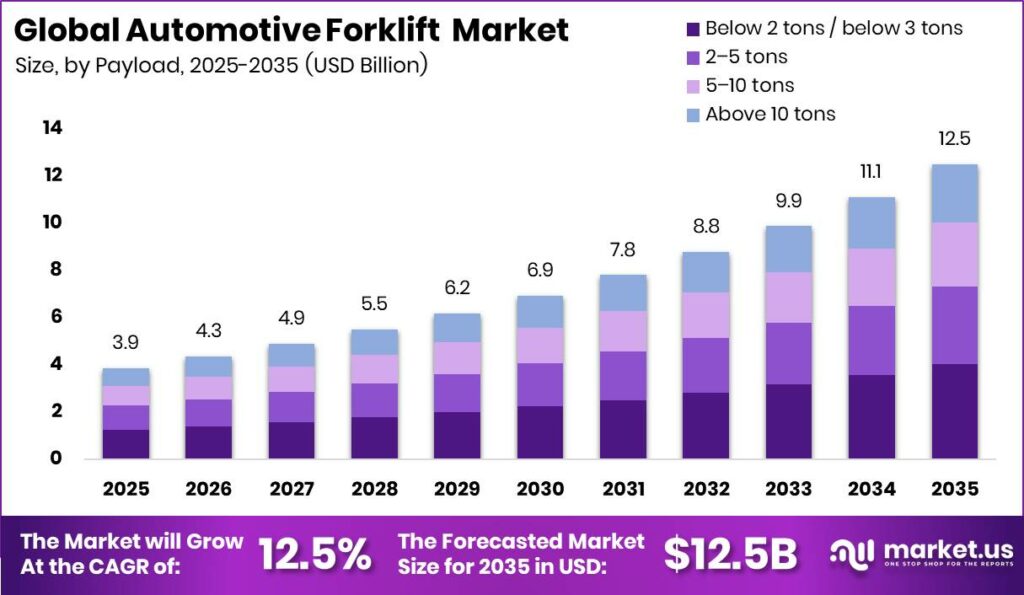
Global Autonomous Forklift Market size is expected to be worth around USD 12.50 Billion by 2035 from USD 3.90 Billion in 2025, growing at a CAGR of 12.5% during the forecast period 2026 to 2035. This growth reflects rapid warehouse automation across logistics and manufacturing. Companies entering now can capture share before the market matures and pricing pressure intensifies.
Autonomous forklifts are self-driving industrial trucks that move, lift, and stack loads without human operators. The market structures around vehicle type, payload capacity, navigation technology, application, and end-user industry. Therefore, buyers evaluate systems by fit against warehouse layout and throughput needs. This structure rewards suppliers who tailor navigation and payload options to specific operational settings rather than selling one generic platform.
Key Takeaways
- Global Autonomous Forklift Market size will reach USD 12.50 Billion by 2035 from USD 3.90 Billion in 2025 at a CAGR of 12.5%.
- Counterbalance Forklifts led the By Type segment with a 27.1% share in 2025.
- Below 2 tons capacity dominated the By Payload segment with a 32.1% share.
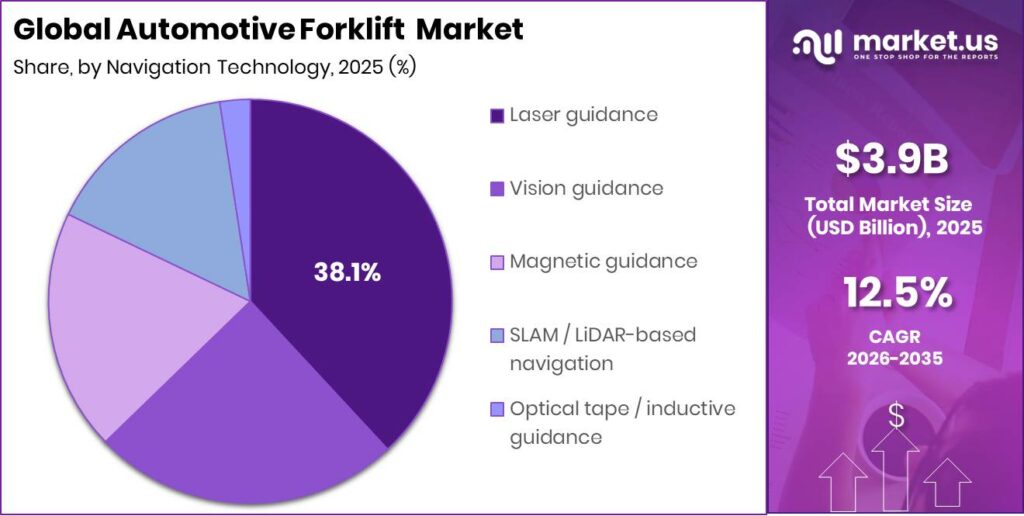
- Laser guidance held the By Navigation Technology segment with a 38.1% share.
- Warehousing captured the By Application segment with a 52.3% share.
- E-commerce and retail led the By End-user segment with a 32.2% share.
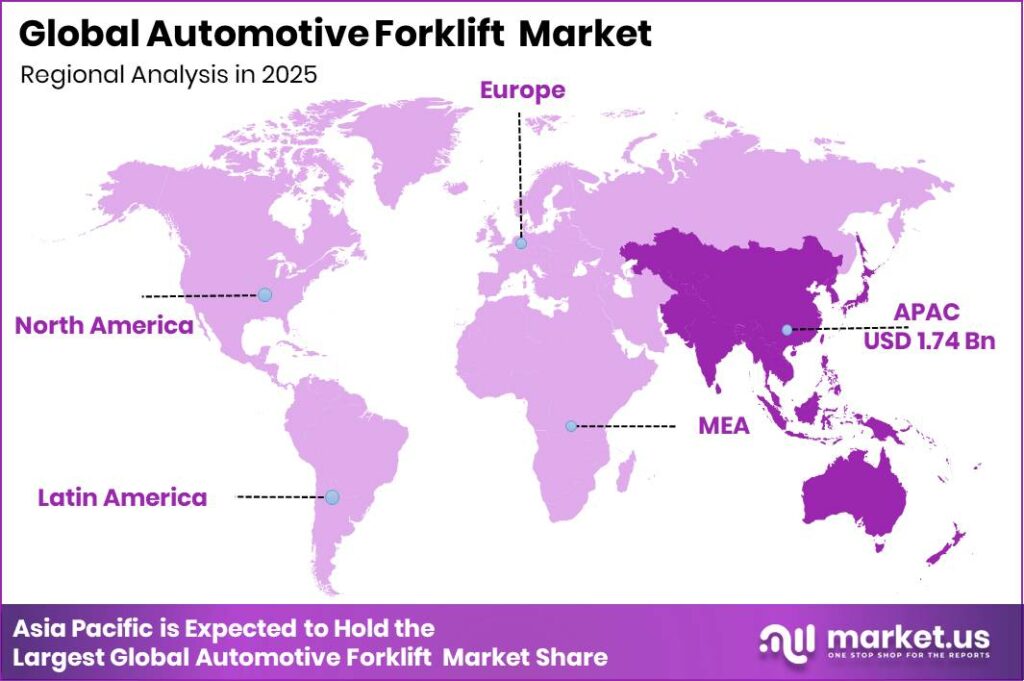
- Asia Pacific dominated globally with a 45.1% share, valued at USD 1.74 Billion.
Government safety mandates and industrial automation incentives push adoption forward across major economies. Regulators in North America and Europe tighten powered-truck safety rules, raising the appeal of driverless systems. Consequently, operators view autonomous fleets as a compliance path, not just a productivity tool. This shift moves purchasing decisions from plant managers toward safety and risk officers with larger budgets.
Cyngn reported a 33% productivity increase after deploying its self-driving industrial vehicles in a 2025 customer operation. This gain shows autonomous handling directly lifts throughput per shift. As a result, warehouse operators can justify capital spend against measurable output rather than speculative savings. Vendors who publish verified productivity data will win faster procurement approval than those relying on generic claims.
A 2025 manufacturer analysis found autonomous forklifts with lithium-ion systems and predictive maintenance lower operating costs by 20% to 30% versus traditional units. Lower running costs shorten payback and strengthen the investment case. In July 2025, Cyngn completed a US$32 Million financing round, extending its runway through 2027 to accelerate deployments. This means well-funded players can scale production while cost-pressured buyers still hesitate.
Type Analysis
Counterbalance Forklifts dominates with 27.1% due to versatile indoor load handling.
In 2025, Counterbalance Forklifts held a dominant market position in the By Type segment of Autonomous Forklift Market, with a 27.1% share. SEER Robotics lists a maximum autonomous driving speed of 2 metres per second under both unloaded and fully loaded conditions. This steady speed supports predictable cycle times in mixed warehouse zones. Buyers favor counterbalance units because they handle diverse loads without specialized racking, easing adoption.
Reach trucks serve high-bay storage where vertical space matters more than floor speed. Narrow-aisle autonomous operations use aisles measuring 2 to 3 metres and generally require single-direction traffic with centimetre-level positioning. This precision lets operators raise storage density without new construction. Therefore, suppliers offering tight-aisle navigation unlock retrofit demand in space-constrained urban warehouses.
Pallet jacks and order pickers cover lighter, repetitive transport tasks across shorter distances. These units suit high-frequency picking lines where speed and simple routing outweigh lifting height. This means labor-intensive picking operations gain the fastest return from low-cost automation. Stacker forklifts hold the remaining share collectively, serving mid-height stacking niches where full counterbalance capacity is unnecessary.
Payload Analysis
Below 2 tons dominates with 32.1% due to high-frequency light load cycles.
In 2025, Below 2 tons held a dominant market position in the By Payload segment of Autonomous Forklift Market, with a 32.1% share. A 2026 peer-reviewed taxonomy classifies payloads as light below 1 metric ton, medium at 1 to 3 metric tons, and heavy above 3 metric tons. This structure guides buyers toward right-sized fleets. Light-payload demand concentrates in e-commerce where fast, frequent moves matter more than lifting mass.
The 2 to 5 ton class serves general warehousing and mixed manufacturing loads. SEER Robotics offers an autonomous pallet truck with a rated load capacity of 2 metric tons, covering this mid-range demand. This capacity range balances throughput with cost, fitting most standard pallet operations. Consequently, suppliers targeting this band reach the broadest installed base of conventional forklift replacement.
Heavier classes above 5 tons handle bulk industrial and freight loads requiring reinforced chassis and stronger drive systems. These units command higher prices and slower adoption due to engineering complexity. This means vendors serving heavy payloads compete on durability rather than volume. The 5 to 10 tons and Above 10 tons classes hold the remaining share collectively across specialized industrial sites.
Laser guidance dominates with 38.1% due to proven high-accuracy indoor positioning.
In 2025, Laser guidance held a dominant market position in the By Navigation Technology segment of Autonomous Forklift Market, with a 38.1% share. Deep-learning vision systems used by autonomous forklifts have achieved recognition rates above 98% for perception and pallet-handling applications. This reliability reduces mis-picks and downtime. Buyers trust laser and vision systems because proven accuracy limits costly handling errors on busy floors.
SLAM and LiDAR-based navigation ranks as the fastest-growing sub-segment because it removes fixed infrastructure needs. Autonomous planning methods have reduced mission completion times by between 2% and 55%, according to a 2026 systematic review. This range shows software-led navigation lifts throughput sharply. Therefore, operators wanting flexible layouts increasingly choose SLAM over rigid guided paths.
Vision guidance and magnetic guidance serve mid-tier deployments where cost and simplicity guide the choice. Magnetic systems suit fixed routes, while vision fits changing environments. This means buyers trade flexibility against installation cost when selecting these methods. Optical tape and inductive guidance hold the remaining share collectively across legacy sites retaining older infrastructure.
Application Analysis
Warehousing dominates with 52.3% due to repetitive high-volume pallet transport.
In 2025, Warehousing held a dominant market position in the By Application segment of Autonomous Forklift Market, with a 52.3% share. Multi-forklift coordination strategies have reduced mission-completion time by as much as 45% through hierarchical conflict resolution. This gain matters most in dense warehouse traffic. Warehouse operators adopt fleets fastest because coordinated routing directly raises daily throughput and order accuracy.
Manufacturing applications value continuous line feeding and predictable material flow between stations. Current research deployments typically involve only 2 to 50 vehicles, whereas large industrial warehouses may require coordination of hundreds. This gap shows scaling headroom in large plants. Consequently, suppliers who master large-fleet orchestration will capture the biggest manufacturing contracts.
Material handling and logistics and freight cover inbound and outbound movement across docks and yards. These tasks reward reliable point-to-point transport over complex lifting. This means straightforward routing systems win in freight-heavy sites. Others such as loading and unloading hold the remaining share collectively across specialized dock and terminal operations.
End-user Analysis
E-commerce and retail dominates with 32.2% due to fast order fulfilment pressure.
In 2025, E-commerce and retail held a dominant market position in the By End-user segment of Autonomous Forklift Market, with a 32.2% share. Evaluated autonomous safety frameworks reduced rollover risk by 53% to 59% in tested conditions. This safety gain protects high-traffic fulfilment floors. E-commerce operators adopt fastest because volume spikes demand round-the-clock handling that manual crews cannot sustain.
Transportation and logistics providers deploy autonomous fleets to standardize handling across many client sites. Uniform automation lets them scale service without proportional labor growth. This means logistics firms gain margin as order volume rises faster than headcount. Manufacturing end-users follow closely, integrating forklifts into continuous production for steady internal material flow.
Food and beverage, automotive, and pharmaceuticals bring strict handling and traceability needs. Cold-chain and pharmaceutical buyers demand precise, contamination-controlled movement. This means suppliers with certified, temperature-tolerant systems command premium pricing. These three verticals hold the remaining share collectively across regulated, quality-sensitive operations.
Key Market Segments
By Type
- Counterbalance Forklifts
- Pallet Jacks
- Reach Trucks
- Order Pickers
- Stacker Forklifts
By Payload
- Below 2 tons
- 2–5 tons
- 5–10 tons
- Above 10 tons
By Navigation Technology
- Laser guidance
- Vision guidance
- Magnetic guidance
- SLAM / LiDAR-based navigation
- Optical tape / inductive guidance
By Application
- Warehousing
- Manufacturing
- Material handling
- Logistics and freight
- Others (Loading, unloading, etc.)
By End-user
- Transportation and logistics
- Manufacturing
- E-commerce and retail
- Food and beverage
- Automotive
- Pharmaceuticals / cold chain
Regional Analysis
Asia Pacific Dominates the Autonomous Forklift Market with a Market Share of 45.1%, Valued at USD 1.74 Billion
Asia Pacific led the Autonomous Forklift Market with a 45.1% share, valued at USD 1.74 Billion in 2025. Dense manufacturing bases in China, Japan, and South Korea drive concentrated demand. This scale lets regional suppliers lower unit costs faster than smaller markets. As a result, global vendors must localize production in Asia Pacific to compete on price and delivery speed.
Europe advances quickly as safety regulation and labor costs push automation across brownfield sites. In April 2026, Toyota Material Handling Europe launched Swarm Automation Storage, enabling coordinated operation of autonomous forklifts and AGVs through one fleet system. This launch signals demand for unified control in dense European warehouses. Therefore, suppliers offering integrated orchestration gain an edge across the region.
North America and Latin America expand on e-commerce growth and warehouse modernization. North American operators prioritize labor replacement, while Latin American buyers weigh financing access. This means flexible leasing models unlock demand in cost-sensitive markets. The Middle East and Africa region grows steadily, led by Gulf logistics hubs investing in port and cold-chain automation.
Key Regions and Countries
North America
- US
- Canada
Europe
- Germany
- France
- The UK
- Spain
- Italy
- Rest of Europe
Asia Pacific
- China
- Japan
- South Korea
- India
- Australia
- Rest of APAC
Latin America
- Brazil
- Mexico
- Rest of Latin America
Middle East and Africa
- GCC
- South Africa
- Rest of MEA
Market Dynamics
Market Opportunity Analysis - Underserved payload classes, cold chain, and emerging-market leasing open new entry points
The Above 10 tons payload class remains underexploited because engineering complexity slows supplier entry. Heavy industrial and freight sites still rely on manual heavy trucks despite clear automation gains. This means early movers offering reinforced autonomous units face limited direct competition. Consequently, vendors who solve heavy-load reliability can command premium pricing in ports, metals, and construction materials handling.
Pharmaceuticals and cold chain sit inside the smaller end-user cluster holding the remaining share, yet demand precise handling. Regulated storage needs temperature-tolerant, contamination-controlled systems that few suppliers offer today. This creates a defensible niche for certified autonomous handling. Therefore, entrants with validated cold-chain designs can lock in high-margin contracts before larger rivals adapt.
Magnetic guidance and optical tape systems serve legacy sites that laser and SLAM leaders often overlook. These older facilities cannot fund full navigation upgrades in one step. This means low-cost upgrade paths open a large retrofit base. As a result, suppliers offering phased migration from tape to vision can capture buyers stalled between old and new systems.
Latin America and the Middle East and Africa remain underpenetrated because financing access limits outright purchases. Buyers there hesitate at high upfront costs despite strong logistics growth. This signals demand for leasing and pay-per-use models. Instead of selling hardware, vendors offering flexible leasing can unlock volume across these price-sensitive but expanding regions.
Technology and Innovation Landscape - Continuous operation, precision localization, and smart planning redefine competitive edges
Autonomous forklifts can operate continuously for 24 hours per day, subject only to charging or battery-swapping needs, removing operator breaks and shift-change downtime. This uptime directly raises daily output per vehicle. As a result, operators recover capital faster through round-the-clock utilization. Suppliers who guarantee minimal charging interruption gain a clear edge in high-volume, multishift facilities.
Cyngn’s autonomous DriveMod forklift reaches 4.5 mph in autonomous mode versus a manual maximum of 11 mph. This deliberate speed limit prioritizes safety in shared human zones. This means buyers trade raw speed for predictable, incident-free operation. Therefore, vendors marketing controlled, verifiable speed profiles appeal to safety-focused facilities managing mixed pedestrian and vehicle traffic.
State-of-the-art localization has achieved accuracy of ±1.4 millimetres, while AiTEN’s hybrid-navigation system reaches ±5 millimetres positioning. This precision enables tight racking and dense storage without collisions. Consequently, warehouses raise capacity within existing footprints. Suppliers delivering millimetre-level accuracy help operators defer costly expansion, turning navigation precision into a direct space-saving selling point.
Hierarchical planning frameworks have produced performance improvements of 15% to 55% in autonomous operations. This wide gain shows software, not just hardware, now drives competitive advantage. This means fleet intelligence increasingly determines throughput. Therefore, vendors investing in advanced planning algorithms can differentiate on performance even when their physical vehicles closely resemble those of rivals.
Drivers
Persistent warehouse recruitment pressure is shifting autonomous forklifts from innovation budgets into labor-productivity programs. The U.S. Bureau of Labor Statistics recorded a median material-mover wage of $18.12 per hour in May 2024 and projects roughly 1,008,300 annual openings over 2024 to 2034. Market.us reported approximately 205,000 new professional service robots in 2023, up 30% year over year. This scarcity forces operators toward automation to protect throughput.
Replacing repetitive pallet transport with autonomous operation can remove 1.5 to 2.5 operator-equivalents per vehicle. This shift extends productive utilization from roughly 40% to 55% toward 65% to 80% and cuts labor cost per pallet movement by an estimated 20% to 35%. As a result, the model moves toward robotics-as-a-service and recurring subscriptions, supporting an estimated +2.4% contribution to the 12.5% CAGR.
| Driver | (~) % Impact on CAGR Forecast | Geographic Relevance | Impact Timeline |
|---|---|---|---|
| Warehouse Labor Replacement Economics | +2.4% | North America, Western Europe, Japan, South Korea | Short term (2 years or less) |
| Forklift Safety Automation | +1.8% | Global, led by North America and Europe | Short term (2 years or less) |
| E-Commerce Fulfilment Intensity | +1.5% | North America, Europe, China, India, Southeast Asia | Medium term (2 to 4 years) |
| Twenty-Four-Hour Manufacturing Operations | +1.2% | China, Japan, South Korea, Germany, United States | Medium term (2 to 4 years) |
| Brownfield Navigation Improvements | +0.9% | Global industrial and logistics hubs | Short term (2 years or less) |
| Fleet-Orchestration Software Adoption | +0.7% | North America, Europe, East Asia | Medium term (2 to 4 years) |
Restraints
The principal sales restraint is not the vehicle alone but the combined cost of site mapping, wireless coverage, charging infrastructure, safety validation, and commissioning. ISO specifies formal safety requirements for driverless industrial trucks under ISO 3691-4:2023, while OSHA requires controlled environments and trained personnel. The European Agency for Safety and Health at Work notes that Regulation (EU) 2023/1230 applies from 20 January 2027. These layers slow small-operator purchasing decisions.
These integration layers can add an estimated 20% to 45% above vehicle acquisition cost and extend pilot-to-production cycles by roughly 6 to 15 months. This pushes acceptable payback beyond 36 months at low-throughput sites. Consequently, smaller operators defer orders and suppliers face margin compression of roughly 3 to 7 percentage points, producing an estimated -2.2% deduction from the baseline CAGR.
| Restraint | (~) % Impact on CAGR Forecast | Geographic Relevance | Impact Timeline |
|---|---|---|---|
| High Upfront Integration Cost | -2.2% | Global, especially small and midsized operators | Short term (2 years or less) |
| Elevated Industrial Borrowing Costs | -1.6% | Europe, North America, emerging markets | Short term (2 years or less) |
| Incompatible Brownfield Infrastructure | -1.3% | Europe, North America, Japan | Medium term (2 to 4 years) |
| Battery Import Tariffs | -0.9% | United States and China-linked supply chains | Short term (2 years or less) |
| Long Customer Payback Thresholds | -0.8% | Price-sensitive emerging and regional markets | Medium term (2 to 4 years) |
| Cybersecurity Procurement Holds | -0.6% | Critical infrastructure and regulated industries | Short term (2 years or less) |
Challenges
Autonomous forklifts must continuously distinguish pedestrians, manual trucks, pallets, and racks while carrying elevated loads. ISO 3691-4:2023 requires verification of driverless trucks, and the U.S. National Safety Council recorded 67 worker deaths involving forklifts in 2023. OSHA estimates roughly 34,900 serious forklift injuries annually, with tip-overs causing about 42% of fatalities, plus 2,248 powered-truck violations in fiscal 2024. This makes safety assurance materially harder.
Site-specific validation can require thousands of scenario tests, speed reductions of roughly 20% to 40% in shared zones, and safety buffers that lower throughput by 10% to 25%. This friction slows deployment without stopping current sales. Therefore, manufacturers must invest in redundant lidar, certified braking, and near-miss telemetry, creating an estimated -1.9% drag on maximum CAGR potential. This opens a paid safety-certification revenue stream.
| Challenge | (~) % CAGR Friction Drag | Geographic Relevance | Mitigation Horizon |
|---|---|---|---|
| Mixed-Traffic Safety Validation | -1.9% | Global warehouses and factories | Medium term (2 to 4 years) |
| Systems Integration Complexity | -1.5% | Global brownfield facilities | Medium term (2 to 4 years) |
| Skilled Integrator Shortage | -1.2% | North America, Europe, India, Southeast Asia | Long term (4 years or more) |
| Battery Component Volatility | -1.0% | Global, concentrated in import-dependent markets | Medium term (2 to 4 years) |
| Navigation Edge Cases | -0.8% | Cold storage, outdoor yards, heavy manufacturing | Long term (4 years or more) |
| Interoperability Standard Fragmentation | -0.7% | Europe, North America, East Asia | Long term (4 years or more) |
Opportunities
Retrofit subscriptions remain white space because most deployments still rely on purpose-built vehicles and engineering-led projects. Market.us characterizes autonomous mobile robots as an established, expanding category and reported 30% growth in new professional service robots during 2023. ISO’s 2023 driverless-truck standard gives a safety architecture for reusable kits. The European Agency for Safety and Health at Work confirms the Machinery Regulation applies on 20 January 2027, creating a clear compliance target.
A hardware-plus-software retrofit could cut initial vehicle-related spend by an estimated 25% to 40% and shorten installation from roughly 12 to 20 weeks down to 4 to 8 weeks. This shift moves 15% to 25% of contract value into recurring fees and could lift gross margins by 4 to 8 percentage points. As a result, successful execution could add around +1.9% upside above the baseline 12.5% CAGR.
| Opportunity | (~) % Potential CAGR Upside | Geographic Relevance | Execution Window |
|---|---|---|---|
| Autonomy Retrofit Subscription Kits | +1.9% | Global installed forklift fleets | Medium term (2 to 4 years) |
| Outdoor Yard Autonomy | +1.6% | Ports, construction materials, automotive, metals | Long term (4 years or more) |
| Cold-Chain Autonomous Handling | +1.3% | North America, Europe, East Asia, Gulf states | Medium term (2 to 4 years) |
| Emerging-Market Leasing Platforms | +1.1% | India, Southeast Asia, Latin America, Middle East | Medium term (2 to 4 years) |
| Shared Multi-OEM Control Layers | +0.9% | Large global enterprises and logistics providers | Long term (4 years or more) |
| Autonomous Fleet Data Services | +0.7% | Digitally mature logistics and manufacturing markets | Medium term (2 to 4 years) |
Key Company Insights
Toyota Industries Corporation holds a structural advantage through its scale and broad material-handling portfolio. In January 2025, Toyota Material Handling North America completed the integration of The Raymond Corporation, expanding its warehouse automation range. This consolidation strengthens its direct distribution and service network. However, a conventional forklift still costs between US$15,000 and US$50,000, so Toyota must prove autonomy value against cheaper manual units.
KION Group AG competes on integrated warehouse automation, pairing forklifts with software and logistics systems. This bundled approach locks customers into a single supplier ecosystem across hardware and control layers. As a result, KION gains recurring revenue and higher switching costs among large operators. However, this breadth raises complexity, leaving room for focused rivals to win price-sensitive buyers with simpler, faster deployments.
Key Players
- Toyota Industries Corporation
- KION Group AG
- Jungheinrich AG
- Mitsubishi Logisnext Co., Ltd.
- Hyster-Yale Materials Handling, Inc.
- Crown Equipment Corporation
- AGILOX Services GmbH
- Seegrid Corporation
- Balyo SA
- Hangcha Group Co., Ltd.
- Swisslog Holding AG
- HD Hyundai Construction Equipment
- Vecna Robotics
- OTTO Motors (Rockwell Automation)
- VisionNav Robotics
Recent Developments
- January 2025: Cyngn raised US$33 Million to scale production and commercial deployment of its DriveMod autonomous forklifts and autonomous industrial vehicles.
- August 2025: Toyota Material Handling launched a new IP69-rated lithium-ion battery platform for electric forklift fleets, designed to improve uptime in automated material handling operations.
Geopolitical Impact Analysis
Escalating trade tensions directly raise autonomous forklift costs through battery and component tariffs. According to the WTO, world merchandise trade volume growth stayed weak near 2.7% in 2024 amid rising protectionism, tightening supply chains. The IEA reports lithium-ion battery demand rose more than 25% in 2024, straining sourcing for electric fleets. This means suppliers dependent on imported cells face pricing pressure and longer procurement cycles.
Supply chain rerouting and shipping disruption lengthen delivery times for imported drive systems and sensors. As reported by UNCTAD, Red Sea diversions cut Suez Canal transits by over 40% in early 2024, adding roughly 10 to 14 days to some Asia-Europe routes. These delays raise landed costs for components sourced across regions. Consequently, manufacturers accelerate regional production and dual sourcing to protect delivery reliability and margins.
Report Scope
| Report Features | Description |
|---|---|
| Market Value (2025) | USD 3.90 Billion |
| Forecast Revenue (2035) | USD 12.50 Billion |
| CAGR (2026-2035) | 12.5% |
| Base Year for Estimation | 2025 |
| Historic Period | 2020-2024 |
| Forecast Period | 2026-2035 |
| Report Coverage | Revenue Forecast, Market Dynamics, Market Opportunity Analysis, Technology and Innovation Landscape, Competitive Landscape, Recent Developments |
| Segments Covered | By Type (Counterbalance Forklifts, Pallet Jacks, Reach Trucks, Order Pickers, Stacker Forklifts), By Payload (Below 2 tons, 2–5 tons, 5–10 tons, Above 10 tons), By Navigation Technology (Laser guidance, Vision guidance, Magnetic guidance, SLAM / LiDAR-based navigation, Optical tape / inductive guidance), By Application (Warehousing, Manufacturing, Material handling, Logistics and freight, Others), By End-user (Transportation and logistics, Manufacturing, E-commerce and retail, Food and beverage, Automotive, Pharmaceuticals / cold chain) |
| Regional Analysis | North America (US and Canada), Europe (Germany, France, The UK, Spain, Italy, and Rest of Europe), Asia Pacific (China, Japan, South Korea, India, Australia, and Rest of APAC), Latin America (Brazil, Mexico, and Rest of Latin America), Middle East and Africa (GCC, South Africa, and Rest of MEA) |
| Competitive Landscape | Toyota Industries Corporation, KION Group AG, Jungheinrich AG, Mitsubishi Logisnext Co., Ltd., Hyster-Yale Materials Handling, Inc., Crown Equipment Corporation, AGILOX Services GmbH, Seegrid Corporation, Balyo SA, Hangcha Group Co., Ltd., Swisslog Holding AG, HD Hyundai Construction Equipment, Vecna Robotics, OTTO Motors (Rockwell Automation), VisionNav Robotics |
| Customization Scope | Customization for segments, region / country-level will be provided. Additional customization can be done based on requirements. |
| Purchase Options | We have three licenses to opt for: Single User License | Multi-User License (Up to 5 Users) | Corporate Use License (Unlimited User and Printable PDF) |





































