Report Overview
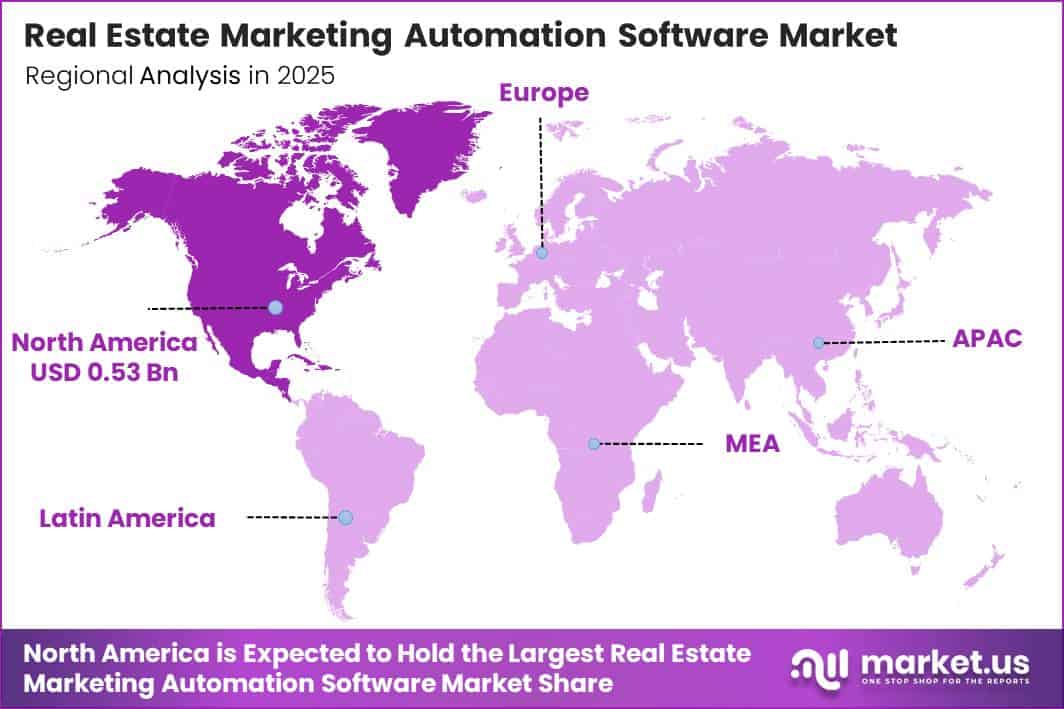
In 2025, the Global Real Estate Marketing Automation Software Market was valued at USD 1.3 billion. The market is projected to grow at a CAGR of 14.8% during 2026–2035, reaching approximately USD 5.2 billion by 2035. North America dominated the global market in 2025, accounting for more than 40.9% of the total market share and generating approximately USD 0.54 billion in revenue.
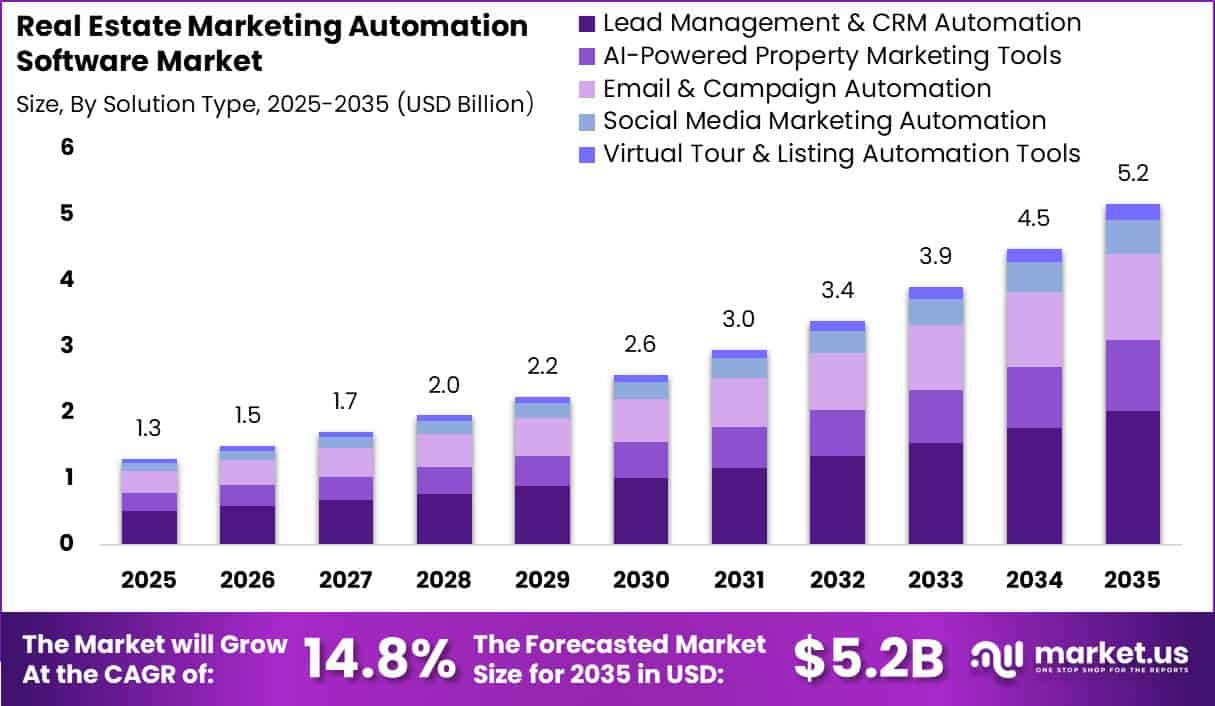
Growth is supported by the large scale of the real estate industry, which contributes around 15–18% of U.S. GDP when residential investment and housing-related consumer spending are combined. In 2025, U.S. builders started approximately 1.3 million housing units, while the annualized construction rate reached 1.4 million units in December 2025.
In addition, nearly 4.06 million existing homes were sold during 2025. This high volume of construction, property listings, buyer inquiries, and transactions is encouraging real estate agencies to automate lead management, email campaigns, property recommendations, customer follow-ups, and sales tracking.
Long-term market expansion is also supported by global urbanization. The United Nations estimates that 68% of the global population will live in urban areas by 2050, compared with 55% currently. This shift is expected to add nearly 2.5 billion urban residents over the next 25 years, with almost 90% of the increase occurring in Asia and Africa.
Key Takeaway
- Market valued at USD 1.3 billion in 2025, projected to reach USD 5.2 billion by 2035 at a 14.8% CAGR.
- Lead Management and CRM Automation led the solution type segment with a 39.4% share.
- Cloud-based platforms dominated deployment mode with a 74.6% share.
- AI and Machine Learning Analytics led the technology segment with a 36.8% share.
- Residential Real Estate Marketing led the application segment with a 41.2% share.
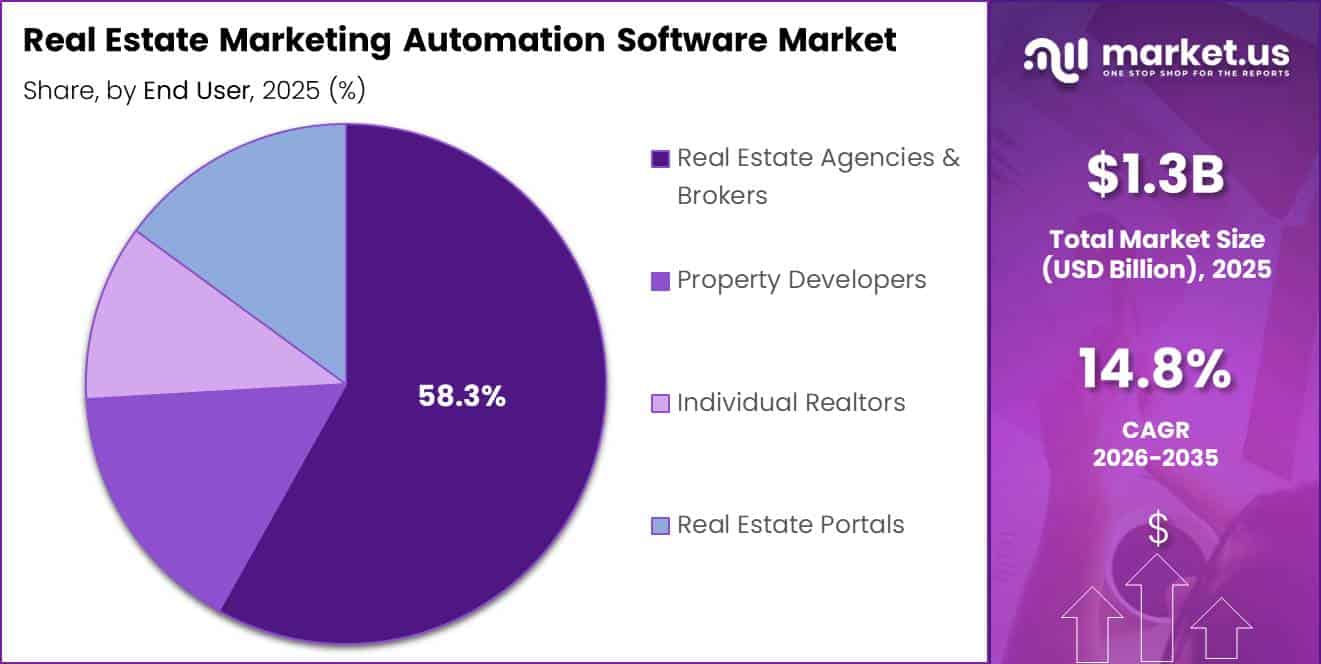
- Real Estate Agencies and Brokers led the end-user segment with a 58.3% share.
- Large Real Estate Firms led the organization size segment with a 62.1% share.
- Email Marketing led the marketing channel segment with a 34.7% share.
- Lead Generation and Nurturing led the function segment with a 43.8% share.
- North America led the market with a 40.9% share, generating USD 0.5 billion in 2025.
By Solution Type
Lead Management and CRM Automation held the leading position in the Real Estate Marketing Automation Software Market, accounting for a 39.4% share. Its dominance is mainly linked to the growing productivity challenges faced by real estate agents. However, more than 923,000 members, representing 71.1%, completed zero property sales during the year.
AI-Powered Property Marketing Tools are expected to be the fastest-growing category. Their growth is supported by rising demand for personalized property descriptions, digital advertisements, listing photographs, videos, and virtual tours. In 2025, approximately 1.4 million housing units were authorized through building permits in the United States.
By Deployment Mode
Cloud-based platforms held a dominant position in the Real Estate Marketing Automation Software Market, accounting for a 74.6% share. This strong adoption is mainly supported by the fragmented and mobile structure of the U.S. real estate brokerage industry. In 2025, real estate employees worked from home for an average of 29.3% of their paid working days, according to Federal Reserve data.
This flexible working model makes traditional on-premises software less practical, as agents require immediate access to property listings, customer records, lead alerts, and marketing campaign information across smartphones, laptops, and tablets. Cloud-based platforms store information on centralized remote servers, allowing teams to access and update data from different locations in real time.
By Technology
AI and Machine Learning Analytics held a dominant position in the Real Estate Marketing Automation Software Market, accounting for a 36.8% share. Its leadership is supported by the growing importance of accurate property pricing and buyer-behavior analysis. In late 2025, homes sold for a median of 99% of their listing price but remained on the market for around four weeks.
This shows that even small pricing errors can increase selling time and reduce returns for property owners. Machine learning tools help agents analyze comparable property sales, local demand, buyer searches, and customer engagement in real time. With 52% of buyers finding homes online, these tools allow brokerages to adjust prices, advertisements, and lead targeting based on current digital activity rather than relying mainly on manual estimates.
Generative AI for Listings is expected to be the fastest-growing segment. Its expansion is driven by the need to create personalized property descriptions, advertisements, images, and promotional content across multiple digital formats. Around 70% of buyers search for properties using mobile phones or tablets, increasing the need for content that can be quickly adapted to smaller screens and different platforms.
In addition, the median seller tenure reached 11 years, indicating that many owners are returning to the market after more than a decade. Generative AI helps agents create fresh and property-specific marketing content instead of depending on repeated templates.
By Application
Residential Real Estate Marketing held a dominant position in the Real Estate Marketing Automation Software Market, accounting for a 41.2% share. Its leadership is mainly supported by the large size of the residential property sector. As of early 2026, the United States had approximately 133.6 million households, while the homeownership rate reached 65.7% in Q4 2025. This large base of owner-occupied properties creates continuous demand for listing, resale, refinancing, and customer engagement activities.
Residential market turnover is also being influenced by changing household structures. The number of one-person households increased to 39.7 million, representing 29% of all households, compared with only 20% in 1975. This shift is supporting demand for smaller housing units and increasing the number of individual property listings that require targeted digital marketing.
Property Listing Optimization is expected to be the fastest-growing segment. Its expansion is supported by rising competition in the rental market, as the U.S. rental vacancy rate reached 7.2% in Q4 2025. Higher vacancy levels encourage landlords, property managers, and agents to improve listing visibility and reduce the time properties remain unoccupied.
By End User
Real Estate Agencies and Brokers held a dominant position in the Real Estate Marketing Automation Software Market, accounting for a 58.3% share. Their leadership is supported by the large workforce directly involved in property promotion, customer communication, and sales activities. In 2025, the United States had approximately 456,000 full-time wage-and-salary real estate brokers and sales agents.
Each professional typically manages several property listings, buyer inquiries, client relationships, and follow-up tasks at the same time. The industry is also expected to record around 46,300 job openings annually through 2034. As agencies continue to recruit new professionals, marketing automation software helps reduce repetitive work, improve lead response times, and allow new employees to become productive more quickly.
Property Developers are expected to be the fastest-growing end-user segment. In 2025, approximately 1,497,800 housing units were completed in the United States. Unlike brokers who may market individual resale properties, developers often need to promote several units within the same building, housing project, or residential community at once.
By Organization Size
Large Real Estate Firms held a dominant position in the Real Estate Marketing Automation Software Market, accounting for a 62.1% share. Their leadership is mainly supported by high transaction volumes, large agent networks, and the ability to invest in enterprise-level software.
SMEs and Independent Agents are expected to be the fastest-growing segment. According to the U.S. Small Business Administration’s Office of Advocacy, 99.9% of American businesses, including most real estate firms, are classified as small businesses with fewer than 500 employees. In addition, approximately 54% of real estate brokers and agents are self-employed and often depend on commission-based income without employee benefits.
By Marketing Channel
Email Marketing held a dominant position in the Real Estate Marketing Automation Software Market, accounting for a 34.70% share. Its leadership is supported by the need for brokerages to manage large email campaigns while meeting federal compliance requirements. Under the FTC’s CAN-SPAM Act, commercial emails must include accurate sender information, clear opt-out options, and unsubscribe requests must be processed within 10 business days.
Violations may result in penalties of up to USD 53,088 for each non-compliant email. Managing these requirements manually across thousands of customer and prospect messages can increase legal and operational risks. Email marketing automation platforms help brokerages maintain subscriber records, process opt-outs, schedule campaigns, personalize messages, and monitor compliance more efficiently.
By Function
Lead Generation and Nurturing held a dominant position in the Real Estate Marketing Automation Software Market, accounting for a 43.80% share. Its leadership is mainly supported by the low conversion rate of online property inquiries. According to National Association of Realtors data, online leads convert at only 0.4% to 1.2%, which means agents may need to manage nearly 100 inquiries to complete 1 transaction.
Listed homes also receive an average of 2.3 offers per sale. Managing large volumes of prospects, follow-ups, and competing offers manually can therefore become difficult. Automated nurturing platforms help brokerages score leads, send scheduled messages, track customer activity, and identify prospects with a higher likelihood of conversion.
Customer Engagement and Retargeting is expected to be the fastest-growing function. Only 5% of buyers complete a home purchase based entirely on virtual tours, indicating that the remaining 95% generally require additional communication, property visits, reminders, and repeated engagement before making a decision. First-time buyers also represented 30% of property purchases, compared with 26% in the previous year.
Key Market Segments
By Solution Type
- Lead Management & CRM Automation
- AI-Powered Property Marketing Tools
- Email & Campaign Automation
- Social Media Marketing Automation
- Virtual Tour & Listing Automation Tools
By Deployment Mode
- Cloud-Based Platforms
- On-Premises Solutions
By Technology
- AI & Machine Learning Analytics
- Generative AI for Listings & Content
- Predictive Lead Scoring
- Marketing Automation Workflows
By Application
- Residential Real Estate Marketing
- Commercial Real Estate Marketing
- Property Listing Optimization
- Tenant Acquisition & Retention
By End User
- Real Estate Agencies & Brokers
- Property Developers
- Individual Realtors
- Real Estate Portals
By Organization Size
- Large Real Estate Firms
- SMEs & Independent Agents
By Marketing Channel
- Email Marketing
- Digital Advertising Automation
- Social Media Campaigns
- SMS & WhatsApp Marketing
By Function
- Lead Generation & Nurturing
- Customer Engagement & Retargeting
- Analytics & Performance Tracking
Geopolitical Impact Analysis
Geopolitical conditions are creating cost and supply risks for the Real Estate Marketing Automation Software Market because these platforms depend heavily on cloud infrastructure, data centers, AI processors, and semiconductor-based hardware. The World Trade Organization expects global merchandise trade growth to slow from 4.6% in 2025 to 1.9% in 2026.
Growth could weaken further to 1.4% if energy disruptions in the Middle East continue. Crude oil prices have already moved above USD 116 per barrel, while Dutch TTF natural gas prices have more than doubled to nearly EUR 67 per megawatt-hour. These increases directly raise electricity, cooling, and operating costs for cloud service providers.
The International Energy Agency reported that data-center electricity demand increased by 17% in 2025. Data centers also accounted for nearly 50% of total electricity demand growth in the United States. As real estate automation platforms require continuous cloud storage, AI-based lead scoring, CRM processing, and digital advertising functions, higher power costs may be passed on to brokerages through increased subscription fees.
Trade disruptions add further pressure. A prolonged Middle East crisis could increase freight costs and reduce transshipment activity, affecting deliveries of servers, networking equipment, and data-center components from Asia. Asia is expected to record 3.3% import growth and 3.5% export growth in 2026, while North American import growth is projected at only 0.3%. Together, higher energy prices, tariffs, and slower hardware supply may raise software prices and delay product upgrades during 2026–2027.
Regional Analysis
North America held the leading position in the Real Estate Marketing Automation Software Market, accounting for a 40.9% share and generating approximately USD 0.5 billion in 2025. This dominance is supported by the region’s large property transaction base and well-developed digital brokerage network. The United States recorded 4.06 million existing home sales in 2025, representing the lowest annual level since 1995 but still creating a substantial volume of listings requiring digital promotion.
In December 2025, existing home sales reached a seasonally adjusted annual rate of 4.3 million, the fastest pace in nearly 3 years. High transaction volumes, changing 3-month housing inventory levels, and widespread adoption of cloud and CRM platforms continue to support demand for automated lead management, campaign tracking, and customer follow-up solutions.
Asia–Pacific is expected to be the fastest-growing regional market, mainly due to rapid urban development and new housing construction. The region currently has around 2.5 billion urban residents, representing nearly 50% of the global urban population. This figure is projected to reach 3.4 billion by 2050, with the region expected to add approximately 1.2 billion urban residents.
India sanctioned 122.06 lakh, or 12.2 million, urban homes under the Pradhan Mantri Awas Yojana-Urban program, while 96.0 lakh, or 9.6 million, homes had been delivered by November 2025. Housing expansion across 9 regional megacities is increasing listing and inquiry volumes, encouraging real estate firms to adopt automation software.
Key Regions and Countries
North America
- US
- Canada
Europe
- Germany
- France
- The UK
- Spain
- Italy
- Rest of Europe
Asia Pacific
- China
- Japan
- South Korea
- India
- Australia
- Rest of APAC
Latin America
- Brazil
- Mexico
- Rest of Latin America
Middle East & Africa
- GCC
- South Africa
- Rest of MEA
Market Dynamics
Drivers
| Driver | (~) % CAGR | Geographic Relevance | Impact Timeline |
|---|---|---|---|
| Shift to digital-first real estate marketing | +3.0% | North America, Europe, Asia-Pacific | Short term (≤ 2 years) |
| Accelerated adoption of immersive visuals | +2.2% | North America, Europe | Short term (≤ 2 years) |
| AI-driven audience targeting & automation | +2.0% | Global | Medium term (2–4 years) |
| Integrated CRM & marketing stacks | +1.6% | North America, Europe, Middle East | Medium term (2–4 years) |
| Mobile-first and social media engagement | +1.4% | Global (urban-focused) | Short term (≤ 2 years) |
| Regulatory focus on transparency & disclosures | +0.8% | OECD markets | Long term (≥ 4 years) |
Shift to digital-first real estate marketing
Over the 2024–2026 window, real estate marketers have been reallocating an estimated 15–25% of traditional print and outdoor budgets into digital channels such as search, social, and programmatic listing promotion as buyers increasingly start their journey online.
This shift is reinforced by evidence that enhanced digital assets significantly compress time-to-decision, with examples such as drone-enhanced listings selling up to 60–70% faster than those with basic photography, which directly raises inventory turnover and fee realization per period for agencies.
As firms embed digital-first processes into their operating models—centralized content hubs, standardized landing pages, and performance-based ad spend—they are structurally lowering cost per qualified lead by an estimated 10–20% while sustaining higher conversion rates, which in turn justifies incremental investment and supports an uplift of roughly +3.0% on the baseline 14.8% CAGR in real estate marketing solutions.
Restraints
| Restraint | (~) % CAGR | Geographic Relevance | Impact Timeline |
|---|---|---|---|
| High interest rates and housing affordability squeeze | -3.2% | North America, Europe, parts of Asia | Short term (≤ 2 years) |
| Constrained marketing budgets at small brokerages | -2.1% | Global (fragmented markets) | Short term (≤ 2 years) |
| Data privacy compliance and consent constraints | -1.6% | EU, UK, selected US states | Medium term (2–4 years) |
| Legacy dependence on offline channels | -1.4% | Emerging markets | Medium term (2–4 years) |
| Volatile residential transaction volumes | -1.3% | Global | Short term (≤ 2 years) |
| Uneven broadband and device access | -0.9% | Latin America, Africa, South Asia | Long term (≥ 4 years) |
High interest rates and housing affordability squeeze
Elevated mortgage rates and real property prices outpacing income growth since around 2023 have compressed affordability, with real house prices in many markets growing faster than real disposable income and quarterly real price increases of around 0.3% still being recorded through 2024.
As a result, transaction volumes in stressed segments can fall by high single digits year-on-year, forcing agencies and developers to freeze or cut marketing budgets by an estimated 10–20% in affected quarters to preserve cash, directly reducing spend available for advanced digital marketing tools and campaigns.
This affordability-driven volume restraint effectively clips the realizable growth of the real estate marketing segment by roughly -3.2% from the baseline CAGR, as fewer completed deals mean lower commission pools to reinvest in media, slower experimentation with new channels, and delayed rollouts of more capital-intensive creative formats such as premium video and interactive experiences.
Challenges
| Challenge | (~) % CAGR | Geographic Relevance | Mitigation Horizon |
|---|---|---|---|
| Complex multi-channel attribution | -2.4% | Global | Medium term (2–4 years) |
| Talent gap in digital marketing | -2.0% | North America, Europe, Asia-Pacific | Medium term (2–4 years) |
| Fragmented proptech and martech stacks | -1.9% | Global | Long term (≥ 4 years) |
| Evolving search and answer algorithms | -1.7% | Global | Medium term (2–4 years) |
| Content production cost inflation | -1.5% | Global | Short term (≤ 2 years) |
| Measurement of immersive experience ROI | -1.2% | North America, Europe | Long term (≥ 4 years) |
Complex multi-channel attribution
As real estate marketers deploy a wider mix of touchpoints—short-form video, social ads, email nurturing, virtual tours, and listing portals—the average buyer journey now spans well over 10 digital interactions before inquiry in many advanced markets, making it difficult to attribute closed deals to specific channels.
Without reliable multi-touch attribution models, budget allocation often defaults to last-click or portal-centric metrics, which can misallocate as much as 15–25% of monthly spend away from upper-funnel and community-based tactics that actually drive long-term pipeline, thereby depressing the realizable growth trajectory of sophisticated real estate marketing solutions by an estimated -2.4%.
Over the medium term, firms must invest in integrated analytics, standardized tracking taxonomies, and cross-channel experimentation frameworks, which add 5–10% to technology and analytics Opex for leading brokerages but gradually improve return on ad spend and stabilize growth, turning this friction into a managed—rather than structural—drag.
Opportunities
| Opportunity | (~) % CAGR | Geographic Relevance | Execution Window |
|---|---|---|---|
| Monetization of immersive and virtual experiences | +2.8% | North America, Europe, Asia-Pacific | Medium term (2–4 years) |
| Answer engine and visual search optimization services | +2.3% | Global | Medium term (2–4 years) |
| Specialized AI co-pilots for agents and developers | +2.1% | Global (tier-1 cities) | Long term (≥ 4 years) |
| Subscription-based marketing-as-a-service models | +1.9% | North America, Europe | Short term (≤ 2 years) |
| Localized data-rich community content hubs | +1.7% | Global | Medium term (2–4 years) |
| Cross-border investor and relocation campaigns | +1.3% | Europe, Middle East, Asia-Pacific | Long term (≥ 4 years) |
Monetization of immersive and virtual experiences
While virtual tours, high-quality video, and interactive 3D or AR experiences are already deployed tactically, there remains substantial untapped upside in turning these from cost centers into structured revenue-generating products—such as premium listing tiers, pay-per-view investor showcases, and bundled media packages that can lift average marketing spend per listing by an estimated 20–40%.
Evidence that listings with richer visual content sell markedly faster—for example, aerial imagery contributing to properties selling up to roughly 68% faster—suggests that agencies can credibly charge performance-linked fees or success premiums tied to reduced days-on-market, expanding gross margin on marketing services by 5–10 percentage points for adopters.
Over a 2–4-year execution window, standardizing immersive asset production pipelines, negotiating platform-level distribution deals, and integrating these packages into CRM and campaign tools can support an incremental upside of around +2.8% on top of the baseline CAGR, without requiring a proportional increase in headcount or fixed studio costs once utilization rates of these assets exceed roughly 60–70% across listings.
Key Players Analysis
Tier-1 companies include large CRM and marketing technology providers with strong financial and research capabilities. Salesforce generated USD 37.9 billion in fiscal 2025 revenue and invested USD 5.49 billion in research and development. Its Sales Cloud and Marketing Cloud platforms support AI-based lead routing, customer engagement, and campaign automation for real estate brokerages.
HubSpot reported USD 3.1 billion in full-year 2025 revenue, USD 45.9 million in net income, and 288,706 customers worldwide. Its trailing 12-month research and development spending reached USD 862 million by mid-2025, increasing 24.27% year over year and supporting the expansion of Smart CRM and customer engagement products.
Zillow Group represents the real-estate-focused Tier-1 category. The company generated USD 2.6 billion in 2025 revenue, rising 16% year over year. It also reported USD 23 million in GAAP net income and USD 622 million in Adjusted EBITDA, with a 24% margin. Zillow strengthened its automation capabilities through the 2023 acquisition of Follow Up Boss, adding CRM and lead-nurturing tools alongside dotloop and ShowingTime. Its Rentals revenue increased 45% year over year to USD 168 million in Q4 2025.
Tier-2 companies, including Real Geeks, kvCORE, BoomTown, Ylopo, Propertybase, LionDesk, Chime Technologies, and Inside Real Estate, mainly compete through specialized real estate features, flexible pricing, and industry-focused services.
Top Key Players in the Market
- HubSpot
- Salesforce
- Zoho
- Real Geeks
- kvCORE
- BoomTown
- Zillow
- Realtor.com
- Ylopo
- Follow Up Boss
- Propertybase
- LionDesk
- Chime Technologies
- Inside Real Estate
- Constant Contact
Recent Developments
- In 2025, HubSpot completed the acquisition of Frame AI on January 6 for approximately USD 60 million. Frame AI’s conversation-intelligence technology will be integrated into HubSpot’s Breeze AI platform, helping businesses combine structured CRM records with unstructured customer conversations and produce more useful sales and marketing insights.
- In 2025, Inside Real Estate acquired ListAssist on March 13 to strengthen its AI-based property search and marketing capabilities. The technology supports natural-language property searches, image recognition, and automated SEO-friendly listing descriptions. Inside Real Estate stated that its platform supported more than 400,000 agents, teams, brokerages, and franchise brands.
- In 2026, Inside Real Estate launched Streams on March 31 as an AI-powered mobile application for BoldTrail users, with expansion to BoomTown users planned afterward. The application provides real-time lead signals, AI assistance, and automatic CRM updates. Early beta users recorded 3 times more conversations and productivity improvements of up to 250%.
Report Scope
| Report Features | Description |
|---|---|
| Market Value (2025) | USD 1.3 Billion |
| Forecast Revenue (2035) | USD 5.2 Billion |
| CAGR (2026-2035) | 14.8% |
| Base Year for Estimation | 2025 |
| Historic Period | 2020–2024 |
| Forecast Period | 2026-2035 |
| Report Coverage | Revenue Forecast, Market Dynamics, Competitive Landscape, Recent Developments |
| Segments Covered | By Solution Type (Lead Management & CRM Automation, AI-Powered Property Marketing Tools, Email & Campaign Automation, Social Media Marketing Automation, Virtual Tour & Listing Automation Tools); By Deployment Mode (Cloud-Based Platforms, On-Premises Solutions); By Technology (AI & Machine Learning Analytics, Generative AI for Listings & Content, Predictive Lead Scoring, Marketing Automation Workflows); By Application (Residential Real Estate Marketing, Commercial Real Estate Marketing, Property Listing Optimization, Tenant Acquisition & Retention); By End User (Real Estate Agencies & Brokers, Property Developers, Individual Realtors, Real Estate Portals); By Organization Size (Large Real Estate Firms, SMEs & Independent Agents); By Marketing Channel (Email Marketing, Digital Advertising Automation, Social Media Campaigns, SMS & WhatsApp Marketing); By Function (Lead Generation & Nurturing, Customer Engagement & Retargeting, Analytics & Performance Tracking) |
| Regional Analysis | North America – US, Canada; Europe – Germany, France, The UK, Spain, Italy, Rest of Europe; Asia Pacific – China, Japan, South Korea, India, Australia, Singapore, Rest of APAC; Latin America – Brazil, Mexico, Rest of Latin America; Middle East & Africa – GCC, South Africa, Rest of MEA |
| Competitive Landscape | HubSpot, Salesforce, Zoho, Real Geeks, kvCORE, BoomTown, Zillow, Realtor.com, Ylopo, Follow Up Boss, Propertybase, LionDesk, Chime Technologies, Inside Real Estate, Constant Contact |
| Customization Scope | Customization for segments and region/country-level will be provided. Moreover, additional customization can be done based on the requirements. |
| Purchase Options | We have three licenses to opt for: Single User License, Multi-User License (Up to 5 Users), Corporate Use License (Unlimited Users and Printable PDF) |