


Report Overview
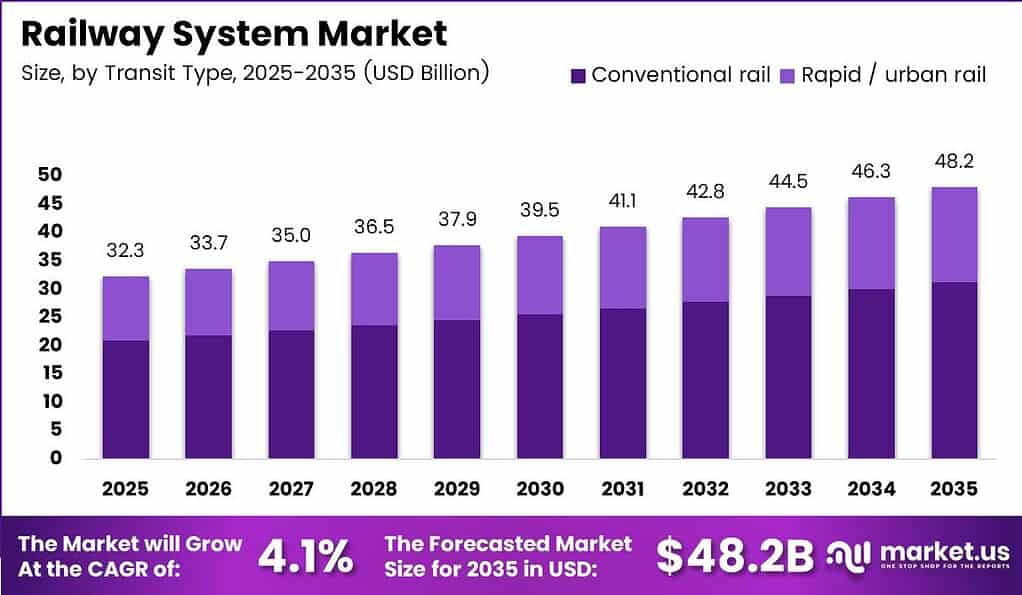
Global Railway System Market size is expected to be worth around USD 48.2 Billion by 2035 from USD 32.3 Billion in 2026, growing at a CAGR of 4.1% during the forecast period 2026 to 2035. Railway systems combine rolling stock, propulsion equipment, signalling, electrification, passenger information, safety controls, and HVAC systems. These products determine network capacity, punctuality, safety, and lifecycle costs for rail operators.
The market serves passenger railways, metro operators, freight carriers, rolling-stock manufacturers, and infrastructure owners. According to International Union of Railways, member-company passenger traffic increased 7% in 2024 from 2023 and returned to its 2019 level. Passenger recovery pushes operators to renew fleets and expand capacity. Suppliers with integrated train, signalling, and maintenance portfolios can capture higher contract values.
Key Takeaways
- The Railway System Market is valued at USD 32.3 Billion in 2026.
- The market is expected to reach USD 48.2 Billion by 2035.
- The market will expand at a CAGR of 4.1% from 2026 to 2035.
- Conventional rail holds a 64.1% share of the transit type segment in 2026.
- Propulsion systems hold a 28.9% share of the voltage class segment in 2026.
- Passenger transportation holds a 58.7% share of the application segment in 2026.
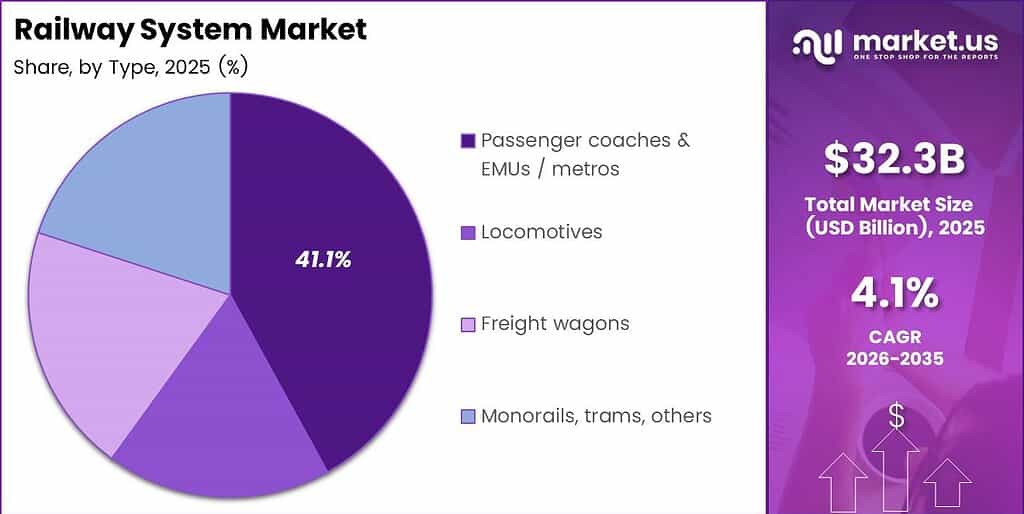
- Passenger coaches and EMUs or metros hold a 41.1% share of the type segment in 2026.
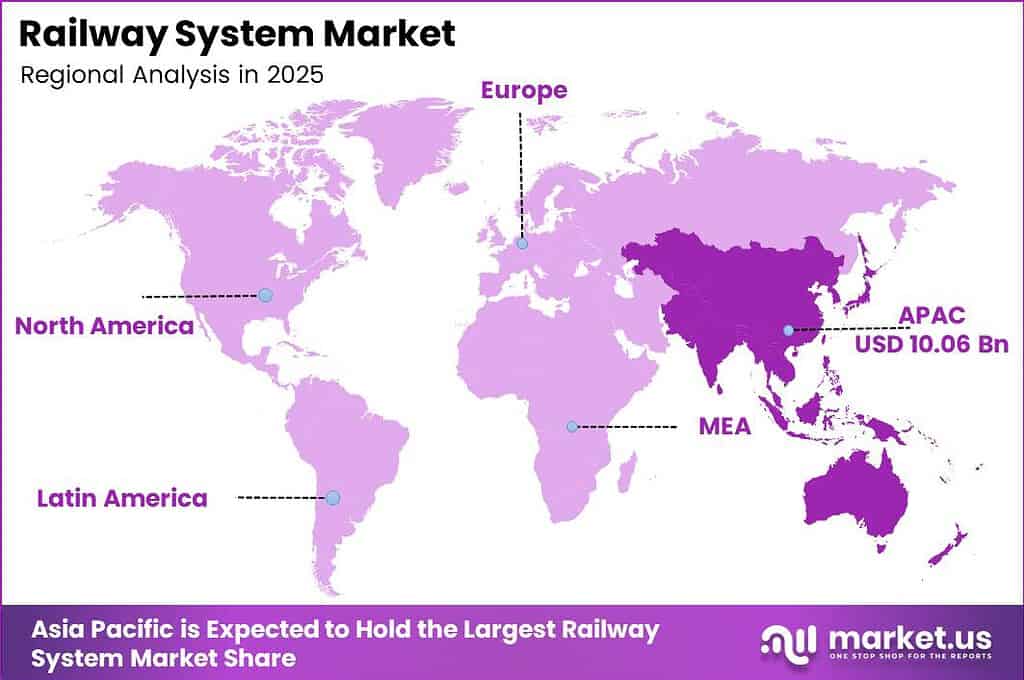
- Asia Pacific leads with a 31.1% share, valued at USD 10.06 Billion in 2026.
Rail investment increasingly targets capacity, electrification, and energy efficiency rather than isolated asset replacement. As reported by International Energy Agency, rail carries 8% of world passengers and 7% of global freight while using only 2% of transport energy demand. This efficiency strengthens public funding cases for rail modernization. Investors should favor suppliers that reduce traction energy use and operating costs.
Alstom secured a contract worth €393 million in January 2026 to supply 23 Coradia Stream EMUs and provide 10 years of maintenance for Hellenic Train. The order links fleet replacement with long-term services. This signals that operators increasingly value predictable availability and maintenance performance, raising the appeal of vendors with recurring service revenue.
Asia Pacific dominates the Railway System Market with a 31.1% share in 2026, valued at USD 10.06 Billion. International Union of Railways indicates that more than 3 billion passengers use high-speed rail each year across nearly 56,000 km of operational routes. Large passenger volumes require reliable propulsion, safety, and information systems. Regional suppliers gain scale advantages through dense procurement pipelines.
Stadler received an order worth about CHF350 million in May 2025 for 7 FLIRT trains connecting Arlanda Airport and Stockholm Central, with an option for one more train. Airport rail links prioritize dependable frequency and passenger comfort. This reflects a wider preference for high-utilization fleets that combine energy efficiency, fast acceleration, and lifecycle support.
Technology and Innovation Landscape
Railway technology investment is shifting from isolated vehicle hardware toward connected operating systems that combine propulsion controls, signalling, onboard diagnostics, passenger information, and fleet analytics. International Energy Agency states that automated trains at technology readiness level 9 can improve safety, lower operating costs, and increase energy efficiency. This shifts supplier competition toward interoperable platforms. Investors should favor firms that can combine certified hardware with recurring software and data services.
Operators increasingly procure equipment through whole-life performance requirements rather than individual component specifications. Train builders must integrate sensors, communication modules, control software, condition-monitoring tools, and remote diagnostic systems into one operating platform. This increases the value of systems engineering capability. Suppliers that control interfaces between traction, braking, HVAC, and passenger systems can improve margins and reduce replacement risk during fleet modernization programs.
Railway operators also use digital tools to raise capacity on congested routes without matching increases in track construction. Predictive diagnostics identify faults before they disrupt schedules, while automated traffic management improves train sequencing. This creates a larger addressable market for software, sensors, edge computing, and communications equipment. Buyers should evaluate technology vendors on interoperability, cybersecurity, lifecycle support, and their ability to integrate with legacy fleets.
Railway Electrification and Energy Efficiency
Railway electrification changes procurement priorities toward traction converters, transformers, battery systems, regenerative braking, onboard energy controls, and grid-connected infrastructure. International Energy Agency reported that India had electrified 42,354 km of railway lines by January 2021 under its Green Railway policy. Electrification reduces dependence on diesel fuel and improves operational efficiency. Suppliers with reliable high-voltage systems can capture fleet and infrastructure upgrade spending.
Energy efficiency directly affects train operating costs because propulsion equipment consumes a large share of railway power. Regenerative braking allows trains to recover kinetic energy during deceleration, while efficient inverters reduce losses during acceleration. Operators can lower energy costs through modern traction packages and optimized auxiliary power systems. This means manufacturers must prove energy savings through measurable performance guarantees during public and private tenders.
Battery-electric and hybrid rail technologies also expand options for routes where full overhead electrification remains uneconomic. These systems require battery packs, power electronics, thermal management, charging equipment, and energy-management software. Suppliers can enter new retrofit and replacement programs by offering modular battery packages. Investors should assess battery sourcing, safety certification, thermal performance, and maintenance capability before assigning premium valuations.
Digital Signalling and Automation
Digital signalling enables rail networks to run more trains safely on existing track by improving train separation, speed supervision, route control, and real-time operating visibility. International Union of Railways has identified future railway information-system architecture as a core part of digital railway development. This creates demand for electronic interlocking, ETCS equipment, communications-based control, and traffic management platforms. Suppliers with certified interoperable products can access high-value modernization contracts.
Automatic train operation supports consistent acceleration, braking, dwell times, and energy use across metro and high-frequency rail systems. Automation can reduce operating variability while increasing service frequency on constrained urban networks. Operators need reliable onboard controllers, wayside equipment, radio communications, and control-center software to deploy these systems. This creates long sales cycles but also raises switching costs once a supplier’s technology becomes embedded in a network.
Railway digitalization also requires dependable communications infrastructure. UIC stated that 5GRAIL supports future railway mobile communication systems and identified rail communication as a key enabler for digitalization. Advanced communications connect trains, depots, stations, and control centers. Vendors that provide secure radio networks and resilient data platforms can secure recurring support revenue after initial infrastructure deployment.
Maintenance, Aftermarket, and Lifecycle Services
Maintenance and lifecycle services convert railway equipment sales into recurring revenue through spare parts, overhauls, inspections, depot support, software upgrades, and availability guarantees. Operators increasingly seek predictable fleet uptime because delays reduce passenger confidence and raise operating costs. Suppliers that provide full-service agreements can earn revenue throughout a train’s operating life. This improves contract visibility and reduces dependence on irregular new-vehicle procurement cycles.
Predictive maintenance uses sensors, diagnostics, and analytics to identify component wear before failures interrupt service. Railway operators can monitor traction motors, braking systems, doors, HVAC units, wheelsets, and batteries through condition data. Early intervention reduces unplanned outages and protects timetable performance. This means suppliers with strong digital diagnostics can win higher-margin aftermarket work while helping operators extend the usable life of existing fleets.
Lifecycle service capability also depends on local depot presence, trained technicians, spare-part availability, and rapid repair processes. Buyers often select suppliers that can support a fleet near its operating network rather than only deliver vehicles. This creates an advantage for companies with established regional service networks. Investors should monitor service-backlog growth, fleet availability targets, parts inventories, and contract renewal rates when assessing supplier quality.
Railway Cybersecurity and Safety Systems
Railway cybersecurity has become a core procurement issue because connected trains, digital signalling, remote diagnostics, passenger-information systems, and control centers exchange operational data continuously. International Union of Railways operates a security platform focused on protecting people, information, goods, rolling stock, and infrastructure. This increases demand for secure communications, identity controls, network monitoring, and incident response tools. Suppliers must demonstrate cyber resilience alongside traditional safety certification.
Safety systems remain essential across conventional, high-speed, metro, and freight rail operations. Train protection equipment, braking controls, obstacle detection, fire safety, passenger emergency systems, and onboard monitoring reduce operational risk. Operators must meet strict safety requirements before placing new rolling stock into service. This creates high barriers to entry because vendors need proven reliability, long testing cycles, and approvals from railway authorities.
Cybersecurity and safety increasingly overlap because digital control failures can disrupt train operations or compromise passenger protection. Rail operators need secure software updates, segmented networks, authenticated communications, and rapid fault isolation. This creates an opportunity for suppliers that combine safety-certified hardware with cyber protection services. Investors should favor businesses with recurring security-monitoring revenue and verified compliance across multiple rail standards.
Market Segmentation
Transit Type Analysis
Conventional rail dominates with 64.1% share in 2026 due to established intercity and freight networks.
In 2026, Conventional rail held a 64.1% share in the Transit Type segment of the Railway System Market. According to International Energy Agency, India operates almost 68,000 km of conventional rail network. Conventional routes require signalling upgrades, traction equipment, and coach refurbishment across dispersed corridors. Equipment suppliers can secure recurring orders by supporting network reliability, energy use, and maintenance cycles.
Rapid and urban rail depends on dense station spacing, frequent acceleration, and strict passenger safety controls. World Bank approved 28 urban transport operations over the past decade, including 5 metro and 3 urban rail projects worth $5.7 billion. Metro expansion needs compact rolling stock, platform systems, and automated control equipment. This creates contract opportunities for suppliers that meet city procurement and localization requirements.
High-speed rail requires precision signalling, high-capacity traction, and stable onboard systems at sustained operating speeds. International Union of Railways found that operational high-speed routes expanded more than 40%, from 44,000 km in 2020 to about 59,000 km in 2022. Network expansion increases demand for advanced train control and monitoring equipment. Investors should prioritize companies with proven certification capabilities.
Voltage Class Analysis
Propulsion systems dominate with 28.9% share in 2026 due to their role in train movement.
In 2026, Propulsion systems held a 28.9% share in the Voltage Class segment of the Railway System Market. International Energy Agency found that rail supports 8% of passengers and 7% of freight using just 2% of transport energy demand. Efficient traction equipment protects rail’s energy advantage. Manufacturers that improve inverter performance and regenerative braking can win fleet renewal contracts.
Auxiliary power systems supply lighting, doors, HVAC equipment, communications, and onboard control loads. Data from International Energy Agency shows oil products still supply nearly 91% of transport final energy demand. Rail operators use auxiliary power optimization to lower energy consumption across fleets. This creates value for suppliers offering efficient converters, battery systems, and load-management hardware.
Train information systems coordinate passenger updates, onboard announcements, service alerts, and operational communications. Siemens Mobility and Leonhard Weiss won an approximately €2.8 billion Deutsche Bahn contract in February 2025 for control and safety technology. Digital information layers reduce service disruption impacts and improve rider confidence. Sellers should package information systems with signalling and cybersecurity services.
Application Analysis
Passenger transportation dominates with 58.7% share in 2026 due to high urban mobility needs.
In 2026, Passenger transportation held a 58.7% share in the Application segment of the Railway System Market. International Union of Railways reported that passenger traffic increased 10% during the first half of 2024 and reached pre-COVID levels. Passenger recovery requires more train availability and better onboard service quality. Operators will prioritize fleet reliability, capacity additions, and digital passenger communication systems.
Freight transportation relies on high axle loads, dependable locomotives, and efficient corridor management. World Bank reported that India built 1,200 km of dedicated freight tracks from 2011 to 2024 and increased freight train capacity fourfold. Dedicated lines reduce conflicts with passenger schedules. Suppliers of freight locomotives, braking systems, and corridor controls benefit from higher freight throughput targets.
Intermodal freight networks require reliable handoffs between rail terminals, ports, warehouses, and road carriers. World Bank found that Indian freight corridors lowered logistics costs by up to $58 million, created about 9 million employment days, and cut 55,000 tonnes of CO2 equivalent in 2024. Efficient rail freight reduces total shipment costs. Investors should assess vendors serving terminals and automated freight operations.
Type Analysis
Passenger coaches and EMUs or metros dominate with 41.1% share in 2026 due to urban fleet renewal.
In 2026, Passenger coaches and EMUs or metros held a 41.1% share in the Type segment of the Railway System Market. Alstom won a €1.03 billion contract in May 2026 to provide 153 Adessia Stream trains in Portugal. EMUs support frequent stops and high passenger turnover. Fleet suppliers with local assembly and maintenance capability can address major public procurement programs.
Locomotives support heavy freight movement and long-distance passenger operations where distributed traction remains unsuitable. Alstom signed an approximately €1.6 billion agreement in May 2026 for 42 double-deck EMUs and 30 years of full-service maintenance. Long-term service commitments raise asset availability and reduce operator risk. Manufacturers can strengthen margins through parts, overhaul, and digital diagnostic contracts.
Freight wagons require braking, monitoring, coupling, and safety systems that tolerate repeated heavy-load cycles. Knorr-Bremse received orders from CRRC in May 2025 to equip more than 1,000 metro railcars and roughly 150 trains. High fleet volumes support standardization of onboard components. Component suppliers can scale production when they secure platform-level equipment positions.
Key Market Segments
Transit Type
- Conventional Rail
- Rapid or Urban Rail
Voltage Class
- Propulsion Systems
- Auxiliary Power Systems
- Train Information Systems
- Train Safety Systems
- HVAC Systems
- Onboard Vehicle Control
Application
- Passenger Transportation
- Freight Transportation
Type
- Passenger Coaches and EMUs or Metros
- Locomotives
- Freight Wagons
- Monorails, Trams, and Others
Regional Analysis
Asia Pacific Dominates the Railway System Market with a Market Share of 31.1% in 2026, Valued at USD 10.06 Billion
Asia Pacific holds a 31.1% share of the Railway System Market in 2026. International Energy Agency found that India accounts for 39% of global conventional rail passenger movement, while China accounts for 27%. These large travel volumes require rolling stock, traction, signalling, and station systems. Asia Pacific suppliers benefit from repeated public investment across urban, intercity, and freight rail projects.
Europe remains a critical replacement market because mature networks require digital upgrades and fleet refurbishment. International Union of Railways estimated that EU-27 rail freight volumes declined 8% in 2024, while Indian Railways freight volumes increased 6%. Lower European volumes pressure operators to improve asset use. Vendors that reduce downtime and energy costs can defend pricing in established networks.
Other regions offer targeted opportunities through private participation and corridor modernization. World Bank reported that private operators manage more than 70% of rail transport activities in the cited region excluding South Africa. Private concession models reward predictable operating performance and lifecycle economics. Suppliers should offer flexible financing, maintenance support, and modular equipment packages for these projects.
Key Regions and Countries
North America
- US
- Canada
Europe
- Germany
- France
- The UK
- Spain
- Italy
- Rest of Europe
Asia Pacific
- China
- Japan
- South Korea
- India
- Australia
- Rest of APAC
Latin America
- Brazil
- Mexico
- Rest of Latin America
Middle East and Africa
- GCC
- South Africa
- Rest of MEA
Market Drivers
| Driver | (~) % Impact on CAGR Forecast | Geographic Relevance | Impact Timeline |
|---|---|---|---|
| Public Rail Capacity Programmes | +1.1% | India, Europe, China, Middle East | Short term (≤ 2 years) |
| Urban Transit Network Expansion | +0.8% | Asia-Pacific, Middle East, Latin America | Medium term (2–4 years) |
| Rail Electrification Investment | +0.6% | India, Europe, Africa | Medium term (2–4 years) |
| Digital Signalling Deployment | +0.5% | Europe, India, East Asia | Medium term (2–4 years) |
| Freight Corridor Modernisation | +0.4% | North America, India, China, Europe | Long term (≥ 4 years) |
| Fleet Renewal Cycles | +0.3% | Global | Short term (≤ 2 years) |
Public Rail Capacity Programmes
Government-led capacity augmentation is the largest active demand catalyst because railways remain infrastructure-intensive, long-cycle systems in which public budget commitments translate directly into orders for civil works, track, electrification, signalling, stations and rolling stock. In India, planned railway capital expenditure for fiscal 2025–26 was ₹2,65,200 crore, with central budgetary support of ₹2,52,200 crore financing roughly 95% of the programme; the preceding fiscal-year allocation was ₹2,62,200 crore.
Capacity-enhancement expenditure was directed toward new lines, doubling, traffic facilities and network modernisation, while the Indian broad-gauge network had moved beyond 99% electrification by late 2025. This sustained project pipeline changes supplier economics from intermittent tendering to multi-year production planning, supporting higher utilisation of fabrication, systems-integration and engineering capacity; however, contractors must still absorb working-capital requirements and performance-guarantee exposure during phased public-project execution.
Market Restraints
| Restraint | (~) % Impact on CAGR Forecast | Geographic Relevance | Impact Timeline |
|---|---|---|---|
| Public Financing Dependence | -0.9% | Emerging markets, Europe, North America | Short term (≤ 2 years) |
| High Project Financing Costs | -0.7% | Global | Short term (≤ 2 years) |
| Lengthy Land Acquisition | -0.5% | India, Southeast Asia, Africa | Medium term (2–4 years) |
| Fiscal Consolidation Pressures | -0.4% | Europe, Latin America, Africa | Medium term (2–4 years) |
| Fragmented Fare Recovery | -0.3% | Urban rail markets globally | Long term (≥ 4 years) |
| Tender Approval Delays | -0.3% | Global public procurement markets | Short term (≤ 2 years) |
Public Financing Dependence
Public-financing dependence is a direct sales restraint because most network expansion, renewal and safety programmes depend on annual appropriations, sovereign borrowing capacity and multiyear political commitment rather than operator cash generation. Indian Railways’ fiscal 2025–26 capital programme illustrates the concentration risk: central budgetary support accounts for about 95% of planned capital expenditure, while internal revenue finances only about 1%.
When budget releases, supplementary approvals or state-level counterpart funding are delayed, awarded packages can be re-sequenced even where underlying passenger and freight demand remains intact. The commercial effect is delayed revenue recognition for engineering and equipment suppliers, higher inventory and bid-cost absorption, and margin compression where fixed-price contracts extend beyond their original mobilisation window.
Market Challenges
| Challenge | (~) % CAGR Friction Drag | Geographic Relevance | Mitigation Horizon |
|---|---|---|---|
| Signalling Retrofit Capacity Gap | -0.8% | Europe, India, East Asia | Long term (≥ 4 years) |
| Specialist Workforce Shortage | -0.6% | Global | Long term (≥ 4 years) |
| Multi-System Interoperability Burden | -0.5% | Europe, cross-border corridors | Medium term (2–4 years) |
| Critical Component Lead Times | -0.4% | Global | Medium term (2–4 years) |
| Brownfield Possession Constraints | -0.4% | Dense rail networks globally | Long term (≥ 4 years) |
| Cybersecurity Assurance Requirements | -0.3% | Europe, North America, Asia-Pacific | Medium term (2–4 years) |
Signalling Retrofit Capacity Gap
The signalling retrofit capacity gap constrains the maximum pace of rail-system digitisation because deployment requires compatible onboard equipment, trackside systems, testing facilities, certified installers, possession windows and cross-border operational validation to advance together. The 2024–2025 European national implementation plans indicated a need to triple ERTMS production capacity, while end-2024 deployment was approximately 12,400 km, or around 10% of the TEN-T network, and only about 19% of the EU fleet had onboard systems.
Current planning implied that just around 50% of the 2030 core-network deployment objective would be achieved on the existing trajectory. This creates persistent delivery friction rather than an immediate demand collapse: system vendors must reserve scarce engineering and test capacity, operators must manage mixed-fleet operations for longer, and project sponsors face cost escalation as retrofit programmes compete for qualified integration resources.
Market Opportunities
| Opportunity | (~) % Potential CAGR Upside | Geographic Relevance | Execution Window |
|---|---|---|---|
| Rail Software Recurring Revenue | +1.0% | Europe, North America, Asia-Pacific | Medium term (2–4 years) |
| Rolling Stock Leasing Platforms | +0.8% | Europe, India, Middle East, Africa | Medium term (2–4 years) |
| Predictive Maintenance Services | +0.7% | Global | Medium term (2–4 years) |
| Battery Regional Rail Conversion | +0.6% | Europe, North America, Japan | Long term (≥ 4 years) |
| Freight Data Marketplace Integration | +0.5% | North America, Europe, India | Long term (≥ 4 years) |
| Station Energy Asset Monetisation | +0.4% | Europe, Asia-Pacific, Middle East | Long term (≥ 4 years) |
Rail Software Recurring Revenue
Rail software recurring revenue remains an untapped opportunity rather than a current baseline driver because many procurement models still buy signalling, fleet-management and asset-monitoring capabilities as capital equipment with limited lifecycle analytics, while data ownership, cyber assurance and interoperability rules remain unresolved across operators.
Converting installed systems to contracted condition monitoring, traffic optimisation, digital-twin and cybersecurity services can shift revenue from one-off project milestones toward multiyear subscriptions and outcome-linked availability fees. With only about 19% of the EU railway fleet equipped with ERTMS onboard systems at the end of 2024, a substantial retrofitting and lifecycle-services white space remains beyond the equipment sale itself.
A successful platform model can reduce manual inspection and unplanned-outage costs by roughly 10–20% on suitable asset classes while increasing supplier gross-margin resilience by combining software, maintenance and remote-support revenue; capturing that upside requires interoperable data architecture, validated cyber controls and commercial agreements that allocate operational-performance risk.
Key Company Insights
CRRC Corporation Limited
CRRC Corporation Limited holds a central position in rolling stock, metro vehicles, locomotives, traction systems, and rail components. The company benefits from its large domestic manufacturing base and export activity. CRRC’s Zhuzhou Institute reported revenue of RMB 7.085 billion in 2025. This scale supports product development and manufacturing capacity. Buyers can seek bundled equipment solutions, while rivals face price and scale pressure.
CRRC commissioned Knorr-Bremse in May 2025 to equip more than 1,000 metro railcars and about 150 trains with rail systems. Knorr-Bremse reported that the orders carried a mid-double-digit-million-euro value. The arrangement confirms CRRC’s high-volume platform activity in urban rail. Component suppliers can access major demand through CRRC programs, but they must meet strict technical and delivery requirements.
Siemens Mobility
Siemens Mobility competes through signalling, electrification, rail automation, onboard systems, and digital service capabilities. The company serves major passenger, metro, and infrastructure programs across several regions. Siemens Mobility secured four HS2 contracts valued at €670 million. The order confirms its ability to combine infrastructure delivery with long-term maintenance. Investors should view integrated service contracts as a source of more stable revenue.
Siemens Mobility signed a framework agreement with Swiss BLS Netz in June 2025 for ETCS Level 2 upgrades worth €110 million. The project targets digital train protection and safer network operations. ETCS deployments increase demand for interoperable signalling and onboard equipment. Siemens Mobility can use these reference contracts to support similar modernization bids across Europe and other regulated rail markets.
Key Players
- CRRC Corporation Limited
- Siemens Mobility
- Alstom
- Hitachi Rail
- Stadler Rail AG
- CAF
- Hyundai Rotem
- Bombardier Transportation
- Wabtec Corporation
- Knorr-Bremse AG
- Thales Group
- ABB Ltd.
- General Electric
- Huawei Technologies Co., Ltd.
- Indra Sistemas S.A.
- Others
Recent Developments
2026
- February 2026: Siemens Mobility and Stadler received a framework agreement for 226 fully automated Copenhagen S-Bane trains, valued at around €3 Billion.
2025
- May 2025: Knorr-Bremse and Hitachi Rail signed a framework agreement to equip up to 30 Rome Metro trains, including a base order for 14 trains.
- September 2025: CAF secured a €500 Million, 24-year maintenance agreement for 107 electric trains in São Paulo.
- September 2025: CAF received a Moroccan intercity rail contract worth almost €600 Million for 30 trains, with an option for 10 additional units.
- September 2025: CAF secured two French rail contracts with a combined value exceeding €300 Million.
2024
- 2024: Stadler received a CHF94 Million order for 10 additional electric multiple units for Stockholm Transport, with options for up to 31 additional vehicles.
Geopolitical Impact Analysis
Global transport disruptions affect railway system supply through metals, electronic components, power equipment, and imported rolling-stock assemblies. UNCTAD reported that global maritime trade expanded by 2.4% in 2023 after a prior contraction. United Nations statistics reported global seaborne trade reached 24.1 billion metric tons in 2024, compared with 20.7 billion metric tons in 2015. Higher cargo volumes tighten shipping capacity for steel, copper, semiconductors, traction equipment, and spare parts. Railway manufacturers must secure inventory and diversify suppliers. Buyers should include delivery safeguards in procurement contracts.
Trade policy changes can affect rail equipment costs because manufacturers source electrical components, metals, machinery, and software hardware across several markets. International Monetary Fund projected average global trade-volume growth of 2.9% during 2025 and 2026. World Bank supported 15 railway investment projects valued at $4.5 billion as of July 2025. Public rail investment can offset uncertain trade conditions, but project schedules remain exposed to imported component delays. Manufacturers should localize critical assemblies and build regional service inventories. Distributors can protect margins through indexed pricing and diversified procurement channels.
Report Scope
| Report Features | Description |
|---|---|
| Market Value (2026) | USD 32.3 Billion |
| Forecast Revenue (2035) | USD 48.2 Billion |
| CAGR (2026-2035) | 4.1% |
| Base Year for Estimation | 2026 |
| Historic Period | 2021-2025 |
| Forecast Period | 2026-2035 |
| Report Coverage | Revenue Forecast, Market Dynamics, Market Opportunity Analysis, Technology and Innovation Landscape, Competitive Landscape, Recent Developments |
| Segments Covered | Transit Type: Conventional Rail, Rapid or Urban Rail. Voltage Class: Propulsion Systems, Auxiliary Power Systems, Train Information Systems, Train Safety Systems, HVAC Systems, Onboard Vehicle Control. Application: Passenger Transportation, Freight Transportation. Type: Passenger Coaches and EMUs or Metros, Locomotives, Freight Wagons, Monorails, Trams, and Others. |
| Regional Analysis | North America (US and Canada), Europe (Germany, France, The UK, Spain, Italy, and Rest of Europe), Asia Pacific (China, Japan, South Korea, India, Australia, and Rest of APAC), Latin America (Brazil, Mexico, and Rest of Latin America), Middle East and Africa (GCC, South Africa, and Rest of MEA) |
| Competitive Landscape | CRRC Corporation Limited, Siemens Mobility, Alstom, Hitachi Rail, Stadler Rail AG, CAF, Hyundai Rotem, Bombardier Transportation, Wabtec Corporation, Knorr-Bremse AG, Thales Group, ABB Ltd., General Electric, Huawei Technologies Co., Ltd., Indra Sistemas S.A., Others |
| Customization Scope | Customization for segments, region / country-level will be provided. Additional customization can be done based on requirements. |
| Purchase Options | We have three licenses to opt for: Single User License | Multi-User License (Up to 5 Users) | Corporate Use License (Unlimited User and Printable PDF) |





































