


Global Quaternary Ammonium Compounds Market Size, Share, And Industry Analysis Report By Product (BAC, ATAC, DDAC, Other Products), By Application (Disinfectants, Fabric Softeners, Wood Preservatives, Surfactants, Anti-static Agents, Others), By Distribution Channel (Online, Offline), By Region and Companies - Industry Segment Outlook, Market Assessment, Competition Scenario, Statistics, Trends and Forecast 2026-2035
- Published date: March 2026
- Report ID: 180332
- Number of Pages: 309
- Format:
-
keyboard_arrow_up
Quick Navigation
Report Overview
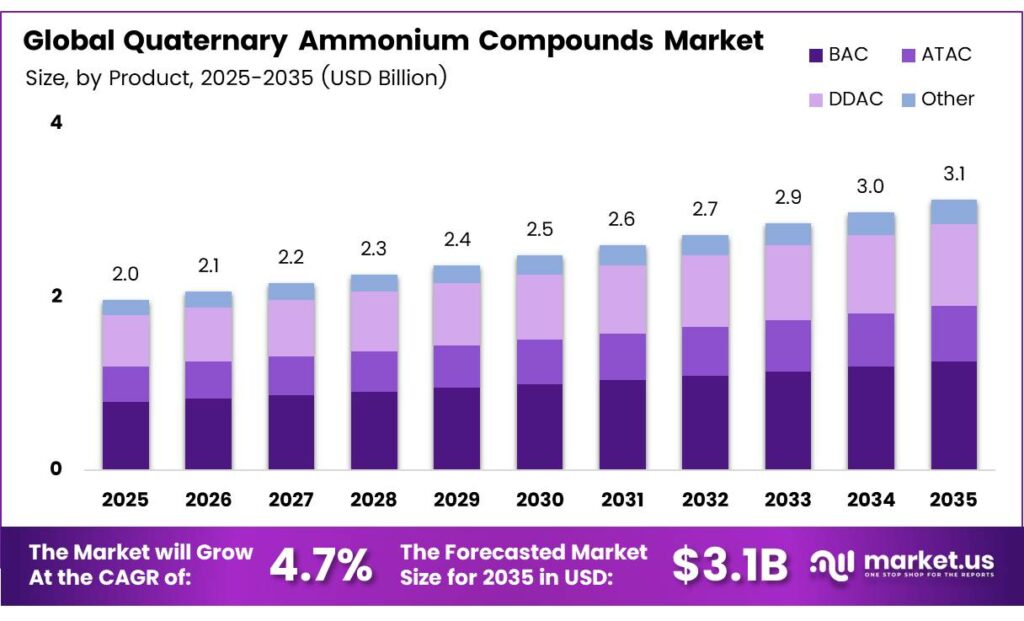
The Global Quaternary Ammonium Compounds Market size is expected to be worth around USD 3.1 billion by 2035 from USD 2.0 billion in 2025, growing at a CAGR of 4.7% during the forecast period 2026 to 2035.
Quaternary ammonium compounds (QACs) are a class of nitrogen-based chemicals widely used as disinfectants, surfactants, fabric softeners, and wood preservatives. These compounds carry a positive charge, which enables them to bind to and destroy negatively charged microbial cell membranes. Consequently, industries across healthcare, agriculture, and personal care rely heavily on them.
The market covers a broad range of product types, including benzalkonium chloride (BAC), alkyl trimethyl ammonium chloride (ATAC), and didecyl dimethyl ammonium chloride (DDAC). Moreover, these compounds serve multiple end-use applications, from institutional cleaning to textile processing. Therefore, they occupy a critical position across several industrial and consumer supply chains.
- The World Integrated Trade Solution (WITS) / UN Comtrade, China led global exports of quaternary ammonium salts (HS 292390) with $393,660.28K and 162,250,000 kg exported in 2024. This dominance reflects China’s scale advantages in chemical manufacturing and its ability to supply cost-competitive volumes to international markets.
- The European Union exported $163,008.94K and 43,780,500 kg of quaternary ammonium salts in 2024. This positions the EU as the second-largest global exporter, underscoring Europe’s role as a high-value specialty chemicals hub. Therefore, regional trade flows remain a key indicator of global market activity and growth dynamics.
Market growth receives strong support from expanding healthcare infrastructure and rising hygiene awareness globally. Post-pandemic behavioral shifts have permanently elevated demand for effective disinfecting solutions. Additionally, commercial construction growth boosts institutional cleaning requirements across offices, hotels, and public facilities, creating a sustained demand pipeline for QAC-based products.
Key Takeaways
- The Global Quaternary Ammonium Compounds Market is valued at USD 2.0 billion in 2025, projected to reach USD 3.1 billion by 2035, growing at a CAGR of 4.7%.
- BAC (Benzalkonium Chloride) dominates with a market share of 45.7% in 2025.
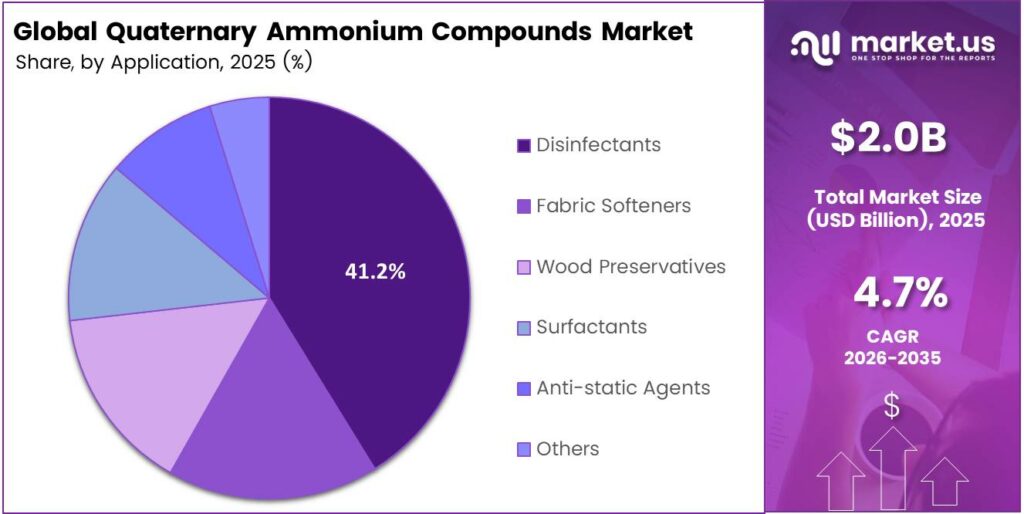
- Disinfectants hold the leading share at 41.2%, driven by healthcare and institutional demand.
- Offline channels account for 78.3% of total market distribution.
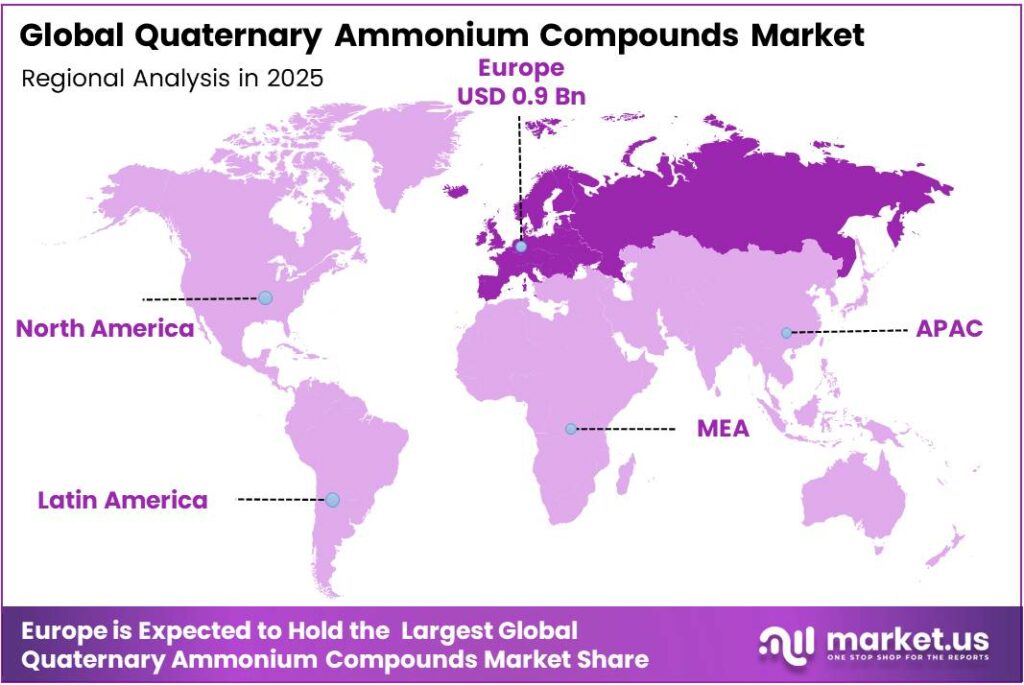
- Europe dominates the regional landscape with a 49.1% market share, valued at USD 0.9 billion in 2025.
By Product Analysis
BAC dominates with 45.7% due to its broad-spectrum antimicrobial efficacy and wide acceptance across healthcare and household disinfection applications.
In 2025, BAC (Benzalkonium Chloride) held a dominant market position in the By Product segment of the Quaternary Ammonium Compounds Market, with a 45.7% share. BAC’s effectiveness against bacteria, fungi, and enveloped viruses makes it the preferred active ingredient in hospital-grade disinfectants and consumer sanitizers. Moreover, its compatibility with multiple formulation types drives continued manufacturer preference.
ATAC (Alkyl Trimethyl Ammonium Chloride) serves as a critical ingredient in fabric softeners and hair conditioning products. Its cationic nature enables effective attachment to textile fibers, delivering softness and static reduction. Additionally, ATAC finds growing use in industrial antistatic applications, particularly within electronics manufacturing and packaging environments.
DDAC (Didecyl Dimethyl Ammonium Chloride) delivers strong biocidal performance in wood preservation and agricultural hygiene. It demonstrates robust activity against mold, fungi, and wood-degrading organisms. However, regulatory scrutiny around DDAC’s environmental persistence has prompted formulators to explore lower-concentration blends combined with co-biocides to maintain efficacy while meeting compliance standards.
Other Products in the QAC category include specialty variants used in textile processing, leather treatment, and pharmaceutical manufacturing. These formulations address niche performance requirements such as controlled-release antimicrobial activity. Consequently, they support emerging applications in smart surface coatings and long-duration disinfection systems.
By Application Analysis
Disinfectants dominate with 41.2% due to elevated hygiene standards across healthcare facilities and institutional cleaning sectors post-pandemic.
In 2025, Disinfectants held a dominant market position in the By Application segment of the Quaternary Ammonium Compounds Market, with a 41.2% share. Healthcare facilities, schools, and food processing plants rely on QAC-based disinfectants for reliable surface and equipment sanitation. Moreover, regulatory mandates for hospital infection control continue to sustain strong institutional procurement volumes.
Fabric Softeners represent a major consumer application segment for QACs, particularly cationic surfactant variants. These compounds deposit onto fabric surfaces during the rinse cycle, reducing static cling and improving textile feel. Additionally, growing consumer preference for premium laundry care products supports steady growth in this application area globally.
Wood Preservatives using QAC formulations protect timber from fungal decay, insect damage, and weathering. The construction industry and outdoor furniture sector drive demand for treated wood products. However, increasing environmental regulations on biocide leaching from treated timber continue to influence formulation strategies in this segment.
Surfactants derived from QACs serve in personal care, industrial cleaning, and water treatment formulations. Their ability to reduce surface tension and emulsify oils makes them versatile performance ingredients. Anti-static Agents based on QACs protect sensitive electronic components during manufacturing and shipping. Others include pharmaceutical, textile, and agricultural uses that continue to expand alongside specialty chemical innovation.
By Distribution Channel Analysis
Offline distribution dominates with 78.3% due to established industrial procurement networks and bulk purchasing preferences among institutional buyers.
In 2025, Offline channels held a dominant market position in the By Distribution Channel segment of the Quaternary Ammonium Compounds Market, with a 78.3% share. Industrial buyers, distributors, and institutional procurement teams prefer offline channels for bulk orders, technical support, and contract-based purchasing. Moreover, the chemical industry’s compliance requirements favor direct supplier relationships over anonymous digital transactions.
Online channels account for the remaining share and continue to expand as specialty chemical e-commerce platforms gain traction. Smaller businesses, research laboratories, and individual consumers increasingly use digital platforms to source QAC-based disinfectants and cleaning products. Consequently, online distribution growth reflects a broader industry shift toward digital accessibility and expanded market reach for specialty formulations.
Key Market Segments
By Product
- BAC
- ATAC
- DDAC
- Other Products
By Application
- Disinfectants
- Fabric Softeners
- Wood Preservatives
- Surfactants
- Anti-static Agents
- Others
By Distribution Channel
- Online
- Offline
Emerging Trends
Smart Surface Technology and Bio-Derived Variants Redefine QAC Market Applications
Formulators increasingly integrate QACs into self-disinfecting surface coatings and smart materials that deliver long-lasting antimicrobial protection. These coatings reduce the need for frequent reapplication, making them attractive for hospitals, transit systems, and high-touch public surfaces. BASF, EBITDA before special items reached €7.9 billion in FY2024, reflecting continued investment in advanced specialty chemical innovations.
A notable shift toward ester-based and bio-derived QAC variants is reshaping fabric softener and personal care formulations. Manufacturers prioritize these variants due to their improved biodegradability profiles and alignment with green chemistry standards. Additionally, consumer demand for environmentally responsible personal care products accelerates this transition, pushing formulators to replace conventional QAC types with more sustainable alternatives.
The proliferation of e-commerce platforms expands the distribution and accessibility of specialty QAC disinfectant solutions beyond traditional industrial channels. The growing application of QACs as antimicrobial preservatives in textile and leather processing also opens new revenue streams. Consequently, this diversification across emerging verticals positions the QAC market for broader adoption across industrial, consumer, and specialty segments through 2035.
Drivers
Rising Hygiene Standards and Healthcare Infrastructure Expansion Drive QAC Market Growth
Post-pandemic hygiene awareness permanently elevated demand for QAC-based disinfectants across healthcare and household sectors. Hospitals, clinics, and institutional facilities now maintain elevated cleaning protocols to combat hospital-acquired infections. The United States exported $152,563.57K and 51,633,000 kg of quaternary ammonium salts in 2024, reflecting robust global supply activity driven by surging end-user demand.
- Rapid urbanization and commercial infrastructure growth boost institutional sanitation requirements across offices, hotels, airports, and public buildings. More urban residents and workers create larger cleaning and disinfection end-user bases for QAC product manufacturers. The Performance Materials segment posted an adjusted EBITDA of $372 million, increasing 7% year over year, indicating healthy specialty chemical demand momentum.
Multifunctional bio-based surfactants derived from QAC chemistry gain traction in personal care and water treatment applications. These ingredients combine antimicrobial, conditioning, and emulsifying functions within a single formulation component. Consequently, formulators reduce ingredient complexity while improving product performance, making QAC-derived surfactants a cost-effective and functionally versatile choice across high-growth personal care and industrial cleaning markets.
Restraints
Environmental Regulations and Antimicrobial Resistance Concerns Limit Unrestricted QAC Market Expansion
Environmental persistence and ecotoxicological impacts of QACs trigger increasingly strict regulatory limits on their discharge and usage concentrations. Regulatory bodies in Europe and North America impose discharge controls on quaternary ammonium compounds entering aquatic systems. Solvay’s underlying net sales declined to €4,686 million, down 4.0% organically, partly reflecting cost and compliance pressures across the specialty chemicals sector.
Antimicrobial resistance (AMR) emerging from widespread QAC overuse raises concerns among healthcare authorities and regulatory agencies globally. Studies indicate that repeated sub-lethal exposure to QACs can promote cross-resistance to antibiotics in certain bacterial strains. Consequently, public health bodies increasingly scrutinize QAC usage frequencies and concentrations in both clinical and household disinfection products, creating formulation and marketing challenges for producers.
Manufacturers face growing pressure to reformulate legacy QAC products to meet evolving environmental and safety standards. This reformulation process involves significant research, regulatory approval timelines, and capital investment. Therefore, smaller producers with limited R&D budgets struggle to adapt quickly, while large chemical companies reallocate resources toward compliant next-generation formulations, creating competitive inequality across market tiers.
Growth Factors
Eco-Friendly Innovation and Agricultural Expansion Accelerate QAC Market Opportunities
Innovation in biodegradable and next-generation eco-friendly QAC formulations creates strong growth pathways for regulatory-compliant product development. Chemical companies invest in ester-quat and bio-derived variants that deliver comparable efficacy while meeting environmental discharge standards. Additionally, rising adoption of green antistatic agents in electronics manufacturing and sustainable wood preservatives in construction broadens the QAC addressable market significantly.
- Evonik’s group recorded sales of €15,157 million and adjusted EBITDA of €2,065 million in FY2024, with the Specialty Additives division contributing €744 million in adjusted EBITDA. This performance demonstrates that specialty chemical segments tied to advanced QAC applications continue to deliver strong profitability.
Expansion into agricultural and food processing hygiene solutions presents a significant growth frontier for QAC producers. Biosecurity requirements in poultry, livestock, and horticultural facilities drive demand for effective, residue-managed disinfection compounds. Consequently, producers that develop agriculture-specific QAC formulations with favorable regulatory profiles stand to capture substantial new volume across Asia Pacific, Latin America, and Middle East markets where food production infrastructure is rapidly modernizing.
Regional Analysis
Europe Dominates the Quaternary Ammonium Compounds Market with a Market Share of 49.1%, Valued at USD 0.9 Billion
Europe leads the global Quaternary Ammonium Compounds Market, holding a dominant share of 49.1% and a market value of approximately USD 0.9 billion in 2025. The region benefits from well-established pharmaceutical, personal care, and industrial cleaning industries that sustain high QAC consumption volumes. Strict EU regulatory frameworks around disinfection and biocidal product registration ensure consistent demand for approved, high-quality QAC formulations from certified manufacturers.
North America represents a mature and significant market for quaternary ammonium compounds, driven by advanced healthcare infrastructure and strong institutional disinfection standards. The United States leads regional demand, with healthcare facilities, food processing plants, and commercial cleaning sectors serving as primary end users. Additionally, growing awareness of antimicrobial surfaces in public and workplace environments continues to support steady QAC product consumption across the region.
Asia Pacific emerges as the fastest-growing regional market for QACs, supported by rapid urbanization, expanding healthcare networks, and growing personal care product consumption. China dominates both production and domestic demand, while India and Southeast Asian markets accelerate QAC imports for industrial and institutional applications. Consequently, the region attracts increasing manufacturing investment from global specialty chemical producers seeking cost-competitive production bases.
The Middle East and Africa region presents growing opportunities for QAC products as healthcare infrastructure investment expands across Gulf Cooperation Council nations and sub-Saharan Africa. Rising awareness of hospital infection control and food safety drives institutional disinfectant demand in this region. Moreover, large-scale hospitality and commercial construction projects in GCC countries increase ongoing cleaning chemical procurement requirements significantly.
Key Regions and Countries
North America
- US
- Canada
Europe
- Germany
- France
- The UK
- Spain
- Italy
- Rest of Europe
Asia Pacific
- China
- Japan
- South Korea
- India
- Australia
- Rest of APAC
Latin America
- Brazil
- Mexico
- Rest of Latin America
Middle East & Africa
- GCC
- South Africa
- Rest of MEA
Key Players Analysis
Arkema is a global specialty chemicals and advanced materials group with a significant presence in performance additives and functional ingredients, including surface-active compounds relevant to QAC markets. The company focuses on high-value applications in construction, electronics, and industrial coatings. Moreover, Arkema’s consistent investment in sustainable chemistry positions it as a formulator-preferred partner for next-generation antimicrobial and surfactant product lines globally.
BASF SE operates as one of the world’s largest chemical producers, with extensive capabilities in care chemicals, performance materials, and specialty surfactants that overlap with quaternary ammonium compound applications. The company serves diverse end markets, including personal care, agriculture, and industrial cleaning. Additionally, BASF’s global manufacturing network and R&D infrastructure enable rapid development and commercialization of reformulated, regulatory-compliant QAC solutions across multiple regions.
DuPont brings deep expertise in specialty biocides and antimicrobial technologies through its Microbial Control division, offering QAC-based active ingredients for healthcare, water treatment, and industrial disinfection markets. The company’s scientific heritage and strong regulatory affairs capabilities help it navigate complex biocidal product registration requirements. Consequently, DuPont maintains a trusted position among formulators seeking validated and compliance-ready antimicrobial active substances for professional-grade disinfection products.
Evonik AG delivers specialized quaternary ammonium compound ingredients through its Care Solutions and Specialty Additives divisions, targeting personal care, fabric care, and industrial applications. The company’s expertise in functional surfactants and bio-derived specialty chemicals aligns well with growing market demand for sustainable QAC alternatives. Illustrating the robust commercial environment for specialty surfactant producers operating alongside Evonik in this competitive landscape.
Top Key Players in the Market
- Arkema
- BASF SE
- DuPont
- Evonik AG
- Ashland
- Novo Nordisk Pharmatech
- Global Amines Company Pte. Ltd.
Recent Developments
- In 2025, BASF launched Dehyquart S18, a new readily biodegradable cationic conditioning agent for European hair-care formulations (conditioners, masks, and treatments). It serves as a naturally derived alternative to persistent traditional quaternary ammonium compounds (quats), featuring renewable carbon content and high efficacy in wet/dry combability, suppleness at low dosages, and frizz protection under high humidity.
- In 2025, Evonik introduced REWOQUAT TS 69, a patented transparent fabric softener concentrate for the Asian market. It replaces solvents and conventional fossil-derived esterquats with bio-based quaternary ammonium salts from botanical sources. Benefits include full biodegradability, high water solubility, room-temperature processing, extreme temperature stability, antimicrobial properties, and elimination of residues, cloudiness, clumping, or water-repellent layers.
Report Scope
Report Features Description Market Value (2025) USD 2.0 Billion Forecast Revenue (2035) USD 3.1 Billion CAGR (2026-2035) 4.7% Base Year for Estimation 2025 Historic Period 2020-2024 Forecast Period 2026-2035 Report Coverage Revenue Forecast, Market Dynamics, Competitive Landscape, Recent Developments Segments Covered By Product (BAC, ATAC, DDAC, Other Products), By Application (Disinfectants, Fabric Softeners, Wood Preservatives, Surfactants, Anti-static Agents, Others), By Distribution Channel (Online, Offline) Regional Analysis North America (US and Canada), Europe (Germany, France, The UK, Spain, Italy, and Rest of Europe), Asia Pacific (China, Japan, South Korea, India, Australia, and Rest of APAC), Latin America (Brazil, Mexico, and Rest of Latin America), Middle East & Africa (GCC, South Africa, and Rest of MEA) Competitive Landscape Arkema, BASF SE, DuPont, Evonik AG, Ashland, Novo Nordisk Pharmatech, Global Amines Company Pte. Ltd. Customization Scope Customization for segments, region/country-level will be provided. Moreover, additional customization can be done based on the requirements. Purchase Options We have three licenses to opt for: Single User License, Multi-User License (Up to 5 Users), Corporate Use License (Unlimited Users and Printable PDF)  Quaternary Ammonium Compounds MarketPublished date: March 2026add_shopping_cartBuy Now get_appDownload Sample
 -
-
- Arkema
- BASF SE
- DuPont
- Evonik AG
- Ashland
- Novo Nordisk Pharmatech
- Global Amines Company Pte. Ltd.
Our Clients

- 180332
- March 2026






