


Report Overview
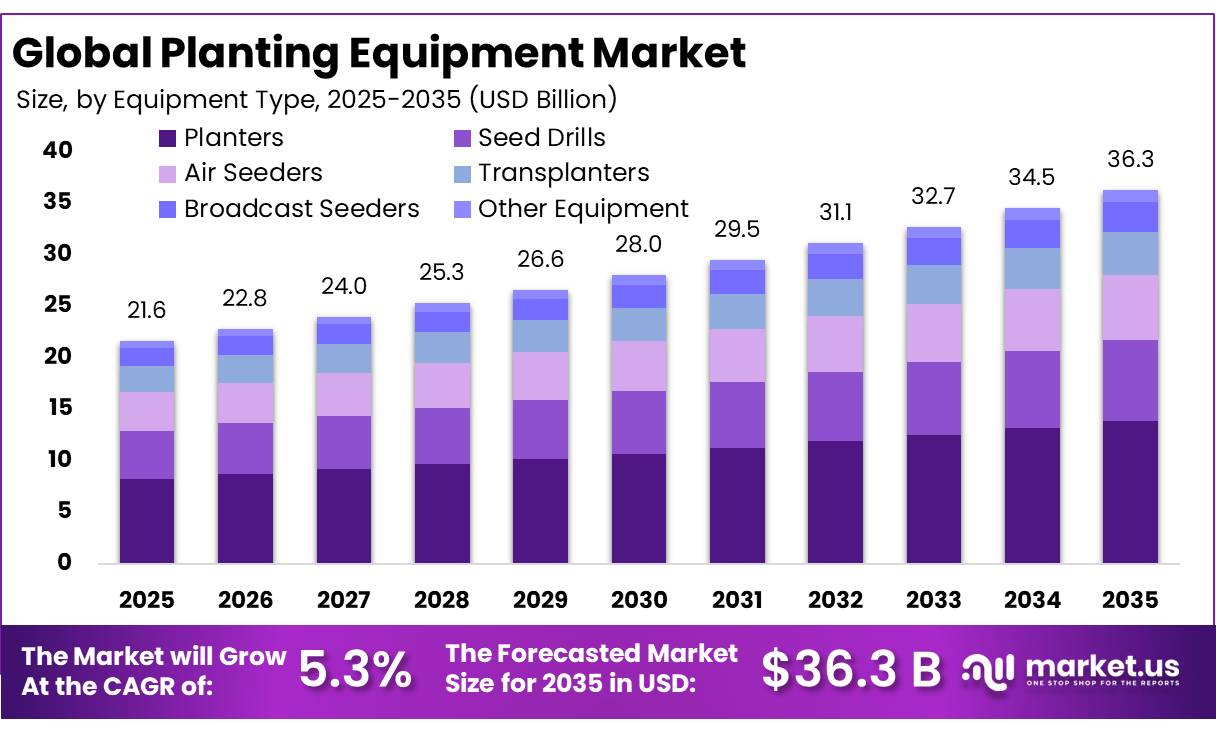
The Global Planting Equipment Market size is expected to be worth around USD 36.3 Billion by 2035, from USD 21.6 Billion in 2025, growing at a CAGR of 5.3% during the forecast period from 2026 to 2035. In 2025, Europe held a dominant market position, capturing more than a 42.50% share, holding USD 9.16 Billion revenue.
The planting equipment industry forms a critical part of modern agricultural mechanization, covering seed drills, row-crop planters, air seeders, precision planters, transplanters, and no-till planting systems. Demand is closely linked with cultivated acreage and the need to complete seeding within narrow seasonal windows.
- In the United States, farmers planted 95.2 million acres of corn in 2025, up 5% from 2024, while soybean planting reached 83.4 million acres. This large acreage base supports recurring demand for high-capacity and accurate planting machinery.
The broader agricultural equipment industry is currently experiencing a mixed investment environment. According to the Association of Equipment Manufacturers, U.S. agricultural tractor sales declined 21.6% in May 2026, while combine sales fell 56.1% year over year, reflecting pressure on farmers’ capital budgets. Europe has also faced equipment-market weakness: CEMA reported 144,400 agricultural tractor registrations in 2024, an 8.1% decline from 2023. These conditions are encouraging manufacturers to emphasize productivity improvements and stronger equipment returns rather than simple capacity expansion.
Precision agriculture is becoming one of the strongest technology drivers for planting equipment. USDA data show that guidance and auto-steering systems were used by 52% of midsize crop farms and 70% of large-scale crop farms in 2023. Yield monitors, yield maps, and soil maps were used by 68% of large-scale crop-producing farms.
- Conservation farming is creating another important equipment opportunity. USDA’s 2022 Census of Agriculture recorded approximately 105.2 million acres under no-till practices. USDA research also shows that combined no-till and reduced-till adoption on U.S. wheat acreage increased from 21% in 1998 to 69% in 2022. Such practices favor specialized no-till drills, residue-handling planters, stronger coulters, accurate depth-control systems, and machines capable of planting directly into high-residue fields.
Labor economics are also supporting long-term mechanization. USDA reported that inflation-adjusted wages for nonsupervisory farmworkers increased at an average 1.9% annually during the latest 10-year period, reaching about US$18.12 per hour in 2024. Meanwhile, approximately 385,000 H-2A agricultural positions were certified in FY2024. Higher labor costs and difficulty securing seasonal workers strengthen the business case for larger planters, automatic guidance, autonomous functions, centralized seed delivery, and systems that allow one operator to cover more hectares within limited planting windows.
Public policy should also support technology adoption indirectly. USDA made up to US$7.7 billion available for conservation and climate-smart practices in FY2025, including US$5.7 billion for climate-smart activities. In Europe, CAP Strategic Plans for 2023–2027 represent about €307 billion in public expenditure across roughly 2,500 interventions, with technology, competitiveness and sustainability among major objectives. These investments create a favorable long-term environment for planting systems that improve seed placement, reduce overlaps, conserve soil and lower input use.
Key Takeaways
- Planting Equipment Market size is expected to be worth around USD 36.3 Billion by 2035, from USD 21.6 Billion in 2025, growing at a CAGR of 5.3%.
- Planters held a dominant market position, capturing more than a 38.20% share.
- Precision Planters held a dominant market position, capturing more than a 36.00% share.
- Mechanical held a dominant market position, capturing more than a 37.70% share.
- Tractor-Mounted held a dominant market position, capturing more than a 48.00% share.
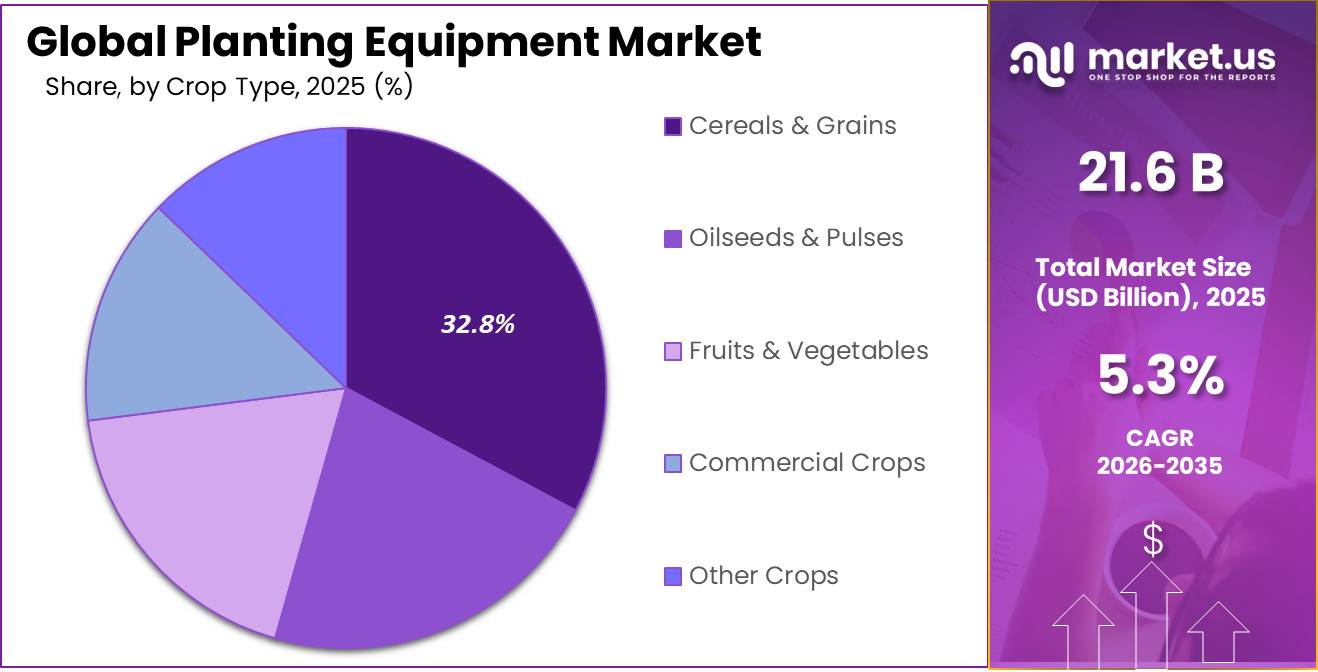
- Cereals & Grains held a dominant market position, capturing more than a 32.80% share.
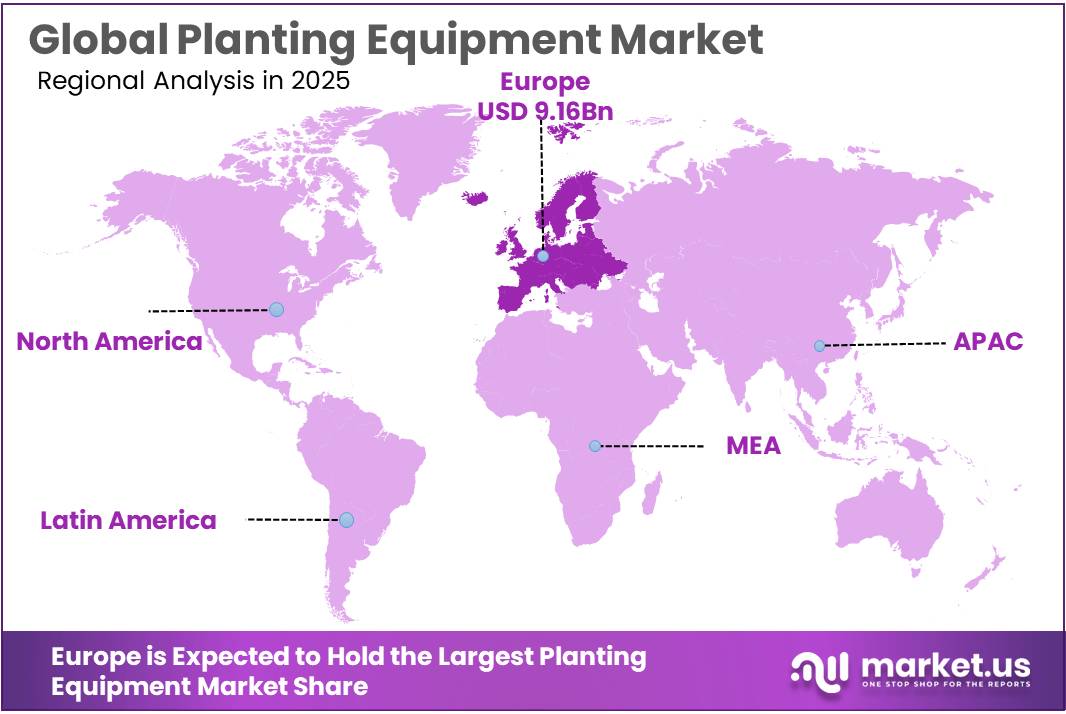
- Europe held a dominant market position, capturing more than a 42.50% share and generating approximately USD 9.16 billion.
By Equipment Type Analysis
Planters lead the planting equipment market with more than 38.20% share, supported by large-scale row-crop planting.
In 2025, Planters held a dominant market position, capturing more than a 38.20% share. The segment benefits from its wide use in large-scale row crops where accurate seed spacing, depth control and faster field coverage are important. Modern planters are increasingly equipped with precision guidance, automatic row control and seed-monitoring technologies, helping farmers improve planting consistency while reducing seed overlap.
- In 2026, the USDA National Agricultural Statistics Service estimated U.S. corn planted area at 95.3 million acres, while soybean planted area reached 85.4 million acres. These crops require efficient planting across extensive farmland, strengthening the use of high-capacity and precision planters among commercial farms. USDA NASS – 2026 Acreage Data
Seed Drills represent an important segment of the Planting Equipment Market, particularly for cereals and other closely spaced field crops. These machines place seed at controlled depth and spacing while covering large areas more consistently than traditional broadcasting methods. Their role is becoming more important as producers focus on uniform crop establishment, reduced seed wastage and compatibility with conservation farming and reduced-tillage practices.
By Planter Type Analysis
Precision Planters dominate the planter type segment with more than a 36.00% share, supported by accurate seed placement and digital farming adoption.
In 2025, Precision Planters held a dominant market position, capturing more than a 36.00% share. The segment remained strong because these machines help farmers control seed spacing, planting depth and row placement more accurately. Precision planters are increasingly integrated with GPS guidance, variable-rate controls, electronic seed meters and automatic row systems, making them useful for large commercial crop farms.
The shift toward digital farming further supports this segment. According to the USDA National Agricultural Statistics Service, 22% of U.S. farms used precision agriculture practices in 2025, covering technologies such as GPS guidance, variable-rate applications, soil mapping and other connected farm systems. These technologies work closely with advanced planting equipment and help improve operating accuracy during narrow planting periods.
Pneumatic Planters represent an important planter type within the Planting Equipment Market. These machines use controlled air pressure or vacuum systems to pick, separate and deliver individual seeds into planting rows. Their ability to handle seeds consistently makes them suitable for crops where uniform spacing and controlled seed placement are important for crop establishment and field productivity.
By Design Analysis
Mechanical Design Dominates with More Than 37.70% Share Due to Simple Operation and Reliable Field Performance
In 2025, Mechanical held a dominant market position, capturing more than a 37.70% share. Mechanical planting equipment continues to be widely used because of its simple construction, dependable seed-metering mechanism, easier maintenance, and ability to operate without complex electronic systems. These machines remain suitable for corn, soybean, wheat, and other broad-acre crops where farmers require durable equipment that can operate for long periods during short planting seasons.
- In 2026, the U.S. Department of Agriculture estimated corn planted area at 95.3 million acres, while soybean planted area reached 85.4 million acres. Corn growers were expected to harvest 87.4 million acres for grain, while soybean harvested area was estimated at 84.4 million acres. This extensive acreage supports continued demand for reliable planting equipment that can cover large fields efficiently with relatively straightforward operation and servicing requirements.
Automatic planting equipment is gaining greater importance within the Planting Equipment Market as growers move toward more accurate seed placement, automated row control, GPS guidance, and variable-rate planting. Automatic systems can reduce repeated passes, maintain more consistent row spacing, and allow operators to manage planting functions from the tractor cab. Their adoption is particularly relevant for larger farms seeking greater field productivity during limited planting windows.
By Power Source Analysis
Tractor-Mounted equipment dominates with more than 48.00% share as large crop acreage supports tractor-based planting operations.
In 2025, Tractor-Mounted held a dominant market position, capturing more than a 48.00% share. Tractor-mounted planting equipment remains widely preferred because it combines planting operations with the power, mobility, and hydraulic capability of agricultural tractors. These systems are suitable for different farm sizes and can support planters, seed drills, and precision planting attachments. Their relatively straightforward operation, flexible field use, and compatibility with existing tractor fleets continue to support adoption among commercial crop producers.
- Government agricultural data highlight the large field area requiring mechanized planting. In 2026, USDA NASS estimated U.S. corn planted acreage at 95.3 million acres and soybean planted acreage at 85.4 million acres. Growers were also expected to harvest 87.4 million acres of corn for grain and 84.4 million acres of soybeans. Such extensive crop areas create a strong operating environment for tractor-mounted planting systems that can cover fields efficiently during limited seasonal planting periods.
Pull-Type planting equipment represents an important segment of the Planting Equipment Market, particularly in large-scale grain and row-crop operations. These machines are connected behind tractors and generally provide larger seed or fertilizer capacity than compact mounted units. Their design allows growers to cover extensive acreage with fewer refilling stops, making them suitable for farms where operating speed, capacity, and efficient use of tractor power are key considerations.
By Crop Type Analysis
Cereals & Grains dominate with more than a 32.80% share, supported by extensive corn and wheat planting acreage.
In 2025, Cereals & Grains held a dominant market position, capturing more than a 32.80% share. The segment remained the largest user of planting equipment because crops such as corn, wheat, barley, rice, and sorghum are generally cultivated across extensive areas and require timely, uniform seeding. Planters and seed drills help growers maintain controlled seed depth, row spacing, and field coverage while reducing the time required to complete planting operations.
- In 2026, USDA NASS estimated U.S. corn planted area at 95.3 million acres, while total wheat planted area reached 42.7 million acres. Within wheat, winter wheat accounted for 31.5 million acres, other spring wheat covered 9.39 million acres, and durum wheat represented 1.83 million acres. These broad planting areas support continued demand for high-capacity planters, grain drills, and precision seeding equipment.
Oilseeds & Pulses represent an important crop segment within the Planting Equipment Market. These crops require controlled seed placement and suitable row spacing to establish uniform plant populations. Precision planters, pneumatic planters, and seed drills are commonly suited to soybean, chickpea, lentil, dry pea, and other oilseed or pulse operations where accurate metering and efficient field coverage are important.
Key Market Segments
By Equipment Type
- Planters
- Seed Drills
- Air Seeders
- Transplanters
- Broadcast Seeders
- Other Equipment
By Planter Type
- Precision Planters
- Pneumatic Planters
- No-Till/Conservation Planters
- Mechanical Planters
By Design
- Mechanical
- Automatic
By Power Source
- Tractor-Mounted
- Pull-Type
- Self-Propelled
By Crop Type
- Cereals & Grains
- Oilseeds & Pulses
- Fruits & Vegetables
- Commercial Crops
- Other Crops
Driver Analysis
Precision Planting and Autonomy
Precision planting is the largest structural growth lever because value is migrating from fabricated steel and mechanical seed delivery toward electric meters, row-by-row shutoffs, automated downforce, high-speed delivery, in-furrow sensing, GNSS correction, cameras, connectivity and software-linked controls. Adoption has moved beyond early trials: USDA reported guidance/autosteer on more than 50% of U.S. corn, soybean, cotton and winter-wheat acreage, while usage reached 52% of midsize and 70% of large crop farms in 2023, leaving meaningful headroom among smaller and mixed fleets.
The agronomic revenue case is measurable: Iowa State indicates that 16–33-inch stand gaps can reduce corn yield by about 2% and 4–6-foot gaps by about 5%, while a stand with at least half of plants emerging three weeks late can justify replanting for roughly 10% additional yield; these losses increase the willingness to pay for consistent depth, singulation and row-unit ground contact.
Commercial technology is also raising throughput and attachment value: Deere states that ExactEmerge can plant at twice conventional speed and that its ExactShot dosing configuration can cut in-furrow starter-fertilizer use by more than 60%, while AGCO introduced 14 PTx products in 2025, including seed-orientation, ISOBUS and autonomous-retrofit offerings, with broader autonomy commercialization targeted for late 2026.
This shifts supplier economics from one-off planter sales toward higher revenue per row, software-enabled upgrades, data services and recurring dealer support; the +1.8 percentage-point CAGR uplift reflects faster electronic-content growth than base-machine units and is concentrated first in large-acreage corn, soybean, wheat and cotton operations where hectares covered per machine make payback fastest
Drivers Impact Analysis
| Driver | (~) % Impact on CAGR Forecast | Geographic Relevance | Impact Timeline |
|---|---|---|---|
| Precision planting and autonomy | +1.8 pp | North America core; EU; Brazil; Australia | Medium term (2–4 years) |
| Labor scarcity and planting-window compression | +1.3 pp | North America; Western Europe; Japan/Korea; Australia | Short term (≤2 years) |
| Subsidies and custom-hiring access | +1.1 pp | India core; Southeast Asia; Africa; Eastern Europe | Medium term (2–4 years) |
| No-till and cover-crop expansion | +0.9 pp | Americas; EU; Australia; South Asia | Long term (≥4 years) |
| Seed, fertilizer and fuel optimization | +0.8 pp | North America; EU; Brazil/Argentina; Australia | Short term (≤2 years) |
| Retrofit-led fleet modernization | +0.6 pp | North America core; EU; Brazil; developed APAC | Medium term (2–4 years) |
Restraint Analysis
Farm-Income Pressure
Planting equipment is a deferrable capital purchase, so weakening real farm earnings and volatile crop economics reduce replacement velocity before they reduce planted area: USDA’s September 2026 baseline places U.S. net farm income at $158.4 billion, down $4.3 billion or 2.6% nominally and $9.1 billion or 5.5% in real terms, while real net cash farm income falls $4.6 billion or 2.5%; farm cash receipts are projected at $540.3 billion, down 0.3% nominally and 3.2% after inflation, as production expenses rise $21.2 billion or 4.5% to $492.8 billion.
Direct government payments rise by $19.5 billion to $47.4 billion, meaning income excluding government support is forecast to fall about $34 billion or 26%, a weaker underlying purchasing signal than the headline income figure suggests. The equipment cycle already reflects this compression: AGCO estimated 2025 industry retail tractor/combine declines of 10%/27% in North America, 2%/22% in Brazil and 7%/5% in Western Europe, while North American tractor and combine demand remained down 9% and 7%, respectively, in the first half of 2026; Europe’s 144,400 agricultural-tractor registrations in 2024 were 8.1% below 2023, 20% below the 2021 peak and the lowest since at least 2014.
Although planters do not move one-for-one with tractors, the same balance sheet funds both, so growers extend planter lives, replace wear parts, remove optional rows or electronics and prioritize only acreage-critical failures; the modeled -2.0 percentage-point CAGR impact is the largest short-term restraint because it suppresses complete-machine units, shifts mix toward lower-ticket attachments and increases discounting, floorplan exposure and dealer inventory risk across North America, Europe and Brazil.
Restraint Impact Analysis
| Restraint | (~) % Impact on CAGR Forecast | Geographic Relevance | Impact Timeline |
|---|---|---|---|
| Farm-income pressure | -2.0 pp | North America core; EU; Brazil | Short term (≤2 years) |
| High capex and credit cost | -1.4 pp | Global; emerging APAC/Africa core | Medium term (2–4 years) |
| Small, fragmented farms | -1.1 pp | India; Southeast Asia; Africa | Long term (≥4 years) |
| Tariffs and input volatility | -0.9 pp | North America; EU; Latin America | Short term (≤2 years) |
| Used, retrofit and rental substitution | -0.7 pp | North America; EU; Brazil; India | Medium term (2–4 years) |
| Digital and service friction | -0.6 pp | North America; EU; rural APAC | Medium term (2–4 years) |
Opportunity Analysis
Specialty-Crop Robotic Planting
The economic pool is attractive: U.S. specialty crops generated $64.7 billion and roughly one-third of crop receipts in the cited USDA benchmark, while labor consumes about 40% of specialty-farm cash expense versus 15% across all farms and only 4% on corn farms; nursery/greenhouse, fruit/tree-nut and vegetable/melon labor shares reached 42.5%, 40.4% and 29.2%, respectively.
Policy is now de-risking product development rather than merely subsidizing established machinery: FY2026 U.S. specialty-crop programs provide more than $275 million, including $175 million annually for the Specialty Crop Research Initiative—up from $80 million—and a first-time minimum $20 million set-aside for mechanization and automation R&D.
The route to value is to combine precision transplanters, vision-guided spacing, autonomous carriers and crop modules under lease or per-hectare contracts; CNH’s narrow R4 concept illustrates enabling architecture at only 0.7–1.2 metres wide, 1.0–1.4 tonnes, with 40 kWh electric or 44 kW hybrid power, but commercial planting modules remain largely open territory.
An analyst scenario in which automated systems penetrate only 3–5% of the labor-intensive specialty production base by 2031, capturing equipment/service revenue equivalent to 2–3% of addressable labor expenditure, supports +1.5 percentage points of market CAGR upside; success requires OEM–university pilots, crop-by-crop validation and dealer agronomy capability, but premium gross margins and less exposure to broadacre replacement cycles make this the largest untapped adjacency.
Opportunity Impact Analysis
| Opportunity | (~) % Potential CAGR Upside | Geographic Relevance | Execution Window |
|---|---|---|---|
| Specialty-crop robotic planting | +1.5 pp | North America; EU; Japan; Korea | Medium term (2–4 years) |
| Planting-as-a-Service platforms | +1.3 pp | India; Southeast Asia; Africa | Short term (≤2 years) |
| Outcome-priced precision subscriptions | +1.0 pp | North America; Brazil; Australia; EU | Short term (≤2 years) |
| Carbon-linked planter data | +0.8 pp | EU core; North America; Australia | Medium term (2–4 years) |
| Open mixed-fleet aftermarket | +0.7 pp | North America; EU; Brazil | Short term (≤2 years) |
| Autonomous light-machine fleets | +0.6 pp | North America; EU; Australia | Long term (≥4 years) |
Challenges Analysis
Mixed-Fleet Data Fragmentation
Connectivity compounds the integration burden: although 85% of U.S. farms had internet access in 2025, only 55% used fixed broadband and 74% used cellular service, while 28% of rural areas lacked fixed 100/20 Mbps coverage; the FCC’s advanced-field target is symmetrical 100 Mbps with latency below 10 milliseconds, materially above many working-land connections.
Each additional gateway, data-conversion layer or duplicate display raises installation hours, software validation, operator training and support tickets, while corrupted prescriptions or time-lagged maps can force manual fallback during a narrow planting window; for an illustrative 24-row machine, troubleshooting only five minutes per row consumes two hours before field losses are counted.
The EU Data Act, applicable since September 2025, will improve user access and third-party portability, but manufacturers must still make data discoverable, machine-readable and interoperable while protecting trade secrets, creating parallel API, consent and documentation workloads.
The modeled -1.1 percentage-point CAGR friction reflects slower premium-feature activation and higher customer-support cost rather than lost base-machine demand; mitigation requires common agronomic schemas, offline-first operation, certified cross-brand interfaces and one-time machine identity mapping, with normalization likely requiring two to four years because installed fleets often remain in service across several product generations.
Challenges Impact Analysis
| Challenge | (~) % CAGR Friction Drag | Geographic Relevance | Mitigation Horizon |
|---|---|---|---|
| Mixed-Fleet Data Fragmentation | -1.1 pp | North America; EU; Brazil; Australia | Medium term (2–4 years) |
| Skilled Service Capacity Gap | -1.0 pp | North America; EU; rural APAC | Long term (≥4 years) |
| Electronics Supply Complexity | -0.8 pp | North America; EU; APAC corridors | Medium term (2–4 years) |
| Weather-Window Volatility | -0.8 pp | Global; Americas and EU core | Long term (≥4 years) |
| Variable Field Performance | -0.7 pp | Global; mixed-soil regions | Medium term (2–4 years) |
| Cyber-Safety Compliance Burden | -0.6 pp | EU core; North America | Medium term (2–4 years) |
Geopolitical Impact Analysis
Russia–Ukraine War Reshapes Current Planting Equipment Demand and Investment
The ongoing Russia–Ukraine war continues to reshape the Planting Equipment market by disrupting farm cash flow, transport routes, access to cropland, and machinery replacement. In September 2026, Ukraine’s government reported that attacks on Black Sea logistics had forced exporters to reroute agricultural shipments, while August exports reached only around one-third of potential volume. Lower export income can delay purchases of planters, seed drills, tractors, and precision systems, especially for farms operating close to affected regions.
At the same time, equipment replacement demand is building because machinery, storage, energy, and transport assets have been damaged during the conflict. A February 2026 joint assessment by the Government of Ukraine, World Bank, European Commission, and United Nations placed agriculture-sector reconstruction and recovery needs at more than US$55 billion. Government support is partly offsetting this pressure.
In September 2026, Ukraine announced an additional ₴6 billion under its affordable lending program to support the sowing campaign. For equipment manufacturers, the market therefore remains uneven: conflict-exposed farms face delayed investment, while safer and recovering areas need durable planters, replacement machinery, precision seeders, and efficient equipment that can restore planting capacity with fewer workers and tighter operating budgets.
Regional Insights
Europe Leads the Planting Equipment Market with 42.50% Share and USD 9.16 Billion, While North America Shows Strong Growth Potential
In 2025, Europe held a dominant market position, capturing more than a 42.50% share and generating approximately USD 9.16 billion. Its strong position is supported by highly mechanized agriculture and extensive cereal cultivation. Eurostat reported that the EU harvested around 49.5 million hectares of cereals in 2024, producing approximately 257.7 million tonnes. CEMA also recorded 144,400 agricultural tractor registrations in Europe in 2024, highlighting the region’s established machinery base and continuing need for planting attachments and replacement equipment.
North America is positioned as the fastest-growing regional segment, supported by large commercial farms and increasing use of precision planting technologies. In 2026, USDA estimated U.S. corn planting at 95.3 million acres and soybean planting at 85.4 million acres. These extensive row-crop areas require planters capable of covering large fields within narrow seasonal windows.
Precision guidance, variable-rate seeding, automatic row shutoff, and electronic seed monitoring are also encouraging equipment upgrades. The combination of large acreage, advanced farm technology, and demand for greater planting efficiency provides a strong foundation for continued growth of planting equipment across North America.
Key Regions and Countries Insights
- North America
- US
- Canada
- Europe
- Germany
- France
- The UK
- Spain
- Italy
- Rest of Europe
- Asia Pacific
- China
- Japan
- South Korea
- India
- Australia
- Rest of APAC
- Latin America
- Brazil
- Mexico
- Rest of Latin America
- Middle East & Africa
- GCC
- South Africa
- Rest of MEA
Key Players Analysis
Deere & Company remains a major force in planting equipment through John Deere planters, ExactEmerge row units and precision technologies. In fiscal 2025, Deere reported USD 45.684 billion in net sales and revenues, while its Production & Precision Agriculture segment generated USD 17.311 billion in net sales. The ExactEmerge system can plant at speeds up to 10 mph, while selected DB planters offer up to 54 rows, supporting farms seeking higher field capacity, accurate seed placement and automated planting control.
CNH Industrial serves the planting equipment market mainly through Case IH and New Holland. In 2025, CNH recorded USD 18.095 billion in consolidated revenues, while Agriculture net sales reached USD 12.390 billion. Case IH continues to strengthen its Early Riser planter range, including 48-row configurations with 20-inch and 22-inch spacing. Its equipment strategy combines high-capacity planting with precision controls, helping commercial growers improve seed placement, field coverage and productivity across large-scale row-crop operations in major agricultural regions worldwide today globally.
AGCO Corporation strengthens its position in planting equipment through Fendt, Precision Planting and its broader smart-farming portfolio. In 2025, AGCO generated about USD 10.1 billion in net sales and invested USD 487.7 million in research and development. The Fendt Momentum planter delivers more than 99% seeding accuracy with Precision Planting technology, while the newer Optimum planter offers a 55-bushel center-fill option. These technologies support AGCO’s focus on accurate seed placement, automation and higher planting efficiency for commercial growers worldwide today.
Top Key Players Outlook
- Deere & Company
- CNH Industrial N.V.
- AGCO Corporation
- Kubota Corporation
- CLAAS KGaA mbH
- Mahindra & Mahindra Limited
- Väderstad AB
- KUHN Group
- HORSCH Maschinen GmbH
- Kverneland Group
- Kinze Manufacturing, Inc.
- Great Plains Manufacturing, Inc.
- Maschio Gaspardo S.p.A.
- LEMKEN GmbH & Co. KG
- SeedMaster Manufacturing Ltd.
Recent Developments
- Kubota generated ¥3,018.9 billion in 2025 revenue and ¥265.5 billion in operating profit, providing a strong base for continued investment in planting, automation, and precision-agriculture technologies.
- CLAAS invested €6.5 million in a new Le Mans production facility in July 2025, while its Omaha R&D project added a 44,800-square-foot development center scheduled for completion in 2026. CLAAS generated €4.918 billion in fiscal 2025 sales and spent €319.9 million on R&D, providing financial support for continued work in connected tractors, autonomous field operations and precision planting technologies.
Report Scope
| Report Features | Description |
|---|---|
| Market Value (2025) | USD 21.6 Bn |
| Forecast Revenue (2035) | USD 36.3 Bn |
| CAGR (2026-2035) | 5.3% |
| Base Year for Estimation | 2025 |
| Historic Period | 2020-2024 |
| Forecast Period | 2026-2035 |
| Report Coverage | Revenue Forecast, Market Dynamics, Competitive Landscape, Recent Developments |
| Segments Covered | By Equipment Type (Planters, Seed Drills, Air Seeders, Transplanters, Broadcast Seeders, Other Equipment), By Planter Type (Precision Planters, Pneumatic Planters, No-Till/Conservation Planters, Mechanical Planters), By Design (Mechanical, Automatic), By Power Source (Tractor-Mounted, Pull-Type, Self-Propelled), By Crop Type (Cereals & Grains, Oilseeds & Pulses, Fruits & Vegetables, Commercial Crops, Other Crops) |
| Regional Analysis | North America – US, Canada; Europe – Germany, France, The UK, Spain, Italy, Rest of Europe; Asia Pacific – China, Japan, South Korea, India, Australia, Singapore, Rest of APAC; Latin America – Brazil, Mexico, Rest of Latin America; Middle East & Africa – GCC, South Africa, Rest of MEA |
| Competitive Landscape | Deere & Company, CNH Industrial N.V., AGCO Corporation, Kubota Corporation, CLAAS KGaA mbH, Mahindra & Mahindra Limited, Väderstad AB, KUHN Group, HORSCH Maschinen GmbH, Kverneland Group, Kinze Manufacturing, Inc., Great Plains Manufacturing, Inc., Maschio Gaspardo S.p.A., LEMKEN GmbH & Co. KG, SeedMaster Manufacturing Ltd. |
| Customization Scope | Customization for segments, region/country-level will be provided. Moreover, additional customization can be done based on the requirements. |
| Purchase Options | We have three licenses to opt for: Single User License, Multi-User License (Up to 5 Users), Corporate Use License (Unlimited User and Printable PDF) |





































