


Report Overview
In 2025, the Global Physical Security Information Management (PSIM) Market was valued at USD 2.8 billion. The market is projected to grow at a CAGR of 12.1% during 2026–2035, reaching approximately USD 8.7 billion by 2035. North America dominated the global market in 2025, accounting for more than 41.3% of the total market share and generating approximately USD 1.3 billion in revenue.
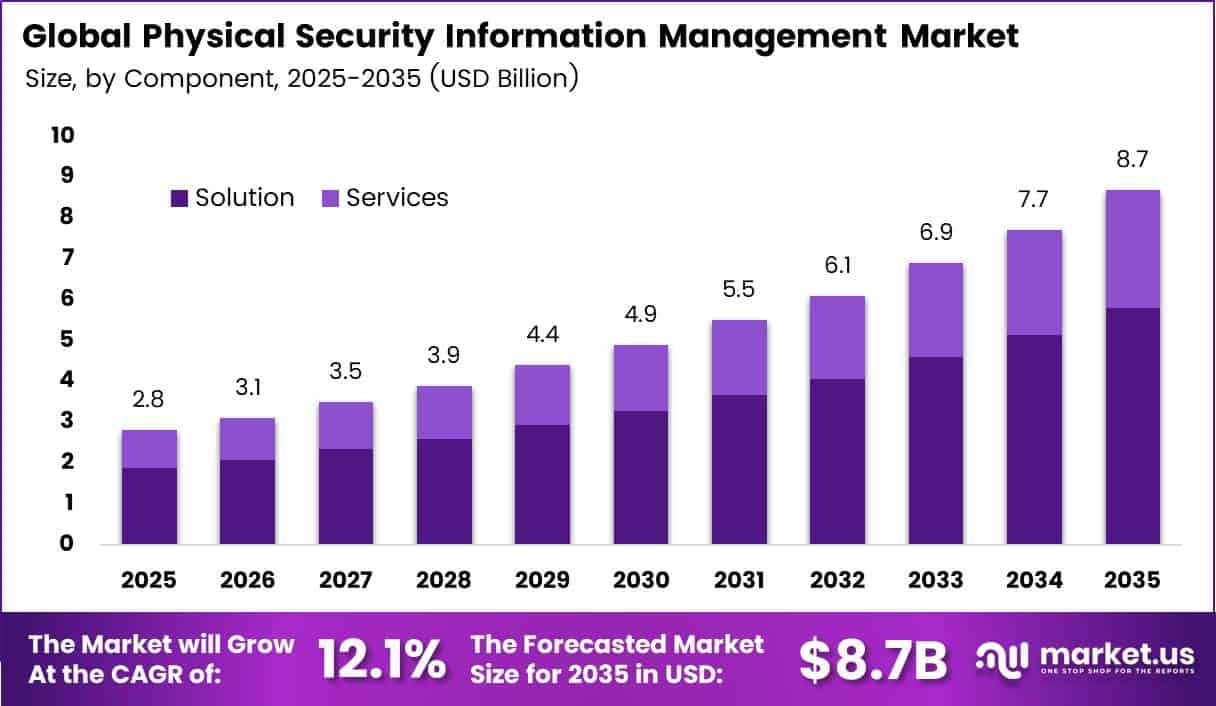
Growth is supported by the rising need to manage security systems across large commercial buildings, critical infrastructure, transport facilities, healthcare sites, data centers, and industrial plants. PSIM platforms combine video surveillance, access control, intrusion alarms, emergency communication, and operational information within a single interface, helping security teams respond more efficiently.
According to the U.S. Census Bureau, U.S. construction spending reached an annualized USD 2.1 trillion in January 2025, increasing 3.3% from January 2024, while private construction spending stood at USD 1.6 trillion. This expanding building base is creating more demand for connected cameras, sensors, gates, and alarms.
In 2025, CISA reported blocking 2.6 billion malicious connections across federal civilian networks and 371 million connections across critical-infrastructure networks. These security pressures are encouraging organizations to adopt integrated platforms that improve incident visibility, coordination, and response, supporting PSIM market growth through 2035.
Key Takeaway
- The Physical Security Information Management (PSIM) Market was valued at USD 2.8 billion in 2025 and is projected to reach USD 8.7 billion by 2035, growing at a CAGR of 12.1%.
- The solution segment dominated the component category with a 66.7% share.
- The on-premises deployment segment led with a 58.3% share.
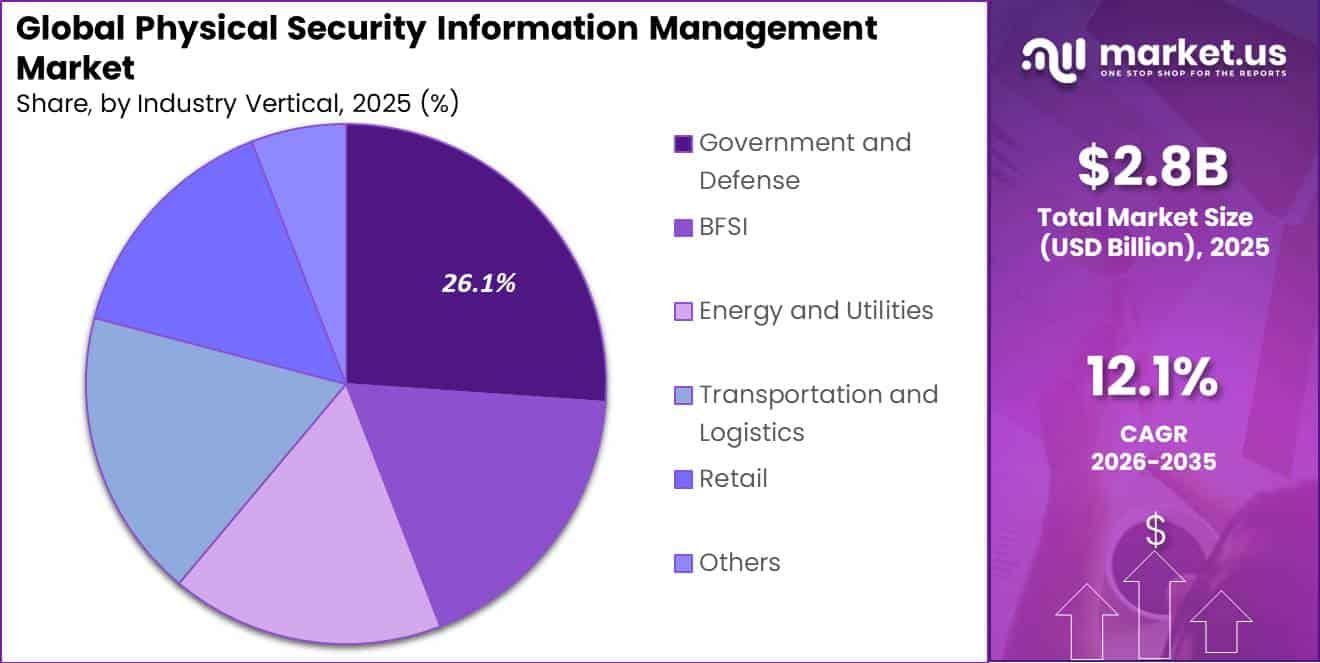
- The government and defense segment led the industry vertical category with a 26.1% share.
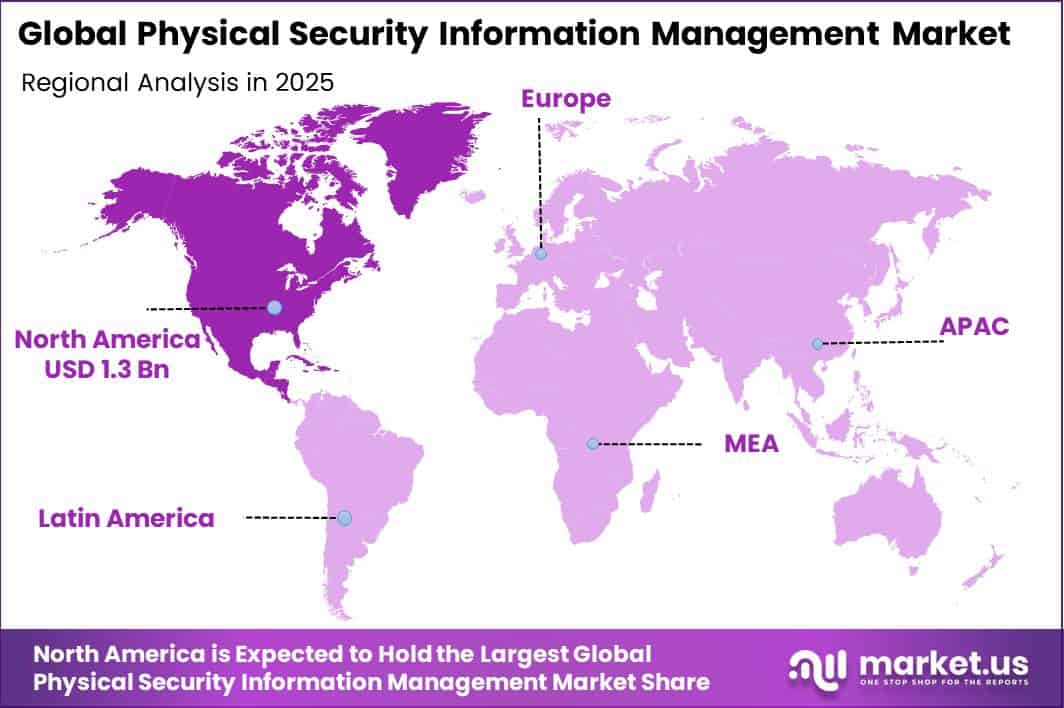
- North America led the market in 2025 with a 41.3% share, generating approximately USD 1.3 billion in revenue.
By Component
The Solution segment held a dominant position in the PSIM market, accounting for a 66.7% share, as organizations increasingly rely on centralized software to manage security systems across complex facilities. PSIM solutions bring video surveillance, access control, alarms, visitor information, maps, and incident-response workflows into a single operating platform.
This approach is especially important in large public facilities such as schools and campuses, where several security technologies operate at the same time. According to the U.S. Department of Education’s National Center for Education Statistics, 97% of public schools controlled access to school buildings and required visitors to check in during the 2021–22 school year, while 93% used security cameras.
The use of security cameras increased significantly from 61% in 2009–10, showing how rapidly the volume of data centers has expanded. As more cameras, access systems, sensors, and alarms are installed, security teams need software that connects these systems and presents alerts in one place.
By Deployment
The On-Premises deployment segment held a dominant position in the PSIM market, accounting for a 58.3% share, as critical facilities prefer security platforms that operate within their own controlled networks. This is particularly important for data centers, where large volumes of computing equipment, power systems, networking hardware, and restricted areas require continuous protection.
According to the U.S. Department of Energy, U.S. data centers consumed around 176 terawatt-hours (TWh) of electricity in 2023, representing 4.4% of total U.S. electricity consumption. This was more than double the approximately 70 TWh consumed in 2014. The DOE further projects that data centers could account for around 6.7% to 12.0% of U.S. electricity use by 2028.
By Industry Vertical
The Government and Defense segment held a dominant position in the PSIM market, accounting for a 26.1% share. These organizations manage large and sensitive facilities where security incidents can affect public safety, national operations, and military readiness. The U.S. Department of Defense requested an FY2025 budget of USD 849.8 billion, reflecting continued spending on defense operations, infrastructure, and facility security.
Within this budget, around USD 19.8 billion was allocated to sustain, restore, and modernize facilities, while USD 17.5 billion was requested for military construction and family-housing programs. These investments support upgrades across military bases, ports, command centers, medical facilities, and restricted locations.
Global defense spending is also strengthening demand for integrated physical security platforms. SIPRI reported that worldwide military expenditure reached USD 2.7 trillion in 2024, representing a 9.4% real-term increase from 2023 and standing 37% above 2015 levels. Higher defense budgets and continued modernization of critical facilities are supporting wider adoption of PSIM platforms for real-time monitoring.
Key Market Segments
By Component
- Solution
- Services
By Deployment
- On-Premises
- Cloud Based
By Industry Vertical
- Government and Defense
- BFSI
- Energy and Utilities
- Transportation and Logistics
- Retail
- Others
Geopolitical Impact Analysis
Geopolitical disruption is increasing the cost and delivery time of hardware used in Physical Security Information Management (PSIM) projects, even though the main PSIM platform is software-based. Installations still depend on IP cameras, sensors, access readers, controllers, servers, network switches, storage systems, cables, and power equipment sourced through global supply chains.
UN Trade and Development reported that rerouting vessels around the Cape of Good Hope can add around 12 days to Asia-Europe voyages, increasing transit time by about 30% and reducing effective global container capacity by nearly 9%. By mid-2024, tonnage passing through the Suez Canal had declined by 70%, while arrivals around the Cape of Good Hope increased by 89%.
Trade tensions are creating additional sourcing pressure for electronic security equipment. In February 2025, China challenged a U.S. 10% additional tariff on Chinese goods through the WTO. The U.S. Congressional Research Service also reported that the United States continued applying a 20% tariff on all Chinese goods following the temporary tariff reduction in May 2025.
Energy and shipping risks are adding further cost pressure. The International Energy Agency reported that European benchmark gas prices increased 18% between June 10 and 19, 2025, while Red Sea war-risk insurance premiums more than doubled from 0.4%. Together, higher transport, energy, and sourcing costs can increase PSIM project prices and encourage suppliers to diversify sourcing and maintain larger inventories.
Regional Analysis
North America held a dominant position in the global Physical Security Information Management (PSIM) market in 2025, accounting for 41.3% of total revenue and approximately USD 1.3 billion in market value. The region benefits from a large base of government buildings, defense facilities, airports, utilities, hospitals, corporate campuses, and data centers that require centralized security management.
Lawrence Berkeley National Laboratory reported that U.S. data centers consumed around 176 TWh of electricity in 2023, representing 4.4% of national electricity use, compared with 58 TWh in 2014. This expansion is increasing the number of high-value facilities requiring integrated video surveillance, access control, alarms, and incident-management systems.
Government and critical-infrastructure security requirements are also supporting PSIM adoption across the region. In Canada, Statistics Canada recorded 225 police-reported cybercrime incidents per 100,000 people in 2024, more than double the 91.9 incidents per 100,000 people reported in 2018.
Asia Pacific is expected to be the fastest-growing region, supported by rapid urban development, digital infrastructure investment, transport expansion, industrial growth, and smart-city projects across China, India, Japan, South Korea, and Southeast Asia.
Key Regions and Countries
North America
- US
- Canada
Europe
- Germany
- France
- The UK
- Spain
- Italy
- Rest of Europe
Asia Pacific
- China
- Japan
- South Korea
- India
- Australia
- Rest of APAC
Latin America
- Brazil
- Mexico
- Rest of Latin America
Middle East & Africa
- GCC
- South Africa
- Rest of MEA
Market Dynamics
Drivers
| Driver | (~) % CAGR | Geographic Relevance | Impact Timeline |
|---|---|---|---|
| Critical-infrastructure security compliance | +2.0% | Europe, North America | Short term (2 years or less) |
| Data-center security expansion | +1.7% | North America, Asia Pacific | Medium term (2 to 4 years) |
| Command-center modernization | +1.3% | Global | Medium term (2 to 4 years) |
| Multi-site enterprise consolidation | +1.1% | North America, Europe | Short term (2 years or less) |
| Public-safety digitalization | +0.9% | Asia Pacific, Middle East | Long term (4 years or more) |
Critical-infrastructure security compliance
Regulatory requirements are making integrated security a necessary operational investment. The European Commission required Member States to apply NIS2 measures from 18 October 2024, covering 18 critical sectors with incident-reporting timelines of 24 hours, 72 hours, and 1 month.
The Critical Entities Resilience framework also requires Member States to identify critical entities by 17 July 2026, increasing demand for stronger access control, risk assessment, and incident-response systems. These compliance requirements support PSIM software, integration, and maintenance spending, contributing an estimated +2.0% CAGR upside to the 12.1% baseline growth rate.
Restraints
| Restraint | (~) % CAGR | Geographic Relevance | Impact Timeline |
|---|---|---|---|
| High upfront integration cost | -1.6% | Global | Short term (2 years or less) |
| Public procurement delays | -1.2% | Europe, North America | Medium term (2 to 4 years) |
| Data-sovereignty restrictions | -1.0% | Europe, Middle East | Medium term (2 to 4 years) |
| Capital-budget prioritization | -0.8% | Global | Short term (2 years or less) |
| Legacy contract lock-in | -0.6% | North America, Europe | Long term (4 years or more) |
High upfront integration cost
High initial integration cost remains a major near-term barrier for PSIM adoption. Deployments often require interface development, network upgrades, server capacity, data migration, and staff training. U.S. data centers consumed around 176 TWh in 2023, equal to 4.4% of national electricity demand, while their share could rise to 6.7%–12.0% by 2028, increasing infrastructure and power-related costs.
High borrowing costs can further delay large security projects, especially in emerging markets. As a result, many organizations choose phased integration or continue using standalone security systems instead of full PSIM deployment. This can reduce near-term software and implementation revenue, creating an estimated -1.6% CAGR drag against the 12.1% baseline CAGR.
Challenges
| Challenge | (~) % CAGR | Geographic Relevance | Mitigation Horizon |
|---|---|---|---|
| Legacy system interoperability | -1.5% | Global | Long term (4 years or more) |
| Security technician shortage | -1.1% | North America, Europe | Medium term (2 to 4 years) |
| Electronic component lead times | -0.9% | Global | Short term (2 years or less) |
| Cross-border data integration | -0.7% | Europe, Asia Pacific | Medium term (2 to 4 years) |
| False alarm management | -0.5% | Global | Medium term (2 to 4 years) |
Legacy system interoperability
Legacy-system interoperability remains a key market challenge because large facilities often use different generations of cameras, access readers, intrusion panels, communication tools, and video-management systems. U.S. Department of Energy projections show data-center electricity demand could rise from 176 TWh in 2023 to around 325 TWh–580 TWh by 2028, increasing the number of high-value sites where security-system downtime is difficult to accept.
Supply-chain disruption adds further pressure. UNCTAD reported that Suez Canal transiting tonnage fell 70% by mid-2024, while Cape of Good Hope arrivals increased 89%. Vendors must therefore maintain backward compatibility, adapter libraries, testing capability, and local technical support, creating an estimated -1.5% CAGR friction drag on market growth.
Opportunities
| Opportunity | (~) % CAGR | Geographic Relevance | Execution Window |
|---|---|---|---|
| Managed PSIM subscription platforms | +1.8% | North America, Europe, Asia Pacific | Medium term (2 to 4 years) |
| Edge AI event automation | +1.5% | Global | Medium term (2 to 4 years) |
| Critical-entity resilience programs | +1.2% | Europe | Short term (2 years or less) |
| Emerging-market smart campuses | +1.0% | Asia Pacific, Middle East | Long term (4 years or more) |
| Security software roll-ups | +0.8% | Global | Medium term (2 to 4 years) |
Managed PSIM subscription platforms
Managed PSIM remains an emerging opportunity, as many deployments still rely on site-specific software and integration projects. The U.S. Department of Energy estimates data-center electricity demand could reach 325 TWh to 580 TWh by 2028, expanding the number of facilities that require continuous security monitoring, maintenance, and incident management.
The European Commission’s NIS2 framework covers 18 sectors and requires initial incident reporting within 24 hours and further reporting within 72 hours. This supports demand for managed security services, while recurring monitoring and analytics contracts could provide a potential +1.8% CAGR upside above the 12.1% baseline.
Key Players Analysis
The Physical Security Information Management (PSIM) market remains highly fragmented, as vendors do not publicly disclose PSIM-only revenue, making exact company market shares difficult to verify. Tier 1 competition is led by Johnson Controls and Hexagon, supported by their large installed customer bases, enterprise software capabilities, and access to major government, infrastructure, airport, healthcare, and multi-site projects.
Johnson Controls reported FY2025 sales of USD 23.5 billion, including USD 16.1 billion from products and systems and USD 7.4 billion from services. The company also invested USD 273 million in R&D and USD 434 million in capital expenditure.
In 2025, Johnson Controls completed the sale of its residential and light-commercial HVAC business to Bosch for about USD 8.3 billion, sharpening its focus on commercial and mission-critical buildings. Hexagon remains another major enterprise player, while Genetec, AxxonSoft, Advancis, SureView Systems, Prysm Software, Scutum, and Vidsys compete as specialist PSIM providers through open-platform integration and command-center capabilities.
Everbridge also competes in adjacent critical-event management, following its acquisition by Thoma Bravo in July 2024 for approximately USD 1.8 billion, or USD 35.0 per share. Directionally, Tier 1 vendors may represent around 30–40% of large-account PSIM spending, while specialist providers serve the remaining opportunity through regional expertise, vertical solutions, and customized integration.
Top Key Players in the Market
- AxxonSoft
- Hexagon AB
- Genetec Inc
- Everbridge Inc.
- Prysm Software
- Johnson Controls International plc
- Sureview Systems
- Advancis software and services Gmbh
- Scutum Group
- VIDSYS INC.
- VC999
- Henkelman
Recent Developments
- In 2026, Genetec announced that SoFi Stadium and Hollywood Park had unified their physical-security operations using Genetec Security Center. The system supports the 3.1 million-square-foot SoFi Stadium and the wider 300-acre Hollywood Park campus. Security teams use the platform to manage more than 3,000 cameras, 700 access readers, and other systems and sensors from three security control rooms.
- In 2026, Octave acquired VXG Inc., a cloud-native video management software provider. VXG generated around USD 1.0 million in 2025 revenue and supports hundreds of camera models. The acquisition strengthens Octave’s physical-security portfolio with AI-enabled video monitoring, cloud VMS, alerting, investigation, and evidence-sharing capabilities across corporate campuses, healthcare, education, finance, retail, and public-safety environments.
Report Scope
| Report Features | Description |
|---|---|
| Market Value (2025) | USD 2.8 Billion |
| Forecast Revenue (2035) | USD 8.7 Billion |
| CAGR (2026-2035) | 12.1% |
| Base Year for Estimation | 2025 |
| Historic Period | 2020-2024 |
| Forecast Period | 2026-2035 |
| Report Coverage | Revenue Forecast, Market Dynamics, Competitive Landscape, Recent Developments |
| Segments Covered | By Component (Solution, Services), By Deployment (On-Premises, Cloud-Based), By Industry Vertical (Government and Defense, BFSI, Energy and Utilities, Transportation and Logistics, Retail, Others) |
| Regional Analysis | North America – US, Canada; Europe – Germany, France, The UK, Spain, Italy, Rest of Europe; Asia Pacific – China, Japan, South Korea, India, Australia, Singapore, Rest of APAC; Latin America – Brazil, Mexico, Rest of Latin America; Middle East & Africa – GCC, South Africa, Rest of MEA |
| Competitive Landscape | AxxonSoft, Hexagon AB, Genetec Inc., Everbridge Inc., Prysm Software, Johnson Controls International plc, Sureview Systems, Advancis Software and Services GmbH, Scutum Group, VIDSYS INC., VC999, Henkelman |
| Customization Scope | Customization for segments and region/country-level will be provided. Moreover, additional customization can be done based on the requirements. |
| Purchase Options | We have three licenses to opt for: Single User License, Multi-User License (Up to 5 Users), Corporate Use License (Unlimited Users and Printable PDF) |





































