


Global Pharmacy Inventory Management Software Solutions and Cabinets Market By Component (Cabinets/Systems (Automated Dispensing Cabinets and Robotic Systems) and Software Solutions (Inventory Optimization, Analytics and Integration Modules)), By Mode of Operations (Centralized and Decentralized), By End Use (Independent Pharmacies, Hospital Pharmacies, Long-Term Care (LTC) and Others), Region and Companies – Industry Segment Outlook, Market Assessment, Competition Scenario, Trends and Forecast 2026-2035
- Published date: March 2026
- Report ID: 181841
- Number of Pages: 333
- Format:
-
keyboard_arrow_up
Quick Navigation
Report Overview
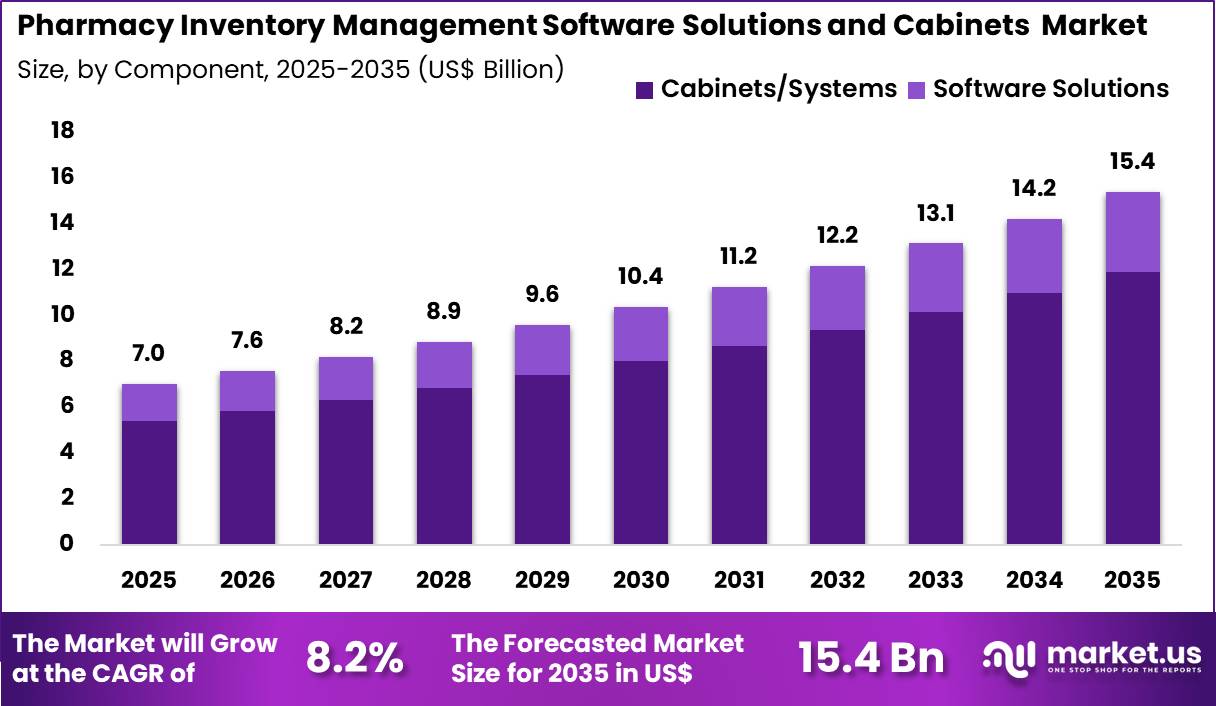
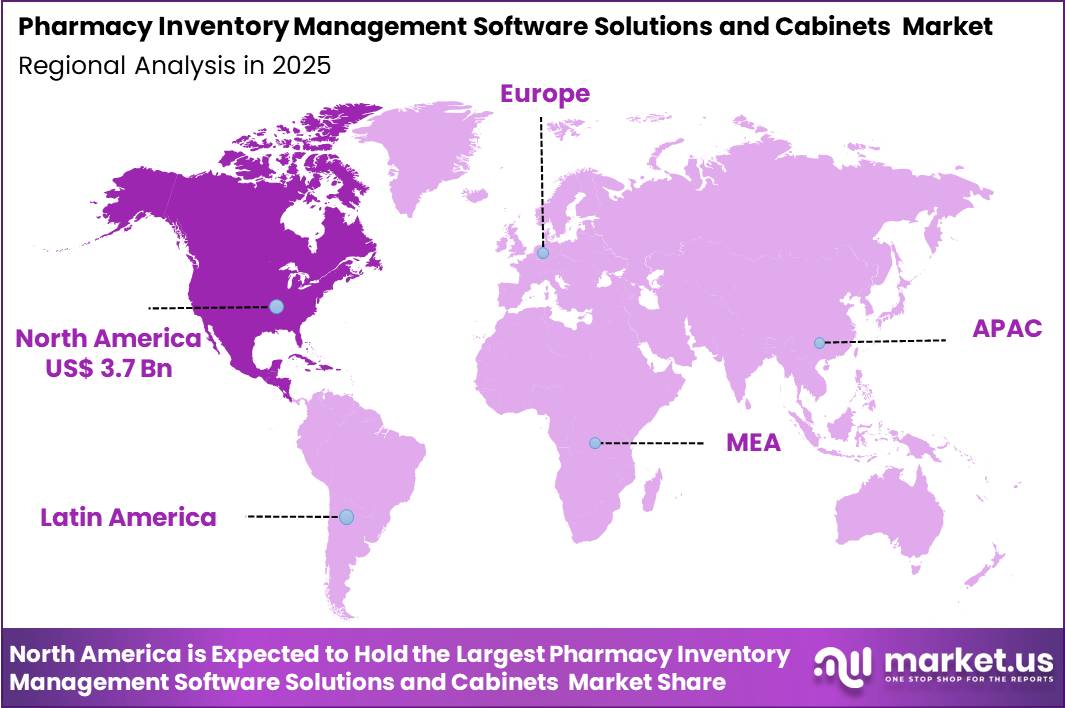
The Global Pharmacy Inventory Management Software Solutions and Cabinets Market size is expected to be worth around US$ 15.4 Billion by 2035 from US$ 7.0 Billion in 2025, growing at a CAGR of 8.2% during the forecast period 2026-2035. In 2025, North America led the market, achieving over 53.1% share with a revenue of US$ 3.7 Billion.
Growing demand for operational efficiency and patient safety accelerates the Pharmacy Inventory Management Software Solutions and Cabinets market as pharmacies and healthcare facilities require automated systems that optimize stock levels, reduce waste, and prevent medication errors.
Retail and hospital pharmacies increasingly deploy integrated software platforms to track medication usage in real time, forecasting demand based on prescription trends and seasonal patterns to maintain adequate supplies of high-turnover drugs such as antibiotics, analgesics, and cardiovascular agents.
These solutions support automated dispensing cabinets in hospital wards and emergency departments, securely storing and dispensing controlled substances and high-alert medications while logging every transaction to ensure chain-of-custody compliance and reduce diversion risks.
Pharmacists utilize centralized inventory dashboards to monitor expiration dates and lot numbers, enabling proactive recalls and minimizing financial losses from expired stock. In compounding pharmacies, software manages raw ingredients and finished preparations, ensuring traceability and regulatory adherence for sterile and non-sterile compounds. Automated cabinets in long-term care facilities dispense unit-dose medications for residents, improving accuracy and reducing administration errors in chronic disease management.
Technology providers pursue opportunities to embed advanced artificial intelligence that autonomously adjusts reorder points and replenishment schedules, expanding applications in dynamic environments where supply chain disruptions or fluctuating prescription volumes require rapid adaptation. These systems analyze historical data, current utilization, and external factors to prevent stockouts of critical medications such as insulin or anticoagulants.
Throughout 2025, pharmacy inventory management systems began evolving toward more autonomous artificial intelligence models capable of managing supply levels without constant manual input. These advanced systems analyze factors such as supply chain disruptions and prescription demand patterns to automatically adjust reorder levels.
Technologies of this type, initially developed by companies such as Supplylogix, were integrated into McKesson’s distribution platform in early 2026. Opportunities emerge in predictive analytics that forecast medication needs during public health events or seasonal disease surges.
Companies invest in interoperable platforms that connect with electronic health records and wholesaler systems, streamlining ordering and invoicing. Recent trends emphasize AI-driven autonomy, real-time visibility, and integration with automated dispensing technologies, positioning the market for growth in resilient, error-resistant pharmacy operations focused on cost control, compliance, and uninterrupted patient care.
Key Takeaways
- In 2025, the market generated a revenue of US$ 7.0 Billion, with a CAGR of 8.2%, and is expected to reach US$ 15.4 Billion by the year 2035.
- The component segment is divided into cabinets/systems and software solutions, with cabinets/systems taking the lead with a market share of 77.3%.
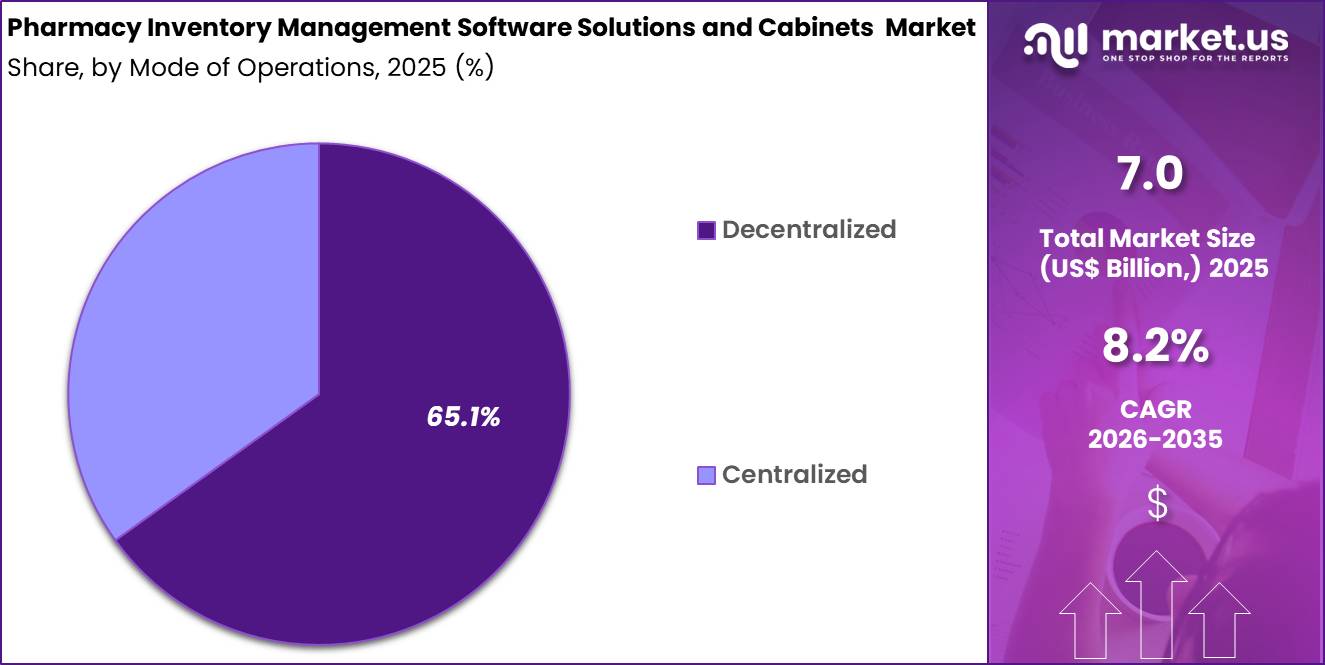
- Considering mode of operations, the market is divided into centralized and decentralized. Among these, decentralized held a significant share of 55.1%.
- Furthermore, concerning the end use segment, the market is segregated into independent pharmacies, hospital pharmacies, long-term care (LTC) and others. The independent pharmacies sector stands out as the dominant player, holding the largest revenue share of 39.2% in the market.
- North America led the market by securing a market share of 53.1%.
Component Analysis
Cabinets and systems accounted for 77.3% of growth within component and dominate the pharmacy inventory management software solutions and cabinets market because automated dispensing cabinets and integrated storage systems improve medication control, safety, and workflow efficiency. Pharmacies increasingly adopt cabinet-based solutions that track medication stock levels, expiration dates, and dispensing records in real time.
These systems help reduce medication errors and inventory losses while ensuring regulatory compliance. The American Society of Health-System Pharmacists highlights the importance of automated dispensing technology in improving medication management and reducing human error in pharmacy operations.
Pharmacies and healthcare facilities increasingly invest in automated cabinets to handle growing prescription volumes and complex medication inventories. The segment is expected to expand as pharmacies modernize medication storage infrastructure and integrate automated cabinets with digital pharmacy management platforms. Increasing emphasis on medication safety and operational efficiency is projected to further strengthen demand for cabinet-based inventory systems.
Mode of Operations Analysis
Decentralized operations accounted for 65.1% of growth within mode of operations and dominate the pharmacy inventory management market due to the growing need for faster medication access across multiple dispensing points. Decentralized pharmacy systems distribute medication storage and dispensing capabilities closer to patient care areas, which reduces delays and improves service efficiency.
Healthcare facilities increasingly implement decentralized medication management systems to support faster prescription processing and inventory tracking. Decentralized systems also allow pharmacies to monitor medication usage across multiple locations simultaneously through integrated software platforms.
This operational model is expected to expand as healthcare providers prioritize faster medication delivery and improved patient care coordination. Pharmacies and healthcare organizations are projected to adopt decentralized systems to support growing prescription volumes and enhance workflow efficiency across distributed pharmacy networks.
End-Use Analysis
Independent pharmacies accounted for 39.2% of growth within end users and dominate the pharmacy inventory management software solutions and cabinets market because these pharmacies require efficient inventory tracking systems to manage diverse medication stocks and high prescription volumes.
Independent pharmacies often operate with limited staff resources, which increases the need for automated inventory management tools that reduce manual tracking tasks. Inventory management software and automated cabinets help these pharmacies monitor medication availability, prevent stock shortages, and manage regulatory compliance requirements.
According to the National Community Pharmacists Association, independent community pharmacies fill a significant share of prescriptions in the United States each year. These pharmacies increasingly adopt digital inventory solutions to improve operational efficiency and maintain competitive service levels. The segment is anticipated to grow as independent pharmacies continue to modernize their technology infrastructure and implement automated medication management systems.
Key Market Segments
By Component
- Cabinets/Systems
- Software Solutions
By Mode of Operations
- Centralized
- Decentralized
By End Use
- Independent Pharmacies
- Hospital Pharmacies
- Long-Term Care (LTC)
- Others
Drivers
Rising demand for automated dispensing cabinets in hospital pharmacies is driving the market.
Hospitals increasingly deploy automated dispensing cabinets to enhance medication safety and inventory accuracy at point-of-care locations. These systems provide secure storage, real-time tracking, and controlled access to medications, reducing dispensing errors. The driver aligns with efforts to minimize controlled substance diversion and improve compliance with regulatory standards.
Facilities report faster restocking cycles through integrated inventory visibility. The trend supports centralized oversight of decentralized medication storage across nursing units. Enhanced traceability features facilitate rapid recall management when required. The adoption reflects ongoing focus on reducing medication waste and expiration losses.
Pharmacists benefit from automated restocking alerts and usage analytics. The momentum corresponds with expansion of inpatient pharmacy operations in growing healthcare networks. This factor sustains procurement of cabinet hardware and supporting software modules.
Restraints
High initial implementation costs for integrated cabinet systems are restraining the market.
Automated dispensing cabinets require substantial upfront capital for hardware purchase, installation, and facility modifications. Smaller community hospitals face budgetary limitations when upgrading legacy manual systems. The restraint extends project timelines due to extensive validation and staff training requirements.
Ongoing maintenance contracts add recurring expenses beyond initial investment. The factor moderates adoption in resource-constrained facilities prioritizing other capital needs. Vendors encounter longer sales cycles as decision-makers evaluate total cost of ownership.
The dynamic limits penetration in rural and critical access hospitals. Integration with existing pharmacy information systems demands additional customization costs. This constraint tempers overall market velocity in certain segments. The limitation persists in constraining rapid replacement of manual inventory processes.
Opportunities
Integration of cloud-based analytics with dispensing cabinets is creating growth opportunities.
Advanced platforms now combine cabinet transaction data with cloud-hosted analytics to provide predictive restocking and usage pattern insights. These capabilities enable proactive inventory optimization and reduction of stockouts. Opportunities arise for value-added services including diversion monitoring and compliance reporting.
The framework supports remote access for centralized pharmacy oversight across multi-site health systems. Developers gain capacity to offer subscription-based analytics modules alongside hardware. The development facilitates data-driven decisions on formulary management. Such integration attracts health systems seeking measurable return on investment.
The opportunity fosters partnerships with electronic health record vendors for seamless data flow. Stakeholders anticipate improved medication availability and cost containment. This advancement positions providers for scalable, data-informed inventory management.
Impact of Macroeconomic / Geopolitical Factors
Healthcare providers increasingly rely on pharmacy inventory management software solutions and automated cabinets to control medication flow, yet macroeconomic pressures influence purchasing decisions across hospitals and pharmacies. Rising operational costs push health systems to scrutinize capital expenditures, which can slow upgrades of digital inventory platforms and automated dispensing infrastructure.
Financing costs also affect expansion plans for smaller pharmacies that plan to modernize storage and tracking systems. Geopolitical uncertainty influences the supply of electronics, scanning modules, and specialized cabinet components used in automated pharmacy equipment. US tariffs on imported hardware such as sensors, processors, and cabinet electronics increase equipment acquisition costs for healthcare providers.
These cost pressures may delay installations in budget-sensitive facilities. At the same time, hospitals seek stronger medication tracking, regulatory compliance, and waste reduction, which strengthens the business case for digital inventory systems. Continued emphasis on medication safety and operational efficiency keeps long-term demand for these solutions moving upward.
Latest Trends
Launch of next-generation automated dispensing cabinets with enhanced security features is driving the market.
Major suppliers introduced updated dispensing cabinet models in 2025 featuring biometric authentication and advanced locking mechanisms. These systems incorporate touchscreen interfaces with improved user ergonomics for faster transaction completion. The launch addresses evolving requirements for controlled substance security in hospital environments.
Pharmacies benefit from integrated camera surveillance and audit trail enhancements. The 2025 development aligns with increased regulatory emphasis on diversion prevention. Facilities report potential reductions in medication discrepancies through precise access controls. The innovation supports compliance with Joint Commission standards for secure storage.
Early implementations demonstrate consistent performance in high-volume units. The advancement stimulates replacement cycles for aging cabinet fleets. Overall, this technological progression elevates safety and efficiency standards in pharmacy operations.
Regional Analysis
North America is leading the Pharmacy Inventory Management Software Solutions and Cabinets Market
North America accounted for 53.1% of the pharmacy inventory management software solutions and cabinets market in 2025 as hospitals and healthcare systems increasingly digitized medication storage and supply chain operations to improve safety and efficiency.
Healthcare providers across the United States and Canada are integrating automated dispensing cabinets and inventory tracking software to monitor medication usage, reduce stock shortages, and prevent dispensing errors. According to the American Society of Health-System Pharmacists, more than 97% of U.S. hospitals used automated dispensing cabinets for medication distribution by 2022, highlighting widespread reliance on automated pharmacy storage technologies.
Growing pressure to reduce medication errors and improve drug traceability has encouraged hospitals to adopt digital inventory platforms that track pharmaceuticals across multiple departments in real time. Healthcare organizations are also expanding centralized pharmacy management systems that integrate with electronic health records and clinical decision support tools.
Pharmaceutical supply chain disruptions in recent years have further emphasized the need for real-time inventory monitoring to maintain adequate medication supplies. Technology vendors are introducing advanced cabinet systems with biometric authentication and automated stock alerts that improve medication security and workflow efficiency.
Hospital pharmacies are also adopting predictive analytics to forecast medication demand and optimize procurement decisions. These developments collectively supported strong expansion of automated pharmacy inventory management systems across North America in 2025.
The Asia Pacific region is expected to experience the highest CAGR during the forecast period
Asia Pacific is expected to experience strong growth during the forecast period as healthcare infrastructure modernization and digital hospital initiatives accelerate across the region. Countries such as China, India, Japan, and South Korea are investing heavily in hospital information systems and automated pharmacy technologies to improve medication management and reduce operational inefficiencies.
The World Health Organization reported in 2022 that medication errors cause at least USD 42 billion in global healthcare costs annually, encouraging healthcare systems to adopt technologies that strengthen medication safety and inventory control. Hospitals across the region are introducing automated dispensing cabinets and digital inventory software to improve drug storage, tracking, and distribution processes.
Governments are also promoting smart hospital programs that integrate pharmacy automation with broader healthcare information systems. Rapid expansion of hospital networks and specialty clinics is increasing demand for efficient pharmaceutical supply management tools.
Technology providers are developing cost-effective automated cabinet systems tailored for high-volume healthcare facilities in emerging markets. Universities and healthcare training institutions are strengthening pharmacy informatics programs to support digital medication management practices. These developments are expected to accelerate adoption of automated pharmacy inventory management technologies across Asia Pacific in the coming years.
Key Regions and Countries
North America
- The US
- Canada
Europe
- Germany
- France
- The U.K.
- Italy
- Spain
- Russia & CIS
- Rest of Europe
Asia Pacific
- China
- India
- Japan
- South Korea
- ASEAN
- Australia & New Zealand
- Rest of Asia Pacific
Middle East & Africa
- GCC
- South Africa
- Rest of Middle East & Africa
Latin America
- Brazil
- Mexico
- Rest of Latin America
Key Players Analysis
Key participants in the Pharmacy Inventory Management Software Solutions and Cabinets Market expand their presence by integrating automated dispensing cabinets with advanced inventory software that tracks medication usage, expiration dates, and stock levels in real time.
Companies collaborate with hospitals and healthcare systems to implement centralized medication management platforms that reduce dispensing errors and improve operational efficiency in pharmacies. They also invest in cloud-based analytics tools and barcode verification technologies that strengthen medication traceability and regulatory compliance.
Omnicell Inc. represents a prominent participant in the Pharmacy Inventory Management Software Solutions and Cabinets Market and operates as a U.S.-based healthcare technology company that develops automated medication dispensing systems, pharmacy automation software, and medication management solutions for hospitals and health systems.
The company focuses on connected pharmacy platforms that optimize inventory control and medication distribution workflows. Industry competitors continue to introduce advanced automation cabinets, expand software capabilities, and strengthen healthcare partnerships to improve pharmacy operational efficiency and patient safety.
Top Key Players
- ARxIUM
- BD (Becton, Dickinson and Company)
- Clanwilliam IRL
- Datascan
- DCS INFOWAY
- Epicor Software Corporation
- JVM Co., Ltd.
- LIBERTY SOFTWARE
- Logic ERP Solutions Pvt Ltd.
- McKesson Corporation
- Omnicell Inc.
- Supplylogix LLC
Recent Developments
- In December 2025, Omnicell introduced Titan XT, a new automated medication dispensing system developed to improve coordination between pharmacy operations and nursing workflows. Built on the OmniSphere cloud platform, the system incorporates artificial intelligence–supported inventory monitoring and medication tracking to support more efficient medication management within hospital environments.
- In September 2025, BD collaborated with Henry Ford Health to implement the BD Rowa Vmax robotic storage and dispensing system within a major US hospital setting. The project represented one of the first large-scale deployments of this automated pharmacy technology in the United States. In March 2026, BD further expanded its robotics initiatives through a partnership with Sinteco to modernize medication storage and handling processes.
- In late 2025, ARxIUM launched the MedSelect Anesthesia Station, a medication management solution designed for operating room environments to improve workflow efficiency and medication access during surgical procedures. In January 2026, the company also released an updated version of its pharmacy management software, RxWorks Pro 15, which introduced enhanced orchestration capabilities and real-time operational monitoring tools.
Report Scope
Report Features Description Market Value (2025) US$ 7.0 Billion Forecast Revenue (2035) US$ 15.4 Billion CAGR (2026-2035) 8.2% Base Year for Estimation 2025 Historic Period 2020-2024 Forecast Period 2026-2035 Report Coverage Revenue Forecast, Market Dynamics, COVID-19 Impact, Competitive Landscape, Recent Developments Segments Covered By Component (Cabinets/Systems (Automated Dispensing Cabinets and Robotic Systems) and Software Solutions (Inventory Optimization, Analytics and Integration Modules)), By Mode of Operations (Centralized and Decentralized), By End Use (Independent Pharmacies, Hospital Pharmacies, Long-Term Care (LTC) and Others) Regional Analysis North America – The US, Canada; Europe – Germany, France, The U.K., Italy, Spain, Russia & CIS, Rest of Europe; Asia Pacific – China, India, Japan, South Korea, ASEAN, Australia & New Zealand, Rest of Asia Pacific; Middle East & Africa – GCC, South Africa, Rest of Middle East & Africa; Latin America – Brazil, Mexico, Rest of Latin America Competitive Landscape ARxIUM, BD, Clanwilliam IRL, Datascan, DCS INFOWAY, Epicor Software Corporation, JVM Co., Ltd., LIBERTY SOFTWARE, Logic ERP Solutions Pvt Ltd., McKesson Corporation, Omnicell Inc., Supplylogix LLC. Customization Scope Customization for segments, region/country-level will be provided. Moreover, additional customization can be done based on the requirements. Purchase Options We have three licenses to opt for: Single User License, Multi-User License (Up to 5 Users), Corporate Use License (Unlimited User and Printable PDF)  Pharmacy Inventory Management Software Solutions and Cabinets MarketPublished date: March 2026add_shopping_cartBuy Now get_appDownload Sample
 -
-
- ARxIUM
- BD (Becton, Dickinson and Company)
- Clanwilliam IRL
- Datascan
- DCS INFOWAY
- Epicor Software Corporation
- JVM Co., Ltd.
- LIBERTY SOFTWARE
- Logic ERP Solutions Pvt Ltd.
- McKesson Corporation
- Omnicell Inc.
- Supplylogix LLC
Our Clients

- 181841
- March 2026






