


Report Overview
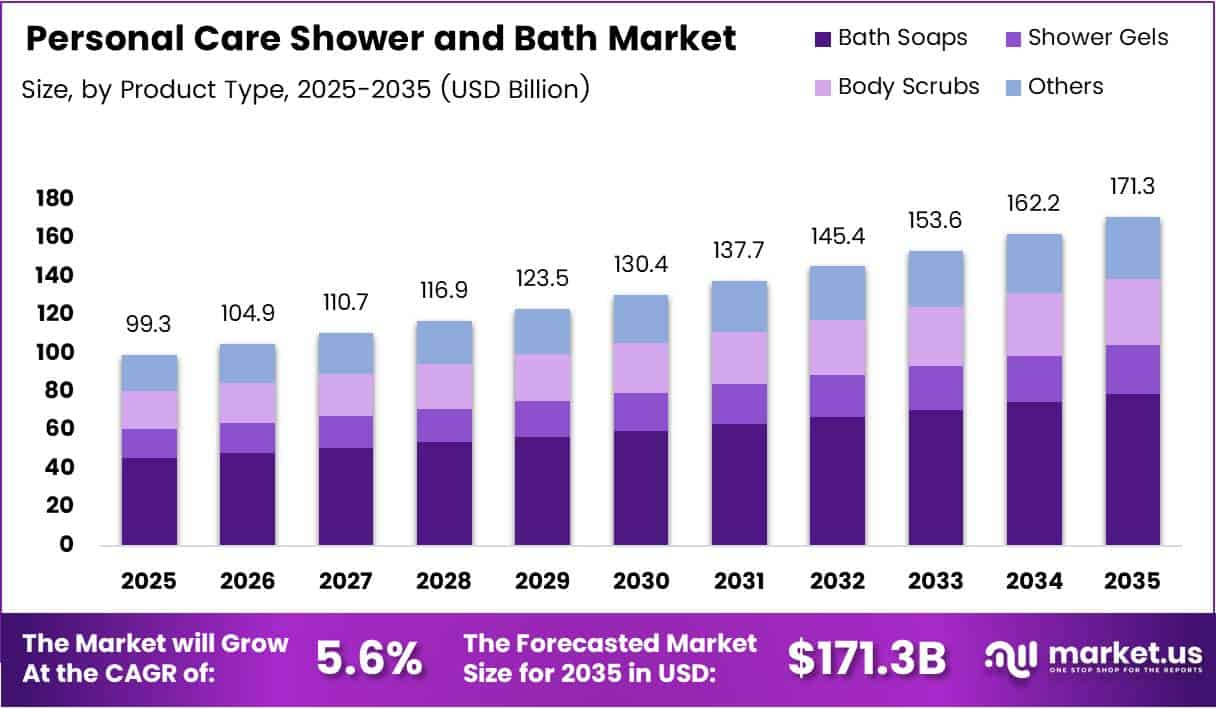
Global Personal Care Shower and Bath Market size is expected to be worth around USD 171.3 Billion by 2035 from USD 99.3 Billion in 2025, growing at a CAGR of 5.6% during the forecast period 2026 to 2035.
The personal care shower and bath market covers a broad range of hygiene and cleansing products, including bath soaps, shower gels, body scrubs, and related formulations. These products serve daily hygiene routines for both residential and institutional users. Consumer spending in this category reflects both basic hygiene needs and elevated personal wellness priorities.
Urbanization continues to reshape purchase behavior, as city-based consumers demonstrate higher frequency of bathing routines and stronger preference for branded, dermatologically tested formulations. This behavioral shift creates consistent volume demand across mass and premium tiers. Manufacturers that position products across both price points hold a structural advantage over single-tier competitors.
Premiumization is reshaping the competitive landscape. Consumers increasingly seek products with active skincare ingredients, clean-label certifications, and specialized benefits such as acne-targeting or brightening. This bifurcation between functional and basic cleansing creates space for mid-market brands to reposition and capture margin-accretive volume.
E-commerce channels are restructuring how personal care brands reach consumers, particularly in Asia Pacific, where mobile-first shopping behavior dominates. Direct-to-consumer models allow brands to bypass traditional retail markups and build first-party consumer data. This structural channel shift favors brands with strong digital marketing capability over those reliant on shelf placement alone.
In June 2025, Unilever signed an agreement to acquire men’s personal care brand Dr. Squatch, signaling that major players are actively expanding their portfolio reach into specialty male grooming — a segment that has historically been underpenetrated relative to women’s bath care.
According to the Alliance for Water Efficiency, using a 2-in-1 shampoo and conditioner product reduces water consumption per shower to 2.1 gallons, compared to a baseline of 7.35 gallons for separate applications — a savings of 5.25 gallons per use. This data point signals a structural shift in formulation strategy, as water-efficient multi-functional products align with both consumer sustainability preferences and tightening regulatory expectations on product environmental impact.
Additionally, according to the Alliance for Water Efficiency, switching to 2-in-1 products delivers annual water savings of 1,316 gallons per average user. For manufacturers, this metric translates into a concrete sustainability claim that differentiates premium SKUs in markets where eco-conscious purchasing is measurable and growing in influence.
Key Takeaways
- The Global Personal Care Shower and Bath Market is valued at USD 99.3 Billion in 2025 and is forecast to reach USD 171.3 Billion by 2035.
- The market grows at a CAGR of 5.6% during the forecast period 2026 to 2035.
- By Product Type, Bath Soaps holds the dominant position with a 45.8% market share in 2025.
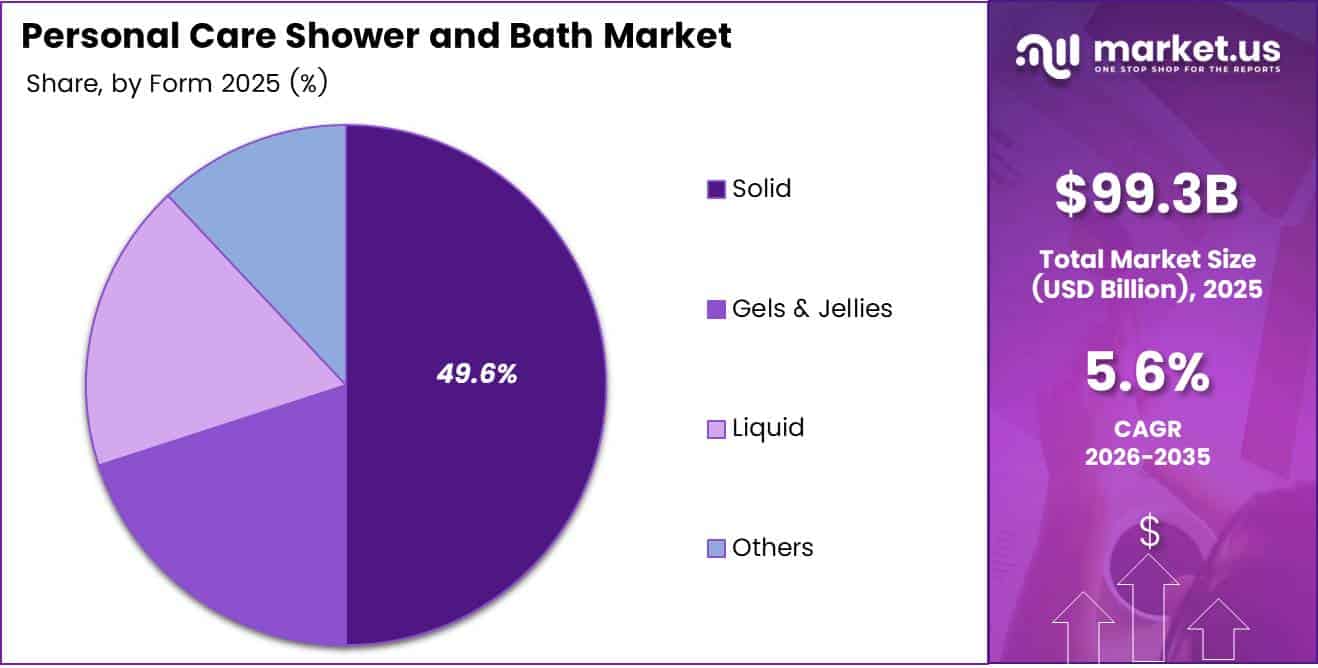
- By Form, Solid form leads the market with a 49.6% share, reflecting consumer preference for traditional and cost-effective formats.
- By End-User, Women account for 72.4% of market demand, making female consumers the primary buyer segment.
- By Distribution Channel, Offline channels command 69.1% share, driven by retail pharmacy and supermarket penetration.
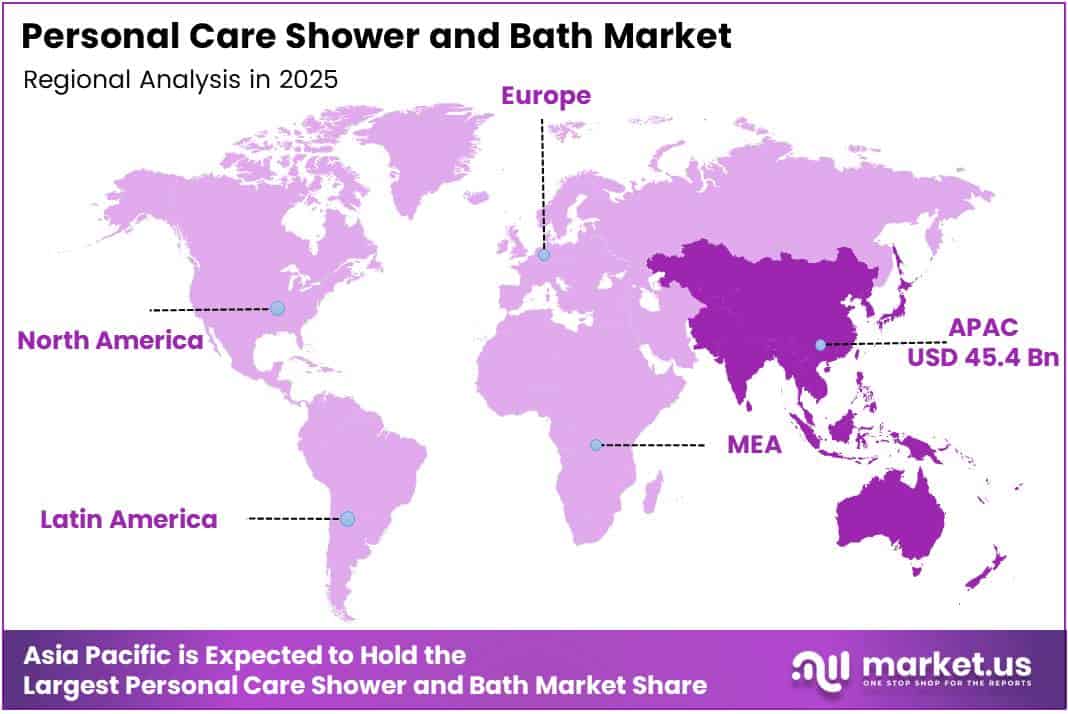
- Asia Pacific leads all regions with a 45.80% share, valued at USD 45.4 Billion in 2025.
Product Type Analysis
Bath Soaps dominates with 45.8% due to widespread availability and affordability.
In 2025, Bath Soaps held a dominant market position in the By Product Type segment of the Personal Care Shower and Bath Market, with a 45.8% share. This dominance reflects the format’s accessibility across income brackets and retail channels — from premium bar soaps in specialty stores to mass-market variants in general trade. High volume and low per-unit price sustain consistent repurchase behavior.
Shower Gels serve as the primary upgrade pathway for consumers moving beyond basic bar soap. The format supports enhanced fragrance delivery, liquid dosing convenience, and premium positioning — making it the preferred format for mid-to-high income urban shoppers. Consequently, shower gel commands disproportionately higher retail margins compared to traditional soaps.
Body Scrubs carry the highest per-unit price within the product type segment, positioning them as a discretionary add-on rather than a daily essential. However, rising consumer interest in at-home exfoliation and skin texture improvement is expanding the addressable buyer base. This shift suggests body scrubs will outpace the segment average in value growth over the forecast period.
Others in the product type segment include bath salts, bath bombs, and specialty cleansing oils. These formats attract niche but high-spending consumers seeking therapeutic or luxury bathing experiences. Moreover, the wellness trend is pulling specialty bath formats into mainstream retail, broadening their commercial reach beyond boutique channels.
Form Analysis
Solid form dominates with 49.6% due to established consumer habit and cost efficiency.
In 2025, Solid form held a dominant market position in the By Form segment of the Personal Care Shower and Bath Market, with a 49.6% share. Solid formats — primarily bar soaps — benefit from lower manufacturing costs, longer shelf life, and minimal packaging requirements. Additionally, the sustainability credentials of solid formats are driving renewed consumer interest, particularly in markets where single-use plastic regulation is tightening.
Gels & Jellies differentiate through texture-based consumer experience, delivering a sensory quality that solid formats cannot replicate. This format supports higher fragrance load and active ingredient retention, which makes it the preferred vehicle for premium skincare-infused bath products. Therefore, brand investments in gel-based innovation are disproportionately concentrated at the premium end of the market.
Liquid form covers body washes and pourable cleansers, offering precise dosing and compatibility with pump dispensers. The liquid format benefits from refillable packaging trends, which align with sustainability mandates across European and North American retail. However, higher water content in liquid formulas increases environmental footprint relative to solid alternatives, a factor that regulators are beginning to scrutinize.
Others within the form segment include powder formats, effervescent bath tablets, and dry cleansing options. These formats serve both convenience-driven and water-scarcity-sensitive consumers. Dry shampoo and similar waterless formats are gaining traction in markets facing water stress, creating a structurally new product tier that incumbents are not yet fully competing in.
End-User Analysis
Women dominate with 72.4% due to higher product category engagement and premium tier adoption.
In 2025, Women held a dominant market position in the By End-User segment of the Personal Care Shower and Bath Market, with a 72.4% share. Female consumers demonstrate higher purchase frequency, stronger brand loyalty, and greater willingness to trade up to premium formulations. Consequently, the majority of product innovation — from serum-infused body washes to aromatherapy bath ranges — targets this segment explicitly.
Men represent the fastest-evolving end-user segment, transitioning from a commodity mindset toward category-specific products with performance claims. Historically underserved by the category, male consumers are now entering a broader set of bath product subcategories, including body scrubs and multi-functional cleansers. Unilever’s June 2025 acquisition of Dr. Squatch underscores how major players are accelerating investment into men’s personal care to capture this structural growth.
Distribution Channel Analysis
Offline dominates with 69.1% due to tactile evaluation preference and broad retail penetration.
In 2025, Offline channels held a dominant market position in the By Distribution Channel segment of the Personal Care Shower and Bath Market, with a 69.1% share. Physical retail remains critical because consumers in bath and personal care typically rely on sensory evaluation — fragrance, texture, and format — before purchase. Supermarkets, pharmacies, and hypermarkets continue to generate the highest volume throughput for mass-market bath products.
Online channels are compressing the offline advantage by enabling direct-to-consumer reach and subscription-based replenishment models. E-commerce platforms provide brands with detailed behavioral data, allowing for targeted cross-sell and upsell at lower acquisition costs than in-store promotion. However, the inability to replicate fragrance-based evaluation online remains a structural barrier that limits online conversion rates for first-time purchasers.
Key Market Segments
By Product Type
- Bath Soaps
- Shower Gels
- Body Scrubs
- Others
By Form
- Solid
- Gels & Jellies
- Liquid
- Others
By End-User
- Women
- Men
By Distribution Channel
- Offline
- Online
Drivers
Daily Hygiene Priorities and Premium Formulation Demand Push Bath Product Volume and Value Simultaneously
Consumer focus on daily hygiene has moved beyond basic cleansing toward skin wellness outcomes. Buyers now evaluate bath and shower products against dermatological credentials, ingredient transparency, and efficacy claims. This behavioral upgrade elevates average transaction value across the category, benefiting manufacturers who invest in tested, claim-backed formulations over generic alternatives.
Premium and dermatologically tested bath products are capturing disproportionate share of consumer wallet spend. In May 2024, Dove launched its Advanced Care Body Wash range across the UK and Europe with a major promotional campaign — a clear signal that leading brands see verified skincare performance as the primary competitive differentiator, not price. This positions the premium segment to outperform the mass tier in value terms.
According to Givaudan’s 2025 Integrated Report, AI-powered tools for concept development in personal care fragrances and bath products achieved 70% daily usage among marketers, supporting over 300 innovation projects. This level of AI adoption compresses the product development cycle significantly, allowing brands to respond to consumer trend signals faster than legacy R&D timelines previously permitted — widening the gap between innovators and slower competitors.
Restraints
Unorganized Local Manufacturers and Ingredient Safety Concerns Constrain Premium Segment Expansion
Low-cost local and unorganized personal care manufacturers apply persistent downward price pressure on branded bath product margins, particularly in price-sensitive emerging markets. These players operate outside formal quality and safety certification frameworks, enabling them to undercut premium competitors on shelf price. Consequently, organized brands face a structural margin squeeze in markets where regulatory enforcement of product standards remains inconsistent.
Rising consumer concern over synthetic chemicals and skin sensitivity creates a dual restraint: it erodes trust in conventional formulations while simultaneously increasing R&D costs for brands reformulating to clean-label standards. According to Givaudan’s 2025 Integrated Report, energy intensity in manufacturing personal care ingredients was reduced to 5.28 GJ per tonne of product. This operational investment signals that sustainable reformulation carries real cost — a burden that smaller players cannot easily absorb.
The combination of unorganized competition and reformulation pressure creates a market where brands must simultaneously defend volume share at the low end and invest heavily at the premium end. This dual-front challenge disproportionately affects mid-market players who lack the scale to absorb reformulation costs and the price elasticity to pass them on to consumers.
Growth Factors
Natural Formulations, Sustainable Packaging, and Multi-Functional Products Open New Revenue Tiers
Natural, organic, and plant-based formulations represent the fastest-growing product development direction in bath and shower. Consumer willingness to pay a premium for botanical and clean-label ingredients is observable across both developed and emerging markets. Brands that secure certified natural ingredient supply chains early hold a sourcing advantage that is difficult for new entrants to replicate quickly.
Sustainable and refillable packaging is transitioning from a niche differentiator to a commercial expectation in key retail channels. According to Givaudan’s 2025 Integrated Report, renewable raw materials accounted for 57% of total purchased materials (718,842 tonnes) used in personal care product ingredients. This supply-side shift toward renewable inputs aligns with retail sustainability mandates and positions ingredient suppliers as strategic enablers of green product launches.
Multi-functional shower products that combine cleansing with active skincare benefits — such as hydration, brightening, or anti-acne action — reduce the number of products consumers need per routine. This consolidation increases per-unit value while lowering per-use cost for the buyer. Moreover, the men’s grooming segment represents a largely underpenetrated growth layer, where category-first buyers are receptive to premium positioning without the brand switching resistance seen in the women’s segment.
Emerging Trends
Aromatherapy, Clean-Label Standards, and Social Media Influence Redefine the Premium Bath Experience
Aromatherapy-infused bath and shower products are shifting from specialty wellness to mainstream retail. Consumer appetite for stress-relief and mood-enhancement benefits in daily routines is pulling therapeutic fragrance claims into mass-market formulations. This trend creates pricing latitude for brands that can credibly communicate sensory wellness outcomes beyond basic cleansing.
Clean-label formulation — sulfate-free, paraben-free, and free-from synthetic fragrance — has moved from a premium niche to a baseline consumer expectation in multiple markets. According to Givaudan’s 2025 Integrated Report, responsibly sourced materials represented 69% of total procurement spend (over CHF 4 billion). This supply-chain commitment signals that ingredient traceability is now a commercial requirement, not merely an ethical preference — and brands without verifiable sourcing will face growing retail de-listing risk.
Social media platforms are compressing the awareness-to-purchase cycle for luxury bath products, with visual content driving impulsive category entry among consumers who previously did not engage with premium bathing. In February 2026, Dove unveiled its Serum+ Oil Body Wash collection featuring serum-powered body wash oils targeting radiance and luxurious skin feel — a direct response to social-media-driven demand for visually differentiated, skin-benefit-forward formats.
Regional Analysis
Asia Pacific Dominates the Personal Care Shower and Bath Market with a Market Share of 45.80%, Valued at USD 45.4 Billion
Asia Pacific leads all regions with a 45.80% share, valued at USD 45.4 Billion in 2025. The region’s dominance reflects the scale of its consumer base across China, India, Japan, and Southeast Asia, combined with rapid urban middle-class expansion. High bathing frequency cultural norms and rising disposable incomes sustain consistent volume demand, while local and multinational brands compete intensively for shelf space and digital reach.
North America Personal Care Shower and Bath Market Trends
North America maintains a mature but structurally premium market, where consumer spending concentrates in dermatologically validated and clean-label formulations. Early regulatory pressure on synthetic ingredients has accelerated reformulation activity among leading brands. The region’s organized retail infrastructure and high e-commerce penetration favor brands with strong direct-to-consumer capability and credible sustainability credentials.
Europe Personal Care Shower and Bath Market Trends
Europe operates under the most stringent ingredient regulation globally, which has made it the benchmark region for clean-label and sustainable bath product development. Regulatory-driven reformulation has raised the quality baseline across all price tiers, compressing differentiation for mid-market players. Consequently, European brands increasingly compete on packaging sustainability and ethical sourcing rather than ingredient novelty alone.
Latin America Personal Care Shower and Bath Market Trends
Latin America presents a bifurcated demand structure, where price-sensitive volume buyers coexist with a premium-aspiring urban consumer base. Brazil and Mexico anchor regional demand, with growing modern trade penetration expanding branded product reach beyond metropolitan areas. However, currency volatility and informal market competition constrain the pace at which premium formulations can scale beyond urban centers.
Middle East and Africa Personal Care Shower and Bath Market Trends
The Middle East and Africa region combines high-spending Gulf consumers with a large, price-sensitive African mass market. GCC consumers demonstrate strong affinity for luxury and fragrance-forward bath products, creating a premium sub-market that attracts international brands. Meanwhile, Africa’s growing urban population is building a structural volume base for mass-market bath and hygiene products at entry-level price points.
Key Regions and Countries
North America
- US
- Canada
Europe
- Germany
- France
- The UK
- Spain
- Italy
- Rest of Europe
Asia Pacific
- China
- Japan
- South Korea
- India
- Australia
- Rest of APAC
Latin America
- Brazil
- Mexico
- Rest of Latin America
Middle East & Africa
- GCC
- South Africa
- Rest of MEA
Key Company Insights
Unilever holds the strongest strategic position in this market through portfolio breadth and tiered brand architecture. Its ability to operate simultaneously across mass hygiene and premium skincare-infused formats allows it to capture volume at the base and margin at the premium end. The June 2025 acquisition of Dr. Squatch demonstrates Unilever’s deliberate move to plug gaps in the men’s specialty grooming segment before competitors consolidate that space.
Procter & Gamble competes through scale-driven distribution and brand equity built across decades of consumer marketing. Its strength lies in converting category awareness into consistent repeat purchase across offline retail channels, where it maintains deep shelf relationships globally. However, P&G’s reliance on traditional retail formats creates exposure as online and direct-to-consumer channels continue to grow their share of total category sales.
Reckitt Benckiser Group PLC differentiates through health and hygiene positioning, bringing clinical credibility to its bath and personal care portfolio. This positioning allows Reckitt to command premium pricing in markets where health-outcome associations drive purchase decisions. The company’s strength in pharmacy and health retail channels provides a structural distribution advantage for products positioned on skin sensitivity and dermatological safety.
Amway leverages its direct selling model to build high-engagement relationships with consumers seeking personalized product recommendations. This channel approach reduces competitive price visibility, allowing Amway to sustain premium pricing on personal care formulations that would face greater pressure in conventional retail. However, direct selling scalability limits Amway’s ability to capture impulse-driven market volume that flows through mass retail and digital platforms.
Key players
- Unilever
- Procter & Gamble
- Reckitt Benckiser Group PLC
- Amway
- Godrej Consumer Products
- Lion Corporation
- GOJO Industries, Inc.
- The Body Shop
- Shiseido
- 3Lab Inc.
- L’Oreal
Recent Developments
- February 2026 – Dove unveiled its NEW Dove Serum+ Oil Body Wash collection featuring three serum-powered body wash oils designed to deliver radiance and luxurious skin feel in a single shower experience, reinforcing Dove’s push into high-efficacy premium bath formats.
- November 2024 – Dove (Unilever) launched its Serum Shower Collection of nine body wash products in North America, featuring active skincare benefits including hydration, acne-targeting, brightening, and nourishment alongside cleansing functionality.
Report Scope
| Report Features | Description |
|---|---|
| Market Value (2025) | USD 99.3 Billion |
| Forecast Revenue (2035) | USD 171.3 Billion |
| CAGR (2026-2035) | 5.6% |
| Base Year for Estimation | 2025 |
| Historic Period | 2020-2024 |
| Forecast Period | 2026-2035 |
| Report Coverage | Revenue Forecast, Market Dynamics, Competitive Landscape, Recent Developments |
| Segments Covered | By Product Type (Bath Soaps, Shower Gels, Body Scrubs, Others), By Form (Solid, Gels & Jellies, Liquid, Others), By End-User (Women, Men), By Distribution Channel (Offline, Online) |
| Regional Analysis | North America (US and Canada), Europe (Germany, France, The UK, Spain, Italy, and Rest of Europe), Asia Pacific (China, Japan, South Korea, India, Australia, and Rest of APAC), Latin America (Brazil, Mexico, and Rest of Latin America), Middle East & Africa (GCC, South Africa, and Rest of MEA) |
| Competitive Landscape | Unilever, Procter & Gamble, Reckitt Benckiser Group PLC, Amway, Godrej Consumer Products, Lion Corporation, GOJO Industries Inc., The Body Shop, Shiseido, 3Lab Inc., L’Oreal |
| Customization Scope | Customization for segments, region/country-level will be provided. Moreover, additional customization can be done based on the requirements. |
| Purchase Options | We have three licenses to opt for: Single User License, Multi-User License (Up to 5 Users), Corporate Use License (Unlimited User and Printable PDF) |





































