


Market Overview
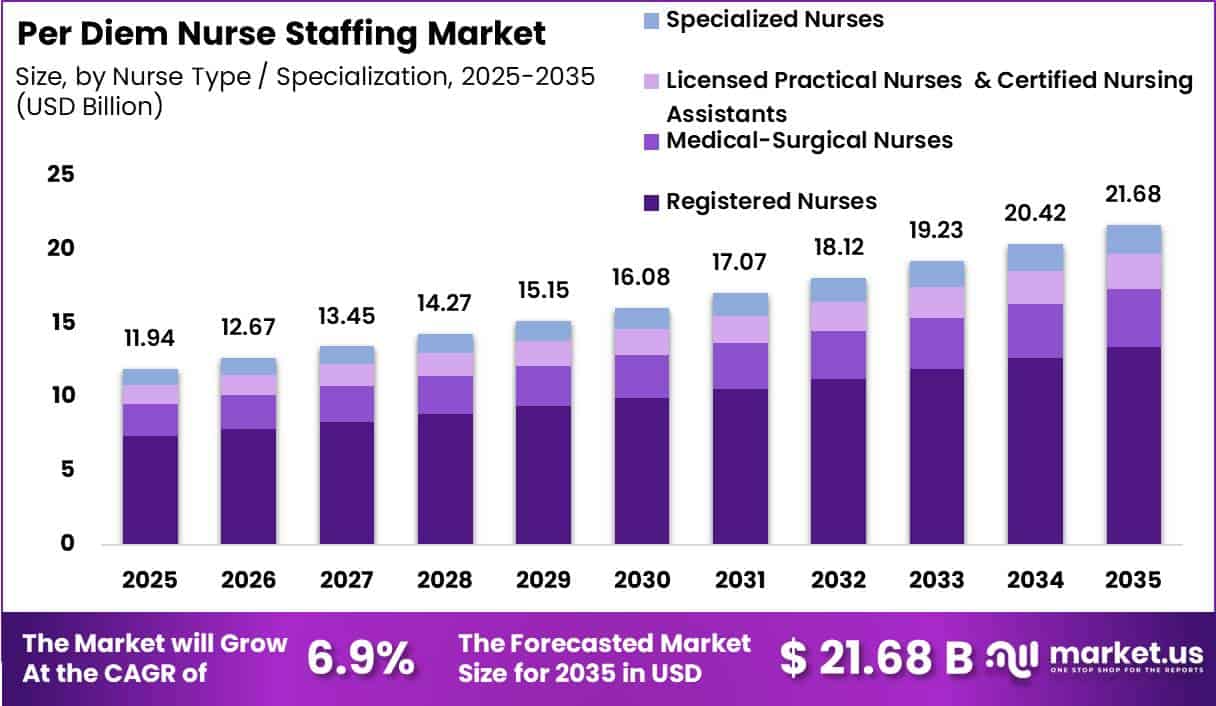
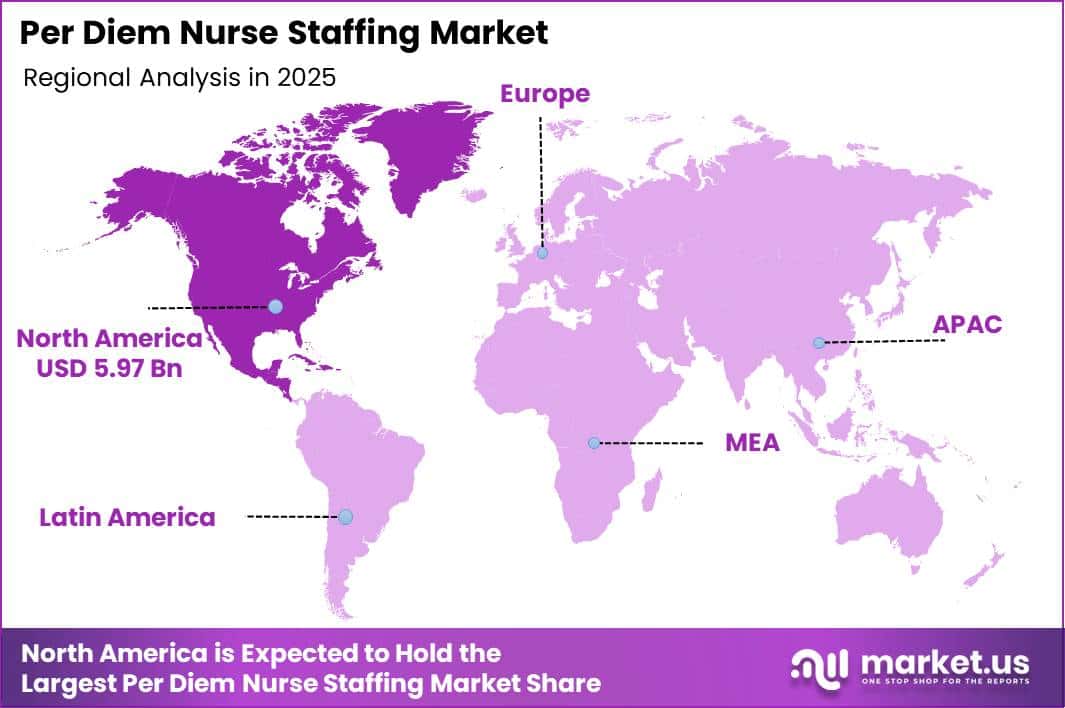
The Global Per Diem Nurse Staffing Market size is expected to be worth around US$ 21.68 Billion by 2035 from US$ 11.94 Billion in 2025, growing at a CAGR of 6.9% during the forecast period from 2026 to 2035. In 2025, North America led the market, achieving over 50% share with a revenue of US$ 5.97 Billion.
The global per diem nurse staffing market is gaining importance as healthcare systems worldwide seek flexible workforce solutions to address fluctuating patient volumes, nursing shortages, and rising demand for specialized care.
Per diem nurse staffing enables hospitals, clinics, long-term care facilities, and other healthcare providers to hire qualified nurses on a short-term, shift-based basis without long-term employment commitments, helping maintain continuous patient care coverage during peak demand periods, seasonal surges, and staff absences.
The increasing need for flexible nursing models is strongly supported by global healthcare workforce challenges. The World Health Organization (WHO) highlights that the global health workforce exceeds 70 million workers, while projected healthcare workforce shortages remain a major concern, with an estimated shortage of around 11 million health workers by 2030. Nurses represent one of the largest segments of the healthcare workforce and play a critical role in achieving universal health coverage.
In the United States, demand for registered nurses continues to expand, supporting growth opportunities for temporary and per diem staffing models. The U.S. Bureau of Labour Statistics reported approximately 3.39 million registered nurses employed in 2024 and projected employment growth to nearly 3.56 million by 2034, representing about 166,100 additional positions and around 189,100 annual job openings over the decade.
Technological advancements, including digital staffing platforms, mobile workforce management applications, automated scheduling tools, and credential verification systems, are further improving the efficiency of nurse placement. The market is expected to benefit from increasing healthcare facility reliance on agile staffing strategies to improve operational continuity, reduce workforce gaps, and support quality patient care delivery.
Key Takeaways
- Market Size: The Global Per Diem Nurse Staffing Market size was US$ 11.94 billion in 2025. The market is estimated to grow to US$ 21.68 billion by 2035.
- Market Share: The Compound Annual Growth Rate (CAGR) of the market from 2026 to 2035 will be 6.9%.
- Nurse Type: Registered Nurses (RNs) have the largest market share, accounting for 62% of total nurse type revenue.
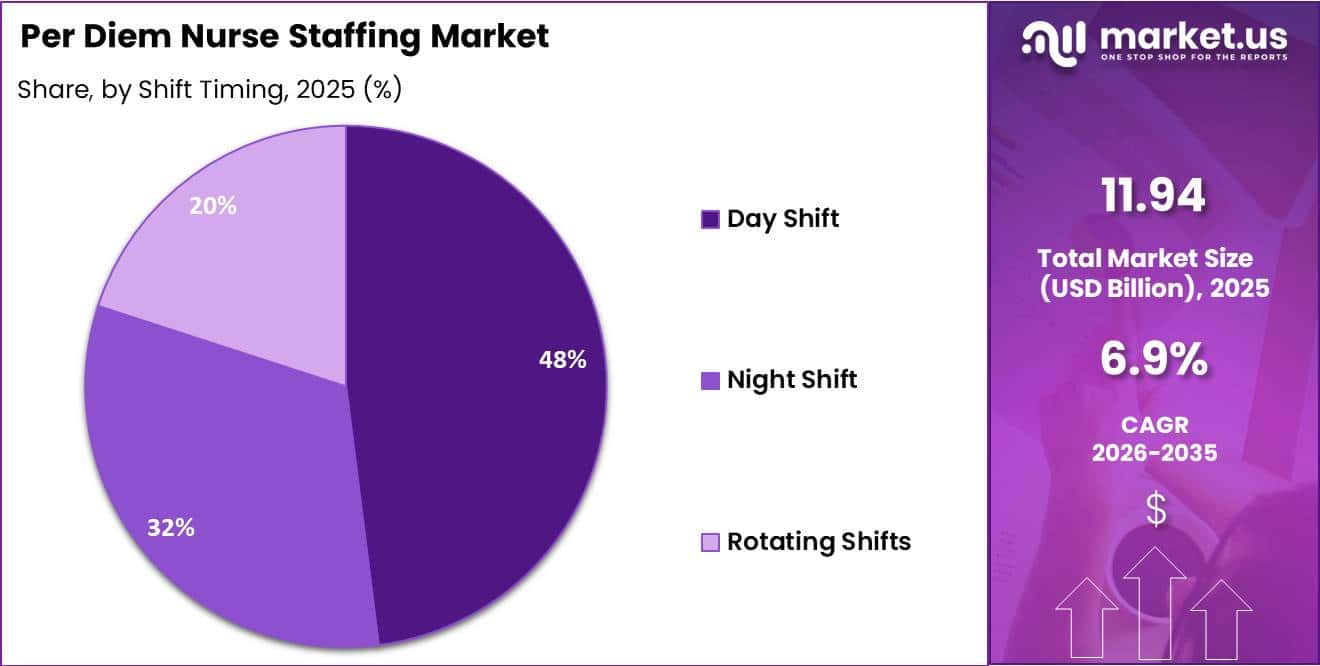
- Shift Timing: Day Shift leads the segment, accounting for 48% of total shift timing revenue.
- Nurse Experience Level: Experienced Nurses lead the segment, accounting for 55% of total nurse experience level revenue.
- End User: Hospitals lead the segment, accounting for 68% of total end-user revenue.
- Regional: North America is the dominant regional market, accounting for 50% of global revenue.
Nurse Type/Specialization Analysis
The Nurse Type / Specialization segment of the Per Diem Nurse Staffing Market is led by Registered Nurses (RNs), which accounted for 62.0% market share in 2025.
The dominance of RNs is supported by their broad clinical responsibilities, including patient assessment, care coordination, medication administration, and support across acute and chronic care settings. Hospitals and healthcare facilities increasingly rely on per diem RNs to address fluctuating patient volumes, seasonal demand, and workforce shortages without increasing permanent staffing costs.
Medical-Surgical (Med-Surg) Nurses represented an 18.0% share in 2025, driven by their high demand in general hospital wards, post-operative care units, and inpatient departments where flexible staffing coverage is frequently required. Licensed Practical Nurses (LPNs) and Certified Nursing Assistants (CNAs) accounted for 11.0%, supported by rising demand for basic patient care, monitoring, and assistance services in long-term care and rehabilitation facilities.
Specialized Nurses captured a 9.0% share, including critical care, emergency, oncology, and specialty care nurses, with growth supported by increasing healthcare complexity and demand for skilled professionals. The segment is expected to continue expanding as healthcare providers adopt flexible staffing models to improve workforce efficiency and maintain quality patient care.
Shift Timing Analysis
The Shift Timing segment of the Per Diem Nurse Staffing Market is dominated by Day Shift assignments, accounting for 48.0% market share in 2025.
Day shifts represent the largest demand category because hospitals, clinics, and healthcare facilities typically experience peak operational activity during daytime hours, including patient admissions, physician rounds, diagnostic procedures, treatments, and care coordination activities. Per diem nurses are frequently deployed during these periods to manage higher patient interaction levels and maintain adequate staffing ratios.
Night Shift assignments held 32.0% share in 2025, supported by continuous healthcare operations requiring round-the-clock nursing coverage. Hospitals and emergency care facilities depend on flexible night shift staffing to address workforce shortages, prevent burnout among permanent employees, and ensure uninterrupted patient monitoring.
Rotating Shifts accounted for 20.0% share, driven by healthcare organizations seeking adaptable staffing solutions that can cover varying schedules, seasonal demand fluctuations, and unexpected staff absences.
The increasing adoption of flexible scheduling platforms and digital workforce management systems is strengthening demand across all shift categories. Healthcare providers are increasingly using per diem staffing models to optimise labour utilisation while ensuring adequate coverage across daytime, overnight, and rotating schedules.
Nurse Experience Level Analysis
The Nurse Experience Level segment is primarily driven by Experienced Nurses, which accounted for 55.0% market share in 2025. Experienced nurses remain highly preferred in per diem staffing because healthcare facilities require professionals who can quickly adapt to different clinical environments, manage patient care independently, and require minimal onboarding or supervision. Their ability to handle complex cases and support high-acuity departments makes them valuable for hospitals facing immediate staffing gaps.
Entry-Level Nurses represent a significant portion of the market, supported by increasing opportunities for newly licensed professionals seeking flexible work arrangements, skill development, and exposure to multiple healthcare settings. Per diem roles allow early-career nurses to gain practical experience across hospitals, clinics, and specialized care facilities while meeting short-term workforce requirements.
Specialized / Advanced Practice Nurses represent another important segment, including professionals with expertise in intensive care, emergency medicine, anesthesia, and other advanced specialties. Demand for this group is increasing due to growing patient complexity and the need for specialized clinical expertise.
Overall, healthcare organizations are balancing experienced professionals with emerging talent to build flexible staffing networks that address immediate shortages while supporting long-term workforce sustainability.
End User Analysis
The End User segment of the Per Diem Nurse Staffing Market is led by Hospitals, which accounted for 68.0% market share in 2025. Hospitals represent the largest user base due to their continuous need for nursing coverage across emergency departments, intensive care units, surgical wards, and general inpatient services.
Increasing patient admissions, workforce shortages, and the requirement to maintain nurse-to-patient ratios are encouraging hospitals to utilize per diem staffing solutions for operational flexibility.
Clinics represent a growing segment as outpatient facilities increasingly require temporary nursing support for patient care, preventive services, and specialty consultations. Nursing Homes are adopting per diem nurses to address rising demand from aging populations and long-term care requirements.
Home Care Agencies are expanding their use of flexible nursing professionals to support home-based healthcare services, chronic disease management, and post-discharge care.
Rehabilitation Centers utilize per diem staffing to maintain adequate nursing support for recovery programs, while Other end users include ambulatory centers, specialty facilities, and community healthcare organizations. The growing emphasis on flexible workforce models, cost control, and rapid staffing availability is expected to strengthen adoption of per diem nurse staffing across diverse healthcare settings.
Key Market Segments
By Nurse Type/Specialization
- Registered Nurses (RNs)
- Acute
- Critical Care Duties
- Medical-Surgical (Med-Surg) Nurses
- Licensed Practical Nurses (LPNs) & Certified Nursing Assistants (CNAs)
- Specialized Nurses
- Intensive Care Unit (ICU)
- Emergency Room (ER)
- Operating Room (OR) Nurses
By Shift Timing
- Day Shift
- Night Shift
- Rotating Shifts
By Nurse Experience Level
- Entry-Level Nurses
- Experienced Nurses
- Specialized/Advanced Practice Nurses
By End User
- Hospitals
- Clinics
- Nursing Homes
- Home Care Agencies
- Rehabilitation Centers
- Others
Driver
CMS nursing-home staffing incentives and compliance recalibration
In the U.S. long-term-care segment, 2026 market demand is being shaped less by a single federal staffing ratio and more by a mixed regime of incentives, facility assessments, and state-level enforcement.
CMS launched a Nursing Home Staffing Campaign in 2026 with up to $ 80 million in program funding, with loan repayment up to $ 40,000 and stipends up to $ 10,000 for qualified RNs and LPNs who commit to three years in qualifying facilities or survey roles. The earliest start date for awards was expected to be July 1, 2026.
At the same time, the federal numeric minimum staffing mandate adopted in 2024 was repealed effective in early 2026, while facility assessment requirements remained, shifting compliance from a uniform national threshold to proof that staffing decisions are documented against resident acuity and service complexity.
That combination is positive for per diem demand because operators still need flexible labour to defend assessment-based staffing adequacy during census spikes, survey preparation, weekend gaps, and admissions surges, even if one national hours-per-resident-day floor no longer governs every building.
Strategically, this favors agencies that can supply LTC-specialized RN/LPN/CNA pools with rapid credential validation and audit-ready documentation, since purchasing decisions now hinge as much on defensible staffing records and fill reliability as on hourly bill rates.
| Driver | (~) % Impact on CAGR Forecast | Geographic Relevance | Impact Timeline |
|---|---|---|---|
| Persistent RN supply gap and replacement demand | +2.1% | North America core, UK, EU, APAC urban hubs | Medium term |
| CMS nursing-home staffing incentives and compliance recalibration | +1.6% | U.S. core, strongest in long-term care dense states | Short term |
| Burnout, turnover, and schedule volatility are lifting float demand | +1.4% | U.S. core, Canada spill-over, UK agency corridors | Short term |
| Wage inflation and premium shift arbitrage favouring flexible staffing | +1.2% | U.S. core, selected EU and Gulf import markets | Medium term |
| Credentialing standardization and faster placement infrastructure | +0.9% | North America core, UK, Australia | Short term |
| Restrictive covenant scrutiny is improving clinician mobility | +0.7% | U.S. core, state-regulated metro markets | Medium term |
Challenge
Persistent Nurse Burnout Restricts Per Diem Staffing Growth
Persistent nurse burnout functions as a compounding drag on per diem staffing efficiency because it drives elevated turnover, reduced willingness to accept additional shifts, and higher expected pay premiums per hour, even as total licensed nurse counts rise globally from roughly 27.9 million in 2018 to 29.8 million in 2023.
Workforce projections in the US alone have highlighted shortages of on the order of 60,000 to 80,000 nurses through 2025 to 2030, with vacancy rates in acute care settings frequently exceeding 20% to 25% and planned departure intentions above 30%, meaning that at any given time 1 in 4 to 1 in 3 nurses are either leaving posts or actively restricting hours.
At the unit level, studies show turnover events costing health systems about $85,000 per nurse, with time to fill vacancies averaging 20 to 22 weeks and as much as 75% of backfill hours covered by high-cost contract labour rather than internal float pools.
For per diem markets, this translates into a structural wage wedge: per diem hourly all-in rates around $65 to $80 versus travel nurse equivalents above $100, with hospitals often forced to mix the two models to keep beds open, eroding margin and constraining the feasible expansion of per diem rosters by roughly 1 to 2 % points of CAGR relative to theoretical demand.
Strategically, providers and staffing firms must deploy burnout sensitive scheduling rules, including caps on consecutive night shifts, minimum 36 to 48 hour recovery windows, predictive acuity based staffing, expand access to mental health support, and redesign roles to retain experienced nurses, such as splitting their time 60/40 between direct care and mentoring or virtual triage, which can reduce turnover by an estimated 20% to 30% over 4 to 6 years and gradually restore 1.0 to 1.4 % points of lost growth capacity in per diem placement volumes.
| Challenge | (~) % CAGR Friction Drag | Geographic Relevance | Mitigation Horizon |
|---|---|---|---|
| Persistent nurse burnout | -1.4% | North America, EU, high-acuity metros | Long-term (≥ 4 years) |
| Volatile shift coverage mix | -1.1% | US urban & suburban, EU hospital hubs | Medium term (2-4 years) |
| Fragmented credentialing & compliance | -0.9% | North America core, EU, GCC | Medium term (2-4 years) |
| Uneven digital platform adoption | -0.8% | North America, APAC corridors | Medium term (2-4 years) |
| Regulatory & reimbursement uncertainty | -1.0% | US, EU, selected APAC | Long-term (≥ 4 years) |
| Local talent depth & skill mismatch | -1.2% | US rural, EU periphery, LATAM | Long-term (≥ 4 years) |
Restraints
Structural Nurse Supply Gaps Limit Per Diem Staffing Expansion
The structural nurse supply gap restrains per diem nurse staffing growth by constraining fill rates, raising acquisition costs, and capping volume scalability, as evidenced by projections that U.S. nursing supply in 2026 will meet only about 91.9% of demand, implying an 8.1% nationwide shortage and up to 25% shortfalls in non metro areas, while advanced WHO and HRSA modeling points to global health workforce needs based deficits of roughly 6.1 million workers, around 5.3 million of them nurses, by 2030.
This gap translates into structurally elevated vacancy rates of 8% to 12% for core inpatient nursing roles in many OECD systems, forcing per diem agencies to compete aggressively for a constrained pool, raising sourcing costs per nurse by an estimated 20% to 30% versus pre-pandemic baselines and reducing average assignment acceptance rates by 5% to 8% in oversubscribed geographies.
Strategically, the shortage limits agencies ability to grow billable hours even when demand surges, compressing utilization of available demand capacity by an estimated 10% to 15%, increasing dependence on travel nurses and overtime premiums, and driving margin pressure as client facilities expect on demand coverage but the structural supply ceiling forces agencies to either over promise and miss fill rate SLAs or maintain conservative booking policies that leave revenue on the table.
Over the long term, unless education pipelines and international recruitment expand materially, this restraint is likely to subtract more than 2 % points from otherwise achievable CAGR by 2030, anchoring per diem growth below broader healthcare staffing trajectories even as underlying patient volume and acuity continue to rise.
| Restraint | (~) % Impact on CAGR Forecast | Geographic Relevance | Impact Timeline |
|---|---|---|---|
| Structural nurse supply gap | -2.2% | US, EU, select APAC | Long-term (≥ 4 years) |
| Burnout and attrition pressure | -1.6% | US, EU, Canada | Medium term (2-4 years) |
| Regulatory and staffing ratio volatility | -1.3% | US, EU | Medium term (2-4 years) |
| Labour cost escalation and wage compression | -1.4% | US, EU, high-income APAC | Short–Medium (≤ 4 years) |
| Payment mix and reimbursement friction | -0.9% | US, fragmented APAC | Medium term (2-4 years) |
| Rural–urban access and logistics constraints | -0.7% | US non-metro, emerging APAC | Long-term (≥ 4 years) |
Opportunity
Platform-Based Marketplaces Transform Per Diem Nurse Staffing
This opportunity refers to building digital, multi-sided marketplaces that aggregate fragmented per diem demand across hospitals, nursing homes, home health agencies, and ambulatory centres into a unified, algorithm-driven pool, creating a step change in fill rate efficiency and margin capture that goes beyond the baseline growth driven by general nursing shortages.
Today, per diem staffing is still largely brokered via phone, email, and siloed agency relationships, resulting in 10% to 20% average shift non-fill rates and bill rate dispersion of 8% to 12% across facilities in the same metro due to information asymmetry.
A scaled marketplace that connects 5,000 to 10,000 facilities per region and 50,000 to 100,000 nurses could realistically compress non-fill rates below 5%, support dynamic pricing with 3% to 5% higher average realised bill rates, and reduce recruiter headcount costs per filled shift by 25% to 35%, adding 200 to 300 basis points to EBITDA margins.
With global nursing shortages still projected in the millions by 2030 and persistent underutilization of part-time and retired nurses who are willing to work 1 to 3 shifts per week, a marketplace model unlocks an incremental untapped TAM of 10% to 15% of total nurse hours that remains outside traditional full-time and travel contracts today.
Because this is a structural monetisation and operating model pivot rather than a simple response to current demand, it sits above the baseline 6% to 7% CAGR implied by conventional staffing forecasts and can justify an additional approximately 2.0 % points of CAGR through to 2035 in regions where marketplace density reaches critical mass.
| Opportunity | (~) % Potential CAGR Upside | Geographic Relevance | Execution Window |
|---|---|---|---|
| Platform-based per diem marketplaces | +2.0% | North America core, EU | Short–Medium term |
| Integrated per diem pools for value-based care | +1.5% | US, UK, DACH | Medium term |
| Cross-border and tier-2 city expansion | +1.8% | APAC emerging, LatAm, Africa urban | Medium–Long term |
| Specialized clinical micro-niches | +1.2% | North America, EU, Japan | Short–Medium term |
| Employer-of-record and benefits bundling | +1.0% | US, Canada, Western Europe | Medium term |
| Data and workforce analytics monetization | +0.8% | Global multi-region | Medium–Long term |
Regional Analysis
In 2025, North America led the market, achieving over 50% share with a revenue of US$ 5.97 billion. North America represents the leading region in the Global Per Diem Nurse Staffing Market, supported by persistent nursing workforce shortages, increasing healthcare demand, and widespread adoption of flexible staffing models.
The United States remains a major contributor due to the high utilization of temporary nursing professionals across hospitals, outpatient facilities, and long-term care centres.
According to the U.S. Bureau of Labor Statistics, employment demand for registered nurses continues to grow due to an ageing population, rising chronic disease burden, and expanding healthcare services. Healthcare providers are increasingly using per diem staffing solutions to manage fluctuating patient volumes, reduce overtime costs, and maintain adequate staffing levels.
Europe is witnessing steady growth, driven by healthcare workforce gaps, ageing demographics, and government initiatives aimed at strengthening healthcare capacity. Countries including Germany, the United Kingdom, and France are increasingly adopting flexible nurse staffing approaches to address shortages in hospitals and elderly care facilities.
The Asia-Pacific region is expected to experience significant expansion due to rising healthcare infrastructure investments, growing patient populations, and increasing demand for skilled nursing professionals. Developing healthcare systems are gradually adopting temporary staffing platforms to improve workforce availability.
Latin America and the Middle East & Africa are emerging markets, supported by healthcare modernization, expanding private healthcare networks, and increasing demand for cost-effective staffing solutions. However, limited workforce availability and regulatory challenges may influence adoption rates across these regions.
Overall, global healthcare labor shortages and the need for flexible workforce management continue to drive regional market growth.
Key Regions and Countries
North America
- The US
- Canada
Europe
- Germany
- France
- The U.K.
- Italy
- Spain
- Russia & CIS
- Rest of Europe
Asia Pacific
- China
- India
- Japan
- South Korea
- ASEAN
- Australia & New Zealand
- Rest of Asia Pacific
Middle East & Africa
- GCC
- South Africa
- Rest of Middle East & Africa
Latin America
- Brazil
- Mexico
- Rest of Latin America
Key Player Analysis
Suppliers in the global per diem nurse staffing market seek competitive advantage through technology-enabled nurse-facility matching platform development integrating real-time shift availability posting, automated credential verification, instant pay processing, and mobile application-based scheduling that reduces nurse placement time from days to hours while simultaneously improving facility staffing flexibility and nurse schedule autonomy.
Key strategic focus areas include AI-powered demand forecasting capability enabling hospital workforce management teams to anticipate per diem staffing needs days in advance rather than reacting to same-day vacancy emergencies, specialized nurse pool development across high-demand ICU, ER, and OR specializations commanding premium bill rates, and gig-economy-inspired flexible staffing platform development attracting nurses who prefer per diem scheduling autonomy over traditional full-time employment models.
Companies continue investing in Joint Commission-aligned credential management systems, competency assessment programs ensuring per diem nurse clinical skills meet facility placement requirements, and workforce analytics platforms providing hospital clients with staffing cost optimization insights supporting per diem versus permanent hire decision-making.
The structural nursing shortage, projected to reach a deficit of over 100,000 registered nurses in the United States alone by 2028, according to the Bureau of Labor Statistics, combined with ageing population demographics driving healthcare demand expansion, is creating non-discretionary institutional per diem staffing procurement demand that sustains market revenue growth independent of short-term economic cycle fluctuations through the forecast period to 2035.
Top Key Players
- AMN Healthcare
- Cross Country Healthcare Inc.
- HealthTrust Workforce Solutions (HCA)
- Maxim Healthcare Services
- Adecco Group
- CHG Management Inc.
- Aya Healthcare
- Jackson Healthcare
- Supplemental Health Care
- Accountable Healthcare Staffing
- Interim HealthCare Inc.
- GHR Healthcare
- CareerStaff Unlimited
- MedPro Healthcare Staffing
- IntelyCare
- Other Key Players
Recent Developments
- In January 2026, AMN Healthcare launched an enhanced AI-powered nurse-facility matching platform integrating real-time credential verification and instant shift posting, targeting hospital workforce management institutional buyers seeking reduced per diem nurse placement lead times across North American healthcare system networks.
- In February 2026, Aya Healthcare expanded its per diem registered nurse pool across ICU and ER specializations in five new US metropolitan markets, targeting hospital health system institutional buyers managing critical care nursing vacancy rates through per diem supplemental staffing programs.
- In March 2026, Cross Country Healthcare secured a multi-year per diem staffing framework agreement with a leading US hospital health system network covering registered nurse, LPN, and CNA per diem placement services across its regional acute care and speciality facility institutional buyer network.
- In May 2026, IntelyCare expanded its AI-driven per diem nursing staffing platform across nursing home and long-term care facility institutional buyers in three additional US states, targeting growing supplemental staffing demand driven by an ageing population-driven census growth across post-acute care settings.
Report Scope
| Report Features | Description |
|---|---|
| Market Value (2025) | US$ 11.94 Billion |
| Forecast Revenue (2035) | US$ 21.68 Billion |
| CAGR (2026-2035) | 6.9% |
| Base Year for Estimation | 2025 |
| Historic Period | 2020-2024 |
| Forecast Period | 2026-2035 |
| Report Coverage | Revenue Forecast, Market Dynamics, Competitive Landscape, Recent Developments |
| Segments Covered | By Nurse Type/Specialization (Registered Nurses (RNs), Medical-Surgical (Med-Surg) Nurses, Licensed Practical Nurses (LPNs) & Certified Nursing Assistants (CNAs), Specialized Nurses), By Shift Timing (Day Shift, Night Shift, Rotating Shifts), By Nurse Experience Level (Entry-Level Nurses, Experienced Nurses, Specialized/Advanced Practice Nurses), By End User (Hospitals, Clinics, Nursing Homes, Home Care Agencies, Rehabilitation Centers, Others) |
| Regional Analysis | North America – The US, Canada; Europe – Germany, France, U.K., Italy, Spain, Russia & CIS, Rest of Europe; Asia Pacific – China, India, Japan, South Korea, ASEAN, Australia & New Zealand, Rest of Asia Pacific; Middle East & Africa – GCC, South Africa, Rest of Middle East & Africa; Latin America – Brazil, Mexico, Rest of Latin America |
| Competitive Landscape | AMN Healthcare, Cross Country Healthcare Inc., HealthTrust Workforce Solutions (HCA), Maxim Healthcare Services, Adecco Group, CHG Management Inc., Aya Healthcare, Jackson Healthcare, Supplemental Health Care, Accountable Healthcare Staffing, Interim HealthCare Inc., GHR Healthcare, CareerStaff Unlimited, MedPro Healthcare Staffing, IntelyCare, Other Key Players |
| Customization Scope | Customization for segments, region/country-level will be provided. Moreover, additional customization can be done based on the requirements. |
| Purchase Options | We have three licenses to opt for: Single User License, Multi-User License (Up to 5 Users), Corporate Use License (Unlimited User and Printable PDF) |





































