Report Overview
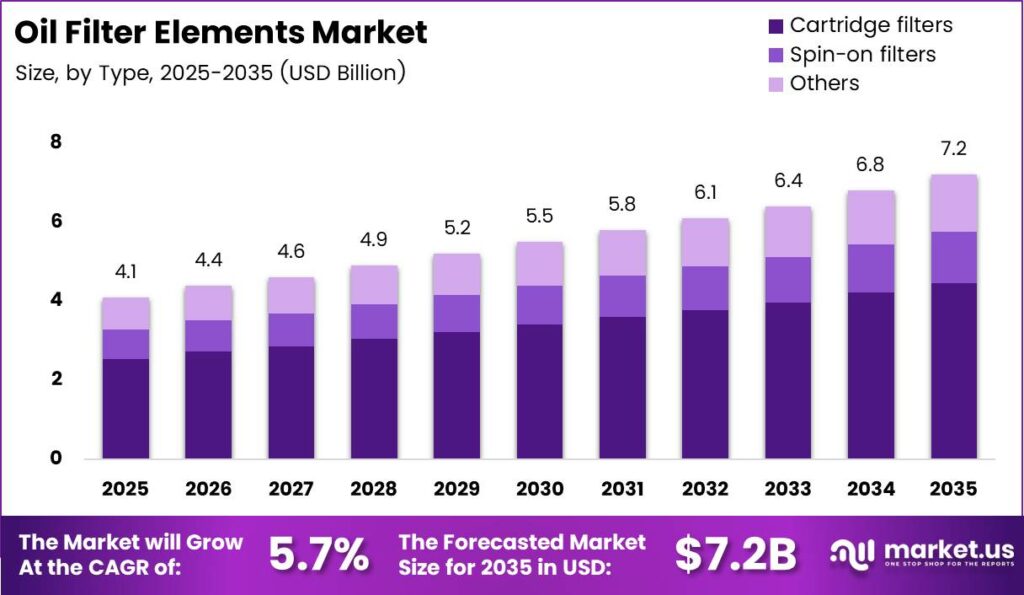
Global Oil Filter Elements Market size is expected to be worth around USD 7.2 Billion by 2035 from USD 4.1 Billion in 2025. The report estimates a CAGR of 5.7% during the forecast period 2026 to 2035. Oil filter elements remove contaminants from circulating lubricants, protecting engines and machinery while creating recurring replacement revenue across automotive, industrial, aviation, and marine equipment.
The market combines original-equipment fitment with replacement sales across vehicles, aircraft, ships, and industrial machinery. According to ACEA, the European Union had 252 million passenger cars in 2022, illustrating the scale of the vehicle service base. Replacement filters protect lubricated components throughout their working lives, connecting sales to equipment use rather than production alone. Distributors therefore compete through application coverage, availability, and workshop relationships.
Key Takeaways
- The report estimates the global market at USD 4.1 Billion in 2025.
- The forecast market value reaches USD 7.2 Billion by 2035.
- The forecast CAGR is 5.7% for 2026 to 2035.
- Cartridge filters lead Type segmentation with an estimated 61.27% share in 2025.
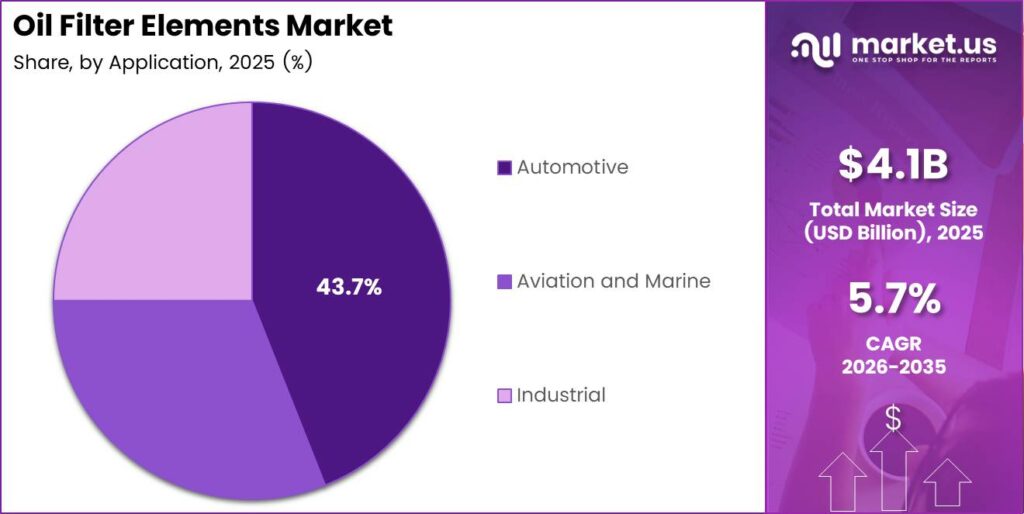
- Automotive leads Application segmentation with an estimated 43.78% share in 2025.
- Aftermarket leads Distribution Channel segmentation with an estimated 63.56% share in 2025.
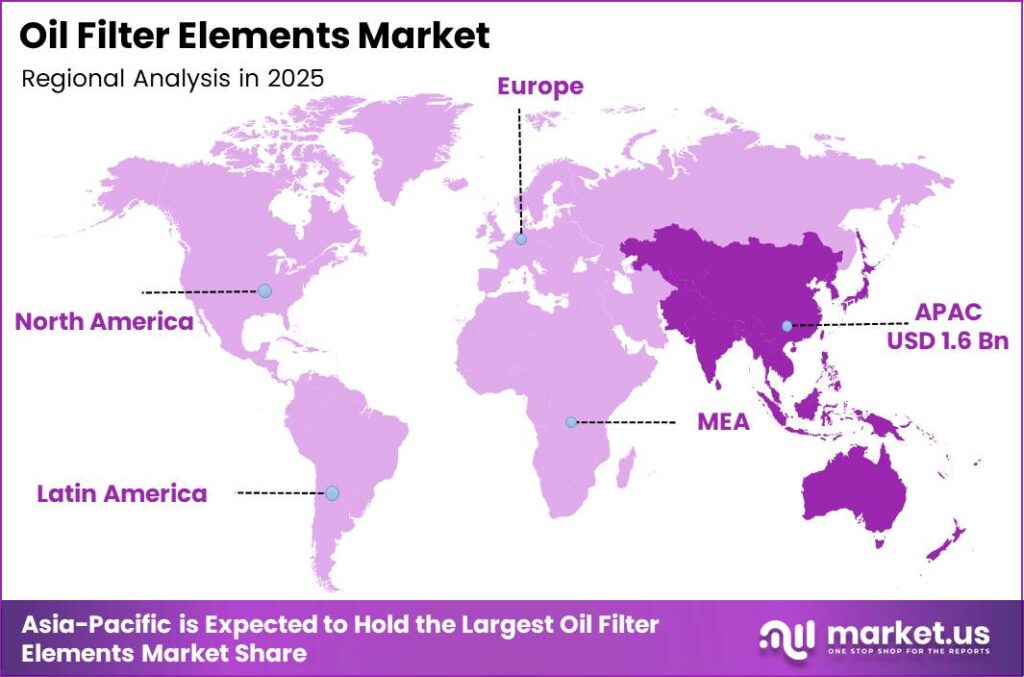
- Asia-Pacific leads regional segmentation with an estimated 40.21% share and approximately USD 1.6 Billion in 2025 revenue.
- The forecast identifies Middle East and Africa, spin-on filters, industrial applications, and aftermarket distribution as the fastest-growing respective categories.
- The base year is 2025, and the forecast period runs from 2026 to 2035.
Aircraft production creates another equipment pipeline, although deliveries do not measure government spending or the effect of specific regulations. As reported by ICAO, manufacturers delivered 1,114 new commercial aircraft in 2024, expanding the equipment population that requires maintenance support. Aviation filtration suppliers must align products with approved equipment specifications and customer qualification requirements. Investors should assess access to maintenance programs rather than assume aircraft deliveries translate directly into filter orders.
MANN+HUMMEL connects filtration innovation with operating-cost savings rather than filter replacement alone. Data from its September 2026 announcement shows an optimized oil-filter-module valve reduced component-related pressure loss by up to 40%. Lower resistance can reduce the energy needed to circulate oil, supporting customer interest in efficiency-focused designs. Suppliers can use such improvements to defend product value, although application-specific calculations require validation before buyers assume comparable equipment-level savings.
Asia-Pacific holds an estimated 40.21% market share in 2025, with regional revenue rounded to USD 1.6 Billion. The regional investment case centers on serving automotive and industrial equipment through local production, replacement inventories, and accessible distribution. The estimate does not establish which country contributes most or explain differences between applications. Buyers should assess local service coverage, while manufacturers should test country-level economics before committing capacity against a regional headline.
MANN+HUMMEL found that its March 2025 lignin-impregnated oil-filter offering covered applications serving approximately 17.6 million European vehicles. The figure represents application coverage, not product sales or installed filters. Material changes can help suppliers refresh established product lines without waiting for new engine platforms. Investors should assess whether qualification, production consistency, and customer acceptance convert that coverage into profitable replacement sales rather than treating technical eligibility as contracted revenue.
Type Analysis
Cartridge filters lead with an estimated 61.27% share in 2025, reflecting replaceable-element servicing within reusable filter housings.
In 2025, cartridge filters held an estimated 61.27% share in the Type segment of the Oil Filter Elements Market. Based on Eaton data, its 01.E replaceable elements offer a high-resistance differential-pressure specification of 160 bar. Replaceable elements retain the housing while renewing the filtration medium, supporting repeated servicing of compatible systems. Buyers should distinguish element collapse resistance from normal system operating pressure when comparing products and maintenance costs.
Spin-on filters combine the element and housing into a replaceable assembly, simplifying service procedures for compatible equipment. Eaton indicates that its WPL range offers filter fineness of 10 micrometres, providing a concrete specification for contamination-control comparisons. Particle capture helps protect lubricated components, while assembly replacement reduces handling of exposed media. Suppliers should match filtration ratings, flow resistance, and mounting compatibility rather than compete through appearance or unit price alone.
Other filter types require a defined product boundary before buyers or investors can compare their commercial position. Figures from MANN-FILTER show approximately 6,800 catalogue products, demonstrating portfolio breadth rather than the size of this residual category. Different housings and operating conditions require application-specific fitment, making correct identification commercially important. Suppliers should separate genuine alternative technologies from standard cartridge and spin-on products before evaluating product coverage or development priorities.
Application Analysis
Automotive leads with an estimated 43.78% share in 2025, reflecting engine protection and recurring vehicle servicing.
In 2025, automotive held an estimated 43.78% share in the Application segment of the Oil Filter Elements Market. According to SIAM, Indian passenger-vehicle domestic sales reached approximately 4.3 million units during fiscal 2024 to 2025. Combustion-engine vehicles require clean lubricating oil, connecting eligible vehicle production with initial fitment and later replacement demand. Suppliers should prioritize application coverage and service-channel access rather than assume every new vehicle requires an engine-oil filter.
Aviation and marine applications connect filter purchasing with equipment operation, maintenance schedules, and approved component specifications. As reported by ICAO, scheduled airline departures reached 37.4 million worldwide in 2024, indicating aviation activity rather than combined aviation and marine demand. Lubricated equipment requires contamination control as operating hours accumulate, supporting maintenance-linked element consumption. Manufacturers should assess approved applications and customer access separately across aircraft and vessels instead of treating both industries as interchangeable.
Industrial applications place filter elements within lubrication and hydraulic systems that support production equipment and machinery uptime. Data from UNIDO shows global manufacturing production increased 1.0% quarter on quarter during the final quarter of 2024. Production activity can increase equipment use, connecting contamination control with maintenance planning rather than new machinery purchases alone. Sellers should assess operating intensity and installed equipment because manufacturing output does not translate directly into filter replacement volumes.
Distribution Channel Analysis
Aftermarket leads with an estimated 63.56% share in 2025, reflecting replacement purchases across equipment service networks.
In 2025, aftermarket held an estimated 63.56% share in the Distribution Channel segment of the Oil Filter Elements Market. ACEA found that EU passenger cars averaged 12.3 years of age in 2022, supporting attention to vehicles remaining in service. Older combustion vehicles continue requiring suitable oil filtration, connecting replacement sales with fleet retention and maintenance behavior. Distributors should maintain accurate fitment data and stock availability while avoiding assumptions that vehicle age determines replacement frequency.
OEM distribution places filtration suppliers inside equipment development and production programs, where specification approval precedes recurring supply. Based on ICAO data, major aircraft manufacturers recorded 1,380 net new aircraft orders during 2024. Those orders indicate an aerospace equipment pipeline, not confirmed filter contracts or automotive channel demand. Suppliers should assess program eligibility, qualification costs, and production timing before converting equipment orders into revenue expectations or committing dedicated tooling and inventory.
Key Market Segments
By Type
- Cartridge filters
- Spin-on filters
- Others
By Application
- Automotive
- Aviation and Marine
- Industrial
By Distribution Channel
- Aftermarket
- OEM
Regional Analysis
Asia-Pacific accounts for an estimated 40.21% market share in 2025, making regional distribution and manufacturing coverage central investment considerations. SIAM indicates that Indian passenger-vehicle exports reached approximately 0.77 million units during fiscal 2024 to 2025. Export production supports application development for eligible combustion vehicles, but India does not represent the entire region. Suppliers should connect export fitments with destination-market servicing networks instead of assuming production location determines replacement revenue.
Middle East and Africa represents the forecast’s fastest-growing region, although the assigned operating indicator covers African aviation rather than regional filter sales. Figures from IATA show African airlines’ passenger traffic increased 13.2% in 2024, highlighting activity within one maintenance-dependent application. Aircraft operation creates servicing needs, but traffic growth does not establish filter replacement rates. Investors should test aviation access alongside automotive and industrial channels before extending this indicator across the region.
Key Regions and Countries
North America
- US
- Canada
Europe
- Germany
- France
- The UK
- Spain
- Italy
- Rest of Europe
Asia Pacific
- China
- Japan
- South Korea
- India
- Australia
- Rest of APAC
Latin America
- Brazil
- Mexico
- Rest of Latin America
Middle East and Africa
- GCC
- South Africa
- Rest of MEA
Market Dynamics
According to the IEA, global electric-car sales exceeded 17 million units in 2024, changing the equipment mix relevant to engine-oil filtration. The category includes plug-in hybrids, so the total does not measure vehicles eliminating combustion-engine filters. Existing engines and industrial lubrication systems continue supporting replacement consumption while new powertrains alter future fitment opportunities. Investors should distinguish battery-electric substitution from hybrid servicing requirements when evaluating product portfolios and dedicated manufacturing capacity.
Drivers
Installed combustion-engine fleets support recurring element consumption because servicing follows vehicles remaining in operation, not new sales alone. As reported by ACEA, its 2025 publication recorded 249 million EU passenger cars in 2023, up 1.4%, with electrically chargeable cars representing 3.9%. Fleet coverage requires checking before comparisons across publications. Manufacturers should align replacement portfolios with serviceable vehicles, while distributors should prioritize workshop access and fitment accuracy.
The replacement-volume relationship connects the serviceable fleet with replacement frequency and supplier capture, making retention and availability commercially important. An illustrative 1% increase in that fleet supports approximately 1% more replacement units when frequency and capture remain unchanged. The table’s +0.45 percentage-point contribution represents a judgmental attribution already embedded in the baseline forecast. Investors should not add it again or treat the estimate as an ACEA forecast.
| Driver | (~) % Impact on CAGR Forecast | Geographic Relevance | Impact Timeline |
|---|---|---|---|
| Expanding installed combustion-engine fleet | +0.45% | Global; Europe and emerging markets | Short term (≤ 2 years) |
| Commercial-vehicle replacement consumption | +0.30% | Global freight corridors | Short term (≤ 2 years) |
| Off-highway engine servicing demand | +0.20% | Asia-Pacific, North America, Latin America | Medium term (2–4 years) |
| Higher-specification filtration product mix | +0.18% | Europe, North America, East Asia | Medium term (2–4 years) |
| Established aftermarket distribution coverage | +0.12% | Global organized aftermarket | Short term (≤ 2 years) |
Restraints
Battery-electric vehicles remove the combustion-engine lubricating-oil circuit and its associated engine-oil filter, narrowing future original-equipment fitment opportunities. The IEA’s electric-car category includes plug-in hybrids, which retain engines, so total electric sales cannot represent equivalent lost filter demand. Existing combustion vehicles continue supporting replacement consumption, while industrial applications remain separate. Manufacturers should evaluate capacity by powertrain and application rather than apply passenger-car electrification rates across the entire filtration portfolio.
An illustrative 10 percentage-point production shift from combustion vehicles to battery-electric vehicles removes approximately 10% of engine-filter fitment opportunities. The example assumes unchanged filters per engine and does not measure the effect on total replacement sales. The estimated −0.40 percentage-point baseline attribution therefore represents gradual addressable-volume pressure, not immediate market-wide contraction. Suppliers should test tooling recovery and application-level profitability before expanding facilities dedicated to combustion-engine filter production.
| Restraint | (~) % Impact on CAGR Forecast | Geographic Relevance | Impact Timeline |
|---|---|---|---|
| Battery-electric substitution of engine filters | −0.40% | China, Europe, North America | Long term (≥ 4 years) |
| Longer scheduled oil-service intervals | −0.20% | Europe, North America, developed Asia | Medium term (2–4 years) |
| Low-price aftermarket substitution | −0.12% | Price-sensitive replacement markets | Short term (≤ 2 years) |
| Contractual restrictions on supplier switching | −0.10% | OEM-controlled service channels | Short term (≤ 2 years) |
| Equipment-production order cancellations | −0.08% | Cyclical machinery-producing regions | Short term (≤ 2 years) |
Challenges
Specialty media, adhesives, and seals create sourcing exposure because substitute materials can require renewed performance validation before production use. Donaldson indicates that purchased raw materials represented approximately 67% of company-wide cost of sales in fiscal 2025, identifying some concentrated supply relationships. The figure measures company exposure rather than an oil-filter-element industry average. Manufacturers should qualify alternatives before disruption, while buyers should assess material continuity alongside purchase price and delivery commitments.
A sensitivity case applying a 5% purchased-material cost increase to that benchmark raises total cost of sales by approximately 3.35% before mitigation. An assumed starting gross margin of 30% would fall approximately 2.35 percentage points with unchanged selling prices. These calculations illustrate exposure rather than observed sector results. The estimated −0.20 percentage-point friction reflects slower qualification and order conversion, supporting selective buffers rather than unrestricted inventory expansion.
| Challenge | (~) % CAGR Friction Drag | Geographic Relevance | Mitigation Horizon |
|---|---|---|---|
| Specialty media sourcing concentration | −0.20% | Global filtration manufacturing | Medium term (2–4 years) |
| Application portfolio manufacturing complexity | −0.12% | Global multi-platform suppliers | Medium term (2–4 years) |
| Contamination performance validation burden | −0.10% | High-specification industrial and engine applications | Medium term (2–4 years) |
| Cross-border replenishment lead-time volatility | −0.08% | Import-dependent assembly and distribution hubs | Short term (≤ 2 years) |
| Pleating process yield variability | −0.05% | Global element-production facilities | Short term (≤ 2 years) |
Opportunities
Condition-linked contracts can combine industrial element supply, monitoring, and maintenance support, shifting selected accounts beyond individual product transactions. Figures from Donaldson’s fiscal 2025 reporting describe filtration systems and replacement parts as principal contractual obligations, with services and installation remaining limited. That company-level position suggests a service-model development path, not an industry subscription penetration rate. Suppliers should test whether retention and service income exceed monitoring costs and any reduction in unnecessary replacements.
A pilot could target a 5–8% annual account revenue premium, 3–5% lower fulfillment cost, and acquisition-cost recovery within 18–24 months. A 2–3 percentage-point account margin improvement remains a hurdle rather than an observed result. The full opportunity portfolio adds conditional upside of 0.65 percentage points, implying 6.35% CAGR against the 5.7% baseline. A separate additional stress equal to the listed restraint and challenge magnitudes implies 4.25%, not a probability-weighted forecast.
| Opportunity | (~) % Potential CAGR Upside | Geographic Relevance | Execution Window |
|---|---|---|---|
| Condition-linked industrial element subscriptions | +0.25% | North American, European and Asian industrial clusters | Medium term (2–4 years) |
| Independent aftermarket acquisition platforms | +0.15% | Fragmented regional replacement markets | Medium term (2–4 years) |
| Circular cartridge take-back contracts | +0.10% | Europe and regulated industrial clusters | Medium term (2–4 years) |
| Wind-turbine lubrication element localization | +0.08% | Wind-power manufacturing and service hubs | Long term (≥ 4 years) |
| Marine lubricant retrofit packages | +0.07% | Global ship-repair and port-service hubs | Medium term (2–4 years) |
Key Company Insights
MANN+HUMMEL
MANN+HUMMEL operates across filtration markets, connecting equipment supply with replacement-product coverage through its broader portfolio. According to its Annual Report 2025 results page, consolidated sales reached approximately EUR 4.2 Billion, indicating group scale rather than oil-filter-element revenue. That distinction matters when comparing competitors with different product mixes and geographic exposure. Investors should assess application access, replacement economics, and operational execution instead of converting consolidated revenue into a filtration submarket share.
As reported by MANN+HUMMEL in May 2026, its Tumkur innovation center and planned Pune manufacturing facility involved combined expected investment exceeding INR 100 crore. The initiatives anticipated 300 to 400 additional employment opportunities over the following 12 months, linking technical and production expansion. The combined figures should not be assigned entirely to either facility. Buyers should assess local engineering support and production readiness before assuming immediate improvements in supply availability.
Donaldson Company, Inc.
Donaldson combines engine, industrial, and other filtration activities, giving investors exposure beyond engine-oil replacement elements alone. Data from its fiscal 2026 Form 10-K shows research and development spending of USD 76.1 Million, reflecting company-wide technical investment. Product validation and design work can support customer qualification, but spending does not guarantee commercial adoption or pricing strength. Investors should connect development expenditure with approved applications, repeat orders, and production returns rather than research scale alone.
Donaldson found that cash consideration for its Facet Filtration acquisition totaled USD 830.2 Million, as reported in its fiscal 2026 filing. The company completed the transaction in May 2026, expanding its fuel and fluid-filtration capabilities rather than purchasing an engine-oil-element business alone. The consideration figure reflects the completed transaction rather than the earlier announced valuation. Investors should assess integration, customer retention, and application expansion before treating acquisition size as evidence of value creation.
Key Players
- Ahlstrom-Munksjö
- Baldwin Filters
- Bosch
- Cummins Filtration
- Denso Corporation
- Donaldson Company, Inc.
- Eaton Corporation
- Fleetguard Filters Pvt. Ltd.
- Hengst SE
- K&N Engineering, Inc.
- Mahle GmbH
- Mann+Hummel
- Parker Hannifin
- Robert Bosch GmbH
- Other Key Players
Recent Developments
2026
- January 2026: Atmus Filtration Technologies completed its acquisition of Koch Filter Corporation for approximately USD 450 Million. According to Atmus, the transaction established an industrial air-filtration platform, making it adjacent consolidation rather than an oil-filter-element-only purchase.
- February 2026: Donaldson introduced ArmorSeal heavy-duty air-filtration technology with a claimed 30% reduction in filter-removal force. As reported by Donaldson, the product addresses engine-air filtration, so buyers should not transfer its performance claim to oil filters.
- February 2026: Eaton launched laser-perforated industrial filter elements with ratings from 100 to 380 micrometres. Data from Eaton shows compatibility with DCF, MCF, and MCS filters, supporting industrial process-filtration applications rather than engine-oil filtration alone.
- June 2026: Ahlstrom expanded ECO filtration-media production to Turin, Italy, with approximately 30% replacement of conventional fossil-based phenolic resin. Ahlstrom indicates that the media serves automotive filtration applications; the percentage describes material substitution, not added production capacity.
- August 2026: Parker Hannifin completed its Filtration Group acquisition, estimating USD 220 Million in pre-tax cost synergies by the end of year 3. Figures from Parker show the integration target concerns a broad filtration portfolio, not oil-filter elements alone.
2025
- March 2025: Ahlstrom enhanced its ECO lignin-based filtration-media offering, reporting 50% to 70% lower formaldehyde emissions during curing. According to Ahlstrom, the platform includes engine-oil and industrial applications, linking materials development with production-stage emissions objectives.
- October 2025: Hengst Filtration announced its Agritechnica hydraulic-filtration offering with durability up to 2 million load cycles at 350 bar. As reported by Hengst, performance depends on product size, requiring buyers to verify the specification for their selected configuration.
2024
- April 2024: Eaton expanded its offline hydraulic-fluid filtration portfolio with the UM 15 unit, weighing approximately 15 kg. Data from Eaton shows pump output around 15 litres per minute, connecting portable filtration with servicing flexibility rather than permanent system redesign.
- May 2024: Eaton launched its WPL spin-on filter range with 5 selectable element sizes. Eaton indicates that the range targets hydraulic contamination control, making size and system compatibility central to purchasing decisions.
- September 2024: Eaton introduced its VS6 electronic differential-pressure sensor for hydraulic and lubrication-oil filter monitoring at pressures up to approximately 420 bar. Figures from Eaton identify a monitoring specification, not filtration efficiency, helping buyers distinguish sensing capability from element performance.
Geopolitical Impact Analysis
According to UNCTAD, global seaborne trade expanded 2.2% in 2024, while maritime ton-miles increased approximately 6% as rerouting lengthened shipping journeys. The gap shows that transport workload rose faster than cargo volume, creating exposure for filtration businesses moving inputs and finished products internationally. Oil-filter manufacturers ship filter media, steel components, adhesives, and seals through supply chains that can involve several production locations. Longer routes can delay material receipts and replenishment even when final equipment demand remains unchanged. Manufacturers should assess supplier routes and purchasing schedules together, while distributors should distinguish route-related inventory needs from genuine changes in replacement consumption. Buyers should compare delivery reliability and landed cost rather than purchase price alone.
As reported by the IEA, approximately 20 million barrels per day of crude oil and oil products transited the Strait of Hormuz in 2025. Approximately 80% of those flows served Asian destinations, concentrating exposure to disruption along a route relevant to energy and petrochemical supply chains. Oil-filter manufacturers use petrochemical-based adhesives, sealing materials, and resins, connecting energy-route risk with selected input costs and production continuity. These historical flows establish exposure, not proof of current unrestricted passage or a measured increase in filter prices. Manufacturers should review material alternatives and supplier continuity, while buyers should test how contracts handle input-cost changes. Distributors should separate energy-related cost pressure from physical shortages before adjusting replenishment policies.
Report Scope
| Report Features | Description |
|---|---|
| Market Value (2025) | USD 4.1 Billion, report estimate |
| Forecast Revenue (2035) | USD 7.2 Billion, report estimate |
| CAGR (2026 to 2035) | 5.7%, forecast assumption |
| Base Year for Estimation | 2025 |
| Historic Period | 2021 to 2025 |
| Forecast Period | 2026 to 2035 |
| Report Coverage | Revenue Forecast, Market Dynamics, Market Opportunity Analysis, Technology and Innovation Landscape, Competitive Landscape, Recent Developments |
| Segments Covered | Type: Cartridge filters, Spin-on filters, Others. Application: Automotive, Aviation and Marine, Industrial. Distribution Channel: Aftermarket, OEM. |
| Regional Analysis | North America (US and Canada), Europe (Germany, France, The UK, Spain, Italy, and Rest of Europe), Asia Pacific (China, Japan, South Korea, India, Australia, and Rest of APAC), Latin America (Brazil, Mexico, and Rest of Latin America), Middle East and Africa (GCC, South Africa, and Rest of MEA) |
| Competitive Landscape | Ahlstrom-Munksjö; Baldwin Filters; Bosch; Cummins Filtration; Denso Corporation; Donaldson Company, Inc.; Eaton Corporation; Fleetguard Filters Pvt. Ltd.; Hengst SE; K&N Engineering, Inc.; Mahle GmbH; Mann+Hummel; Parker Hannifin; Robert Bosch GmbH; Other Key Players. |
| Customization Scope | Customization for segments and region or country-level analysis will be provided. Additional customization can be arranged according to requirements. |
| Purchase Options | Single User License | Multi-User License, up to 5 users | Corporate Use License, unlimited users and printable PDF |
| Evidence Qualification | Market values, shares, and growth rankings are report estimates, not independently verified primary-source measurements. Regional and selected segment indicators provide contextual evidence rather than direct market sizing. |