


Report Overview
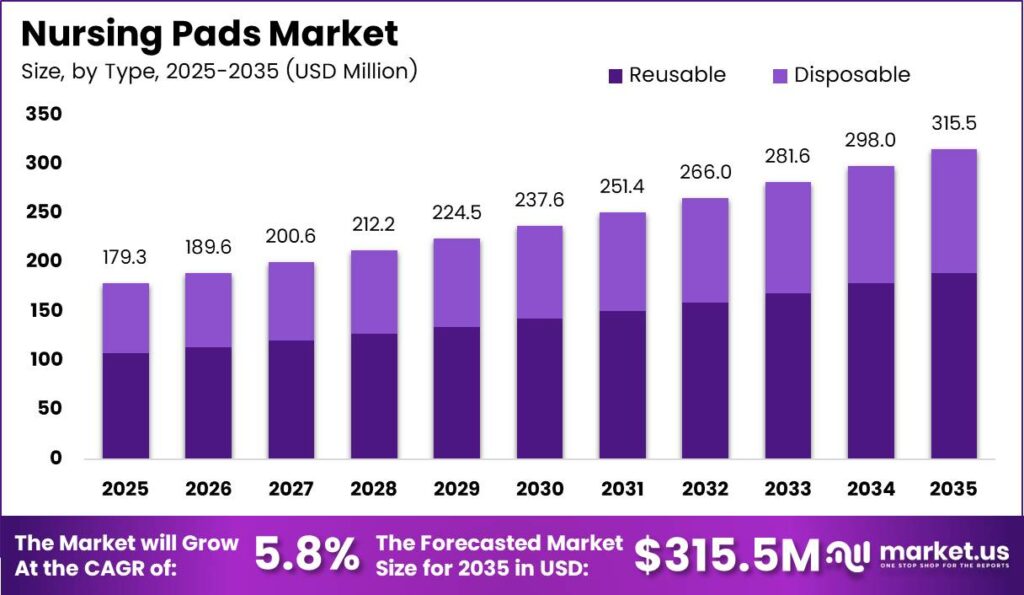
Global Nursing Pads Market size is expected to be worth around USD 315.5 Million by 2035 from USD 179.3 Million in 2025, growing at a CAGR of 5.8% during the forecast period 2026 to 2035.
The nursing pads market covers absorbent products worn inside a bra to prevent milk leakage during lactation. The market includes two core product types, disposable and reusable pads, distributed through retail stores, online marketplaces, supermarkets, and other channels. Demand is shaped by breastfeeding participation rates, household income levels, and the expansion of organized maternity retail.
Key Takeaways
- The global nursing pads market was valued at USD 179.3 Million in 2025 and is forecast to reach USD 315.5 Million by 2035.
- The market is growing at a CAGR of 5.8% during the forecast period 2026 to 2035.
- By Type, Reusable pads dominate with a 56.78% share and represent the fastest-growing sub-segment.
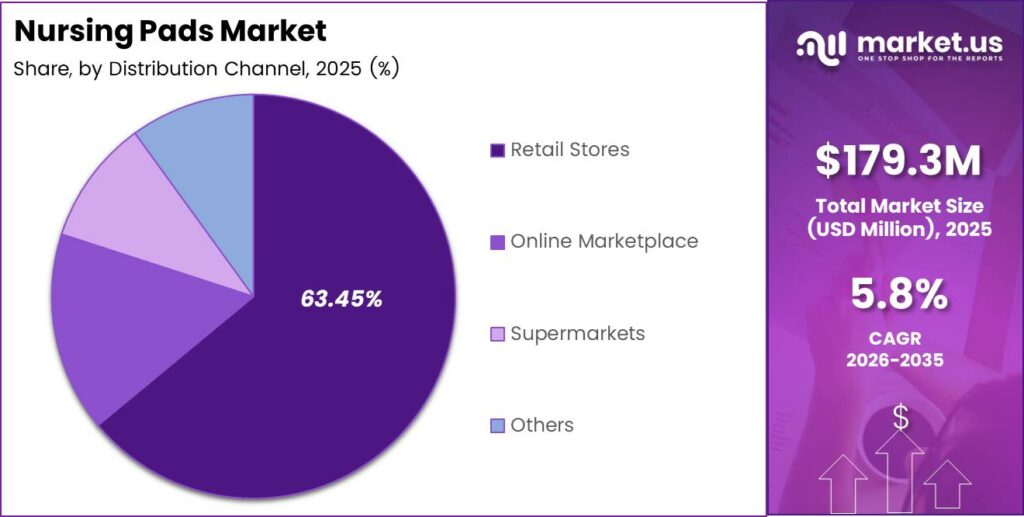
- By Distribution Channel, Retail Stores hold the leading position with a 63.45% share.
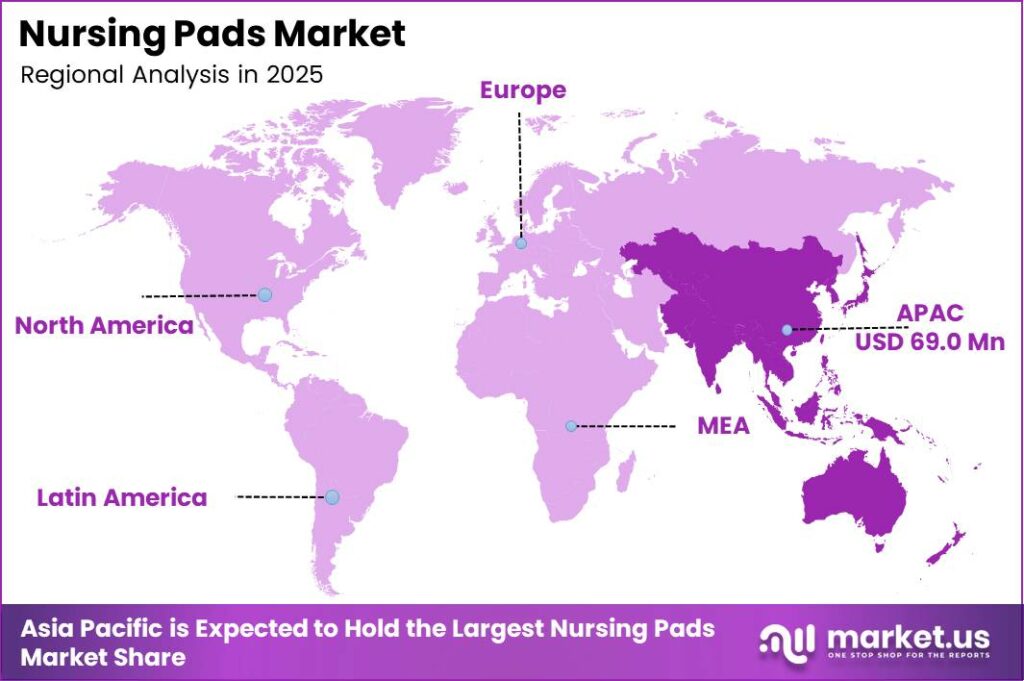
- Asia-Pacific is the dominant region with a 38.56% share, valued at USD 69.0 Million.
- Europe is the fastest-growing regional market.
- Online Marketplace is the fastest-growing distribution channel.
According to WHO, 48% of infants under six months worldwide were exclusively breastfed as of 2024, following an increase exceeding 10 percentage points over 12 years. This expanding breastfeeding base directly widens the population requiring leakage-management products. Suppliers with strong retail and online distribution will be positioned to capture replenishment demand across the full lactation cycle.
As reported by UNICEF, more than 1 in 5 babies in high-income countries were never breastfed in 2018, compared with 1 in 25 in low- and middle-income countries. This gap signals that penetration in developed markets remains structurally constrained. Brands that invest in clinical endorsement and postpartum education campaigns can unlock demand from the non-breastfeeding majority in premium markets.
UNCTAD reported that tonnage passing through the Suez Canal remained 70% below 2023 levels by May 2025. WTO reported that world merchandise trade volume increased 4.6% in 2025, yet its March 2026 forecast projected growth slowing to 1.9% in 2026. Manufacturers sourcing from Asia face elevated logistics costs that compress margins and slow replenishment cycles across European and North American retail channels.
Type Analysis
Reusable dominates with 56.78% due to lower long-term cost per use.
In 2025, Reusable nursing pads held a dominant market position in the By Type segment of the Nursing Pads Market, with a 56.78% share. Cost-conscious mothers favor reusable pads because repeated washing eliminates ongoing purchase expenditure. This loyalty to washable formats creates a durable replenishment ceiling for disposable manufacturers, pushing them to compete on convenience and premium absorbency features rather than volume alone.
Disposable nursing pads attract buyers who prioritize hygiene and on-the-go convenience over cost savings. Eurostat reported 3.55 million births in the European Union in 2024, a 3.3% decrease from 2023. Declining birth cohorts in high-income markets compress the addressable first-purchase population, meaning disposable brands must increase average transaction value through multi-pack formats and premium positioning to sustain revenue per customer.
Distribution Channel Analysis
Retail Stores dominates with 63.45% due to established maternity-aisle shelf presence.
In 2025, Retail Stores held a dominant market position in the By Distribution Channel segment of the Nursing Pads Market, with a 63.45% share. Physical pharmacy and baby-care chains provide immediate product access at the point of postpartum need. WTO’s March 2026 baseline forecast projected world merchandise trade volume growth of 1.9% in 2026, and with 11% of global trade passing through the Strait of Hormuz, shelf replenishment timelines for import-reliant retailers carry measurable supply risk.
Online Marketplace is the fastest-growing distribution channel, driven by subscription convenience and direct-to-consumer margin advantages. Eurostat reported that 78% of EU internet users aged 16 to 74 bought or ordered goods online during the preceding 12 months in 2025. The U.S. Census Bureau estimated total U.S. retail e-commerce sales at USD 1,233.7 Billion in 2025, up 5.4% from 2024. Brands that build subscription replenishment programs capture predictable revenue and reduce dependence on retail shelf allocation.
Supermarkets serve price-sensitive buyers through high-footfall locations that generate impulse and planned purchases during routine grocery trips. In April 2025, Lansinoh introduced its Thrive 2-in-1 Breast Pump, featuring nine suction levels and suction of up to 280 mmHg, strengthening its cross-category presence in maternity aisles. Other channels, including hospital pharmacies and specialty maternity stores, capture a smaller collective share but serve clinical and premium buyer segments with distinct conversion economics.
Key Market Segments
By Type
- Reusable
- Disposable
By Distribution Channel
- Retail Stores
- Online Marketplace
- Supermarkets
- Others
Regional Analysis
Asia-Pacific Dominates the Nursing Pads Market with a Market Share of 38.56%, Valued at USD 69.0 Million
In 2025, Asia-Pacific held a 38.56% share of the global nursing pads market, valued at USD 69.0 Million. WHO reported on August 10, 2025, that 48.4% of infants under six months in Pakistan were exclusively breastfed, signaling active breastfeeding cultures across South Asian markets. This participation rate supports sustained demand and gives regional manufacturers a defensible volume base that global entrants must price competitively to challenge.
Europe is the fastest-growing regional market, reflecting premiumization trends and rising consumer spending on maternal wellness products. In January 2024, Lansinoh announced the launch of its DiscreetDuo Wearable Pump, featuring nine suction levels, four pumping modes, suction of up to 260 mmHg, and 6 oz reusable collection cups, signaling that innovation-led product launches in European maternity channels are accelerating. Brands investing in clinical positioning and retail channel depth in Western Europe will capture disproportionate revenue growth during the forecast period.
Key Regions and Countries
North America
- US
- Canada
Europe
- Germany
- France
- The UK
- Spain
- Italy
- Rest of Europe
Asia Pacific
- China
- Japan
- South Korea
- India
- Australia
- Rest of APAC
Latin America
- Brazil
- Mexico
- Rest of Latin America
Middle East and Africa
- GCC
- South Africa
- Rest of MEA
Drivers
Increasing breastfeeding participation enlarges the population potentially requiring leakage-management products. The WHO-UNICEF statement issued in July 2024 reported that exclusive breastfeeding among infants younger than 6 months had reached 48%, following an increase exceeding 10 percentage points over 12 years. This supports a shift from isolated postpartum starter-pack sales toward replenishment throughout the leakage-prone portion of lactation.
Online replenishment convenience and premium disposable product mix each contribute additional CAGR support across North America, Europe, and developed Asia. Existing maternity-retail cross-selling and urban pharmacy assortment expansion in India, Southeast Asia, and Latin America add further near- and medium-term lift. Suppliers that align product portfolios with these channel and format trends will capture the most defensible share of forecast growth.
| Driver | (~) % Impact on CAGR Forecast | Geographic Relevance | Impact Timeline |
|---|---|---|---|
| Increasing breastfeeding participation | +0.40% | Global; especially Africa and Asia | Short term (≤ 2 years) |
| Online replenishment convenience | +0.20% | North America, Europe, urban Asia | Short term (≤ 2 years) |
| Premium disposable-pad product mix | +0.15% | North America, Europe, developed Asia | Short term (≤ 2 years) |
| Existing maternity-retail cross-selling | +0.15% | Global organized retail | Short term (≤ 2 years) |
| Urban pharmacy assortment expansion | +0.10% | India, Southeast Asia, Latin America | Medium term (2–4 years) |
Restraints
Smaller birth cohorts directly reduce new entrants into a category tied to childbirth. OECD reporting published in June 2024 placed average fertility at 1.5 children per woman in 2022, compared with 3.3 in 1960 and a replacement benchmark of 2.1. Suppliers must protect contribution per customer and avoid capacity additions premised solely on expanding maternal populations in affected markets.
Household affordability exclusion and improvised cloth substitution suppress paid category participation in South Asia, Africa, and price-sensitive markets. Low-leakage consumer nonparticipation and established washable-pad replacement cycles further limit volume expansion in developed markets. Brands that address affordability through tiered pricing and smaller pack formats will reduce the demand drag these restraints collectively impose on the 5.8% baseline.
| Restraint | (~) % Impact on CAGR Forecast | Geographic Relevance | Impact Timeline |
|---|---|---|---|
| Smaller birth cohorts | -0.35% | Europe, East Asia, North America | Long term (≥ 4 years) |
| Household affordability exclusion | -0.20% | Low-income markets and households | Short term (≤ 2 years) |
| Improvised cloth substitution | -0.15% | South Asia, Africa, price-sensitive markets | Short term (≤ 2 years) |
| Low-leakage consumer nonparticipation | -0.10% | Global | Long term (≥ 4 years) |
| Established washable-pad replacement cycles | -0.10% | Europe, North America, developed Asia | Medium term (2–4 years) |
Challenges
Ocean freight routing volatility raises landed costs and extends replenishment cycles for manufacturers sourcing finished pads and absorbent materials from Asia. UNCTAD reported that rerouting increased container-ship demand by 12% by mid-2024, while average Suez Canal transits by mid-October 2024 were 55% below their year-earlier level. Longer-term mitigation requires dual sourcing, regional finishing, and inventory buffers calibrated to route-specific variability.
Absorbency and adhesion consistency challenges in disposable pad manufacturing create quality risk that triggers returns and damages brand trust in regulated retail markets. Skin-contact material qualification requirements add compliance cost and slow product launch timelines. Brands that invest in process controls and third-party certification build a defensible quality moat that private-label competitors cannot easily replicate.
| Challenge | (~) % CAGR Friction Drag | Geographic Relevance | Mitigation Horizon |
|---|---|---|---|
| Ocean freight routing volatility | -0.25% | Asia-Europe and connected import corridors | Short term (≤ 2 years) |
| Absorbency and adhesion consistency | -0.12% | Global disposable-pad manufacturing | Medium term (2–4 years) |
| Skin-contact material qualification | -0.10% | Global; especially regulated retail markets | Medium term (2–4 years) |
| Postpartum demand forecasting errors | -0.08% | Global multichannel distribution | Short term (≤ 2 years) |
| Sustainability claim verification complexity | -0.05% | Europe, North America, developed Asia | Medium term (2–4 years) |
Opportunities
Institutional postpartum procurement programs represent white space in markets where health providers do not yet include nursing pads in discharge or community-care kits. WHO and UNICEF reported in July 2024 that approximately 4.5 billion people lacked full essential-health-service coverage. Standardized bulk-pack formats targeting India, Southeast Asia, Africa, and Latin America can achieve a pilot hurdle of 2 to 4 percentage points of contribution-margin improvement through reduced per-unit packaging and fulfillment costs.
Adaptive anatomical fit platforms offer a medium-term revenue lever in North America, Europe, and developed Asia, where consumers pay a premium for comfort-differentiated formats. Sleep-specific nursing-pad formats address an underserved nighttime-use occasion in global premium segments, with a short execution window. Together, all listed opportunity programs offer a conditional CAGR ceiling of +0.80 percentage points above the 5.8% baseline, reaching 6.6% only under full execution.
| Opportunity | (~) % Potential CAGR Upside | Geographic Relevance | Execution Window |
|---|---|---|---|
| Institutional postpartum procurement programs | +0.30% | India, Southeast Asia, Africa, Latin America | Medium term (2–4 years) |
| Adaptive anatomical fit platforms | +0.18% | North America, Europe, developed Asia | Medium term (2–4 years) |
| Sleep-specific nursing-pad formats | +0.14% | Global premium consumer segments | Short term (≤ 2 years) |
| Regional brand portfolio consolidation | +0.10% | Fragmented regional consumer markets | Medium term (2–4 years) |
| Post-weaning leakage care kits | +0.08% | Global specialist maternity channels | Medium term (2–4 years) |
Key Company Insights
Medela reported a 37% reduction in virgin plastic across its retail packaging in its 2024 impact report, signaling a deliberate sustainability repositioning in premium maternity channels. In July 2026, Medela launched its Melody InBra and Freestyle Mini Hands-free breast pumps. This product and packaging strategy strengthens shelf appeal in European and North American retail, where sustainability credentials increasingly influence buyer ranging decisions.
Cardinal Health reported consolidated revenue of USD 222.6 Billion for the fiscal year ended June 30, 2025, down 2% from fiscal 2024. The 2025 Global Breastfeeding Scorecard found that only 33 countries had legal measures substantially aligned with the International Code of Marketing of Breast-milk Substitutes. In November 2024, Cardinal Health announced a definitive agreement to acquire Advanced Diabetes Supply Group for approximately USD 1.1 Billion, reflecting a strategic pivot toward specialty health that may reduce near-term nursing-category focus.
Key Players
- Medela
- Cardinal Health
- Lansinoh Laboratories, Inc.
- Ameda, Inc.
- NUK USA LLC
- Pigeon Corporation
- Bamboobies
- LilyPadz
- Cache Coeur
- KINDRED BRAVELY
- Koninklijke Philips N.V.
- Other Key Players
Recent Developments
- July 20, 2026 – Cardinal Health announced definitive agreements to acquire AdaptHealth’s Diabetes Health business and Strive Medical for approximately USD 360 Million combined in cash, subject to working-capital adjustments and customary closing conditions.
- January 13, 2026 – Lansinoh announced the launch of its NaturalWave Double Electric Breast Pump, featuring 12 adjustable suction-strength levels and 5 included flange sizes, with a retail price of USD 219.99.
- October 20, 2025 – Medela announced the launch of Motion InBra, featuring 24 mm breast shields and 3 inserts measuring 15 mm, 18 mm, and 21 mm; the company stated that these options accommodate more than 95% of nipple sizes.
- November 11, 2024 – Cardinal Health announced a definitive agreement to acquire a 71% ownership stake in GI Alliance for approximately USD 2.8 Billion in cash, subject to customary closing conditions.
Report Scope
| Report Features | Description |
|---|---|
| Market Value (2025) | USD 179.3 Million |
| Forecast Revenue (2035) | USD 315.5 Million |
| CAGR (2026-2035) | 5.8% |
| Base Year for Estimation | 2025 |
| Historic Period | 2020-2024 |
| Forecast Period | 2026-2035 |
| Report Coverage | Revenue Forecast, Market Dynamics, Market Opportunity Analysis, Technology and Innovation Landscape, Competitive Landscape, Recent Developments |
| Segments Covered | By Type (Reusable, Disposable), By Distribution Channel (Retail Stores, Online Marketplace, Supermarkets, Others) |
| Regional Analysis | North America (US and Canada), Europe (Germany, France, The UK, Spain, Italy, and Rest of Europe), Asia Pacific (China, Japan, South Korea, India, Australia, and Rest of APAC), Latin America (Brazil, Mexico, and Rest of Latin America), Middle East and Africa (GCC, South Africa, and Rest of MEA) |
| Competitive Landscape | Medela, Cardinal Health, Lansinoh Laboratories, Inc., Ameda, Inc., NUK USA LLC, Pigeon Corporation, Bamboobies, LilyPadz, Cache Coeur, KINDRED BRAVELY, Koninklijke Philips N.V., Other Key Players |
| Customization Scope | Customization for segments, region/country-level will be provided. Additional customization can be done based on requirements. |
| Purchase Options | We have three licenses to opt for: Single User License, Multi-User License (Up to 5 Users), Corporate Use License (Unlimited User and Printable PDF) |





































