


Report Overview
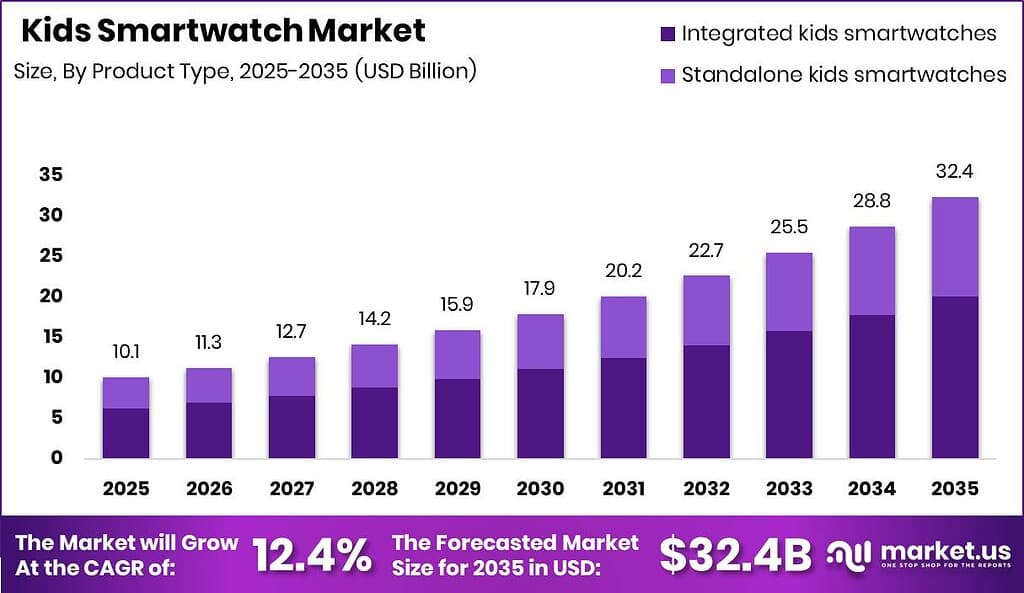
Global Kids Smartwatch Market size is expected to be worth around USD 32.40 Billion by 2035 from USD 10.1 Billion in 2025, growing at a CAGR of 12.4% during the forecast period 2026 to 2035. This growth path rewards vendors who convert hardware sales into lasting connectivity and safety service revenue. Investors should treat recurring plan attach rates as the core value driver rather than unit volume alone.
Therefore, the market covers wrist-worn connected devices built for children with location, calling, messaging, and parental controls. Structure splits across product type, connectivity, age group, price range, and distribution channel. Integrated designs, cellular links, school-age users, economy pricing, and online retail currently set the competitive baseline for share capture.
Key Takeaways
- The market is valued at USD 10.1 Billion in 2025 and is projected to reach USD 32.40 Billion by 2035 at a CAGR of 12.4%.
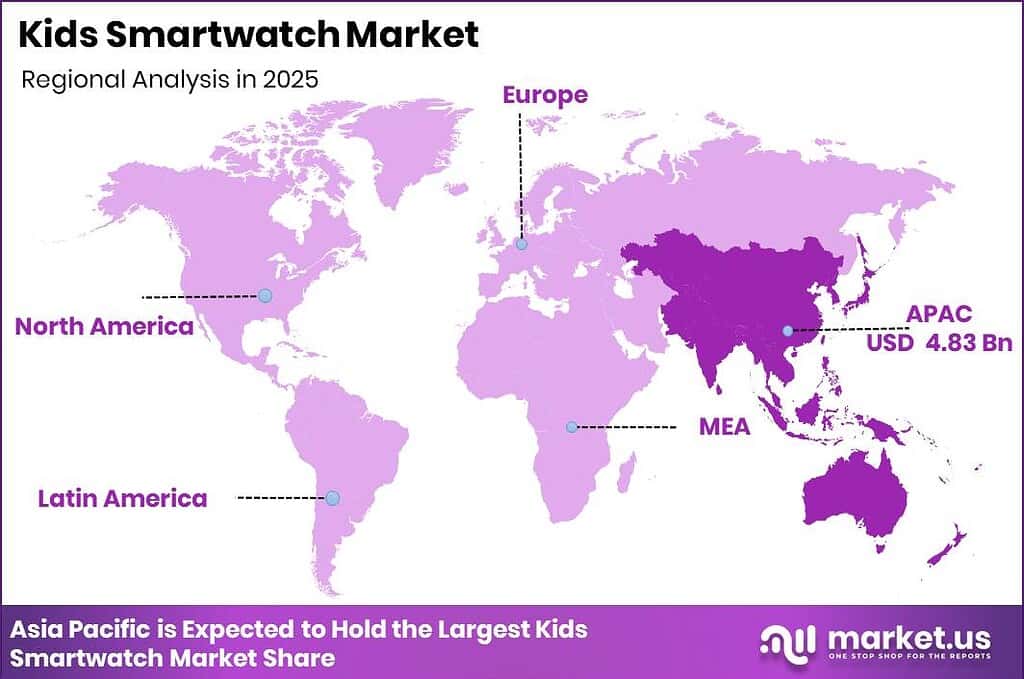
- Asia Pacific leads with a 48.00% share, valued at USD 4.83 Billion.
- Integrated kids smartwatches lead product type with a 62.00% share.
- Cellular leads connectivity with a 38.00% share.
- The 7–12 years age group leads with a 57.00% share.
- Economy pricing leads price range with a 43.00% share.
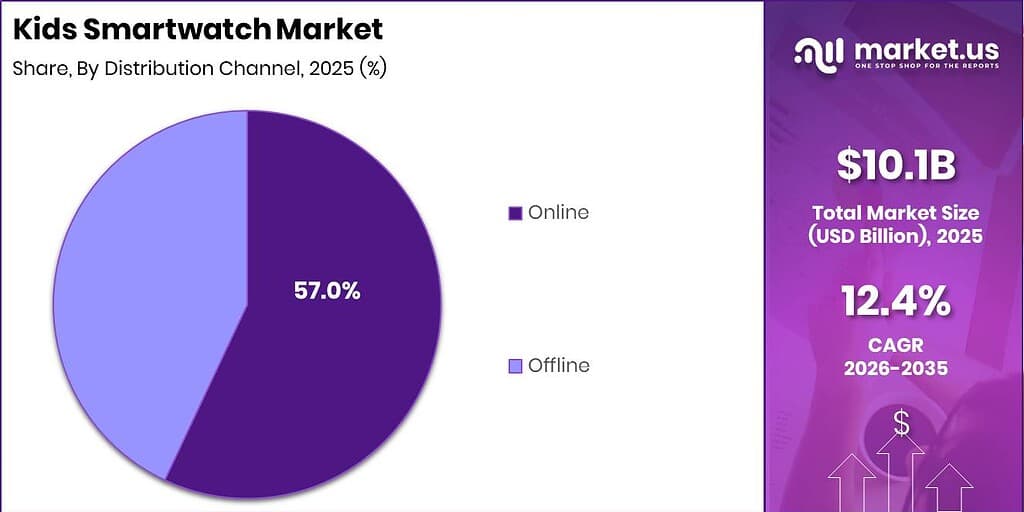
- Online channels lead distribution with a 57.00% share.
As per our research, only 11% of U.S. parents reported a child using a smartwatch in 2025. This low base leaves large headroom if safety messaging converts non-users. Brands that pair clear geofence value with simple onboarding can lift household penetration without heavy discounting.
However, a 2025 mixed-methods review found child smartwatch usage ranging from 15% to 40% by country of residence. Cross-border variance signals that one global SKU mix will underperform. Regional catalogs and local carrier partnerships will decide which vendors scale beyond home markets.
Consequently, the FTC finalized 2025 COPPA Rule updates that take effect 60 days after Federal Register publication, with operators getting 1 year to reach full compliance. Privacy engineering now sits on the critical path for U.S. launches. In 2025 Garmin also expanded Bounce 2 as an LTE smartphone alternative with Garmin Jr. controls, showing how compliance-ready communication features support premium positioning.
Product Type Analysis
Integrated kids smartwatches dominates with 62.00% due to bundled phone free safety features.
In 2025, Integrated kids smartwatches held a dominant market position in the By Product Type segment of Kids Smartwatch Market, with a 62.00% share. GSMA data show mobile broadband coverage for 96% of the global population, so parents can buy a full wrist device without giving a child a phone. This means integrated SKUs capture first purchases where supervision and calling must coexist on one band.
Standalone kids smartwatches form the fastest growing product path as buyers seek lighter tracking-first hardware. ITU and UNICEF tracking shows only 33% of children and young people had home internet access, so wrist cellular contact fills a real supervision gap. Vendors that price standalone units for replacement cycles can win households that already own a basic tracker.
Product roadmaps that blur integrated and standalone lines will confuse retail shelves and dilute brand messaging. Clear feature tiers help parents match spend to safety needs rather than unused apps. This creates room for dual-SKU strategies without cannibalizing the integrated majority share.
Connectivity Analysis
Cellular dominates with 38.00% due to independent calling without phone.
In 2025, Cellular held a dominant market position in the By Connectivity segment of Kids Smartwatch Market, with a 38.00% share. GSMA figures show 5G covering about 54% of the world population by end of 2024 while 4G reached 93%. Carriers and OEMs that pre-provision SIMs reduce setup friction and raise paid plan conversion at unboxing.
Wi-Fi connectivity supports home and school zones where parents want location pings without full cellular fees. Households already pay broadband, so Wi-Fi-first models lower monthly cost objections in price-sensitive cities. Sellers who explain hybrid handoff rules clearly cut return rates tied to missed outdoor fixes.
Bluetooth links keep watches paired to a parent phone for short-range alerts and setup. This mode suits younger users who stay near caregivers and do not need always-on radios. Portfolio designers should treat Bluetooth as an entry ramp into higher ARPU cellular upgrades.
NFC and GPS/GNSS hold the remaining share collectively and matter for payments experiments and outdoor fixes. GPS quality still decides trust when a child leaves a geofence. Investors should fund antenna and hybrid-location work before adding novelty radios.
Age Group Analysis
7–12 years dominates with 57.00% due to school age safety monitoring needs.
In 2025, 7–12 years held a dominant market position in the By Age Group segment of Kids Smartwatch Market, with a 57.00% share. Pew Research Center data show only about 11% of U.S. parents reported any child smartwatch use in 2025, so school-age conversion remains early. Devices tuned for school modes and parent-approved contacts will own this band first.
The 0–6 years group needs simpler interfaces, tougher housings, and fewer open apps. Caregivers prioritize SOS and location over sports modes at this stage. Brands that certify materials and limit data collection win trust with first-time parent buyers.
The 13–17 years group expects messaging and style closer to adult wearables while parents still want controls. Feature creep toward full smartphones raises privacy and school-policy risk. Balanced teen SKUs with supervised social tools can extend replacement demand without losing the safety thesis.
Price Range Analysis
Economy dominates with 43.00% due to price sensitive first device buyers.
In 2025, Economy held a dominant market position in the By Price Range segment of Kids Smartwatch Market, with a 43.00% share. Component cost pressure in Asia-Pacific manufacturing hubs supports sub-premium shelves for first watches. Retailers that bundle a low monthly plan with economy hardware can raise lifetime value without leaving the entry price band.
Mid-range models trade up buyers who want better batteries and clearer location apps. Parents compare day-long runtime against cheap units that fail after school sports. Clear battery labels at shelf level reduce post-purchase disappointment and protect brand scores.
Premium tiers rely on durable builds, stronger apps, and trusted ecosystems. Higher ASPs fund compliance and support teams required under child privacy rules. Premium share grows when schools and carriers endorse specific managed devices.
Distribution Channel Analysis
Online dominates with 57.00% due to direct parent comparison shopping ease.
In 2025, Online held a dominant market position in the By Distribution Channel segment of Kids Smartwatch Market, with a 57.00% share. E-commerce marketplaces and social commerce platforms let parents compare GPS claims and plan fees in one session. Marketplace content that shows real geofence demos lifts conversion versus static feature lists.
Offline retail still matters for touch-and-feel checks on straps, buttons, and screen brightness. Supermarkets, hypermarkets, department stores, convenience stores, and brand-exclusive stores serve gift seasons and last-minute safety buys. Staff scripts that explain school mode cut misuse returns after holidays.
Hybrid paths that start online and finish with carrier store SIM activation raise attach rates. Parents rarely want a second complicated account setup after checkout. Channel partners who own activation earn sticky service margins beyond the device sale.
Key Market Segments
By Product Type
- Integrated kids smartwatches
- Standalone kids smartwatches
By Connectivity
- Cellular
- Wi-Fi
- Bluetooth
- NFC
- GPS/GNSS
By Age Group
- 0–6 years
- 7–12 years
- 13–17 years
By Price Range
- Economy
- Mid-range
- Premium
By Distribution Channel
- Online
- E-commerce marketplaces
- Social commerce platforms
- Others
- Offline
- Supermarkets and hypermarkets
- Department stores
- Convenience stores
- Brand-exclusive stores
- Other
Regional Analysis
Asia Pacific Dominates the Kids Smartwatch Market with a Market Share of 48.00%, Valued at USD 4.83 Billion
Asia Pacific leads on manufacturing depth, urban parent safety demand, and dense cellular retail. A 48.00% share and USD 4.83 Billion value in 2025 give regional brands scale advantages in economy hardware. Local players that lock carrier shelf space can defend share as global names enter with premium LTE models.
North America and Europe act as compliance and premium growth arenas where privacy rules shape design. School policies and COPPA-style duties raise the cost of weak consent flows. Vendors that certify early gain preferred status with carriers and family plan bundles.
Latin America and Middle East and Africa add volume through shared plans and rising urban monitoring needs. Price and prepaid flexibility decide adoption more than feature depth today. Portfolio splits that keep rugged economy SKUs in these regions protect global volume targets.
Key Regions and Countries
North America
- US
- Canada
Europe
- Germany
- France
- The UK
- Spain
- Italy
- Rest of Europe
Asia Pacific
- China
- Japan
- South Korea
- India
- Australia
- Rest of APAC
Latin America
- Brazil
- Mexico
- Rest of Latin America
Middle East and Africa
- GCC
- South Africa
- Rest of MEA
Market Dynamics
Market Opportunity Analysis - Standalone cellular, school platforms, and shared plans open whitespace beyond integrated hardware
Standalone kids smartwatches remain the fastest growing product path while integrated designs still hold 62.00% share. Many households that already own a basic tracker will not repurchase a full integrated unit. Entrants that ship reliable cellular standalone SKUs can win replacement cycles without fighting the integrated shelf majority head-on.
However, the 7–12 years band holds 57.00% share yet global child penetration is still early in several countries. School-day safety needs outpace current managed device deployments. Suppliers that pre-build school mode and attendance-friendly APIs can lock district pilots before larger phone brands react.
Economy pricing leads with 43.00% share, which leaves mid-range underserved on proven battery and GPS quality. Parents step up when cheap units miss geofences after school sports. A credible mid-tier with published field accuracy can take margin without abandoning volume channels.
As a result, online channels at 57.00% share still under-serve carrier-assisted activation in many emerging cities. Shared family plans in India, Africa, Latin America, and Southeast Asia can unlock prepaid buyers. Players who bundle SIM activation inside marketplace checkout will convert browsers that abandon complex self-setup.
Technology and Innovation Landscape - Hybrid location, power budgets, and consent stacks redefine product trust
Reliable 2026 kids GPS watches target sub-30-meter outdoor fixes, while field guides cite 5 to 20 meter accuracy under good coverage. Parents judge brands on missed alerts, not chipset brand names. Vendors that publish test methods and fail rates will separate from catalog clones.
Therefore, a practical 2026 benchmark expects a 50-meter home geofence alert within 90 seconds of boundary cross and voice call setup within 8 seconds. Slow rings destroy emergency trust even if maps look precise. Firmware teams should prioritize call setup and geofence latency equal to map polish.
This reflects power limits: continuous GPS and cellular use often yields only 6 to 12 hours, while stronger designs advertise 24 to 72 hours of active tracking. Mixed-use claims mislead buyers who enable all-day tracking. Honest mode-based battery labels cut returns and protect online ratings.
By contrast, privacy stacks now sit beside radios as core technology. Consent, retention, and deletion workflows must ship with the same rigor as GNSS firmware. Investors should fund compliance engineering as a product feature, not a legal afterthought, to keep app-store and carrier doors open.
Drivers
Parents treat a kids smartwatch as a controlled first connected device rather than a miniature smartphone. Demand centers on location alerts, geofencing, emergency calling, and recurring connectivity services. GSMA tracking shows mobile broadband available to 96% of the global population, while FCC rules pushed dispatchable or vertical positioning by April 2025 against a 50-meter horizontal benchmark. UNICEF and ITU data show only 33% of children and young people had home internet access, so wrist cellular contact fills a supervision gap.
These conditions support about +2.3% incremental contribution to the baseline 12.4% CAGR through higher device conversion. Service revenue can represent roughly 10% to 20% of customer lifetime receipts. This reduces dependence on one-time hardware margins and favors vendors with carrier-grade apps and consent flows.
| Driver | (~) % Impact on CAGR Forecast | Geographic Relevance | Impact Timeline |
|---|---|---|---|
| Parental Location-Safety Demand | +2.3% | Global; strongest in urban Asia-Pacific, North America, and Europe | Short term (2 years or less) |
| Standalone Cellular Connectivity | +1.7% | China, North America, Europe, India, and developed Asia | Short term (2 years or less) |
| Child Fitness Monitoring | +1.2% | North America, Europe, Oceania, and urban Asia-Pacific | Medium term (2 to 4 years) |
| Parent-Controlled Communication | +1.0% | Global urban households | Short term (2 years or less) |
| Wearable Component Commoditization | +0.7% | Asia-Pacific manufacturing hubs and price-sensitive markets | Medium term (2 to 4 years) |
Restraints
Collecting precise location, voice, contact, and health data from minors creates a structural sales barrier. Market access depends on verified parental consent, data minimization, secure retention, and auditable deletion. The FTC applies COPPA below age 13, while EU Digital Services Act Article 28 requires high privacy and blocks profiling-based ads when a user is known to be a minor. July 2025 EU guidance further pushed private-by-default accounts and stronger age assurance.
Compliance can add an estimated 8% to 15% to software-development and assurance budgets and extend launches by 3 to 6 months. Cloud-security operating costs can rise about 5% to 10%. This produces a plausible -2.1% drag against the baseline 12.4% CAGR through delayed releases, withdrawals, and thinner margins.
| Restraint | (~) % Impact on CAGR Forecast | Geographic Relevance | Impact Timeline |
|---|---|---|---|
| Children’s Privacy Compliance | -2.1% | North America and Europe, with global product-design spillover | Short term (2 years or less) |
| Recurring Plan Affordability | -1.6% | India, Latin America, Africa, and Southeast Asia | Short term (2 years or less) |
| School Wearable Restrictions | -1.1% | Europe, North America, Oceania, and selected Asian school systems | Short term (2 years or less) |
| Low-Cost Product Saturation | -0.9% | India, China, and Southeast Asia | Medium term (2 to 4 years) |
| Short Replacement Justification | -0.6% | Global middle-income households | Medium term (2 to 4 years) |
Challenges
Continuous cellular registration, satellite positioning, Wi-Fi scanning, and sensor sampling compete for power in a small enclosure. GSMA data indicate 5G coverage reached about 54% of the global population by end of 2024, yet child devices still hand over across mixed 4G, 5G, and Wi-Fi conditions. The FCC 50-meter horizontal-location benchmark and April 2025 vertical-location milestone raise accuracy expectations for safety use. U.S. guidance also calls for children aged 6 to 17 to complete at least 60 minutes of daily activity.
Manufacturers face roughly 10% to 20% higher component and optimization costs for efficient chipsets and power management. Aggressive tracking intervals can cut practical runtime by 30% to 50%. This supports a -1.8% friction drag and forces multi-year spend on adaptive sampling, hybrid positioning, and low-power firmware that buyers will pay to trust.
| Challenge | (~) % CAGR Friction Drag | Geographic Relevance | Mitigation Horizon |
|---|---|---|---|
| Battery-Accuracy Trade-Off | -1.8% | Global | Medium term (2 to 4 years) |
| Patchy Indoor Positioning | -1.3% | Dense cities and multi-storey buildings globally | Medium term (2 to 4 years) |
| Fragmented Carrier Provisioning | -1.0% | Latin America, India, Southeast Asia, and Europe | Medium term (2 to 4 years) |
| Child-Proof Durability Engineering | -0.8% | Global | Short term (2 years or less) |
| Sensor Data Reliability | -0.5% | Global, especially health-oriented segments | Long term (4 years or more) |
Opportunities
School safety integration remains open white space because most products still run as isolated parent-to-child devices. They rarely link to attendance, transport, campus access, or emergency systems. July 2025 European Commission minors-protection guidance and FCC April 2025 location milestones create policy and infrastructure foundations for campus routing. UNICEF-ITU figures on 33% home internet access for children and young people leave unmet demand around schools and transport corridors.
Vendors that build consent-based school dashboards could move from hardware gross margins near 15% to 25% toward blended margins near 25% to 35%. Fleet provisioning and pooled connectivity could cut per-device service costs by 10% to 20%. Successful execution could add about +1.9% above the baseline 12.4% CAGR for early institutional movers.
| Opportunity | (~) % Potential CAGR Upside | Geographic Relevance | Execution Window |
|---|---|---|---|
| School Safety Platform Integration | +1.9% | North America, Europe, Gulf states, and developed Asia | Medium term (2 to 4 years) |
| Pediatric Remote-Care Services | +1.5% | North America, Europe, Oceania, and affluent Asian markets | Long term (4 years or more) |
| Emerging-Market Shared Plans | +1.2% | India, Africa, Latin America, and Southeast Asia | Medium term (2 to 4 years) |
| Neurodiverse Child Assistance | +0.9% | North America, Europe, Oceania, and urban Asia | Long term (4 years or more) |
| Circular Upgrade Programs | +0.6% | Europe, North America, Japan, and South Korea | Medium term (2 to 4 years) |
Key Company Insights
BBK Electronics Corporation (imoo) holds scale advantages in Asia-built integrated kids devices aimed at parent-controlled communication. Independent 2026 testing showed only 37% of sub-$100 kids GPS watches held ≤15 meter accuracy under peak suburban load. This means imoo must prove real-world fixes, not only shelf price, to defend economy share against quality backlash.
Huawei Technologies Co., Ltd. competes with ecosystem depth in connected wearables and parent apps across Asia-focused channels. In September 2025 Garmin added Bounce 2 sports modes for running, cycling, jump rope, and team sports, raising the activity bar rivals must match. Huawei needs equal fitness credibility plus clear privacy controls to keep premium school-age buyers from switching.
Key Players
- BBK Electronics Corporation — imoo
- Huawei Technologies Co., Ltd.
- Xiaomi Corporation
- Xplora Technologies AS
- VTech Holdings Limited
- Garmin Ltd.
- Apple Inc.
- Google LLC — Fitbit
- Qihoo 360 Technology Co., Ltd.
- TickTalk Tech LLC
- Gabb Wireless, Inc.
- Verizon Communications Inc. — GizmoWatch
- Contixo Inc.
- Omate Inc.
- JOY FamilyTech, Inc. — Octopus
Recent Developments
- September 2025: Garmin launched Bounce 2, an LTE-enabled kids smartwatch with two-way calling, text messaging, real-time location tracking, activity tracking, voice commands, Amazon Music support, and Garmin Jr. app integration.
- July 2026: Verizon launched Gizmo Watch 4 with watch removal detection alerts, real-time location insights, custom safe zones, video calling, school mode controls, and Verizon Family app integration.
- July 2026: Verizon upgraded the Gizmo Watch lineup with a faster processor, scratch-resistant display, water-resistant design, and up to three-day battery performance for daily child use.
Geopolitical Impact Analysis
According to GSMA data, mobile broadband covers about 96% of the global population while 5G reached roughly 54% by end of 2024. Kids smartwatch makers still depend on cross-border modem, GNSS, and battery supply chains concentrated in Asia. Tariff swings on electronics and components raise BOM risk for economy SKUs that dominate first-time buys.
However, UNCTAD and trade trackers noted global goods trade still expanded in 2025 even as U.S. tariff layers on Chinese-origin electronics stayed elevated, including Section 301 rates near 50% on broad goods classes and baseline duties near 10% on many non-exempt imports. This signals higher landed costs for GPS watches assembled or sourced through China-centric routes. Brands that dual-source modules and pre-negotiate carrier device subsidies will protect retail price points better than single-country assemblers.
Report Scope
| Report Features | Description |
|---|---|
| Market Value (2025) | USD 10.1 Billion |
| Forecast Revenue (2035) | USD 32.40 Billion |
| CAGR (2026-2035) | 12.4% |
| Base Year for Estimation | 2025 |
| Historic Period | 2020-2024 |
| Forecast Period | 2026-2035 |
| Report Coverage | Revenue Forecast, Market Dynamics, Market Opportunity Analysis, Technology and Innovation Landscape, Competitive Landscape, Recent Developments |
| Segments Covered | By Product Type (Integrated kids smartwatches, Standalone kids smartwatches), By Connectivity (Cellular, Wi-Fi, Bluetooth, NFC, GPS/GNSS), By Age Group (0–6 years, 7–12 years, 13–17 years), By Price Range (Economy, Mid-range, Premium), By Distribution Channel (Online (E-commerce marketplaces, Social commerce platforms, Others), Offline (Supermarkets and hypermarkets, Department stores, Convenience stores, Brand-exclusive stores, Other)) |
| Regional Analysis | North America (US and Canada), Europe (Germany, France, The UK, Spain, Italy, and Rest of Europe), Asia Pacific (China, Japan, South Korea, India, Australia, and Rest of APAC), Latin America (Brazil, Mexico, and Rest of Latin America), Middle East and Africa (GCC, South Africa, and Rest of MEA) |
| Competitive Landscape | BBK Electronics Corporation — imoo, Huawei Technologies Co., Ltd., Xiaomi Corporation, Xplora Technologies AS, VTech Holdings Limited, Garmin Ltd., Apple Inc., Google LLC — Fitbit, Qihoo 360 Technology Co., Ltd., TickTalk Tech LLC, Gabb Wireless, Inc., Verizon Communications Inc. — GizmoWatch, Contixo Inc., Omate Inc., JOY FamilyTech, Inc. — Octopus |
| Customization Scope | Customization for segments, region / country-level will be provided. Additional customization can be done based on requirements. |
| Purchase Options | We have three licenses to opt for: Single User License | Multi-User License (Up to 5 Users) | Corporate Use License (Unlimited User and Printable PDF) |





































