


Report Overview
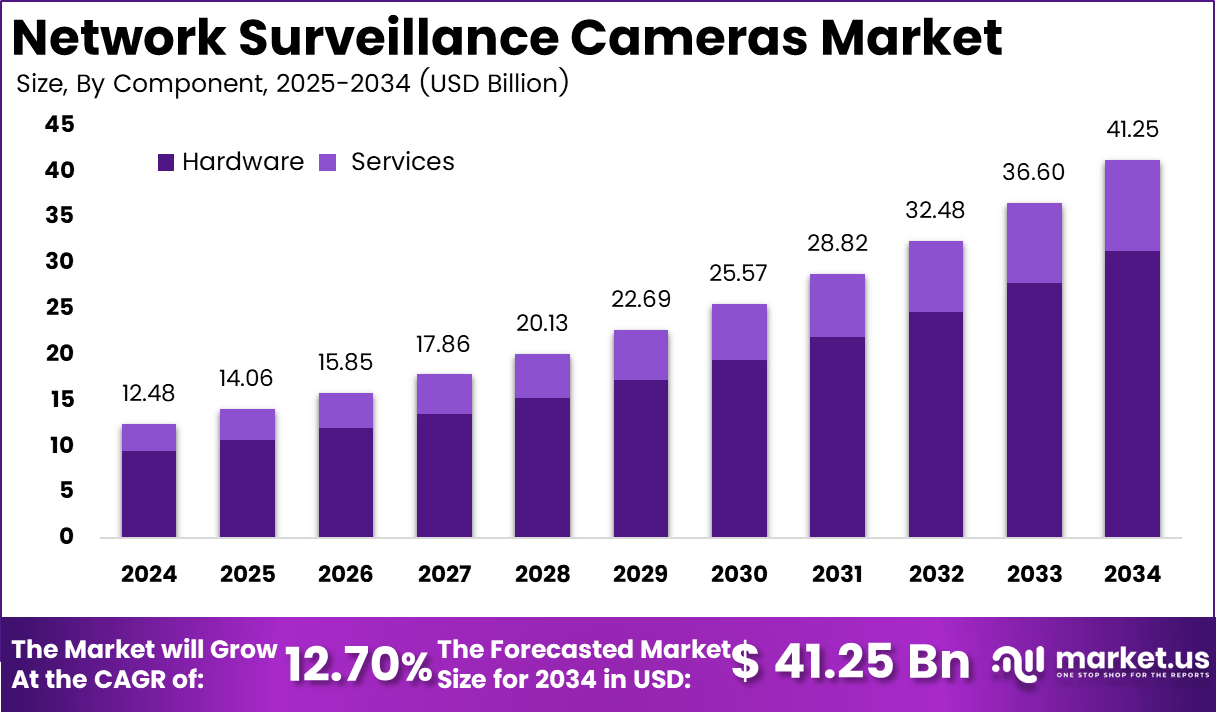
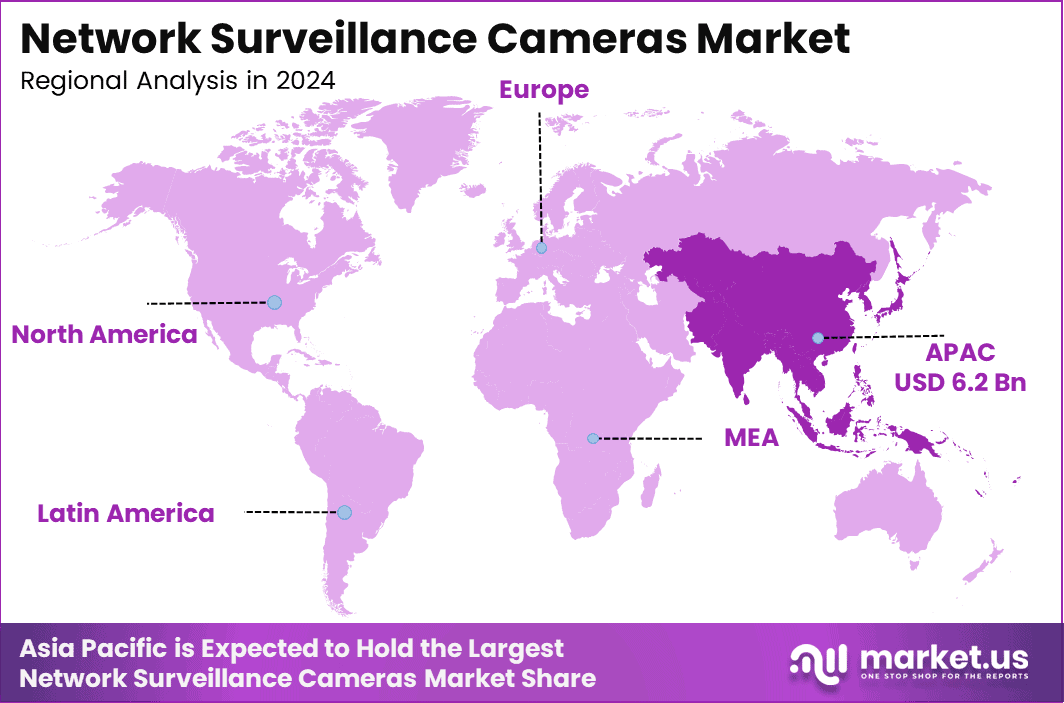
In 2024, the Global Network Surveillance Cameras Market was valued at USD 12.5 billion. The market is projected to grow at a CAGR of 12.7% during 2024–2034, reaching approximately USD 41.3 billion by 2034. Asia Pacific dominated the global market in 2024, accounting for 49.1% of the total market share and generating approximately USD 6.12 billion in revenue.
Network surveillance cameras range in price based on features and brand. Basic models typically cost China 50-100, while mid-range cameras with enhanced resolution and night vision are priced between China 200-500.
High-end models with 4K resolution and AI features can cost China 1,000-3,000. Sales of network surveillance cameras are growing, with global sales expected to exceed 30 million units in 2024. The commercial sector, including retail and government buildings, accounts for 40-50% of total sales. Advanced systems with facial recognition or automated monitoring can reach prices above 10,000 per unit in China.
Key Takeaways
- Market Size & Growth: The global market is valued at USD 12.48 billion in 2024,
- with a projected 12.7% CAGR from 2025 to 2034, reaching USD 41.25 billion by 2034.
- Regional Dominance: APAC is set to lead the market with a value of USD 6.12 billion in 2024, driven by high investments in security and surveillance infrastructure.
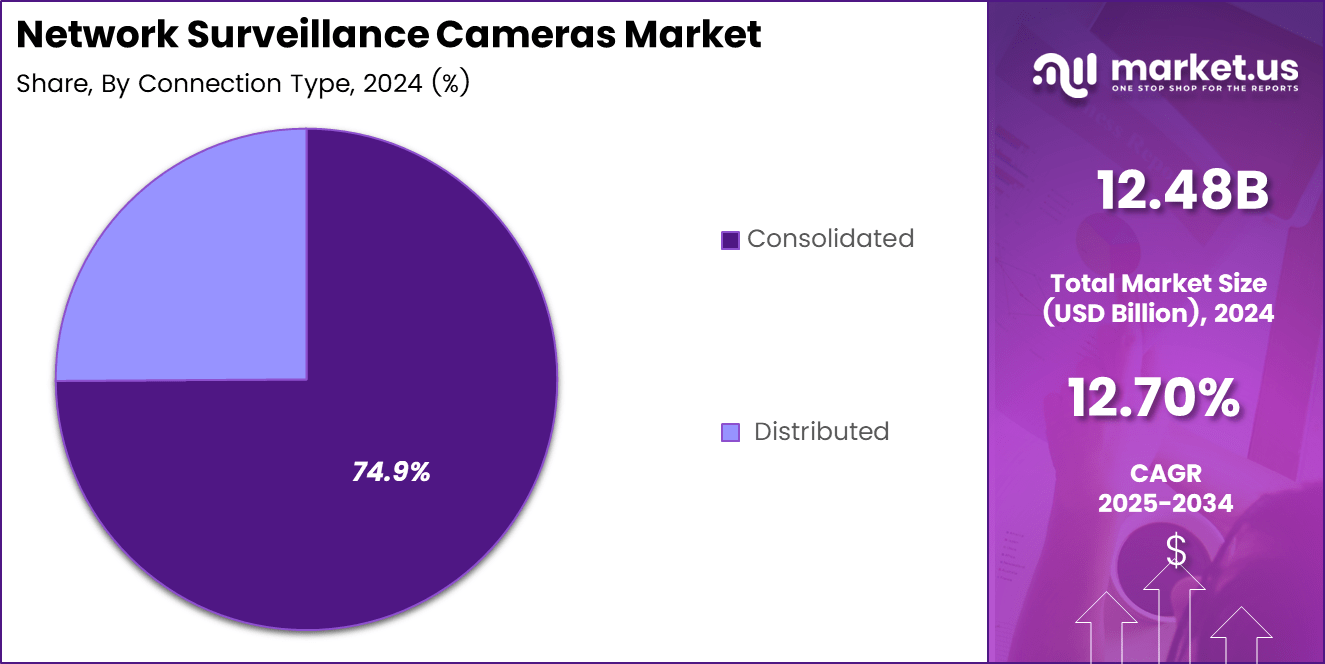
- Connection Type: 74.9% of the market share in 2024 is dominated by consolidated connection types, with the remaining share by distributed connections.
- Market by Component: The market consists of both hardware and services, with hardware holding a significant share throughout the forecast period.
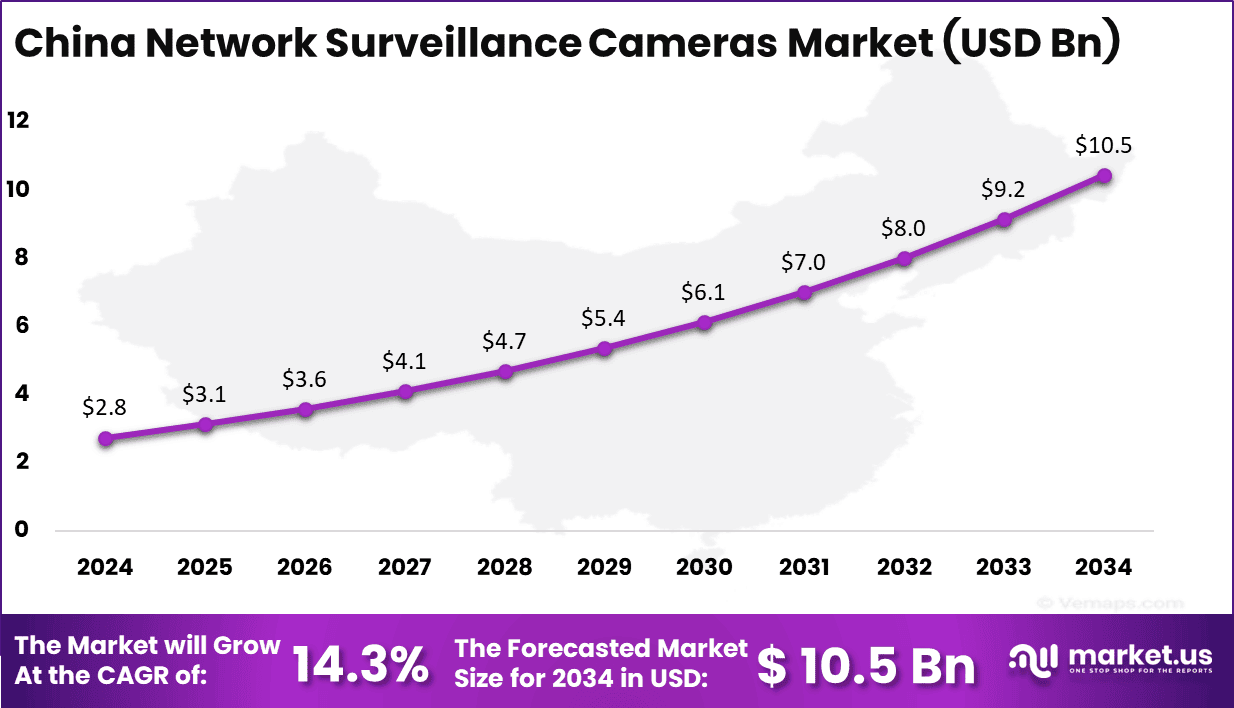
- China Market Growth: The China market is expected to grow from China 2.75 billion in 2024 to China 10.47 billion by 2034, with a 14.3% CAGR, reflecting strong demand for surveillance technologies.
By Component
The hardware segment is projected to generate 76.1% of the total revenue in 2024. Profit margins for hardware products are typically higher due to the upfront cost of components like cameras, sensors, and processing units.
The growth in demand for high-quality, advanced surveillance cameras, such as infrared and 4K models, is expected to lead to a 10-15% increase in profit margins over the next few years. However, the segment may face pricing pressure from increased competition in manufacturing and the rise of low-cost alternatives.
Despite this, hardware sales are anticipated to see a 5-7% year-over-year increase, driven by growing infrastructure investments and expanding commercial use. Profit losses in this segment are expected to be minimal, as the technology becomes a necessity for businesses investing in comprehensive surveillance solutions.
By Product Type
Infrared cameras are predicted to hold 44.7% of the market share in 2024. These cameras typically offer higher profit margins due to their advanced technology, such as thermal imaging capabilities, which are essential for high-security applications.
The profit margins on infrared cameras are projected to be 12-18% higher than standard surveillance cameras, as their demand is primarily driven by security-critical industries like defense, healthcare, and law enforcement. The growth in demand for infrared solutions in smart buildings, industrial security, and surveillance applications is expected to lead to a 6-9% annual sales increase.
However, the market for infrared cameras might face slight profit losses if competing technologies, such as high-definition cameras with enhanced night vision, gain traction. Overall, sales are projected to rise steadily, with a potential profit growth rate of 8-10% annually through 2034.
By Connection Type
Consolidated connection systems are expected to capture 74.9% of the market share in 2024, with a significant portion of total sales driven by the enterprise sector, which prefers integrated surveillance solutions.
Profit margins for consolidated systems are anticipated to be 10-14%, reflecting the premium associated with centralizing surveillance management. The growth of cloud-based solutions and edge computing is expected to push the sales of consolidated systems, with projected annual growth in sales of 8-10%.
However, pricing pressures from emerging distributed systems and the need to continuously update and maintain systems may cause 2-4% profit losses annually. Despite this, the overall growth trajectory for consolidated connection systems remains strong, with sales expected to increase by 6-8% annually, bolstered by expanding IoT integration.
By End-Use
The Commercial sector is projected to account for 67.8% of the total sales in 2024. Within this segment, industries such as retail, BFSI, healthcare, and transportation will contribute significantly to both sales and profit margins.
The profitability of the commercial sector is expected to see 10-15% growth due to the increasing adoption of advanced surveillance solutions, driven by heightened security concerns and regulatory requirements. The retail sector, in particular, is expected to see a 12-15% increase in sales,
Profit losses could occur if economic downturns or competition from cheaper, less advanced systems affect large-scale infrastructure projects. The commercial segment is expected to continue its growth trend with sales expected to rise by 7-10% annually through 2034, ensuring a stable profit margin expansion in the long run.
Key Market Segments
By Component
- Hardware
- Services
By Product Type
- Fixed
- Pan-Tilt-Zoom (PTZ)
- Infrared
By Connection Type
- Consolidated
- Distributed
By End-use
- Residential
- Commercial
- BFSI
- Education
- Healthcare
- Real Estate
- Retail
- Transportation & Logistics
- Others
- Industrial
Investment and Business Benefits
Investors should target sectors showing high growth potential, such as the IP camera market, which is projected to grow by 16.66%, and the video surveillance market, growing by 78.99%. Night vision cameras, expected to grow by 199.49%, represent a lucrative investment area, driven by their increasing use in security systems requiring monitoring in challenging light conditions.
Companies innovating in AI, cloud-based services, and advanced surveillance technology are well-positioned for strong returns as the market evolves. The network surveillance camera market is set to grow significantly across various segments. The network cameras and video analytics market is expected to expand by 43.4% by 2025, driven by the increasing need for AI and video analytics in security solutions.
Similarly, the IP camera market is projected to grow by 16.66% from 2025 to 2034, reflecting the shift towards IP-based surveillance systems. The video surveillance market is anticipated to grow by 78.99% by 2025, spurred by demand for high-definition and cloud-integrated surveillance systems.
Regional Analysis
In 2024, APAC is expected to dominate the Network Surveillance Cameras Market with a share of approximately 45%, valued at USD 6.12 billion. This regional breakdown reflects varying market dynamics based on economic development, security needs, and government initiatives, highlighting APAC’s dominant position in the market.
China Market Size
The China Network Surveillance Cameras Market is expected to grow significantly from China 2.75 billion in 2024 to China 10.47 billion by 2034, driven by a compound annual growth rate (CAGR) of 14.3%. By 2034, the market size is projected to increase by 28% compared to its initial value in 2024, highlighting strong demand and expansion in the sector.
The China Network Surveillance Cameras Market is expected to grow steadily as demand for advanced security solutions continues to rise. The market is driven by the increasing need for enhanced surveillance in various industries such as retail, government, and commercial sectors, focusing on improving safety, monitoring, and data security.
Key Regions and Countries
- North America
- US
- Canada
- Europe
- Germany
- France
- The UK
- Spain
- Italy
- Rest of Europe
- Asia Pacific
- China
- Japan
- South Korea
- India
- Australia
- Singapore
- Rest of Asia Pacific
- Latin America
- Brazil
- Mexico
- Rest of Latin America
- Middle East & Africa
- South Africa
- Saudi Arabia
- UAE
- Rest of MEA
Drivers
| Driver | (~) % Impact on CAGR Forecast | Geographic Relevance | Impact Timeline |
|---|---|---|---|
| Cloud VMS subscriptions | +2.4% | North America, Europe, developed Asia | Short term (≤ 2 years) |
| Critical-infrastructure hardening | +2.0% | Global, strongest in public-sector estates | Medium term (2–4 years) |
| Edge AI analytics adoption | +1.8% | Global metropolitan and enterprise sites | Short term (≤ 2 years) |
| Retail loss-prevention upgrades | +1.3% | North America, Europe, East Asia | Short term (≤ 2 years) |
| Smart-city camera densification | +1.1% | Asia-Pacific, Middle East, selected European cities | Medium term (2–4 years) |
Cloud VMS subscriptions
The migration from appliance-led deployments toward cloud-managed video platforms is reshaping revenue from irregular hardware refreshes into recurring software, storage and device-management fees. Across 2022 and 2023, rising hybrid-work security requirements and multi-site operational consolidation accelerated demand for remote health monitoring, centralized policy control and lower on-premise server dependence.
A cloud-managed deployment can reduce local recording-server and maintenance expenditure by roughly 20–35% while increasing attach rates for analytics, retention and cyber-management services by roughly 15–25%. This supports the estimated +2.4% incremental CAGR contribution by improving vendor lifetime value, lowering installer support intensity and shifting buyer decisions from episodic capital expenditure toward operating-budget subscriptions.
Restraints
| Restraint | (~) % Impact on CAGR Forecast | Geographic Relevance | Impact Timeline |
|---|---|---|---|
| Procurement-origin restrictions | -2.3% | United States, allied public-sector markets | Short term (≤ 2 years) |
| Privacy-driven project cancellations | -1.7% | Europe, North America, advanced Asian economies | Short term (≤ 2 years) |
| High financing costs | -1.4% | Global, especially leveraged commercial buyers | Short term (≤ 2 years) |
| Public-budget funding constraints | -1.2% | Municipal and transport authorities globally | Medium term (2–4 years) |
| Legacy-system replacement costs | -1.0% | Global installed-base markets | Medium term (2–4 years) |
Procurement-origin restrictions
National-security screening is directly removing eligible camera and video-surveillance configurations from public procurement lists, forcing buyers to redesign specifications rather than simply defer a feature upgrade. The United States communications-equipment Covered List remained active through 2024 and encompassed covered video-surveillance equipment, increasing documentation, interoperability testing and approved-source qualification requirements for federally funded and security-sensitive projects.
A supplier transition can add roughly 10–20% to qualified-system acquisition cost and extend tender-to-installation cycles by approximately 3–9 months, compressing channel margins through re-engineering, inventory write-downs and lower bid conversion; these effects support a -2.3% deduction from baseline CAGR.
Challenges
| Challenge | (~) % CAGR Friction Drag | Geographic Relevance | Mitigation Horizon |
|---|---|---|---|
| Cybersecurity lifecycle management | -1.9% | Global connected-camera deployments | Medium term (2–4 years) |
| Installer skills scarcity | -1.5% | North America, Europe, developed Asia | Medium term (2–4 years) |
| Component sourcing volatility | -1.3% | Global manufacturing supply chains | Short term (≤ 2 years) |
| Bandwidth storage escalation | -1.1% | Global high-resolution deployments | Medium term (2–4 years) |
| Interoperability fragmentation | -0.9% | Global multi-vendor estates | Long term (≥ 4 years) |
Cybersecurity lifecycle management
Network cameras are persistent edge endpoints with long field lives, creating a structural exposure when firmware, credentials, certificates and third-party components are not continuously governed. A large enterprise estate may require patches, inventory validation and vulnerability review across hundreds or thousands of devices, while a single unpatched device can create lateral-movement risk and trigger costly network segmentation.
Recurring cyber operations can add roughly 5–12% to total ownership cost over a typical deployment cycle. The resulting -1.9% growth friction does not stop demand, but it shifts corporate investment toward secure-by-design engineering, signed firmware, automated device lifecycle tools, longer support commitments, and specialist service capacity before suppliers can scale connected-camera volumes reliably.
Opportunities
| Opportunity | (~) % Potential CAGR Upside | Geographic Relevance | Execution Window |
|---|---|---|---|
| Outcome-based security subscriptions | +2.2% | North America, Europe, developed Asia | Medium term (2–4 years) |
| Privacy-preserving edge analytics | +1.8% | Europe, North America, Japan | Medium term (2–4 years) |
| Industrial vision convergence | +1.6% | Global manufacturing hubs | Medium term (2–4 years) |
| Managed multi-site monitoring | +1.4% | Global retail, logistics and hospitality | Short term (≤ 2 years) |
| Retrofit wireless camera estates | +1.1% | Emerging markets and aging commercial sites | Long term (≥ 4 years) |
Outcome-based security subscriptions
Outcome-based security remains untapped because most deployments are still priced around camera units, installation labor, and discrete software licenses rather than contracted availability, incident response, compliance reporting, and loss-prevention outcomes.
Providers that bundle devices, connectivity, monitoring, cyber maintenance and analytics into multi-year service contracts can raise recurring gross-margin potential by roughly 8–15 percentage points versus hardware-only transactions, while reducing customer upfront expenditure by approximately 25–40% through monthly pricing.
This is future upside rather than a current driver because it requires financing capacity, service-delivery networks, standardized performance metrics and channel compensation redesign; successful execution could add roughly +2.2% above the 12.7% baseline CAGR by expanding wallet share and improving unit economics.
Key Players Analysis
For the Network Surveillance Cameras Market (rather than IoT environmental sensors), Chinese scale manufacturers form Tier 1. Hikvision is the clear leader: FY2025 revenue was RMB 92.51 billion (US$12.95 billion), including RMB 27.22 billion overseas (29.4% of sales), while R&D reached RMB 11.75 billion (12.7% of revenue); its “innovative business” added RMB 25.45 billion.
Dahua follows with RMB 32.74 billion FY2025 AIoT revenue, of which RMB 26.41 billion (80.7%) came from AIoT products and solutions; it spent RMB 4.34 billion (13.24% of sales) on R&D and employed 11,594 R&D personnel.
Using disclosed surveillance/AIoT revenue as a scale proxy, not a claimed audited market total, Hikvision is reasonably estimated at 25–30% of global network-camera revenue and Dahua at 10–15%; together they dominate high-volume, price-sensitive deployments through vertically integrated hardware and sustained double-digit R&D intensity.
Tier 2 comprises premium networked-video platform providers, led by Motorola Solutions/Avigilon and Axis Communications. Motorola’s Video Security & Access Control business generated US$2.1 billion in 2025, grew at a double-digit rate, and had deployed more than 5.5 million fixed cameras.
The group invested US$970 million in R&D. Its US$79 million acquisition of AI remote-video-monitoring provider Blue Eye in November 2025 extends the offering from cameras into recurring monitoring services, while the 2024 US$37 million Silent Sentinel acquisition strengthened long-range imaging.
Top Key Players
- Hangzhou Hikvision Digital Technology Co.Ltd.
- Honeywell International Inc.
- Johnson Controls
- Kintronics Inc.
- SAMSUNG
- Sony Corporation
- Matrix Comsec.
- Panasonic
- Arecont Vision Costar LLC.
- Motorola Solutions, Inc.
- Belkin
- Bosch Sicherheitssysteme GmbH
- CAMERAFTP
- CAMCLOUD
- EOS Digital Services
- GEOVISION Inc.
- PRO-VIGIL
- Others
Recent Developments
- In March 2025, a leading manufacturer of network surveillance cameras launched a new series of AI-powered cameras that integrate advanced facial recognition and motion detection technologies. This innovation enhances real-time monitoring capabilities and provides more accurate threat detection, significantly improving security in public spaces.
- In December 2024, a prominent player in the network surveillance industry introduced a rugged outdoor camera designed for extreme environmental conditions. Sales of this rugged model are expected to grow by 15-18% in the next two years, driven by the increasing need for durable and high-performance security cameras.
Report Scope
| Report Features | Description |
|---|---|
| Market Value (2024) | USD 12.5 Bn |
| Forecast Revenue (2034) | USD 41.3 Bn |
| CAGR(2025-2034) | 12.7% |
| Base Year for Estimation | 2024 |
| Historic Period | 2020-2023 |
| Forecast Period | 2025-2034 |
| Report Coverage | Revenue forecast, AI impact on Market trends, Share Insights, Company ranking, competitive landscape, Recent Developments, Market Dynamics, and Emerging Trends |
| Segments Covered | By Component (Hardware, Services), By Product Type (Fixed, Pan-Tilt-Zoom (PTZ), Infrared), By Connection Type (Consolidated, Distributed, By End-use (Residential, Commercial [BFSI, Education, Healthcare, Real Estate, Retail, Transportation & Logistics, Others], Industrial) |
| Regional Analysis | North America – US, Canada; Europe – Germany, France, The UK, Spain, Italy, Russia, Netherlands, Rest of Europe; Asia Pacific – China, Japan, South Korea, India, New Zealand, Singapore, Thailand, Vietnam, Rest of Latin America; Latin America – Brazil, Mexico, Rest of Latin America; Middle East & Africa – South Africa, Saudi Arabia, UAE, Rest of MEA |
| Competitive Landscape | Hangzhou Hikvision Digital Technology Co.Ltd., Honeywell International Inc., Johnson Controls, Kintronics Inc., SAMSUNG, Sony Corporation, Matrix Comsec., Panasonic, Arecont Vision Costar LLC., Motorola Solutions, Inc., Belkin, Bosch Sicherheitssysteme GmbH, CAMERAFTP, CAMCLOUD, EOS Digital Services, GEOVISION Inc., PRO-VIGIL, Others. |
| Customization Scope | Customization for segments, region/country-level will be provided. Moreover, additional customization can be done based on the requirements. |
| Purchase Options | We have three licenses to opt for: Single User License, Multi-User License (Up to 5 Users), Corporate Use License (Unlimited Users and Printable PDF) |





































