Report Overview
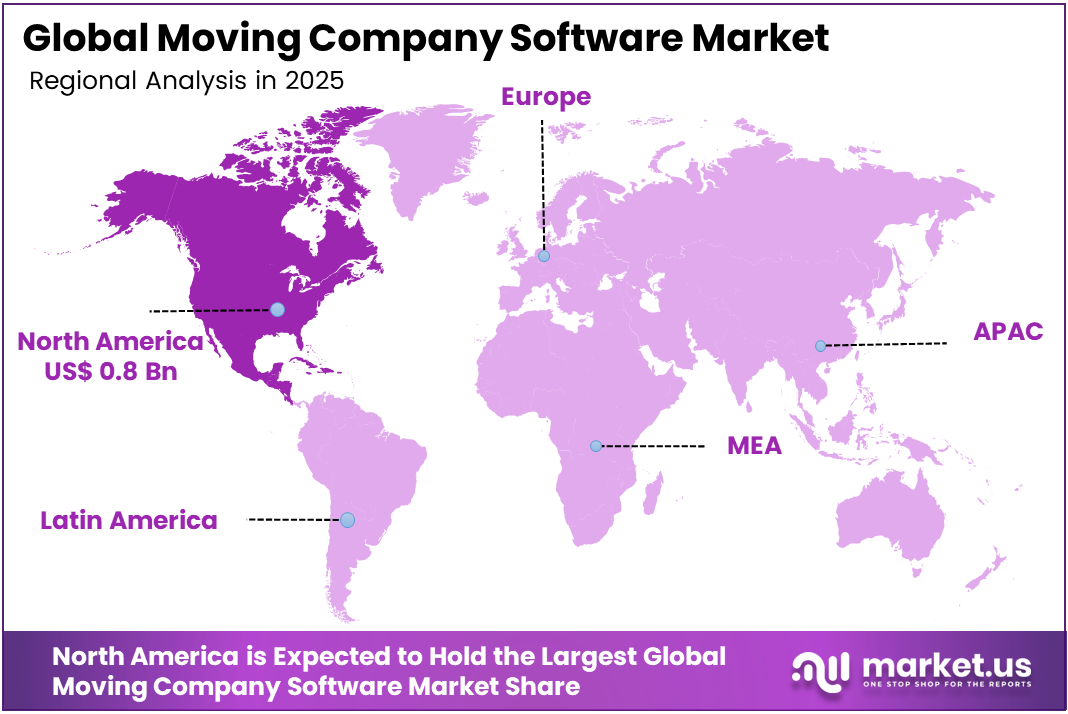
The Global Moving Company Software Market size is expected to be worth around USD 5.1 billion by 2035, from USD 1.8 billion in 2025, growing at a CAGR of 11.2% during the forecast period from 2026 to 2035. North America held a dominant market position, capturing more than a 47.1% share, holding USD 0.8 billion in revenue.
Moving Company Software refers to a digital platform used by moving businesses to manage bookings, quotes, dispatching, route planning, customer records, billing, and job updates. It helps companies reduce manual paperwork, improve crew coordination, track moves more clearly, and provide faster communication to customers throughout the relocation process.
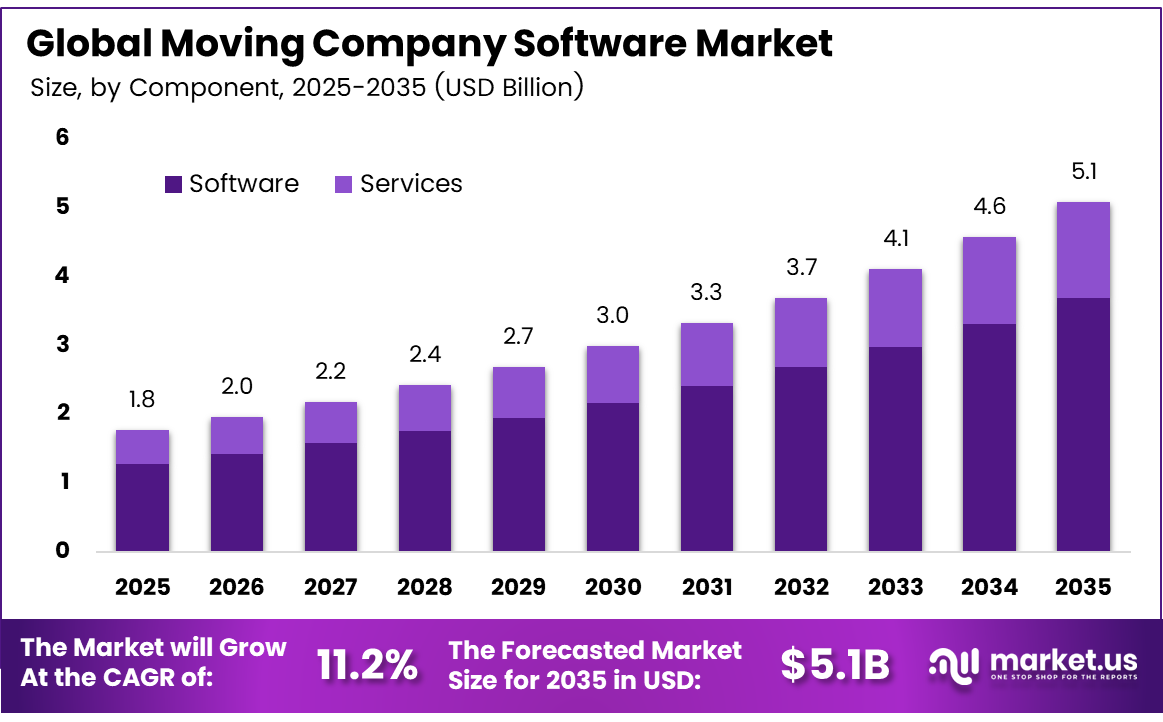
Top driving factors include rising urban migration, higher intercity relocations, and customer demand for real-time updates on one device. Moving firms are adopting software to track trucks, staff, fuel, and job schedules. This improves route and load planning, reduces missed appointments, and helps lower avoidable costs by well over 10%.
The market for Moving Company Software is driven by the shift toward digital relocation services, rising online bookings, and the need for better crew and route management. Moving firms are adopting these tools to manage quotes, dispatching, billing, inventories, and customer updates. Growth is also supported by demand for faster service, lower paperwork, improved tracking, and better operational control.
Demand is increasing as moving companies face labor shortages and higher claims ratios. Software helps standardize checklists, contracts, damage photos, and customer records in one workflow. Digital inventories and e-signatures now cover more than 70% of moves in many fleets, reducing paperwork and cutting booking time from days to a few minutes.
For instance, in February 2026, Service Fusion is emphasizing fleet and asset tracking in its product updates, addressing a key pain point for movers: knowing where trucks, teams, and high-value items are in real time. Operators report tighter control of overtime and fuel spend, with some cutting unbilled overtime by 15–25% after deployment.
Key Takeaway
- In 2025, the Software segment held a dominant market position, capturing a 72.5% share of the Global Moving Company Software Market.
- In 2025, the Cloud-based segment held a dominant market position, capturing a 68.3% share of the Global Moving Company Software Market.
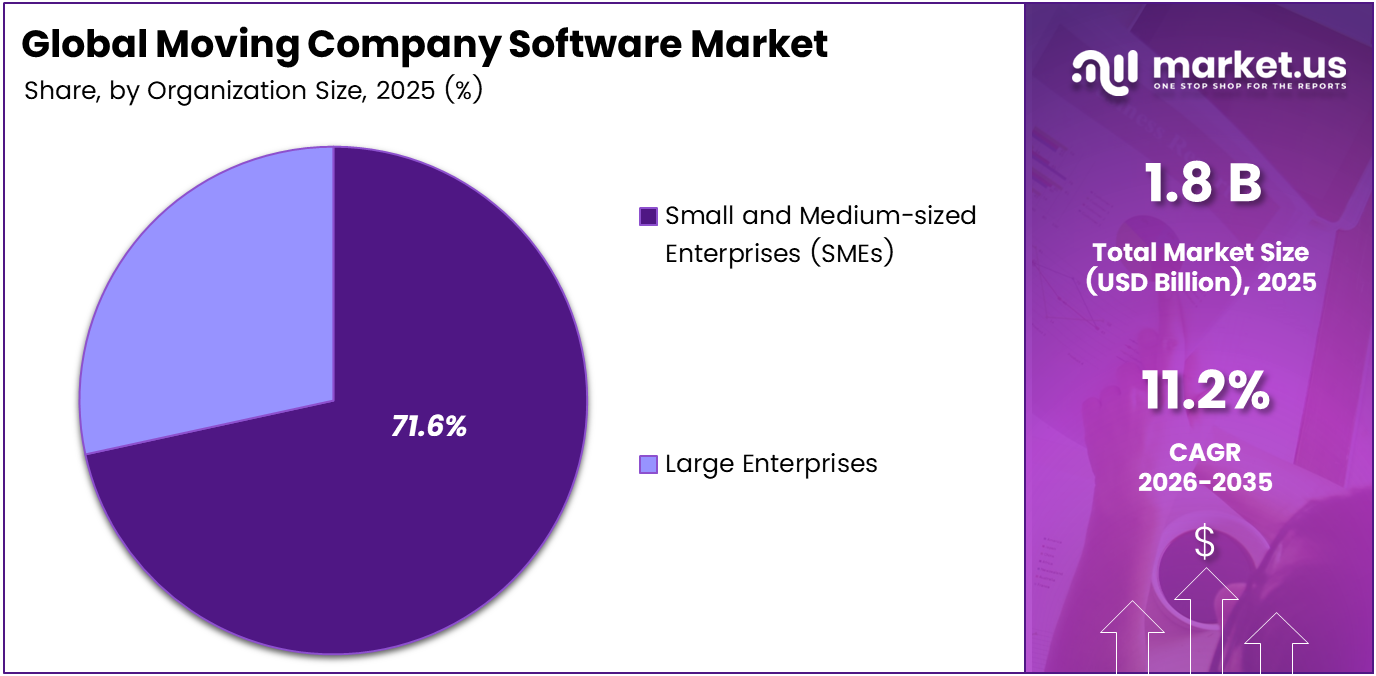
- In 2025, the Small and Medium-sized Enterprises (SMEs) segment held a dominant market position, capturing a 71.6% share of the Global Moving Company Software Market.
- In 2025, the Dispatching & Route Optimization segment held a dominant market position, capturing a 36.4% share of the Global Moving Company Software Market.
- In 2025, the Local Moving Companies segment held a dominant market position, capturing a 51.8% share of the Global Moving Company Software Market.
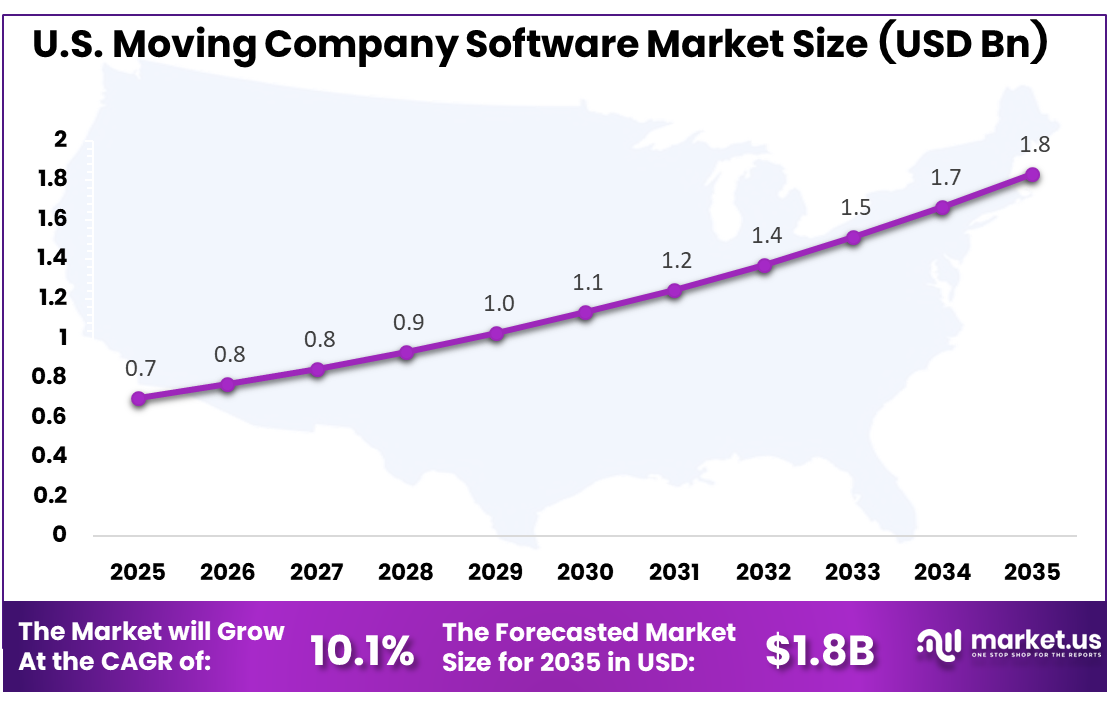
- The U.S. Moving Company Software Market was valued at USD 0.7 Billion in 2025, with a robust CAGR of 10.1%.
- In 2025, North America held a dominant market position in the Global Moving Company Software Market, capturing more than a 47.1% share.
Role of Generative AI
Generative AI is becoming useful in customer-facing tasks for moving companies. AI chat tools and virtual assistants help answer price questions, collect inventory details, and schedule surveys with limited staff support. AI-based virtual surveys can reduce survey and quoting time from over an hour to a few minutes.
On the back end, generative AI helps create draft quotes, contracts, emails, and customer summaries inside CRM systems. More than 70% of businesses testing generative tools report faster content production for customer communication. Moving software vendors are now adding similar features to improve sales, support, and follow-up activities.
Investment and Business Benefits
Investment opportunities are growing in AI-based pricing, video survey tools, and integration platforms that connect moving software with payroll, tax, and compliance systems. Investors are also focusing on cross-border documentation tools, where automation can cut manual checks by more than 30% and reduce customs-related delays by similar levels.
Business benefits are seen in fewer claims, better on-time arrivals, and stronger audit trails for every shipment and crew. Centralized dashboards help moving companies make faster decisions on fleet use and staff allocation. Branch performance can also be reviewed daily, instead of waiting for monthly spreadsheets and delayed reports.
Regional Analysis
In 2025, North America held a dominant market position in the Global Moving Company Software Market, capturing more than a 47.1% share, holding USD 0.8 billion in revenue. This dominance is due to the strong digital adoption among moving companies across North America. Firms are using software to manage online bookings, dispatching, route planning, customer communication, digital inventories, and billing from one platform. Growth is also supported by frequent residential relocations, high use of cloud-based tools, and customer demand for faster quotes, real-time tracking, and transparent service updates.
For instance, in December 2025, Service Fusion expanded its cloud field-service management suite in the U.S., offering job scheduling, fleet tracking, and invoicing for trades and some local movers. By helping operators replace spreadsheets with integrated workflows, it contributes to North America’s leading share of the moving-company software and services market.
U.S. Moving Company Software Market Size
The market for Moving Company Software within the U.S. is growing tremendously and is currently valued at USD 0.7 billion. The market has a projected CAGR of 10.1%. The market is growing due to the rising shift from manual moving operations to digital platforms. Moving firms are using software to manage online bookings, route planning, crew schedules, payments, customer updates, and digital inventories. Demand is also supported by higher relocation activity, stronger customer expectations, and the need to reduce service delays, paperwork, and operating errors.
For instance, in September 2025, PacSoft’s Move-IT platform continued to serve North American logistics and moving businesses with dispatch, inventory, and warehouse controls. By providing on-premise-style depth via modern cloud deployment, it supports complex U.S. relocation workflows and underpins the region’s advanced digitalisation of moving and storage management.
Key Regions and Countries
North America
- US
- Canada
Europe
- Germany
- France
- The UK
- Spain
- Italy
- Russia
- Netherlands
- Rest of Europe
Asia Pacific
- China
- Japan
- South Korea
- India
- Australia
- Singapore
- Thailand
- Vietnam
- Rest of APAC
Latin America
- Brazil
- Mexico
- Rest of Latin America
Middle East & Africa
- South Africa
- Saudi Arabia
- UAE
- Rest of MEA
Component Analysis
In 2025, the Software segment held a dominant market position, capturing a 72.5% share of the Global Moving Company Software Market. This dominance is due to the growing use of digital platforms for booking, dispatch, billing, inventory, and customer communication. Moving companies prefer software because it brings daily operations into one system and reduces the need for paper records, manual tracking, and scattered communication between teams.
Software also helps movers improve service quality by giving staff better control over jobs, crews, and customer updates. It supports faster quote handling, clear task assignment, and stronger visibility across each move. This makes it useful for both small operators and larger branch-based moving businesses.
For instance, in February 2026, MoverBase highlighted updates to its cloud platform that give office staff and crews a single place to manage leads, jobs, and follow-ups, helping smaller movers shift more work into software-driven workflows. The focus on ease of use shows how vendors are pushing deeper adoption of software across everyday moving operations.
Deployment Mode Analysis
In 2025, the Cloud-Based segment held a dominant market position, capturing a 68.3% share of the Global Moving Company Software Market. This dominance is due to the need for flexible access from offices, trucks, warehouses, and mobile devices. Cloud-based systems allow moving teams to update job details, track schedules, and communicate with customers in real time without depending on local servers or fixed workplace systems.
Cloud deployment is also preferred because it lowers the burden of IT management for moving companies. Updates, storage, and system access are easier to manage through hosted platforms. This helps operators scale their services, add users, and manage several locations with better control and lower technical complexity.
For instance, in December 2025, Jobber Now 2025 introduced new automation and routing features delivered entirely through its cloud platform, so users get updates without manual installs. This kind of continuous, remote delivery demonstrates why cloud-based deployment remains the preferred model for service software.
Organization Size Analysis
In 2025, the Small and Medium-sized Enterprises (SMEs) segment held a dominant market position, capturing a 71.6% share of the Global Moving Company Software Market. This dominance is due to the large number of small and medium-sized moving firms that need affordable tools to manage sales, crews, payments, and customer service. These companies use software to compete with larger providers and improve response time for online inquiries and service requests.
For small and medium-sized movers, software reduces dependence on spreadsheets, calls, and printed job sheets. It helps owners track leads, assign jobs, manage customer records, and review performance more clearly. This improves daily control and supports better service delivery without requiring large administrative teams.
For instance, in January 2026, Jobber positioned its platform as an all-in-one hub for smaller service businesses, bundling quoting, scheduling, invoicing, and payments into a single subscription. This focus on simplicity and predictable costs speaks directly to SMEs, encouraging more small operators to adopt professional-grade software.
Application Analysis
In 2025, the Dispatching & Route Optimization segment held a dominant market position, capturing a 36.4% share of the Global Moving Company Software Market. This dominance is due to the importance of route planning and crew scheduling in moving operations. Dispatching tools help companies assign the right staff, track vehicles, and manage job timing. Better routing reduces delays, improves arrival accuracy, and supports smoother coordination between drivers, movers, and office teams.
Route optimization is especially valuable because moving jobs often face traffic, customer timing changes, and last-minute crew adjustments. Software helps dispatchers react faster and plan more efficient daily schedules. This improves fleet use, reduces wasted travel, and gives customers clearer updates about their moving timeline.
For instance, in October 2025, SmartMoving highlighted improvements around scheduling and error reduction, including tools that help avoid conflicts in dispatch and invoicing. These capabilities show how moving platforms are sharpening dispatch and route-related functions to support tighter, more predictable operations.
End User Analysis
In 2025, the Local Moving Companies segment held a dominant market position, capturing a 51.8% share of the Global Moving Company Software Market. This dominance is due to the high number of local moving jobs handled across cities and nearby areas. Local movers need software to manage frequent bookings, short-distance routes, crew allocation, customer updates, and job records. These tools help them handle busy schedules with better accuracy.
Local moving companies also face strong competition from nearby service providers. Software helps them respond faster to inquiries, prepare quotes, manage digital inventories, and improve customer communication. As more customers book services online, local movers are adopting digital systems to remain organized and deliver reliable service.
For instance, in April 2026, Housecall Pro announced AI-driven tools that help residential service pros manage calls, dispatch, and marketing from one interface. While broader than moving alone, these updates show local operators how software can streamline customer communication and daily job flow, encouraging more local movers to digitize.
Key Market Segments
By Component
- Software
- Services
By Deployment Mode
- Cloud-based
- On-premises
By Organization Size
- Small and Medium-sized Enterprises (SMEs)
- Large Enterprises
By Application
- Dispatching & Route Optimization
- Invoicing & Billing
- Inventory & Tracking
- Customer & CRM Management
- Others
By End User
- Local Moving Companies
- Long-Distance & Interstate Movers
- International Moving Companies
- Others
Emerging Trends
A key trend in moving software is the shift from static forms to AI-led self-service journeys. Virtual video surveys now use computer vision and AI to identify items, estimate volume, and create inventory lists. Early users report 30–50% fewer on-site survey visits and fewer no-show appointments.
Another trend is stronger data integration across logistics platforms. Moving software is being linked with traffic systems, documentation tools, and wider transport networks. Digital adoption in logistics is crossing 60–70% in some markets, while customers now expect live tracking and proactive updates as a standard service.
Growth Factors
Growth is supported by the shift from phone-first service to digital-first customer behavior. Many customers now search, compare, and book moving services online before speaking to a salesperson. Studies show well over 70% of service buyers begin through search or marketplaces, pushing movers toward digital tools.
Small and mid-sized movers are adopting CRM systems, pricing engines, and online booking tools to stay competitive. These platforms reduce reliance on spreadsheets and printed job sheets. As customers expect faster quotes, easier scheduling, and better communication, moving company software is becoming a practical need rather than an optional system.
Market Dynamics
Drivers - Digital Transformation of Relocation Services
The market for Moving Company Software is driven by the shift from manual coordination to digital relocation management. Moving companies are using software to handle bookings, quotes, dispatching, customer records, billing, and crew schedules from one platform. This helps reduce paperwork and improve daily operational control.
Customer expectations are also changing as people want faster quotes, live updates, and clearer communication during the move. Digital tools help movers track jobs, manage routes, and share service updates more efficiently. This makes software adoption important for firms aiming to improve reliability and customer experience.
For instance, in January 2026, MoverBase continued to promote its cloud moving CRM as an all-in-one hub for quotes, scheduling, crew dispatch, and payments, helping smaller movers move away from spreadsheets and phone-based coordination. Its dashboard and centralized job views support more structured workflows, reinforcing the push toward fully digital relocation operations.
Restraint - Integration Gaps and Legacy Processes
Integration gaps remain a key restraint for moving companies that still depend on older tools, spreadsheets, and paper-based records. When new software does not connect smoothly with accounting, payment, fleet, or customer systems, teams may face duplicate work and slower adoption across daily operations.
Legacy processes also create resistance among staff who are used to manual workflows. Training, data transfer, and process changes can take time, especially for smaller movers with limited resources. This can delay full software adoption and reduce the value expected from digital relocation systems.
For instance, in January 2024, a Vonigo app update focused on general improvements and bug fixes rather than large new integrations. For multi-system operators that still depend on accounting or CRM platforms outside Vonigo, the pace of integration-oriented releases can feel slow, extending the life of parallel legacy processes.
Opportunities - AI and Automation in Moving Workflows
AI and automation create strong opportunities in pricing, virtual surveys, inventory capture, quote generation, and customer support. Moving companies can use these tools to reduce manual effort and improve the speed of booking. Automated workflows also help sales and operations teams manage more requests with better accuracy.
Automation can also improve dispatching, route planning, and crew allocation. Software can support faster decisions by organizing job details, traffic inputs, vehicle availability, and customer timing needs. This helps movers reduce delays, improve service planning, and provide more consistent updates throughout the relocation process.
For instance, in August 2025, Arborgold expanded e-invoice settings, letting users customize labels, add surcharge notes, and include tailored messages. This richer digital documentation lays the groundwork for automated pricing suggestions, smarter collections processes, and AI-based prompts that adapt communication to each customer’s history and service mix.
Challenges - Service Reliability
Service reliability remains a major challenge because moving operations depend on accurate timing, clear communication, and correct inventory details. Even with software, poor data entry or delayed updates can lead to missed appointments, customer complaints, and service disputes. Strong internal discipline is needed to gain full value.
Moving companies also face pressure from traffic delays, labor shortages, weather issues, and last-minute customer changes. Software can improve visibility, but it cannot remove every operational risk. Firms must combine digital tools with trained staff, clear processes, and responsive communication to maintain dependable service quality.
For instance, in August 2024, Movegistics emphasized a smarter and faster experience with version 5.0, implying that previous releases had limits in responsiveness and ease of use on mobile. For busy moving days, any lag in loading surveys or warehouse scans can hurt reliability, so improving performance is central to sustaining user trust.
Key Players Analysis
One of the leading players in January 2026, SmartMoving, a specialist moving-company platform, acquired Remedy Payments to pull embedded payments directly into its core suite, making card processing, deposits, and collections a profit lever rather than a back-office chore. This move tightens control over cash flow, improves close-rates, and deepens SmartMoving’s footprint with growth-oriented movers.
Top Key Players in the Market
- MoverBase
- MoveitPro
- Vonigo
- Movegistics
- Arborgold
- SmartMoving Software
- PacSoft (Move-IT)
- Jobber
- ServiceTitan
- Housecall Pro
- MarketBox
- Wintac
- Total Move Management
- Tekmetric AX
- Service Fusion
- Others
Recent Developments
- In May 2026, ServiceTitan continues to push horizontally from HVAC and plumbing into adjacent trades, including local logistics and moving. The company is investing heavily in AI-driven call-booking, pricebook optimization, and technician routing, giving larger movers a path to enterprise-grade analytics and multi-branch performance dashboards.
- In February 2026, MarketBox, a booking platform for mobile and home services, began expanding its route-optimization and multi-technician scheduling features. For moving companies using it as a light-weight layer, the appeal is simple: an integrated online booking journey that can lift digital conversion by 10–20% versus phone-only quoting.
Report Scope
| Report Features | Description |
|---|---|
| Market Value (2025) | USD 1.8 Billion |
| Forecast Revenue (2035) | USD 5.1 Billion |
| CAGR (2026-2035) | 11.2% |
| Base Year for Estimation | 2025 |
| Historic Period | 2020-2024 |
| Forecast Period | 2026-2035 |
| Report Coverage | Revenue Forecast, Market Dynamics, Competitive Landscape, Recent Developments |
| Segments Covered | By Component (Software, Services), By Deployment Mode (Cloud-based, On-premises), By Organization Size (Small and Medium-sized Enterprises (SMEs), Large Enterprises), By Application (Dispatching & Route Optimization, Invoicing & Billing, Inventory & Tracking, Customer & CRM Management, Others), By End User (Local Moving Companies, Long-Distance & Interstate Movers, International Moving Companies, Others) |
| Regional Analysis | North America (US and Canada), Europe (Germany, France, The UK, Spain, Italy, and Rest of Europe), Asia Pacific (China, Japan, South Korea, India, Australia, and Rest of APAC), Latin America (Brazil, Mexico, and Rest of Latin America), Middle East & Africa (GCC, South Africa, and Rest of MEA) |
| Competitive Landscape | MoverBase, MoveitPro, Vonigo, Movegistics, Arborgold, SmartMoving Software, PacSoft (Move-IT), Jobber, ServiceTitan, Housecall Pro, MarketBox, Wintac, Total Move Management, Tekmetric AX, Service Fusion, Others |
| Customization Scope | Customization at the segment and region/country levels will be provided. Moreover, customization can be tailored to the requirements. |
| Purchase Options | We have three licenses to opt for: Single User License, Multi-User License (Up to 5 Users), Corporate Use License (Unlimited Users and Printable PDF) |