Report Overview
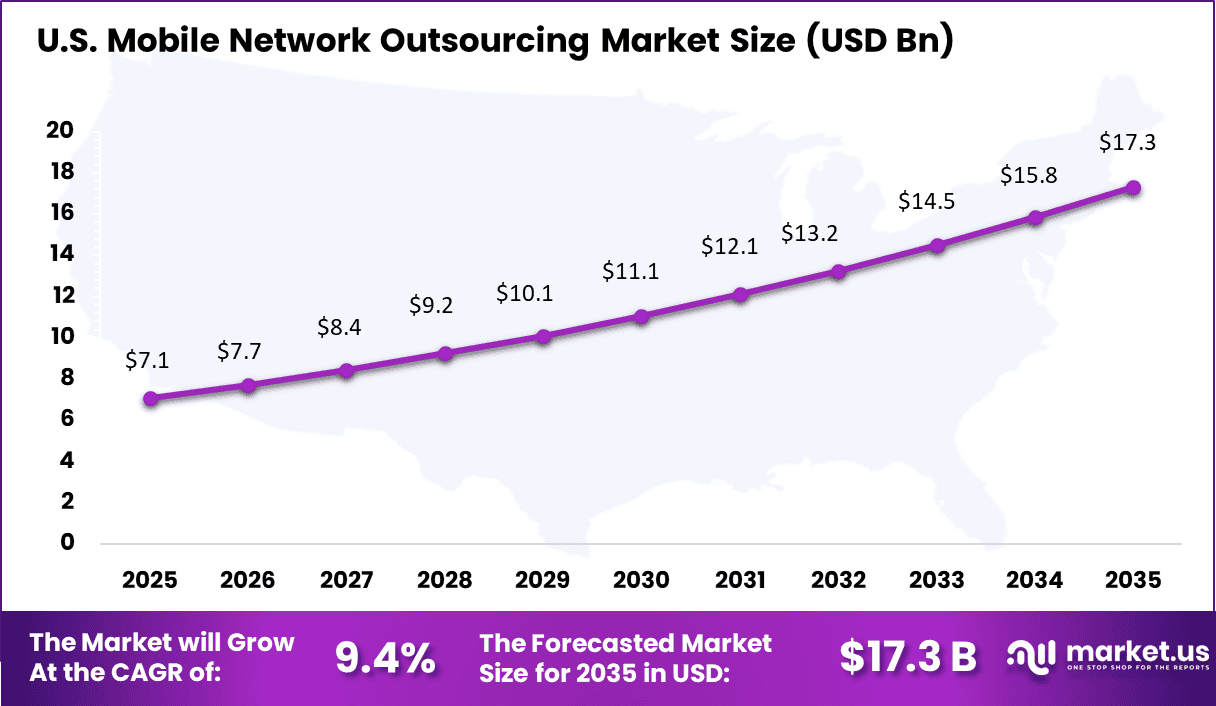
The Global Mobile Network Outsourcing Market generated USD 25.4 billion in 2025 and is predicted to register growth from USD 28.3 billion in 2026 to about USD 76.0 billion by 2035, recording a CAGR of 11.6% throughout the forecast span. In 2025, North America held a dominant market position, capturing more than a 34.2% share, with USD 8.67 billion in revenue.
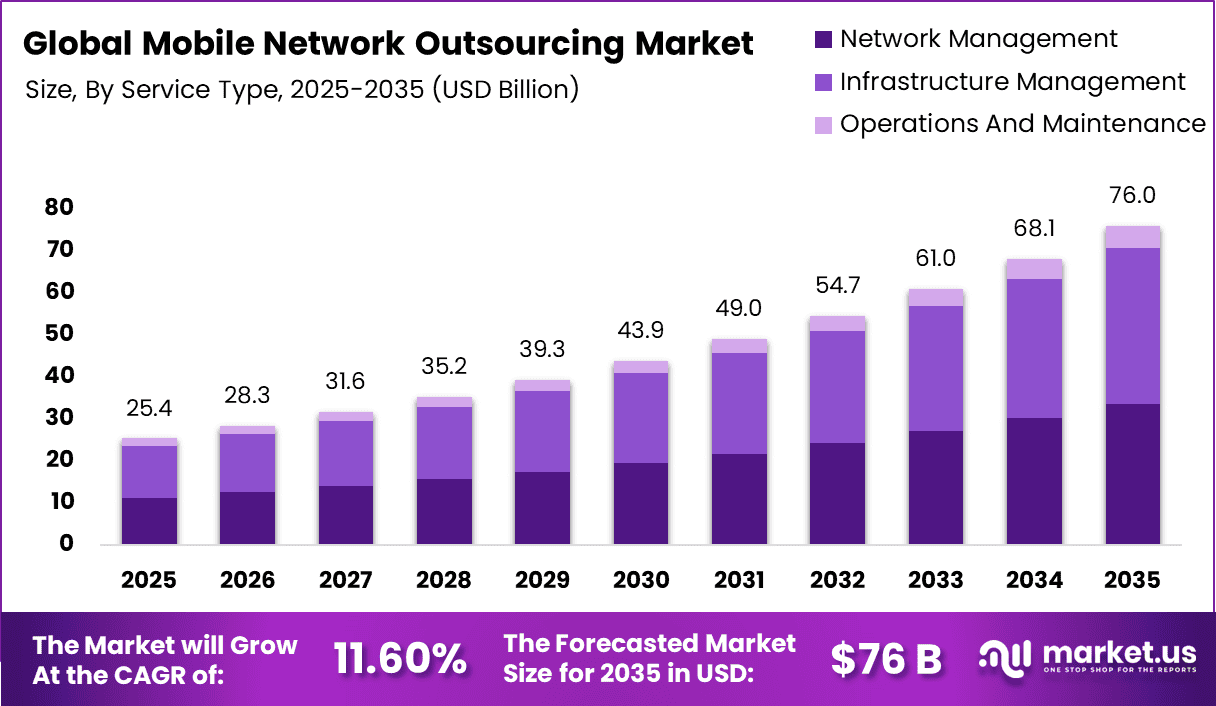
The Mobile Network Outsourcing Market involves telecom operators assigning network functions such as planning, deployment, maintenance, monitoring, optimization, and technical support to external service providers. Market growth is being driven by the increasing complexity of mobile networks, rising data traffic, wider coverage requirements, and the deployment of advanced technologies.
Outsourcing supports continuous network management, improves operational efficiency, and reduces pressure on internal technical teams. Demand is increasing among telecom operators seeking scalable support for network rollout and daily operations. This approach allows operators to improve service quality, expand network coverage, manage technical upgrades, and focus on customer experience and long-term network strategy.
Top Market Takeaways
- Network management commands 44.3% market share, providing proactive monitoring, fault resolution, and performance optimization across multi-vendor radio access networks.
- 4G or LTE networks capture 47.6%, enabling mature ecosystem outsourcing for capacity upgrades, small cell densification, and legacy modernization before 5G standalone.
- Cloud-based deployment dominates at 75.4%, delivering elastic scaling, virtualized RAN functions, and centralized orchestration without capex-heavy infrastructure.
- Telecom operators hold 53.2%, leveraging outsourcing for OpEx reduction, faster rollout cycles, and specialized expertise in spectrum refarming initiatives.
- North America drives 34.2% global value, with the U.S. market at USD 7.06 billion and 9.4% CAGR, fueled by T-Mobile and Verizon consolidation strategies.
By Service Type Analysis
Network management accounted for 44.3% of the Mobile Network Outsourcing Market. This segment leads because telecom operators rely on external partners to manage daily network operations, monitoring, and maintenance. Outsourcing these functions helps reduce operational complexity and allows operators to focus on service delivery and customer experience.
The segment is also supported by the need for continuous network performance optimization. As networks expand and become more complex, operators prefer managed services that ensure uptime, fault resolution, and efficient resource utilization across infrastructure.
By Network Type Analysis
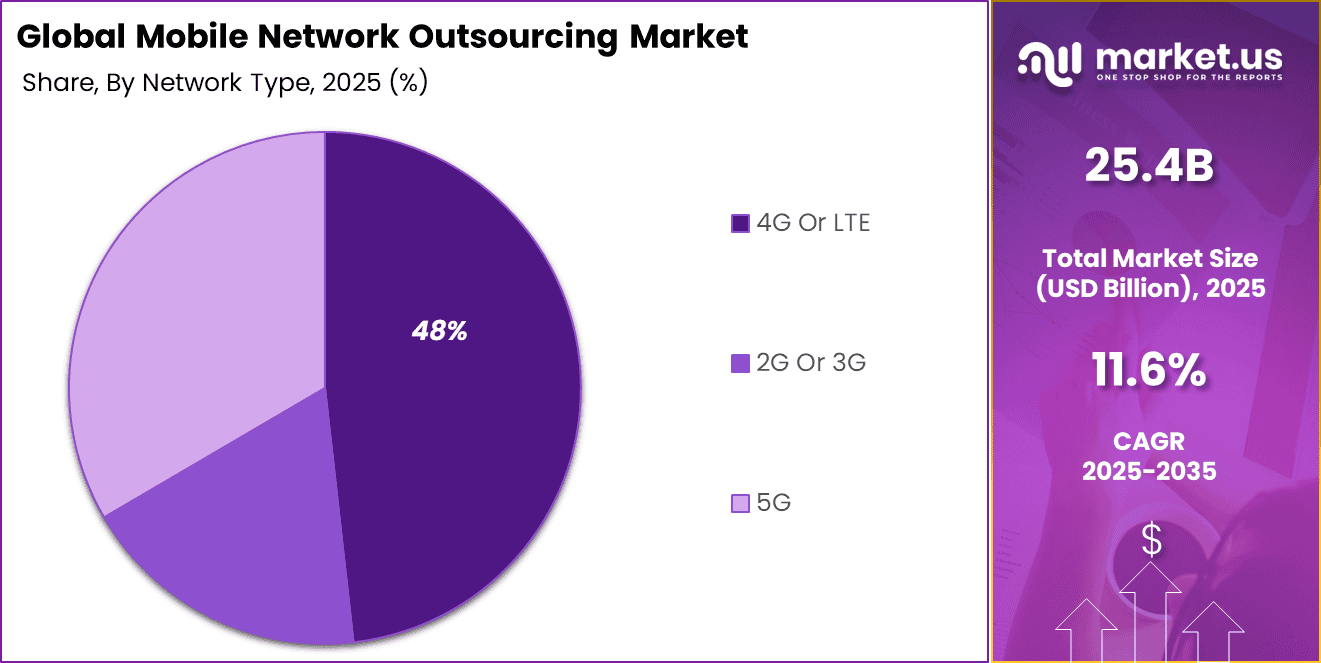
4G or LTE represented 48% of the market. This segment dominates because 4G networks still handle a large share of global mobile traffic. Telecom operators continue to maintain and optimize these networks while gradually expanding next-generation infrastructure.
The segment is driven by ongoing demand for stable and widespread connectivity. Even as newer technologies emerge, 4G remains essential for coverage and service reliability, which keeps outsourcing demand strong for network operations and maintenance.
By Deployment Model Analysis
Cloud-based deployment held 75.4% of the market. This segment leads because cloud platforms allow operators to manage network functions more flexibly and efficiently. It supports remote monitoring, centralized control, and scalable resource management across different network environments.
The segment is also supported by the shift toward virtualized and software-defined networks. Cloud-based models help operators reduce infrastructure costs and improve operational agility, which encourages broader adoption of outsourcing services.
By End User Analysis
Telecom operators accounted for 53.2% of the market. This segment dominates because telecom companies are the primary users of outsourcing services to manage complex network infrastructure. They rely on external expertise to handle operations, upgrades, and performance management.
The segment is driven by the need to improve efficiency while managing growing data demand. Telecom operators adopt outsourcing strategies to streamline operations, reduce costs, and focus on innovation and service expansion across competitive markets.
Key Market Segments
By Service Type
- Network Management
- Infrastructure Management
- Operations And Maintenance
By Network Type
- 2G Or 3G
- 4G Or LTE
- 5G
By Deployment Model
- On-Premises
- Cloud-Based
By End-User
- Telecom Operators
- Enterprises
- Government Agencies
Regional Analysis
North America accounted for 34.2% of the Mobile Network Outsourcing Market, reflecting strong reliance on external service providers for network management and operations. Telecom operators across the region increasingly outsource functions such as network maintenance, optimization, and infrastructure management to improve efficiency and reduce operational complexity.
The growing scale of mobile networks and continuous expansion of 5G infrastructure continue to encourage operators to adopt outsourcing models that support cost control and service quality.
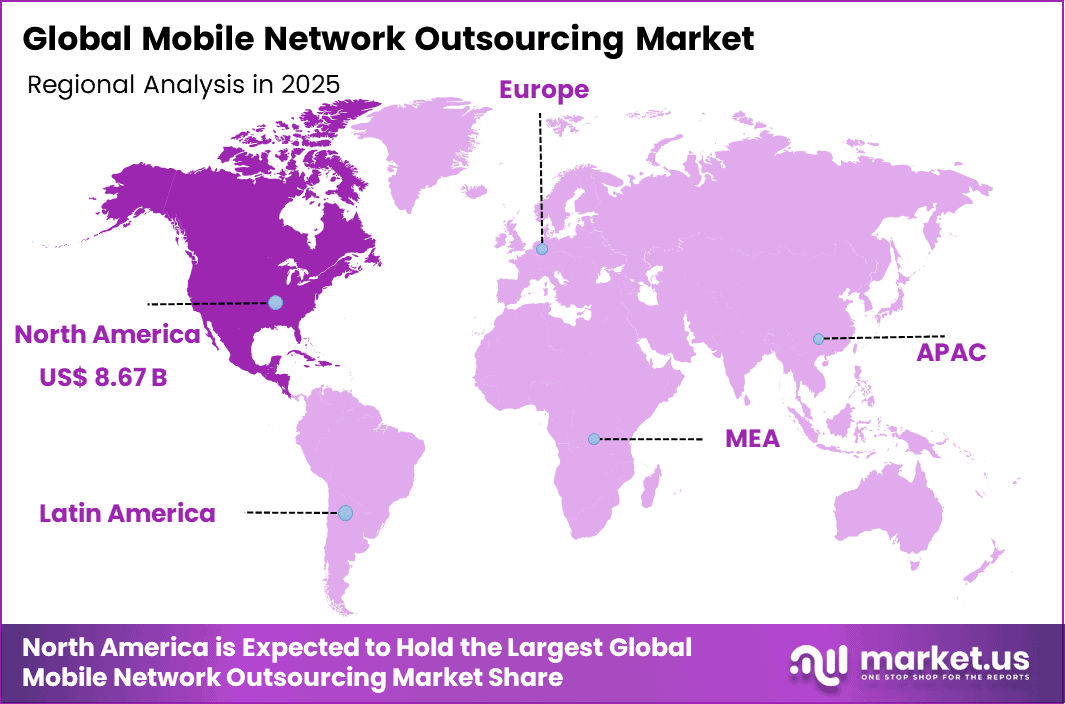
The U.S. generated about USD 7.06 billion within the regional market and is projected to expand at a CAGR of 9.4%. Telecom companies across the country continue to partner with outsourcing providers to manage large and complex network environments.
These services help operators focus on core business activities while ensuring network performance, upgrades, and scalability. As mobile data demand continues to rise and networks become more advanced, reliance on outsourcing solutions continues to grow steadily across the US market.
Key Regions and Countries
- North America
- US
- Canada
- Europe
- Germany
- France
- The UK
- Spain
- Italy
- Russia
- Netherlands
- Rest of Europe
- Asia Pacific
- China
- Japan
- South Korea
- India
- Australia
- Singapore
- Thailand
- Vietnam
- Rest of APAC
- Latin America
- Brazil
- Mexico
- Rest of Latin America
- Middle East & Africa
- South Africa
- Saudi Arabia
- UAE
- Rest of MEA
Drivers Impact Analysis
| Key Driver | Impact on CAGR Forecast (~%) | Geographic Relevance | Impact Timeline | Strategic Effect |
|---|---|---|---|---|
| Increasing need for cost optimization among telecom operators | +2.4% | North America, Europe, Asia Pacific | Short to Mid Term (2025–2031) | Reduces operational expenses |
| Rapid expansion of 5G and network infrastructure | +2.2% | Asia Pacific, North America, Europe | Mid Term (2026–2032) | Drives outsourcing of network management |
| Growing complexity of network operations and maintenance | +2.0% | Global | Mid Term (2026–2032) | Encourages specialized service providers |
| Rising focus on core business and strategic operations | +1.8% | Global | Mid to Long Term (2026–2035) | Increases outsourcing adoption |
| Increasing demand for managed services and automation | +1.7% | Global | Mid to Long Term (2026–2035) | Enhances operational efficiency |
Restraints Impact Analysis
| Key Restraint | Impact on CAGR Forecast (~%) | Geographic Relevance | Impact Timeline | Strategic Effect |
|---|---|---|---|---|
| Concerns over loss of control and service quality | -2.1% | North America, Europe | Short to Mid Term (2025–2031) | Limits outsourcing decisions |
| Data security and privacy risks | -1.9% | Global | Mid to Long Term (2026–2035) | Creates trust issues |
| Dependence on third-party vendors | -1.7% | Global | Mid Term (2026–2032) | Increases operational risk |
| Regulatory and compliance challenges | -1.6% | Europe, North America | Mid to Long Term (2026–2035) | Adds complexity |
| Integration challenges with existing network systems | -1.5% | Global | Mid Term (2026–2032) | Slows implementation |
Investor Type Impact Analysis
| Investor Type | Growth Sensitivity | Risk Exposure | Geographic Focus | Investment Outlook |
|---|---|---|---|---|
| Venture Capital Firms | Medium to High | Medium | US, Europe | Growth in telecom service innovation |
| Private Equity Firms | High | Medium | North America, Europe | Expansion in managed network services |
| Strategic Technology Investors | High | Medium | US, China, Japan | Strengthens telecom ecosystem |
| Corporate Venture Arms | Medium to High | Medium | Global | Supports outsourcing partnerships |
| Government and Infrastructure Funds | Medium | Low | Asia Pacific, Europe | Supports telecom infrastructure development |
Technology Enablement Analysis
| Technology Enabler | Impact on CAGR Forecast (~%) | Geographic Relevance | Impact Timeline | Implementation Significance |
|---|---|---|---|---|
| Automation and AI-driven network management tools | +2.5% | Global | Mid Term (2026–2032) | Improves operational efficiency |
| Cloud-based telecom infrastructure management | +2.3% | Global | Short to Mid Term (2025–2031) | Enables scalable services |
| Integration with 5G and next-generation networks | +2.1% | Asia Pacific, North America, Europe | Mid Term (2026–2032) | Enhances network capabilities |
| Remote monitoring and predictive maintenance systems | +1.9% | Global | Mid to Long Term (2026–2035) | Reduces downtime |
| Network virtualization and software-defined networking | +1.7% | Global | Mid Term (2026–2032) | Improves flexibility |
Key Challenges
- Managing service quality is a major challenge because mobile operators must ensure that outsourced network operations still meet performance, uptime, and customer expectations.
- Coordination between operators and outsourcing partners can be difficult because multiple teams may follow different processes, timelines, and technical standards.
- Data security and privacy remain important concerns because outsourced operations often involve access to sensitive network, customer, and traffic information.
- Dependence on third-party vendors can create risk because delays, weak service, or contract issues may affect network performance and business continuity.
- Integration with legacy systems is another challenge because many telecom operators still use older network infrastructure that is not easy to manage through outsourced models.
Emerging Trends
A key trend in the Mobile Network Outsourcing market is the increasing shift toward managed network operations where service providers handle planning, deployment, and maintenance of mobile infrastructure. Telecom operators are focusing more on core business areas such as customer experience and service innovation, while outsourcing technical network functions to specialized partners.
This approach allows better operational efficiency and ensures networks are managed with updated tools and expertise. The trend reflects a move toward more flexible operating models where network performance is maintained without heavy internal resource management.
Growth Factors
The growing complexity of mobile networks is supporting the expansion of outsourcing services. With the rise of advanced connectivity technologies and increasing data traffic, managing network operations internally can become resource-intensive. Outsourcing helps operators maintain network quality while reducing operational burden.
It also allows faster upgrades and smoother handling of network demands. At the same time, the need to optimize costs and improve service reliability encourages telecom operators to adopt outsourcing strategies that support efficient and scalable network management.
Competitive Analysis
The competitive landscape of the Mobile Network Outsourcing market includes telecom operators, network equipment providers, and IT service companies that support network planning, operations, maintenance, and modernization.
Samsung Electronics Co. Ltd., Verizon Communications Inc., AT&T Inc., Huawei Technologies Co. Ltd., Cisco Systems Inc., Telefonaktiebolaget LM Ericsson, NEC Corporation, and ZTE Corporation hold strong positions because they bring telecom infrastructure expertise and wide operational reach. These companies help mobile operators improve network performance, manage costs, and support growing data traffic.
IT and consulting firms such as Accenture plc, IBM Corporation, NTT DATA Corporation, Tata Consultancy Services Limited, Fujitsu Limited, Capgemini SE, Cognizant Technology Solutions Corporation, Infosys Limited, Kyndryl Holdings Inc., DXC Technology Company, HCL Technologies Limited, Wipro Limited, Tech Mahindra Limited, Amdocs Limited, and Unisys Corporation add strong competition through managed services, cloud integration, analytics, and system support.
The market is shaped by service quality, automation capability, technical expertise, and the ability to manage complex mobile network environments efficiently.
Top Key Players in the Market
- Samsung Electronics Co. Ltd.
- Verizon Communications Inc.
- AT&T Inc.
- Huawei Technologies Co. Ltd.
- Accenture plc
- IBM Corporation
- Cisco Systems Inc.
- NTT DATA Corporation
- Tata Consultancy Services Limited
- Fujitsu Limited
- Telefonaktiebolaget LM Ericsson
- Capgemini SE
- NEC Corporation
- Cognizant Technology Solutions Corporation
- Infosys Limited
- ZTE Corporation
- Kyndryl Holdings Inc.
- DXC Technology Company
- HCL Technologies Limited
- Wipro Limited
- Tech Mahindra Limited
- Amdocs Limited
- Unisys Corporation
- Others
Future Outlook
The future outlook for the Mobile Network Outsourcing Market looks positive as telecom operators seek outside support to manage more complex 5G networks, control operating costs, and improve service quality. Current industry guidance shows that managed services are moving beyond basic outsourcing toward end-to-end operations supported by AI, automation, analytics, and multi-vendor management, while operators are also investing more in 5G standalone, cloud, network slicing, and autonomous network frameworks. As mobile networks become harder to run internally and customer expectations stay high, demand for outsourcing services is expected to grow steadily in the coming years.
Recent Developments
- In February 2026, Verizon awarded HCLTech a $1.2B multi-year network outsourcing deal for 5G core operations across 100M+ subscribers featuring L4 autonomous driving networks. Private 5G slicing platform served 5K+ enterprises.
- In March 2026, Samsung Networks secured a $2.5B Verizon 5G-A RAN outsourcing contract spanning 6K+ cell sites with vRAN automation processing 10Tbps+ traffic across the US Northeast. AI-RAN optimization reduced energy consumption by 40%.
Report Scope
| Report Features | Description |
|---|---|
| Market Value (2025) | USD 25.4 Billion |
| Forecast Revenue (2035) | USD 76.0 Billion |
| CAGR(2025-2035) | 11.6% |
| Base Year for Estimation | 2024 |
| Historic Period | 2020-2024 |
| Forecast Period | 2025-2035 |
| Report Coverage | Revenue forecast, AI impact on Market trends, Share Insights, Company ranking, competitive landscape, Recent Developments, Market Dynamics and Emerging Trends |
| Segments Covered | By Service Type (Network Management, Infrastructure Management, Operations And Maintenance), By Network Type (2G Or 3G, 4G Or LTE, 5G), By Deployment Model (On-Premises, Cloud-Based), By End-User (Telecom Operators, Enterprises, Government Agencies) |
| Regional Analysis | North America – US, Canada; Europe – Germany, France, The UK, Spain, Italy, Russia, Netherlands, Rest of Europe; Asia Pacific – China, Japan, South Korea, India, New Zealand, Singapore, Thailand, Vietnam, Rest of Latin America; Latin America – Brazil, Mexico, Rest of Latin America; Middle East & Africa – South Africa, Saudi Arabia, UAE, Rest of MEA |
| Competitive Landscape | Samsung Electronics Co. Ltd., Verizon Communications Inc., AT&T Inc., Huawei Technologies Co. Ltd., Accenture plc, IBM Corporation, Cisco Systems Inc., NTT DATA Corporation, Tata Consultancy Services Limited, Fujitsu Limited, Telefonaktiebolaget LM Ericsson, Capgemini SE, NEC Corporation, Cognizant Technology Solutions Corporation, Infosys Limited, ZTE Corporation, Kyndryl Holdings Inc., DXC Technology Company, HCL Technologies Limited, Wipro Limited, Tech Mahindra Limited, Amdocs Limited, Unisys Corporation, Others |
| Customization Scope | Customization for segments, region/country-level will be provided. Moreover, additional customization can be done based on the requirements. |
| Purchase Options | We have three licenses to opt for: Single User License, Multi-User License (Up to 5 Users), Corporate Use License (Unlimited Users and Printable PDF) |