


Market Overview
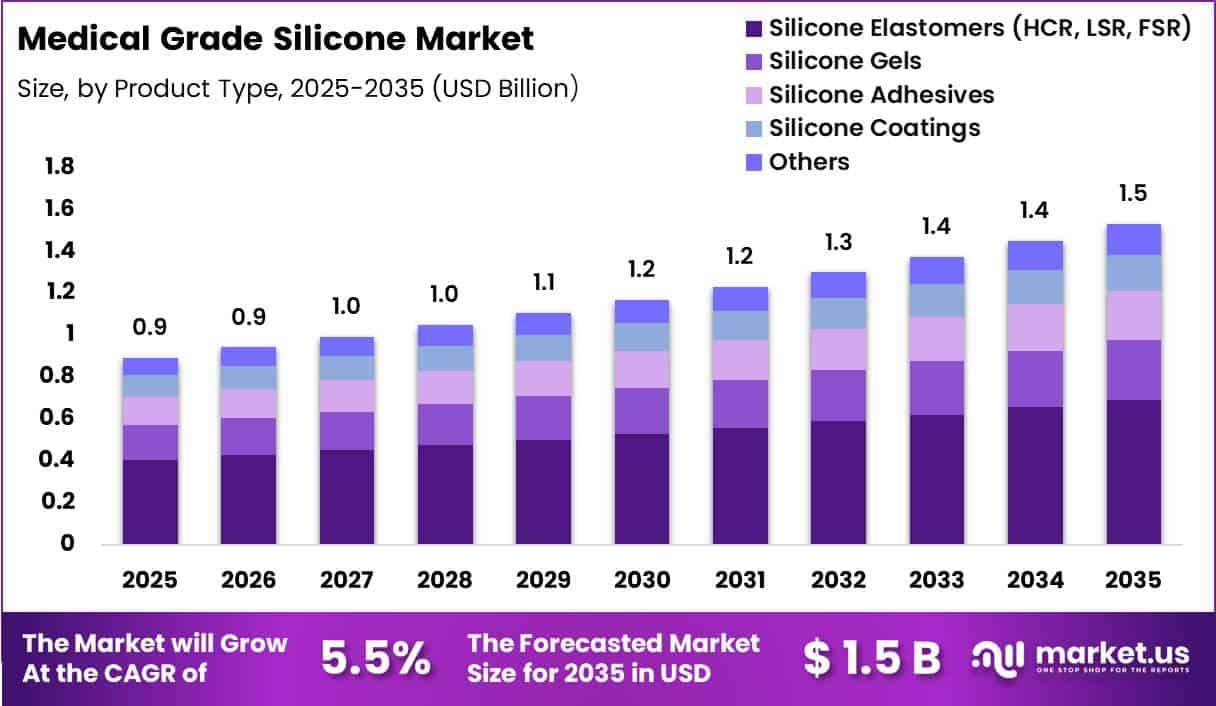
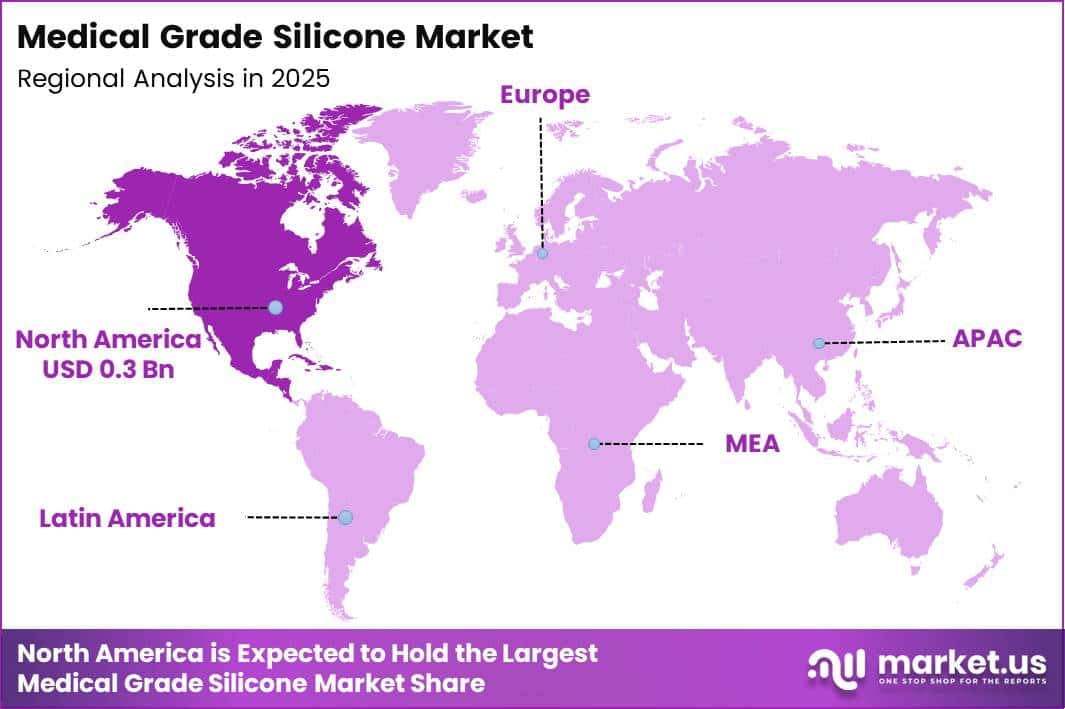
Global Medical Grade Silicone Market size is expected to be worth around US$ 1.5 Billion by 2035 from US$ 0.9 Billion in 2025, growing at a CAGR of 5.5% during the forecast period from 2026 to 2035. In 2025, North America led the market, achieving over 38.5% share with a revenue of US$ 0.3 Billion.
Medical-grade silicone is a high-performance elastomer widely used in healthcare because of its excellent biocompatibility, chemical stability, flexibility, and resistance to extreme temperatures. It is a critical material for manufacturing long-term and short-term implantable devices, catheters, wound care products, respiratory masks, prosthetics, tubing, syringes, and wearable medical technologies.
Regulatory agencies such as the U.S. Food and Drug Administration (FDA) require medical devices made from silicone and other patient-contacting materials to undergo rigorous biological safety evaluations in accordance with recognized standards, including ISO 10993, before market approval.
The growing burden of chronic diseases, rising surgical procedures, expanding elderly population, and increasing demand for minimally invasive treatments are supporting the adoption of medical-grade silicone across the healthcare sector.
According to the World Health Organization (WHO), noncommunicable diseases account for approximately 43 million deaths annually, representing about 75% of all non-pandemic deaths worldwide, driving sustained demand for advanced medical devices and implants.
Additionally, the FDA currently recognizes the latest ISO 10993-1:2025 standard for biological safety evaluation of medical devices, reinforcing stringent quality and safety requirements for materials used in patient-contact applications.
Medical-grade silicone also offers high durability, sterilization compatibility, and long service life, making it suitable for repeated clinical use while maintaining patient safety. Continuous innovation in implantable devices, wearable health monitoring systems, and advanced drug-delivery technologies is expected to further expand its applications.
Supported by evolving regulatory standards, technological advancements, and increasing healthcare investments, medical-grade silicone remains an essential material for the next generation of safe and reliable medical devices.
Key Takeaways
- Market Size: Global Medical Grade Silicone Market size is expected to be worth around US$ 1.5 Billion by 2035 from US$ 0.9 Billion in 2025.
- Market Share: The market is growing at a CAGR of 5.5% during the forecast period from 2026 to 2035.
- Product Type: The Silicone Elastomers (HCR, LSR, FSR) segment dominated the medical grade silicone market in 2025, accounting for 45.3% of the total market share.
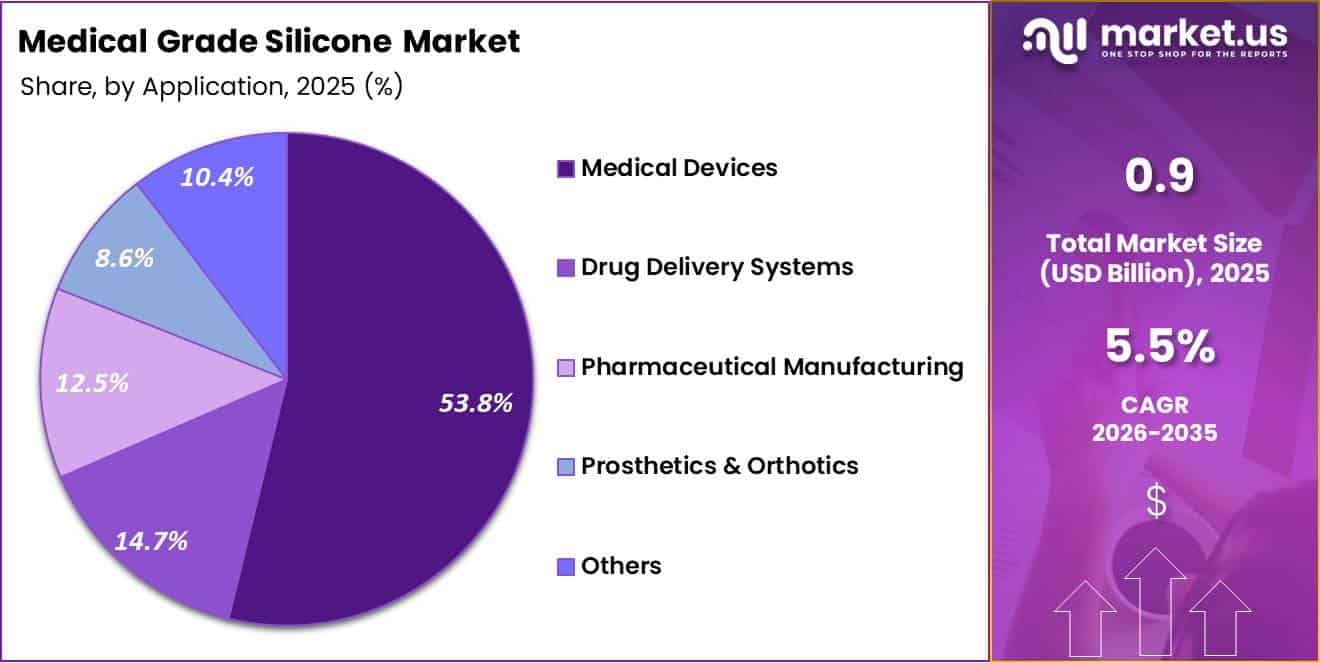
- Application: The Medical Devices segment led the medical grade silicone market in 2025 with a 53.8% market share, reflecting the material’s critical role in manufacturing high-performance healthcare products.
- End User: The Medical Device Manufacturers segment dominated the medical grade silicone market in 2025, accounting for 58.4% of the overall market share.
- Regional Analysis: In 2025, North America led the market, achieving over 38.5% share with a revenue of US$ 0.3 Billion.
Product Type Analysis
Silicone Elastomers (HCR, LSR, FSR) segment dominated the medical grade silicone market in 2025.
The Silicone Elastomers (HCR, LSR, FSR) segment dominated the medical grade silicone market in 2025, accounting for 45.3% of the total market share. Their leadership is attributed to outstanding flexibility, biocompatibility, chemical stability, and resistance to sterilization methods such as steam, gamma radiation, and ethylene oxide.
High Consistency Rubber (HCR), Liquid Silicone Rubber (LSR), and Fluorosilicone Rubber (FSR) are widely used in catheters, seals, valves, respiratory masks, implantable components, and wearable medical devices because they maintain mechanical performance under demanding clinical conditions. The growing production of minimally invasive devices and long-term implantable products continues to strengthen demand for silicone elastomers.
Silicone Gels represented 18.7% of the market, supported by increasing use in wound care, scar management, and soft tissue applications due to their cushioning and skin-friendly characteristics. Silicone Adhesives captured 15.2%, benefiting from rising demand for secure skin-contact products, wearable sensors, and transdermal patches.
Silicone Coatings accounted for 11.4%, driven by their ability to reduce friction, improve lubricity, and enhance the durability of medical devices. The Others segment held 9.4%, including specialized silicone materials used in niche healthcare applications, advanced diagnostics, and customized biomedical products, supporting continued market diversification and product innovation.
Application Analysis
Medical Devices segment led the medical grade silicone market.
The Medical Devices segment led the medical grade silicone market in 2025 with a 53.8% market share, reflecting the material’s critical role in manufacturing high-performance healthcare products.
Medical grade silicone is extensively utilized in catheters, tubing, respiratory equipment, surgical instruments, implants, seals, gaskets, and wearable monitoring devices because of its superior biocompatibility, flexibility, durability, and sterilization resistance. The rapid expansion of minimally invasive procedures, home healthcare equipment, and implantable technologies has further accelerated demand within this segment.
Drug Delivery Systems accounted for 14.7% of the market, supported by growing adoption of silicone in infusion pumps, transdermal systems, syringe components, and controlled-release devices that require precise performance and chemical stability.
Pharmaceutical Manufacturing represented 12.5%, driven by the use of silicone tubing, seals, stoppers, and processing components in sterile manufacturing environments. Others held 10.4%, comprising laboratory consumables, diagnostic equipment, dental products, and specialized healthcare applications requiring medical-grade materials.
Prosthetics & Orthotics captured 8.6%, benefiting from silicone’s comfort, flexibility, durability, and skin compatibility in prosthetic liners, orthotic supports, and customized rehabilitation products. Continuous advancements in healthcare technologies are expected to sustain demand across all application segments.
End User Analysis
Medical Device Manufacturers segment dominated the medical grade silicone market in 2025.
The Medical Device Manufacturers segment dominated the medical grade silicone market in 2025, accounting for 58.4% of the overall market share. The segment’s leadership is driven by the extensive integration of medical grade silicone into the production of catheters, implants, tubing, respiratory devices, surgical instruments, wearable sensors, and diagnostic equipment.
Manufacturers increasingly prefer silicone because of its excellent biocompatibility, thermal stability, flexibility, chemical resistance, and compatibility with multiple sterilization processes. Rising investments in advanced medical technologies, minimally invasive devices, and connected healthcare products continue to strengthen demand from this end-user group.
Hospitals represent another significant segment, supported by the continuous use of silicone-based medical consumables, surgical products, drainage systems, wound care materials, and respiratory equipment in patient care.
Pharmaceutical Companies also contribute substantially through the adoption of silicone components in drug manufacturing systems, filling equipment, pharmaceutical packaging, stoppers, seals, and drug delivery devices that require contamination-free processing and regulatory compliance.
The Others segment includes research laboratories, contract manufacturing organizations, academic institutions, and specialty healthcare providers utilizing medical grade silicone in customized biomedical applications, laboratory equipment, and innovative therapeutic technologies. Collectively, these end users continue to drive technological innovation, product quality improvements, and long-term market expansion.
Key Market Segments
By Product Type
- Silicone Elastomers (HCR, LSR, FSR)
- Silicone Gels
- Silicone Adhesives
- Silicone Coatings
- Others
By Application
- Medical Devices
- Drug Delivery Systems
- Pharmaceutical Manufacturing
- Prosthetics & Orthotics
- Others
By End User
- Medical Device Manufacturers
- Hospitals
- Pharmaceutical Companies
- Others
Drivers
Chronic Disease Device Load Lifting Silicone Demand in Medical Devices.
The rising global burden of noncommunicable diseases (NCDs) is expanding long term dependence on medical devices that use silicone based components. WHO estimates that NCDs caused at least 43 million deaths in 2021 and account for about 75% of non pandemic mortality, with cardiovascular diseases contributing ~19 million deaths and diabetes related conditions exceeding 2 million deaths annually.
This large and growing patient population relies on recurring use medical devices rather than one time interventions, increasing demand for durable, biocompatible materials such as medical grade silicone. It is widely used in tubing, seals, catheters, respiratory interfaces, implantable leads, and wearable device components due to its flexibility, thermal stability, and long term biocompatibility.
In India, expanding national screening and treatment programs further reinforce this trend. Government initiatives have already covered tens of millions of diabetes and hypertension patients, with large scale screening programs targeting adults aged 30+, significantly increasing downstream demand for diagnostic devices, infusion systems, and monitoring accessories that incorporate silicone components.
Overall, chronic disease management is shifting silicone demand from episodic, capital equipment linked usage toward recurring consumables and semi durable device components, improving revenue stability for manufacturers that meet stringent medical safety, sterilization, and traceability requirements.
| Driver | (~) % Impact on CAGR Forecast | Geographic Relevance | Impact Timeline |
|---|---|---|---|
| Chronic disease device load lifting tubing, seals, catheters, and wearables silicone demand | +2.1% | North America core, EU, China, India, developed APAC | Medium term (2-4 years) |
| Aging and assistive-care expansion raising prosthetic, hearing, respiratory, and skin-contact component usage | +1.7% | EU, Japan, North America, South Korea, urban China | Medium term (2-4 years) |
| FDA QMSR and ISO-aligned compliance favoring qualified silicone suppliers with clean validation packages | +1.3% | U.S. core, EU export base, APAC export corridors | Short term (≤ 2 years) |
| Outpatient and home-care migration increasing need for biocompatible, sterilizable, soft-touch device materials | +1.5% | U.S. core, EU, Australia, high-income APAC | Short term (≤ 2 years) |
| Skin-contact biocompatibility pathways accelerating low-risk silicone component commercialization | +1.0% | U.S. core, EU follow-through, global OEM supply chains | Short term (≤ 2 years) |
| Premiumization toward long-life implantable and high-purity specialty grades improving value capture per kg | +1.4% | North America, Western Europe, Japan, advanced medtech clusters in APAC | Long term (≥ 4 years) |
Challenges
Regulatory Biocompatibility Tightening in Medical Grade Silicone.
Rising biocompatibility expectations for polymers and elastomers in patient contact applications are increasing regulatory complexity for medical grade silicone products. Under FDA frameworks aligned with ISO 10993-1, manufacturers must now provide more detailed risk based biocompatibility evidence, including material characterization, device history documentation, and structured safety justifications rather than relying on standardized test matrices alone.
Even for well established materials like silicone, which is broadly considered low risk for skin and tissue contact, companies must maintain extensive documentation covering hypersensitivity data, chemical composition, additives, and post market surveillance.
This has increased submission complexity, expanding regulatory dossiers by 20–40% and adding roughly 3–6 months to development timelines for devices such as tubing, catheters, and implantable components. For OEMs and compounders, these requirements raise non recurring engineering and compliance costs, often by 1–2% of project budgets, while also increasing internal quality and regulatory staffing needs.
Overall, tighter biocompatibility oversight slows product development cycles and raises compliance burdens, modestly constraining innovation speed and contributing to a measurable drag on growth in silicone based medical device markets, particularly in highly regulated regions like the US and EU.
| Challenge | (~) % CAGR Friction Drag | Geographic Relevance | Mitigation Horizon |
|---|---|---|---|
| Regulatory biocompatibility tightening | -1.2% | U.S., EU, high-reg markets | Medium term (2-4 years) |
| Cyclic siloxane restriction compliance | -0.8% | EU, UK, affiliated markets | Long term (≥ 4 years) |
| Quality & contamination control | -1.0% | Global manufacturing hubs | Medium term (2-4 years) |
| Skilled processing talent gap | -0.7% | North America, EU, APAC | Long term (≥ 4 years) |
| Supply chain & sterilization capacity | -0.9% | Global, especially APAC | Medium term (2-4 years) |
| OEM validation & postmarket data load | -0.6% | U.S., EU device clusters | Short term (≤ 2 years) |
Restraints
Competition from Lower Cost Alternative Polymers in Medical Devices.
Competition from lower cost polymers is a steady restraint on medical grade silicone demand, especially in non implantable, short term, and disposable applications where silicone’s full biocompatibility and durability advantages are not strictly required.
In these segments, materials such as thermoplastic elastomers (TPEs), polyurethanes, and other advanced plastics are increasingly substituted. These alternatives can be 15–30% cheaper in raw material and processing costs while still meeting baseline regulatory and performance requirements, making them attractive for cost sensitive product lines like consumer health devices, basic tubing, and disposable components.
Under ongoing healthcare cost pressures, hospitals and procurement teams are prioritizing total cost of ownership, encouraging OEMs to redesign devices and replace silicone components where feasible. This substitution can reduce device level bill of materials costs by 2–5% in certain applications.
For silicone manufacturers, this leads to margin pressure in commoditized segments, with price competition and occasional discounting of 5–10% in tender driven markets. While high end implantable and life support applications remain strongly silicone dependent, gradual substitution in peripheral and emerging market applications limits volume growth.
Overall, this material migration away from silicone in selected use cases acts as a moderate structural drag on long term market expansion, particularly in cost driven healthcare environments.
| Restraint | (~) % Impact on CAGR Forecast | Geographic Relevance | Impact Timeline |
|---|---|---|---|
| Tightening device regulatory burden | -1.2% | North America core, EU | Medium term |
| High-purity silicone raw material volatility | -1.0% | EU, APAC corridors, North America | Short to medium term |
| Supply chain concentration in limited producers | -0.8% | APAC corridors, global OEMs | Medium term |
| Escalating compliance and quality system costs | -0.7% | North America core, EU, Japan | Long term |
| Competition from lower-cost alternative polymers | -0.6% | EU, APAC corridors, Latin America | Long term |
| Capital intensity of implantable-grade capacity expansion | -0.5% | North America core, EU, China | Medium term |
Opportunity
Value Based Device OEM Partnerships in Medical Grade Silicone.
This opportunity involves shifting medical grade silicone suppliers from commodity material vendors to strategic partners for device OEMs operating under value based care and reimbursement models in the US and Europe. Instead of competing primarily on price per kilogram, suppliers would co develop higher performance components such as catheters, tubing, wound care systems, and implantable devices.
By optimizing design and material performance, these collaborations can reduce device failure rates by 15–25%, extend product lifespan by 20–30%, and lower complication risks, helping OEMs improve procedure level margins by 200–300 basis points. This also strengthens OEM positioning in reimbursement linked environments where outcomes increasingly influence pricing and adoption.
If even 10–15% of silicone intensive OEM procurement shifts toward long term, outcome linked partnerships with embedded design and validation services, the addressable solutions oriented market could expand by 20–25% above baseline materials demand. This would translate into meaningful revenue uplift through higher value contracts, longer agreement durations (3 to 7 years), and greater integration into OEM R&D cycles.
Overall, this represents a transition from transactional material supply to integrated value based collaboration, but remains an emerging opportunity as most silicone suppliers today still operate primarily on cost, compliance, and basic material performance metrics.
| Opportunity | (~) % Potential CAGR Upside | Geographic Relevance | Execution Window |
|---|---|---|---|
| Value-based device OEM partnerships | +2.3% | North America, EU, select APAC | Medium term (2-4 years) |
| Chronic disease home-care silicone ecosystems | +2.0% | North America core, EU, APAC urban | Medium term (2-4 years) |
| Low-cost implantable silicone platforms for emerging markets | +2.7% | APAC emerging, LATAM, MEA | Long term (≥ 4 years) |
| Regulatory-fast-track skin-contact silicone portfolios | +1.8% | North America, EU | Short term (≤ 2 years) |
| Surgical throughput expansion and procedure-linked consumables | +2.5% | Global; HICs first | Medium term (2-4 years) |
| Digital wound-care and scar management monetization | +1.9% | North America, EU, APAC tier-1 | Short term (≤ 2 years) |
Regional Analysis
North America led the Medical Grade Silicone Market in 2025.
In 2025, North America led the Medical Grade Silicone Market, accounting for over 38.5% of global revenue with a market value of US$ 0.3 billion. The region’s dominance is driven by its well-established healthcare infrastructure, advanced medical device manufacturing capabilities, and strong demand for high-performance silicone materials used in implantable devices, catheters, prosthetics, wound care products, and diagnostic equipment.
The United States remains the largest contributor, supported by rising volumes of minimally invasive surgeries, increasing adoption of wearable and implantable medical technologies, and continuous investments in healthcare innovation. Stringent regulatory standards for medical materials have also accelerated the use of premium biocompatible silicone across a wide range of clinical applications.
The region further benefits from the presence of leading medical device manufacturers, specialized silicone material suppliers, and extensive research and development activities focused on next-generation healthcare products.
Growing healthcare expenditure, an aging population, and increasing prevalence of chronic diseases continue to fuel demand for durable and safe silicone-based medical components. Canada also contributes to regional growth through expanding biomedical research, healthcare modernization initiatives, and greater adoption of advanced medical technologies.
Strong collaboration between healthcare providers, research institutions, and manufacturers supports continuous product innovation, reinforcing North America’s position as the largest and most technologically advanced regional market for medical-grade silicone.
Key Regions and Countries
North America
- The US
- Canada
Europe
- Germany
- France
- The U.K.
- Italy
- Spain
- Russia & CIS
- Rest of Europe
Asia Pacific
- China
- India
- Japan
- South Korea
- ASEAN
- Australia & New Zealand
- Rest of Asia Pacific
Middle East & Africa
- GCC
- South Africa
- Rest of Middle East & Africa
Latin America
- Brazil
- Mexico
- Rest of Latin America
Key Player Analysis
The Medical Grade Silicone Market is moderately consolidated, with a handful of global manufacturers accounting for a significant share of premium medical-grade silicone production, while numerous regional and niche suppliers compete in specialized applications.
Dow Inc., Wacker Chemie AG, Shin-Etsu Chemical Co., Ltd., Elkem ASA, and Momentive Performance Materials Inc. are among the leading companies shaping competitive dynamics through extensive product portfolios, advanced manufacturing capabilities, and global distribution networks.
Other participants, including Avantor, Inc., NuSil Technology LLC, Primasil Silicones Ltd., Specialty Silicone Products, Inc., Simtec Silicone Parts, LLC, Applied Silicone Corporation, Stockwell Elastomerics, Inc., Zhejiang Xinan Chemical Industrial Group Co., Ltd., China National Bluestar (Group) Co., Ltd., Reiss Manufacturing Inc., and Others, strengthen competition by offering customized silicone materials and components for medical devices, implants, diagnostics, and pharmaceutical applications.
Competition is increasingly centered on research and development to enhance biocompatibility, sterilization resistance, mechanical performance, and long-term durability of medical-grade silicone materials. Leading companies continue to invest in partnerships with medical device manufacturers, contract development organizations, and healthcare technology firms to accelerate product commercialization and expand global market presence.
Product innovation focuses on advanced liquid silicone rubber (LSR), implant-grade elastomers, silicone gels, and precision-engineered components designed for minimally invasive devices and wearable healthcare technologies.
Companies are also improving workflow integration by providing end-to-end capabilities, including material formulation, design assistance, precision molding, validation, and regulatory support. This ecosystem-based approach enables manufacturers to deliver comprehensive solutions rather than standalone materials, helping customers reduce development timelines, ensure compliance with stringent medical standards, and build long-term strategic partnerships across the healthcare value chain.
Top Key Players
- Dow Inc.
- Wacker Chemie AG
- Momentive Performance Materials Inc.
- Elkem ASA
- Shin-Etsu Chemical Co., Ltd.
- Avantor, Inc.
- NuSil Technology LLC
- Primasil Silicones Ltd.
- Specialty Silicone Products, Inc.
- Simtec Silicone Parts, LLC
- Applied Silicone Corporation
- Stockwell Elastomerics, Inc.
- Zhejiang Xinan Chemical Industrial Group Co., Ltd.
- China National Bluestar (Group) Co, Ltd.
- Reiss Manufacturing Inc.
- Others
Recent Developments
- In March 2025, Wacker Chemie AG announced that it expects stronger sales in 2025, driven by rising demand for specialty silicones and semiconductor-grade polysilicon. The company projected around 10% growth in its silicones business, reflecting continued expansion in high-value silicone applications, including healthcare and medical technologies.
- In June 2026, Dow Inc. announced an investment of approximately US$ 100 million to expand its global specialty silicones manufacturing and innovation capabilities across the United States, China, and Japan. The expansion is intended to support growing demand from healthcare, electronics, and mobility industries while strengthening the company’s global supply chain and advanced silicone processing capabilities.
Report Scope
| Report Features | Description |
|---|---|
| Market Value (2025) | US$ 0.9 Billion |
| Forecast Revenue (2035) | US$ 1.5 Billion |
| CAGR (2026-2035) | 5.5% |
| Base Year for Estimation | 2025 |
| Historic Period | 2020-2024 |
| Forecast Period | 2026-2035 |
| Report Coverage | Revenue Forecast, Market Dynamics, Competitive Landscape, Recent Developments |
| Segments Covered | By Product Type (Silicone Elastomers (HCR, LSR, FSR), Silicone Gels, Silicone Adhesives, Silicone Coatings, Others), By Application (Medical Devices, Drug Delivery Systems, Pharmaceutical Manufacturing, Prosthetics & Orthotics, Others), By End User (Medical Device Manufacturers, Hospitals, Pharmaceutical Companies, Others) |
| Regional Analysis | North America – The US, Canada; Europe – Germany, France, U.K., Italy, Spain, Russia & CIS, Rest of Europe; Asia Pacific – China, India, Japan, South Korea, ASEAN, Australia & New Zealand, Rest of Asia Pacific; Middle East & Africa – GCC, South Africa, Rest of Middle East & Africa; Latin America – Brazil, Mexico, Rest of Latin America |
| Competitive Landscape | Dow Inc., Wacker Chemie AG, Momentive Performance Materials Inc., Elkem ASA, Shin-Etsu Chemical Co., Ltd., Avantor, Inc., NuSil Technology LLC, Primasil Silicones Ltd., Specialty Silicone Products, Inc., Simtec Silicone Parts, LLC, Applied Silicone Corporation, Stockwell Elastomerics, Inc., Zhejiang Xinan Chemical Industrial Group Co., Ltd., China National Bluestar (Group) Co, Ltd., Reiss Manufacturing Inc., Others |
| Customization Scope | Customization for segments, region/country-level will be provided. Moreover, additional customization can be done based on the requirements. |
| Purchase Options | We have three licenses to opt for: Single User License, Multi-User License (Up to 5 Users), Corporate Use License (Unlimited User and Printable PDF) |





































