


Market Overview
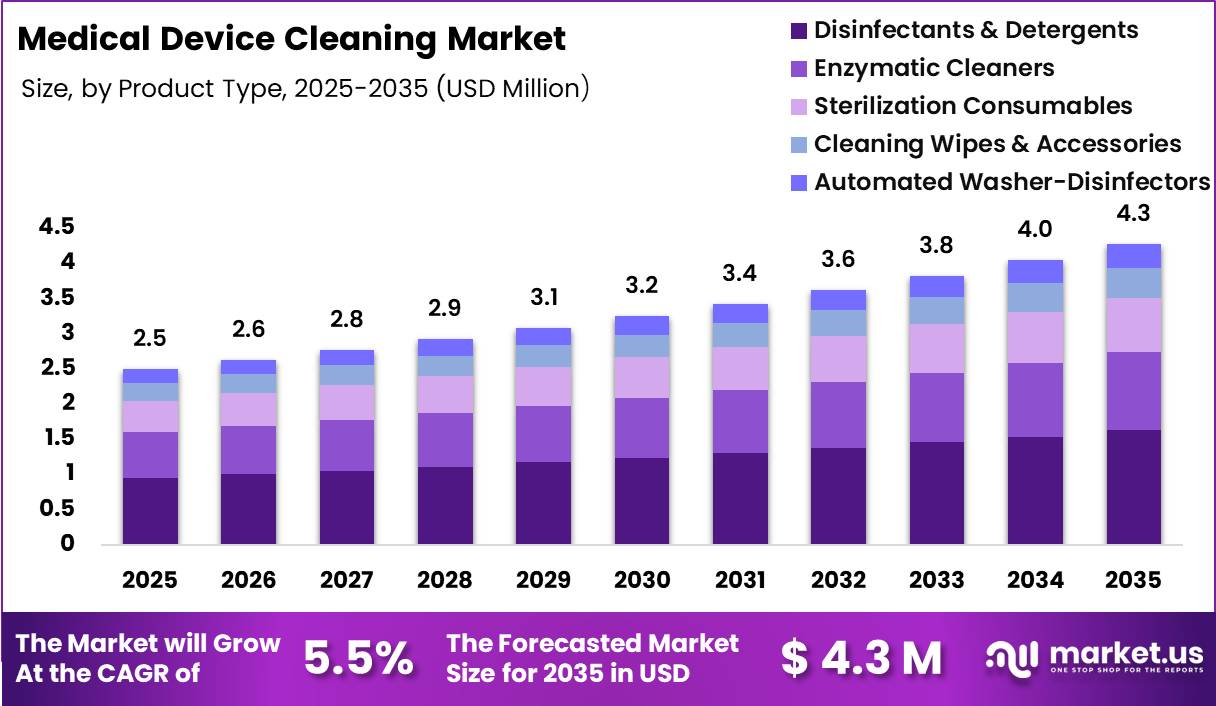
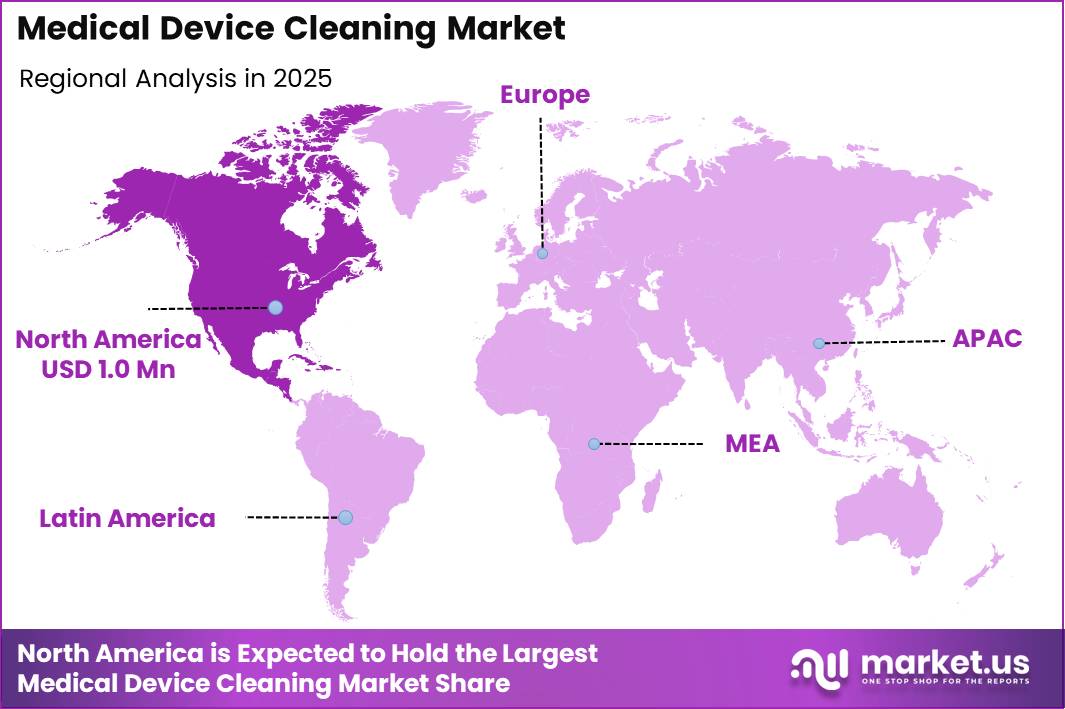
Global Medical Device Cleaning Market size is expected to be worth around US$ 4.3 Million by 2035 from US$ 2.5 Million in 2025, growing at a CAGR of 5.5% during the forecast period from 2026 to 2035. In 2025, North America led the market, achieving over 39.0% share with a revenue of US$ 1.0 Million.
The Medical Device Cleaning Market plays a critical role in safeguarding patient safety by ensuring reusable surgical instruments, endoscopes, and diagnostic equipment are effectively cleaned, disinfected, and sterilized before reuse.
Regulatory agencies and healthcare organizations continue to strengthen infection prevention requirements, driving the adoption of validated cleaning technologies, automated reprocessing systems, and standardized decontamination workflows.
According to the U.S. Food and Drug Administration (FDA), reusable medical devices must undergo a multistep reprocessing cycle comprising cleaning, disinfection or sterilization, and appropriate storage to prevent microbial contamination and healthcare-associated infections (HAIs). The FDA also emphasizes that inadequate cleaning can leave blood and tissue residues that allow microorganisms to survive subsequent sterilization processes.
The importance of effective medical device cleaning is reinforced by the U.S. Centers for Disease Control and Prevention (CDC), which reports that 1 in 31 hospital patients has at least one healthcare-associated infection on any given day, highlighting the need for rigorous infection control practices.
Recent CDC data also show measurable national reductions between 2023 and 2024, including 11% fewer Clostridioides difficile infections, 10% fewer catheter-associated urinary tract infections, 9% fewer central line-associated bloodstream infections, and 7% fewer MRSA bloodstream infections, reflecting continued improvements in hospital infection prevention.
Meanwhile, healthcare providers are increasingly investing in automated washer-disinfectors, low-temperature sterilization technologies, digital traceability, and validated cleaning protocols to enhance operational efficiency, regulatory compliance, and patient outcomes while supporting the growing volume of reusable medical devices used across modern healthcare facilities.
Key Takeaways
- Market Size: Global Medical Device Cleaning Market size is expected to be worth around US$ 4.3 Million by 2035 from US$ 2.5 Million in 2025.
- Market Share: The market is growing at a CAGR of 5.5% during the forecast period from 2026 to 2035.
- Product Type: The Disinfectants & Detergents segment dominates the Medical Device Cleaning Market, accounting for 38.0% of the market share in 2025.
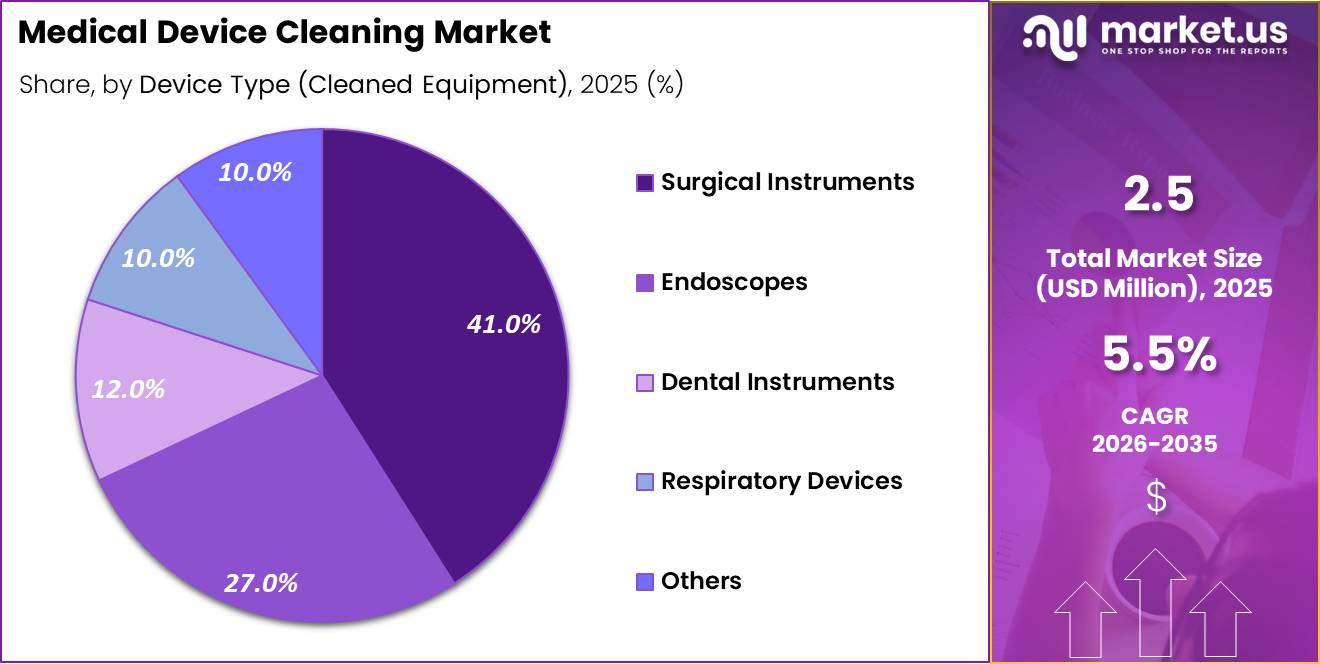
- Device Type (Cleaned Equipment): The Surgical Instruments segment leads the Medical Device Cleaning Market with 41.0% of the market share in 2025.
- Cleaning Type: The Manual Cleaning segment dominates the Medical Device Cleaning Market with 44.0% of the market share in 2025.
- End User: The Hospitals segment dominates the Medical Device Cleaning Market, accounting for 63.0% of the market share in 2025.
- Application: The Surgical Instrument Reprocessing segment leads the Medical Device Cleaning Market with 46.0% of the market share in 2025.
- Distribution Channel: The Direct Sales segment dominates the Medical Device Cleaning Market, holding 52.0% of the market share in 2025.
- Regional Analysis: In 2025, North America led the market, achieving over 39.0% share with a revenue of US$ 1.0 Million.
Product Type Analysis
Disinfectants & Detergents segment dominates the Medical Device Cleaning Market.
The Disinfectants & Detergents segment dominates the Medical Device Cleaning Market, accounting for 38.0% of the market share in 2025. Its leadership is driven by the extensive use of disinfectant formulations for routine cleaning and decontamination of reusable medical devices across hospitals, ambulatory surgical centers, and diagnostic facilities.
These products provide effective removal of microorganisms while remaining compatible with various medical instruments, making them indispensable in infection prevention programs. Increasing regulatory emphasis on sterilization compliance and healthcare-associated infection reduction continues to strengthen adoption. Growing procedural volumes and the need for faster instrument turnaround also contribute to sustained demand for disinfectants and detergents.
Enzymatic Cleaners account for 26.0% of the market, supported by their ability to remove blood, tissue, and protein residues from complex instruments before sterilization. Sterilization Consumables represent 18.0%, benefiting from increasing use of sterilization wraps, indicators, and packaging products in central sterile departments.
Cleaning Wipes & Accessories hold 10.0%, driven by demand for rapid surface cleaning and point-of-care disinfection. Automated Washer-Disinfectors, contributing 8.0%, are gaining adoption as healthcare providers invest in automated reprocessing systems that improve cleaning consistency, reduce manual labor, and support standardized workflows.
Device Type (Cleaned Equipment) Analysis
Surgical Instruments segment leads the Medical Device Cleaning Market.
The Surgical Instruments segment leads the Medical Device Cleaning Market with 41.0% of the market share in 2025. Surgical instruments require thorough cleaning after every procedure to remove biological contaminants before sterilization, making them the largest category.
Rising surgical procedure volumes, increasing adoption of minimally invasive surgeries, and stringent sterilization regulations continue to support demand. Healthcare facilities are also investing in advanced reprocessing systems to improve patient safety and maintain compliance with infection control standards.
Endoscopes account for 27.0% of the market due to their complex internal channels that require specialized cleaning and high-level disinfection. Dental Instruments represent 12.0%, supported by expanding dental care services and mandatory sterilization requirements.
Respiratory Devices contribute 10.0%, reflecting consistent demand for cleaning reusable ventilator components and breathing circuits. The Others segment, also holding 10.0%, includes reusable laboratory equipment, ophthalmic instruments, and specialty medical devices that require validated cleaning protocols to ensure safe reuse.
Cleaning Type Analysis
Manual Cleaning segment dominates the Medical Device Cleaning Market.
The Manual Cleaning segment dominates the Medical Device Cleaning Market with 44.0% of the market share in 2025. Manual cleaning remains the preferred method for delicate and complex reusable medical devices that require careful handling before sterilization.
It is widely used because of its flexibility, lower equipment investment, and ability to effectively remove visible contaminants from instruments with intricate designs. The process continues to serve as a critical first step in achieving successful sterilization and regulatory compliance.
Automated Cleaning represents the second-largest segment, supported by increasing investments in washer-disinfectors and automated reprocessing systems that deliver standardized, repeatable cleaning outcomes while reducing labor requirements and human error.
Semi-Automated Cleaning accounts for the remaining share by combining manual intervention with equipment-assisted processes, making it suitable for healthcare facilities seeking improved efficiency without fully automated infrastructure. Growing emphasis on workflow optimization and infection prevention is supporting adoption across both automated cleaning categories.
End User Analysis
Hospitals segment dominates the Medical Device Cleaning Market.
The Hospitals segment dominates the Medical Device Cleaning Market, accounting for 63.0% of the market share in 2025. Hospitals generate the highest demand for medical device cleaning because they perform large numbers of surgical procedures, diagnostic examinations, and therapeutic interventions every day.
Central sterile services departments require continuous reprocessing of reusable medical devices to maintain instrument availability while complying with strict infection prevention regulations. Ongoing investments in sterilization infrastructure and patient safety initiatives further reinforce hospital leadership.
Ambulatory Surgical Centers (ASCs) represent the second-largest segment as outpatient surgeries continue to increase, creating demand for efficient instrument turnaround and validated cleaning processes. Clinics also contribute significantly due to routine cleaning requirements for reusable diagnostic and treatment equipment across multiple specialties.
Diagnostic Laboratories account for the remaining share, supported by the need to maintain contamination-free laboratory environments through regular cleaning of reusable analytical instruments and accessories. These end users continue to adopt advanced cleaning technologies to improve operational efficiency and regulatory compliance.
Application Analysis
Surgical Instrument Reprocessing segment leads the Medical Device Cleaning Market.
The Surgical Instrument Reprocessing segment leads the Medical Device Cleaning Market with 46.0% of the market share in 2025. Surgical instruments require comprehensive cleaning before sterilization to eliminate blood, tissue, and microbial contamination that could compromise patient safety.
Rising surgical volumes, stricter sterilization standards, and increasing emphasis on reducing healthcare-associated infections continue to support this segment’s dominance. Healthcare providers are also expanding centralized reprocessing operations to improve workflow efficiency and instrument availability.
Infection Prevention & Control represents the second-largest application, driven by healthcare facilities implementing comprehensive cleaning protocols to minimize contamination risks. Endoscope Reprocessing continues to expand due to the increasing number of minimally invasive procedures and the complex cleaning requirements of flexible endoscopes.
Dental Equipment Cleaning also contributes steadily as dental clinics follow mandatory sterilization and infection control protocols for reusable instruments. Advancements in cleaning formulations and automated reprocessing technologies continue to strengthen all application segments.
Distribution Channel Analysis
Direct Sales segment dominates the Medical Device Cleaning Market.
The Direct Sales segment dominates the Medical Device Cleaning Market, holding 52.0% of the market share in 2025.
Large hospitals and healthcare networks prefer direct procurement from manufacturers to secure consistent product quality, technical support, equipment servicing, and long-term supply agreements. Direct purchasing also enables customized contracts, bulk procurement, and reliable product availability, making it the preferred distribution model for high-volume healthcare institutions.
Distributors form the second-largest distribution channel by expanding access to cleaning products across regional hospitals, clinics, and smaller healthcare facilities through established logistics and inventory networks.
Online Channels are steadily gaining traction as digital procurement platforms simplify purchasing, inventory management, and product comparison for routine consumables and cleaning accessories. Increasing digitalization of healthcare procurement and stronger manufacturer-distributor partnerships continue to improve product accessibility and supply chain efficiency across the market.
Key Market Segments
Product Type
- Disinfectants & Detergents
- Enzymatic Cleaners
- Sterilization Consumables
- Cleaning Wipes & Accessories
- Automated Washer-Disinfectors
Device Type (Cleaned Equipment)
- Surgical Instruments
- Endoscopes
- Dental Instruments
- Respiratory Devices
- Others
Cleaning Type
- Manual Cleaning
- Automated Cleaning
- Semi-Automated Cleaning
End User
- Hospitals
- Ambulatory Surgical Centers (ASCs)
- Clinics
- Diagnostic Laboratories
Application
- Surgical Instrument Reprocessing
- Infection Prevention & Control
- Endoscope Reprocessing
- Dental Equipment Cleaning
Distribution Channel
- Direct Sales
- Distributors
- Online Channels
Drivers
Stricter Endoscope Reprocessing Protocols Driving Market Upside.
Flexible endoscopes remain the highest-intensity cleaning subsegment because they combine narrow lumens, high bioburden exposure, and direct links to cross-contamination risk, so every standards upgrade translates into incremental chemistry, verification consumables, drying, storage, and automated reprocessor demand.
AAMI ST91 related practice shifts have raised the operating threshold by pushing cleaning verification on high-risk endoscopes, recommending at least 10 minutes of drying with pressure regulated or HEPA filtered air, and favoring unidirectional dirty to clean workflows with separated rooms or pass-through designs, all of which increase per-scope processing time, accessory use, and capex intensity at endoscopy units.
Commercially, that shifts buyers away from low-cost manual cleaning dependence toward bundled procurement of detergents, channel brushes, verification tests, drying cabinets, AER compatible workflows, and service contracts; the result is stronger recurring revenue density per installed endoscope fleet, especially in North America, Western Europe, Japan, South Korea, and tertiary APAC hospitals where GI and pulmonary procedure volumes justify compliance led upgrades.
| Driver | (~) % Impact on CAGR Forecast | Geographic Relevance | Impact Timeline |
|---|---|---|---|
| Endoscope reprocessing tightening | +2.1% | North America core, EU, Japan, South Korea, Australia, tier-1 APAC hospitals | Short term (≤ 2 years) |
| Reusable device validation burden | +1.8% | U.S., EU core, UK, export-oriented APAC manufacturing hubs | Short term (≤ 2 years) |
| Sterile processing automation adoption | +1.6% | U.S., Canada, Western Europe, GCC, China urban hospitals | Medium term (2-4 years) |
| HAI and SSI reduction economics | +1.4% | Global, strongest pull in North America, EU, India, China, Brazil | Short term (≤ 2 years) |
| Single-use device reprocessing expansion | +1.1% | U.S. core, selected EU markets, large IDN hospital networks | Medium term (2-4 years) |
| QMS harmonization and global compliance scaling | +0.9% | U.S., EU, ASEAN exporters, China, India, Mexico | Medium term (2-4 years) |
Challenges
Fragmented multi jurisdictional compliance and audit burden.
Divergent and continuously evolving infection prevention, disinfection, and sterilization requirements across regulatory agencies and accreditation bodies continue to create a significant compliance burden for healthcare providers and reprocessing service vendors.
Hospitals are required to maintain multiple protocols, documentation formats, and product validation processes to satisfy varying regulatory expectations, resulting in an additional 8 to 12 audit days per facility each year. This complexity also increases quality assurance expenditures by approximately 10% to 15% of the overall infection control budget.
The lack of harmonization is further reflected in differences in national guidelines governing high-level disinfection cycles, allowable device reprocessing limits, and residual chemical thresholds, with variations of approximately 20% to 30% across major global jurisdictions.
Consequently, multinational original equipment manufacturers (OEMs) are compelled to produce multiple formulations, stock keeping units (SKUs), and instructions for use (IFUs) for identical detergents or enzymatic cleaners. Product label modifications and localized validation requirements typically extend commercialization timelines for new cleaning chemistries and washer-disinfector systems by an estimated 6 to 9 months.
The operational impact is particularly significant for large integrated delivery networks managing between 10 and 30 healthcare facilities. These organizations must conduct approximately 50 to 120 additional internal training sessions annually to ensure sterile processing personnel remain compliant with evolving standards and device-specific cleaning instructions.
As a result, non-clinical training commitments for sterile processing employees often reach 40 to 50 hours per year, limiting workforce productivity and slowing the adoption of advanced cleaning technologies by an estimated 3 to 4 percentage points annually.
To address these challenges, industry participants are increasingly investing in harmonized global validation frameworks, digital IFU management platforms, and automated compliance documentation systems capable of maintaining cycle logs, chemical concentration records, and audit-ready documentation. Such investments have the potential to reduce manual compliance efforts by approximately 20% to 30% per facility.
Over the next two to four years, continued collaboration among trade associations, regulatory authorities, and standards organizations to align testing methodologies and reprocessing labeling requirements is expected to reduce regulatory fragmentation, gradually unlocking approximately 1.0 to 1.2 percentage points of addressable market CAGR by enabling a transition from fragmented, site-specific compliance practices to standardized, evidence-based infection prevention protocols.
| Challenge | (~) % CAGR Friction Drag | Geographic Relevance | Mitigation Horizon |
|---|---|---|---|
| Fragmented compliance burden | -1.2% | North America, EU, Japan | Medium term (2-4 years) |
| Volatile chemistries & EtO risk | -0.9% | North America, EU regulatory hubs | Long term (≥ 4 years) |
| Instrument reprocessing bottlenecks | -1.0% | Global tertiary hospitals, ASC clusters | Medium term (2-4 years) |
| Talent and training shortfalls | -1.3% | North America, Europe, urban APAC | Long term (≥ 4 years) |
| Supply chain and cost volatility | -0.8% | APAC logistics corridors, import-reliant markets | Short term (≤ 2 years) |
| Digital traceability & data gaps | -0.7% | OECD hospitals, large IDNs | Medium term (2-4 years) |
Restraints
Shift Toward Single Use Devices Reduces Cleaning Demand.
The accelerated pivot toward single use and disposable medical devices, particularly in high income health systems seeking to reduce instrument turnaround complexity and infection risk, structurally erodes reprocessing and cleaning demand volumes by an estimated 10 to 15% across select product lines over 2026 to 2031, translating into a roughly 1.8% point drag on market CAGR versus a like for like multi use baseline.
In the US and Western Europe, infection control committees are still under pressure from post pandemic quality metrics and public reporting of healthcare associated infection rates, leading to procurement policies where high risk categories such as electrophysiology catheters, some laparoscopic tools, and complex narrow lumen devices are increasingly specified as single use, redirecting spend toward device acquisition rather than detergents, enzymatic cleaners, washer disinfectors, and related validation services.
As hospitals rebalance budgets around DRG based reimbursement and value based purchasing penalties, a 2 to 3% annual shift of procedure volumes from reusable to single use in targeted specialties can depress unit volume growth for cleaning chemistry by 20 to 30 bps per year and for capital reprocessing equipment by 30 to 40 bps per year.
Cumulatively removing several hundred million dollars in addressable spend from mature markets by 2030 and lengthening payback periods on new CSSD (central sterile supply department) automation capex from 5 to 6 years to 7 to 8 years, which in turn prompts CFOs to defer or down spec upgrades.
At the same time, OEM marketing of single use portfolios often emphasises simplified compliance, reduced validation burden, and lower staff training intensity, which resonates with hospitals facing 10 to 20% vacancy rates in sterile processing departments and high turnover, further reinforcing the substitution effect and weakening the volume leverage historically underpinning cleaning chemical suppliers’ margins in North America and Western Europe.
| Restraint | (~) % Impact on CAGR Forecast | Geographic Relevance | Impact Timeline |
|---|---|---|---|
| Shift to single-use devices | -1.8% | North America core, Western Europe | Medium term (2–4 years) |
| Reprocessing compliance and liability risk | -1.4% | North America, EU, select APAC | Short–Medium term (≤ 4 years) |
| Input cost and chemical regulations | -1.6% | EU, North America, Japan | Short term (≤ 2 years) |
| Sterile processing labor and capacity constraints | -1.2% | North America core, EU hospitals | Short–Medium term (≤ 4 years) |
| Emerging market capex and reimbursement gaps | -1.5% | Tier-2/3 APAC, LATAM, MEA | Long term (≥ 4 years) |
| OEM integration and locked cleaning ecosystems | -1.0% | North America, EU, high-end APAC | Medium–Long term (≥ 3 years) |
Opportunity
Scaling regulated single-use medical device reprocessing programs.
This is future upside rather than a baseline driver because routine device cleaning revenue today mainly comes from reusable instruments, while the larger strategic expansion comes from capturing value from devices originally labeled single use through regulated reprocessing, relabeling, testing, and remarketing.
The FDA explicitly allows third party reprocessors and hospitals to reprocess suitable SUDs under the same regulatory framework as original manufacturers, provided they validate cleaning, disinfection, sterilization, functional performance, and maximum reuse cycles, which creates a legal route to monetize a currently undercaptured portion of procedure related consumables spend.
In the EU, MDR Article 17 allows reprocessing of single use devices where national law permits it, and the 2024 Commission report plus 2026 implementation activity show that the policy framework is moving from ambiguity toward operationalization, creating a multi country but uneven adoption map that favors early entrants with country specific compliance capability.
Commercially, the upside can be material because regulated reprocessed SUDs can offer hospitals procurement savings often large enough to justify program adoption, while peer reviewed evidence summarized by NAM shows 40 percent to 60 % GHG reductions and an average 44 % reduction in kgCO2e versus virgin devices, enabling reprocessors to win both cost and sustainability budgets; for cleaning market participants, this can add new validation, decontamination, packaging, and QA revenue streams that expand addressable market by an estimated 8 percent to 12 percent in eligible categories over time.
| Opportunity | (~) % Potential CAGR Upside | Geographic Relevance | Execution Window |
|---|---|---|---|
| ASC-focused reprocessing platforms | +1.9% | North America core, EU urban, APAC private care hubs | Short term |
| Single-use device reprocessing expansion | +2.4% | U.S. core, selective EU states | Medium term |
| MDR validation outsourcing bundles | +1.6% | EU, UK, export manufacturers in APAC | Short term |
| High-risk endoscope digital assurance | +2.1% | U.S., EU, Japan, South Korea | Medium term |
| Rural and mid-tier sterile services networks | +1.4% | North America secondary markets, India, LATAM, CEE | Medium term |
| Sustainability-linked cleaning chemistries | +1.2% | EU, NHS-linked markets, U.S. IDNs | Long term |
Regional Analysis
North America dominated the Medical Device Cleaning Market in 2025.
North America dominated the Medical Device Cleaning Market in 2025, accounting for more than 39.0% of the global market and generating approximately US$ 1.0 million in revenue. The region’s leadership is supported by its highly developed healthcare infrastructure, stringent infection prevention regulations, and widespread adoption of reusable surgical and diagnostic instruments that require validated cleaning and disinfection processes.
Hospitals, ambulatory surgical centers, and specialized clinics continue to invest in advanced cleaning technologies to comply with sterilization standards and reduce healthcare-associated infections. Increasing procedure volumes, aging populations, and the expansion of minimally invasive surgeries further strengthen demand for enzymatic cleaners, automated washer-disinfectors, and high-level disinfectants. Additionally, healthcare providers are emphasizing workflow automation and standardized reprocessing protocols to improve operational efficiency while ensuring patient safety.
Europe represents another significant regional market, supported by strict medical device reprocessing regulations and growing investments in hospital modernization. Countries across the region continue to prioritize infection control programs, encouraging the adoption of advanced cleaning chemicals and automated decontamination equipment.
The Asia-Pacific region is projected to witness the fastest growth during the forecast period due to expanding healthcare infrastructure, rising hospital admissions, increasing medical device utilization, and greater awareness of sterilization practices in emerging economies.
Meanwhile, Latin America and the Middle East & Africa are experiencing steady market expansion as healthcare access improves, hospital construction accelerates, and governments increase investments in healthcare quality and patient safety initiatives, creating sustained demand for reliable medical device cleaning solutions.
Key Regions and Countries
North America
- The US
- Canada
Europe
- Germany
- France
- The U.K.
- Italy
- Spain
- Russia & CIS
- Rest of Europe
Asia Pacific
- China
- India
- Japan
- South Korea
- ASEAN
- Australia & New Zealand
- Rest of Asia Pacific
Middle East & Africa
- GCC
- South Africa
- Rest of Middle East & Africa
Latin America
- Brazil
- Mexico
- Rest of Latin America
Key Player Analysis
The Medical Device Cleaning Market is moderately consolidated, with leading global companies competing through broad product portfolios, technological innovation, regulatory compliance, and integrated infection prevention solutions. Market participants are focused on delivering high-performance cleaning chemistries, automated reprocessing systems, and digital workflow solutions that improve cleaning validation and operational efficiency across healthcare facilities.
Innovation is increasingly centered on reducing manual intervention, enhancing compatibility with complex reusable medical devices, and supporting sustainability objectives through resource-efficient cleaning technologies. STERIS plc, Getinge AB, Ecolab Inc., 3M Health Care, and Belimed AG maintain strong competitive positions through comprehensive sterilization and decontamination portfolios.
While Cantel Medical (STERIS) and Advanced Sterilization Products (ASP) continue to strengthen specialized reprocessing capabilities. Metrex Research LLC, Reckitt Benckiser Healthcare, B. Braun Melsungen AG, MMM Group, Sotera Health, Olympus Corporation, Fortive Corporation, and Whiteley Corporation further intensify competition by addressing diverse healthcare cleaning and infection prevention requirements.
Competition is increasingly driven by investments in research and development to introduce advanced enzymatic cleaners, high-level disinfectants, and automated washer-disinfector technologies that meet evolving regulatory standards.
Strategic partnerships with hospitals, healthcare networks, and medical device manufacturers enable companies to develop validated cleaning protocols and strengthen customer relationships. Product innovation focuses on improving cleaning efficacy, material compatibility, traceability, and digital monitoring of reprocessing workflows.
Companies are also integrating software, equipment, consumables, and technical support into unified ecosystems that simplify device reprocessing and enhance compliance. This ecosystem-based approach, combined with continuous portfolio expansion and workflow integration, enables leading participants to differentiate themselves while supporting healthcare providers in achieving consistent infection control, operational efficiency, and patient safety outcomes.
Top Key Players
- STERIS plc
- Getinge AB
- Ecolab Inc.
- 3M Health Care
- Belimed AG
- Cantel Medical (STERIS)
- Advanced Sterilization Products (ASP)
- Metrex Research LLC
- Reckitt Benckiser Healthcare
- B. Braun Melsungen AG
- MMM Group
- Sotera Health
- Olympus Corporation
- Fortive Corporation
- Whiteley Corporation
Recent Developments
- In September 2025, Belimed AG (SteelcoBelimed) entered a strategic partnership with iM Med in the UK to strengthen healthcare decontamination services. The agreement combines both companies’ expertise to expand service capabilities, improve access to advanced decontamination technologies, and support more than 1,000 healthcare assets across the country.
- In September 2025, STERIS plc continued its expansion strategy in fiscal 2026 by completing another tuck-in acquisition worth approximately US$15.0 million. The acquisition further strengthened the company’s Healthcare segment by adding complementary products and service capabilities for infection prevention and device reprocessing.
- In January 2025, Olympus Corporation issued a voluntary medical device advisory for its MAJ-891 Forceps/Irrigation Plug after identifying a potential contamination risk caused by improper reprocessing. The company updated cleaning and reprocessing guidance to help healthcare providers reduce infection risks during endoscope reprocessing.
Report Scope
| Report Features | Description |
|---|---|
| Market Value (2025) | US$2.5 Million |
| Forecast Revenue (2035) | US$4.3 Million |
| CAGR (2026-2035) | 5.5% |
| Base Year for Estimation | 2025 |
| Historic Period | 2020-2024 |
| Forecast Period | 2026-2035 |
| Report Coverage | Revenue Forecast, Market Dynamics, Competitive Landscape, Recent Developments |
| Segments Covered | By Product Type (Disinfectants & Detergents, Enzymatic Cleaners, Sterilization Consumables, Cleaning Wipes & Accessories, Automated Washer-Disinfectors), By Device Type (Cleaned Equipment) (Surgical Instruments, Endoscopes, Dental Instruments, Respiratory Devices, Others), By Cleaning Type (Manual Cleaning, Automated Cleaning, Semi-Automated Cleaning), By End User (Hospitals, Ambulatory Surgical Centers (ASCs), Clinics, Diagnostic Laboratories), By Application (Surgical Instrument Reprocessing, Infection Prevention & Control, Endoscope Reprocessing, Dental Equipment Cleaning), By Distribution Channel (Direct Sales, Distributors, Online Channels) |
| Regional Analysis | North America – The US, Canada; Europe – Germany, France, U.K., Italy, Spain, Russia & CIS, Rest of Europe; Asia Pacific – China, India, Japan, South Korea, ASEAN, Australia & New Zealand, Rest of Asia Pacific; Middle East & Africa – GCC, South Africa, Rest of Middle East & Africa; Latin America – Brazil, Mexico, Rest of Latin America |
| Competitive Landscape | STERIS plc, Getinge AB, Ecolab Inc., 3M Health Care, Belimed AG, Cantel Medical (STERIS), Advanced Sterilization Products (ASP), Metrex Research LLC, Reckitt Benckiser Healthcare, B. Braun Melsungen AG, MMM Group, Sotera Health, Olympus Corporation, Fortive Corporation, Whiteley Corporation |
| Customization Scope | Customization for segments, region/country-level will be provided. Moreover, additional customization can be done based on the requirements. |
| Purchase Options | We have three licenses to opt for: Single User License, Multi-User License (Up to 5 Users), Corporate Use License (Unlimited User and Printable PDF) |





































