


Global Malted Wheat Flour Market Size, Share, And Industry Analysis Report By Product (Diastatic, Non-diastatic), By Nature (Conventional, Organic), By Application (Bakery and Confectionery, Food and Beverage, Others), By Region and Companies - Industry Segment Outlook, Market Assessment, Competition Scenario, Statistics, Trends and Forecast 2026-2035
- Published date: March 2026
- Report ID: 182363
- Number of Pages: 285
- Format:
-
keyboard_arrow_up
Quick Navigation
Report Overview
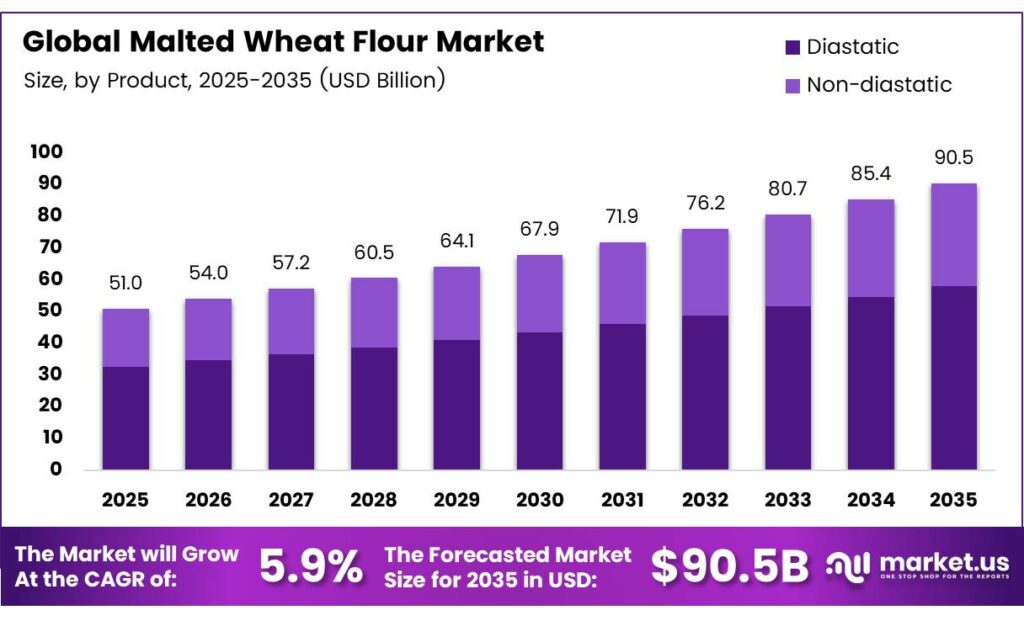
The Global Malted Wheat Flour Market size is expected to be worth around USD 90.5 billion by 2035 from USD 51.0 billion in 2025, growing at a CAGR of 5.9% during the forecast period 2026 to 2035.
Malted wheat flour is a specialty grain ingredient produced by germinating wheat kernels, then drying them through a controlled kilning process. This process activates natural enzymes that improve dough performance, flavor development, and fermentation efficiency. Food manufacturers and bakers widely use this ingredient to enhance product texture, taste, and nutritional value.
The market serves a broad range of end users across the bakery, confectionery, brewing, and convenience food industries. Demand continues to grow as food producers seek enzyme-rich, clean-label ingredients that improve product quality. Moreover, the rising popularity of artisanal baking and craft food production supports wider adoption of malted wheat ingredients globally.
Emerging economies in the Asia Pacific and Latin America are investing in grain processing capacity to meet rising domestic and export demand. India, in particular, has emerged as a significant player in wheat-derived product exports. India’s exports of milling products, including malt and wheat gluten, reached $753.38 million in 2024, reflecting strong export-oriented processing capacity tied to malted flour value chains.
Raw material availability directly influences production costs and market pricing across regions. Global wheat stockpiles are projected to reach a nine-year low in 2024, indicating supply constraints affecting flour and malted wheat flour production costs. Consequently, manufacturers are exploring diversified sourcing strategies to manage input cost volatility and maintain supply chain stability.
Key Takeaways
- The Global Malted Wheat Flour Market is valued at USD 51.0 billion in 2025 and is projected to reach USD 90.5 billion by 2035 at a CAGR of 5.9% during the forecast period 2026–2035.
- Diastatic malted wheat flour dominates with a 67.3% market share in 2025.
- Conventional malted wheat flour holds the largest share at 89.1% in 2025.
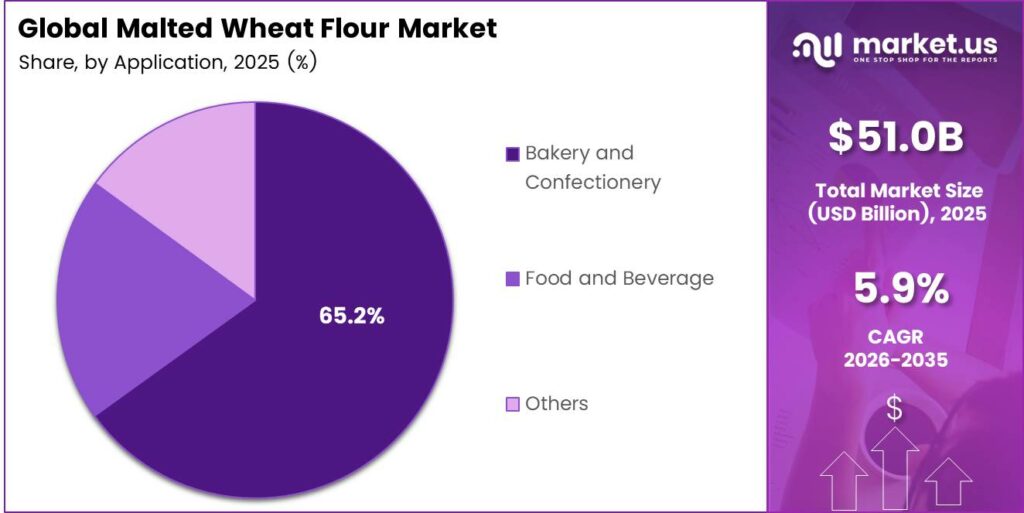
- Bakery and Confectionery leads with a 65.2% share in 2025.
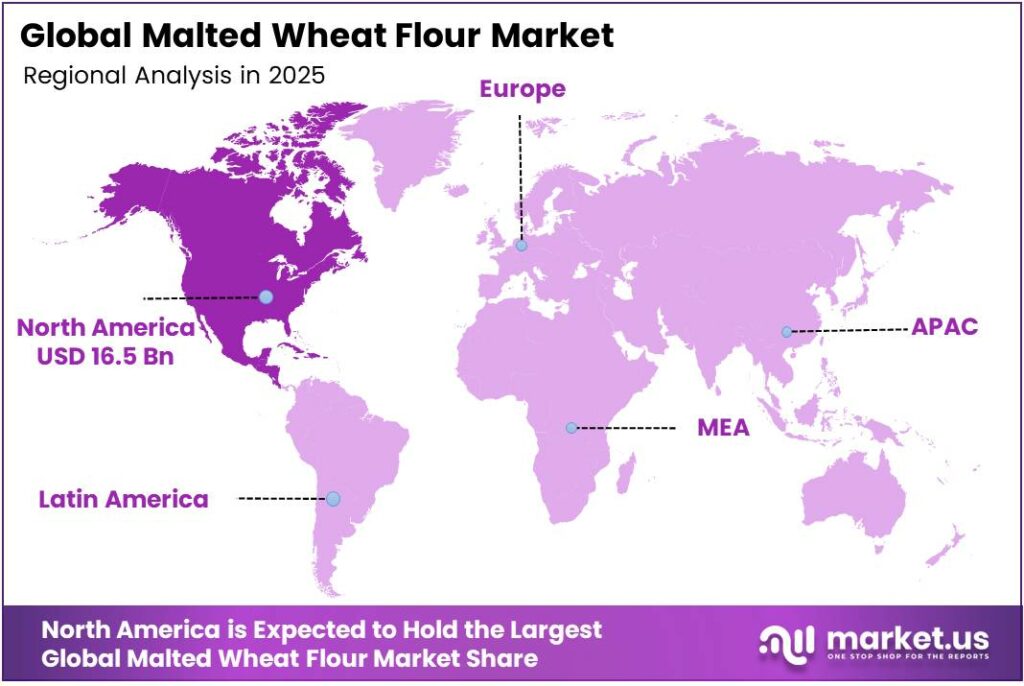
- North America dominates the regional landscape with a 32.4% market share, valued at USD 16.5 billion in 2025.
By Product Analysis
Diastatic malted wheat flour dominates with 67.3% due to its active enzyme content, driving superior dough fermentation performance.
In 2025, Diastatic malted wheat flour held a dominant market position in the by-product segment of the Malted Wheat Flour Market, with a 67.3% share. Diastatic variants retain active amylase enzymes that accelerate starch conversion during fermentation. Bakers and food manufacturers prefer this type because it improves dough rise, crust color, and overall loaf structure consistently.
Non-diastatic malted wheat flour, while smaller in share, serves a distinct role in the market. This variant contains deactivated enzymes, making it suitable for flavor enhancement without altering dough chemistry. Confectionery producers and premium snack manufacturers increasingly adopt non-diastatic options to deliver complex malt flavors in controlled formulations.
By Nature Analysis
Conventional malted wheat flour dominates with 89.1% due to its established supply chain, cost efficiency, and wide industrial availability.
In 2025, Conventional malted wheat flour held a dominant market position in the By Nature segment of the Malted Wheat Flour Market, with an 89.1% share. Large-scale food manufacturers rely on conventional variants due to consistent quality, lower cost, and reliable large-volume supply. This segment continues to serve the backbone of the global bakery and food processing industries.
Organic malted wheat flour, though a smaller segment, is gaining traction among health-conscious consumers and clean-label food brands. Rising awareness around sustainable agriculture and non-GMO ingredients is expanding demand for organic variants. Moreover, specialty food retailers and artisan bakeries are increasingly sourcing organic malted flour to meet premium product positioning requirements.
By Application Analysis
Bakery and confectionery dominate with 65.2% due to the widespread use of malted wheat flour in bread, pastries, and sweet goods production.
In 2025, Bakery and Confectionery held a dominant market position in the By Application segment of the Malted Wheat Flour Market, with a 65.2% share. Bread producers, pastry manufacturers, and biscuit makers rely heavily on malted wheat flour for consistent fermentation, improved texture, and enhanced flavor. This application segment drives the bulk of global malted flour consumption.
The Food and Beverage segment represents a growing application area for malted wheat flour. Brewing companies, beverage producers, and flavor manufacturers use malted flour to develop rich malt profiles in their products. Additionally, the craft brewing revival and rising functional beverage consumption are expanding the role of malted wheat ingredients in this segment.
The Others category includes nutraceuticals, convenience foods, and specialty snack applications. Manufacturers use malted wheat flour in cereal products, health bars, and fortified snacks to add nutritional value and extended shelf life. Consequently, product innovation across these niche categories is gradually broadening the application scope of malted wheat flour beyond traditional uses.
Key Market Segments
By Product
- Diastatic
- Non-diastatic
By Nature
- Conventional
- Organic
By Application
- Bakery and Confectionery
- Food and Beverage
- Others
Emerging Trends
Non-Diastatic Variants and Premium Flavor Demand Rise in Confectionery
Premium confectionery brands are driving demand for non-diastatic malted wheat flour as a flavoring agent rather than a functional enzyme source. Manufacturers seek complex malt notes to differentiate high-end bakery and snack products. Middle East flour processors maintained approximately 45 days of wheat inventory in 2024, showing tight upstream supply impacting specialty flour procurement cycles.
Advanced Milling Technologies and Home Baking Growth Reshape Market Dynamics
Advanced fermentation and milling technologies are enabling producers to develop malted wheat flour with enhanced nutritional profiles and improved bioavailability. Moreover, the post-pandemic surge in home baking has increased consumer demand for specialty ingredients, including malted flour variants. Clean-label preferences and transparent sourcing requirements are further pushing manufacturers toward process innovation and certified ingredient platforms.
Drivers
Enzyme-Rich Ingredients and Bakery Sector Growth Drive Malted Flour Demand
Bakery producers globally are prioritizing enzyme-rich ingredients that improve dough fermentation, texture, and product shelf life. Malted wheat flour delivers natural amylase activity that enhances fermentation efficiency in bread and pastry production. Russia’s wheat and wheat-rye flour exports reached $300 million in 2024, reflecting strong export activity in processed wheat derivatives that support global flour supply chains.
Artisanal Baking Revival and Brewing Industry Adoption Expand Market Reach
The growing popularity of artisanal baking and craft food production is increasing consumer interest in traditional malted flavors. Small-batch bakers and specialty food brands actively seek high-quality malted wheat flour to achieve authentic taste profiles. Additionally, the brewing and beverage industry is expanding its use of malted wheat ingredients for flavor enhancement, creating new and consistent demand streams beyond traditional bakery applications.
Restraints
Gluten-Free Substitutes and Rising Consumer Health Awareness Limit Market Growth
Consumer demand for gluten-free and alternative flour products is creating competitive pressure on the malted wheat flour market. Health-conscious buyers increasingly choose rice flour, almond flour, or oat-based alternatives over traditional wheat-derived ingredients. This behavioral shift limits market penetration, particularly in North America and Europe, where gluten-free product demand has grown significantly over recent years.
Wheat Price Volatility and Constrained Supply Chains Challenge Manufacturer Margins
Raw material price fluctuations directly impact production costs for malted wheat flour manufacturers. Indian wheat export prices averaged $280 per ton in 2026, impacting the cost competitiveness of flour and malted flour exports globally. Asian flour millers held only 1–2 months of wheat supply inventory in 2024, indicating tight upstream conditions affecting production planning and margin stability.
Growth Factors
Organic Segment Expansion and E-Commerce Accessibility Unlock New Market Potential
Demand for organic and non-GMO malted wheat flour is accelerating as sustainability-focused consumers and clean-label food brands seek certified specialty ingredients. E-commerce platforms are improving product accessibility in emerging markets where traditional distribution channels remain underdeveloped. India approved exports of 2.5 million metric tons of wheat in 2026, supporting downstream flour and malted flour export potential in global markets.
Functional Food Innovation and Health Snack Trends Boost Application Scope
Food manufacturers are leveraging malted wheat flour in convenience foods, health snacks, and functional beverages to improve nutrition and extend product shelf life. Rising demand for fortified and protein-enriched food products creates consistent growth opportunities for malted wheat flour applications. India’s wheat production reached 117.9 million metric tons in 2025, providing a large raw material base that supports domestic malted wheat flour manufacturing capacity.
Regional Analysis
North America Dominates the Malted Wheat Flour Market with a Market Share of 32.4%, Valued at USD 16.5 Billion
North America leads the global Malted Wheat Flour Market, holding a dominant 32.4% share valued at USD 16.5 billion in 2025. The region benefits from a mature bakery industry, strong craft brewing culture, and high consumer demand for specialty and artisanal food products. Moreover, established grain processing infrastructure and leading food manufacturers support consistent regional market growth.
Europe represents a significant market for malted wheat flour, driven by centuries-old baking traditions and a robust brewing sector. Countries such as Germany, France, and the United Kingdom maintain strong demand for high-quality malted ingredients in premium bakery and beverage products. Growing consumer preference for clean-label and organic food formulations is encouraging product innovation across European flour processing industries.
Asia Pacific is the fastest-growing regional market, supported by rapid urbanization, rising disposable incomes, and expanding bakery industries across China, India, and Southeast Asia. Growing middle-class populations are driving demand for packaged baked goods and convenience foods that use malted wheat flour. Furthermore, government investments in agricultural processing infrastructure are strengthening regional wheat milling and malting production capacity.
Latin America is witnessing steady growth in malted wheat flour demand, particularly within the bakery and food manufacturing sectors of Brazil and Mexico. Rising consumer interest in specialty baked products and craft beverages is supporting the adoption of malted ingredients. However, price sensitivity and limited local malting capacity continue to restrict faster market expansion across some parts of the region.
Key Regions and Countries
North America
- US
- Canada
Europe
- Germany
- France
- The UK
- Spain
- Italy
- Rest of Europe
Asia Pacific
- China
- Japan
- South Korea
- India
- Australia
- Rest of APAC
Latin America
- Brazil
- Mexico
- Rest of Latin America
Middle East & Africa
- GCC
- South Africa
- Rest of MEA
Key Players Analysis
Cargill, Incorporated, is a global agribusiness leader with a strong presence in grain processing and specialty flour production. The company operates extensive wheat sourcing and milling networks across North America, Europe, and the Asia Pacific. Cargill leverages its integrated supply chain to deliver consistent malted wheat flour quality to food manufacturers, brewers, and bakery producers worldwide, reinforcing its position as a preferred ingredient supplier.
ADM (Archer-Daniels-Midland) is a major player in the global grain and ingredient processing sector. The company offers a broad portfolio of malt-based ingredients and specialty flours catering to diverse food and beverage applications. ADM’s investment in processing innovation and global distribution infrastructure allows it to serve large-scale food manufacturers effectively, positioning the company as a key contributor to the malted wheat flour supply chain.
Malteurop Group is one of the world’s largest malting companies, operating malting facilities across multiple continents. The company focuses on producing high-quality malt for the brewing, distilling, and food industries. Malteurop’s deep expertise in the malting process, combined with its commitment to sustainable sourcing and agricultural partnerships, supports its strong market standing in the global specialty malted ingredient sector.
Crisp Malt is a respected specialty malt producer serving craft brewers, distillers, and artisan food manufacturers globally. The company is known for its wide range of traditional and innovative malt products, including specialty malted wheat flours. Crisp Malt’s focus on small-batch quality, traceability, and craft-oriented product development positions it well within the growing premium and artisanal malted ingredient market segment.
Top Key Players in the Market
- Cargill
- ADM
- Malteurop Group
- Crisp Malt
- Baird’s Malt Ltd.
- Imperial Malts Ltd.
- King Arthur Baking Company, Inc.
- IREKS GmbH
- GrainCorp
- PMV Maltings Pvt. Ltd.
Recent Developments
- In 2025, Crisp Malt maintains a dedicated ESG Report on its official website, outlining its ongoing sustainability strategy for malting operations, including net-zero commitments and Field Forward farming programs.
- In 2025, Baird’s Malt’s and parent company announcements highlight the following recent malt-sector developments: Project Angel capacity has been added at two UK maltings to meet growing demand from distillers and brewers worldwide. The company operates five UK maltings and sources barley from over 800 UK growers.
Report Scope
Report Features Description Market Value (2025) USD 51.0 Billion Forecast Revenue (2035) USD 90.5 Billion CAGR (2026-2035) 5.9% Base Year for Estimation 2025 Historic Period 2020-2024 Forecast Period 2026-2035 Report Coverage Revenue Forecast, Market Dynamics, Competitive Landscape, Recent Developments Segments Covered By Product (Diastatic, Non-diastatic), By Nature (Conventional, Organic), By Application (Bakery and Confectionery, Food and Beverage, Others) Regional Analysis North America (US and Canada), Europe (Germany, France, The UK, Spain, Italy, and Rest of Europe), Asia Pacific (China, Japan, South Korea, India, Australia, and Rest of APAC), Latin America (Brazil, Mexico, and Rest of Latin America), Middle East & Africa (GCC, South Africa, and Rest of MEA) Competitive Landscape Cargill, Incorporated, ADM, Malteurop Group, Crisp Malt, Bairds Malt Ltd., Imperial Malts Ltd., King Arthur Baking Company, Inc., IREKS GmbH, GrainCorp, PMV Maltings Pvt. Ltd. Customization Scope Customization for segments, region/country-level will be provided. Moreover, additional customization can be done based on the requirements. Purchase Options We have three licenses to opt for: Single User License, Multi-User License (Up to 5 Users), Corporate Use License (Unlimited Users and Printable PDF)  Malted Wheat Flour MarketPublished date: March 2026add_shopping_cartBuy Now get_appDownload Sample
 -
-
- Cargill
- ADM
- Malteurop Group
- Crisp Malt
- Baird's Malt Ltd.
- Imperial Malts Ltd.
- King Arthur Baking Company, Inc.
- IREKS GmbH
- GrainCorp
- PMV Maltings Pvt. Ltd.
Our Clients

- 182363
- March 2026






