


Global Machine-to-Machine (M2M) Connections Market Size, Share, Growth Analysis By Technology (Wired, Wireless), By End-Use Industry (Automotive and Transportation, Consumer Electronics, Healthcare, Manufacturing, Retail, Power and Utilities, Others), By Region and Companies - Industry Segment Outlook, Market Assessment, Competition Scenario, Statistics, Trends and Forecast 2026-2035
- Published date: Feb 2026
- Report ID: 178586
- Number of Pages: 239
- Format:
-
keyboard_arrow_up
Quick Navigation
Market Overview
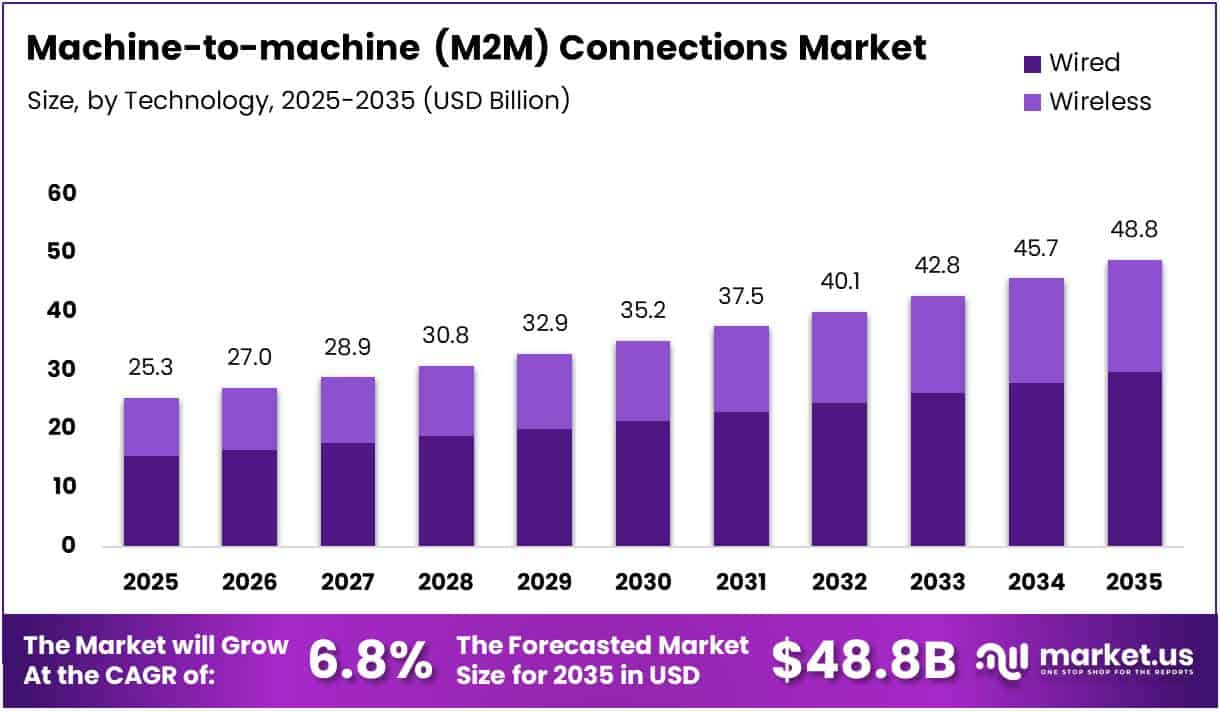
The Global Machine-to-Machine (M2M) Connections Market size is expected to be worth around USD 48.8 Billion by 2035 from USD 25.3 Billion in 2025, growing at a CAGR of 6.8% during the forecast period 2026 to 2035.
The M2M connections market refers to the ecosystem of technologies, protocols, and platforms that enable devices to communicate with each other without human intervention. These connections form the backbone of industrial automation, smart infrastructure, and connected mobility. M2M technology is foundational to the broader Internet of Things landscape.
M2M solutions span multiple industries including automotive, healthcare, manufacturing, and utilities. They enable seamless data exchange between embedded devices, sensors, and backend systems. Consequently, businesses rely on M2M connectivity to automate workflows, reduce operational costs, and improve decision-making through real-time data access.
The market is experiencing strong growth driven by the rapid expansion of 5G networks and LPWAN technologies. These advancements allow reliable low-latency communication across large device networks. Moreover, industries are increasingly investing in remote monitoring, predictive maintenance, and asset tracking solutions powered by M2M connectivity.
Government initiatives supporting smart city infrastructure, digital manufacturing, and connected healthcare are creating significant investment opportunities. Regulatory bodies in key economies are developing frameworks to standardize M2M communication protocols. Therefore, policy support is playing a meaningful role in accelerating market adoption across both developed and emerging regions.
According to a study published on arxiv.org, a controlled smart manufacturing IoT/M2M implementation integrating sensor networks, edge computing, and cloud systems delivered up to a 22% reduction in machine downtime, along with 18% lower energy consumption and 15% improved resource utilization. These figures highlight the measurable operational value M2M deployments provide.
Additionally, according to research published on ResearchGate, implementation of a resource optimization algorithm in an IoT/M2M environment reduced operational latency by up to 30% through dynamic network resource allocation. This underscores how M2M platforms, when integrated with intelligent algorithms, can significantly enhance network and operational efficiency across industries.
Key Takeaways
- The global M2M Connections Market is valued at USD 25.3 Billion in 2025 and is projected to reach USD 48.8 Billion by 2035.
- The market is growing at a CAGR of 6.8% during the forecast period 2026 to 2035.
- By Technology, the Wired segment dominates with a market share of 60.8% in 2025.
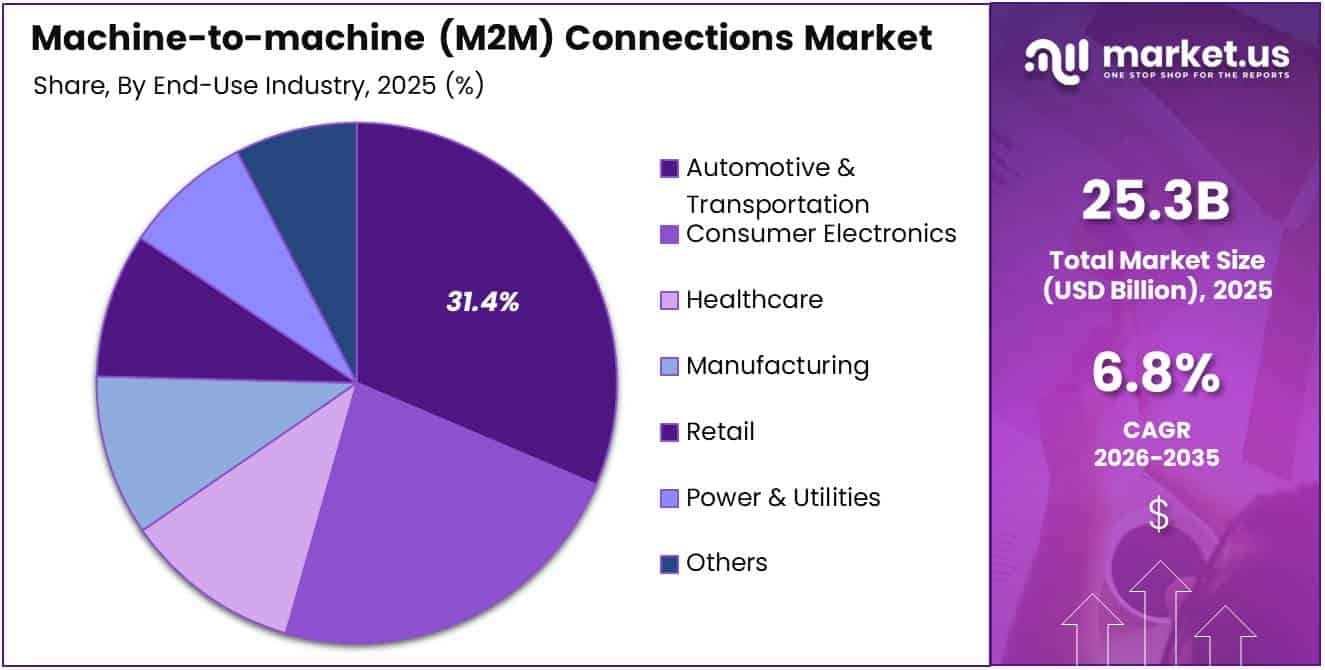
- By End-Use Industry, Automotive and Transportation leads with a market share of 31.4% in 2025.
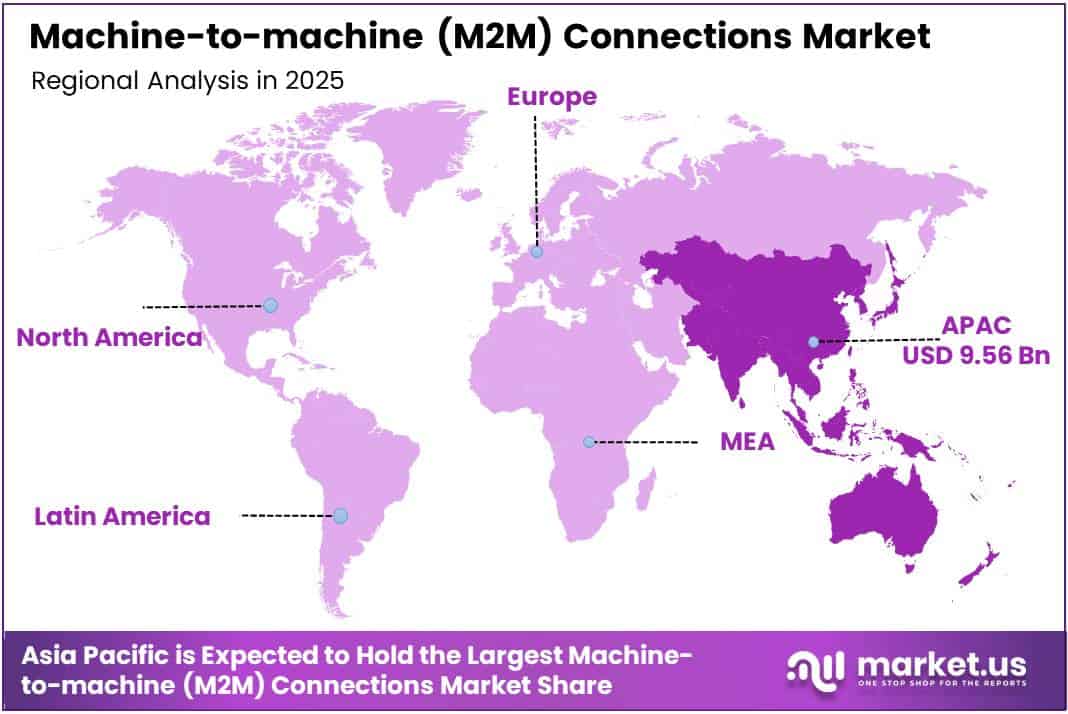
- Asia Pacific is the dominant region, holding a market share of 37.8%, valued at USD 9.56 Billion.
By Technology Analysis
Wired dominates with 60.8% due to its reliability and established industrial infrastructure.
In 2025, Wired held a dominant market position in the By Technology segment of the Machine-to-Machine (M2M) Connections Market, with a 60.8% share. Wired M2M technology continues to lead due to its high data reliability, consistent performance, and widespread deployment in fixed industrial environments. Additionally, legacy infrastructure compatibility makes it the preferred choice in manufacturing and utilities.
The Wireless segment is experiencing accelerating growth as 5G, LPWAN, and cellular networks expand globally. Wireless M2M connections offer flexibility, scalability, and remote deployment capabilities that wired systems cannot match. Moreover, rising demand for mobile asset tracking, connected vehicles, and smart healthcare devices is driving rapid adoption of wireless M2M solutions across multiple industries.
By End-Use Industry Analysis
Automotive and Transportation dominates with 31.4% due to high telematics and connected vehicle adoption.
In 2025, Automotive and Transportation held a dominant market position in the By End-Use Industry segment of the M2M Connections Market, with a 31.4% share. This leadership reflects strong adoption of vehicle telematics, fleet management systems, and connected mobility platforms. Furthermore, regulatory mandates for vehicle tracking and safety systems are reinforcing M2M integration across automotive supply chains.
Consumer Electronics is a growing segment driven by the proliferation of smart home devices, wearables, and connected appliances. M2M connectivity enables seamless device synchronization and remote control capabilities. Consequently, consumer demand for integrated and automated home ecosystems is supporting steady expansion of M2M applications in this segment.
Healthcare is emerging as a high-value segment for M2M connections, particularly in remote patient monitoring and medical device integration. Connected health devices rely on M2M communication to transmit real-time patient data to care providers. Therefore, the growing aging population and rising chronic disease burden are fueling M2M adoption across hospital and home care settings.
Manufacturing is leveraging M2M connectivity to power smart factory operations, predictive maintenance, and production line automation. Sensor networks embedded in industrial equipment communicate performance data continuously. Moreover, integration with edge computing systems allows manufacturers to process data locally and reduce response times across automated workflows.
Retail is adopting M2M solutions for inventory tracking, point-of-sale automation, and supply chain visibility. Real-time data from connected shelf sensors and logistics systems improves operational efficiency. Additionally, M2M technology supports automated replenishment and loss prevention programs across both physical and omnichannel retail environments.
Power and Utilities use M2M connections to manage smart grid operations, remote meter reading, and infrastructure monitoring. These applications reduce manual inspection costs and improve outage response times. Furthermore, regulatory requirements for energy efficiency and grid modernization are pushing utilities to expand M2M-enabled networks across distribution systems.
Others include agriculture, education, and public safety sectors that are progressively integrating M2M solutions for automation and monitoring. Smart irrigation, environmental sensing, and surveillance systems represent growing use cases. Consequently, cross-sector adoption is broadening the overall demand base for M2M connection technologies beyond traditional verticals.
Key Market Segments
By Technology
- Wired
- Wireless
By End-Use Industry
- Automotive and Transportation
- Consumer Electronics
- Healthcare
- Manufacturing
- Retail
- Power and Utilities
- Others
Drivers
Industrial IoT Expansion and Next-Generation Connectivity Drive M2M Market Growth
The rapid expansion of Industrial IoT deployments across manufacturing and utilities is a primary driver for the M2M connections market. Factories and energy providers are embedding connected sensors and communication modules into operational systems. Consequently, demand for reliable, scalable M2M infrastructure to support automated processes is growing steadily across industrial sectors.
Accelerated adoption of 5G and LPWAN networks is enabling more reliable, low-latency M2M communication at scale. These technologies support massive device connectivity with minimal power consumption. Moreover, network operators are expanding coverage into industrial zones and remote areas, making M2M deployment feasible for applications previously constrained by connectivity limitations.
Growing demand for real-time asset tracking and remote monitoring solutions is further driving M2M adoption. Businesses across logistics, healthcare, and utilities require continuous visibility into equipment status and location. Therefore, organizations are investing in M2M platforms to reduce downtime, improve asset utilization, and respond faster to operational events across distributed environments.
Restraints
Interoperability Issues and Security Vulnerabilities Restrain M2M Market Expansion
Interoperability challenges across diverse communication protocols and legacy systems present a significant barrier to M2M adoption. Many organizations operate multi-vendor environments where devices use incompatible standards. Consequently, integrating new M2M solutions with existing infrastructure requires substantial technical effort, increasing deployment complexity and extending project timelines for enterprises.
Heightened concerns around data security, privacy, and network vulnerabilities are limiting confidence in M2M deployments. Connected device networks create multiple potential entry points for cyberattacks. Moreover, sensitive data transmitted between machines in healthcare, utilities, and financial systems must meet strict regulatory standards, adding compliance burdens that slow down deployment decisions.
The lack of unified global standards for M2M communication compounds these challenges. Fragmented regulatory environments across regions create additional complexity for solution providers and enterprise buyers. Therefore, organizations operating across multiple markets face elevated costs and risks when standardizing M2M platforms, particularly where data sovereignty and cross-border communication regulations differ significantly.
Growth Factors
Healthcare Monitoring, Connected Vehicles, and Edge Computing Accelerate M2M Market Growth
Rising deployment of M2M solutions in healthcare remote patient monitoring represents a major growth opportunity. Connected devices enable continuous transmission of patient vitals to clinical systems without manual intervention. Moreover, aging global populations and increasing demand for home-based care are creating sustained investment in M2M-enabled medical monitoring infrastructure across both developed and emerging healthcare markets.
Expansion of connected vehicle ecosystems and telematics platforms is driving significant M2M growth in the automotive sector. Vehicles increasingly rely on M2M connectivity for diagnostics, navigation, insurance telematics, and fleet management. Consequently, automakers and fleet operators are integrating advanced M2M modules to improve vehicle performance visibility and meet regulatory requirements for safety and emissions tracking.
Increasing use of edge computing to optimize data processing efficiency is enhancing the value of M2M deployments. Processing data at the network edge reduces latency and bandwidth usage for time-sensitive applications. Additionally, edge-enabled M2M systems allow real-time responses to operational events, making them particularly valuable in manufacturing, energy management, and autonomous vehicle control environments.
Emerging Trends
eSIM Adoption, AI Integration, and Cloud-Native Platforms Shape the Future of M2M Connectivity
The shift toward embedded SIM (eSIM) and integrated SIM (iSIM) technologies is transforming M2M device management. These solutions eliminate the need for physical SIM replacement and enable remote provisioning of connectivity profiles. Moreover, eSIM and iSIM adoption reduces hardware complexity and supports global roaming, making it easier to deploy and manage large-scale M2M device fleets.
Convergence of M2M platforms with AI-driven analytics capabilities is enabling smarter, more autonomous device networks. Machine learning models applied to M2M data streams can detect anomalies, predict failures, and optimize operational parameters automatically. Consequently, organizations are increasingly selecting M2M platforms that offer built-in AI and analytics features to extract greater operational value from connected device data.
Adoption of cloud-native M2M connectivity management platforms is accelerating as enterprises seek scalable and flexible infrastructure. Cloud-native architectures allow organizations to manage millions of connected devices through centralized dashboards with real-time visibility. Additionally, these platforms offer faster deployment cycles, lower upfront costs, and seamless integration with enterprise systems such as ERP and supply chain management solutions.
Regional Analysis
Asia Pacific Dominates the M2M Connections Market with a Market Share of 37.8%, Valued at USD 9.56 Billion
Asia Pacific leads the global M2M Connections Market, holding a dominant share of 37.8% and valued at USD 9.56 Billion in 2025. The region benefits from rapid industrialization, large-scale 5G rollouts, and strong government support for smart city and digital manufacturing initiatives. Moreover, high device manufacturing output in China, Japan, and South Korea accelerates M2M module integration across sectors.
North America M2M Connections Market Trends
North America represents a mature and highly advanced M2M market, driven by strong enterprise IoT adoption and extensive telecommunications infrastructure. The United States leads regional demand through deployments in automotive telematics, healthcare monitoring, and industrial automation. Additionally, major technology investment and favorable regulatory frameworks continue to support sustained growth across the region.
Europe M2M Connections Market Trends
Europe maintains a significant share of the global M2M market, supported by stringent regulatory requirements for connected vehicle safety, smart energy grids, and industrial automation. Germany, the UK, and France are key contributors to regional M2M adoption. Furthermore, EU-level digital transformation programs and sustainability mandates are driving continued investment in M2M-enabled infrastructure across the continent.
Middle East and Africa M2M Connections Market Trends
The Middle East and Africa region is at an early but accelerating stage of M2M adoption, with growth driven by smart city projects, oil and gas infrastructure monitoring, and expanding mobile networks. GCC countries are investing heavily in digital infrastructure as part of national economic diversification programs. Consequently, M2M demand across utilities and public safety applications is rising steadily.
Latin America M2M Connections Market Trends
Latin America is a growing market for M2M connections, led by Brazil and Mexico across sectors such as logistics, agriculture, and retail. Increasing mobile penetration and government-backed digital inclusion programs are supporting network expansion. However, economic volatility and uneven connectivity infrastructure in rural areas continue to moderate the pace of large-scale M2M deployments across the region.
Key Regions and Countries
North America
- US
- Canada
Europe
- Germany
- France
- The UK
- Spain
- Italy
- Rest of Europe
Asia Pacific
- China
- Japan
- South Korea
- India
- Australia
- Rest of APAC
Latin America
- Brazil
- Mexico
- Rest of Latin America
Middle East & Africa
- GCC
- South Africa
- Rest of MEA
Key Company Insights
AT&T Intellectual Property is a leading force in the M2M connections market, offering end-to-end IoT and connectivity management solutions across enterprise verticals. The company’s broad network coverage and robust developer ecosystem position it as a preferred partner for large-scale M2M deployments. Additionally, its recent cloud-integrated IoT offerings reflect a strategic focus on scalable connectivity solutions for connected industries.
Cisco Systems, Inc. delivers comprehensive M2M networking infrastructure including industrial routers, gateways, and connectivity management platforms. The company’s deep expertise in enterprise networking and cybersecurity makes it a trusted provider for organizations deploying M2M solutions in critical environments. Moreover, Cisco’s ongoing investments in edge computing integration strengthen its position across manufacturing and utilities deployments globally.
Deutsche Telekom AG is a prominent European player in the M2M and IoT connectivity space, providing managed connectivity services across automotive, healthcare, and smart infrastructure sectors. The company leverages its extensive European network footprint and technology partnerships to deliver reliable M2M services. Furthermore, Deutsche Telekom’s focus on eSIM and cloud-native platforms aligns well with evolving enterprise connectivity requirements.
Huawei Technologies Co. Ltd is a globally recognized provider of M2M communication modules, chipsets, and IoT platform solutions. The company offers a broad portfolio of wireless connectivity products that support cellular, LPWAN, and satellite-based M2M applications. Consequently, Huawei’s scale in device manufacturing and network infrastructure gives it strong competitive positioning across Asia Pacific and emerging market deployments.
Key Players
- AT&T Intellectual Property
- Cisco Systems, Inc.
- CommSolid GmbH
- Deutsche Telekom AG
- Huawei Technologies Co. Ltd
- Intel Corporation
- Murata Manufacturing Co. Ltd.
- NXP Semiconductors
- Sierra Wireless
- Texas Instruments Incorporated
- Thales Group
- T-Mobile USA INC
- U-Blox Holding AG
- Virscient Limited
- Vodafone Group
- Others
Recent Developments
- January 2026 – AT&T launched its first end-to-end IoT solution on the AWS Marketplace under the Connected Spaces initiative, expanding enterprise access to integrated M2M and cloud services. This development strengthens AT&T’s position in the cloud-connected IoT ecosystem and broadens its commercial IoT service reach.
- August 2025 – Private equity firm Advent International agreed to acquire U-Blox Holding AG for approximately CHF 1.05 billion (around USD 1.3 billion) through a public tender offer, intending to delist the company. The acquisition aims to accelerate U-Blox’s growth across M2M, positioning, and connectivity technology segments.
Report Scope
Report Features Description Market Value (2025) USD 25.3 Billion Forecast Revenue (2035) USD 48.8 Billion CAGR (2026-2035) 6.8% Base Year for Estimation 2025 Historic Period 2020-2024 Forecast Period 2026-2035 Report Coverage Revenue Forecast, Market Dynamics, Competitive Landscape, Recent Developments Segments Covered By Technology (Wired, Wireless), By End-Use Industry (Automotive and Transportation, Consumer Electronics, Healthcare, Manufacturing, Retail, Power and Utilities, Others) Regional Analysis North America (US and Canada), Europe (Germany, France, The UK, Spain, Italy, and Rest of Europe), Asia Pacific (China, Japan, South Korea, India, Australia, and Rest of APAC), Latin America (Brazil, Mexico, and Rest of Latin America), Middle East & Africa (GCC, South Africa, and Rest of MEA) Competitive Landscape AT&T Intellectual Property, Cisco Systems Inc., CommSolid GmbH, Deutsche Telekom AG, Huawei Technologies Co. Ltd, Intel Corporation, Murata Manufacturing Co. Ltd., NXP Semiconductors, Sierra Wireless, Texas Instruments Incorporated, Thales Group, T-Mobile USA INC, U-Blox Holding AG, Virscient Limited, Vodafone Group, Others Customization Scope Customization for segments, region/country-level will be provided. Moreover, additional customization can be done based on the requirements. Purchase Options We have three licenses to opt for: Single User License, Multi-User License (Up to 5 Users), Corporate Use License (Unlimited User and Printable PDF)  Machine-to-machine (M2M) ConnectionsPublished date: Feb 2026add_shopping_cartBuy Now get_appDownload Sample
 -
-
- AT&T Intellectual Property
- Cisco Systems, Inc.
- CommSolid GmbH
- Deutsche Telekom AG
- Huawei Technologies Co. Ltd
- Intel Corporation
- Murata Manufacturing Co. Ltd.
- NXP Semiconductors
- Sierra Wireless
- Texas Instruments Incorporated
- Thales Group
- T-Mobile USA INC
- U-Blox Holding AG
- Virscient Limited
- Vodafone Group
- Others
Our Clients

- 178586
- Feb 2026






