Report Overview
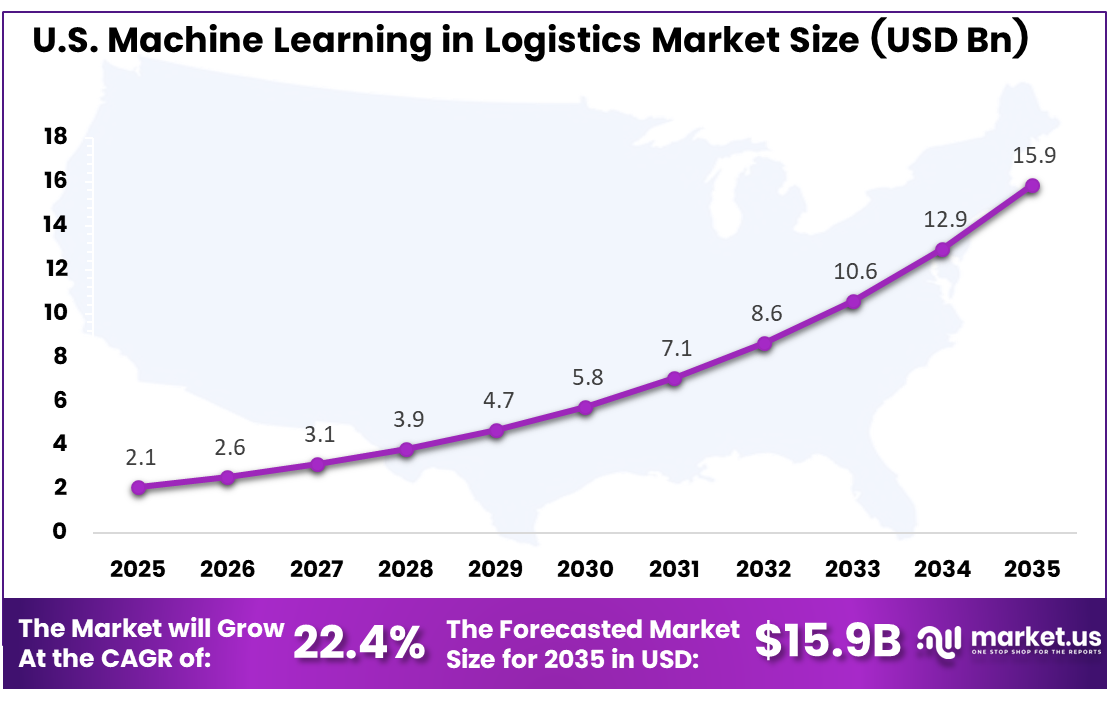
The Global Machine Learning in Logistics Market size is expected to be worth around USD 47.6 billion by 2035, from USD 5.1 billion in 2025, growing at a CAGR of 24.9% during the forecast period from 2026 to 2035. North America held a dominant market position, capturing more than 44.8% share and generating USD 2.2 billion in revenue.
Machine Learning in Logistics refers to the use of intelligent algorithms to improve transport, warehousing, inventory, and delivery operations. It helps logistics teams study large data sets, predict demand, plan better routes, reduce delays, and improve asset use. These systems support faster decisions and more reliable supply chain performance.
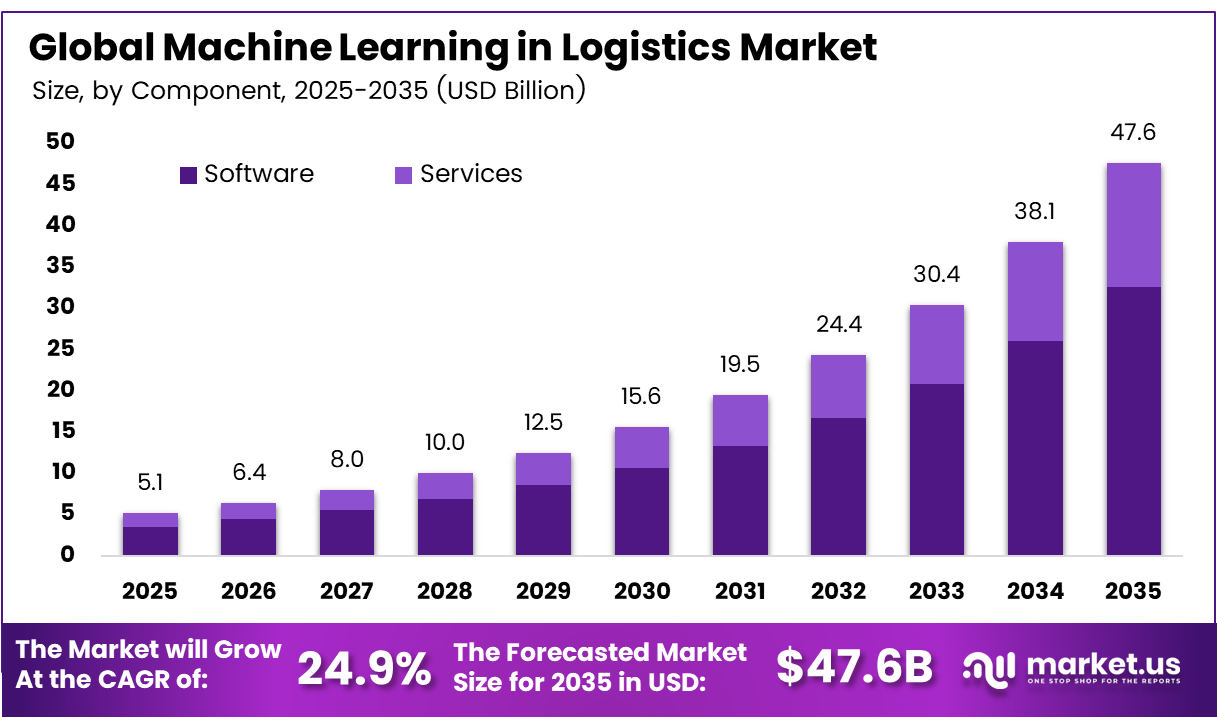
Top driving factors include rising e-commerce volumes, growing pressure to reduce transport emissions, and the need for 24 by 7 visibility across global supply chains. Companies are also using advanced models to manage driver shortages and fuel cost changes. These tools help reduce route distance and idle time by several percentage points at a large network scale.
The market for Machine Learning in Logistics is driven by the rising need for smarter logistics planning, faster delivery, and better control over complex supply chains. Companies are adopting these tools to improve demand forecasting, route planning, warehouse flow, and fleet performance. Growing e-commerce activity, fuel cost pressure, and the need to reduce delays are also supporting wider adoption.
Demand is growing as shippers understand the value of better delivery performance and leaner inventory. Even a 5 to 10% gain in on-time delivery and a small reduction in inventory can create strong yearly savings. Large distribution networks are showing higher interest, as thousands of daily orders are difficult to manage through manual systems.
For instance, in October 2025, SAP rolled out additional AI and ML capabilities in SAP Digital Supply Chain, including predictive freight analytics and smart warehouse task assignment. Logistics teams using SAP S/4HANA gain tighter integration between transportation planning, yard operations, and demand sensing, improving on-time delivery and resource utilization.
Key Takeaways
- In 2025, the Software segment held a dominant market position, capturing a 68.5% share of the Global Machine Learning in Logistics Market.
- In 2025, the Cloud-based segment held a dominant market position, capturing a 58.7% share of the Global Machine Learning in Logistics Market.
- In 2025, the Large Enterprises segment held a dominant market position, capturing a 62.8% share of the Global Machine Learning in Logistics Market.
- In 2025, the Demand Forecasting and Planning segment held a dominant market position, capturing a 38.5% share of the Global Machine Learning in Logistics Market.
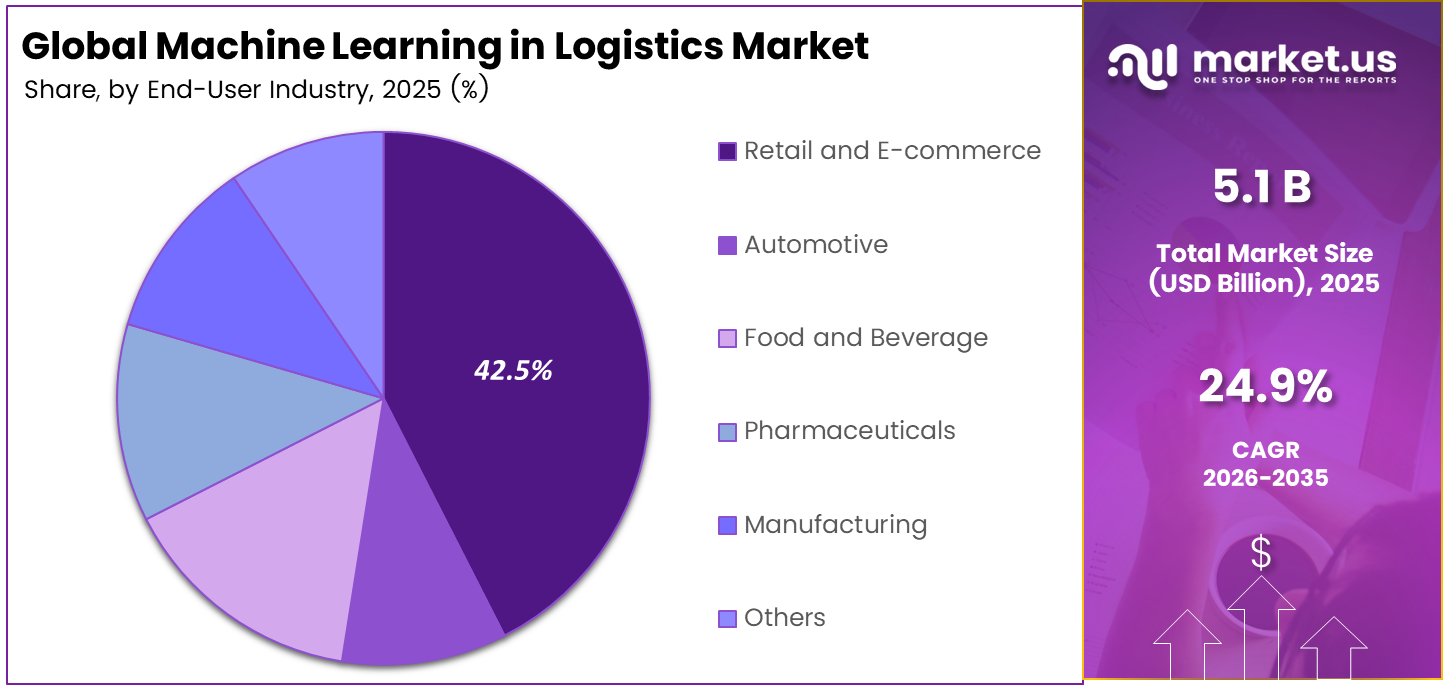
- In 2025, the Retail and E-commerce segment held a dominant market position, capturing a 42.5% share of the Global Machine Learning in Logistics Market.
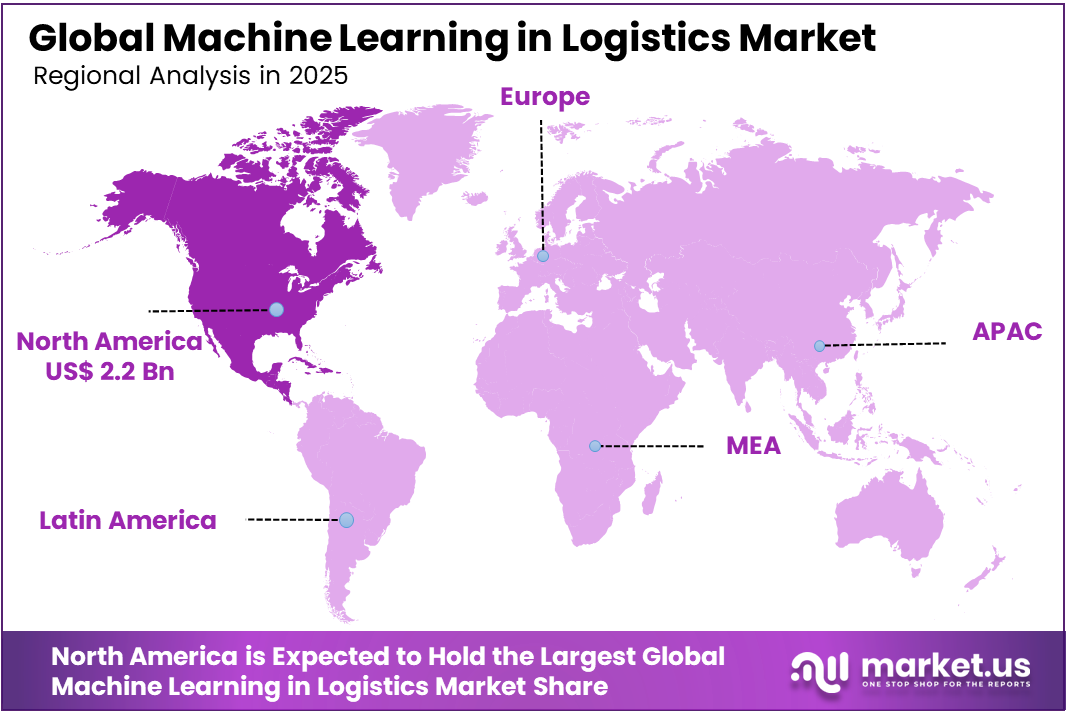
- The U.S. Machine Learning in Logistics Market was valued at USD 2.1 billion in 2025, with a robust CAGR of 22.4%.
- In 2025, North America held a dominant market position in the Global Machine Learning in Logistics Market, capturing more than a 44.8% share.
Role of Generative AI
Generative AI is becoming a useful layer above core machine learning systems in logistics. It helps convert complex supply chain data into clear actions, instructions, and content for planners, operators, and customers. While adoption is rising, many companies are still moving from early testing toward mature and scaled use cases.
Spending on generative AI is increasing as logistics firms test copilots, automated document drafting, tender support, and customer communication tools. These systems help teams prepare shipment updates, operating playbooks, and planning notes faster. The strongest value is expected where repetitive content and decision support can be improved without slowing daily operations.
Investment and Business Benefits
Investment opportunities are increasing in route optimization tools, warehouse automation software, predictive maintenance platforms, and control towers that use analytics to manage different supply chain nodes. Niche providers also have strong scope in areas such as road logistics, cold chain operations, returns handling, and slot booking, where focused solutions can improve speed and operating control.
Business benefits are seen in higher asset use, fewer stockouts, reduced spoilage, and better use of driver hours through smarter dispatch planning. Predictive maintenance is also becoming important, as it can cut unplanned downtime by 20 to 30% when sensor data is used effectively. This supports lower operating losses and more reliable logistics performance.
Regional Analysis
In 2025, North America held a dominant market position in the Global Machine Learning in Logistics Market, capturing more than 44.8% share and generating USD 2.2 billion in revenue. This dominance is due to North America’s strong logistics infrastructure, mature e-commerce ecosystem, and early adoption of advanced digital tools. The region has large warehouse networks, high shipment volumes, and strong demand for faster delivery, which supports wider use of machine learning. Companies are using these systems to improve route planning, inventory control, fleet performance, and demand forecasting while reducing delays and operating pressure across complex supply chains.
For instance, in March 2026, Intel promoted its latest data-center platforms as foundations for large-scale machine-learning workloads in logistics, helping North American carriers and retailers run route optimization, computer-vision inspection, and demand forecasting at scale. By powering many regional clouds and on-premise systems, Intel underpins the infrastructure layer of AI-driven logistics in the U.S.
U.S. Machine Learning in Logistics Market Size
The market for Machine Learning in Logistics within the U.S. is growing tremendously and is currently valued at USD 2.1 billion; the market has a projected CAGR of 22.4%. The market is growing due to the strong expansion of e-commerce, advanced warehouse networks, and rising pressure for faster delivery. Logistics companies are using machine learning to improve routing, demand planning, inventory control, and fleet performance. Adoption is also supported by mature digital infrastructure, high automation spending, and the need to reduce delays, labor gaps, and operating costs across complex supply chains.
For instance, in November 2025, IBM continued to expand Watson-based machine learning for logistics, using Watson Machine Learning on IBM Cloud to help enterprises build, deploy, and manage models for demand forecasting and end-to-end supply-chain visibility. These capabilities support North American shippers and retailers in reducing stockouts, optimizing inventory, and improving on-time deliveries.
Key Regions and Countries
North America
- US
- Canada
Europe
- Germany
- France
- The UK
- Spain
- Italy
- Russia
- Netherlands
- Rest of Europe
Asia Pacific
- China
- Japan
- South Korea
- India
- Australia
- Singapore
- Thailand
- Vietnam
- Rest of APAC
Latin America
- Brazil
- Mexico
- Rest of Latin America
Middle East & Africa
- South Africa
- Saudi Arabia
- UAE
- Rest of MEA
Component Analysis
In 2025, the Software segment held a dominant market position, capturing a 68.5% share of the Global Machine Learning in Logistics Market. This dominance is due to the rising need for intelligent logistics software that can support planning, routing, warehouse visibility, and maintenance decisions. Logistics firms are using software platforms to study large data sets, improve shipment control, and make faster decisions across transport, inventory, and order management activities.
Software also allows companies to connect machine learning models with existing supply chain systems. This makes it easier to manage demand changes, delivery delays, and asset performance from one digital layer. As logistics networks become more complex, software remains central to improving accuracy, speed, and operating discipline.
For instance, in March 2026, IBM introduced a predictive logistics platform that uses machine learning to improve routing, monitor shipments in real time, and flag likely disruptions before they occur. This kind of software shows how machine learning is being embedded directly into logistics workflows, pushing more companies to upgrade from manual tools to intelligent applications.
Deployment Mode Analysis
In 2025, the Cloud-Based segment held a dominant market position, capturing a 58.7% share of the Global Machine Learning in Logistics Market. This dominance is due to the growing preference for flexible logistics systems that can be accessed across warehouses, transport teams, and regional offices. Cloud-based deployment helps companies share real-time information, manage distributed operations, and support faster planning without depending heavily on local infrastructure.
Cloud platforms also support easier updates, better data storage, and smoother integration with other supply chain tools. Logistics firms prefer this model because it can scale with order volumes and new routes. It also helps decision makers track operations more clearly across multiple locations and partners.
For instance, in January 2025, Oracle announced new AI-enabled logistics and order management features within its cloud supply chain suite. Delivered as SaaS, these capabilities let shippers improve routing decisions, predict transit issues, and manage global trade from a single cloud environment, reinforcing why many logistics teams prefer cloud deployment for flexibility and faster updates.
Organization Size Analysis
In 2025, the Large Enterprises segment held a dominant market position, capturing a 62.8% share of the Global Machine Learning in Logistics Market. This dominance is due to the wide logistics networks and complex supply chain needs of large enterprises. These companies handle higher shipment volumes, multiple warehouses, and broad customer bases, which makes machine learning more useful for routing, demand planning, risk tracking, and inventory coordination.
Large enterprises also have stronger budgets and internal teams to adopt advanced logistics systems. They can invest in machine learning tools to improve asset use, reduce delays, and manage large data flows. Even small improvements in planning can create meaningful operational gains across their wider networks.
For instance, in October 2025, SAP detailed new AI-powered supply chain orchestration tools aimed at large, networked enterprises. These solutions connect planning, logistics, and procurement into one intelligent layer, enabling multinational companies to detect risks, coordinate responses, and standardize decisions across regions, which is driving machine learning adoption among big organizations first.
Application Analysis
In 2025, the Demand Forecasting and Planning segment held a dominant market position, capturing a 38.5% share of the Global Machine Learning in Logistics Market. This dominance is due to the strong need for accurate demand visibility in modern logistics. Companies use machine learning to study order patterns, seasonal changes, customer behavior, and stock movement. This helps planners make better decisions on inventory, transport capacity, and warehouse preparation.
Demand forecasting and planning also help reduce stock shortages and excess inventory. Logistics firms can respond faster when demand shifts across regions or product categories. Better planning supports smoother deliveries, lower waste, and improved coordination between suppliers, warehouses, carriers, and retail channels.
For instance, in June 2025, AWS Supply Chain added new planning features that use machine learning to anticipate demand patterns and support upstream supply decisions. These enhancements help logistics and supply chain teams react earlier to demand shifts, align capacity, and reduce uncertainty, which is exactly why demand forecasting and planning are leading use cases.
End-User Industry Analysis
In 2025, the Retail and E-commerce segment held a dominant market position, capturing a 42.5% share of the Global Machine Learning in Logistics Market. This dominance is due to the fast movement of online orders, frequent delivery changes, and high customer expectations in retail and e-commerce. These businesses need machine learning to improve order routing, delivery planning, inventory placement, and return handling across large and active networks.
Retail and e-commerce firms also depend on strong logistics visibility to manage short delivery windows and changing demand patterns. Machine learning helps them forecast orders, reduce delays, and improve warehouse flow. This supports better customer service while helping companies control costs in highly active fulfillment environments.
For instance, in October 2025, NVIDIA showcased digital twin technology that lets retailers simulate warehouse operations and last-mile delivery using AI. By testing different layouts and routing strategies virtually, retail and e-commerce players can improve fulfillment speed and reliability, which strengthens the business case for machine learning in their logistics networks.
Key Market Segments
By Component
- Software
- Services
By Deployment Mode
- Cloud-based
- On-premises
By Organization Size
- Large Enterprises
- Small and Medium-sized Enterprises
By Application
- Demand Forecasting and Planning
- Route Optimization
- Warehouse Automation
- Fleet Management
- Supply Chain Visibility
- Others
By End-User Industry
- Retail and E-commerce
- Automotive
- Food and Beverage
- Pharmaceuticals
- Manufacturing
- Others
Emerging Trends
Machine learning is becoming a key part of dynamic routing, demand forecasting, predictive maintenance, and quality checks across logistics operations. Models now use traffic data, route history, and driver behavior to improve trip planning. Computer vision is also being used to detect damaged parcels, wrong labels, and warehouse handling issues earlier.
Another major trend is the use of machine learning with Internet of Things sensors and digital twins. These tools help logistics operators simulate warehouse flows, test network changes, and manage capacity with live data. This is becoming more important as e-commerce volumes remain high and customers expect faster delivery windows.
Growth Factors
Several long-term forces are supporting the growth of machine learning in logistics. Global trade is becoming more complex, customer expectations are rising, and companies face cost pressure from fuel, labor, and asset use. Machine learning helps firms improve service reliability while reducing dependence on manual planning and fixed operating rules.
E-commerce growth is also creating more volatile parcel demand and smaller delivery windows. Traditional planning tools often struggle with these fast-changing patterns. Machine learning supports better forecasting, inventory planning, and route decisions, helping companies reduce stockouts and excess stock at the same time while improving overall supply chain efficiency.
Market Dynamics
Drivers - Need for Smarter Logistics Planning
The market is driven by the need for smarter logistics planning as supply chains become more complex and time-sensitive. Machine learning helps logistics teams study shipment patterns, route conditions, warehouse activity, and customer demand to make better daily decisions with greater accuracy.
It also supports faster response to delivery delays, demand changes, and transport disruptions. Companies are using these tools to improve route planning, fleet use, and inventory movement. This helps reduce manual effort while improving service reliability across wider logistics networks.
For instance, in April 2026, Microsoft showcased its Intelligent Fulfillment Service for the cloud supply chain, combining machine learning, optimization, and generative AI to speed shipment planning and reduce decision time from days to minutes. The same principles can help event logistics teams simulate scenarios for equipment moves, stage builds, and attendee flows, then lock in better plans earlier.
Restraints - Data and Integration Gaps
Data and integration gaps remain a major restraint for the market. Many logistics firms still use separate systems for transport, warehouse, inventory, and customer orders. When these systems do not connect properly, machine learning models may receive incomplete or inconsistent data.
This makes implementation slower and less effective, especially for firms with older technology setups. Poor data quality can reduce trust in model outputs and delay adoption. Companies need better data cleaning, system integration, and process alignment before machine learning can deliver strong operational value.
For instance, in October 2025, IBM’s partnership with S&P Global to embed AI agents in supply chain tools highlighted how data silos across procurement, trade, and risk sources complicate analytics. The collaboration aims to knit these datasets together, showing that even large players must invest heavily to overcome fragmented information before AI can fully support event logistics decisions.
Opportunities - Predictive and Automated Operations
Predictive and automated operations offer strong opportunities for machine learning in logistics. These systems can help firms forecast demand, identify equipment issues early, improve warehouse planning, and support smarter dispatch decisions. This allows logistics teams to act before problems affect delivery performance.
Automation also supports better coordination across transport, storage, and customer service functions. Machine learning can guide routing, inventory placement, and maintenance planning with less manual intervention. As delivery expectations rise, such tools can help companies improve speed, control costs, and strengthen service quality.
For instance, in May 2026, Logility emphasizes decision-centric, AI-powered orchestration that keeps supply chains moving forward. Event logistics managers using Logility can lean on predictive and automated planning to adjust sourcing, transport, and inventory positions as ticket sales, weather, and supplier signals change closer to the event date.
Challenges - Skills Gap
The skills gap is a key challenge for machine learning adoption in logistics. Many companies need employees who understand both logistics operations and data-driven systems. Without trained teams, it becomes difficult to build, manage, and apply machine learning models in daily workflows.
Operational staff may also hesitate to trust automated recommendations if the system is not clearly explained. Training, governance, and gradual adoption are needed to build confidence. Firms that fail to develop internal skills may struggle to scale machine learning beyond small pilot projects.
For instance, in August 2025, Manhattan’s AI-driven capabilities require customers to adopt new ways of working, often supported by training and change programs. Event logistics operations, especially those with seasonal staff, face a challenge in embedding these skills across teams, potentially slowing the shift from manual to AI-assisted decisions.
Key Players Analysis
One of the leading players in December 2025, IBM expanded its WatsonX-based optimization and forecasting tools for supply chain planning, packaging them with industry blueprints for logistics, retail, and manufacturing clients in North America. This move underpins IBM’s role in machine-learning-driven demand sensing, route planning, and inventory optimization across complex global networks.
Top Key Players in the Market
- IBM Corporation
- Google LLC
- Microsoft Corporation
- Amazon Web Services Inc.
- Oracle Corporation
- SAP SE
- NVIDIA Corporation
- Intel Corporation
- FICO (Fair Isaac Corporation)
- Blue Yonder (Panasonic)
- Manhattan Associates Inc.
- C3.ai Inc.
- Llamasoft (Coupa)
- Element AI (ServiceNow)
- Logility Inc.
- Others
Recent Developments
- In January 2026, AWS added new generative and ML templates on AWS Supply Chain and Amazon Forecast tailored for transportation planning and warehouse slotting. Logistics users can now stand up predictive models faster, using pre-built data schemas that address shipment delays, capacity utilization, and last-mile delivery performance.
- In November 2025, Oracle upgraded its Fusion Cloud Supply Chain & Manufacturing suite with enhanced embedded machine-learning for ETA prediction, carrier selection, and inventory positioning. For logistics-intensive industries, this reduces manual exception handling and supports more reliable, cost-optimized freight decisions across ocean, air, and ground modes.
Report Scope
| Report Features | Description |
|---|---|
| Market Value (2025) | USD 5.1 Billion |
| Forecast Revenue (2035) | USD 47.6 Billion |
| CAGR (2026-2035) | 24.9% |
| Base Year for Estimation | 2025 |
| Historic Period | 2020-2024 |
| Forecast Period | 2026-2035 |
| Report Coverage | Revenue Forecast, Market Dynamics, Competitive Landscape, Recent Developments |
| Segments Covered | By Component (Software, Services), By Deployment Mode (Cloud-based, On-premises), By Organization Size (Large Enterprises, Small and Medium-sized Enterprises), By Application (Demand Forecasting and Planning, Route Optimization, Warehouse Automation, Fleet Management, Supply Chain Visibility, Others), By End-User Industry (Retail and E-commerce, Automotive, Food and Beverage, Pharmaceuticals, Manufacturing, Others) |
| Regional Analysis | North America (US and Canada), Europe (Germany, France, The UK, Spain, Italy, and Rest of Europe), Asia Pacific (China, Japan, South Korea, India, Australia, and Rest of APAC), Latin America (Brazil, Mexico, and Rest of Latin America), Middle East & Africa (GCC, South Africa, and Rest of MEA) |
| Competitive Landscape | IBM Corporation, Google LLC, Microsoft Corporation, Amazon Web Services Inc., Oracle Corporation, SAP SE, NVIDIA Corporation, Intel Corporation, FICO (Fair Isaac Corporation), Blue Yonder (Panasonic), Manhattan Associates Inc., C3.ai Inc., Llamasoft (Coupa), Element AI (ServiceNow), Logility Inc., Others |
| Customization Scope | Customization at the segment and region/country levels will be provided. Moreover, customization can be tailored to the requirements. |
| Purchase Options | We have three licenses to opt for: Single User License, Multi-User License (Up to 5 Users), Corporate Use License (Unlimited Users and Printable PDF) |