Report Overview
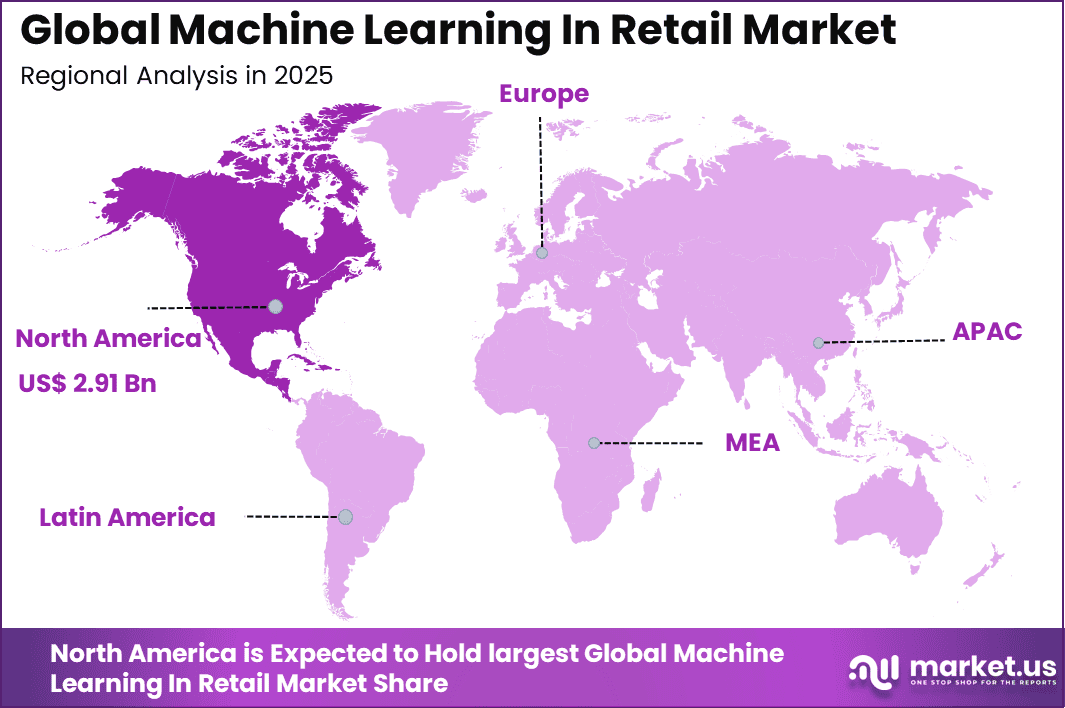
The Global Machine Learning In Retail Market size is expected to be worth around USD 82.3 billion by 2035, from USD 7.6 billion in 2025, growing at a CAGR of 26.9% during the forecast period from 2025 to 2035. North America held a dominant market position, capturing more than a 38.4% share, holding USD 2.91 billion in revenue.
Machine Learning in Retail refers to the use of advanced algorithms and data models to analyze customer behavior, sales patterns, and operational data. It helps retailers make smarter decisions, such as improving product recommendations, managing inventory, and optimizing pricing. This approach enables more efficient operations and enhances the overall shopping experience for customers.
Retail adoption of machine learning is increasing as customers expect faster and more personalized shopping experiences. Nearly 70% of shoppers now prefer recommendations aligned with their preferences, encouraging retailers to adopt intelligent systems. Growing volumes of transactional and behavioral data further require advanced tools to process insights efficiently and maintain competitive positioning in dynamic retail environments.
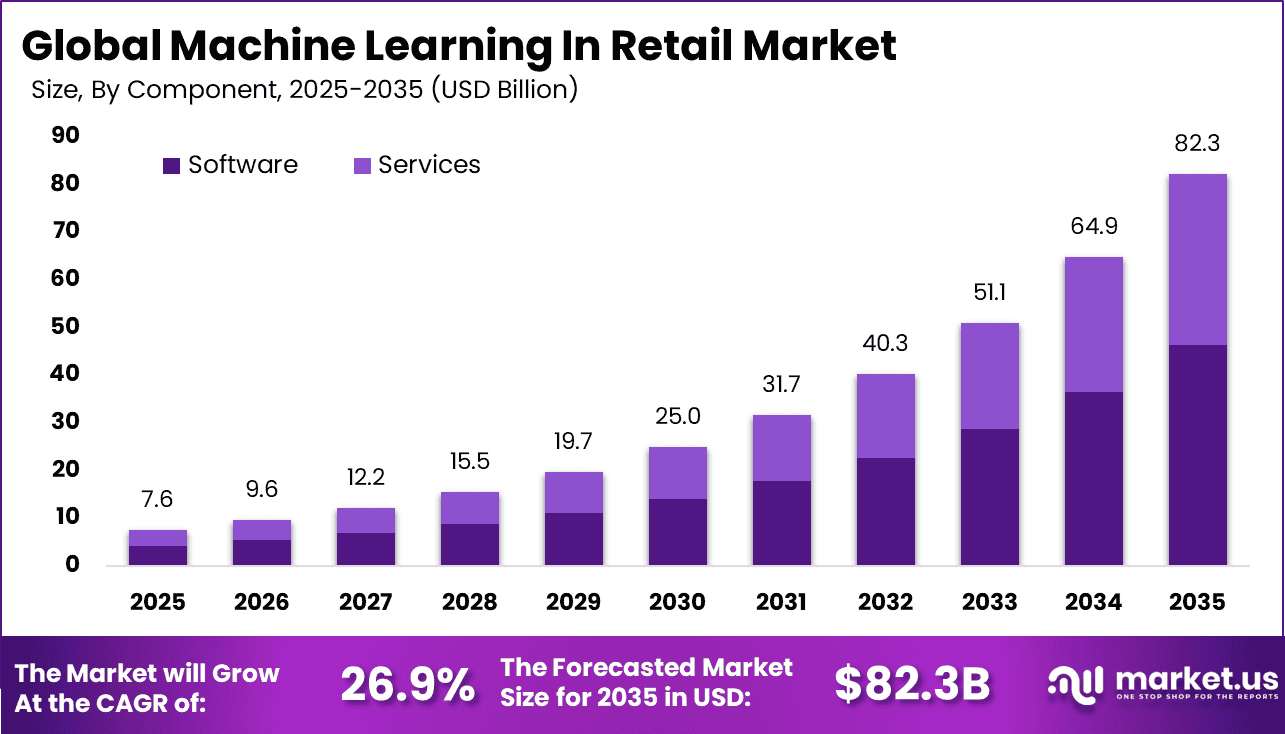
The market for Machine Learning in Retail is driven by the growing need to understand customer behavior, improve product recommendations, and manage inventory more efficiently. Retailers are using these tools to make faster decisions from large volumes of sales and shopping data. The rise of digital commerce and higher expectations for personalized experiences are also encouraging wider adoption across retail operations.
Demand for machine learning in retail is rising steadily with the expansion of mobile and online shopping channels. Retailers benefit from improved inventory management, with over 20% fewer stockouts observed through predictive systems. Enhanced product availability and timely recommendations contribute to stronger customer retention, supporting consistent demand across both large retail chains and independent stores.
For instance, in March 2025, Algolia launched an AI‑powered “Commerce‑Search” module built on large‑language models, designed to improve product discovery and intent‑driven ranking for online retailers. The new capability auto‑learns from user queries and past behavior, allowing brands to serve more intuitive search results and personalized category experiences at scale.
Key Takeaway
- In the machine learning in retail market, software accounted for 56.4%, showing strong demand for analytics and automation platforms.
- Cloud-based deployment led with 63.8%, supported by scalability, flexibility, and easier integration across retail operations.
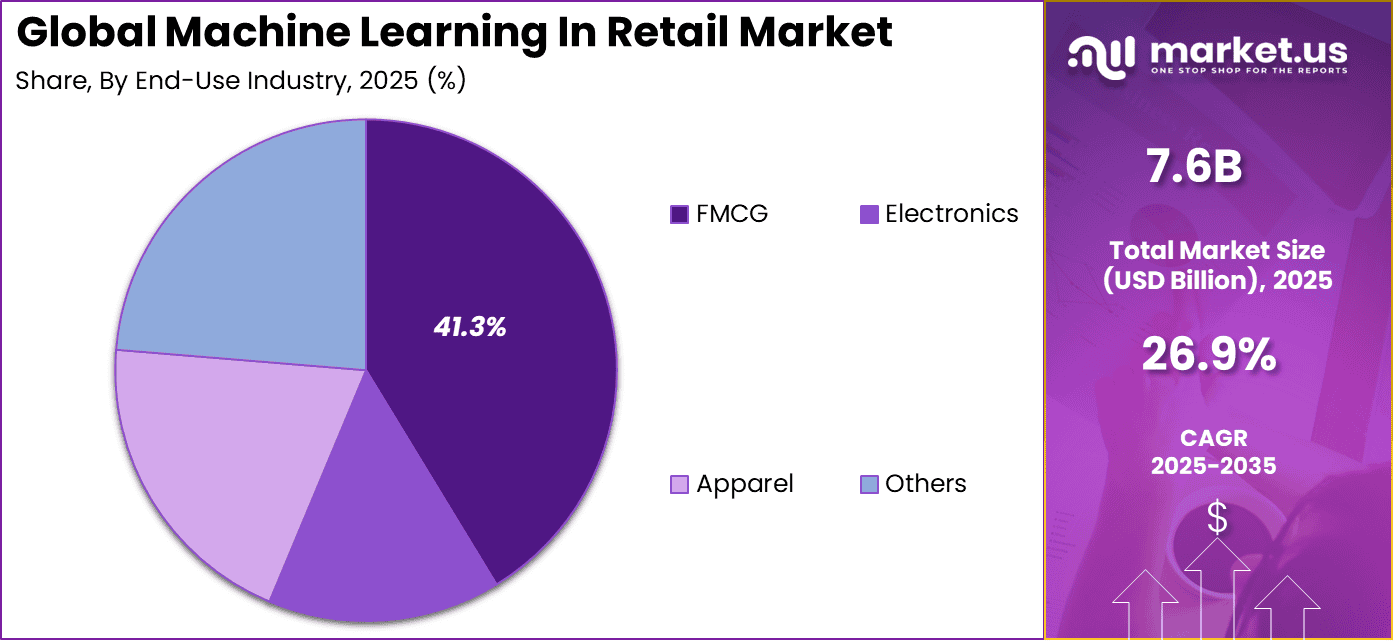
- The FMCG segment held 41.3%, reflecting high adoption in pricing, demand forecasting, and inventory optimization.
- North America captured 38.4% of the market, driven by strong digital retail infrastructure and early AI adoption.
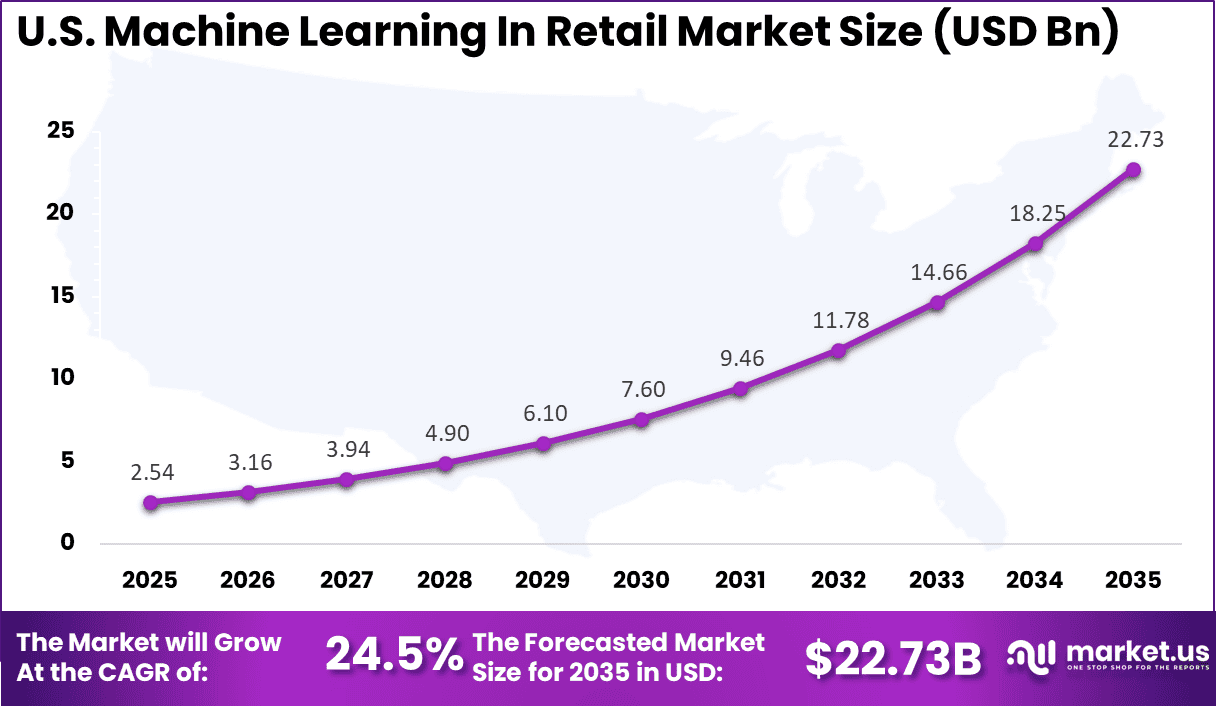
- The U.S. market was valued at USD 2.54 billion, and it is projected to expand at a CAGR of 24.5%.
Key Performance Statistics
- Retailers using AI and machine learning report nearly 8% annual profit growth, while sales and profit growth reached 14.2% between 2023 and 2024, compared with 6.9% for traditional approaches.
- Machine learning-based forecasting can achieve up to 95% accuracy, helping reduce inventory costs by 40% and cut stockouts by 60%.
- Businesses adopting these systems report a 10% to 30% reduction in total operational costs across logistics and marketing functions.
- Retail AI investments generate an average return of 3.7x, while top-performing organizations have achieved returns as high as 10.3x.
- Recommendation engines can contribute around 35% of total sales on major retail platforms.
- Personalization can increase conversion rates by up to 40% and improve customer retention by 15%.
- Dynamic pricing supported by machine learning can improve profit margins by nearly 15% through real-time price adjustments.
- Generative AI in customer service can lower service costs by about 30%.
- AI-led fraud detection tools can identify suspicious activity in milliseconds, with some systems improving authorization rates by 300 basis points.
- Computer vision applications such as virtual try-on tools have delivered conversion gains of 20% to 45%.
- Amazon has been reported to change product prices nearly 2.5 million times per day using machine learning-driven pricing systems.
- Walmart’s automated inventory systems can process up to 360,000 inventory transactions per second.
- Zara has reduced the turnaround time for new designs to nearly 1 week, compared with the typical industry range of 3 to 6 months.
- Starbucks has reported a 12% increase in average order value when customers accept AI-based personalized drink recommendations.
Component Analysis
In 2025, the software segment held a dominant share of 56.4% in the machine learning in retail market, driven by the increasing adoption of analytics platforms and AI-driven applications. Retailers are leveraging software solutions for demand forecasting, customer behavior analysis, and personalized recommendations. These tools help improve operational efficiency and enhance decision-making across supply chain and sales functions. As digital retail continues to expand, software solutions remain central to machine learning adoption.
The segment’s growth is further supported by the need for real-time data processing and automation in retail operations. Advanced algorithms are being integrated into retail systems to optimize pricing, inventory, and customer engagement strategies. Retailers are also investing in scalable software platforms that can adapt to changing consumer patterns. This has strengthened the role of software as the foundation of machine learning applications in the retail sector.
For Instance, in November 2025, SAS Institute Inc. rolled out new forecast and optimization templates in its retail‑specific analytics suite, integrating ML into assortment planning and markdown management. These packaged software capabilities make it easier for retailers to standardize ML processes across stores and channels, further cementing software as the core component of retail ML stacks.
Deployment Analysis
In 2025, the cloud-based segment accounted for 63.8% share, reflecting strong demand for flexible and scalable deployment models. Retailers are increasingly adopting cloud infrastructure to manage large volumes of data and support machine learning applications. Cloud platforms enable real-time analytics, remote accessibility, and seamless integration with other digital systems. This has made cloud deployment a preferred choice for modern retail operations.
The growth of this segment is also driven by cost efficiency and faster implementation compared to traditional systems. Cloud-based solutions reduce the need for heavy infrastructure investments and allow businesses to scale operations as needed. Retailers benefit from continuous updates and improved system performance without additional maintenance efforts. As digital transformation accelerates, cloud deployment continues to dominate the market.
For instance, in January 2026, Microsoft Corp unveiled expanded retail scenarios on Azure that run machine learning models at the edge while syncing training data back to the cloud. This hybrid setup lets retailers benefit from low‑latency in‑store decisions without giving up the flexibility and scalability of cloud‑based ML infrastructure.
End-Use Industry Analysis
In 2025, the FMCG segment held a leading share of 41.3%, supported by the sector’s high transaction volumes and dynamic consumer demand. Fast-moving consumer goods companies rely on machine learning to optimize inventory, predict demand, and enhance supply chain efficiency. The use of AI-driven insights helps improve product availability and reduce wastage. This has made machine learning a critical tool for managing large-scale retail operations in the FMCG sector.
The segment’s dominance is further reinforced by the growing importance of customer personalization and targeted marketing. FMCG companies are using machine learning algorithms to analyze purchasing patterns and deliver customized offers. This improves customer engagement and drives sales growth. As competition intensifies in the retail sector, the adoption of machine learning technologies continues to expand within FMCG operations.
For Instance, in March 2026, SAP SE deepened its integration between its retail and supply‑chain applications, using ML to surface demand shifts and out‑of‑stock risks for FMCG product lines. This integration helps FMCG players respond faster to changing consumer behavior, which is why so many of them are investing heavily in ML‑enabled retail systems.
Regional Analysis
In 2025, North America accounted for 38.4% of the machine learning in retail market, supported by advanced digital infrastructure and high adoption of AI technologies. Retailers in the region are early adopters of machine learning solutions to improve operational efficiency and customer experience. The presence of a large number of technology-driven retail companies has further strengthened market growth. This has positioned North America as a leading region in the global market.
The region’s dominance is also driven by strong investments in innovation and data analytics capabilities. Retail organizations are focusing on integrating AI into core business processes to stay competitive. Increasing consumer expectations for personalized shopping experiences further support the adoption of machine learning. These factors continue to drive sustained growth in the region.
For instance, in March 2026, Databricks launched the Retail Lakehouse ML platform in San Francisco, unifying customer data for personalized promotions, yielding 35% uplift. This advances North American ML dominance by enabling scalable, governed AI across retail enterprises.
Country Analysis: United States
In 2025, the United States machine learning in retail market reached USD 2.54 billion and is expanding at a CAGR of 24.5%, reflecting rapid adoption of AI-driven technologies. Retailers in the country are leveraging machine learning to enhance customer insights, optimize pricing strategies, and improve supply chain management. The strong digital ecosystem and widespread use of e-commerce platforms have accelerated technology adoption. This has contributed to consistent market expansion.
The growth in the U.S. market is further supported by increasing investments in automation and data analytics. Retailers are focusing on improving efficiency and delivering personalized experiences to customers. The integration of machine learning with existing retail systems has enabled faster decision-making and improved performance. As a result, the United States remains a key contributor to the global machine learning in retail market.
For instance, in January 2026, Adobe launched Adobe Sensei Retail AI, revolutionizing personalized shopping with ML-driven recommendations. This innovation solidified U.S. leadership in retail analytics, helping major chains boost conversion rates by 25% through hyper-personalized customer experiences across North America.
Emerging Trends
The machine learning in retail market is undergoing a strong transition toward real-time and autonomous decision-making systems. Retailers are increasingly adopting predictive and prescriptive analytics, where machine learning models not only analyze past data but also recommend and execute actions such as dynamic pricing, demand forecasting, and automated replenishment. This shift is enabling retailers to move from reactive operations to proactive and data-driven strategies, improving responsiveness to changing consumer behavior.
Another key trend is the rapid advancement of hyper-personalization and phygital retail experiences. Machine learning is being used to deliver personalized product recommendations, virtual try-ons, and AI-driven customer engagement across both online and offline channels. The integration of computer vision, recommendation engines, and conversational AI is transforming the retail journey into a highly customized experience, where every interaction is optimized based on individual customer data.
Growth Factors
Increasing customer expectations are a primary growth driver, as consumers seek consistent experiences across digital and physical channels. Machine learning helps integrate data from multiple touchpoints to deliver seamless interactions. Studies indicate that 70% of consumers are likely to switch brands if personalization does not meet expectations.
Supply chain challenges are further accelerating the adoption of machine learning solutions. Advanced algorithms help optimize logistics, forecast disruptions, and improve delivery timelines. Approximately 62% of retailers report enhanced on-time delivery performance after implementing machine learning, supporting better inventory flow and improved customer satisfaction levels.
Key Market Segments
By Component
- Software
- Services
By Deployment
- On-Premises
- Cloud-based
By End-Use Industry
- FMCG
- Electronics
- Apparel
- Others
Key Regions and Countries
North America
- US
- Canada
Europe
- Germany
- France
- The UK
- Spain
- Italy
- Russia
- Netherlands
- Rest of Europe
Asia Pacific
- China
- Japan
- South Korea
- India
- Australia
- Singapore
- Thailand
- Vietnam
- Rest of APAC
Latin America
- Brazil
- Mexico
- Rest of Latin America
Middle East & Africa
- South Africa
- Saudi Arabia
- UAE
- Rest of MEA
Driver Analysis
The primary driver of the machine learning in retail market is the increasing need for personalized customer experiences. Retailers are using machine learning to analyze customer preferences, purchasing patterns, and behavioral data to deliver targeted promotions and recommendations. This level of personalization has been shown to improve customer engagement, increase conversion rates, and enhance brand loyalty, making it a critical competitive factor in modern retail.
In addition, the demand for operational efficiency and cost optimization is accelerating adoption. Machine learning enables retailers to optimize inventory management, streamline supply chains, and implement dynamic pricing strategies based on real-time market conditions. These capabilities reduce operational costs, minimize stockouts and overstocking, and improve overall profitability, which is driving widespread adoption across both e-commerce and physical retail segments.
Restraint Analysis
One of the key restraints in the machine learning in retail market is the high dependency on quality data. Machine learning models require accurate, clean, and structured datasets to deliver reliable insights. In many retail environments, fragmented data systems and inconsistent data quality can lead to incorrect predictions and inefficient decision-making, limiting the effectiveness of machine learning solutions.
Another restraint is the cost and complexity associated with implementation. Deploying machine learning systems often requires significant investment in infrastructure, skilled workforce, and data integration processes. Small and mid-sized retailers may face challenges in adopting these technologies due to limited financial and technical resources, which slows down overall market penetration.
Opportunity Analysis
The growing expansion of e-commerce and digital retail platforms is creating strong opportunities for machine learning adoption. Online retail environments generate large volumes of customer and transaction data, which can be effectively utilized by machine learning models to improve recommendations, optimize pricing, and enhance customer engagement. As digital shopping continues to grow globally, the demand for intelligent analytics solutions is expected to increase significantly.
Furthermore, the integration of machine learning with emerging technologies such as computer vision and IoT is opening new application areas. Smart shelves, automated checkout systems, and real-time store analytics are enabling retailers to gain deeper insights into in-store customer behavior. These innovations are helping bridge the gap between physical and digital retail, creating new growth avenues for advanced machine learning solutions.
Challenge Analysis
A major challenge in the machine learning in retail market is data privacy and regulatory compliance. Retailers collect large volumes of customer data to train machine learning models, which raises concerns related to data protection and ethical use. Ensuring compliance with evolving data privacy regulations while maintaining effective personalization strategies remains a complex issue for retailers.
Another critical challenge is the integration of machine learning systems with existing legacy infrastructure. Many retail organizations still operate on outdated systems that are not designed to support advanced analytics or AI-driven processes. Integrating machine learning into such environments requires significant system upgrades and process changes, which can delay implementation and increase operational complexity.
Key Players Analysis
The Machine Learning in Retail Market is driven by leading cloud and enterprise technology providers offering scalable AI and data platforms. Amazon Web Services Inc., Google Cloud, and Microsoft Corporation enable real-time analytics and personalization. Oracle Corporation and SAP SE provide integrated retail intelligence solutions. Adobe Inc. supports customer experience optimization. These companies invest in AI infrastructure. Their platforms enhance decision-making and operational efficiency in retail.
Advanced analytics and AI-focused firms contribute significantly to innovation in retail intelligence. Databricks Inc., Snowflake Inc., and SAS Institute Inc. offer data processing and predictive analytics solutions. H2O.ai Inc. and Teradata Corporation strengthen machine learning deployment. Algolia Inc. and BloomReach Inc. improve search and personalization. These technologies support demand forecasting and customer insights.
Retail-focused and emerging players are enhancing AI adoption across commerce platforms. Blue Yonder Group Inc., Feedzai, and Stylumia Intelligence Technology Pvt Ltd. focus on pricing, fraud detection, and demand analytics. Sephora USA Inc. and Walmart Inc. adopt machine learning for customer engagement and inventory optimization. Other key players continue to invest in AI-driven retail transformation. This competitive landscape supports continuous innovation and market expansion.
Top Key Players in the Market
- Adobe Inc.
- Algolia Inc.
- Amazon Web Services Inc.
- BloomReach Inc.
- Blue Yonder Group Inc.
- Feedzai
- Databricks Inc.
- Google Cloud
- H2O.ai Inc.
- Microsoft Corp
- Oracle Corp
- SAP SE
- SAS Institute Inc.
- Sephora USA Inc.
- Snowflake Inc.
- Stylumia Intelligence Technology Pvt Ltd.
- Teradata Corp
- Walmart Inc.
- Other Key Players
Recent Developments
- In October 2025, Feedzai expanded its machine‑learning capabilities into retail transaction risk, launching a new “Fraud & Loyalty Engine” for omnichannel payments. The platform correlates card‑not‑present, click‑and‑collect, and in‑store transactions to detect fraud and loyalty abuse, enabling retailers to protect margins and customer trust.
- In January 2026, Google Cloud launched a new Vertex AI “Retail Pack” for retailers, bundling pre‑trained ML models for personalization, shelf‑stocking analytics, and localized pricing. The pack simplifies deployment for global brands and quick‑serve retailers, helping them run real‑time experiments and optimize store‑level assortments.
Report Scope
| Report Features | Description |
|---|---|
| Market Value (2025) | USD 7.6 Bn |
| Forecast Revenue (2035) | USD 82.3 Bn |
| CAGR (2026-2035) | 26.9% |
| Base Year for Estimation | 2025 |
| Historic Period | 2020-2024 |
| Forecast Period | 2026-2035 |
| Report Coverage | Revenue forecast, AI impact on Market trends, Share Insights, Company ranking, competitive landscape, Recent Developments, Market Dynamics and Emerging Trends |
| Segments Covered | By Component (Software, Services), By Deployment (On-Premises, Cloud-based), By End-Use Industry (FMCG, Electronics, Apparel, Others) |
| Regional Analysis | North America – US, Canada; Europe – Germany, France, The UK, Spain, Italy, Russia, Netherlands, Rest of Europe; Asia Pacific – China, Japan, South Korea, India, New Zealand, Singapore, Thailand, Vietnam, Rest of Latin America; Latin America – Brazil, Mexico, Rest of Latin America; Middle East & Africa – South Africa, Saudi Arabia, UAE, Rest of MEA |
| Competitive Landscape | Adobe Inc., Algolia Inc., Amazon Web Services Inc., BloomReach Inc., Blue Yonder Group Inc., Feedzai, Databricks Inc., Google Cloud, H2O.ai Inc., Microsoft Corp, Oracle Corp, SAP SE, SAS Institute Inc., Sephora USA Inc., Snowflake Inc., Stylumia Intelligence Technology Pvt Ltd., Teradata Corp, Walmart Inc., Other Key Players |
| Customization Scope | Customization for segments, region/country-level will be provided. Moreover, additional customization can be done based on the requirements. |
| Purchase Options | We have three license to opt for: Single User License, Multi-User License (Up to 5 Users), Corporate Use License (Unlimited User and Printable PDF) |