Location Data Monetization Market By Component (Platform, Services), By Application (Advertising & Marketing, Risk Management, Asset Management, Business Intelligence, Others), By Deployment Mode (On-Premises, Cloud-based), By End-User (Retail & Ecommerce, Transportation & Logistics, BFSI, Healthcare, Telecom, Government, Others), By Regional Analysis, Global Trends and Opportunity, Future Outlook By 2026-2035
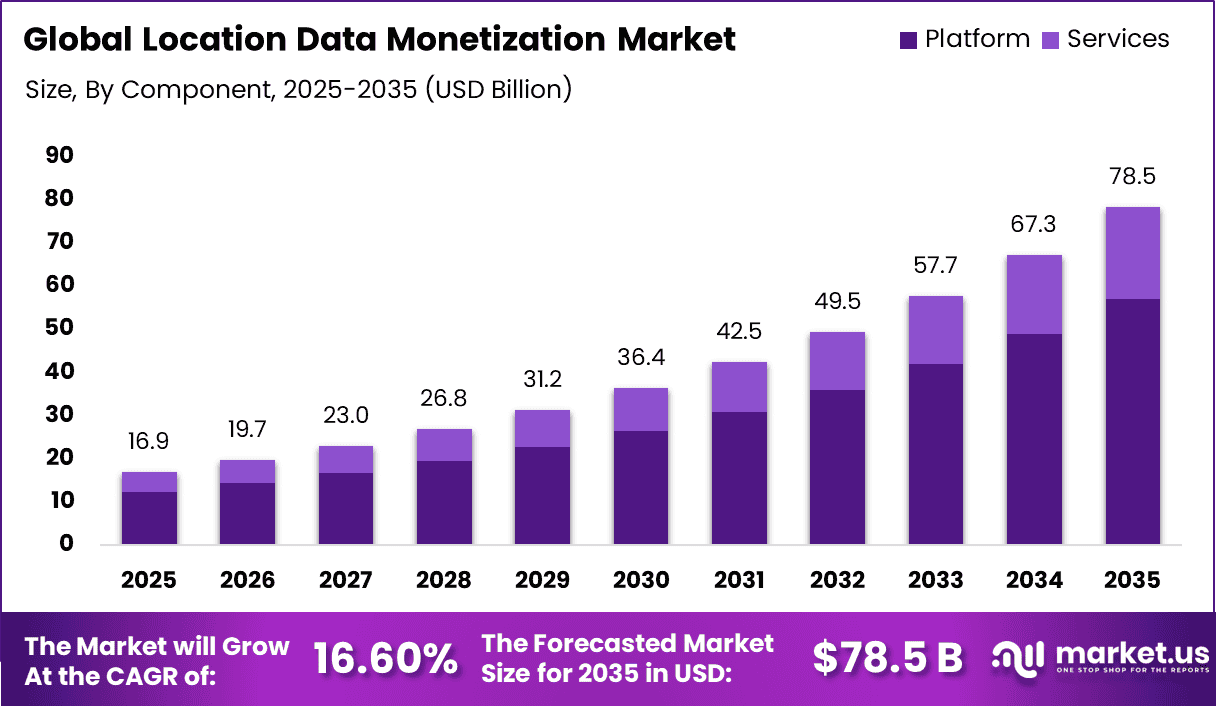
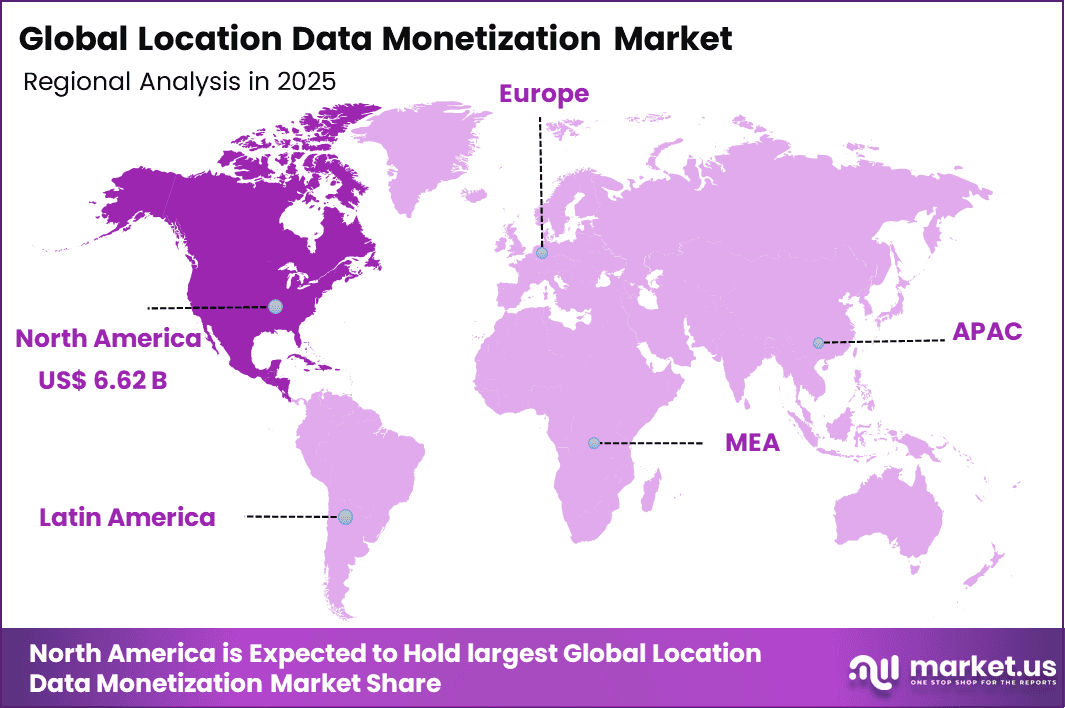
The Global Location Data Monetization Market generated USD 16.9 billion in 2025 and is predicted to register growth from USD 19.7 billion in 2026 to about USD 78.5 billion by 2035, recording a CAGR of 16.60% throughout the forecast span. In 2025, North America held a dominant market position, capturing more than a 39.2% share, holding USD 6.62 Billion revenue.
Top Market Takeaways
Platforms command 72.6% market share, delivering anonymized location aggregation, real-time bidding integration, and audience segmentation for hyper-local ad targeting.
Advertising & marketing applications capture 34.5%, enabling foot traffic analytics, proximity-based promotions, and conversion attribution across mobile and in-store channels.
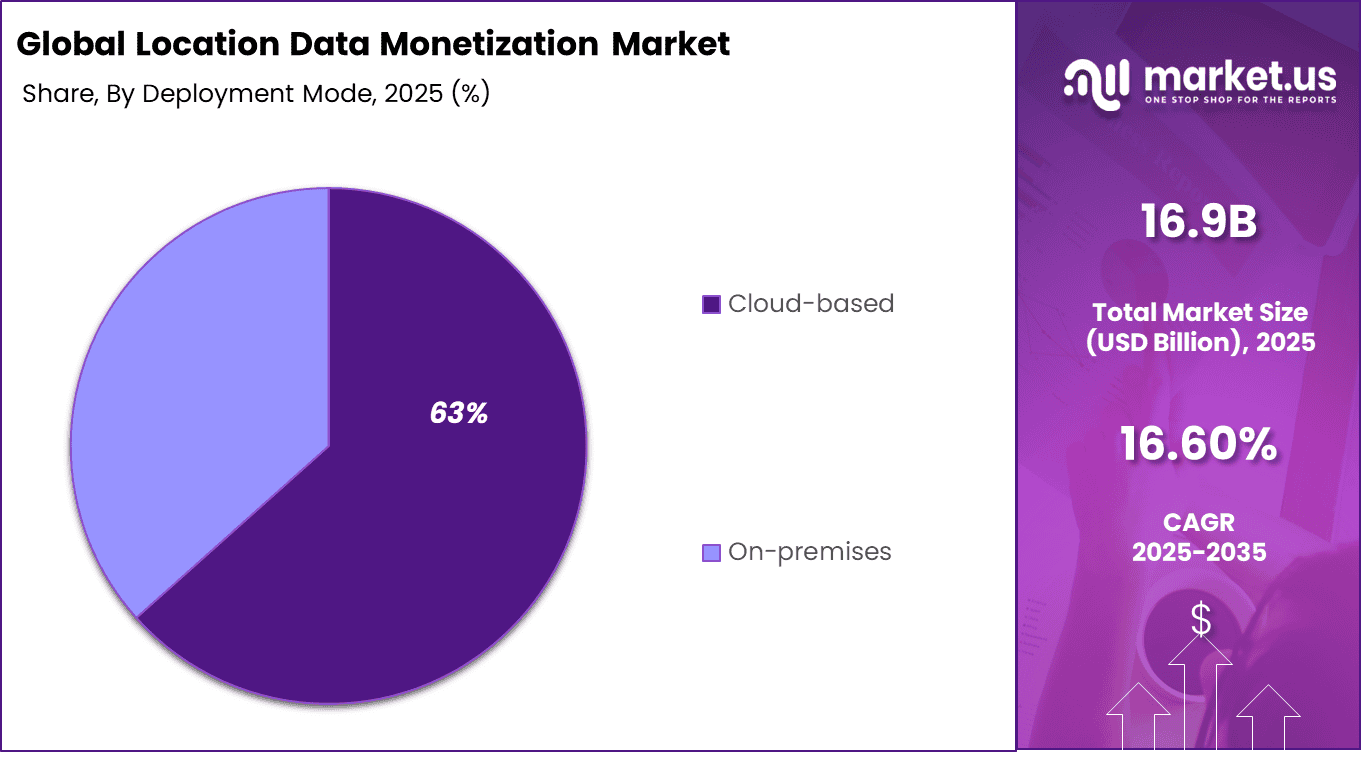
Cloud-based deployment dominates at 63.4%, providing elastic data lakes, GDPR/CCPA compliance tools, and scalable API delivery to DSPs and ad exchanges.
Retail & ecommerce holds 27.3%, leveraging location insights for store visit ROI measurement, dynamic pricing, and omnichannel customer journey optimization.
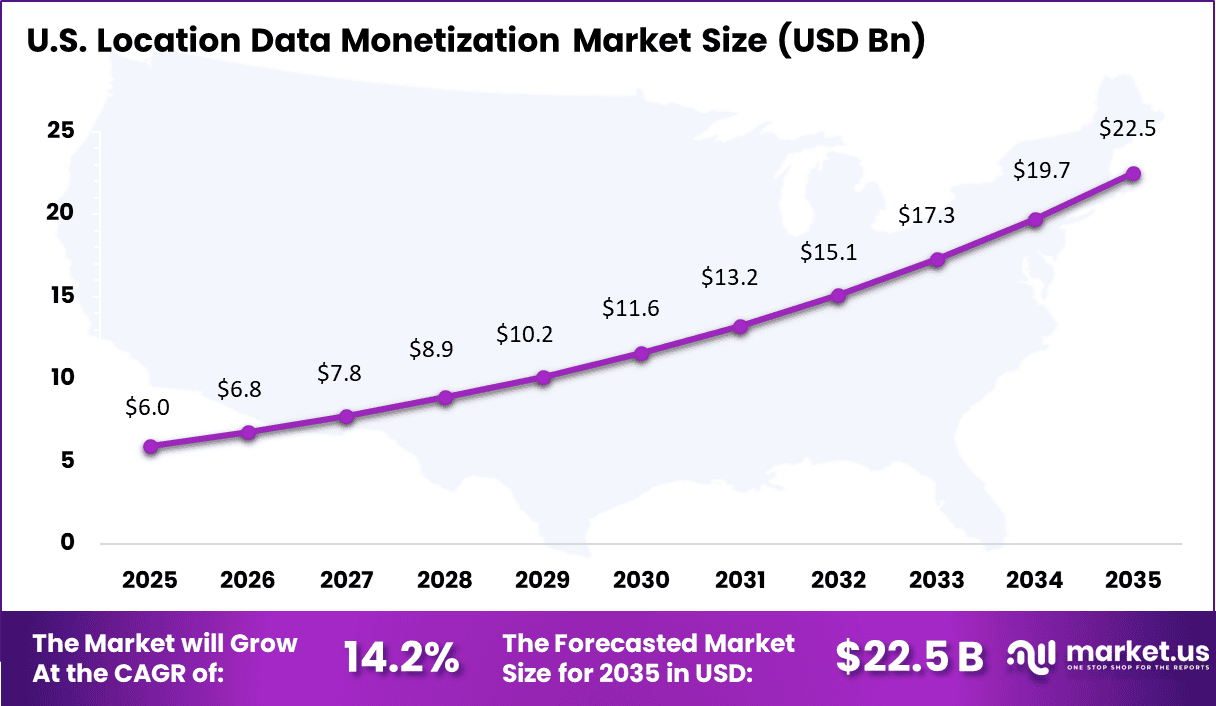
North America drives 39.2% global value, with U.S. market at USD 5.97 billion and 14.2% CAGR, fueled by iOS privacy changes and CTV location targeting advancements.
Location Data Monetization market refers to the use of location based information to generate commercial value through analytics, advertising, consumer insights, mobility planning, and business intelligence services. This market includes platforms and tools that collect, process, and analyze geographic movement patterns from mobile devices, connected assets, vehicles, and digital applications.
It is gaining importance as businesses increasingly use location signals to understand customer behavior, improve service delivery, support site selection, and create more targeted commercial strategies across retail, transport, real estate, and urban services.
One of the main factors driving this market is the rising use of smartphones, connected devices, and digital applications that continuously generate location related information. Businesses want to use this data to improve marketing precision, customer engagement, and operational planning.
Another important driver is the growing need for real world movement insights, as companies and public facing organizations look for better ways to study foot traffic, travel patterns, and location based demand across different areas.
Demand for location data monetization solutions is increasing among retailers, advertisers, mobility service providers, real estate users, financial service firms, and urban planning stakeholders that want stronger decision support from movement based insights.
These buyers are looking for practical tools that can turn raw location information into usable intelligence for targeting, planning, and performance analysis. Demand is also rising because organizations now view location data as a valuable business asset that can support both revenue generation and operational improvement.
Drivers Impact Analysis
Key Driver
Impact on CAGR Forecast (~%)
Geographic Relevance
Impact Timeline
Strategic Effect
Increasing use of location based services in mobile applications
+3.4%
North America, Europe, Asia Pacific
Short to Mid Term (2025–2031)
Enables targeted services and insights
Growth of digital advertising and location based marketing
+3.1%
US, Europe, Asia Pacific
Mid Term (2026–2032)
Improves customer engagement and monetization
Rising adoption of connected devices and IoT ecosystems
+2.9%
Global
Mid to Long Term (2026–2035)
Expands volume of location data
Increasing demand for real time analytics and geospatial insights
+2.6%
Global
Mid Term (2026–2032)
Enhances decision making capabilities
Expansion of smart cities and mobility solutions
+2.4%
Asia Pacific, Europe, North America
Mid to Long Term (2026–2035)
Supports urban planning and optimization
Restraints Impact Analysis
Key Restraint
Impact on CAGR Forecast (~%)
Geographic Relevance
Impact Timeline
Strategic Effect
Data privacy concerns and regulatory restrictions
-2.7%
Europe, North America
Mid to Long Term (2026–2035)
Limits data sharing and monetization
Lack of standardized frameworks for data usage
-2.3%
Global
Mid Term (2026–2032)
Creates interoperability challenges
High cost of data acquisition and processing
-2.0%
Global
Mid Term (2026–2032)
Reduces profitability
Risk of inaccurate or low quality location data
-1.8%
Global
Short to Mid Term (2025–2031)
Affects analytics reliability
Consumer concerns over data misuse
-1.6%
Global
Mid to Long Term (2026–2035)
Impacts user trust
By Component Analysis
Platform accounted for 72.6% of the Location Data Monetization Market. This segment leads because organizations rely on centralized platforms to collect, process, and analyze location data from multiple sources. These platforms enable data aggregation, analytics, and integration with business systems, which supports effective monetization strategies.
The segment is also supported by increasing demand for data driven decision making. Companies prefer platform based solutions that can handle large volumes of location data and provide actionable insights, which strengthens their adoption across industries.
By Application Analysis
Advertising and marketing represented 34.5% of the market. This segment dominates because businesses use location data to deliver targeted campaigns, personalized promotions, and location based offers. It helps improve customer engagement and optimize marketing effectiveness.
The segment is driven by growing focus on personalized marketing strategies. Companies leverage location insights to understand consumer behavior, refine campaign targeting, and improve return on marketing investments.
By Deployment Mode Analysis
Cloud based deployment held 63% of the market. This segment leads because cloud platforms provide scalable infrastructure for processing large datasets and enable real time access to location analytics. It allows organizations to manage data efficiently without heavy infrastructure investment.
The segment is supported by the need for flexible and cost effective solutions. Cloud deployment enables faster data processing, easy integration with digital platforms, and improved accessibility, which drives widespread adoption.
By End User Analysis
Retail and ecommerce accounted for 27.3% of the market. This segment leads because retailers use location data to understand customer movement, optimize store layouts, and enhance online to offline engagement. It helps businesses improve customer experience and drive sales.
The segment is driven by increasing competition in retail and digital commerce. Companies adopt location data monetization strategies to gain insights into consumer behavior, improve targeting, and strengthen overall business performance.
Investor Type Impact Analysis
Investor Type
Growth Sensitivity
Risk Exposure
Geographic Focus
Investment Outlook
Venture Capital Firms
Very High
High
US, Europe, Israel
Strong geospatial analytics opportunity
Private Equity Firms
High
Medium
North America, Europe
Expansion in data driven platforms
Strategic Technology Investors
Very High
Medium
US, China, Japan
Strengthens data ecosystem
Corporate Venture Arms
High
Medium
Global
Supports partnerships in data monetization
Government and Smart City Funds
Medium
Low
Asia Pacific, Europe
Supports urban data initiatives
Technology Enablement Analysis
Technology Enabler
Impact on CAGR Forecast (~%)
Geographic Relevance
Impact Timeline
Implementation Significance
AI driven geospatial analytics and data processing
+3.5%
Global
Short to Mid Term (2025–2031)
Improves insight generation
Cloud based data platforms and storage solutions
+3.1%
Global
Short to Mid Term (2025–2030)
Enables scalable data handling
Integration with IoT and connected device ecosystems
+2.8%
Global
Mid to Long Term (2026–2035)
Expands data sources
Real time location tracking and analytics tools
+2.6%
Global
Mid Term (2026–2032)
Enhances responsiveness
Advanced data anonymization and privacy technologies
+2.3%
Global
Mid to Long Term (2026–2035)
Supports regulatory compliance
Key Challenges
Data privacy is a major challenge because location data is sensitive, and companies must handle user consent, storage, and sharing very carefully.
Regulatory compliance is difficult because different countries and regions follow different rules for collecting, using, and selling location based information.
Data accuracy can be a problem because weak signals, outdated records, or incomplete location tracking can reduce the value of monetized data.
Consumer trust remains a challenge because many users worry that their movement data may be used without enough transparency or control.
Integration with advertising, analytics, and business platforms can be complex because companies need location data to move smoothly across different systems and use cases.
Emerging Trends
A key trend in the Location Data Monetization market is the growing use of real time mobility insights to support targeted decision making across industries. Organizations are increasingly analyzing location signals from mobile devices, connected vehicles, and smart infrastructure to understand movement patterns and consumer behavior.
These insights are being applied in areas such as retail planning, urban development, and digital advertising. This trend reflects a shift toward using location intelligence as a strategic asset that helps organizations respond more effectively to changing user behavior.
Growth Factors
The increasing demand for data driven strategies is supporting the growth of location data monetization solutions. Businesses seek deeper understanding of customer movement and engagement to improve service delivery and operational planning. Location data provides valuable context that enhances marketing, logistics, and resource allocation decisions.
At the same time, the expansion of connected devices and digital platforms encourages the generation and use of location based data, which strengthens the need for systems that can organize, analyze, and generate value from this information.
Key Market Segments
By Component
Platform
Services
By Application
Advertising & Marketing
Risk Management
Asset Management
Business Intelligence
Others
By Deployment Mode
On-Premises
Cloud-based
By End-User
Retail & Ecommerce
Transportation & Logistics
BFSI
Healthcare
Telecom
Government
Others
Regional Analysis
North America accounted for 39.2% of the Location Data Monetization Market, reflecting strong adoption of data driven strategies across retail, transportation, and digital services. Organizations across the region increasingly use location data to understand consumer behavior, optimize operations, and deliver targeted services.
Businesses continue to monetize geospatial insights through advertising, logistics optimization, and urban planning applications. The growing use of mobile devices and connected platforms continues to generate large volumes of location data, supporting steady demand for monetization solutions across North America.
The U.S. generated about USD 5.97 Billion within the regional market and is projected to expand at a CAGR of 14.2%. Companies across the country continue to leverage location intelligence to enhance customer engagement and improve business outcomes.
Retailers, app developers, and mobility service providers actively use location data to deliver personalized experiences and optimize service delivery. As data driven decision making becomes more important across industries, demand for location data monetization solutions continues to grow steadily across the US market.
Key Regions and Countries
North America
US
Canada
Europe
Germany
France
The UK
Spain
Italy
Russia
Netherlands
Rest of Europe
Asia Pacific
China
Japan
South Korea
India
Australia
Singapore
Thailand
Vietnam
Rest of APAC
Latin America
Brazil
Mexico
Rest of Latin America
Middle East & Africa
South Africa
Saudi Arabia
UAE
Rest of MEA
Competitive Analysis
The competitive landscape of the Location Data Monetization market includes mapping technology providers, geospatial analytics firms, and location intelligence companies. HERE Technologies, Foursquare, UberMedia, Pitney Bowes, Gravy Analytics, SafeGraph, Cuebiq, Mapbox, Esri, and TomTom compete by offering data platforms that help businesses use location insights for advertising, site selection, customer analysis, and market planning. These companies focus on data quality, geographic coverage, and strong analytics capabilities.
Other players such as LocationSmart, Ubimo, PlaceIQ, Skyhook, Veraset, and X-Mode Social strengthen the market through mobile location data, audience insights, and movement pattern analysis. Competition in this market is shaped by data accuracy, privacy compliance, integration support, and the ability to convert location signals into useful business value. Overall, companies compete by improving data depth, analytics strength, and industry specific use cases.
The future outlook for the Location Data Monetization Market looks positive as businesses continue to see value in location and geospatial data for analytics, services, and commercial decision making, while public policy bodies also describe location data as offering major economic opportunities.
At the same time, the market is expected to become more compliance focused because regulators in the US and UK are applying stricter standards around user consent and the sale or use of sensitive location data. As companies invest more in consent management, anonymization, and higher quality location intelligence, demand for responsible location data monetization solutions is likely to grow steadily in the coming years.
Recent Developments
February, 2026 – HERE launches Location Graph 3.0 for HD maps in AV fleets and sells POI data to insurers for risk scores. Adds 5G VenueCast for mall analytics and partners with 50 cities for traffic monetization. Boosts AR nav data sales to auto makers while adding privacy tiers for EU compliance.
March, 2026 – UberMedia rolls VenueGraph for ride-hail insights and licenses trip patterns to city planners. Targets logistics with dwell-time APIs and adds EV charging heatmaps for energy nets. Grows B2B sales to delivery apps with sub-hour freshness.
Report Scope
Report Features
Description
Market Value (2025)
USD 16.9 Billion
Forecast Revenue (2035)
USD 78.5 Billion
CAGR(2025-2035)
16.60%
Base Year for Estimation
2024
Historic Period
2020-2024
Forecast Period
2026-2035
Report Coverage
Revenue forecast, AI impact on Market trends, Share Insights, Company ranking, competitive landscape, Recent Developments, Market Dynamics and Emerging Trends
Segments Covered
By Component (Platform, Services), By Application (Advertising & Marketing, Risk Management, Asset Management, Business Intelligence, Others), By Deployment Mode (On-Premises, Cloud-based), By End-User (Retail & Ecommerce, Transportation & Logistics, BFSI, Healthcare, Telecom, Government, Others)
Regional Analysis
North America – US, Canada; Europe – Germany, France, The UK, Spain, Italy, Russia, Netherlands, Rest of Europe; Asia Pacific – China, Japan, South Korea, India, New Zealand, Singapore, Thailand, Vietnam, Rest of Latin America; Latin America – Brazil, Mexico, Rest of Latin America; Middle East & Africa – South Africa, Saudi Arabia, UAE, Rest of MEA