


Report Overview
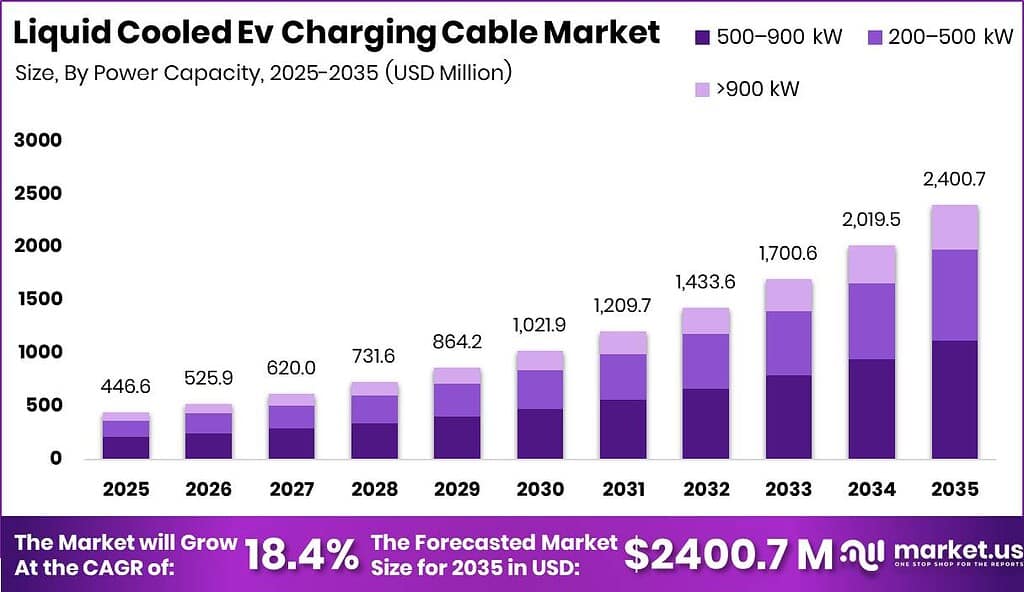
Global Liquid Cooled EV Charging Cable Market size is expected to be worth around USD 2,400.7 Million by 2035 from USD 446.6 Million in 2025, growing at a CAGR of 18.4% during the forecast period 2026 to 2035. Therefore, investors track cable thermal design as a core bottleneck for high-power DC deployment economics.
Liquid cooled EV charging cables move heat away from power conductors through sealed coolant loops. This design keeps cable diameter and mass low while current climbs past air-cooled limits. The market covers assemblies sold into ultrafast hubs, public DC sites, and fleet depots across passenger and commercial electric fleets.
Key Takeaways
- The market reaches USD 446.6 Million in 2025 and USD 2,400.7 Million by 2035 at a CAGR of 18.4%.
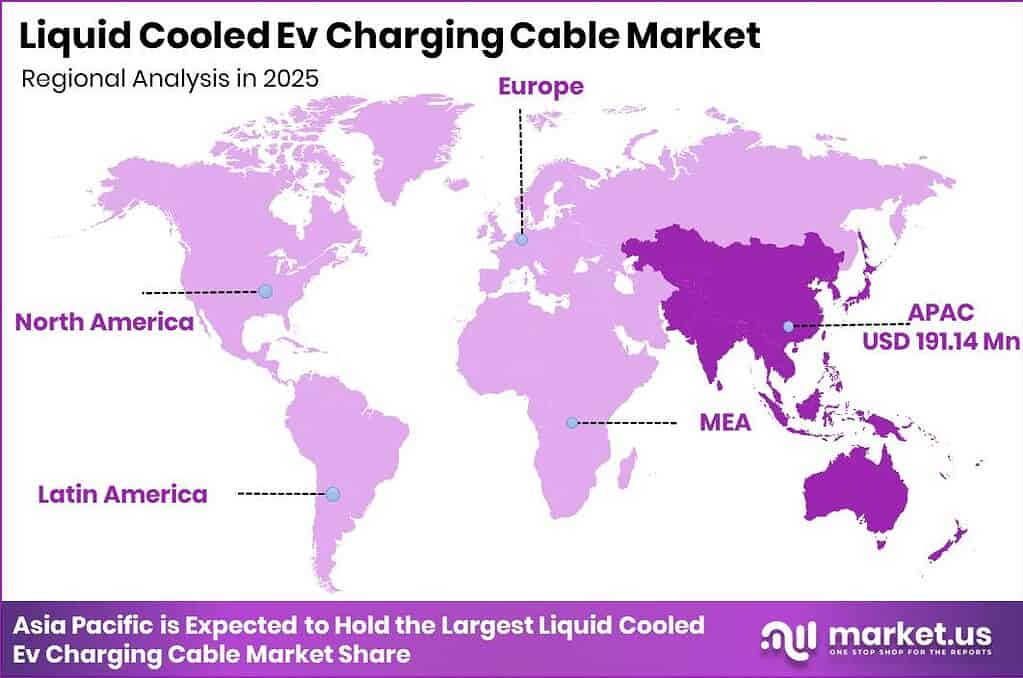
- Asia Pacific leads with a 42.8% share valued at USD 191.14 Million.
- By Power Capacity, 500–900 kW holds 46.7%.
- By Application, Ultrafast / high-power charging hubs hold 54.6%.
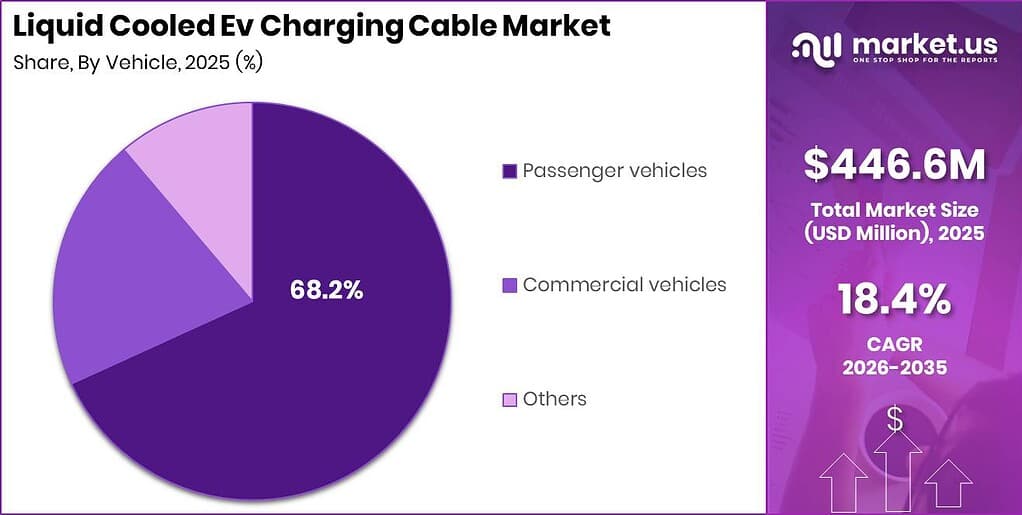
- By Vehicle, Passenger vehicles hold 68.2%.
- By Connector, CCS1 / CCS2 holds 45.6%.
- Europe is the fastest-growing region; >900 kW, Depot and fleet charging, Commercial vehicles, and CHAdeMO are the fastest sub-segments in their groups.
Charge point operators now specify liquid cooling when continuous session power exceeds conventional cable thermal envelopes. As per our research, systems that deliver up to 500 kW continuous and 700 kW boost power force operators to buy actively cooled assemblies rather than thicker copper air-cooled leads. This means suppliers who certify high continuous ratings lock multi-year hub framework contracts before price competition intensifies.
However, end-use growth in highway corridor and depot electrification lifts cable unit demand in lockstep with stall count. A 2025 technical source found liquid cooling lets smaller conductors carry 500 A while cutting cable weight by about 40%. Lighter handles raise session completion rates and cut installer injury risk, which improves operator utilization economics on busy sites.
Consequently, platform partners integrate megawatt-ready cables into packaged chargers. In September 2025, Autel Energy paired 1,000 A liquid-cooled CCS Type 2 technology with its MaxiCharger DT1000 megawatt-class system. Alpitronic’s HYC1000 design uses one liquid-cooled CCS connector rated above 1,000 A and up to 1,000 kW. Buyers who standardize on these ratings reduce future retrofit spend when vehicle peak acceptance rises.
Power Capacity Analysis
500–900 kW dominates with 46.7% due to hub ultrafast stall standardization.
In 2025, 500–900 kW held a dominant market position in the By Power Capacity segment of Liquid Cooled EV Charging Cable Market, with a 46.7% share. Connector industry reporting shows liquid-cooled CCS designs deliver 500 kW at 500 A and 1 kV with controlled temperature rise. This power band matches most passenger ultrafast stalls now specified by corridor operators. Vendors who lock OEM-approved 500 to 900 kW SKUs capture volume before >900 kW fleets scale.
200–500 kW cables serve mid-tier DC sites where grid capacity and dwell patterns do not justify megawatt hardware. Public networks still add large counts of mid-power stalls as total public points passed 7 million worldwide after nearly 1.8 million additions in 2025, per IEA-linked charging rollout tracking. Operators choose liquid cooling in this band when cable weight and heat limit concurrent sessions. Suppliers win when they price cooling as an uptime tool rather than a premium only.
>900 kW is the fastest capacity band as heavy-duty and flagship passenger acceptance climb. CharIN-backed MCS work targets up to 1,250 V and 3,000 A, or as much as 3.75 MW, under IEC TS 63379. Early corridor pilots pull cable designs with higher coolant flow and redundant seals. Firms that qualify >900 kW products early secure design wins before standards freeze purchasing specs. TMEV Net’s CryoFlux PowerCable won a CES 2025 Innovation Award for phase-change cooling aimed at megawatt duty with cable mass below 10 kg.
Application Analysis
Ultrafast / high-power charging hubs dominate with 54.6% due to corridor multi-stall density needs.
In 2025, Ultrafast / high-power charging hubs held a dominant market position in the By Application segment of Liquid Cooled EV Charging Cable Market, with a 54.6% share. Manufacturer guidance states 350 kW or higher liquid-cooled charging can move a pack from 10% to 80% in 15 to 20 minutes. Hubs sell throughput, so cable thermal headroom directly lifts revenue per stall-hour. Investors favor vendors tied to hub EPCs with multi-year cable refresh clauses.
Public charging stations deploy liquid-cooled leads where peak concurrent load would otherwise force derating. Global public charging stock exceeded 7 million points after strong 2025 additions, raising the share of high-power stalls that need active cooling. Station owners pay for lower handle weight and stable connector temperature during back-to-back sessions. Cable makers that bundle sensors for predictive maintenance raise switching costs against pure hardware bids.
DC fast charging applications sit between hub and depot duty cycles and still require controlled conductor temperature at elevated amperage. Expected liquid-cooled cable and connector equipment life of 5 to 8 years from reduced thermal stress improves total cost of ownership versus frequent air-cooled replacements. This life band supports multi-year service contracts. Depot and fleet charging is the fastest application as operators schedule high daily energy throughput on return-to-base routes. Fleet buyers specify rugged coolant jackets and quick-swap connectors to limit vehicle downtime.
Vehicle Analysis
Passenger vehicles dominate with 68.2% due to mass-market ultrafast acceptance growth.
In 2025, Passenger vehicles held a dominant market position in the By Vehicle segment of Liquid Cooled EV Charging Cable Market, with a 68.2% share. Peer-reviewed 2026 review data show liquid-cooled CCS2 builds typically support up to 500 A DC and 1,000 V, or about 350 to 500 kW peak. Passenger platforms on 800 V architectures use this window for short highway stops. Cable suppliers aligned to CCS passenger inlets win the largest unit volumes today.
Commercial vehicles form the fastest vehicle band as trucks and buses need higher energy per stop. MCS ratings discussed at 1,250 V and 3,000 A target heavy-duty dwell reduction on freight corridors. Fleet CapEx favors cables that sustain long high-current sessions without thermal foldback. Early commercial design wins carry higher average selling prices than passenger ultrafast leads.
Others covers specialty, off-highway, and mixed-duty electric platforms that still need liquid cooling when continuous current exceeds air-cooled comfort. Private light-duty charging already exceeded 43 million points globally in 2025 while public networks scaled past 7 million, showing how broad EV stock growth pulls specialty cable variants. Niche buyers accept longer lead times for custom coolant routing. Suppliers who modularize pumps and jackets serve this tail without full redesign cost.
Connector Analysis
CCS1 / CCS2 dominates with 45.6% due to global DC fast charging interoperability.
In 2025, CCS1 / CCS2 held a dominant market position in the By Connector segment of Liquid Cooled EV Charging Cable Market, with a 45.6% share. IEC 62893-4-2 category guidance for liquid-cooled EV charging cables cites rated voltage up to 1,000 V DC within the covered cable class. CCS ecosystems already dominate many public DC networks, so liquid-cooled CCS SKUs move first into hub upgrades. Connector-cable pairs that pass regional CCS certification clear procurement gates faster.
Type 2 AC-oriented interfaces remain relevant at sites that mix AC and DC hardware, yet liquid cooling demand concentrates on DC power pins. Type 1 footprints appear mainly in legacy North American AC contexts with limited high-power liquid-cooled pull. Buyers still need backward-compatible mechanical packages during multi-year network transitions. Vendors offering dual-certified mechanical families reduce operator SKU count.
CHAdeMO is the fastest connector band from a growth-rate view where remaining fleets and cross-standard adapters still need high-current thermal control. GB/T and other regional systems, including China-centric DC inlets, pull localized liquid-cooled builds as domestic hub power rises. IEC TS 63379 MCS publication in 2026 sets connector and cable assembly rules for megawatt duty up to 1,250 V and 3,000 A. Suppliers that map CCS, CHAdeMO, GB/T, and MCS cooling modules onto shared pump platforms protect share as standards fragment by region.
Key Market Segments
By Power Capacity
- 500–900 kW
- 200–500 kW
- >900 kW
By Application
- Ultrafast / high-power charging hubs
- Public charging stations
- DC fast charging
- Depot and fleet charging
By Vehicle
- Passenger vehicles
- Commercial vehicles
- Others
By Connector
- Type 1
- Type 2
- CCS1 / CCS2
- CHAdeMO
- GB/T and other
Regional Analysis
Asia Pacific Dominates the Liquid Cooled EV Charging Cable Market with a Market Share of 42.8%, Valued at USD 191.14 Million
Asia Pacific leads on the back of dense public DC buildout and domestic cable manufacturing scale in China and neighboring markets. Regional operators push high-power stalls along urban and highway corridors, which lifts liquid-cooled unit demand ahead of other regions. Local connector and cable plants shorten lead times for CCS and GB/T variants. Investors treat Asia Pacific volume as the anchor for global plant utilization and copper procurement planning.
Europe is the fastest-growing region as corridor hubs and commercial fleet rules tighten. Policy-backed ultrafast networks favor cables that hold continuous high current without heavy conductors. In 2025, Mercedes-Benz validated liquid-cooled CCS technology on the CONCEPT AMG GT XX prototype and recorded charging power above 1 MW in testing. That OEM signal accelerates European CPO specifications toward megawatt-ready liquid-cooled assemblies.
North America scales highway and depot projects with strong interest in MCS-ready thermal designs. Latin America and Middle East and Africa remain smaller in absolute cable spend yet add selective high-power tourism and logistics corridors. Cross-region suppliers that carry multi-standard certifications avoid redesign cost when bids span continents. Capital therefore follows firms with dual-region test labs and coolant supply agreements.
Key Regions and Countries
North America
- US
- Canada
Europe
- Germany
- France
- The UK
- Spain
- Italy
- Rest of Europe
Asia Pacific
- China
- Japan
- South Korea
- India
- Australia
- Rest of APAC
Latin America
- Brazil
- Mexico
- Rest of Latin America
Middle East and Africa
- GCC
- South Africa
- Rest of MEA
Market Dynamics
Market Opportunity Analysis - Lower-share power bands, fleet depots, and commercial vehicles still leave open entry lanes
The 200–500 kW band remains less crowded than the 46.7% 500–900 kW core, yet public networks still add large stall counts in this window. New entrants can win municipal and secondary-highway tenders with lighter cooled cables priced below hub flagship SKUs. This creates a volume bridge while brands build MCS credentials. Regional assemblers in India and Southeast Asia fit this lane under local content rules.
Depot and fleet charging is labeled the fastest application, which means the installed base is still thin versus ultrafast hubs at 54.6%. Fleet buyers need scheduled high-energy sessions and care more about uptime SLAs than brand legacy. Therefore, specialists who bundle leak detection and swap-out logistics can displace generalist hub suppliers. Contract length in fleets also smooths revenue versus spot public projects.
Commercial vehicles are the fastest vehicle group against passenger share of 68.2%, so absolute competition is still lighter. Truck corridor pilots need higher current and tougher jackets than passenger CCS leads. As a result, early MCS-qualified cable vendors can lock OEM and fleet standards before passenger-centric rivals adapt. Margin structure favors this niche once statutory truck rules tighten.
Europe as the fastest region offers share gains outside Asia Pacific’s 42.8% anchor. Corridor funding and ergonomic cable mandates pull premium cooled products sooner than many emerging markets. Entrants with EU certification capacity can take secondary supplier slots on multi-country hub frameworks. This path diversifies revenue away from single-country Asia concentration risk.
Technology and Innovation Landscape - Coolant geometry, pressure control, and MCS standards reshape cable value
A 2025 cooling study used a heat exchanger layout with 28 parallel tube rows to raise thermal performance in high-power EV charging cables. Denser tube packing cuts hot spots along the conductor path during long sessions. Manufacturers who industrialize this geometry can advertise higher continuous ampacity without thicker copper. Buyers gain lower derating risk at summer ambient peaks.
The same 2025 evaluation paired perfluoro-based coolant with a serpentine microchannel heat exchanger for DC fast duty. Microchannels increase surface area for heat transfer inside a slim jacket. This signals a materials race where coolant chemistry and channel tooling become moats. Investors should track patent filings on channel extrusion as a leading indicator of cost curves.
SAE’s 2025 Megawatt Charging System work under J3271/3 treats liquid-cooled cables, handling, cooling, and automated connection as one system stack. Standards that bind cable and robotized docking raise the bar for partial adapters. Suppliers present in the full workstream influence test methods that later appear in tenders. This creates an advantage for vertically briefed connector-cable pairs.
Phoenix Contact documents liquid-cooled cable cooling circuits at 1.00 to 2.00 bar with a maximum permissible pressure of 4.00 bar. Controlled pressure bands protect seals while sustaining flow under boost current. Competitors must publish equal operating envelopes to pass CPO safety reviews. Transparent pressure specs shorten technical due diligence on multi-megawatt projects.
Drivers
Automakers moved many passenger EV platforms from 400 V toward 800 V architectures between 2024 and 2025 to cut charge time and pack mass. Higher voltage still leaves ultrafast sessions above 500 amperes, so operators need liquid cooled assemblies that shrink conductor cross-section by about 30% to 40% versus air-cooled builds. Cable makers that certify sub-1.5 kg per meter products win OEM sourcing preference and protect gross margins near 28% to 33%.
This driver lifts near-term orders for hub-grade cables across Europe and China first. Operators that delay face CapEx rework inside 18 to 24 months as vehicle acceptance outruns air-cooled stalls. Sellers who pair voltage-ready cables with ergonomic handles capture both OEM and CPO budgets in one specification cycle.
| Driver | (~) % Impact on CAGR Forecast | Geographic Relevance | Impact Timeline |
|---|---|---|---|
| 800V Vehicle Architecture Rollout | +4.2% | Global (Europe, China lead) | Short term (2 years or less) |
| Ultrafast & Megawatt Charging Buildout | +3.6% | Europe, North America, China | Short term (2 years or less) |
| I2R Heat Dissipation Requirements at High Amperage | +2.1% | Global | Short term (2 years or less) |
| Highway & Urban Corridor Charging Hub Expansion | +1.8% | Europe, India, Southeast Asia | Medium term (2 to 4 years) |
| OEM Ergonomic Cable Design Mandates | +1.1% | Europe, North America | Short term (2 years or less) |
Restraints
A liquid cooled assembly adds pump, reservoir, and dielectric coolant hardware that investor materials place near 2.5x to 3x the unit cost of air-cooled cables. Benchmark rates held above 4.5% through 2025 in major EV markets, stretching high-power stall payback beyond 36 months for some operators. Cost-sensitive regions paused or rescoped gigawatt-scale tenders toward lower-power air-cooled options.
This restraint compresses near-term shipment volume and pushes suppliers to concede 3 to 5 percentage points of margin to keep contracts. Buyers in emerging markets delay liquid-cooled adoption until financing eases or subsidies offset the bill-of-materials gap. Vendors who offer staged retrofit kits reduce the single-year CapEx spike and defend volume.
| Restraint | (~) % Impact on CAGR Forecast | Geographic Relevance | Impact Timeline |
|---|---|---|---|
| High Upfront Cost of Cooling-Integrated Cable Assemblies | -2.8% | Global, acute in Emerging Markets | Short term (2 years or less) |
| Elevated Interest Rates Delaying Charge Point Operator CapEx | -1.9% | North America, Europe | Short term (2 years or less) |
| Copper & Dielectric Coolant Input Cost Volatility | -1.4% | Global | Short term (2 years or less) |
| Fragmented Certification Standards Across Regions | -1.1% | India, Southeast Asia, Latin America | Short term (2 years or less) |
Challenges
Internal coolant channels raise jacket stiffness and cut bend-radius tolerance versus simple power cables. Field patterns cited through industry warranty channels show liquid cooled failure rates from coolant-jacket micro-fractures running 15% to 20% higher than air-cooled units after 10,000 charge cycles. Each incident can idle a stall for about 4 to 6 hours and lifts manufacturer warranty reserves.
This challenge opens a paid durability upgrade path rather than only a cost burden. Suppliers raising R&D by 1.5 to 2 percentage points of revenue for flexible composite hoses and stronger strain relief can sell extended-life SKUs. Operators will pay for lower downtime once cycle-life data is third-party verified.
| Challenge | (~) % CAGR Friction Drag | Geographic Relevance | Mitigation Horizon |
|---|---|---|---|
| Cable Flex Fatigue Under Repeated Sessions | -1.6% | Global | Medium term (2 to 4 years) |
| Thermal Engineering Talent Shortage | -1.2% | North America, Europe | Medium term (2 to 4 years) |
| Coolant Leak & Seal Reliability Risk | -0.9% | Global | Medium term (2 to 4 years) |
| Weight & User Handling Ergonomics | -0.7% | Global | Short term (2 years or less) |
Opportunities
Megawatt charging above 1,000 kW and about 1,400 amperes for heavy-duty trucks still sits mainly in corridor pilots through 2026. Cable ASPs in this band run about 2.5x to 4x standard ultrafast pricing with thicker engineering content and fewer qualified vendors. Early fleet design wins can lift blended margins by roughly 4 to 7 percentage points once EU and California zero-emission truck rules tighten after 2027.
This opportunity rewards firms that finish CharIN MCS qualification before volume ramps. Retrofit programs on existing DC fleets and localized manufacturing under national EV incentives add secondary pools of demand. Cable-as-a-service and predictive maintenance create recurring revenue once sensors sit inside coolant loops. Early movers who package hardware with uptime SLAs capture operator budgets beyond one-time cable sales.
| Opportunity | (~) % Potential CAGR Upside | Geographic Relevance | Execution Window |
|---|---|---|---|
| Megawatt Charging for Heavy-Duty & Commercial Fleets | +2.9% | North America, Europe, China | Medium term (2 to 4 years) |
| Retrofit Upgrade Cycle for Existing DC Fast Charger Fleets | +1.7% | Global | Medium term (2 to 4 years) |
| Localized Manufacturing Under National EV Incentive Schemes | +1.4% | India, Southeast Asia | Medium term (2 to 4 years) |
| Cable-as-a-Service & Predictive Maintenance Monetization | +1.0% | Global | Long term (4 years or more) |
Key Company Insights
Phoenix Contact positions liquid-cooled HPC cables at 500 A continuous, 700 A boost, and 1,000 V DC for high-power systems. Its 2026 portfolio lists CCS Type 2 builds with 1,000 A boost and 800 A permanent current at 1,000 V. This rating stack gives CPOs a single vendor path from ultrafast to megawatt boost modes and raises switching costs against lower-current rivals.
HUBER+SUHNER AG competes through high-frequency and power connectivity depth that transfers into rugged EV charging cable programs. Its brand strength in controlled-impedance and harsh-environment interconnects supports premium positioning on thermally stressed DC links. October 2025 activity around next-generation liquid-cooled demonstration cables at CharIN North America events, including Philatron’s silicone designs on the same stage, keeps competitive pressure high on materials and flexibility. Firms without equal test-event visibility risk slower design-in cycles.
Key Players
- Phoenix Contact
- HUBER+SUHNER AG
- BRUGG eConnect
- LEONI AG
- LS Cable & System
- Southwire Company
- Shanghai Mida EV Power Co., Ltd.
- Zhejiang OMG Electric Vehicle Co., Ltd.
- ChinaEVSE
- ABB Ltd
- Sinbon Electronics Co., Ltd.
- ITT Cannon
- Caledonian Cables
- Joint Charging
- others
Recent Developments
- May 2025: Phoenix Contact launched the second generation of its liquid-cooled CHARX connect professional CCS charging cable and connector system, enabling up to 1,000 kW charging in boost mode and 800 kW continuous power through direct coolant routing around the power conductors.
- June 2025: VOSS Automotive, Amphenol-Tuchel Electronics, and GG Group introduced a 1 MW liquid-cooled EV charging harness combining GG Group’s Power2Flow cable, Amphenol’s CHARGESOK CCS2 socket, and VOSS thermal management technology to support megawatt-level charging with reduced cable thermal stress.
- June 2025: SINBON Electronics secured UL safety certification for its liquid cooling system used in EV charging stations, validating a system designed for 1 MW charging capability and enabling a 100 kWh battery charge in approximately 6 minutes.
- April 2025: Huawei launched its fully liquid-cooled megawatt charging solution with 1.5 MW peak output and 2,400 A maximum current capability, integrating liquid-cooled charging cables for heavy-duty EV applications.
Geopolitical Impact Analysis
According to UNCTAD maritime monitoring patterns, Red Sea and related rerouting since 2024 added transit days on Asia–Europe box trades, with many services reporting double-digit percentage schedule inflation versus pre-crisis baselines. Liquid cooled cable bills of materials depend on copper conductors and specialty polymers that move on these lanes. As a result, European hub projects face longer lead times and higher freight adders on finished assemblies. Buyers dual-source Asia and regional cut-and-cool plants to cap delay risk near 2 to 4 weeks per shipment cycle.
Data from World Bank and IMF commodity desks show copper and energy price swings remaining elevated versus 2020–2021 averages, with policy rates in major markets still influencing CapEx after multi-year holds above 4% in several economies. Dielectric coolants and extruded jackets track oil-linked and chemical intermediate costs. This creates quote validity windows often under 90 days for cooled cable tenders. Operators that index contracts to metal benchmarks transfer part of the geopolitical cost shock back to project sponsors.
Report Scope
| Report Features | Description |
|---|---|
| Market Value (2025) | USD 446.6 Million |
| Forecast Revenue (2035) | USD 2,400.7 Million |
| CAGR (2026-2035) | 18.4% |
| Base Year for Estimation | 2025 |
| Historic Period | 2020-2024 |
| Forecast Period | 2026-2035 |
| Report Coverage | Revenue Forecast, Market Dynamics, Market Opportunity Analysis, Technology and Innovation Landscape, Competitive Landscape, Recent Developments |
| Segments Covered | By Power Capacity (500–900 kW, 200–500 kW, >900 kW), By Application (Ultrafast / high-power charging hubs, Public charging stations, DC fast charging, Depot and fleet charging), By Vehicle (Passenger vehicles, Commercial vehicles, Others), By Connector (Type 1, Type 2, CCS1 / CCS2, CHAdeMO, GB/T and other) |
| Regional Analysis | North America (US and Canada), Europe (Germany, France, The UK, Spain, Italy, and Rest of Europe), Asia Pacific (China, Japan, South Korea, India, Australia, and Rest of APAC), Latin America (Brazil, Mexico, and Rest of Latin America), Middle East and Africa (GCC, South Africa, and Rest of MEA) |
| Competitive Landscape | Phoenix Contact, HUBER+SUHNER AG, BRUGG eConnect, LEONI AG, LS Cable & System, Southwire Company, Shanghai Mida EV Power Co., Ltd., Zhejiang OMG Electric Vehicle Co., Ltd., ChinaEVSE, ABB Ltd, Sinbon Electronics Co., Ltd., ITT Cannon, Caledonian Cables, Joint Charging, others |
| Customization Scope | Customization for segments, region / country-level will be provided. Additional customization can be done based on requirements. |
| Purchase Options | We have three licenses to opt for: Single User License | Multi-User License (Up to 5 Users) | Corporate Use License (Unlimited User and Printable PDF) |





































