


Report Overview
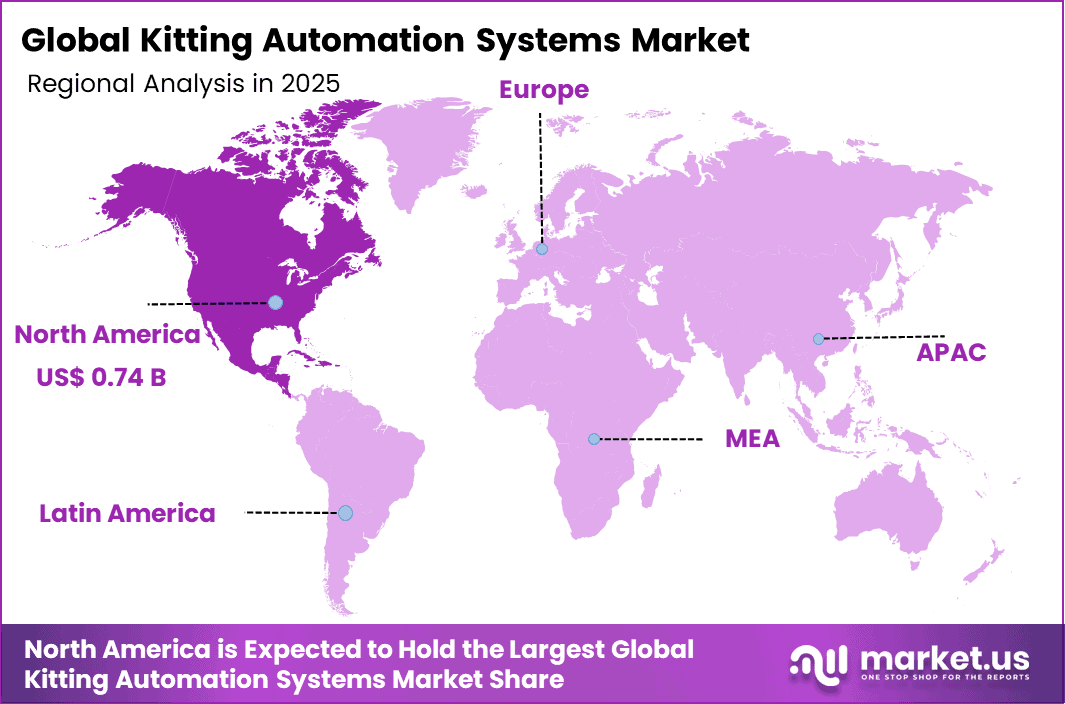
The Global Kitting Automation Systems Market generated USD 2.1 billion in 2025 and is predicted to register growth from USD 2.4 billion in 2026 to about USD 6.8 billion by 2035, recording a CAGR of 12.2% throughout the forecast span. In 2025, North America held a dominant market position, capturing more than a 34.6% share, with USD 0.74 billion in revenue.
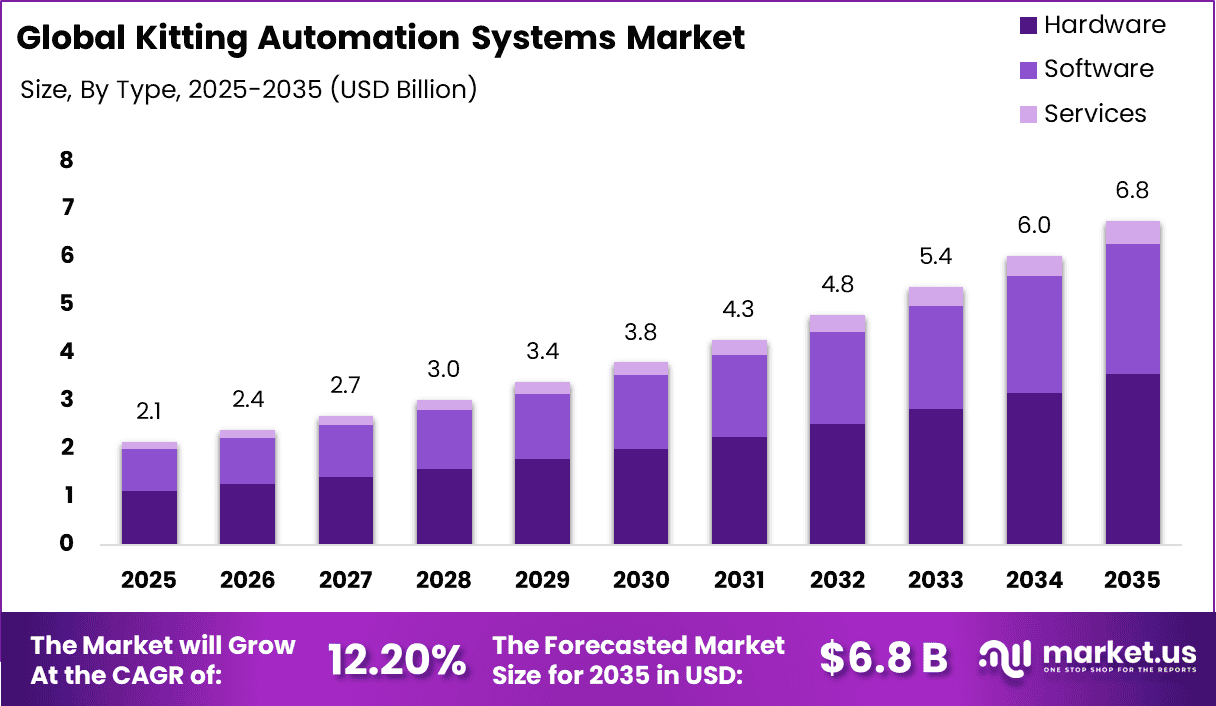
Kitting Automation Systems market refers to automated solutions used to group individual items into ready-to-use kits for manufacturing, assembly, warehousing, and order fulfillment. These systems usually combine software, conveyors, workstations, scanning, light-directed processes, and sometimes robotics to improve how parts or products are collected and organized before final use or shipment.
One of the main factors driving this market is the growing need to improve speed and accuracy in order preparation and material handling. Kitting helps reduce repeated picking activity and lowers the risk of packing or assembly errors compared with less organized manual methods. Another important factor is the wider use of warehouse automation and value-added service workflows, as businesses want smoother operations during periods of higher order complexity and labor pressure.
Top Market Takeaways
- Hardware commands 52.6% market share, delivering robotic pick-and-pack arms, conveyor sequencing, and smart totes optimized for mixed-SKU kitting stations.
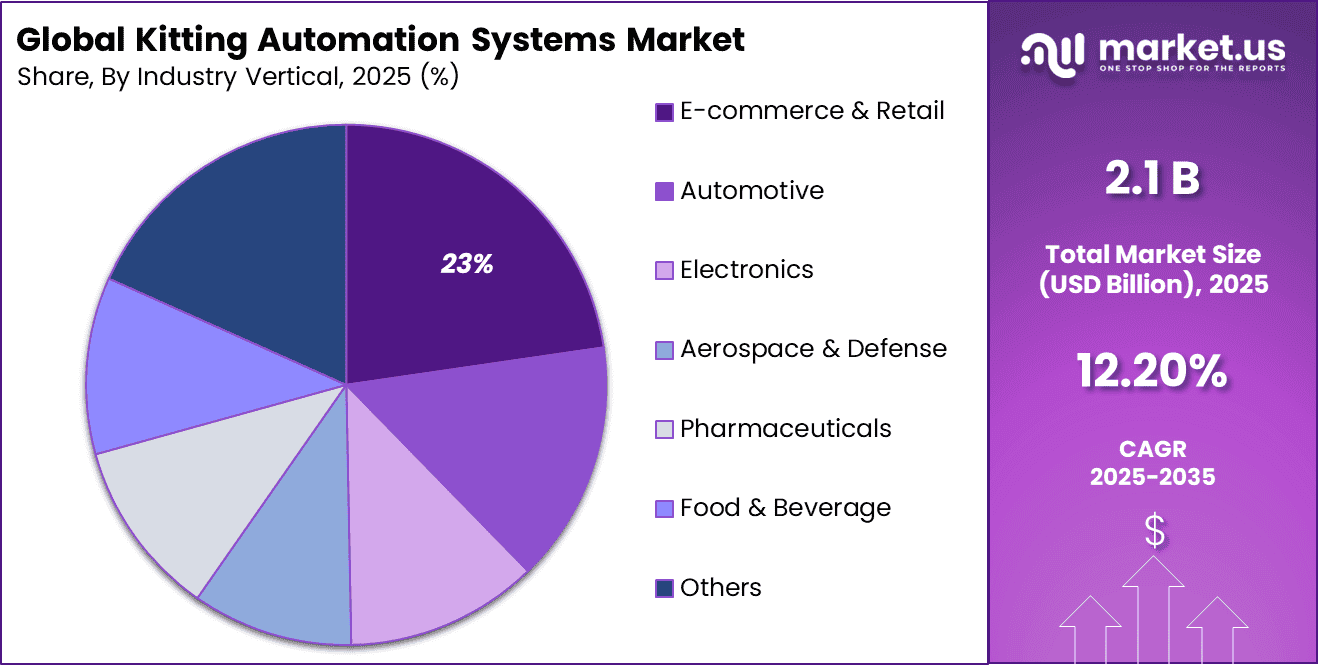
- E-commerce & retail applications capture 22.7%, enabling high-velocity order consolidation, same-day fulfillment, and returns processing at mega-fulfillment centers.
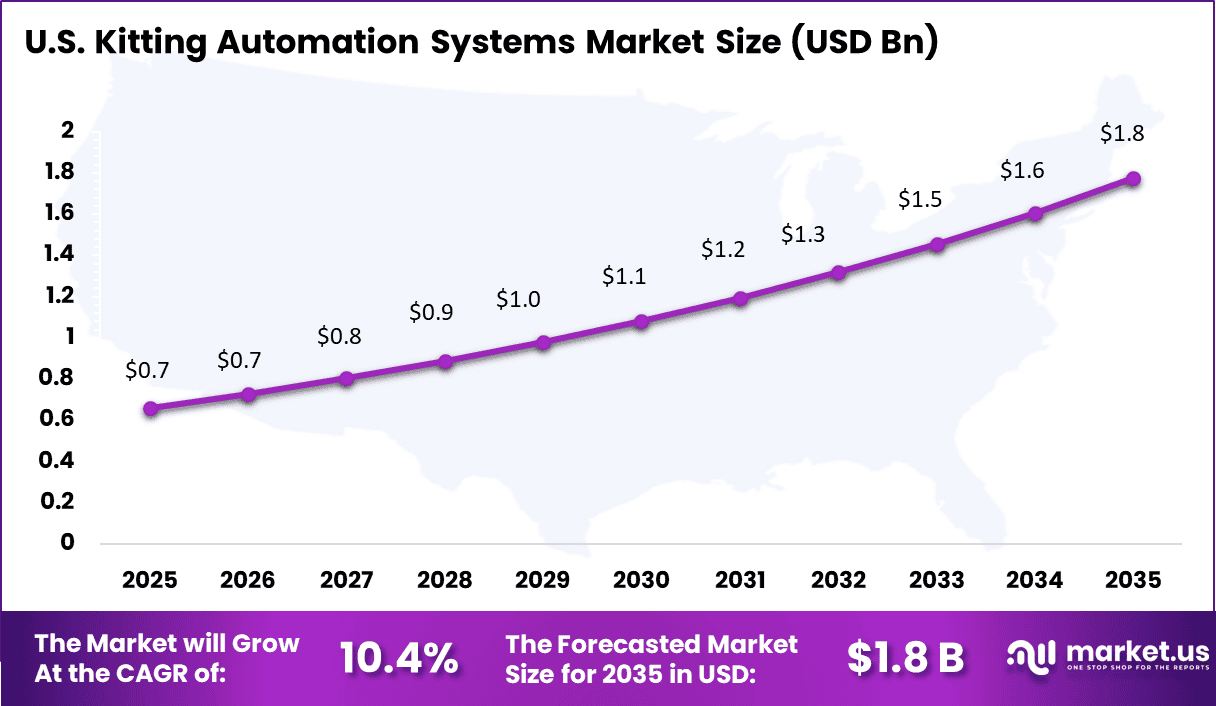
- North America drives 34.6% global value, with the U.S. market at USD 0.66 billion and 10.4% CAGR, fueled by Amazon-style automation and peak-season scalability demands.
By Component Analysis
Hardware accounted for 52.6% of the Kitting Automation Systems Market. This segment leads because robotic arms, conveyors, sorting systems, and automated storage units form the core of kitting operations. These components enable precise picking, grouping, and packaging of items, which improves speed and reduces manual handling errors.
The segment is also supported by increasing adoption of warehouse automation. Companies invest in reliable hardware to handle high order volumes and ensure consistent performance, which strengthens demand for automated kitting infrastructure across logistics and fulfillment environments.
By Application Analysis
E-commerce and retail represented 23% of the market. This segment dominates because online retailers and distribution centers require efficient kitting systems to manage bundled products, promotional kits, and customized orders. Automation helps streamline order fulfillment and improves delivery timelines.
The segment is driven by rising demand for faster order processing and personalized packaging. Businesses in e-commerce and retail use kitting automation to improve operational efficiency, reduce labor dependency, and enhance customer satisfaction through accurate and timely order fulfillment.
Key Market Segments
By Component
- Hardware
- Robotic Kitting Systems
- Automated Storage and Retrieval Systems
- Conveyor Systems
- Pick-to-Light Systems
- Others
- Software
- On-Premises
- Cloud-Based
- Services
By Application
- Automotive
- Electronics
- Aerospace & Defense
- E-commerce & Retail
- Pharmaceuticals
- Food & Beverage
- Others
Regional Analysis
North America accounted for 34.6% of the Kitting Automation Systems Market, reflecting strong adoption of automated assembly and packaging solutions across manufacturing and logistics sectors. Companies across the region increasingly deploy kitting automation systems to streamline order fulfillment, reduce manual handling, and improve operational efficiency.
Industries such as automotive, electronics, and e-commerce continue to integrate automation into their workflows to manage high-volume production and complex inventory requirements, which supports steady demand across North America.
The U.S. generated about USD 0.66 billion within the regional market and is projected to expand at a CAGR of 10.4%. Manufacturers and distribution centers across the country continue to invest in systems that automate the grouping and packaging of components into kits.
These solutions help improve accuracy, reduce labor dependency, and enhance throughput in fulfillment operations. As supply chains become more dynamic and demand for faster order processing increases, adoption of kitting automation systems continues to grow steadily across the US market.
Key Regions and Countries
- North America
- US
- Canada
- Europe
- Germany
- France
- The UK
- Spain
- Italy
- Russia
- Netherlands
- Rest of Europe
- Asia Pacific
- China
- Japan
- South Korea
- India
- Australia
- Singapore
- Thailand
- Vietnam
- Rest of APAC
- Latin America
- Brazil
- Mexico
- Rest of Latin America
- Middle East & Africa
- South Africa
- Saudi Arabia
- UAE
- Rest of MEA
Drivers Impact Analysis
| Key Driver | Impact on CAGR Forecast (~%) | Geographic Relevance | Impact Timeline | Strategic Effect |
|---|---|---|---|---|
| Increasing adoption of warehouse and logistics automation | +2.6% | North America, Europe, Asia Pacific | Short to Mid Term (2025–2031) | Improves order fulfillment efficiency |
| Rising demand for faster and error-free order processing | +2.3% | Global | Mid Term (2026–2032) | Enhances operational accuracy |
| Growth of e-commerce and omnichannel retail | +2.1% | North America, Asia Pacific, Europe | Mid Term (2026–2032) | Drives automated kitting demand |
| Increasing labor shortages in warehousing and manufacturing | +1.9% | US, Europe, Japan | Mid to Long Term (2026–2035) | Encourages automation adoption |
| Expansion of smart factories and Industry 4.0 initiatives | +1.8% | Global | Mid to Long Term (2026–2035) | Supports integrated automation systems |
Restraints Impact Analysis
| Key Restraint | Impact on CAGR Forecast (~%) | Geographic Relevance | Impact Timeline | Strategic Effect |
|---|---|---|---|---|
| High initial investment and system integration costs | -2.2% | Global | Mid Term (2026–2032) | Limits adoption among SMEs |
| Complexity in configuring automated kitting systems | -2.0% | Global | Mid Term (2026–2032) | Increases deployment time |
| Lack of skilled workforce for automation systems | -1.8% | Global | Mid Term (2026–2032) | Slows implementation |
| Integration challenges with legacy warehouse systems | -1.6% | North America, Europe | Mid Term (2026–2032) | Delays modernization |
| Maintenance and system downtime concerns | -1.4% | Global | Mid to Long Term (2026–2035) | Affects operational continuity |
Investor Type Impact Analysis
| Investor Type | Growth Sensitivity | Risk Exposure | Geographic Focus | Investment Outlook |
|---|---|---|---|---|
| Venture Capital Firms | High | Medium | US, Europe | Growth in warehouse automation startups |
| Private Equity Firms | High | Medium | North America, Europe | Expansion in logistics automation |
| Strategic Technology Investors | High | Medium | US, China, Germany | Strengthens industrial automation ecosystem |
| Corporate Venture Arms | Medium to High | Medium | Global | Supports supply chain partnerships |
| Government and Industrial Funds | Medium | Low | Asia Pacific, Europe | Supports smart manufacturing initiatives |
Technology Enablement Analysis
| Technology Enabler | Impact on CAGR Forecast (~%) | Geographic Relevance | Impact Timeline | Implementation Significance |
|---|---|---|---|---|
| Robotics and automated picking systems | +2.7% | Global | Short to Mid Term (2025–2031) | Improves kitting speed and accuracy |
| AI-driven inventory and order management systems | +2.4% | Global | Mid Term (2026–2032) | Enhances decision making |
| Integration with warehouse management systems | +2.2% | Global | Mid Term (2026–2032) | Improves operational coordination |
| IoT-enabled tracking and monitoring solutions | +2.0% | Global | Mid to Long Term (2026–2035) | Enhances visibility |
| Cloud-based automation platforms | +1.8% | Global | Mid to Long Term (2026–2035) | Supports scalability |
Key Challenges
- High setup cost is a major challenge because kitting automation systems require robots, conveyors, software, sensors, and system integration before they can run efficiently.
- Integration with existing warehouse and production systems can be difficult, especially when companies still use older equipment and disconnected software.
- Handling different product sizes, shapes, and order combinations is a challenge because automated systems must stay flexible across changing kit requirements.
- System accuracy is very important, and even small picking or sorting errors can lead to incomplete kits, shipment delays, and customer complaints.
- Maintenance and skilled support are ongoing challenges because automation systems need regular monitoring, repairs, and trained staff to keep operations running smoothly.
Emerging Trends
A key trend in the Kitting Automation Systems market is the increasing use of integrated robotic and software-driven solutions that streamline the process of assembling and organizing components into kits. These systems are designed to handle varied product configurations and adapt to changing order requirements in real time.
Facilities are moving toward flexible automation setups where machines can identify items, sort them accurately, and prepare kits with minimal manual intervention. This trend reflects a shift toward smarter fulfillment operations that improve consistency and reduce errors in assembly processes.
Growth Factors
The growing need for efficient order fulfillment and inventory handling is supporting the expansion of kitting automation systems. Businesses across manufacturing, e-commerce, and logistics aim to reduce manual effort and improve speed in preparing product kits.
Automated systems help maintain accuracy while handling large volumes of items, which improves operational efficiency. At the same time, increasing demand for customized products encourages the adoption of flexible solutions that can manage different kit combinations without slowing down overall workflow.
Competitive Analysis
The competitive landscape of the Kitting Automation Systems market includes major warehouse automation and material handling companies that provide sorting, picking, storage, and order assembly solutions.
Daifuku Co., Ltd., Honeywell Intelligrated, Dematic (KION Group), SSI SCHAEFER, Mecalux, S.A., and Kardex Group hold strong positions because they offer integrated automation systems that improve kitting speed, order accuracy, and warehouse efficiency.
Other players such as Murata Machinery, Ltd., Bastian Solutions, Fives Group, System Logistics S.p.A., WITRON Logistik + Informatik GmbH, Interroll Group, Hytrol Conveyor Company, Inc., Okura Yusoki Co., Ltd., and Schaefer Systems International, Inc. add competition through conveyor systems, robotics, storage solutions, and software support.
Top Key Players in the Market
- Daifuku Co., Ltd.
- Honeywell Intelligrated
- Dematic (KION Group)
- SSI SCHAEFER
- Swisslog (KUKA Group)
- Murata Machinery, Ltd.
- Vanderlande Industries
- Bastian Solutions
- TGW Logistics Group
- KNAPP AG
- BEUMER Group
- Mecalux, S.A.
- Fives Group
- System Logistics S.p.A.
- WITRON Logistik + Informatik GmbH
- Interroll Group
- Hytrol Conveyor Company, Inc.
- Okura Yusoki Co., Ltd.
- Schaefer Systems International, Inc.
- Kardex Group
- Others
Future Outlook
The future outlook for the Kitting Automation Systems Market looks positive as manufacturers and warehouses seek faster, more accurate ways to group parts and prepare orders. Current industry solutions already combine automated storage, goods-to-person workflows, conveyors, and warehouse management integration to reduce manual work and improve kit accuracy. As labor efficiency, order speed, and inventory control become more important, demand for kitting automation systems is expected to grow steadily in the coming years.
Recent Developments
- In February 2026, Honeywell Momentum WES with Decision Intelligence orchestrated 20K+ SKUs across high-speed shuttle kitting stations, achieving 40% throughput gains over manual operations for e-commerce returns processing. Cloud-native lifecycle support optimized 1M+ daily order consolidations.
- In January 2026, Daifuku RDS v2.0 Robotic De-Layering System enhanced 3D vision singulation processing mixed-SKU pallets at 1,200 cases/hour across 500+ automotive lines with 99.5% accuracy and compact footprint design. India plant expansion quadrupled AS/RS kitting capacity serving food/chemical sectors.
Report Scope
| Report Features | Description |
|---|---|
| Market Value (2025) | USD 2.1 Billion |
| Forecast Revenue (2035) | USD 6.8 Billion |
| CAGR(2025-2035) | 12.2% |
| Base Year for Estimation | 2024 |
| Historic Period | 2020-2024 |
| Forecast Period | 2025-2035 |
| Report Coverage | Revenue forecast, AI impact on Market trends, Share Insights, Company ranking, competitive landscape, Recent Developments, Market Dynamics and Emerging Trends |
| Segments Covered | By Component (Hardware (Robotic Kitting Systems, Automated Storage and Retrieval Systems, Conveyor Systems, Pick-to-Light Systems, Others), Software (On-Premises, Cloud-Based), Services), By Application (Automotive, Electronics, Aerospace & Defense, E-commerce & Retail, Pharmaceuticals, Food & Beverage, Others) |
| Regional Analysis | North America – US, Canada; Europe – Germany, France, The UK, Spain, Italy, Russia, Netherlands, Rest of Europe; Asia Pacific – China, Japan, South Korea, India, New Zealand, Singapore, Thailand, Vietnam, Rest of Latin America; Latin America – Brazil, Mexico, Rest of Latin America; Middle East & Africa – South Africa, Saudi Arabia, UAE, Rest of MEA |
| Competitive Landscape | Daifuku Co., Ltd., Honeywell Intelligrated, Dematic (KION Group), SSI SCHAEFER, Swisslog (KUKA Group), Murata Machinery, Ltd., Vanderlande Industries, Bastian Solutions, TGW Logistics Group, KNAPP AG, BEUMER Group, Mecalux, S.A., Fives Group, System Logistics S.p.A., WITRON Logistik + Informatik GmbH, Interroll Group, Hytrol Conveyor Company, Inc., Okura Yusoki Co., Ltd., Schaefer Systems International, Inc., Kardex Group, Others |
| Customization Scope | Customization for segments, region/country-level will be provided. Moreover, additional customization can be done based on the requirements. |
| Purchase Options | We have three licenses to opt for: Single User License, Multi-User License (Up to 5 Users), Corporate Use License (Unlimited Users and Printable PDF) |





































