


Report Overview
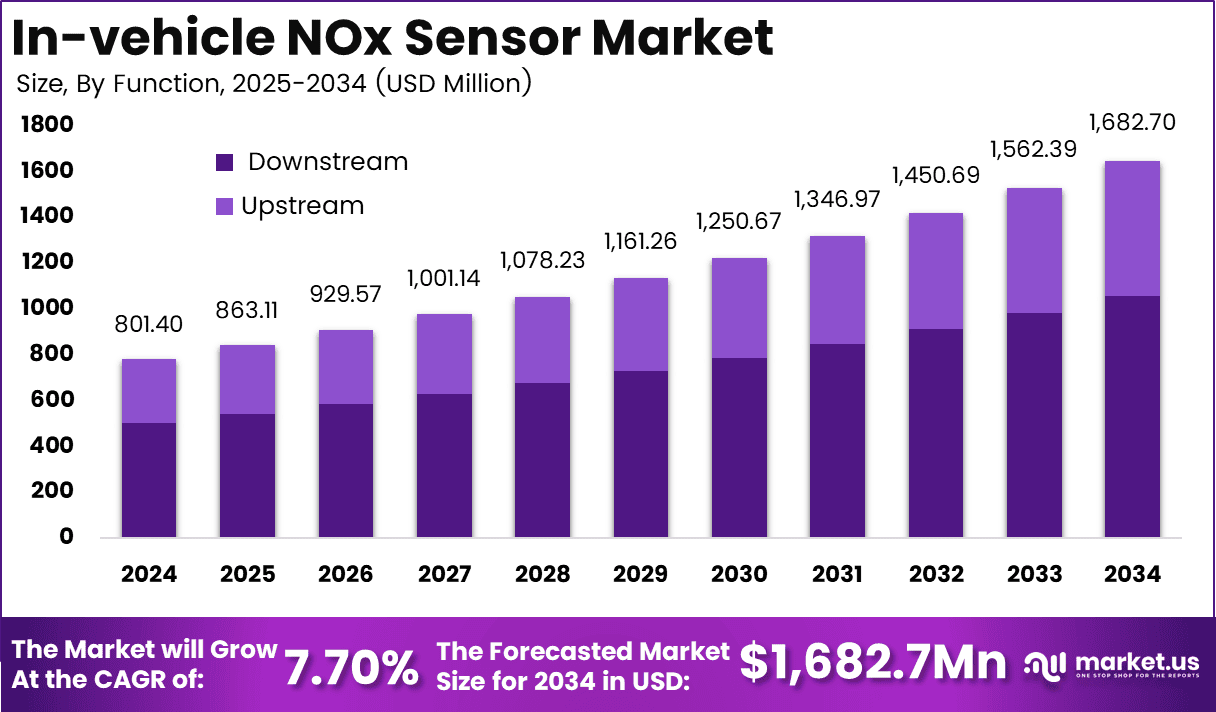
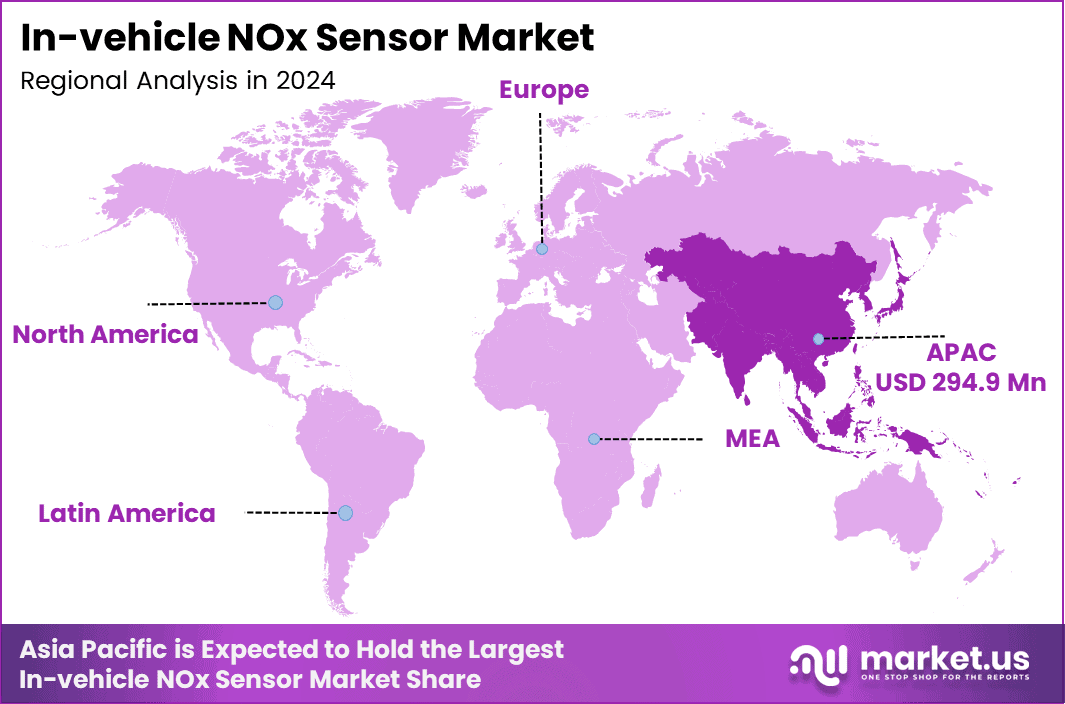
In 2024, the Global In-vehicle NOx Sensor Market was valued at USD 801.4 million. The market is projected to grow at a CAGR of 7.7% during 2024–2034, reaching approximately USD 1,682.7 million by 2034. Asia Pacific dominated the global market in 2024, accounting for 36.8% of the total market share.
The International Organization of Motor Vehicle Manufacturers (OICA) reports that global vehicle production reached 92.7 million units in 2024. Each new diesel vehicle and many gasoline, hybrid, and commercial vehicle platforms require accurate exhaust monitoring to manage NOx emissions and protect the performance of emission-control systems.
NOx sensors supply real-time data to the engine-control unit and selective catalytic reduction system, helping manufacturers control urea injection, detect faults, and maintain legal emissions performance. As vehicle output rises and vehicles remain on the road for longer, both original-equipment demand and replacement demand for these sensors increase.
Asia Pacific is the world’s largest vehicle manufacturing region. OICA records 54.91 million vehicles produced in Asia-Oceania in 2024, about 59% of global output, creating a very large installed base for emission sensors. Regulation is also turning this production volume into direct sensor demand. India’s Ministry of Environment, Forest and Climate Change states that Bharat Stage VI applies to vehicles manufactured from 1 April 2020; the rule limits diesel sulphur to 10 ppm and enables selective catalytic reduction systems specifically used to reduce NOx.
In China, the China 6b standard introduced a fuel-neutral NOx limit of 0.035 g/km for light-duty vehicles. In Europe, Euro 7 requires onboard systems to monitor and record NOx emissions, including driver warnings when emissions greatly exceed limits. These rules make NOx sensing a compliance-critical vehicle component rather than an optional add-on, supporting the projected growth rate.
Key Takeaways
- The global In-vehicle NOx Sensor Market was valued at USD 801.4 million in 2024.
- The global In-vehicle NOx Sensor Market is projected to grow at a CAGR of 7.7% and is estimated to reach USD 1,682.7 million by 2034.
- On the basis of type, the Electrochemical NOx Sensor segment dominated the market, accounting for 52.37% of the total market share.
- By function, the Downstream segment dominated the market, accounting for 62.8% of the total market share.
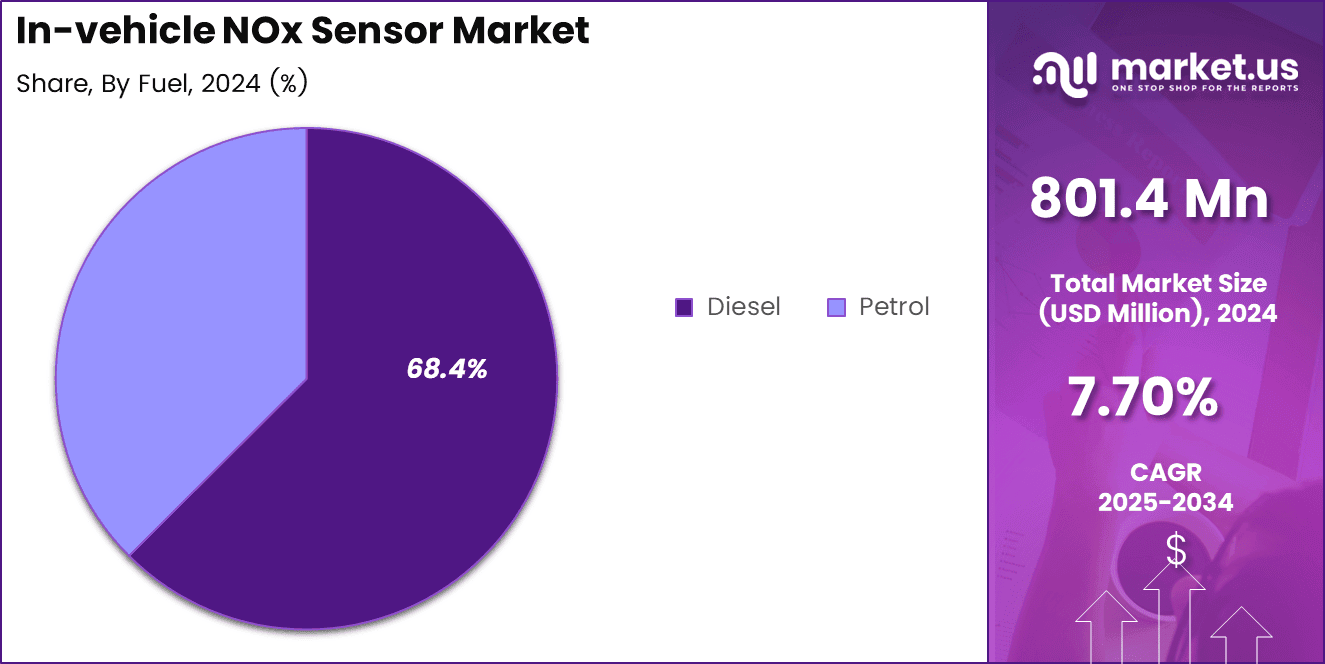
- Based on fuel, the Diesel segment dominated the market, accounting for 68.4% of the total market share.
- By vehicle type, the Commercial Vehicle segment dominated the market, accounting for 63.7% of the total market share.
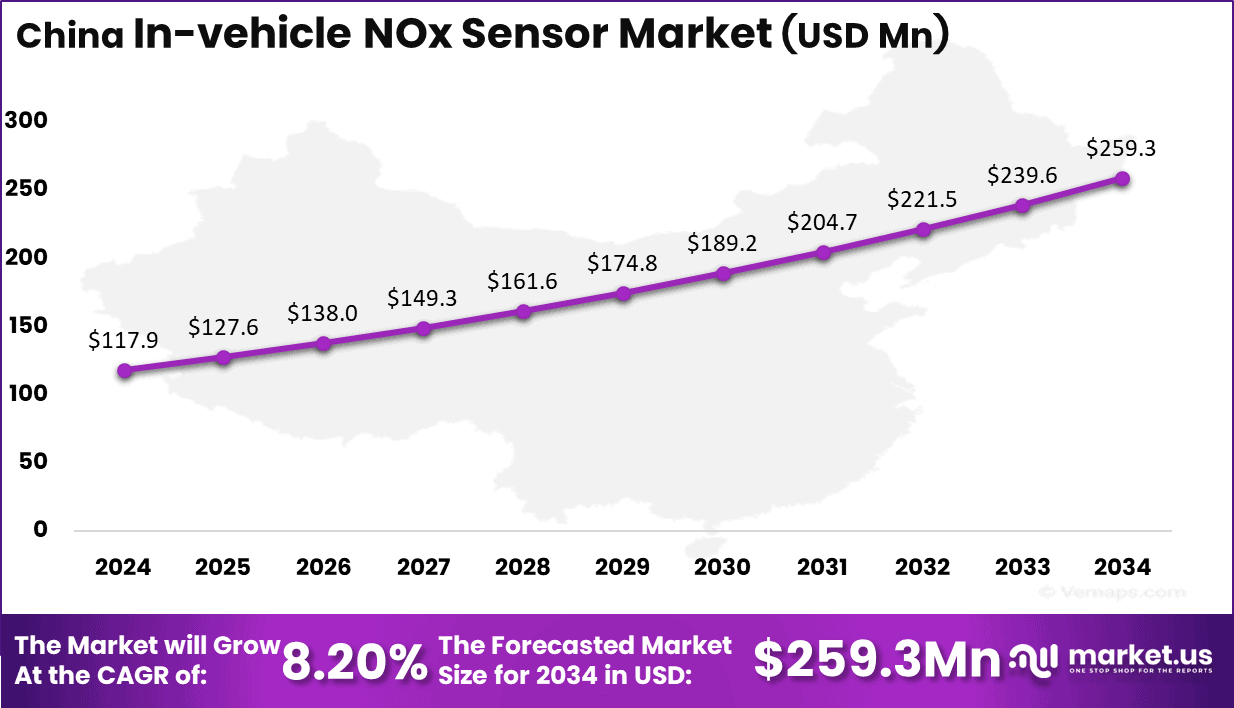
- In 2024, Asia Pacific was the most dominant region in the In-vehicle NOx Sensor Market, accounting for 36.8% of the total market share. China generated approximately USD 117.9 million in revenue.
By Type
The Electrochemical NOx Sensor segment is expected to capture 52.37% of the market share in the China In-vehicle NOx Sensor Market. This dominance is primarily due to their high accuracy, cost-effectiveness, and widespread adoption in emission control systems. Electrochemical sensors are highly effective in measuring nitrogen oxides (NOx), especially in diesel-powered engines, which require stringent emission standards.
The cost-efficiency of electrochemical sensors makes them the preferred choice for automakers looking to comply with regulatory requirements without significantly raising production costs. Looking forward, this segment is predicted to maintain a 55-58% market share by 2034, driven by their continued effectiveness in meeting regulatory standards and their ability to operate under various temperature and pressure conditions.
By Function
The Downstream segment is projected to hold a dominant 62.8% market share in 2024, owing to its critical role in emissions management. Downstream sensors monitor NOx emissions after combustion, helping to ensure compliance with environmental regulations. As global emissions standards become stricter, the adoption of downstream sensors is anticipated to increase.
By 2034, the segment is expected to expand to 65-70% of the market, as new regulatory measures enforce stricter limits on post-combustion emissions. The downstream sensors’ central role in after-treatment systems, such as selective catalytic reduction (SCR), will continue to drive their market share.
By Fuel
The Diesel segment is set to capture 68.4% of the market share in 2024, as diesel-powered vehicles produce significantly higher levels of nitrogen oxides (NOx) compared to petrol vehicles. Due to stricter environmental regulations aimed at reducing diesel emissions, the demand for NOx sensors is increasing, particularly in commercial and heavy-duty vehicles.
By 2034, the diesel segment is predicted to maintain 70-72% of the market, driven by continued adoption of advanced emission control technologies in the diesel vehicle fleet. While petrol vehicles will also see growth in NOx sensor adoption due to tightening regulations, diesel’s higher emissions output ensures that diesel-powered vehicles will continue to dominate the market.
By Vehicle Type
The Commercial Vehicle segment is forecasted to dominate with a 63.7% market share, driven by the higher fuel consumption and emissions of heavy-duty, medium, and light commercial vehicles. The significant demand for NOx sensors in the commercial vehicle sector is largely due to the stringent emission regulations applied to these vehicles.
By 2034, the commercial vehicle segment is expected to grow to 65-70% of the market, as more regulations are enforced globally, especially in the growing freight and logistics industries. The need for emission control in commercial vehicles, including trucks and buses, is paramount, as these vehicles contribute significantly to air pollution.
Key Market Segments
By Type
- Optical NOx Sensor
- Electrochemical NOx Sensor
- Solid-State NOx Sensor
By Gas
- Nitric Oxide (NO)
- Nitrogen Dioxide (NO2)
- Nitrous Oxide (N2O)
By Function
- Upstream
- Downstream
By Fuel
- Petrol
- Diesel
By Vehicle Type
- Passenger Vehicle
- Commercial Vehicle
- Light Commercial
- Medium Commercial
- Heavy Commercial
Investment and Business Benefits
The In-vehicle NOx Sensor Market presents promising investment opportunities driven by the increasing regulatory push for cleaner automotive technologies and stricter emission standards. As governments globally adopt stringent environmental policies, the demand for advanced NOx sensors in vehicles is expected to grow significantly, with the market predicted to expand by 7.7% annually. This growth trajectory is likely to boost the overall market value by 50-60% over the next decade.
Businesses entering the market can benefit from the growing adoption of diesel-powered vehicles, which will remain a significant segment for NOx sensors, holding an estimated 65-70% market share through 2030. In addition, expansion in regions such as North America and APAC will further accelerate demand, with the APAC region expected to grow at an 8-9% CAGR.
China, driven by substantial government incentives for cleaner technologies, could see its market share rise by 20-25% over the next 5-6 years. Companies focused on meeting emission standards are projected to capture substantial revenue, with annual sales expected to grow 45-50% by 2034, making the sector highly attractive for investors.
Regional Analysis
The APAC region, led by China, is projected to dominate the global market, with USD 294.9 million in 2024, and is expected to account for 50% of the market share by 2034. North America is also a key player, expected to hold 25-30% market share due to stringent emissions standards and technological innovation in the automotive industry.
Europe, with its strong regulatory framework, is expected to capture 20-25% of the global market share, while regions such as MEA and Latin America are projected to see slower growth. The market’s expansion will be driven by increased demand for NOx sensors as part of the automotive industry’s push for better emission control systems.
The steady increase in market size reflects both a shift towards cleaner technology and the growing importance of regulatory compliance in vehicle manufacturing worldwide. As emissions regulations tighten, the market for NOx sensors is expected to witness consistent growth across key global regions.
China Market Size
The China In-vehicle NOx Sensor Market is expected to grow from USD 117.9 million in 2024 to USD 259.3 million in 2034, reflecting a CAGR of 8.20%. This growth is driven by increasing regulatory pressures for cleaner emissions and advancements in vehicle technology.
Key Regions and Countries
- North America
- US
- Canada
- Europe
- Germany
- France
- The UK
- Spain
- Italy
- Rest of Europe
- Asia Pacific
- China
- Japan
- South Korea
- India
- Australia
- Singapore
- Rest of Asia Pacific
- Latin America
- Brazil
- Mexico
- Rest of Latin America
- Middle East & Africa
- South Africa
- Saudi Arabia
- UAE
- Rest of MEA
Drivers
| Driver | (~) % Impact on CAGR Forecast | Geographic Relevance | Impact Timeline |
|---|---|---|---|
| China VI Remote-OBD Fitment | +1.8% | China heavy-duty vehicles | Short term (≤ 2 years) |
| SCR System Replacement Demand | +1.4% | Europe, North America, China | Short term (≤ 2 years) |
| Pre-Compliance Engine Programs | +1.2% | North America, Europe | Medium term (2–4 years) |
| Fleet Uptime Diagnostics | +0.9% | Global commercial-vehicle fleets | Short term (≤ 2 years) |
| Off-Highway Emissions Enforcement | +0.7% | Europe, China, North America | Medium term (2–4 years) |
China VI Remote-OBD Fitment
China VI-b became applicable to all new heavy-duty vehicles on July 1, 2023, following the earlier China VI-a rollout, and requires remote emissions-monitoring data that include NOx-sensor inputs. The standard cut permissible NOx emissions by roughly 77% versus China V, converting sensor accuracy, response stability, and diagnostic reliability from a component-level specification into a recurring vehicle-certification requirement.
This supports an estimated +1.8% contribution to the 7.7% baseline CAGR by increasing dual-sensor SCR architectures, raising validation content per truck, and shifting supplier competition toward fault-detection performance and long-term calibration assurance rather than unit-price bidding alone.
Restraints
| Restraint | (~) % Impact on CAGR Forecast | Geographic Relevance | Impact Timeline |
|---|---|---|---|
| Battery-Electric Powertrain Displacement | -1.3% | China, Europe, North America | Medium term (2–4 years) |
| OEM Annual Price-Downs | -1.0% | Global OEM supply chains | Short term (≤ 2 years) |
| Counterfeit Aftermarket Modules | -0.8% | Asia, Middle East, Latin America | Short term (≤ 2 years) |
| Diesel Production Volatility | -0.7% | Europe, North America | Short term (≤ 2 years) |
| Service-Channel Sensor Bypass | -0.6% | Emerging markets | Short term (≤ 2 years) |
Battery-Electric Powertrain Displacement
Battery-electric vehicles remove the exhaust stream and therefore eliminate the NOx-sensor fitment opportunity that accompanies combustion-based SCR systems. Electric cars represented about 18% of global car sales in 2023, while battery-electric vehicles accounted for roughly 70% of the electric-car stock; this makes China, Europe, and selected North American fleet segments the most exposed sources of foregone combustion-platform volume.
A single battery-electric substitution can displace one or more NOx-sensor positions, creating an estimated -1.3% drag on the baseline CAGR, increasing fixed-cost absorption pressure for dedicated sensor lines and forcing suppliers to prioritize heavy-duty, off-highway, hybrid, and replacement-demand mix resilience.
Challenges
| Challenge | (~) % CAGR Friction Drag | Geographic Relevance | Mitigation Horizon |
|---|---|---|---|
| High-Temperature Sensor Durability | -1.1% | Global heavy-duty applications | Medium term (2–4 years) |
| Ceramic Substrate Concentration | -0.9% | Asia, Europe, North America | Medium term (2–4 years) |
| Cross-Platform Calibration Complexity | -0.8% | Global OEM programs | Medium term (2–4 years) |
| Field-Diagnostic Data Fragmentation | -0.7% | Global fleet service networks | Long term (≥ 4 years) |
| Skilled Calibration Talent Gap | -0.6% | Europe, Japan, North America | Long term (≥ 4 years) |
High-Temperature Sensor Durability
NOx sensors operate in corrosive exhaust environments exposed to thermal cycling, vibration, soot, sulfur compounds, urea deposits, and water ingress, making field durability a persistent engineering constraint rather than a temporary sales barrier. A sensor that drifts outside diagnostic thresholds can trigger derate events, warranty claims, and replacement costs even when the underlying SCR hardware remains functional.
Extending validated service life by only 20% can materially reduce replacement frequency but requires longer thermal-aging cycles, tighter heater-control tolerances, and higher screening expenditure. This produces an estimated -1.1% friction drag on maximum growth potential and compels suppliers to fund accelerated aging laboratories, software-based plausibility diagnostics, and application-specific calibration libraries.
Opportunities
| Opportunity | (~) % Potential CAGR Upside | Geographic Relevance | Execution Window |
|---|---|---|---|
| Predictive Aftermarket Diagnostics | +1.5% | Europe, North America, China | Medium term (2–4 years) |
| Remanufactured Sensor Programs | +1.1% | Europe, North America | Medium term (2–4 years) |
| Non-Road Equipment Retrofits | +1.0% | Asia-Pacific, Europe, North America | Long term (≥ 4 years) |
| Fleet Compliance Subscription Bundles | +0.9% | Global logistics fleets | Medium term (2–4 years) |
| Localized Service Distribution | +0.7% | Latin America, Middle East, Africa | Medium term (2–4 years) |
Predictive Aftermarket Diagnostics
This remains untapped rather than a current driver because most sensor suppliers still monetize primarily at original fitment or failure replacement, not through fleet-level degradation analytics and proactive service workflows.
A 10–15% reduction in avoidable roadside events and a 15–25% increase in service-channel attachment can improve unit economics through higher diagnostic content, lower warranty leakage, and recurring software revenue. If suppliers secure data access, repair-network integration, and fleet contracts, this model could add approximately +1.5% above the baseline CAGR while expanding margins beyond standalone sensor sales.
Key Players Analysis
Tier-1 leaders Bosch, DENSO and Continental likely control an estimated 50–60% of global in-vehicle NOx-sensor value, based on their unmatched OEM exhaust-aftertreatment integration, global production footprint and mobility-scale purchasing power. This is an analyst estimate, not a company-reported share. Bosch is the scale leader.
Its Mobility business generated €55.8 billion in 2024 sales and €2.0 billion EBIT, while group R&D reached €7.9 billion, supporting integrated engine-management, exhaust-sensing and diagnostics platforms. DENSO is the principal Japanese challenger, with FY2025 revenue of ¥7,161.8 billion, R&D of ¥619.4 billion (8.6% of sales), and ¥371.1 billion of capital expenditure directed toward electrification, advanced safety and semiconductor capacity.
These investments strengthen its electronics, control-unit and sensor-system attachment rates. Continental’s Automotive business produced €19.4 billion in 2024 sales. Its €2.356 billion Automotive R&D spend, equal to 12.1% of segment revenue, shows unusually high engineering intensity as the business is separated from the wider group.
Tier-2 specialists Niterra and Sensata are estimated at a combined 15–25% share, with greater exposure to discrete sensing components and the replacement market than the Tier-1 systems suppliers. Niterra’s sensor business recorded 4% year-on-year sales growth in FY2025 despite weaker ICE production, while group R&D was ¥28.144 billion, or 4.3% of revenue.
Its focused exhaust-gas sensor portfolio makes it a credible NOx specialist but materially smaller than Bosch and DENSO. Sensata provides a diversified sensing alternative. Automotive represented 57.0% of FY2025 revenue, and R&D was $133.8 million, while its Performance Sensing segment contributed 70.5% of third-quarter 2025 revenue.
Top Key Players
- Continental AG
- Delphi Technologies (BorgWarner)
- Denso Corporation
- Emerson Electric Co.
- Faurecia
- Hella KGaA Hueck & Co.
- Hitachi Automotive Systems
- Honeywell International Inc.
- Horiba, Ltd.
- Infineon Technologies AG
- Mitsubishi Electric Corporation
- NGK Insulators, Ltd.
- Robert Bosch GmbH
- Sensata Technologies
- Other
Recent Developments
- In March 2024, Bosch introduced a new generation of NOx sensors designed to meet the stringent Euro 7 emission standards, enhancing emission control in modern vehicles. Bosch’s advanced sensor technology aims to support regulatory compliance while maintaining vehicle performance, helping manufacturers meet global emission standards.
- In February 2024, Continental AG launched a NOx sensor tailored for electric and hybrid vehicles. This new sensor is designed to address the growing need for efficient emission control in the expanding electric and hybrid vehicle market, offering improved performance, accuracy, and reliability in emission measurement systems.
- In 2023, Delphi Technologies, now part of BorgWarner, reported a 6.7% year-over-year increase in revenue from emissions-related products, including NOx sensors. This growth reflects the rising demand for NOx sensors driven by tightening environmental regulations and increasing vehicle production worldwide.
Report Scope
| Report Features | Description |
|---|---|
| Market Value (2024) | USD 801.4 Mn |
| Forecast Revenue (2034) | USD 1,682.7 Mn |
| CAGR(2025-2034) | 7.7% |
| Base Year for Estimation | 2024 |
| Historic Period | 2020-2023 |
| Forecast Period | 2025-2034 |
| Report Coverage | Revenue forecast, AI impact on Market trends, Share Insights, Company ranking, competitive landscape, Recent Developments, Market Dynamics and Emerging Trends |
| Segments Covered | By Type (Optical NOx Sensor, Electrochemical NOx Sensor, Solid-State NOx Sensor), By Gas (Nitric Oxide (NO), Nitrogen Dioxide (NO2), Nitrous Oxide (N2O)), By Function (Upstream, Downstream), By Fuel (Petrol, Diesel), By Vehicle Type, (Passenger Vehicle, Commercial Vehicle[Light Commercial, Medium Commercial, Heavy Commercial]) |
| Regional Analysis | North America – US, Canada; Europe – Germany, France, The UK, Spain, Italy, Russia, Netherlands, Rest of Europe; Asia Pacific – China, Japan, South Korea, India, New Zealand, Singapore, Thailand, Vietnam, Rest of Latin America; Latin America – Brazil, Mexico, Rest of Latin America; Middle East & Africa – South Africa, Saudi Arabia, UAE, Rest of MEA |
| Competitive Landscape | Continental AG, Delphi Technologies (BorgWarner), Denso Corporation, Emerson Electric Co., Faurecia, Hella KGaA Hueck & Co., Hitachi Automotive Systems, Honeywell International Inc., Horiba, Ltd., Infineon Technologies AG, Mitsubishi Electric Corporation, NGK Insulators, Ltd., Robert Bosch GmbH, Sensata Technologies, Other |
| Customization Scope | Customization for segments, region/country-level will be provided. Moreover, additional customization can be done based on the requirements. |
| Purchase Options | We have three licenses to opt for: Single User License, Multi-User License (Up to 5 Users), Corporate Use License (Unlimited Users and Printable PDF) |





































