Report Overview
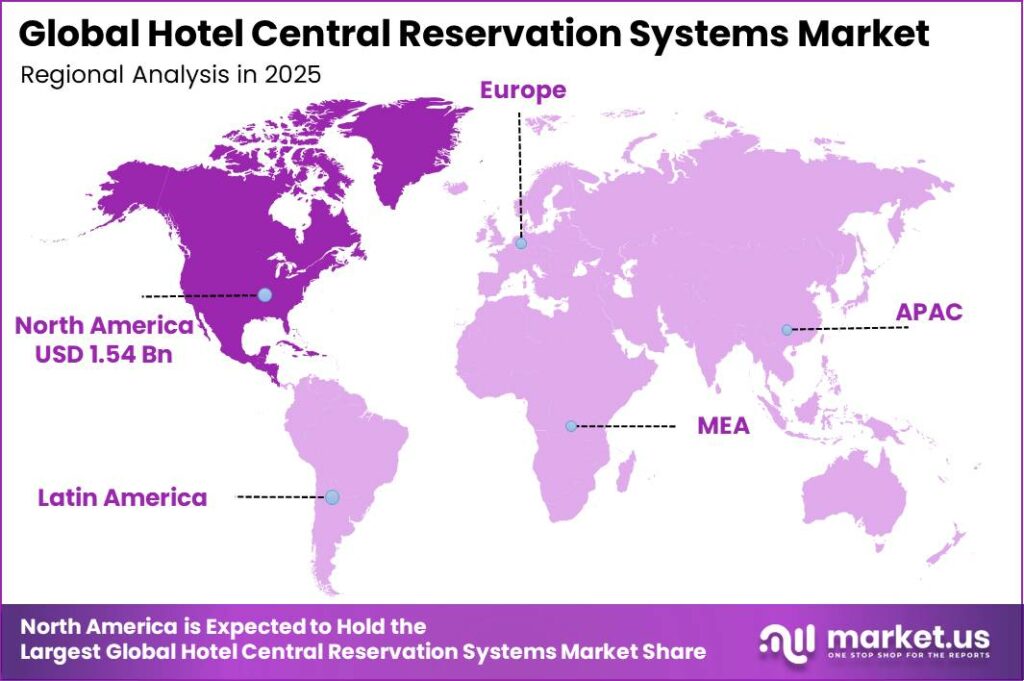
In 2025, the Global Hotel Central Reservation Systems Market was valued at USD 3.7 billion. The market is projected to expand at a CAGR of 12.1% during 2026–2035, reaching approximately USD 11.4 billion by 2035. North America dominated the global market in 2025, accounting for more than 42.1% of the total market share and generating approximately USD 1.54 billion in revenue.
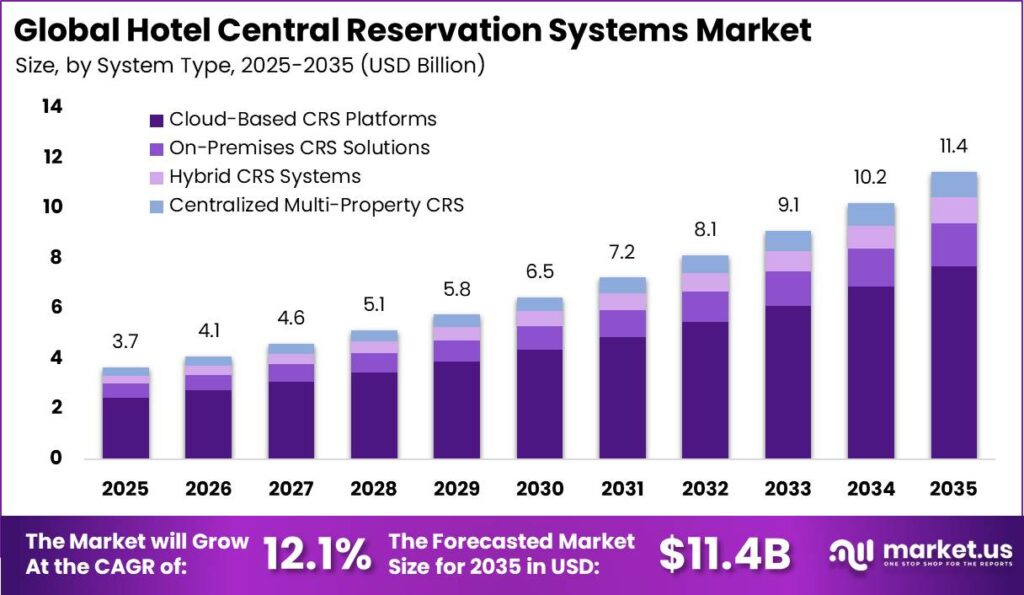
The market growth is supported by the steady recovery of global tourism and the rapid expansion of digital hotel booking platforms. UN Tourism reported 1.4 billion international tourist arrivals in 2024, an increase of 11% compared to 2023, with travel volumes returning to pre-pandemic levels. This rise in travel has increased the need for centralized reservation systems that can efficiently manage room inventory, pricing, and bookings across multiple distribution channels.
The global online travel market exceeded USD 640 billion in 2024, while online channels accounted for nearly 70% of global travel and tourism revenue, highlighting the growing dependence on digital reservation platforms for real-time availability, instant booking confirmation, and channel synchronization.
North America’s leading position is supported by its advanced hospitality sector and strong digital adoption. The region generated approximately USD 650 billion in hospitality revenue in 2024, while hotel occupancy rates remained between 68% and 70%, encouraging continued investment in cloud-based reservation technologies. International tourist arrivals are expected to increase by around 4–5% annually.
Key Takeaway
- The Global Hotel Central Reservation Systems Market was valued at USD 3.7 billion in 2025 and is projected to reach USD 11.4 billion by 2035, growing at a CAGR of 12.1% during 2026–2035.
- Cloud-Based CRS Platforms held the largest system type share at 67.3% in 2025.
- Room Inventory & Rate Management led the functionality segment with a 34.8% market share in 2025.
- SaaS-Based CRS dominated the deployment model segment, accounting for 71.2% of the market in 2025.
- Chain Hotels & Hotel Groups represented the largest hotel type segment with a 58.6% share in 2025.
- Booking Management was the leading application segment, capturing 39.4% of the global market in 2025.
- Large Hotel Enterprises accounted for the largest end-user share at 63.1% in 2025.
- PMS Integrated CRS led the integration type segment with a 46.2% market share in 2025.
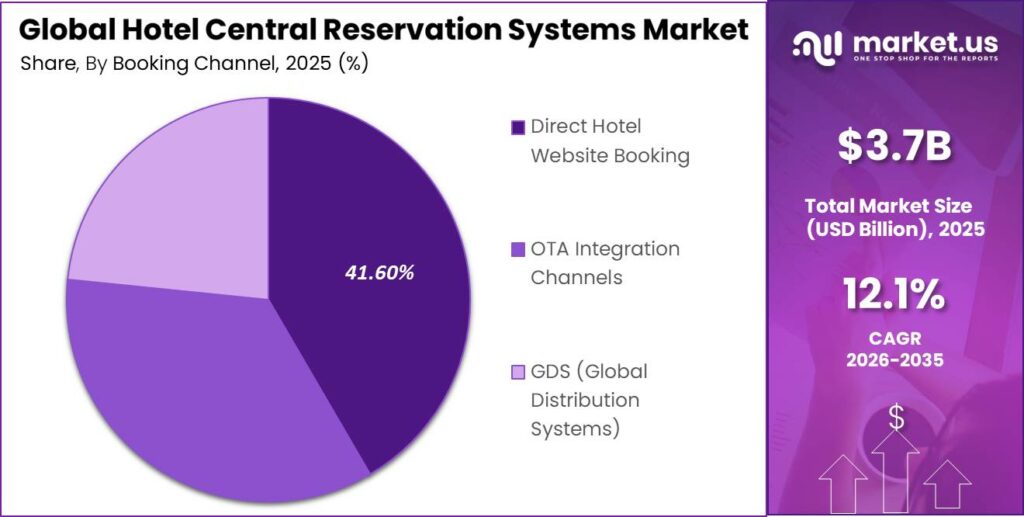
- Direct Hotel Website Booking was the largest booking channel, accounting for 41.6% of the market in 2025.
- North America dominated the global market in 2025, accounting for 42.1% of the market and generating approximately USD 1.54 billion in revenue.
By System Type
Cloud-Based CRS Platforms held a dominant market position, capturing more than a 67.3% share. Hotels are moving to cloud delivery because it removes the need for heavy local servers and allows teams to update rates and availability from anywhere, which matters when more than 70% of travel research and booking traffic is already online and heavily mobile.
In many properties, process automation through CRS has been shown to cut administrative workload and help minimize human error, which is a growing concern for organizations trying to manage complex digital operations. Moving into 2026, cloud-based platforms benefit from the broader trend where over 60% of small and mid-sized businesses host most workloads in the cloud.
By Functionality
Room Inventory & Rate Management held a dominant market position in 2025, capturing more than a 34.8% share. Hotels depend on this module because it directly controls how rooms are sold across websites, OTAs, and other digital channels that now account for well over 60% of travel bookings.
A CRS that manages inventory and rates in real time helps reduce booking errors and mismatched prices, and independent evidence shows centralized reservation systems can cut booking mistakes by around 30% while improving operational efficiency.
By Deployment Model
SaaS-Based CRS held a dominant market position in 2025, capturing more than a 71.2% share. Hotels favor software-as-a-service delivery because it offers quick deployment, browser-based access, and regular updates without large on-site installations, reflecting broader business technology patterns where cloud-hosted applications increasingly support core workflows.
This model also supports multi-property visibility for groups, letting them apply different prices locally while keeping brand-level policies aligned. Moving into 2026, hotels continue to adopt SaaS CRS as they see gains in speed and fewer booking errors from automated updates, consistent with findings that central reservation systems can cut mistakes by about 30% in independent properties.
By Hotel Type
Chain Hotels & Hotel Groups held a dominant market position in 2025, capturing more than a 58.6% share. These operators lean heavily on CRS platforms because they must coordinate inventory, rates, and booking policies across many properties, often in different regions where online booking penetration is approaching 70% by the middle of this decade.
Independent Hotels is emerging as a fast-growing segment in 2025 as smaller properties adopt CRS tools to compete more effectively. Research indicates CRS adoption among independents has reached about 65%, helping them streamline reservations and reduce booking mistakes by roughly 30%, which directly improves guest satisfaction and staff productivity.
By Application
Booking Management held a dominant market position in 2025, capturing more than a 39.4% share. This is the core application of hotel CRS platforms, converting interest into confirmed stays across direct websites, OTAs, and other digital channels that now represent around 70% of overall travel bookings. A central reservation system automates the flow of reservations, syncing data from multiple sources and reducing manual administration.
Revenue Optimization is emerging as a fast-growing segment in 2025 as hotels try to improve what they earn from each room night, rather than simply focusing on occupancy. With OTAs charging commissions that often sit between 15% and 30%, many operators are looking for CRS-connected strategies that favor direct bookings where possible while still using distribution partners to reach new guests.
By End User
Large Hotel Enterprises held a dominant market position in 2025, capturing more than a 63.1% share. These organizations operate big portfolios and must coordinate bookings across regions where online travel market penetration and mobile usage are both high, making centralized systems critical.
SMEs & Boutique Hotels are emerging as a fast-growing segment in 2025 because smaller properties now have easier access to cloud-based CRS platforms. Studies show that cloud adoption among small and mid-sized businesses is high, with over 60% of workloads hosted in the cloud, which makes web-based reservation tools a natural fit.
By Integration Type
PMS Integrated CRS held a dominant market position in 2025, capturing more than a 46.2% share. Hotels value tight integration because it connects reservation data directly with room status, housekeeping, and billing, shortening the gap between sales and operations.
API-Based Distributed CRS is emerging as a fast-growing segment in 2025, driven by hotels that want flexibility in how systems talk to each other. In 2025, this approach fits well with wider technology trends, where over 80% of enterprises use multi-cloud and hybrid strategies, expecting systems to interoperate rather than rely on a single vendor environment.
By Booking Channel
Direct Hotel Website Booking held a dominant market position in 2025, capturing more than a 41.6% share. Hotels actively promote this channel because it provides better control over content, pricing, and guest data, while reducing dependence on intermediaries. In 2025, digital behavior supported this focus: over 70% of travel bookings were made online.
OTA Integration Channels are emerging as a fast-growing segment in 2025 because online travel agencies still account for a majority of travel transactions and shape how many guests discover hotel options. Research suggests OTAs hold around 55% of the online booking market, and four in five travelers visit an OTA at some stage before making a purchase, even if they ultimately book elsewhere.
Key Market Segments
System Type
- Cloud-Based CRS Platforms
- On-Premises CRS Solutions
- Hybrid CRS Systems
- Centralized Multi-Property CRS
Functionality
- Room Inventory & Rate Management
- AI-Based Revenue Management Systems
- Booking & Distribution Management
- Channel Management Integration
- Guest Data & CRM Integration
Deployment Model
- SaaS-Based CRS
- Managed Services CRS
- Self-Hosted Systems
Hotel Type
- Chain Hotels & Hotel Groups
- Independent Hotels
- Luxury Hotels & Resorts
- Budget & Economy Hotels
Application
- Booking Management
- Revenue Optimization
- Distribution Channel Management
- Guest Experience Management
End User
- Large Hotel Enterprises
- SMEs & Boutique Hotels
- Travel Agencies & OTAs
Integration Type
- PMS Integrated CRS
- Standalone CRS Systems
- API-Based Distributed CRS
Booking Channel
- Direct Hotel Website Booking
- OTA Integration Channels
- GDS (Global Distribution Systems)
Geopolitical Impact Analysis
Geopolitical tensions are exerting direct and quantifiable pressure on the cost structure and delivery reliability of global hotel central reservation systems (CRS), primarily through ICT hardware, cloud infrastructure, and cross-border software services embedded in these platforms. WTO tariff data for 2024 show applied MFN tariffs on information and communication technology equipment rising to 6–10% in several major economies following recent trade disputes.
UNCTAD’s latest freight analysis indicates that container freight rates surged in early 2024, with scenarios suggesting that sustained rate spikes could raise global import prices by up to 11%, while demand in the container shipping market grew 7.1% in 2024 after stagnation in 2023, translating into double-digit increases in end-to-end logistics costs and 5–15-day transit delays for data-center equipment and hotel IT hardware routed around conflict-affected chokepoints such as the Red Sea.
Simultaneously, energy market volatility is reshaping the operating economics of the data centers that underpin CRS availability and latency. The IEA estimates that global data-center electricity consumption is around 415 TWh in 2024 (1.5% of global electricity use) and is projected to grow at roughly 15% per year to about 945 TWh by 2030, more than four times faster than total electricity demand growth in other sectors, with renewables meeting nearly 50% of additional demand but fossil fuels still providing about 40% of data-center power by 2035.
This rapid demand growth, combined with regional energy shocks linked to conflicts and sanctions, is driving mid-single-digit to low-double-digit percentage increases in data-center power tariffs in several markets, forcing CRS providers to renegotiate power purchase agreements and pass 5–10% higher infrastructure and hosting costs into multi-year CRS licensing and transaction-based fee schedules.
At the distribution level, rerouting of physical and digital supply chains to avoid high-risk jurisdictions is pushing hotel groups to regionalize CRS hosting and support, fragmenting global architectures and increasing duplication of infrastructure by 15–25% across regions, which ultimately feeds into higher total cost of ownership for hotel operators seeking resilient, always-on reservation platforms.
Regional Analysis
North America is the clear epicenter of the global Hotel Central Reservation Systems (CRS) market, commanding 42.1% of worldwide CRS revenues, equivalent to USD 1.54 billion. This leadership is reinforced by high digitalization of hotel operations: in many branded chains, cloud-based CRS penetration is estimated at 65–75% of properties, reflecting sustained investment in centralized inventory, dynamic pricing, and AI-assisted demand forecasting.
Large integrated groups across the U.S. and Canada increasingly deploy unified, cloud-native CRS across portfolios exceeding several thousand hotels, amplifying transaction volumes and cementing North America’s role as the primary engine of global CRS fee and subscription income.
Asia Pacific represents the fastest-growing CRS region, underpinned by rapid expansion in hotel capacity, tourism spending, and online booking behavior. In recent years, international and domestic travel spending in key APAC markets has been rising at mid- to high-single-digit annual rates, with some destinations recording booking growth above 20–25% compared with pre-pandemic baselines.
Key Regions and Countries
North America
- US
- Canada
Europe
- Germany
- France
- The UK
- Spain
- Italy
- Rest of Europe
Asia Pacific
- China
- Japan
- South Korea
- India
- Australia
- Rest of APAC
Latin America
- Brazil
- Mexico
- Rest of Latin America
Middle East & Africa
- GCC
- South Africa
- Rest of MEA
Market Dynamics
Drivers
| Driver | (~) % Impact on CAGR Forecast | Geographic Relevance | Impact Timeline |
|---|---|---|---|
| Cloud-native CRS adoption | +3.2% | North America, Europe, Asia-Pacific | Short term (≤ 2 years) |
| Multi-channel distribution centralization | +2.1% | Global | Short term (≤ 2 years) |
| Dynamic pricing & revenue optimization | +2.0% | Global | Medium term (2–4 years) |
| Rise of mid-scale & boutique chains | +1.6% | Europe, Asia-Pacific, Latin America | Medium term (2–4 years) |
| Direct booking & brand.com focus | +1.3% | North America, Europe | Short term (≤ 2 years) |
| Corporate & TMC integration needs | +1.0% | Global urban markets | Medium term (2–4 years) |
Cloud-native CRS adoption
Cloud-native CRS adoption has accelerated since around 2024, as hotel groups have sought to replace monolithic on-premise reservation stacks with subscription models that can lower upfront IT CapEx by around 30–40% per property and reduce upgrade cycles from multi-year releases to continuous monthly sprints.
This shift is tightly coupled with real-time inventory and rate synchronization across dozens of channels, with many chains now pushing updates to OTAs, GDS, and brand sites in intervals of under 5 minutes, versus legacy batch windows of several hours, which in turn improves realized ADR yield by an estimated 2–4% due to fewer stale rates in high-compression periods.
At the business-model level, moving CRS workloads into cloud-native architectures with elastic scaling has allowed vendors to price on a per-room or per-transaction basis, often cutting per-reservation processing costs by roughly 15–25% while supporting spikes of >3x normal query volume during peak events without overprovisioning hardware.
These unit-economic gains support the incremental uplift of roughly +3.2 percentage points to the baseline CAGR by raising willingness to invest among mid-size chains that previously deferred CRS replacement due to high integration effort and downtime risk.
Restraints
| Restraint | (~) % Impact on CAGR Forecast | Geographic Relevance | Impact Timeline |
|---|---|---|---|
| Data protection & consent compliance burden | -2.4% | Europe, North America | Short term (≤ 2 years) |
| Legacy PMS & CRS lock-in | -2.1% | Global | Medium term (2–4 years) |
| High integration & switching costs | -1.8% | Global chains | Short term (≤ 2 years) |
| Capital discipline in high-rate environment | -1.5% | North America, Europe | Short term (≤ 2 years) |
| Vendor concentration & single-point risk | -1.2% | Global | Medium term (2–4 years) |
| Uneven digitalization in emerging markets | -0.9% | Asia-Pacific, Africa, Latin America | Long term (≥ 4 years) |
Data protection & consent compliance burden
Hotels using centralized reservation platforms are now subject to stringent data protection regimes such as GDPR in the EU and CCPA in California, which mandate explicit consent, clear purpose limitation, and breach notification within 72 hours, forcing CRS operators to redesign data models and workflows to minimize personally identifiable information in transactional messages.
Compliance programs typically require incremental spend on encryption, tokenization, and audit logging, which can add low single-digit points to IT operating budgets and lengthen CRS implementation projects by an estimated 3–6 months as privacy impact assessments and security testing are completed across all integrated channels.
This combination of higher upfront project costs and legal-liability exposure acts as an immediate restraint, reducing near-term CRS upgrade and consolidation cycles enough to shave roughly 2.4 percentage points off the otherwise achievable CAGR during the baseline window.
Challenges
| Challenge | (~) % CAGR Friction Drag | Geographic Relevance | Mitigation Horizon |
|---|---|---|---|
| Complex omni-channel connectivity | -2.3% | Global | Medium term (2–4 years) |
| Real-time data quality assurance | -2.0% | Global | Short term (≤ 2 years) |
| Specialized CRS talent shortages | -1.7% | North America, Europe | Medium term (2–4 years) |
| Interoperability with legacy stacks | -1.5% | Global | Long term (≥ 4 years) |
| Cybersecurity threat surface expansion | -1.4% | Global | Medium term (2–4 years) |
| Vendor roadmap & release churn | -1.1% | Global | Short term (≤ 2 years) |
Complex omni-channel connectivity
Central reservation systems increasingly sit at the center of a mesh of 20–50 external endpoints per hotel group, spanning OTAs, GDS, metasearch, wholesalers, tour operators, and brand.com, each with its own API cadence, mapping logic, and outage profile, which structurally elevates integration maintenance costs and incident rates.
Even when the CRS itself is stable, mismatches in rate plans, room-type codes, and tax logic across channels can lead to inventory discrepancies in the low single-digit percentage range that translate into measurable overbooking or spoilage, forcing operators to keep safety buffers that effectively reduce sellable capacity by roughly 1–2% on peak dates.
Over time, these frictions cap how quickly CRS platforms can scale the number of actively configured channels per property, translating into an estimated -2.3 percentage point drag on the market’s maximum achievable growth versus a frictionless connectivity scenario, even though current sales continue to grow off the installed base.
Opportunities
| Opportunity | (~) % Potential CAGR Upside | Geographic Relevance | Execution Window |
|---|---|---|---|
| Ancillary & non-room revenue orchestration | +2.6% | Global urban & resort markets | Medium term (2–4 years) |
| AI-driven offer personalization | +2.3% | North America, Europe, Asia-Pacific | Medium term (2–4 years) |
| Multi-property & multi-brand consolidation | +2.0% | Global chains & groups | Long term (≥ 4 years) |
| Subscription-based CRS for independents | +1.7% | Europe, Asia-Pacific, Latin America | Short term (≤ 2 years) |
| Corporate dynamic pricing integration | +1.5% | Global business hubs | Medium term (2–4 years) |
| Embedded payment & fintech services | +1.4% | Global | Medium term (2–4 years) |
Ancillary & non-room revenue orchestration
While most current CRS deployments concentrate on rooms, there is sizable untapped upside in orchestrating non-room revenues such as parking, F&B packages, day-use, co-working, spa, and activities, where ancillary share can already exceed 15–25% of total spend in urban and resort properties but is often managed in disconnected systems.
Converging these into the CRS booking flow would allow configuration of bundled offers, upsell prompts, and time-based inventory controls at the reservation stage, which can increase revenue per available guest (RevPAG) by mid-single-digit percentages and lift contribution margins by 3–5 percentage points because many ancillary services carry lower variable cost than room inventory.
From a unit-economics standpoint, embedding ancillaries into CRS-supported direct booking journeys can reduce third-party commission leakage on those services, potentially trimming effective commission rates by 2–3 percentage points on the incremental revenue and improving cash conversion cycles where prepaid ancillaries are collected at booking.
Because few CRS platforms today offer fully unified non-room inventory management at scale, this white space remains largely unmonetized; systematically capturing it in the next 2–4 years could add roughly +2.6 percentage points of upside to the baseline CAGR by expanding the monetizable scope of each reservation beyond the room night alone.
Key Players Analysis
Tier-1 companies in the Global Hotel Central Reservation Systems Market are led by Sabre (SynXis CRS), Amadeus Hospitality, and Oracle Hospitality, which together are estimated to account for 55–65% of the enterprise-grade CRS market due to their strong presence across global hotel chains and GDS-connected distribution networks. Sabre reported USD 3.0 billion in total revenue in 2024, while SynXis is estimated to generate around USD 300 million annually and supports more than 40% of hotels globally, reflecting its strong position in hotel reservation and distribution technology.
Amadeus generated €6.14 billion in total revenue in 2024, with its Hospitality & Other Solutions segment increasing 12.3% year over year to €991.3 million, driven by demand for central reservation systems, property management solutions, channel management, and guest engagement platforms. Oracle Hospitality reported a 31% year-over-year increase in properties using OPERA Cloud Central and OPERA Cloud PMS, reaching approximately 3,500 properties, strengthening its position among large hotel chains, particularly in North America.
Tier-2 vendors, including SiteMinder, Shiji, Agilysys, and several regional cloud-based CRS providers, collectively account for an estimated 35–45% of the market, serving primarily independent hotels, mid-scale brands, and regional chains. SiteMinder processes more than 125 million hotel reservations annually, while its 2024 Hotel Booking Trends Report found that direct hotel website bookings generated an average value of USD 519 per reservation, approximately 60% higher than OTA bookings, highlighting the growing importance of direct booking technologies.
Cloud adoption continues to reshape competition, with cloud-based reservation systems representing nearly 67% of deployments, while the overall CRS market is expected to expand at a CAGR of around 8–10% through 2034. Tier-1 providers continue to strengthen their market position through integrated revenue management, loyalty, and distribution platforms, whereas Tier-2 vendors compete through faster SaaS deployment, flexible pricing, and lower implementation costs.
Top Key Players in the Market
- Oracle Hospitality
- Sabre Hospitality Solutions
- Amadeus IT Group
- Shiji Group
- Infor Hospitality
- SiteMinder
- Cloudbeds
- Guestline
- RoomRaccoon
- Protel
- eZee Technosys
- RMS Cloud
- Mews
- Hotelogix
- ResNexus
Recent Developments
- In April 2025, Sabre Corporation signed a definitive agreement for TPG to acquire its Hospitality Solutions business for $1.1 billion in cash, with the unit serving more than 40% of the world’s leading hotel brands and the transaction expected to close by the end of Q3 2025, subject to approvals.
- In January 2026, Mews raised $300 million in a Series D round led by EQT Growth, valuing the company at $2.5 billion and bringing its platform transaction volume to $19.7 billion in 2025.
- In April 2026, SiteMinder expanded its platform into the AI era, saying it connects 53,000 hotels across 150 countries and introducing new AI-driven demand and distribution pathways through DirectBooker, Demand Plus, and Channels Plus.
Report Scope
| Report Features | Description |
|---|---|
| Market Value (2025) | USD 3.7 Billion |
| Forecast Revenue (2035) | USD 11.4 Billion |
| CAGR (2026-2035) | 12.1% |
| Base Year for Estimation | 2025 |
| Historic Period | 2020-2024 |
| Forecast Period | 2026-2035 |
| Report Coverage | Revenue Forecast, Market Dynamics, Competitive Landscape, Recent Developments |
| Segments Covered | By System Type (Cloud-Based CRS Platforms, On-Premises CRS Solutions, Hybrid CRS Systems, and Centralized Multi-Property CRS), By Functionality (Room Inventory & Rate Management, AI-Based Revenue Management Systems, Booking & Distribution Management, Channel Management Integration, and Guest Data & CRM Integration), By Deployment Model (SaaS-Based CRS, Managed Services CRS, and Self-Hosted Systems), By Hotel Type (Chain Hotels & Hotel Groups, Independent Hotels, Luxury Hotels & Resorts, and Budget & Economy Hotels), By Application (Booking Management, Revenue Optimization, Distribution Channel Management, and Guest Experience Management), By End User (Large Hotel Enterprises, SMEs & Boutique Hotels, and Travel Agencies & OTAs), By Integration Type (PMS Integrated CRS, Standalone CRS Systems, and API-Based Distributed CRS), By Booking Channel (Direct Hotel Website Booking, OTA Integration Channels, and Global Distribution Systems (GDS)) |
| Regional Analysis | North America – US, Canada; Europe – Germany, France, The UK, Spain, Italy, Rest of Europe; Asia Pacific – China, Japan, South Korea, India, Australia, Singapore, Rest of APAC; Latin America – Brazil, Mexico, Rest of Latin America; Middle East & Africa – GCC, South Africa, Rest of MEA |
| Competitive Landscape | Oracle Hospitality, Sabre Hospitality Solutions, Amadeus IT Group, Shiji Group, Infor Hospitality, SiteMinder, Cloudbeds, Guestline, RoomRaccoon, Protel, eZee Technosys, RMS Cloud, Mews, Hotelogix, ResNexus |
| Customization Scope | Customization for segments, region/country-level will be provided. Moreover, additional customization can be done based on the requirements. |
| Purchase Options | We have three licenses to opt for: Single User License, Multi-User License (Up to 5 Users), Corporate Use License (Unlimited Users and Printable PDF) |