


Market Overview
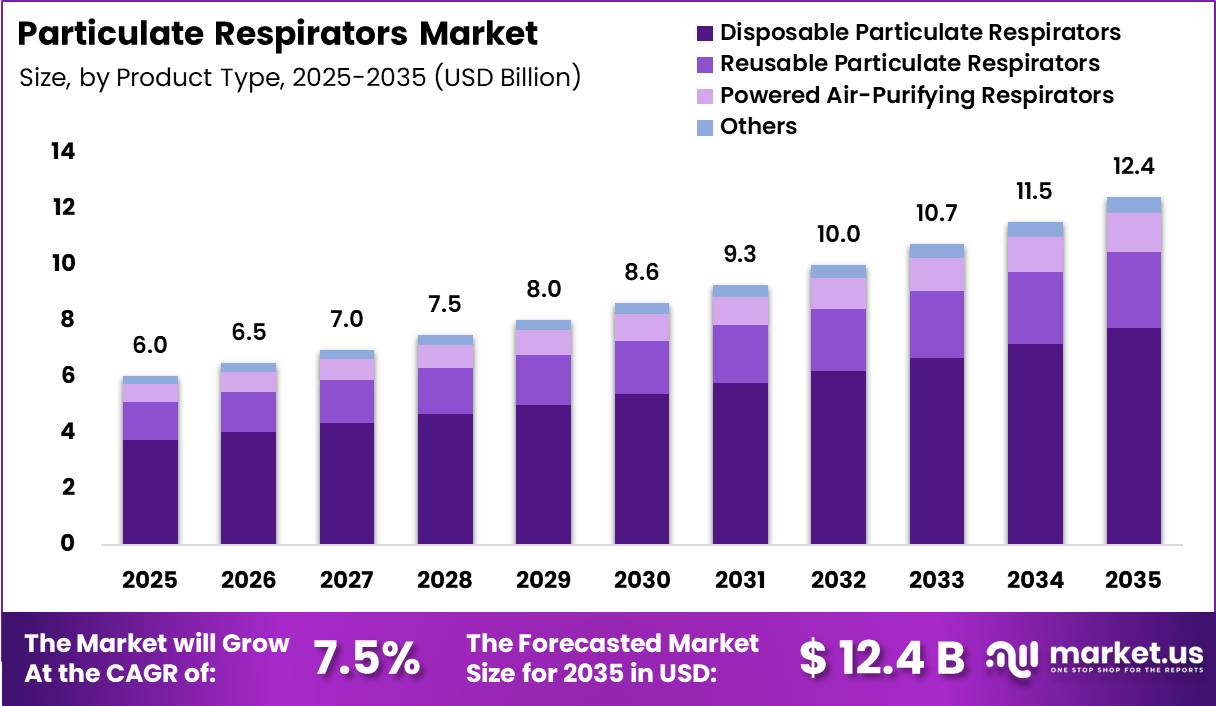
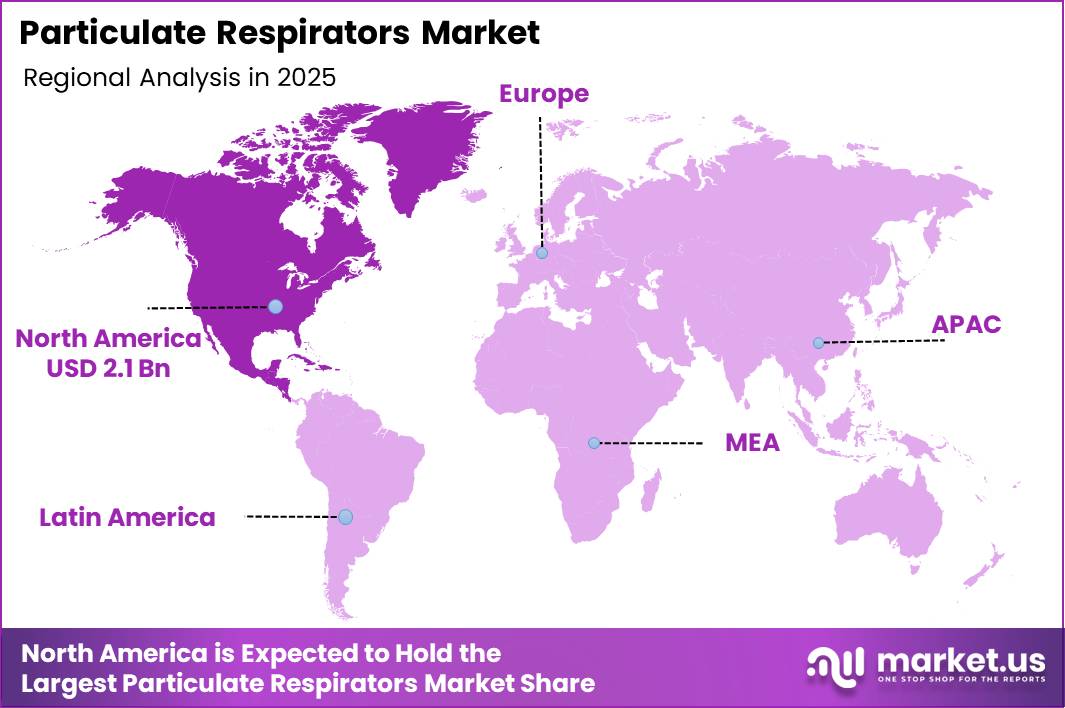
The Global Particulate Respirators Market size is expected to be worth around US$ 12.4 Billion by 2035 from US$ 6.0 Billion in 2025, growing at a CAGR of 7.5% during the forecast period from 2026 to 2035. In 2025, North America led the market, achieving over 34.5% share with a revenue of US$ 2.1 billion.
Particulate respirators are a crucial type of air-purifying personal protective equipment (PPE) designed to protect users from inhaling hazardous airborne particles, such as dust, aerosols, and infectious agents. According to U.S. federal regulations, respirators must be approved by the National Institute for Occupational Safety and Health (NIOSH) to ensure they meet minimum performance and safety standards.
Additionally, workplaces that utilise these respirators are required to implement comprehensive respiratory protection programs in accordance with OSHA’s Respiratory Protection Standard (29 CFR 1910.134) to minimise occupational illness and injury.
Particulate respirators include tight-fitting filtering facepiece respirators (FFRs), such as N95S, which are tested to filter at least 95% of airborne particles when properly fitted. NIOSH categorises these devices into nine filter classes based on their oil resistance and filtration efficiency: N, R, and P filters, with efficiencies of 95%, 99%, and 99.97% against particulates.
The particulate respirator category also encompasses reusable options, such as elastomeric half-mask respirators and powered air-purifying respirators (PAPRs), which can filter up to 99.97% of airborne particles.
Particulate respirators are widely used in healthcare, construction, mining, and emergency response to protect millions of workers from respiratory hazards. Government and public health authorities recommend fit testing and training to ensure these respirators function effectively.
Key Takeaways
- Market Size: The Global Particulate Respirators Market size was US$ 6.0 billion in 2025. The market is estimated to grow to US$ 12.4 billion by 2035.
- Market Share: The market’s Compound Annual Growth Rate (CAGR) from 2026 to 2035 will be 7.5%.
- Product Type: Disposable Particulate Respirators has the largest market share, accounting for 62.3% of total sales.
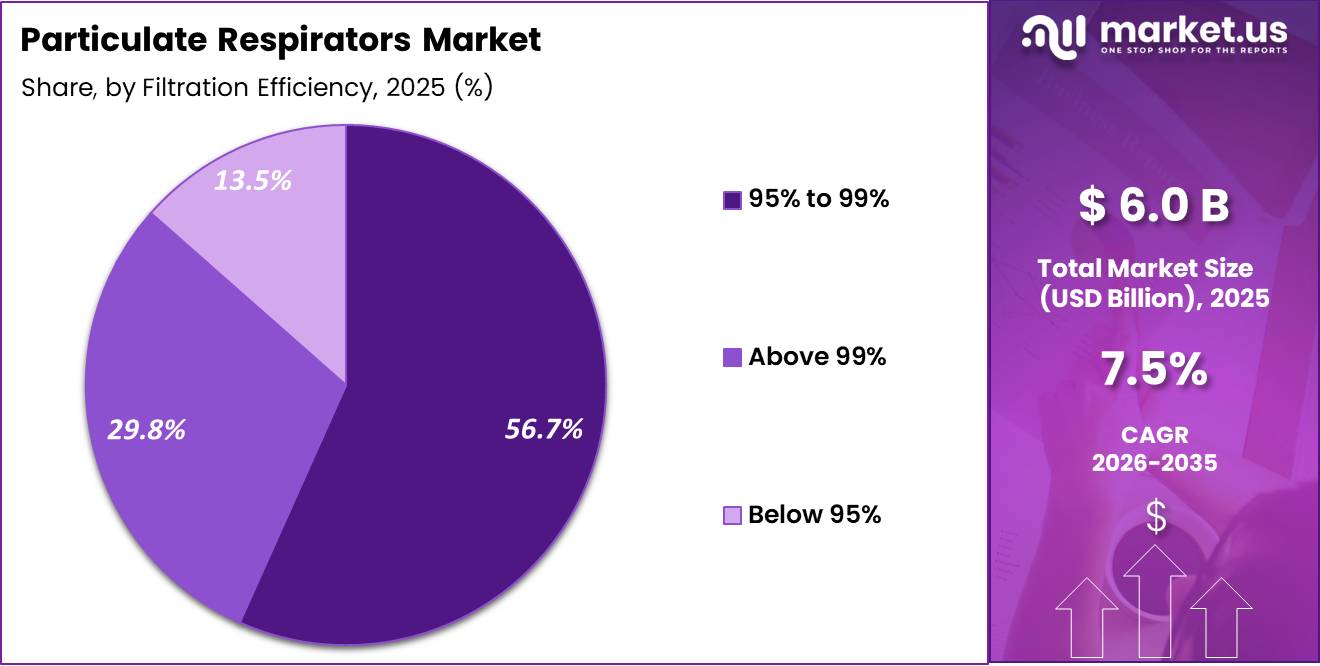
- Filtration Efficiency: 95% to 99% dominates the segment, accounting for 56.7% of total revenue.
- End-Use Industry: Healthcare leads the segment, accounting for 28.7% of total revenue.
- Distribution Channel: Distributors & Wholesalers dominate the segment, accounting for 42.3% of total revenue.
- Regional: North America is the dominant regional market, accounting for 34.5% of global sales.
Product Type Analysis
Disposable particulate respirators held a commanding 62.3% share of the market in 2025, reflecting strong demand for low-cost, single-use protection across healthcare, construction, and manufacturing. Their dominance is driven by broad regulatory acceptance, ease of stockpiling for surge events, and simple user training qualities that favour procurement by hospitals, contractors, and large industrial buyers.
Reusable particulate respirators at 22.1% serve segments requiring longer-term cost efficiency and higher durability, such as chemical processing and facilities with recurring exposure risks. Their market position benefits from replaceable filters and rising employer interest in lifecycle cost reduction.
Powered Air Purifying Respirators (PAPRs) account for 11.0% and are adopted where user comfort, higher protection factors, and compatibility with extended wear are critical, notably in specialised healthcare procedures, high-contamination labs, and certain heavy industrial tasks.
The remaining 4.6%, categorised as Others, includes hybrid systems, elastomeric designs not classified as standard reusable units, and niche engineered solutions for specific occupational hazards. Overall, procurement choices balance unit cost, protection level, compliance, and operational considerations such as maintenance and training, shaping persistent preference for disposables while creating steady growth opportunities for reusable and powered systems.
Filtration Efficiency Analysis
Masks with 95% to 99% filtration efficiency dominated 56.7% of the particulate respirator market in 2025, driven by the widespread adoption of standards such as N95 and FFP2 equivalent protection across healthcare, industrial, and public health procurement. This mid-high efficiency band offers a favourable trade-off between breathability and protection, making it the default choice for routine airborne particulate risks and pandemic preparedness stockpiles.
Above 99% filtration at 29.8% captures interest where maximal protection is required, including high-risk medical procedures, certain cleanroom environments, and industries handling ultrafine particulates, leading to premium pricing, specialised certification needs, and increased demand for compatible fit testing and seal assurance.
Below 95% products at 13.5% remain in use for low-exposure tasks, consumer-grade face coverings, and contexts prioritising comfort and affordability over certified occupational protection. Market dynamics show buyers increasingly selecting filtration efficiency based on risk assessment, regulatory guidance, and user acceptance.
At the same time, innovations in filter media and electrostatic layers are improving performance within each segment, nudging some share from lower to mid and high efficiency categories as regulators and employers tighten protection expectations.
End-Use Industry Analysis
Healthcare led end-use demand with a 28.7% share in 2025, reflecting continued emphasis on clinician and patient safety, stringent infection control protocols, and stockpiling after recent global health events. Hospitals, outpatient facilities, and long-term care institutions consistently purchase large volumes of certified respirators for both routine and surge use.
Industrial manufacturing and construction are significant buyers where particulate control and worker safety are regulated, and enforcement is increasing, with these sectors favouring durable or disposable options depending on task and exposure.
Mining, oil and gas, and chemicals and petrochemicals represent high-protection segments requiring specialised respirators and higher filtration efficiency due to toxic dusts and fumes. Pharmaceuticals demand contamination control solutions, often above 99% filtration or PAPRs, to protect both product and personnel.
Agriculture uses respirators seasonally for dust, pesticides, and bioaerosols, typically in disposable and mid-efficiency categories. The Others category covers services, transportation, and education sectors that buy respirators for episodic needs and emergency preparedness.
Overall, buyer requirements vary by regulatory pressure, exposure severity, and operational budgets, concentrating volume in healthcare while providing steady industrial demand for diverse product types.
Distribution Channel Analysis
Distributors and wholesalers dominated distribution in 2025 with a 42.3% market share, acting as the primary procurement channel for institutional buyers such as hospitals, large manufacturers, and construction firms because they provide bulk logistics, certification verification, and inventory management services. Their scale enables competitive pricing, contract fulfilment, and rapid response during demand spikes.
Direct sales remain important for large end users and OEMs that prefer vendor-managed inventories, customised product specifications, and long-term service agreements. This channel supports higher-margin, tailored offerings such as PAPRs and corporate procurement deals.
Online retail has grown rapidly for smaller buyers and individual consumers seeking convenience, transparent product information, and faster access to a wide product range. E-commerce platforms also facilitate new brand entry and subscription models for disposables.
Speciality safety equipment stores continue to serve niche industrial customers requiring expert counsel, fit testing services, and hands-on demonstrations, supporting sales of reusable respirators and PAPRs.
Channel choice depends on order size, required after-sales support such as fit testing and maintenance, and urgency. Distributors’ logistical strengths explain their leading share, while digital and speciality channels expand reach into smaller and specialised buyer segments.
Key Market Segments
By Product Type
- Disposable Particulate Respirators
- N-Series Respirators (N95, N99, N100),
- P-Series Respirators (P95, P99, P100)
- R-Series Respirators (R95, R99, R100))
- Reusable Particulate Respirators
- Half-Face Respirators
- Full-Face Respirators
- Powered Air-Purifying Respirators (PAPRs)
- Others
By Filtration Efficiency
- Below 95%
- 95% to 99%
- Above 99%
By End-Use Industry
- Healthcare
- Industrial Manufacturing
- Construction
- Mining
- Oil & Gas
- Chemicals & Petrochemicals
- Pharmaceuticals
- Agriculture
- Others
By Distribution Channel
- Direct Sales
- Distributors & Wholesalers
- Online Retail
- Speciality Safety Equipment Stores
Drivers
Airborne infection control in hospitals, clinics, and emergency preparedness stockpiles
Healthcare demand has shifted from crisis spike purchasing to protocol-based respiratory protection for airborne pathogens, with CDC guidance for measles requiring respiratory protection consistent with airborne precautions and preferring airborne infection isolation rooms for suspected or confirmed cases.
Pediatric and clinical guidance in 2026 also specifies NIOSH-certified disposable N95 or higher-level respirators for staff entering rooms of measles patients, alongside fit-testing, training, and medical clearance expectations, converting respirators into a preparedness-line item rather than an ad hoc outbreak purchase.
Supplier planning is also influenced by stockpile logic: preparedness recommendations reference historical usage from the 2024–2025 season, 12–16-week seasonal surges, and inventory rotation with quarterly supplier-capacity review, which encourages framework contracts, dual sourcing, and SKU rationalisation by health systems.
This adds roughly +1.3 % points to CAGR because hospital buyers increasingly treat particulate respirators as part of routine airborne infection control, outbreak reserve inventory, and staff-readiness programs across North America, Europe, and dense East Asian healthcare systems
| Driver | (~) % Impact on CAGR Forecast | Geographic Relevance | Impact Timeline |
|---|---|---|---|
| Occupational compliance refresh cycles in fit-tested, tight-fitting respirators | +1.6% | North America core, EU, Japan, Australia, Gulf industrial sites | Short term (≤ 2 years) |
| Airborne infection control in hospitals, clinics, and emergency preparedness stockpiles | +1.3% | North America, EU, East Asia, urban APAC healthcare corridors | Short term (≤ 2 years) |
| High PM2.5 exposure and urban workforce protection demand | +1.1% | South Asia core, China replacement demand, Southeast Asia, MENA spill-over | Medium term (2-4 years) |
| Quality enforcement, approval revocations, and premiumization toward certified supply | +0.9% | U.S. core, EU, selected LATAM import markets, regulated APAC | Short term (≤ 2 years) |
| Industrial production resilience in chemicals, pharma, metals, and fabrication | +1.0% | EU manufacturing belt, U.S., China, South Korea, ASEAN export hubs | Medium term (2-4 years) |
| Regulatory simplification and channel expansion for filtering facepiece respirators | +0.7% | U.S. occupational market first, then multinational employer networks | Medium term (2-4 years) |
Challenges
Regulatory Certification and Approval Cycle Complexity
The particulate respirators market is not constrained by demand but by the regulatory complexity associated with maintaining certifications across multiple jurisdictions. Any modification to filter media, nose-foam materials, straps, packaging, or labelling can trigger additional testing, documentation updates, artwork revisions, and inventory segregation requirements across NIOSH, CE-related, and BIS-regulated markets.
Although NIOSH reduced average approval timelines from approximately 100 days in 2024 to 65 days from mid-2025, manufacturers still face a meaningful commercialisation delay, as a 65-day approval process, combined with 30–45 days of internal design-freeze periods and validation across 3–5 production lots, can postpone market entry during critical procurement cycles.
In addition, channel relaunch activities can consume approximately 1.5%–2.5% of annual SKU revenue, increasing the cost of product updates and portfolio optimisation. As a result, manufacturers are increasingly adopting modular certified platforms, regional regulatory teams, and digital traceability systems to reduce approval risk and accelerate the transition from product development to commercial launch.
| Challenge | (~) % CAGR Friction Drag | Geographic Relevance | Mitigation Horizon |
|---|---|---|---|
| Certification cycle complexity | -1.1% | North America core, EU regulatory hubs, India compliance markets | Medium term (2-4 years) |
| Meltblown input volatility | -0.9% | China supply base, APAC manufacturing clusters, EU import channels | Medium term (2-4 years) |
| Fit-testing execution gaps | -1.3% | U.S. healthcare, EU industrial sites, GCC mega-projects | Short term (≤ 2 years) |
| Counterfeit channel leakage | -0.8% | North America e-commerce, LATAM distributors, APAC online trade | Medium term (2-4 years) |
| Safety-talent capacity deficit | -1.0% | U.S. and Canada, Western Europe, and advanced APAC plants | Long-term (≥ 4 years) |
| Logistics rerouting instability | -0.7% | Asia-Europe corridors, MENA transit nodes, East Africa lanes | Short term (≤ 2 years) |
Restraint
Post-Pandemic Demand Normalisation and Stockpiling Decline
A core demand-side restraint is the normalisation away from emergency stockpiling, because the extraordinary pull-forward that supported particulate respirator volumes during the public-health emergency has not been replaced by equally strong structural consumption outside high-risk occupational settings, and the earlier phase-out and revocation of emergency-only approvals underscored the market’s transition from crisis procurement back to specification-based purchasing.
In practical terms, this means many hospitals, distributors, and government buyers entered 2025–2026 with elevated safety-stock discipline but lower replenishment urgency, pushing reorder frequency down by an estimated 15% to 25% versus peak pandemic-era norms.
Raising channel competition, and driving price-led tenders that can strip 200 to 400 basis points from operating margin for second-tier brands; that combination of softer volume cadence and harsher price realization plausibly removes around 1.4 percentage points from medium-term CAGR in North America, Europe, and developed APAC
| Restraint | (~) % Impact on CAGR Forecast | Geographic Relevance | Impact Timeline |
|---|---|---|---|
| Certification churn | -1.2% | North America core, EU | Short term (≤ 2 years) |
| Tariff-led input inflation | -1.5% | North America core, APAC export corridors | Short term (≤ 2 years) |
| EU conformity bottlenecks | -1.0% | EU, UK-adjacent supply chains | Medium term (2-4 years) |
| Post-pandemic demand reset | -1.4% | North America, EU, developed APAC | Medium term (2-4 years) |
| Counterfeit and non-certified leakage | -0.9% | APAC corridors, LatAm, MEA, e-commerce channels | Short term (≤ 2 years) |
| Public-use standard fragmentation | -0.7% | North America, EU, urban APAC | Long-term (≥ 4 years) |
Opportunity
Respirator Adoption Expansion in TB Endemic Markets
This is untapped upside because baseline demand models typically centre on established hospital infection control and industrial safety spending, whereas the white space is the formalisation of respirator programs across tuberculosis-heavy and airborne-pathogen-prone care pathways in lower- and middle-income markets where respirators are still under-penetrated or procured episodically.
WHO recommends particulate respirators in high-risk tuberculosis transmission settings, and CDC similarly places respiratory protection within the hierarchy of TB infection control, but adoption is uneven, leaving a monetizable gap in public hospitals, diagnostic labs, primary clinics, mobile screening units, and community health networks.
The opportunity is not simply selling more masks it is building tiered channel models with lower-cost certified respirators, centralized fit-test campaigns, pooled state procurement, and replenishment programs that can lift addressable unit demand by 1.5x to 2.0x in targeted public-health systems, reduce customer acquisition cost through tender aggregation by 20% to 30%, and generate a meaningful premium for vendors that bundle training and audit readiness rather than competing only on price.
| Opportunity | (~) % Potential CAGR Upside | Geographic Relevance | Execution Window |
|---|---|---|---|
| Reusable hospital fleets | +1.8% | North America core, EU, GCC, Australia | Short term (≤ 2 years) |
| TB and airborne-care expansion | +1.4% | India, Southeast Asia, Sub-Saharan Africa | Medium term (2-4 years) |
| Silica-compliance conversion bundles | +1.6% | North America, EU, Middle East, APAC industrial | Short term (≤ 2 years) |
| Managed stockpile subscriptions | +1.2% | U.S., Canada, EU, Japan | Medium term (2-4 years) |
| Pollution-professional crossover | +1.0% | India, China, Southeast Asia, and Latin American cities | Medium term (2-4 years) |
| Roll-up of fit-test and filter service | +1.5% | North America, UK, EU, Australia | Long-term (≥ 4 years) |
Regional Analysis
In 2025, North America led the market with over a 34.5% share and a revenue of US$ 2.1 billion. The particulate respirators market exhibits significant regional variations, influenced by factors such as regulatory frameworks, levels of industrial activity, healthcare infrastructure, and awareness of occupational safety.
North America remains a dominant market, bolstered by strict workplace safety regulations, high compliance with respiratory protection standards, and sustained demand from healthcare, construction, and industrial manufacturing sectors. The presence of well-established certification systems and employer-mandated respiratory protection programs continues to support stable consumption in the region.
Europe also represents a mature market, driven by strong worker safety directives, environmental health regulations, and widespread adoption of reusable and high-efficiency respirators in both industrial and healthcare settings. Countries with significant manufacturing and chemical industries contribute notably to the regional demand.
The Asia-Pacific region stands out as the fastest-growing market, propelled by rapid industrialisation, increasing construction activities, and rising healthcare expenditures. The large labour forces in manufacturing, mining, and infrastructure development, paired with growing awareness of occupational health risks, are leading to an accelerated adoption of respirators. Additionally, government-led initiatives aimed at improving worker safety standards further drive this growth.
Latin America is experiencing steady expansion, particularly in the construction, mining, and oil & gas sectors. However, adoption levels vary by country due to differences in enforcement and economic conditions. The Middle East and Africa are showing emerging demand, fueled by infrastructure development, energy projects, and rising healthcare investments.
Overall, the dynamics of regional growth reflect a combination of regulatory maturity, industrial activity, and healthcare preparedness.
Key Regions and Countries
North America
- The US
- Canada
Europe
- Germany
- France
- The U.K.
- Italy
- Spain
- Russia & CIS
- Rest of Europe
Asia Pacific
- China
- India
- Japan
- South Korea
- ASEAN
- Australia & New Zealand
- Rest of Asia Pacific
Middle East & Africa
- GCC
- South Africa
- Rest of the Middle East & Africa
Latin America
- Brazil
- Mexico
- Rest of Latin America
Key Player Analysis
Competitive advantage in the global particulate respirators market is achieved through broad product portfolio coverage spanning disposable, reusable, and powered air-purifying respirator categories, established regulatory certification expertise across NIOSH N-Series, P-Series, and R-Series filtration standards, and extensive distribution relationships spanning industrial wholesalers, healthcare procurement networks, and speciality safety equipment retailers globally.
Major strategic priorities for leading manufacturers include continued investment in high-filtration-efficiency product development exceeding 99% particulate capture rates, expansion of reusable respirator product lines addressing sustainability and total cost of ownership considerations among industrial buyers, and growing manufacturing capacity investment supporting healthcare and industrial demand surges during public health emergencies and occupational safety compliance cycles.
Strong distributor and wholesaler relationships, combined with a growing direct sales presence with large industrial and healthcare institutional buyers, represent a critical competitive differentiator for manufacturers serving the dominant healthcare end-use segment globally.
Top Key Players
- 3M Company
- Honeywell International Inc.
- Kimberly-Clark Corporation
- Moldex-Metric, Inc.
- Drägerwerk AG & Co. KGaA
- MSA Safety Inc.
- Shanghai Dasheng Health Products Manufacture Co., Ltd.
- Uvex Safety Group
- Alpha ProTech Ltd.
- Cardinal Health, Inc.
- Ansell Limited
- Lakeland Industries, Inc.
- Gateway Safety, Inc.
- Protective Industrial Products (PIP)
- Other Key Players
Recent Developments
- In January 2026, 3M Company launched an expanded N95 respirator product line featuring enhanced breathability technology, targeting healthcare institutional buyers seeking improved worker comfort during extended wear periods in clinical settings.
- In February 2026, Honeywell International Inc. introduced a new powered air-purifying respirator system with extended battery life, targeting industrial manufacturing and chemicals & petrochemicals buyers requiring continuous high-filtration protection in hazardous work environments.
- In March 2026, Drägerwerk AG & Co. KGaA expanded its reusable half-face respirator portfolio with new modular filter cartridge technology, targeting mining and oil & gas sector buyers seeking improved total cost of ownership and reduced disposable waste.
Report Scope
| Report Features | Description |
|---|---|
| Market Value (2025) | US$ 6.0 Billion |
| Forecast Revenue (2035) | US$ 12.4 Billion |
| CAGR (2026-2035) | 7.5% |
| Base Year for Estimation | 2025 |
| Historic Period | 2020-2024 |
| Forecast Period | 2026-2035 |
| Report Coverage | Revenue Forecast, Market Dynamics, Competitive Landscape, Recent Developments |
| Segments Covered | By Product Type (Disposable Particulate Respirators, Reusable Particulate Respirators, Powered Air-Purifying Respirators (PAPRs), Others), By Filtration Efficiency (Below 95%, 95% to 99%, Above 99%), By End-Use Industry (Healthcare, Industrial Manufacturing, Construction, Mining, Oil & Gas, Chemicals & Petrochemicals, Pharmaceuticals, Agriculture, Others), By Distribution Channel (Direct Sales, Distributors & Wholesalers, Online Retail, Specialty Safety Equipment Stores) |
| Regional Analysis | North America – The US, Canada; Europe – Germany, France, U.K., Italy, Spain, Russia & CIS, Rest of Europe; Asia Pacific – China, India, Japan, South Korea, ASEAN, Australia & New Zealand, Rest of Asia Pacific; Middle East & Africa – GCC, South Africa, Rest of Middle East & Africa; Latin America – Brazil, Mexico, Rest of Latin America |
| Competitive Landscape | 3M Company, Honeywell International Inc., Kimberly-Clark Corporation, Moldex-Metric, Inc., Drägerwerk AG & Co. KGaA, MSA Safety Inc., Shanghai Dasheng Health Products Manufacture Co., Ltd., Uvex Safety Group, Alpha ProTech Ltd., Cardinal Health, Inc., Ansell Limited, Lakeland Industries, Inc., Gateway Safety, Inc., Protective Industrial Products (PIP), Other Key Players |
| Customization Scope | Customization for segments, region/country-level will be provided. Moreover, additional customization can be done based on the requirements. |
| Purchase Options | We have three licenses to opt for: Single User License, Multi-User License (Up to 5 Users), Corporate Use License (Unlimited User and Printable PDF) |





































