


Report Overview
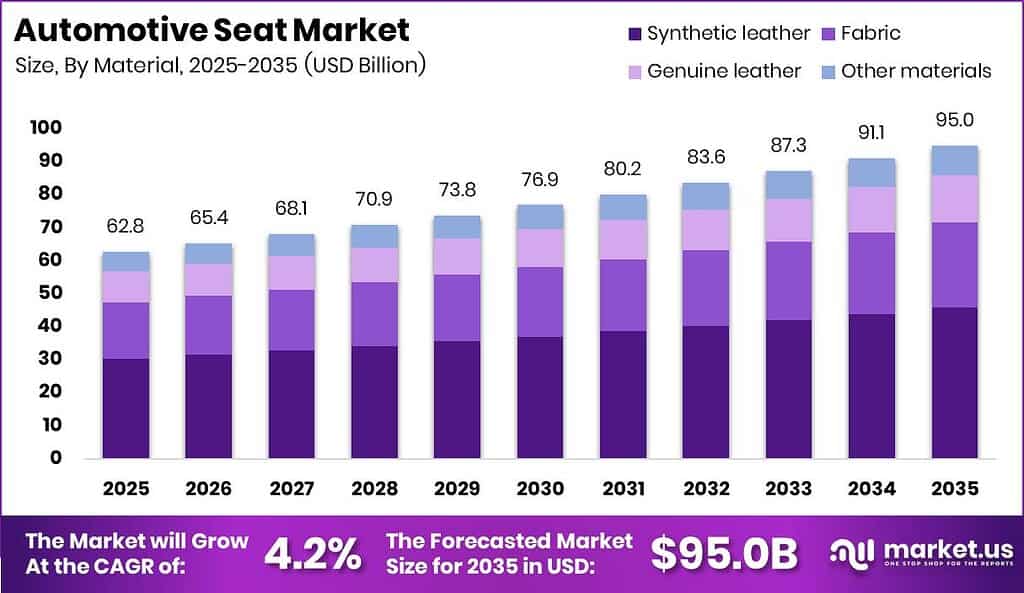
Global Automotive Seat Market size is expected to be worth around USD 95.0 Billion by 2035 from USD 62.8 Billion in 2025, growing at a CAGR of 4.2% during the forecast period 2026 to 2035. This trajectory reflects consistent investment across seat design, materials engineering, and embedded electronics from both OEMs and tier-one suppliers. Investors entering this market face a decade-long structural growth window tied directly to vehicle platform cycles and electrification timelines.
The automotive seat market covers the design, manufacture, and supply of seating assemblies installed in passenger cars, light commercial vehicles, and heavy commercial vehicles. The market spans multiple seat types including bucket, bench, split bench, folding, suspension, and other configurations. Material categories range from fabric and synthetic leather to genuine leather. Technology tiers extend from standard mechanical seats through powered, heated, ventilated, and fully smart integrated systems.
Key Takeaways
- The global automotive seat market was valued at USD 62.8 Billion in 2025 and is forecast to reach USD 95.0 Billion by 2035.
- The market is growing at a CAGR of 4.2% during the forecast period 2026 to 2035.
- Bench seats hold the dominant position in the By Seat Type segment with a share of 43.2%.
- Synthetic leather leads the By Material segment with a share of 48.2%.
- Powered seats dominate the By Technology segment with a share of 40.3%.
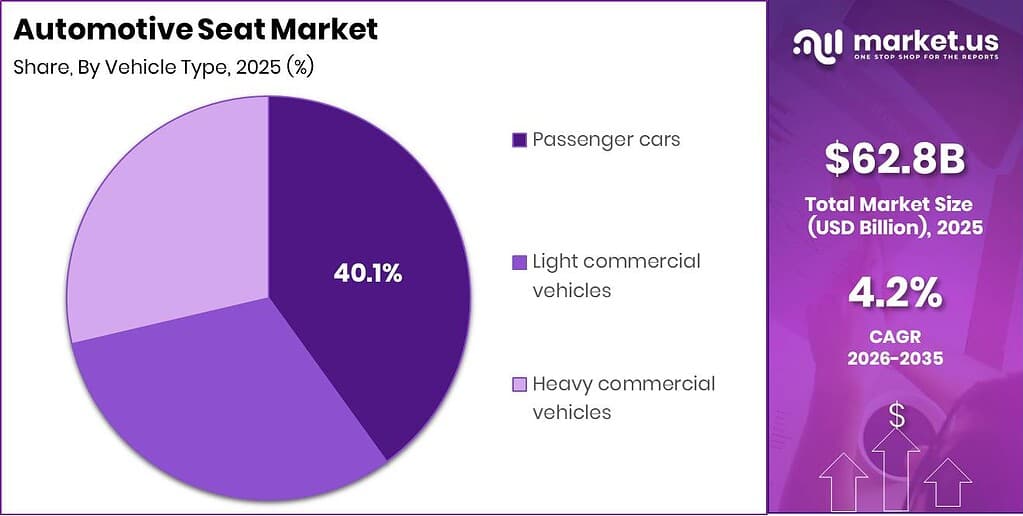
- Passenger cars lead the By Vehicle Type segment with a share of 40.1% and are also the fastest-growing sub-segment.
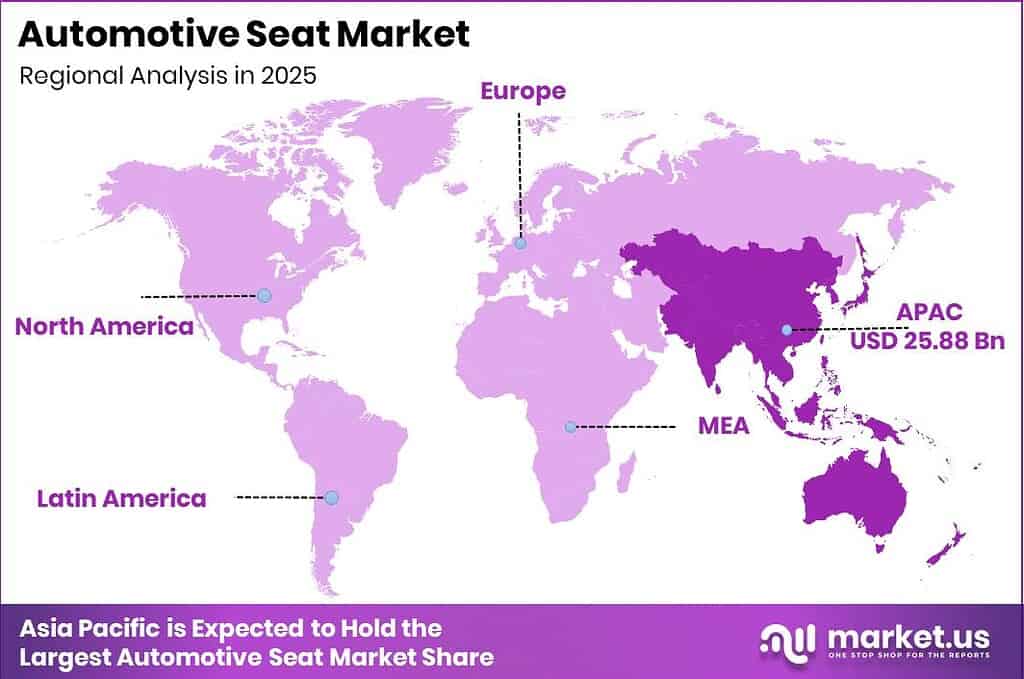
- Asia Pacific dominates the global automotive seat market with a share of 41.2%, valued at USD 25.88 Billion.
- Bucket seats are the fastest-growing seat type. Fabric is the fastest-growing material. Ventilated seats are the fastest-growing technology.
Government regulations on vehicle occupant safety and emissions compliance are accelerating seat technology investment across major production markets. Safety standards in North America and Europe mandate crashworthiness and restraint system integration at the seat level, raising minimum engineering specifications for all new programs. This regulatory floor creates a durable demand baseline for tier-one suppliers and raises the technical barrier to entry for lower-cost regional competitors.
As per our research, Lear expected operational net performance initiatives to improve its Seating segment margin by 40 basis points during 2025. This margin improvement signals that structural cost discipline, not just volume growth, is reshaping supplier profitability. Suppliers that combine platform efficiency with electronics integration will widen the gap against peers dependent on legacy cost structures.
Lear’s ComfortMax seat achieved up to 40% faster time-to-sensation for both seat heating and ventilation when integrated into General Motors vehicles beginning in Q2 2025. This performance gain is directly linked to reduced component count and tighter thermal system integration. As per our research, faster feature response at lower system cost is now a program-win differentiator that OEMs weigh at the platform selection stage, not just at final vehicle trim.
Seat Type Analysis
Bench seats dominate with 43.2% due to high volume compact car fitment.
In 2025, bench seats held a dominant market position in the By Seat Type segment of the Automotive Seat Market, with a 43.2% share. According to the International Organization of Motor Vehicle Manufacturers (OICA), global passenger car and light commercial vehicle production exceeded 85 million units in 2024, and bench seat configurations remain the primary choice for entry-level and mid-size vehicles across Asia and Latin America. This volume dependency means any regional production ramp directly expands bench seat demand, giving suppliers with established mass-market tooling a compounding cost advantage over platform-switching competitors.
Bucket seats are the fastest-growing seat type and are capturing a rising share of premium and performance vehicle programs. Corporate annual reports from major OEMs including BMW Group confirm that bucket seat content has increased across multiple new platform launches, driven by ergonomic regulatory guidance and consumer preference for lateral support. The International Trade Administration reports that automotive seating components exports involving bucket seat assemblies have grown steadily in trade flows from Germany and Japan. Suppliers investing in contoured foam tooling and adjustable lumbar modules for bucket seats now access margin-accretive content per vehicle. In August 2025, Adient launched the ModuGo modular seat platform, enabling OEMs to configure lightweight seats with interchangeable comfort and trim modules across bucket seat variants.
Split bench seats serve dual-purpose vehicle interiors where flexibility between passenger capacity and cargo access is a primary buyer requirement. Trade association data from the Automotive Industry Action Group (AIAG) confirms that split bench configurations are specified across a significant share of North American pickup and SUV platforms. National statistical office production records from the US Census Bureau show that light truck output, the primary vehicle category using split bench seats, reached over 8 million units in the US alone in 2024. This production base creates a stable and recurring order pipeline for seat suppliers serving domestic truck programs.
Folding and convertible seats serve space-optimization needs in minivans, compact SUVs, and multi-purpose vehicles, while suspension seats address occupant protection in heavy commercial and off-road applications. Other seat type variants cover specialty and aftermarket configurations. These sub-segments collectively hold the remaining share of the By Seat Type segment and represent niche but consistently specified categories tied to commercial vehicle fleet purchasing cycles.
Material Analysis
Synthetic leather dominates with 48.2% due to cost-performance balance across volume trims.
In 2025, synthetic leather held a dominant market position in the By Material segment of the Automotive Seat Market, with a 48.2% share. UNIDO manufacturing output data for polymer-coated textile production confirms strong industrial capacity across China, South Korea, and Germany supporting automotive-grade synthetic leather supply. The material’s combination of durability, ease of cleaning, and lower cost relative to genuine leather makes it the default specification for mid-range and volume vehicle trims globally. Suppliers aligned with synthetic leather supply chains benefit from predictable raw material sourcing and broad OEM approval coverage across multiple platform programs simultaneously.
Fabric is the fastest-growing material category in automotive seating, driven by OEM sustainability commitments and the adoption of recycled fiber content in seat cover specifications. The European Automotive Suppliers Association (CLEPA) has documented rising OEM demand for woven and knitted seat fabrics meeting recycled content thresholds under voluntary environmental sourcing frameworks. ITU and national environmental regulatory filings confirm that over 30 European OEM platforms launched between 2023 and 2025 specified recycled polyester fabric as a standard interior surface material. This structural shift positions fabric seat cover suppliers with certified recycled inputs as preferred sourcing partners for the next vehicle program cycle.
Genuine leather retains a defined share in premium and luxury vehicle segments where material authenticity remains a purchase decision factor. Corporate annual reports from Mercedes-Benz Group confirm that premium upholstery specifications continue to command a price premium at the trim level, sustaining supplier margin for certified leather seat producers. UNIDO industrial statistics show that automotive-grade leather processing facilities in Europe and Latin America maintain consistent output supporting multi-year OEM supply agreements. Genuine leather’s share trajectory reflects the gradual narrowing of the premium vehicle mix rather than any demand collapse in its core segment.
Other materials including bio-based textiles, mycelium composites, and specialty technical fabrics hold the remaining share and currently appear primarily in concept vehicles and limited production capsule programs. These materials represent a future sourcing evolution rather than a current volume driver, but pilot program volumes create early-mover advantage for suppliers that certify these inputs now ahead of regulatory mandates.
Technology Analysis
Powered seats dominate with 40.3% due to mainstream OEM adoption across volume platforms.
In 2025, powered seats held a dominant market position in the By Technology segment of the Automotive Seat Market, with a 40.3% share. OICA production data confirms that global output of passenger vehicles equipped with electrically adjustable seating has expanded steadily as OEMs standardize power adjustment across C-segment and D-segment vehicle lines. The electrification of seat adjustment functions is now a cost-of-entry feature for vehicles priced above USD 25,000 in North America and Europe. This threshold standardization expands powered seat volume in direct proportion to mid-market vehicle production, giving established motor and actuator suppliers a predictable recurring demand base across multi-year platform contracts.
Ventilated seats are the fastest-growing technology sub-segment, reflecting consumer preference for thermal comfort management across a longer range of climate conditions. In October 2025, Adient and Autoliv jointly unveiled an integrated dynamic seating safety system combining advanced seat structures with occupant protection technologies, signaling that ventilation and safety integration are converging at the seat level. Industry trade association filings from the Society of Automotive Engineers (SAE) document that ventilated seat specifications have expanded from luxury-only fitment into premium mid-range trims across more than 40 new vehicle nameplates launched globally since 2022. Suppliers with validated ventilation perforation and airflow management know-how are positioned to capture this attach rate expansion before the technology reaches mass-market standardization.
Heated seats and powered-and-heated combination seats represent well-established technology categories with high penetration rates in cold-climate markets including Northern Europe, Canada, and Northern China. National statistical office data from Statistics Canada confirms that heated seat specifications appear in over 70% of new passenger vehicles sold in Canada annually. The powered-and-heated combination tier captures buyers upgrading from base powered configurations and provides seat suppliers with a content uplift opportunity of approximately one to two additional electronic modules per seat assembly.
Smart seats integrating biometric sensing, occupant monitoring, and over-the-air update capability hold the remaining technology share alongside standard mechanical seats. Standard seats continue to serve entry-level vehicle programs in emerging markets where cost is the primary specification driver, while smart seats represent the highest-value frontier for tier-one suppliers investing in software-defined seat platforms.
Vehicle Type Analysis
Passenger cars dominate with 40.1% due to the largest global vehicle production base.
In 2025, passenger cars held a dominant market position in the By Vehicle Type segment of the Automotive Seat Market, with a 40.1% share, and are simultaneously the fastest-growing sub-segment. OICA global production data shows passenger car output exceeded 57 million units in 2024, representing the single largest seat demand pool across all vehicle categories. The dual status of market leader and fastest-growing sub-segment reflects EV-driven platform refreshes and the expansion of affordable passenger car programs across India, Southeast Asia, and Latin America. Seat suppliers with cost-optimized designs for high-volume passenger car programs access the broadest and most resilient order book in the market.
Light commercial vehicles represent a structurally distinct demand tier where seat durability, serviceability, and weight ratings take priority over comfort feature content. UN Comtrade trade flow data shows that automotive seat assemblies for light commercial vehicle applications represent a significant share of cross-border seat component trade between Mexico, the US, and Canada under the USMCA framework. Toyota Boshoku’s current automotive seating portfolio includes a removable and stowable 20% seat section, illustrating how modular engineering is extending into light commercial seating to address fleet buyers’ cargo flexibility requirements. Suppliers serving this sub-segment compete on structural engineering and serviceability rather than electronics integration.
Heavy commercial vehicles require suspension seating systems that isolate operators from vibration and road shock over extended duty cycles. ILO workplace safety standards and national regulatory filings across the EU and US mandate minimum vibration attenuation performance for commercial vehicle operator seats, creating a compliance-driven specification floor that independent aftermarket suppliers cannot easily undercut on price alone. Customs database records from the US International Trade Commission confirm consistent import volumes of air-suspension commercial seat assemblies, reflecting domestic OEM reliance on specialized seating suppliers for this category.
Key Market Segments
By Seat Type
- Bucket Seats
- Bench Seats
- Split Bench Seats
- Folding / Convertible Seats
- Suspension Seats
- Other Seat Types
By Material
- Fabric
- Synthetic Leather
- Genuine Leather
- Other Materials
By Technology
- Standard
- Powered
- Heated Seats
- Ventilated
- Powered and Heated
- Smart
By Vehicle Type
- Passenger Cars
- Light Commercial Vehicles
- Heavy Commercial Vehicles
Regional Analysis
Asia Pacific Dominates the Automotive Seat Market with a Market Share of 41.2%, Valued at USD 25.88 Billion
Asia Pacific commands the automotive seat market at 41.2% share, valued at USD 25.88 Billion, driven by China’s dominant vehicle production volume and India’s rapidly expanding passenger car output. According to Market.us data, the region’s production concentration gives local and internationally deployed seat suppliers a structural cost advantage through shorter logistics chains and proximity to vehicle assembly plants. This geographic density of both OEM demand and seat manufacturing capacity reinforces Asia Pacific’s lead and raises the competitive threshold for suppliers attempting to enter without an established regional footprint.
In December 2025, Toyota Boshoku America opened its first smart manufacturing facility in Hopkinsville, Kentucky, to produce advanced seat track and recliner mechanisms for automotive seating systems. This move reflects a broader North American nearshoring trend as OEMs and tier-one suppliers reduce exposure to transoceanic supply chain risk. As reported by Market.us, North America benefits from USMCA-aligned seat production across the US, Canada, and Mexico, creating a regional supply network that competes on speed-to-assembly and tariff compliance rather than lowest-cost labor.
Europe represents a technology-intensive regional market where premium vehicle concentration and stringent end-of-life vehicle regulations elevate seat material and electronics specifications above the global average. Based on Market.us data, Latin America and the Middle East and Africa regions collectively hold the remaining market share, with Brazil and GCC countries serving as the primary growth nodes within their respective regions. These markets present entry opportunities for seat suppliers offering cost-optimized powered and heated seat configurations matched to regional vehicle mix and consumer spending levels.
Key Regions and Countries
North America
- US
- Canada
Europe
- Germany
- France
- The UK
- Spain
- Italy
- Rest of Europe
Asia Pacific
- China
- Japan
- South Korea
- India
- Australia
- Rest of APAC
Latin America
- Brazil
- Mexico
- Rest of Latin America
Middle East and Africa
- GCC
- South Africa
- Rest of MEA
Market Dynamics
Market Opportunity Analysis - Underpenetrated technology tiers and emerging regional markets create entry points for focused seat suppliers.
Smart seats currently hold the smallest share of the By Technology segment, yet they represent the highest-value content tier in the entire automotive seating market. Established in Task 2, smart seat adoption remains concentrated in flagship vehicle programs, leaving volume-segment OEMs without a cost-competitive smart seat option. Suppliers that develop a mid-market smart seat platform priced within 15% to 20% of powered seat content can access a segment where no incumbent holds dominant share, creating an uncontested first-mover window before electronics cost curves standardize the tier.
Suspension seats serve heavy commercial vehicles but currently represent the smallest specified seat type category. As established in Task 2, compliance-driven specification floors from ILO and EU workplace safety standards create a non-discretionary demand base in this sub-segment. This means new entrants do not need to build consumer preference to win volume; they need only to meet regulatory certification thresholds. Suppliers that certify suspension seat designs to current EU and US vibration attenuation standards gain immediate access to a procurement-driven market where price is secondary to compliance documentation.
Fabric is the fastest-growing material category and, as established in Task 2, is being pulled forward by OEM recycled content sourcing requirements across European vehicle programs. This growth is currently concentrated among a small number of certified recycled-fiber seat cover suppliers. The certification gap between general fabric producers and automotive-qualified recycled fabric suppliers creates an entry opportunity for textile manufacturers willing to invest in automotive homologation. Suppliers achieving qualification within the next two to three program cycles position themselves ahead of EU End-of-Life Vehicle Regulation mandates before the sourcing window narrows.
Latin America and the Middle East and Africa hold the remaining share of the global market and, as established in Task 4, represent the least competitively saturated regional markets in the automotive seat space. Brazil and GCC countries serve as primary demand anchors within these regions, driven by growing middle-class vehicle ownership rates. Tier-one suppliers without an emerging market presence face no entrenched competitor with full product-line coverage in these geographies. A targeted entry with cost-optimized powered seat configurations matched to regional vehicle mix and income levels offers a path to early market position before global consolidation reaches these territories.
Technology and Innovation Landscape - Material circularity, modular architecture, and thermal system integration define the next competitive frontier in automotive seating
Adient, JLR, and Dow demonstrated in 2025 that recovered end-of-life polyurethane foam could constitute 20% of the material used in new automotive-seat foam. This circular material innovation directly addresses OEM decarbonization targets and opens a supply chain differentiation path that virgin-material seat producers cannot replicate without capital investment in foam recovery infrastructure. Suppliers that scale post-consumer foam reprocessing capacity ahead of EU End-of-Life Vehicle Regulation enforcement timelines convert a current pilot achievement into a durable program-award advantage.
Mercedes-Benz reported that a microfibre nonwoven used for automotive seat covers and other cabin surfaces contains up to 73% recycled material. Mercedes-Benz also reported series-production vehicle-interior upholstery fabrics containing up to 100% recycled PET-bottle material. These production-line deployments confirm that recycled material performance thresholds for seat surface applications have cleared OEM validation gates at the highest quality tier. This matters because performance validation by a premium OEM removes the technical risk argument that previously blocked recycled material adoption in mainstream seat programs.
Lear’s ComfortMax modular seat design reduced the number of parts required by up to 50%, simplifying seat assembly and lowering manufacturing complexity in 2025. This parts reduction directly compresses assembly labor costs and reduces supply chain exposure across multiple component categories simultaneously. Suppliers adopting modular seat architecture as a platform design principle, rather than a program-specific solution, create a compounding cost advantage that becomes harder for competitors to close with each successive vehicle program generation.
Gentherm confirmed that in 2025, 100% of employees at its automotive manufacturing sites worked at facilities certified to the ISO 14001 environmental-management standard, with 84% of its entire workforce covered. Gentherm produces automotive seat heating, ventilation, and climate-control systems. This operational certification signals that environmental management compliance is now a table-stakes qualification criterion for seat electronics and thermal system suppliers, not a voluntary reputational measure, and that OEMs evaluating seat system sourcing partners will increasingly screen for facility-level environmental certification as a baseline supply qualification requirement.
Drivers
Premiumization of comfort and wellness seating features is the single strongest demand driver in this market. The steady migration of powered adjustment, heating, ventilation, and massage functions from flagship trims into volume-segment vehicles is lifting average seat electronics content per vehicle by an estimated 12% to 18% across mainstream trims, per OICA global vehicle production statistics. This upgrade cycle compresses tier-one integration lead times from roughly 14 months to under 9 months as suppliers pre-validate modular seat platforms, per SAE International seating ergonomics benchmarking.
This comfort-led shift is pushing OEM bill-of-materials allocation toward seating by an incremental 2 to 3 percentage points of interior cost per unit. The strategic consequence is a durable margin-expansion runway for tier-one suppliers of roughly 80 to 120 basis points on comfort-feature attach rates. Smaller regional suppliers without embedded electronics capability face consolidation or exit pressure, a dynamic corroborated by Federal Reserve industrial production indices showing seat-electronics subsector output outpacing base vehicle assembly growth through 2025.
| Driver | (~) % Impact on CAGR Forecast | Geographic Relevance | Impact Timeline |
|---|---|---|---|
| Premiumization of comfort and wellness seating features | +1.1% | Global | Short term (2 years or less) |
| Growth in SUV, crossover and pickup production | +0.9% | North America and Asia Pacific | Short term (2 years or less) |
| Scaling of EV production requiring flat-floor seat architectures | +0.8% | Global | Short term (2 years or less) |
| Mandatory occupant safety and crashworthiness regulations | +0.7% | North America and Europe | Short term (2 years or less) |
| Integration of seats into software-defined smart cockpits | +0.5% | Global | Medium term (2 to 4 years) |
| Post-shortage vehicle production recovery in Asia Pacific | +0.3% | Asia Pacific | Short term (2 years or less) |
Restraints
Persistent swings in benchmark steel, aluminum, and polyurethane foam feedstock prices are compressing tier-one seat-frame and cushion supplier gross margins by an estimated 150 to 220 basis points per program year. The escalation of Section 301 and Section 232 tariff schedules on automotive-grade steel and aluminum imports, recorded by the U.S. Census Bureau through 2024 and into 2025, has worsened the cost environment. Most seat-supply contracts carry 12 to 24 month fixed-price clauses negotiated before input costs reset, forcing suppliers to absorb a cost-pass-through lag.
As reported by Market.us, Federal Reserve producer price index tracking places the cost recovery lag at roughly 6 to 9 months, requiring renegotiation of legacy platform pricing. This results in deferred new seat-plant capital expenditure, with several regional expansion decisions pushed out by 2 to 3 fiscal quarters as manufacturers prioritize working-capital preservation over capacity growth. Commentary from Magna International and Forvia earnings calls on raw-material hedging strategy confirms this defensive posture is widespread across the tier-one supplier base.
| Restraint | (~) % Impact on CAGR Forecast | Geographic Relevance | Impact Timeline |
|---|---|---|---|
| Raw material price volatility in steel, aluminum and foam | -0.6% | Global | Short term (2 years or less) |
| Elevated interest rates delaying OEM capital expenditure | -0.5% | North America and Europe | Short term (2 years or less) |
| Tariff escalation on automotive components and metals | -0.5% | North America | Short term (2 years or less) |
| Semiconductor and electronic component supply constraints | -0.4% | Global | Short term (2 years or less) |
| Costly homologation delaying new seat platform launches | -0.3% | Europe | Short term (2 years or less) |
Challenges
As seats evolve into networked cabin nodes, they must interoperate with ADAS controllers, infotainment head units, climate-control modules, and cloud-connected occupant-monitoring services. ISO 26262 compliance testing has pushed software integration cycles out by an estimated 4 to 6 months per platform relative to purely mechanical seat programs. This extended timeline raises average seat-ECU development cost by roughly 8% to 12% per program, a friction compounded by a documented embedded-software engineering talent deficit that SAE International places at several thousand unfilled automotive-electronics roles across North America and Europe through 2025.
The long-term adjustment required is a shift toward standardized AUTOSAR-based software architectures and shared electronic control units across seat, climate, and restraint systems. This consolidation path reduces recurring non-recurring engineering spend and accelerates platform validation timelines. Suppliers that adopt shared ECU architectures earliest will compress their software integration cycle by an estimated 2 to 3 months per program, creating a bid-win advantage on smart seat platform awards where OEMs prioritize time-to-production certainty above component-level price differentials.
| Challenge | (~) % CAGR Friction Drag | Geographic Relevance | Mitigation Horizon |
|---|---|---|---|
| Embedded software talent shortage | -0.3% | Global | Medium term (2 to 4 years) |
| Rising seat ECU integration complexity | -0.3% | Global | Medium term (2 to 4 years) |
| High cost of advanced tech in mass market | -0.3% | Emerging markets | Medium term (2 to 4 years) |
| Fragmented end-of-life recycling regimes | -0.2% | Europe | Medium term (2 to 4 years) |
| Extended lead times for specialty components | -0.2% | Asia Pacific | Medium term (2 to 4 years) |
| Currency and FX volatility on contracts | -0.2% | Global | Medium term (2 to 4 years) |
Opportunities
Large-scale substitution of virgin leather and petroleum-derived foam with bio-based textiles, mycelium composites, and post-consumer recycled polyester remains confined to premium halo trims rather than mainstream platform sourcing. Life-cycle assessments referenced against UNFCCC national emissions inventories suggest full-scale adoption could cut per-seat embedded carbon by 25% to 35%. OEM decarbonization commitments from Volkswagen Group and BMW Group signal willingness to pay a premium of 3% to 5% per unit for certified low-carbon trim.
Recycled and bio-based feedstocks currently carry a cost-per-unit premium of roughly 15% to 20% over virgin material at sub-scale volumes, per OECD industrial materials pricing indices. Suppliers achieving production scale could compress that premium toward cost parity within 3 to 4 years. This creates an estimated margin expansion opportunity of 200 to 300 basis points on sustainable-trim product lines once sourcing quotas under the European Union’s End-of-Life Vehicles Regulation move from voluntary pilots to enforced mandates.
| Opportunity | (~) % Potential CAGR Upside | Geographic Relevance | Execution Window |
|---|---|---|---|
| Bio-based and recycled seating material white space | +0.6% | Global | Medium term (2 to 4 years) |
| Biometric occupant health and wellness sensing monetization | +0.5% | Global | Long term (4 years or more) |
| Reconfigurable lounge-style seating for autonomous vehicles | +0.5% | Global | Long term (4 years or more) |
| Feature-on-demand subscription seat upgrades via over-the-air updates | +0.4% | North America and Europe | Medium term (2 to 4 years) |
| Tier-one supplier consolidation and acquisitions in emerging markets | +0.4% | Asia Pacific | Medium term (2 to 4 years) |
| Nearshoring of seat production footprint | +0.3% | North America | Medium term (2 to 4 years) |
Key Company Insights
Adient plc demonstrated in 2025 that recovered end-of-life polyurethane foam could constitute 20% of the material used in new automotive-seat foam, in collaboration with JLR and Dow. Adient’s 2025 seating concept also reduced total seat weight by 5% to 10%, with lower mass directly linked to reduced vehicle energy consumption. This dual focus on circular material sourcing and lightweighting positions Adient as the preferred seat partner for OEMs under tightening EU End-of-Life Vehicle mandates.
Lear Corporation generated USD 4.2 Billion in Seating segment sales in Q1 2025 and reported that its ComfortFlex and ComfortMax solutions can improve thermal-comfort system costs by 5% to 20% by reducing component count, weight, complexity, and assembly labor. Lear also reported that product innovations and process improvements reduced seating costs for new vehicle programs by 200 to more than 500 basis points. Magna’s Seating Systems delivered adjusted EBIT of 8.3% of sales in Q4 2025, up from 4.4% in Q4 2024, with adjusted EBIT rising 103% year over year, confirming that operational discipline at scale is the primary profitability lever across the tier-one seat supplier base.
Key Players
- Adient plc
- Lear Corporation
- Forvia SE
- Toyota Boshoku Corporation
- Magna International Inc.
- Aisin Corporation (Aisin Seiki)
- TS Tech Co., Ltd.
- NHK Spring Co., Ltd.
- Tachi-S Co., Ltd.
- RECARO Automotive
- Grammer AG
- Fisher and Company
- Johnson Controls
- Grupo Antolin
- Tata Autocomp Systems Limited
Recent Developments
- April 2026: Adient launched the ProForce Massage Flow Solution, a mechanical massage seating technology delivering enhanced occupant comfort without pneumatic systems, targeting OEMs seeking premium comfort content at reduced system complexity.
- April 2026: Adient acquired an automotive seating foam production plant in Romulus, Michigan, strengthening its vertically integrated foam manufacturing capabilities and North American supply chain resilience.
- January 2026: Adient introduced the ModuTec modular seating architecture, enabling automakers to simplify seat customization, reduce manufacturing complexity, and accelerate vehicle program development timelines.
- December 2025: Adient acquired a 49% equity stake in SCI (Zhangjiakou) Co., Ltd. and established a joint venture to expand its automotive seating manufacturing footprint in China.
Geopolitical Impact Analysis
According to WTO trade monitoring reports, global automotive parts tariff escalation accelerated through 2024 and into 2025, with Section 232 steel and aluminum tariffs adding an estimated 25% duty burden on automotive-grade metal imports entering the United States. This directly raises input costs for seat frames and structural components manufactured outside North America. As a result, tier-one seat suppliers operating transoceanic supply chains face a cost disadvantage of several hundred dollars per seat assembly relative to USMCA-compliant domestic producers, accelerating nearshoring decisions across the supplier base.
Data from the World Shipping Council shows that Red Sea conflict-related shipping disruptions extended average container transit times on Asia-to-Europe routes by 14 to 20 days through 2024 and into 2025. For just-in-time automotive seat assembly operations, this transit delay translates directly into elevated safety-stock holding costs and expedited airfreight exposure on critical component shipments. Based on IMF commodity price tracking, polyurethane foam feedstock prices rose by approximately 18% in 2024 due to energy cost volatility in Europe, compressing seat cushion supplier margins across programs with fixed-price supply agreements that predated the energy shock.
Report Scope
| Report Features | Description |
|---|---|
| Market Value (2025) | USD 62.8 Billion |
| Forecast Revenue (2035) | USD 95.0 Billion |
| CAGR (2026-2035) | 4.2% |
| Base Year for Estimation | 2025 |
| Historic Period | 2020-2024 |
| Forecast Period | 2026-2035 |
| Report Coverage | Revenue Forecast, Market Dynamics, Market Opportunity Analysis, Technology and Innovation Landscape, Competitive Landscape, Recent Developments |
| Segments Covered | By Seat Type (Bucket Seats, Bench Seats, Split Bench Seats, Folding / Convertible Seats, Suspension Seats, Other Seat Types), By Material (Fabric, Synthetic Leather, Genuine Leather, Other Materials), By Technology (Standard, Powered, Heated Seats, Ventilated, Powered and Heated, Smart), By Vehicle Type (Passenger Cars, Light Commercial Vehicles, Heavy Commercial Vehicles) |
| Regional Analysis | North America (US and Canada), Europe (Germany, France, The UK, Spain, Italy, and Rest of Europe), Asia Pacific (China, Japan, South Korea, India, Australia, and Rest of APAC), Latin America (Brazil, Mexico, and Rest of Latin America), Middle East and Africa (GCC, South Africa, and Rest of MEA) |
| Competitive Landscape | Adient plc, Lear Corporation, Forvia SE, Toyota Boshoku Corporation, Magna International Inc., Aisin Corporation (Aisin Seiki), TS Tech Co., Ltd., NHK Spring Co., Ltd., Tachi-S Co., Ltd., RECARO Automotive, Grammer AG, Fisher and Company, Johnson Controls, Grupo Antolin, Tata Autocomp Systems Limited |
| Customization Scope | Customization for segments, region / country-level will be provided. Additional customization can be done based on requirements. |
| Purchase Options | We have three licenses to opt for: Single User License | Multi-User License (Up to 5 Users) | Corporate Use License (Unlimited User and Printable PDF) |





































