


Report Overview
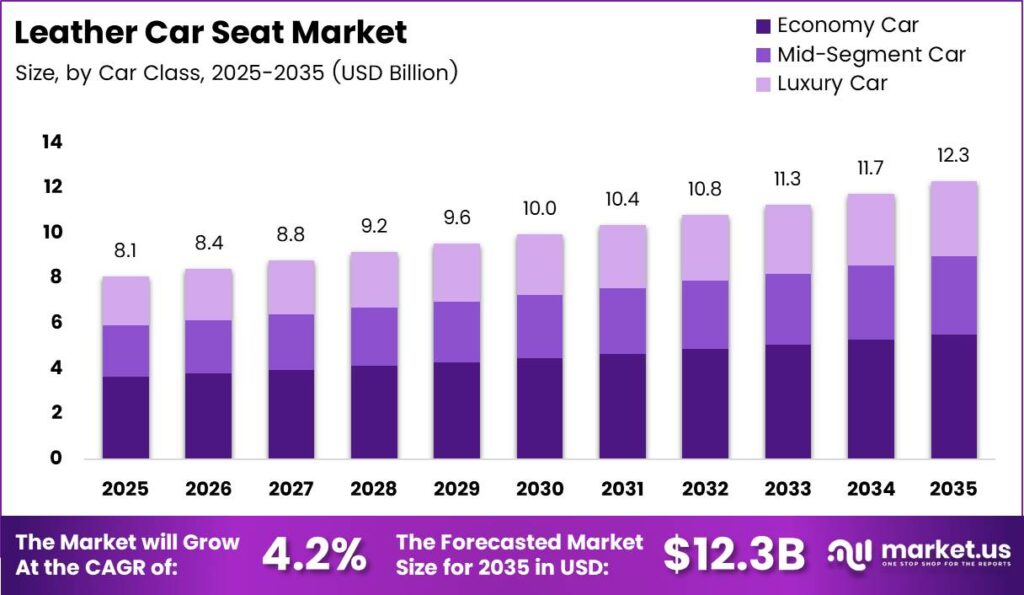
Global Leather Car Seat Market size is expected to be worth around USD 12.3 Billion by 2035 from USD 8.1 Billion in 2025, growing at a CAGR of 4.20% during the forecast period 2026 to 2035. This trajectory signals sustained OEM investment in premium cabin materials across both conventional and electric vehicle segments.
The leather car seat market covers seating surface materials, trim assemblies, and upholstery systems supplied to passenger vehicle manufacturers and aftermarket fitment providers worldwide. The market spans genuine leather and synthetic leather solutions, serving economy, mid-segment, and luxury vehicle classes. Applications include factory-fitted OEM programs and post-sale aftermarket installations across all major global automotive regions.
Key Takeaways
- Market value in 2025 stands at USD 8.1 Billion, forecast to reach USD 12.3 Billion by 2035.
- The market grows at a CAGR of 4.20% from 2026 to 2035.
- Synthetic Leather Seats dominates the By Type segment with a 61.2% share.
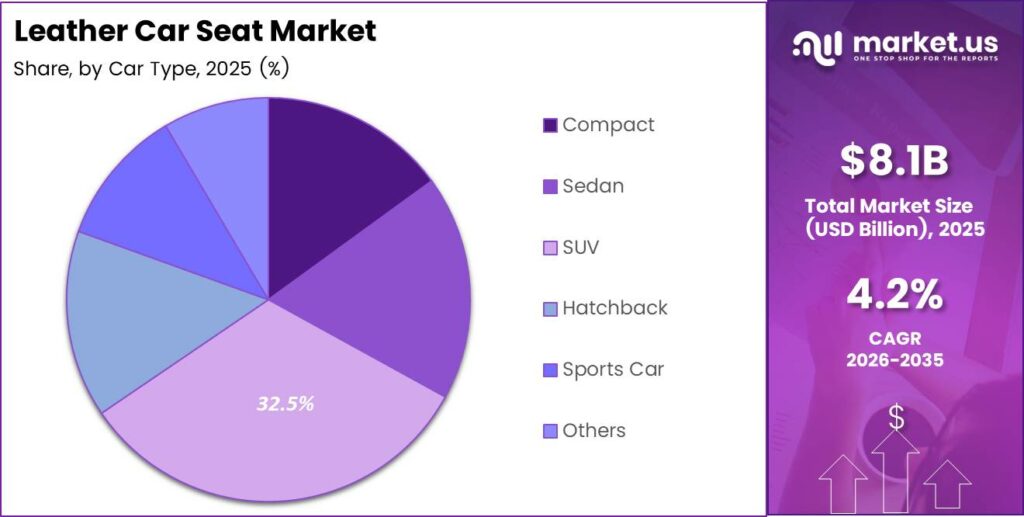
- SUV dominates the By Car Type segment with a 32.5% share.
- Economy Car dominates the By Car Class segment with a 44.3% share.
- OEM Fitment dominates the By Application segment with a 65.2% share.
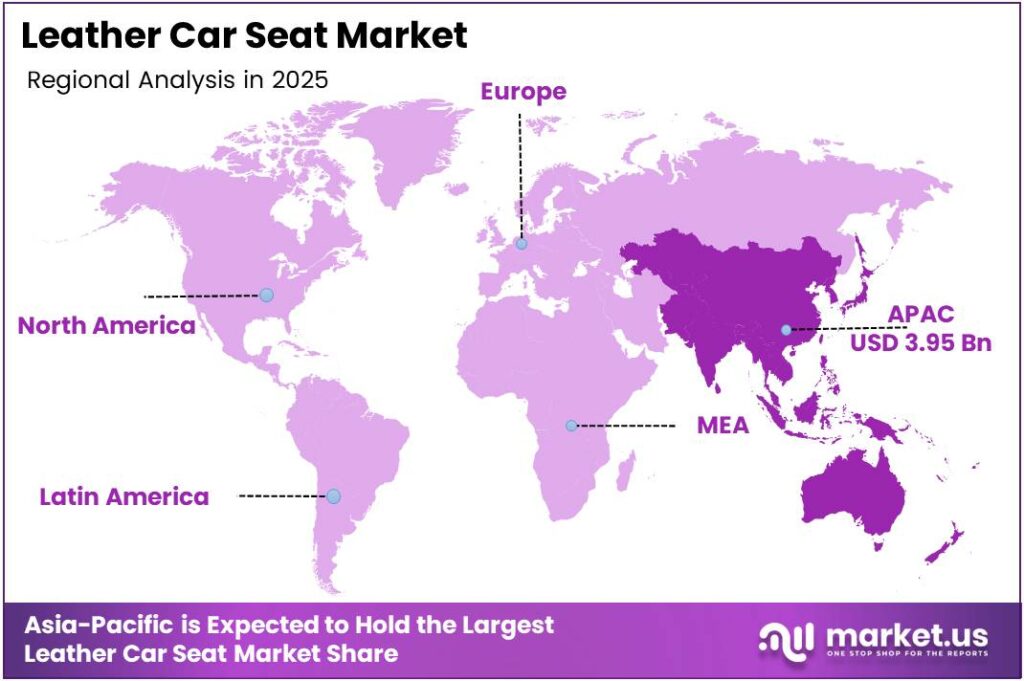
- Asia-Pacific leads all regions with a 48.5% market share, valued at USD 3.95 Billion.
Consumer expectations for interior quality are rising across both volume and premium segments. The 2025 Global Automotive Consumer Study, which surveyed more than 30,000 consumers across 30 countries, identified increasing vehicle brand-switching intentions. This finding signals that automakers must differentiate through premium interiors and seating experiences to retain buyers, creating direct commercial pressure to upgrade leather and upholstery specifications.
Tesla delivered 1,789,226 electric vehicles globally in 2024, confirming that EV volume has reached a scale where cabin material decisions carry mass-market weight. As EV lineups expand, seat surface materials become a primary differentiator in a product category where traditional mechanical differentiation no longer applies. Suppliers positioned in synthetic and premium leather for EV interiors stand to capture share across multiple global OEM programs.
Type Analysis
Synthetic Leather Seats dominates with 61.2% due to consistent quality, lower cost, and scalability.
In 2025, Synthetic Leather Seats held a dominant market position in the By Type segment of the Leather Car Seat Market, with a 61.2% share. Synthetic materials offer OEMs color-matching precision, processing consistency, and cost efficiency that genuine leather cannot match at volume. This structural advantage makes synthetic leather the default choice for economy and mid-segment programs, where per-unit material cost directly shapes vehicle pricing strategy.
Genuine Leather Seats retain a premium positioning that sustains above-average selling prices in luxury and flagship vehicle programs. The J.D. Power 2025 U.S. Seat Quality and Satisfaction Study surveyed 92,694 purchasers of new 2025 model-year vehicles, making it one of the largest consumer studies focused on seating quality. This data set confirms that seat material remains a high-visibility attribute for new vehicle buyers, supporting the business case for genuine leather in programs where consumer perception justifies the cost premium.
Car Type Analysis
SUV dominates with 32.5% due to higher interior spend and premium positioning.
In 2025, SUV held a dominant market position in the By Car Type segment of the Leather Car Seat Market, with a 32.5% share. SUV buyers consistently allocate higher budgets to interior features, making this segment the most commercially attractive entry point for leather seating suppliers. OEMs use leather trim packages as a primary value-add in SUV model ranges, driving volume through both factory-fit and dealer-installed programs.
Sedan continues to represent a meaningful share of leather seating demand, particularly in markets where three-box body styles retain strong cultural preference such as China and the United States. Leather seating in sedans skews toward mid-to-upper trim levels, where buyers compare interior quality directly against SUV alternatives. Suppliers that serve sedan programs maintain access to high-volume production runs tied to established OEM platforms.
Electric Car is an emerging sub-segment where leather and premium synthetic seating are becoming a key differentiator as mechanical features converge across competing models. OEM programs for EVs increasingly bundle interior upgrades as part of range-topping configurations, creating a new demand channel for both genuine and engineered seat materials. This sub-segment will expand as EV production volumes increase across Asia-Pacific, Europe, and North America.
Car Class Analysis
Economy Car dominates with 44.3% due to volume scale across global OEM platforms.
In 2025, Economy Car held a dominant market position in the By Car Class segment of the Leather Car Seat Market, with a 44.3% share. High unit volumes in economy segments across Asia-Pacific, Latin America, and emerging markets generate aggregate seating demand that outpaces premium tiers by count. Synthetic leather is the primary material in this class, and its dominance here directly reinforces the overall market split reported in the By Type segment.
Mid-Segment Car represents the fastest commercially active tier for leather seat upgrades, as buyers in this class stretch toward premium interior features previously reserved for luxury models. OEMs use mid-segment programs to test and scale perforated leather, ventilation integration, and two-tone trim configurations before deploying them across broader lineups. This tier connects volume production economics with premium material specifications.
Luxury Car commands the highest per-unit leather content value and sets the design direction adopted across lower tiers over time. Genuine leather dominates in this class, and its specifications often include heated, ventilated, and massage-enabled seat assemblies. Suppliers that maintain qualification in luxury programs benefit from technology transfers and reference status that strengthens their competitive positioning across all car class tiers.
Application Analysis
OEM Fitment dominates with 65.2% due to factory integration and long-term supply contracts.
In 2025, OEM Fitment held a dominant market position in the By Application segment of the Leather Car Seat Market, with a 65.2% share. Factory-fit programs lock in supplier relationships through multi-year sourcing agreements, creating revenue predictability unavailable in aftermarket channels. OEM contracts also require suppliers to meet stringent quality, delivery, and traceability standards, which raises barriers to entry and protects incumbent positions.
Aftermarket Fitment serves vehicle owners seeking to upgrade interiors post-purchase, particularly in markets where factory leather options are limited or priced out of reach. This channel is growing in ride-hailing and fleet segments, where operators retrofit seats to extend vehicle life and improve passenger experience. Aftermarket demand is less contract-driven but offers higher margin potential per unit for specialized suppliers.
Key Market Segments
By Type
- Genuine Leather Seats
- Synthetic Leather Seats
By Car Type
- Compact
- Sedan
- SUV
- Hatchback
- Sports Car
- Electric Car
- Others
By Car Class
- Economy Car
- Mid-Segment Car
- Luxury Car
By Application
- OEM (Original Equipment Manufacturer) Fitment
- Aftermarket Fitment
Market Dynamics
Market Opportunity Analysis - Underserved segments and regions offer entry points for suppliers ready to move beyond conventional leather programs
The Aftermarket Fitment segment, which holds the minority share against OEM’s 65.2% dominance, remains underexploited relative to its structural opportunity. Ride-hailing operators and aging vehicle fleet owners represent a distinct buyer profile that factory-focused suppliers do not currently serve with dedicated product lines. Entrants that develop modular, retrofit-ready leather and synthetic seat systems for this channel can build revenue without competing directly for OEM contracts.
Electric Car, currently a minority sub-segment within the By Car Type breakdown, is advancing toward mainstream volume as global EV production scales. However, few seat suppliers have developed EV-specific leather trim packages that account for the distinct thermal, weight, and cabin architecture requirements of battery-electric platforms. This gap creates an entry window for specialists who invest in EV-qualified materials before the sub-segment reaches full OEM sourcing maturity.
Latin America holds a small regional share but contains structural conditions that favor premium trim expansion. As Brazil and Mexico deepen their roles as OEM assembly hubs and domestic income levels rise, the per-vehicle leather content in locally produced models is positioned to increase. Suppliers that establish material qualification and local supply agreements ahead of this shift will hold a sourcing advantage when OEM programs expand leather and synthetic trim options in the region.
The Middle East and Africa region, anchored by GCC consumer preference for premium interior finishes, carries above-average leather content per vehicle but remains underserved by global suppliers focused on high-volume APAC and European markets. Aftermarket fitment activity in this region is elevated, and per-unit value is higher than in economy-skewed markets. By contrast, suppliers that build dedicated distribution and fitment partnerships in GCC countries can access premium margin pools without the capital intensity of full OEM program entry.
Technology and Innovation Landscape - Material science and manufacturing automation are redefining competitive advantage across automotive seat supply chains
Olive-tanned and chrome-free leather is gaining traction in automotive interior manufacturing as OEMs face regulatory and consumer pressure to reduce hazardous chemical use in cabin materials. Chrome-free tanning eliminates one of the primary environmental concerns associated with conventional leather processing, allowing suppliers to meet emerging EU material disclosure requirements. Suppliers that qualify chrome-free hides for OEM programs position themselves for mandatory compliance-driven sourcing shifts before competitors.
Lightweight leather composites are being developed to support vehicle weight reduction targets across both conventional and electric vehicle programs. Reducing seat system weight directly contributes to fuel efficiency and EV range outcomes, making material innovation a performance variable rather than purely an aesthetic choice. Suppliers that commercialize validated lightweight leather composite systems gain a technical specification advantage in OEM programs where total vehicle weight is a regulated or marketed parameter.
Recycled leather content integration into automotive seating systems addresses both circular economy mandates and raw material cost management. By incorporating post-industrial or post-consumer leather fibers into seat surfaces and backing layers, suppliers reduce dependence on virgin hide supply and lower exposure to livestock-cycle cost volatility. This innovation also supports OEM sustainability reporting requirements, which are becoming a sourcing evaluation criterion in European and North American procurement programs.
Smart sensor integration within leather seat assemblies is an emerging technology direction targeting occupant monitoring, posture detection, and comfort automation. Embedding sensor arrays beneath leather surfaces without compromising tactile quality or seating aesthetics requires precision materials engineering and new manufacturing process design. Suppliers that develop and qualify sensor-compatible leather assembly systems will serve a differentiated product category where both material science and electronics integration expertise are required simultaneously.
Drivers
Rising APAC passenger car output is a primary growth driver for the automotive seating industry. In 2025, the Asia-Pacific region produced approximately 59.2 million vehicles, accounting for more than 61% of global automotive output. China remained the world’s largest vehicle producer at 34.53 million units, while India contributed 6.49 million units. This manufacturing scale allows seat suppliers to localize production and expand leather fitment options beyond imported luxury vehicles.
This localized production model directly supports just-in-time assembly operations and reduces logistics costs for OEM programs. As a result, APAC’s production base creates consistent demand for higher-value seating materials and customization packages across domestically produced SUVs, MPVs, and premium compact cars. Suppliers with regional manufacturing presence in China and India are best positioned to capture this structural demand.
| Driver | (~) % Impact on CAGR Forecast | Geographic Relevance | Impact Timeline |
|---|---|---|---|
| Global vehicle production recovery | +2.3% | APAC corridors, North America, EU | Short term (≤ 2 years) |
| Hybrid and EV cabin premiumization | +2.0% | EU, China, Korea, North America | Medium term (2-4 years) |
| Rising APAC passenger car output | +1.9% | China, India, ASEAN, Middle East | Long term (≥ 4 years) |
| Sustainable premium material shift | +1.6% | EU, North America, premium APAC | Medium term (2-4 years) |
| OEM trim-pack monetization | +1.5% | Global OEM hubs, major urban markets | Short term (≤ 2 years) |
| Seat comfort and wellness demand | +1.3% | North America, EU, premium Asia | Medium term (2-4 years) |
Restraints
Platform-level material standardization is becoming a structural challenge for genuine leather suppliers as automakers consolidate global vehicle platforms. OEMs favor materials that deliver consistent color, grain, and surface performance across multiple production plants and climate zones. Synthetic and hybrid seat coverings meet these requirements more reliably, while genuine leather’s natural variation in grain patterns, thickness, and surface characteristics requires additional grading and inspection steps.
These characteristics limit leather’s competitiveness in high-volume mainstream programs, where per-unit cost and production efficiency outweigh premium material associations. Leather is expected to retain a strong position in flagship and premium segments but faces increasing material substitution pressure in volume platforms. Suppliers that rely heavily on genuine leather revenue must develop complementary synthetic or bio-based product lines to protect their OEM contract base.
| Restraint | (~) % Impact on CAGR Forecast | Geographic Relevance | Impact Timeline |
|---|---|---|---|
| Non-leather premium substitution | -2.4% | EU, North America, premium APAC | Long term (≥ 4 years) |
| BEV-led trim redesign | -1.9% | EU core, China, North America | Medium term (2-4 years) |
| Mainstream affordability ceiling | -1.7% | India, ASEAN, LATAM, entry-EU segments | Short term (≤ 2 years) |
| OEM sustainability procurement shift | -1.5% | EU, UK spill-over, premium global OEMs | Medium term (2-4 years) |
| Regional production re-centering | -1.2% | Europe, North America, APAC corridors | Medium term (2-4 years) |
| Platform-level material standardization | -1.0% | Global OEM hubs, volume vehicle segments | Long term (≥ 4 years) |
Challenges
Surface quality consistency is a critical operational challenge for automotive seat suppliers, as OEM programs require identical appearance across multiple production plants and diverse climatic conditions. Attributes including grain uniformity, stitching alignment, perforation quality, gloss levels, and color consistency are closely evaluated at each vehicle delivery point. Small deviations in dye absorption, embossing depth, or sewing tension can trigger product rejection, rework, or warranty claims.
The adoption of sustainable and circular-material alternatives compounds this challenge, as these materials often exhibit greater processing sensitivity and variability than conventional inputs. Suppliers must invest in tighter process controls and higher inspection intensity to maintain OEM quality standards, which increases production costs and slows manufacturing ramp-ups. These pressures are most acute across global OEM hubs and export-oriented production programs where consistency requirements are non-negotiable.
| Challenge | (~) % CAGR Friction Drag | Geographic Relevance | Mitigation Horizon |
|---|---|---|---|
| Material transition qualification | -1.8% | EU, North America, premium APAC | Medium term (2-4 years) |
| Eastward supply realignment | -1.6% | Europe, North America, APAC corridors | Long term (≥ 4 years) |
| Surface quality consistency | -1.4% | Global OEM hubs, export programs | Medium term (2-4 years) |
| Leather processing cost volatility | -1.3% | Global tanning and finishing hubs | Medium term (2-4 years) |
| Skilled trim labor shortage | -1.1% | Europe, North America, premium Asia | Long term (≥ 4 years) |
| Circularity-proof traceability gap | -1.0% | EU, UK, global sourcing bases | Long term (≥ 4 years) |
Opportunities
Sustainable premium surface migration is creating new revenue pathways as automakers combine sustainability targets with interior premiumization strategies. Volkswagen is developing a 100% bio-based hemp-derived leather alternative targeted for vehicle applications from 2028. Industry assessments indicate that eco-premium trim packages could expand adoption across 5 to 8% of eligible vehicle programs, giving early-qualified suppliers a first-mover window before the category becomes broadly competitive.
Certified low-impact materials may support 8 to 15% higher average selling prices compared with conventional seat-surface materials. This pricing premium directly improves supplier margin profiles without requiring volume increases, which is a structurally rare advantage in a market where cost compression is the default OEM negotiating position. Demand for these materials is strengthening across Europe, North America, and premium Asia-Pacific segments where environmental credentials influence purchase decisions.
| Opportunity | (~) % Potential CAGR Upside | Geographic Relevance | Execution Window |
|---|---|---|---|
| Sustainable premium surface migration | +2.4% | EU, North America, premium APAC | Medium term (2-4 years) |
| Emerging-market premium trim upsell | +2.1% | China, India, ASEAN, Middle East | Medium term (2-4 years) |
| EV-hybrid comfort package bundling | +1.8% | EU, China, Korea, North America | Short term (≤ 2 years) |
| Seat-cover subscription and refresh | +1.3% | North America, EU, GCC, urban Asia | Long term (≥ 4 years) |
| OEM-private label modular interiors | +1.7% | Global OEM hubs, APAC suppliers | Medium term (2-4 years) |
| M&A roll-up in coated materials | +1.5% | EU, U.S., China | Long term (≥ 4 years) |
Regional Analysis
Asia-Pacific Dominates the Leather Car Seat Market with a Market Share of 48.5%, Valued at USD 3.95 Billion
Asia-Pacific commands 48.5% of the global leather car seat market, driven by China and India’s combined vehicle output and a rapidly expanding middle-income consumer base. The region’s manufacturing density allows OEMs and seat suppliers to co-locate production, reducing lead times and logistics costs. This structural advantage deepens APAC’s dominance as domestic automakers add leather-optioned trims to compete with international brands.
North America holds a strong position in the global market, underpinned by high per-vehicle leather content in SUVs and trucks, which dominate the US vehicle sales mix. Consumer willingness to pay for premium interior features in this region is above the global average, supporting both OEM fitment and a mature aftermarket retrofit channel. Regulatory momentum toward EV adoption is also accelerating interest in premium cabin materials as a differentiation tool.
Europe is a strategically important region where OEM sustainability mandates are reshaping material specifications across premium and volume vehicle programs. Automakers based in Germany, France, and the UK are under pressure to reduce animal-derived materials and demonstrate circular sourcing, which is accelerating investment in certified synthetic and bio-based leather alternatives. This regulatory environment is restructuring supplier qualification processes across the region.
Latin America presents a developing opportunity, with Brazil and Mexico serving as the primary OEM assembly hubs in the region. Vehicle production in this region skews toward economy and compact segments, where synthetic leather fitment is the norm. As domestic income levels rise and OEMs expand premium trim options into local production programs, the region’s leather seat content per vehicle is expected to increase.
Key Regions and Countries
North America
- US
- Canada
Europe
- Germany
- France
- The UK
- Spain
- Italy
- Rest of Europe
Asia Pacific
- China
- Japan
- South Korea
- India
- Australia
- Rest of APAC
Latin America
- Brazil
- Mexico
- Rest of Latin America
Middle East and Africa
- GCC
- South Africa
- Rest of MEA
Competitive Analysis
Adient plc holds a broad global supply footprint across major OEM programs in North America, Europe, and Asia-Pacific. The company reinforced its manufacturing efficiency in February 2026 by launching Sculpted Soft Trim technology, which reduces sewing requirements by up to 50% while enabling more complex premium leather seat designs. This positions Adient to win cost-sensitive OEM contracts without sacrificing premium design capability, a combination few global suppliers can match.
Lear Corporation competes across both seating systems and electrical distribution, giving it an integration advantage as OEMs seek suppliers capable of bundling seat assemblies with embedded sensor and connectivity systems. This dual-capability model is increasingly relevant as smart seat technologies, including occupant monitoring and comfort automation, move from luxury flagships into mainstream programs. However, Lear’s broader product scope also exposes it to capital allocation trade-offs between its two major business divisions.
Key Players
- Adient plc
- Lear Corporation
- Toyota Boshoku Corporation
- Faurecia S.A.
- Magna International Inc.
- Grammer AG
- Gentherm Incorporated
- Grupo Antolin-Irausa S.A.
- TS Tech Co. Ltd.
Recent Developments
- April 2026 – Apollo Funds agreed to acquire FORVIA’s Automotive Interiors Business for an enterprise value of approximately €1.82 Billion, creating one of the world’s largest independent automotive interior suppliers.
- April 2026 – FORVIA announced the sale of its Interiors Business Group to Apollo Funds for approximately €1.82 Billion, as part of its strategy to reduce debt and refocus on advanced seating, electronics, and sustainable mobility technologies.
Report Scope
| Report Features | Description |
|---|---|
| Market Value (2025) | USD 8.1 Billion |
| Forecast Revenue (2035) | USD 12.3 Billion |
| CAGR (2026-2035) | 4.20% |
| Base Year for Estimation | 2025 |
| Historic Period | 2020-2024 |
| Forecast Period | 2026-2035 |
| Report Coverage | Revenue Forecast, Market Dynamics, Market Opportunity Analysis, Technology and Innovation Landscape, Competitive Landscape, Recent Developments |
| Segments Covered | By Type (Genuine Leather Seats, Synthetic Leather Seats), By Car Type (Compact, Sedan, SUV, Hatchback, Sports Car, Electric Car, Others), By Car Class (Economy Car, Mid-Segment Car, Luxury Car), By Application (OEM Fitment, Aftermarket Fitment) |
| Regional Analysis | North America (US and Canada), Europe (Germany, France, The UK, Spain, Italy, and Rest of Europe), Asia Pacific (China, Japan, South Korea, India, Australia, and Rest of APAC), Latin America (Brazil, Mexico, and Rest of Latin America), Middle East and Africa (GCC, South Africa, and Rest of MEA) |
| Competitive Landscape | Adient plc, Lear Corporation, Toyota Boshoku Corporation, Faurecia S.A., Magna International Inc., Grammer AG, Gentherm Incorporated, Grupo Antolin-Irausa S.A., TS Tech Co. Ltd. |
| Customization Scope | Customization for segments, region/country-level will be provided. Additional customization can be done based on requirements. |
| Purchase Options | We have three licenses to opt for: Single User License, Multi-User License (Up to 5 Users), Corporate Use License (Unlimited User and Printable PDF) |





































