


Report Overview
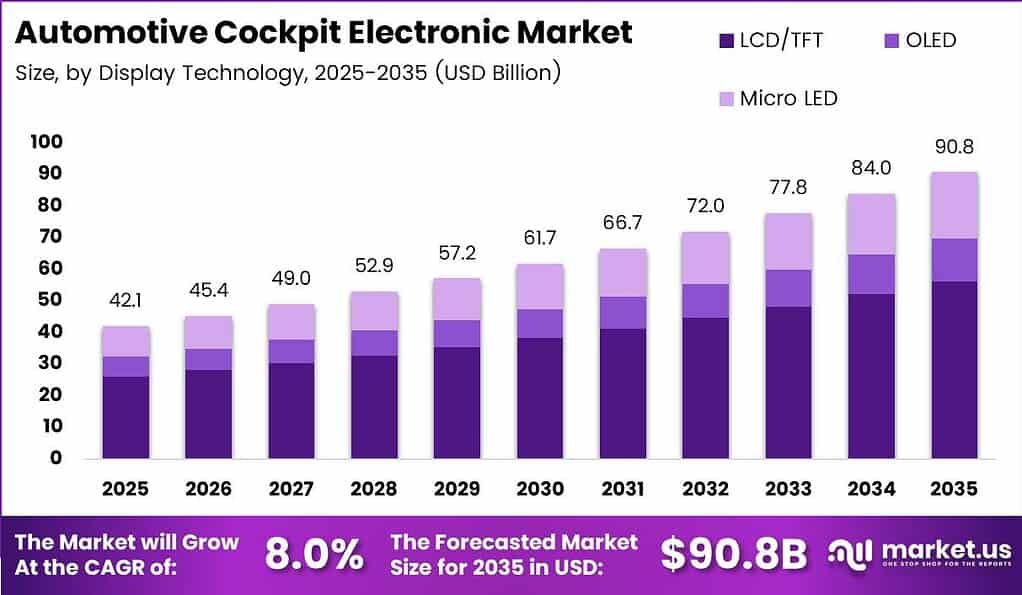
Global Automotive Cockpit Electronics Market size is expected to be worth around USD 90.8 Billion by 2035 from USD 42.1 Billion in 2025, growing at a CAGR of 8.0% during the forecast period 2026 to 2035.
The automotive cockpit electronics market covers the full suite of driver-facing and passenger-facing electronic systems integrated into the vehicle cabin. This includes infotainment and navigation units, instrument clusters, head-up displays, information displays, and telematics hardware. These systems span both OEM-fitted and aftermarket channels across passenger cars, light commercial vehicles, and heavy commercial vehicles.
Key Takeaways
- Global Automotive Cockpit Electronics Market is valued at USD 42.1 Billion in 2025 and is forecast to reach USD 90.8 Billion by 2035.
- The market is growing at a CAGR of 8.0% during the forecast period 2026 to 2035.
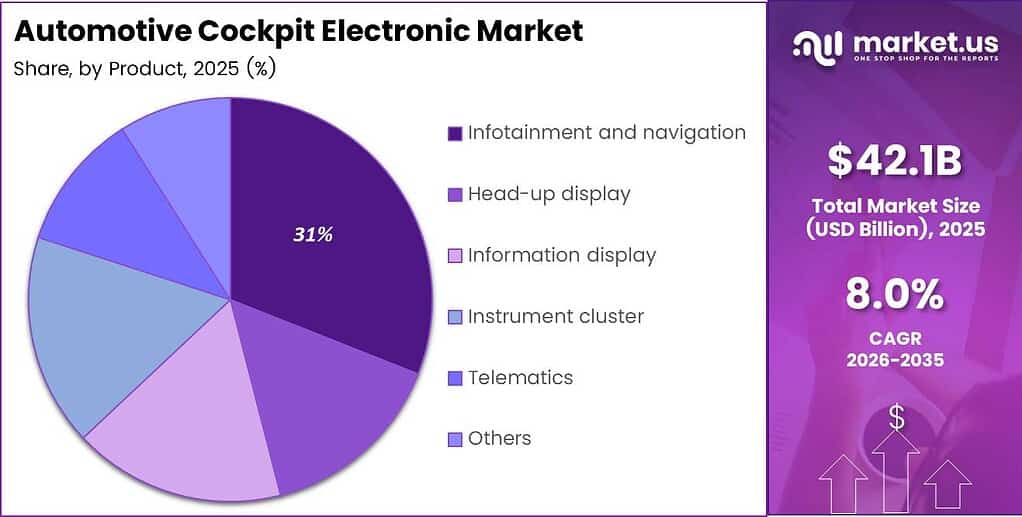
- By Product, Infotainment and Navigation dominates with a 31.00% share in 2025.
- By Display Technology, LCD/TFT holds the leading position with a 61.20% share.
- By Vehicle Type, Passenger Cars account for 82.00% of the market.
- By Propulsion Type, Internal Combustion Engine Vehicles hold 63.50% share.
- By Sales Channel, OEM dominates with an 86.20% share.
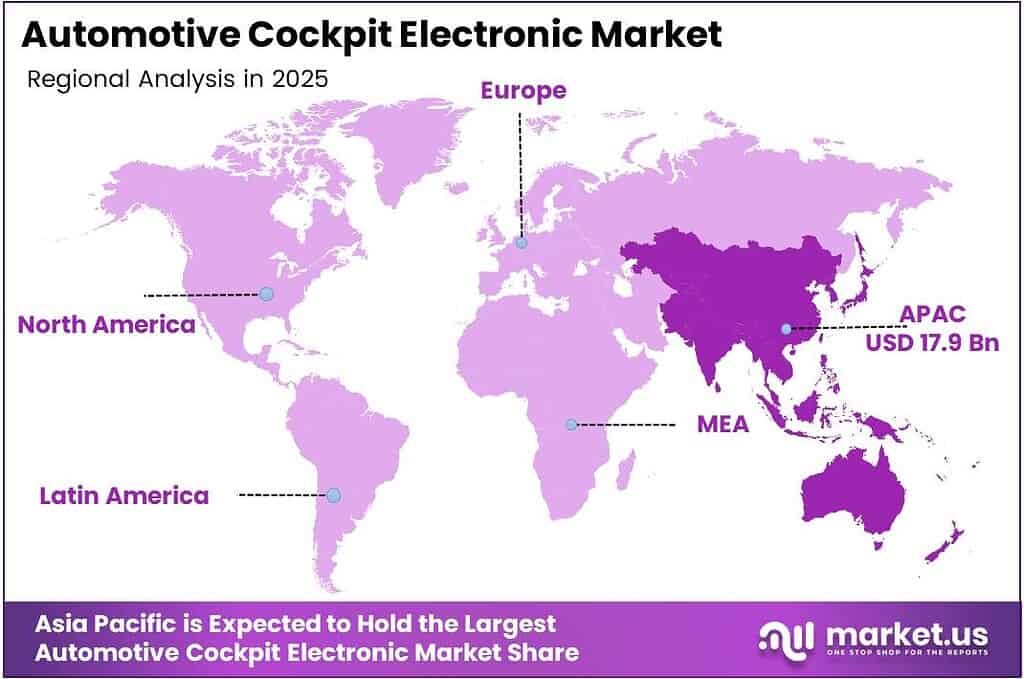
- Asia Pacific leads all regions with a 42.60% market share, valued at USD 17.9 Billion.
According to the International Energy Agency, global electric-car sales grew by 20% to exceed 20 million units in 2025, representing one-quarter of all new cars sold worldwide. This structural shift directly expands the addressable market for EV-native cockpit interfaces, where digital instrument clusters and integrated control panels replace analog systems by default.
Data from OICA shows global motor-vehicle production reached 96,383,650 units in 2025, up from 92,723,280 units in 2024. This production volume creates a direct and growing demand base for factory-fitted cockpit electronics, as each new vehicle represents an OEM opportunity for display, connectivity, and telematics integration.
NHTSA data indicates US motor-vehicle crashes involving distracted drivers killed 3,208 people and injured 315,167 people in 2024. This casualty scale justifies mandatory driver-monitoring and alert systems, giving suppliers with certified attention-warning and emergency-stop functions a regulatory compliance edge over rivals without them. In April 2025, Hyundai Mobis targeted USD 200 million in Chinese orders at Auto Shanghai 2025, signaling active commercial expansion into one of the world’s highest-volume cockpit markets.
Product Analysis
Infotainment and Navigation dominates with 31.00% due to universal fitment across vehicle segments.
In 2025, Infotainment and Navigation held a dominant market position in the By Product segment of the Automotive Cockpit Electronics Market, with a 31.00% share. This category functions as the primary human-machine interface in modern vehicles, combining audio, connectivity, and route guidance into a single unit. OEMs across all vehicle classes now treat infotainment as a baseline specification rather than an optional upgrade, which locks in volume regardless of vehicle price point. In March 2026, Panasonic Automotive Systems announced 12.9-inch and 10.5-inch infotainment configurations for the 2026 Toyota RAV4, planned for deployment across more than 170 countries.
Head-up displays represent the fastest-premium segment within the product mix, projecting speed, navigation, and safety alerts onto the windshield to reduce driver eye movement. Adoption is accelerating in both premium and near-premium segments as ADAS integration requirements increase. Suppliers developing HUD systems with ADAS overlay capability will find growing OEM traction as safety content per vehicle expands. In December 2025, Hyundai Mobis announced plans to present an 18.1-inch expandable cockpit display at CES 2026, illustrating the scale ambitions now entering the HUD and display space.
Information displays and instrument clusters together serve distinct but overlapping functions. Information displays relay real-time vehicle status and connected-service content to multiple cabin zones, while instrument clusters translate powertrain and safety data into driver-readable formats. As per our research, Visteon reported USD 1.9 billion in new business wins and 16 new product launches during the first quarter of 2025, reflecting deep customer demand across both product categories. Telematics and other product sub-segments hold the remaining share, serving fleet management, connectivity, and auxiliary cabin functions.
Display Technology Analysis
LCD/TFT dominates with 61.20% due to cost efficiency and broad OEM adoption across price tiers.
In 2025, LCD/TFT held a dominant market position in the By Display Technology segment of the Automotive Cockpit Electronics Market, with a 61.20% share. LCD/TFT panels offer proven brightness, durability, and supply chain depth that mass-market OEMs require across high-volume production programs. This cost-performance balance makes LCD/TFT the default technology for infotainment, instrument cluster, and information display applications in mainstream vehicles. The technology’s wide supplier base also reduces single-source risk for OEM procurement teams.
OLED displays are gaining traction in premium cockpit segments by delivering higher contrast ratios, thinner form factors, and per-pixel dimming that LCD cannot match. These properties align with multi-display cabin architectures where visual differentiation supports brand positioning. In January 2024, LG Display unveiled a 32-inch slidable automotive OLED at CES 2024, a format that signals future interior design flexibility. Suppliers investing in automotive-grade OLED qualification now stand to capture the premium tier before supply catches demand.
Micro LED occupies the emerging tier within display technology, offering the brightness and longevity advantages of LED with the pixel-level control of OLED. Production costs remain high, but the technology is entering early series programs through premium cockpit introductions. As the cost curve improves, Micro LED is positioned to compete across a broader range of vehicle segments over the medium term.
Vehicle Type Analysis
Passenger Cars dominate with 82.00% due to volume scale and standard cockpit content requirements.
In 2025, Passenger Cars held a dominant market position in the By Vehicle Type segment of the Automotive Cockpit Electronics Market, with an 82.00% share. SIAM data shows Indian passenger-vehicle sales reached 4.3 million units in FY2024–25, up 2% from the prior year, with the market continuing to grow in subsequent periods. Passenger cars generate the largest absolute volume of cockpit electronics demand globally, as each unit carries a full suite of display, connectivity, and safety interface hardware. This volume concentration makes the passenger car segment the primary battleground for OEM supplier awards.
Light commercial vehicles represent a structurally distinct demand layer within the vehicle type segment. ACEA data shows new EU van registrations increased 1.9% to 742,759 units in the first half of 2026. Fleet operators in logistics and last-mile delivery are adopting telematics-integrated cockpit systems to improve route efficiency, driver monitoring, and compliance reporting. This creates a platform opportunity for suppliers with fleet-specific HMI and connectivity solutions.
Heavy commercial vehicles carry a smaller unit count but higher per-unit cockpit content value. ACEA figures show new EU truck registrations increased 9.8% to 171,933 units in H1 2026, including 11.1% growth in heavy-truck registrations. Regulatory pressure on driver hours and fleet safety is pushing OEMs to integrate advanced driver monitoring and multi-screen cockpit systems into heavy trucks. Suppliers who can deliver certified safety HMI for commercial platforms will capture a disproportionate share of this value.
Propulsion Type Analysis
Internal Combustion Engine Vehicles dominate with 63.50% due to production volume and fleet size across mature and emerging markets.
In 2025, Internal Combustion Engine Vehicles held a dominant market position in the By Propulsion Type segment of the Automotive Cockpit Electronics Market, with a 63.50% share. ACEA data shows petrol and diesel cars together represented 35.5% of EU registrations in 2025, with petrol at 26.6% and diesel at 8.9%. ICE vehicles continue to drive cockpit electronics demand at scale due to their installed fleet size and ongoing production in emerging markets. This volume base sustains supplier revenue even as electrification advances.
Hybrid electric vehicles form the fastest-growing propulsion sub-segment within mature markets. The US Department of Energy reports that US hybrid-electric vehicle sales increased 53% in 2023 to nearly 1.2 million units. Hybrid powertrains require dual-mode cockpit interfaces that display both combustion and electric system data, raising per-vehicle electronics content. Suppliers who can deliver integrated hybrid HMI ahead of OEM program timelines will hold a specification advantage.
Plug-in hybrid electric vehicles extended their share in key regulated markets. ACEA data shows EU plug-in-hybrid registrations reached 1,015,887 units in 2025, capturing 9.4% of the market, up from 7.2% in 2024. The US also imposed additional tariffs of 25% on imported automobiles and automobile parts in 2025, reshaping supply chain economics for propulsion-related cockpit hardware sourced cross-border. Battery electric vehicles hold the remaining share within the propulsion segment, driving demand for fully digital, screen-dominant cockpit architectures.
Sales Channel Analysis
OEM dominates with 86.20% due to design-in cycles, qualification barriers, and standard fitment programs.
In 2025, OEM held a dominant market position in the By Sales Channel segment of the Automotive Cockpit Electronics Market, with an 86.20% share. OEM integration locks cockpit electronics into vehicle architecture from the design phase, creating multi-year exclusive supplier relationships that the aftermarket cannot displace. Platform-wide sourcing decisions at the OEM level produce high-volume, predictable revenue streams for qualified suppliers. This channel concentration rewards suppliers with early design-in wins over those competing on price alone after launch.
The aftermarket channel holds the remaining share of the sales channel segment. Aftermarket suppliers serve vehicle owners seeking to upgrade older models with newer display, connectivity, or navigation features outside the factory fitment cycle. As fleet age extends in mature markets, the aftermarket gains a longer window to address vehicles that left the factory without current-generation cockpit systems. Suppliers with modular, retrofit-compatible product lines can build a profitable niche in this channel without competing directly on OEM program timelines.
Key Market Segments
By Product
- Infotainment and Navigation
- Head-up Display
- Information Display
- Instrument Cluster
- Telematics
- Others
By Display Technology
- LCD/TFT
- OLED
- Micro LED
By Vehicle Type
- Passenger Cars
- Light Commercial Vehicles
- Heavy Commercial Vehicles
By Propulsion Type
- Internal Combustion Engine Vehicles
- Hybrid Electric Vehicles
- Plug-in Hybrid Electric Vehicles
- Battery Electric Vehicles
By Sales Channel
- OEM
- Aftermarket
Regional Analysis
Asia Pacific Dominates the Automotive Cockpit Electronics Market with a Market Share of 42.60%, Valued at USD 17.9 Billion
Asia Pacific holds the largest regional share of the Automotive Cockpit Electronics Market at 42.60%, valued at USD 17.9 Billion. China drives regional volume through its high-output EV production ecosystem and mandated digital cockpit content across both domestic and export platforms. Japan and South Korea contribute through their globally competitive Tier-1 supplier networks and established OEM relationships. SIAM data shows Indian passenger-vehicle sales reached 4,643,439 units in FY2025–26, up 7.9% from the prior year, expanding the addressable base for factory-fitted cockpit systems in a high-growth market.
North America represents the fastest-growing region outside Asia Pacific, driven by EV platform expansion and tightening safety HMI requirements tied to NHTSA regulation. OICA data shows NAFTA motor-vehicle production totaled 15,573,367 units in 2025, comprising 10,243,844 units in the United States, 4,092,448 in Mexico, and 1,237,075 in Canada. In June 2025, Visteon announced a USD 10 million initial investment in Chennai production lines for 1.3 to 8-megapixel automotive cameras and display-backlight units, signaling active supplier investment in production infrastructure tied to regional demand. In March 2024, Panasonic Automotive Systems confirmed its 12.3-inch full-display meter was installed in the Mazda CX-70, illustrating active platform wins across the region.
Europe sustains demand through its mandatory safety fitment rules and a large but aging passenger-car fleet. ACEA data shows the EU passenger-car fleet reached 256 million vehicles in 2024, growing 1.4% from 2023, providing a continuous baseline for OEM replacement cycles. Latin America, the Middle East, and Africa collectively represent emerging opportunity zones where factory-fitted cockpit electronics penetration remains lower than in mature markets, creating a long-term volume runway for suppliers entering with cost-competitive platforms.
Key Regions and Countries
North America
- US
- Canada
Europe
- Germany
- France
- The UK
- Spain
- Italy
- Rest of Europe
Asia Pacific
- China
- Japan
- South Korea
- India
- Australia
- Rest of APAC
Latin America
- Brazil
- Mexico
- Rest of Latin America
Middle East and Africa
- GCC
- South Africa
- Rest of MEA
Market Dynamics
Market Opportunity Analysis - Underserved propulsion segments and emerging regional markets offer volume entry points for cockpit electronics suppliers
The aftermarket sales channel, which currently holds a minority share against the OEM-dominant 86.20%, represents a structurally underexploited route to market. Europe’s aging passenger-car fleet, averaging 12.3 years of age in 2024, generates a large base of vehicles outside factory-fitted digital cockpit content. Suppliers with certified retrofit product lines can address this installed base without competing on OEM program timelines.
Heavy commercial vehicles remain underpenetrated in cockpit electronics relative to their safety criticality and regulatory exposure. EU truck registrations grew 9.8% to 171,933 units in H1 2026, including 11.1% growth in heavy trucks, yet per-vehicle cockpit content in this class lags behind passenger car standards. This gap creates a direct opportunity for suppliers with certified multi-screen and driver-monitoring systems designed for commercial platforms.
India stands out as a regional market where cockpit electronics penetration remains early relative to vehicle sales momentum. Passenger-vehicle sales reached 4,643,439 units in FY2025–26, growing 7.9% year over year, yet factory-fitted cockpit electronics content per vehicle sits below the global average. Suppliers who enter with cost-optimized platforms sized for the Indian market can build volume share before premium competitors consolidate the segment.
Battery electric vehicles hold the smallest propulsion share within the current market but carry the highest per-vehicle cockpit electronics content requirement. As BEV production scales across China, Europe, and North America, each additional unit carries a fully digital instrument cluster, large-format touchscreen, and integrated thermal management interface by default. This content intensity means BEV growth disproportionately benefits cockpit electronics suppliers compared with ICE volume growth at equivalent unit levels.
Technology and Innovation Landscape - Display scale, sensing integration, and AI computing power redefine cockpit content value per vehicle
Large-format display technology is shifting from a premium differentiator to a production expectation across multiple vehicle segments. LG Display began mass production of a 40-inch pillar-to-pillar automotive display for the Afeela sedan in February 2025, and unveiled a 48-inch pillar-to-pillar display at K-Display 2026. These formats eliminate the segmented multi-screen approach, replacing it with a single continuous surface that requires new optical bonding, thermal management, and driver-facing luminance calibration from suppliers.
Augmented-reality head-up display technology is entering early series production, projecting safety-relevant and navigation data at windshield scale. Hyundai Mobis developed an AR-HUD that projects a 70-inch high-resolution virtual image onto the windshield, overlaying real-world driving context with digital guidance. This capability raises the per-vehicle content value of HUD systems well above conventional combiner-based HUDs and creates a supplier qualification barrier that protects margins for certified AR-HUD developers.
AI computing integration is reshaping the cockpit electronics hardware specification. Bosch announced an AI Extension Platform in December 2025 delivering 150 to 200 TOPS of additional computing power to in-vehicle systems. This processing headroom supports real-time personalization, driver-state monitoring, and voice recognition without offloading tasks to cloud infrastructure. Suppliers who build AI-ready cockpit platforms early will hold a specification advantage as OEMs demand on-device intelligence across mainstream vehicle lines.
Micro LED technology is entering series cockpit production through premium introductions that test supply chain readiness ahead of broader deployment. Continental’s Emotional Cockpit combines a 12.3-inch TFT display with a 3.5-inch Micro LED panel, integrating two display technologies within a single cockpit architecture. This hybrid approach allows OEMs to introduce Micro LED selectively in high-visibility zones while managing cost exposure. As Micro LED yields improve, this technology pathway will expand from premium trim levels into broader platform adoption.
Drivers
EU safety regulations applied to all new vehicles from 7 July 2024, mandating intelligent-speed assistance, reversing detection, driver-attention warnings, emergency-stop signalling, and event-data functions. These requirements had already applied to new vehicle types since July 2022. This regulatory sequence converted safety HMI from an optional feature into standard series content, directly raising processor, display, alerting, and software content per vehicle across the entire EU production base.
Market.us estimates this regulatory shift contributes an estimated +2.1 percentage points to CAGR, supported by platform-wide interface reuse that could offset approximately 8 to 12% of per-variant engineering cost. Suppliers with reusable certified safety architectures shift their economics from isolated hardware awards toward software maintenance and compliance-update revenue. Those without reusable architectures face duplicated validation cycles and corresponding margin compression.
| Driver | (~) % Impact on CAGR Forecast | Geographic Relevance | Impact Timeline |
|---|---|---|---|
| Mandatory Safety HMI Fitment | +2.1% | EU and UNECE-aligned markets | Short term (≤ 2 years) |
| EV-Native Interface Growth | +1.5% | China, EU, North America | Short term (≤ 2 years) |
| Domain-Controller Consolidation | +1.1% | Global vehicle platforms | Medium term (2–4 years) |
| Multi-Display Cabin Adoption | +0.9% | China and premium global segments | Short term (≤ 2 years) |
| Open Cockpit OS Adoption | +0.7% | Global passenger vehicles | Medium term (2–4 years) |
| In-Cabin Sensing Expansion | +0.6% | China, Japan, Korea and EU | Medium term (2–4 years) |
Restraints
EU passenger cars averaged 12.3 years of age in 2024, with some national fleets approaching 17 years, keeping a large installed base outside factory-fitted digital cockpit demand. EU new-car volume increased only 1.4% during the first 8 months of 2024, and August registrations fell 18.3% year over year. This combination of fleet age and weak registration growth directly caps the volume of vehicles entering with new cockpit electronics content.
Where integrated displays, processors, and sensing raise an entry model’s cockpit-related cost by an estimated 6 to 10%, price-sensitive buyers defer purchases or select lower-content trims. Market.us estimates this dynamic creates a -1.9-percentage-point drag against the baseline CAGR, forcing suppliers to absorb redesign costs, simplify configurations, or accept lower margins to protect program share.
| Restraint | (~) % Impact on CAGR Forecast | Geographic Relevance | Impact Timeline |
|---|---|---|---|
| Slow Vehicle Replacement | -1.9% | Europe and mature markets | Short term (≤ 2 years) |
| High Upfront System Cost | -1.4% | Global mass-market segments | Short term (≤ 2 years) |
| Data-Consent Monetization Limits | -1.1% | EU and privacy-regulated markets | Medium term (2–4 years) |
| Technology Trade Controls | -0.9% | China, North America and Europe | Short term (≤ 2 years) |
| Lengthy OEM Qualification Gates | -0.7% | Global automotive supply chains | Medium term (2–4 years) |
| Retrofit Certification Barriers | -0.5% | Europe, Japan and North America | Long term (≥ 4 years) |
Challenges
Centralized cockpit architectures combine infotainment, safety alerts, connectivity, and over-the-air update functions on shared hardware. A defect or compromised interface can now propagate across functions that previously operated on separate control units. UN cybersecurity and software-update rules apply across 54 contracting countries, requiring lifecycle controls across 4 disciplines: risk management, secure-by-design development, fleet monitoring, and incident response.
For a safety-relevant cockpit program, this validation burden can add an estimated 6 to 12 months to the development cycle and raise software-engineering expenditure by 10 to 15%. Market.us estimates this creates approximately -1.6 percentage points of friction against maximum CAGR potential. Long-term mitigation requires standardized middleware, automated regression testing, and organizational separation between rapid feature releases and safety-certified code paths.
| Challenge | (~) % CAGR Friction Drag | Geographic Relevance | Mitigation Horizon |
|---|---|---|---|
| Safety Software Validation Complexity | -1.6% | Global regulated vehicle markets | Medium term (2–4 years) |
| Legacy-Node Supply Concentration | -1.2% | Global semiconductor supply chains | Medium term (2–4 years) |
| Thermal and Power Constraints | -0.9% | Global vehicle platforms | Medium term (2–4 years) |
| Automotive Software Talent Gap | -0.6% | Europe, Japan and North America | Long term (≥ 4 years) |
| Multi-OS Integration Friction | -0.5% | Global multi-brand manufacturers | Medium term (2–4 years) |
| Display Obsolescence Mismatch | -0.3% | Global electronics supply chains | Long term (≥ 4 years) |
Opportunities
The EU Data Act became applicable on 12 September 2025, giving connected-device users access to vehicle-generated data and the ability to share it with selected third parties, while permitting reasonable compensation for the technical cost of making data available. This regulatory framework converts previously locked vehicle data into a monetizable asset. Suppliers who build modular software ownership and interoperable data interfaces now hold a structural position ahead of those offering bundled hardware without software revenue layers.
Market.us estimates that converting approximately 4 to 7% of cockpit revenue into navigation, personalization, entertainment, maintenance, or fleet-workflow subscriptions could lift blended gross margin by 3 to 6 percentage points. This model would also reduce workshop-dependent update activity by 20 to 30% and add roughly +1.3 percentage points above the baseline CAGR. Capturing this upside requires transparent opt-in pricing and sustained feature pipelines rather than undeveloped service bundles.
| Opportunity | (~) % Potential CAGR Upside | Geographic Relevance | Execution Window |
|---|---|---|---|
| Lifecycle Cockpit Subscriptions | +1.3% | EU, North America and China | Medium term (2–4 years) |
| Commercial Vehicle Control Centers | +0.9% | Global logistics corridors | Medium term (2–4 years) |
| Localized Emerging-Market Platforms | +0.7% | India, ASEAN, Latin America | Medium term (2–4 years) |
| Circular Cockpit Remanufacturing | +0.4% | Europe and mature vehicle markets | Long term (≥ 4 years) |
| Accessibility-Adaptive Interfaces | +0.3% | Japan, Europe and North America | Long term (≥ 4 years) |
| Powered Two-Wheeler Adjacencies | +0.3% | India and Southeast Asia | Medium term (2–4 years) |
Key Company Insights
Continental AG generated consolidated sales of €39.7 billion in 2024, while its Automotive business reported an adjusted EBIT margin of 2.3%. This margin thinness signals that scale alone does not protect profitability in the cockpit segment. In December 2024, Continental introduced an Emotional Cockpit combining a 12.3-inch TFT display and a 3.5-inch Micro LED display with Swarovski technology, targeting premium OEMs where design differentiation commands higher content value than cost-parity supply.
Robert Bosch GmbH Mobility division generated €55.795 billion in sales in 2024, representing 61.8% of total Bosch Group revenue, confirming automotive as the dominant revenue engine across the entire group. ITU-T specifications recommend smartphone-to-vehicle infotainment connection completion within 5 seconds and a connection success rate of at least 99%, setting a performance floor that Bosch must meet across every program. In April 2026, DENSO announced plans to invest ¥3.7 trillion in research and development over five years and target approximately ¥4 trillion in electrification and intelligence sales, intensifying competitive pressure on every major cockpit supplier.
In January 2026, HARMAN expanded its road-ready in-cabin portfolio, backed by an installed base of more than 50 million vehicles using HARMAN technologies, creating a data and loyalty advantage difficult for new entrants to replicate. In June 2024, Hyundai Mobis unveiled M.VICS 5.0 with five display panels, including 27-inch, 12.3-inch, and 7-inch screens, establishing multi-panel cabin architecture as a near-term production direction rather than a concept exercise.
Key Players
- Continental AG
- Robert Bosch GmbH
- DENSO Corporation
- Visteon Corporation
- HARMAN International
- Panasonic Automotive Systems Co., Ltd.
- Aptiv PLC
- Marelli Holdings Co., Ltd.
- LG Electronics Inc.
- Hyundai Mobis Co., Ltd.
- Valeo S.A.
- Alps Alpine Co., Ltd.
- Nippon Seiki Co., Ltd.
- Yazaki Corporation
- Forvia Hella
Recent Developments
- December 18, 2025 – Bosch announced an AI Extension Platform delivering 150 to 200 TOPS of additional computing power and targeted more than €2 billion in in-vehicle infotainment sales by 2030.
- June 3, 2026 – Visteon introduced a 12.3-inch narrow-border driver display for the Lexus ES, marking its first production driver-information program with Lexus.
- July 21, 2026 – LG Display presented a cockpit equipped with a 48-inch pillar-to-pillar automotive display at K-Display 2026.
- April 23, 2026 – Visteon reported USD 1.0 billion in new business wins and 20 new product launches across 11 customers during the first quarter of 2026.
- January 8, 2025 – Continental presented a 1.30-meter-long and 4-centimeter-high E Ink Prism cockpit display spanning the full dashboard width.
- February 24, 2025 – LG Display began mass production of a 40-inch pillar-to-pillar automotive display for Sony Honda Mobility’s Afeela sedan.
- January 9, 2024 – LG Display unveiled a 57-inch pillar-to-pillar automotive LCD and a 32-inch slidable automotive OLED at CES 2024.
- January 5, 2024 – BOE announced the global launch of the Geely Galaxy E8 with a 45-inch 8K borderless smart-cockpit display covering 98% of the active area.
Report Scope
| Report Features | Description |
|---|---|
| Market Value (2025) | USD 42.1 Billion |
| Forecast Revenue (2035) | USD 90.8 Billion |
| CAGR (2026-2035) | 8.0% |
| Base Year for Estimation | 2025 |
| Historic Period | 2020-2024 |
| Forecast Period | 2026-2035 |
| Report Coverage | Revenue Forecast, Market Dynamics, Market Opportunity Analysis, Technology and Innovation Landscape, Competitive Landscape, Recent Developments |
| Segments Covered | By Product (Infotainment and Navigation, Head-up Display, Information Display, Instrument Cluster, Telematics, Others), By Display Technology (LCD/TFT, OLED, Micro LED), By Vehicle Type (Passenger Cars, Light Commercial Vehicles, Heavy Commercial Vehicles), By Propulsion Type (Internal Combustion Engine Vehicles, Hybrid Electric Vehicles, Plug-in Hybrid Electric Vehicles, Battery Electric Vehicles), By Sales Channel (OEM, Aftermarket) |
| Regional Analysis | North America (US and Canada), Europe (Germany, France, The UK, Spain, Italy, and Rest of Europe), Asia Pacific (China, Japan, South Korea, India, Australia, and Rest of APAC), Latin America (Brazil, Mexico, and Rest of Latin America), Middle East and Africa (GCC, South Africa, and Rest of MEA) |
| Competitive Landscape | Continental AG, Robert Bosch GmbH, DENSO Corporation, Visteon Corporation, HARMAN International, Panasonic Automotive Systems Co. Ltd., Aptiv PLC, Marelli Holdings Co. Ltd., LG Electronics Inc., Hyundai Mobis Co. Ltd., Valeo S.A., Alps Alpine Co. Ltd., Nippon Seiki Co. Ltd., Yazaki Corporation, Forvia Hella |
| Customization Scope | Customization for segments, region/country-level will be provided. Additional customization can be done based on requirements. |
| Purchase Options | We have three licenses to opt for: Single User License, Multi-User License (Up to 5 Users), Corporate Use License (Unlimited User and Printable PDF) |





































