


Global Formamide Market Size, Share Analysis Report By Grade (Industrial Grade and Pharma Grade), By Application (Cosmetics And Personal Care, Pharmaceuticals, Agrochemicals, Textiles And Leather, and Others), By Region and Companies - Industry Segment Outlook, Market Assessment, Competition Scenario, Trends and Forecast 2026-2035
- Published date: Mar 2026
- Report ID: 181821
- Number of Pages: 291
- Format:
-
keyboard_arrow_up
Quick Navigation
Report Overview
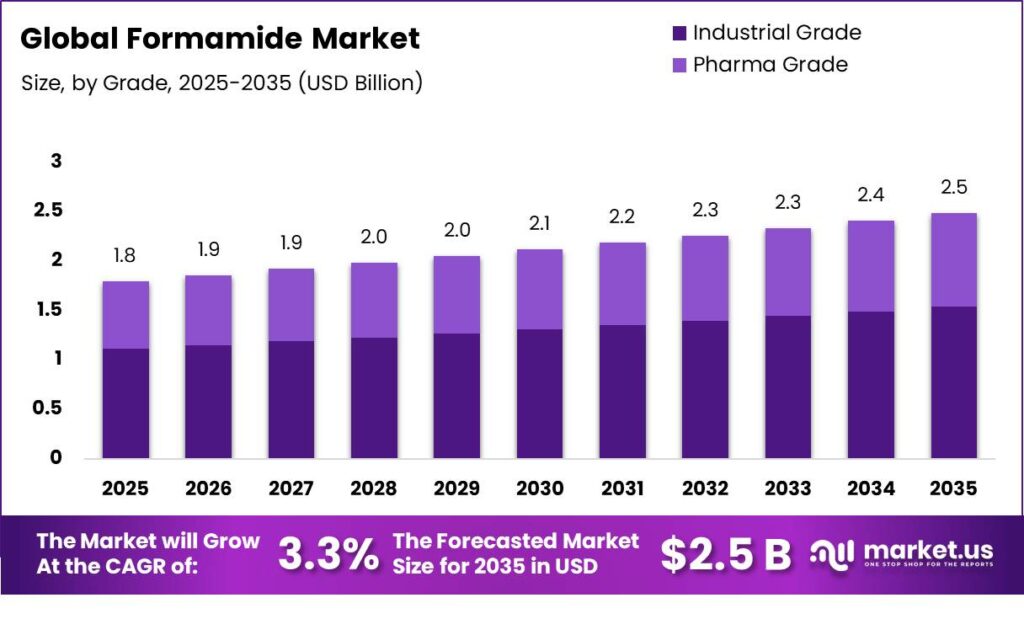
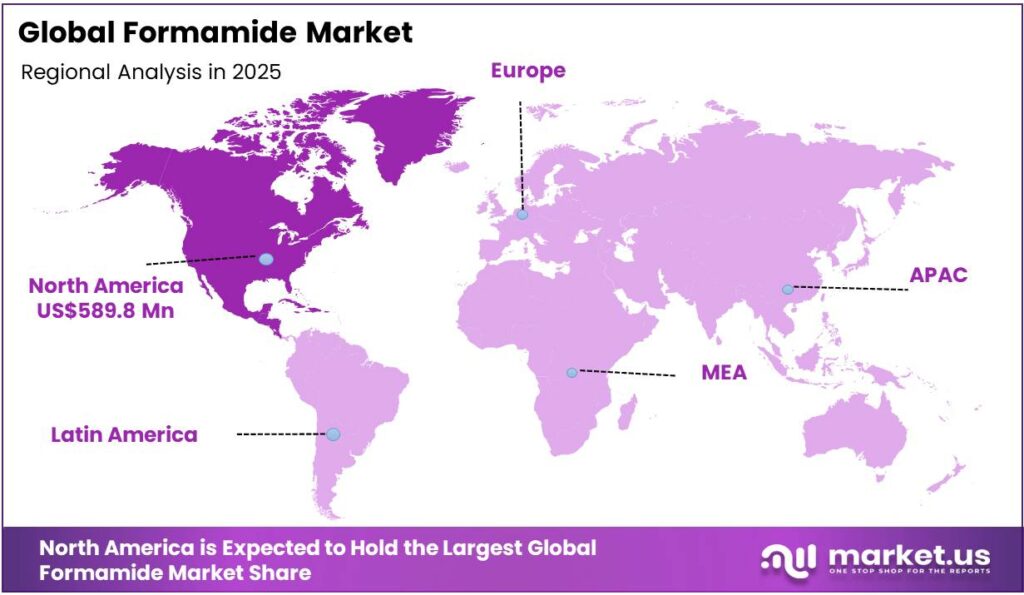
The Global Formamide Market size is expected to be worth around USD 2.5 Billion by 2035, from USD 1.8 Billion in 2025, growing at a CAGR of 3.3% during the forecast period from 2026 to 2035. In 2025, North America held a dominant market position, capturing more than a 33.7% share, holding USD 589.8 Million revenue.
Formamide, known as methanamide, is the simplest amide, derived from formic acid. It is a colorless, oily liquid with a faint, ammonia-like odor and is fully miscible with water. It is a versatile chemical widely employed as a solvent and intermediate across pharmaceutical, industrial, and biotechnological applications. North America represents a leading consumption region, with the USDA data noting extensive agrochemical application.
In addition, its high polarity and aprotic nature make it essential for pharmaceutical synthesis, RNA electrophoresis, in situ hybridization, and polymer-based processes, while industrial applications include coatings, adhesives, and electrolytic processes. Industrial-grade formamide dominates consumption due to large-volume applications that do not require pharmaceutical-level purity, whereas pharmaceutical-grade formamide is reserved for sensitive synthesis and biotechnological procedures.
Furthermore, regulatory and safety considerations, including reproductive toxicity and occupational exposure limits (OSHA, ECHA, EPA), present ongoing challenges for handling and environmental management. Geopolitical factors, such as trade restrictions and precursor supply disruptions, further influence production and distribution. Strategic manufacturer initiatives focus on process optimization, purity enhancement, application-specific formulations, and supply chain resilience to maintain competitiveness.
Key Takeaways
- The global formamide market was valued at USD 1.8 billion in 2025.
- The global formamide market is projected to grow at a CAGR of 3.3% and is estimated to reach USD 2.5 billion by 2035.
- Based on the grades of formamide, industrial-grade formamide dominated the market, with a market share of around 61.9%.
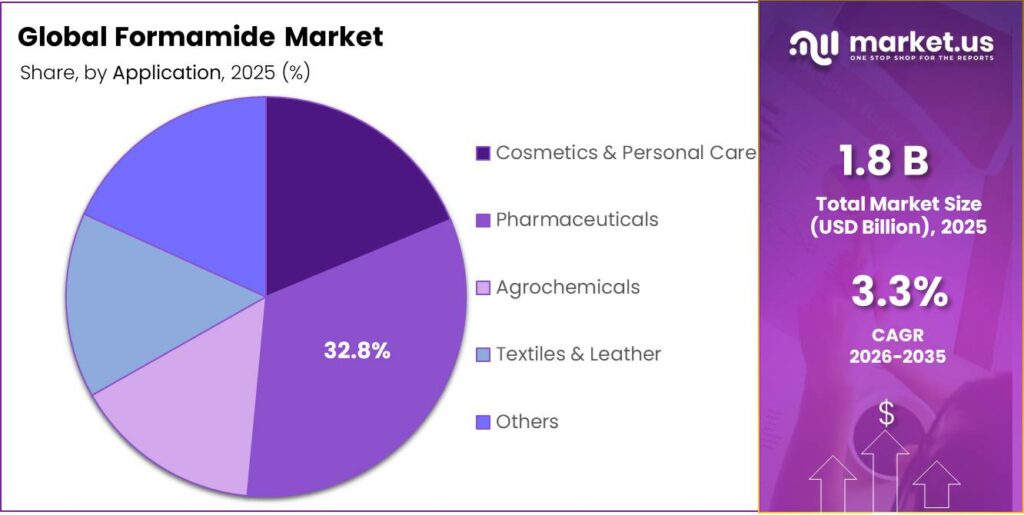
- Among the applications of formamide, the pharmaceutical industry held a major share in the market, 32.8% of the market share.
- In 2025, North America was the most dominant region in the formamide market, accounting for around 33.7% of the total global consumption.
Grade Analysis
Industrial Grade Formamide Held the Largest Share in the Market.
The formamide market is segmented based on grades into industrial grade and pharma grade. The industrial-grade formamide dominated the market, comprising around 61.9% of the market share, primarily due to the scope and scale of its applications. Industrial processes, such as polymer production, resin and coating formulations, adhesives, and metalworking fluids, require large volumes of formamide where ultra-high purity is not critical. Disclosures from BASF and Solvay indicate that industrial-grade formamide typically contains controlled levels of water and minimal impurities, sufficient for these applications, allowing cost-effective bulk production and handling.
In contrast, pharmaceutical-grade formamide must meet stringent purity, contaminant, and endotoxin limits, as specified in U.S. Pharmacopeia and FDA filings, restricting its use to sensitive chemical synthesis and molecular biology procedures. Consequently, the broader range of volume-intensive industrial applications, combined with lower production constraints, drives higher consumption of industrial-grade formamide relative to its pharmaceutical counterpart.
Application Analysis
Formamide is Mostly Utilized in the Pharmaceutical Industry.
Based on the applications of formamide, the market is divided into cosmetics & personal care, pharmaceuticals, agrochemicals, textiles & leather, and others. The pharmaceuticals industry dominated the formamide market, with a market share of 32.8%, as its chemical properties, including high polarity, aprotic nature, and ability to dissolve a wide range of organic compounds, are critical for the synthesis of active pharmaceutical ingredients (APIs) and intermediates. Formamide facilitates complex reactions, enhances the solubility of nucleic acids, and stabilizes intermediates in drug manufacturing, functions that are largely unique to pharmaceuticals.
In contrast, applications in cosmetics and personal care are limited due to regulatory restrictions on reproductive toxicants, and their inclusion in formulations is often replaced by safer solvents. Similarly, agrochemical, textile, and leather processes require less specialized chemical properties, and alternative solvents or adjuvants are sufficient. The technical requirements and chemical specificity of pharmaceutical production drive the predominant use of formamide in this sector.
Key Market Segments
By Grade
- Industrial Grade
- Pharma Grade
By Application
- Cosmetics & Personal Care
- Pharmaceuticals
- Agrochemicals
- Textiles & Leather
- Others
Drivers
Pharmaceutical and Agrochemical Sector Demand Drives the Formamide Market.
Formamide serves as a critical chemical feedstock and intermediate, primarily driven by its role in nitrogen-containing heterocyclic synthesis for the pharmaceutical and agrochemical sectors. It is a fundamental building block in the synthesis of active pharmaceutical ingredients (APIs), particularly pyrimidines and sulfonamides (sulfa drugs). The industry utilizes formamide for its high dielectric constant and ability to dissolve ionic compounds and proteins, facilitating complex organic reactions.
According to the Indian Ministry of Chemicals and Fertilizers and related reports for fiscal year 2025, the domestic manufacturing capacity in India alone established for critical Key Starting Materials (KSMs), drug intermediates, and Active Pharmaceutical Ingredients (APIs) reached approximately 56,800 metric tons per annum, highlighting formamide’s role in drug synthesis.
In agrochemicals, the demand is anchored by formamide’s utility in manufacturing crop protection agents. It is an essential intermediate for the production of 1,2,4-triazoles and imidazoles, which are core structures in many modern herbicides and fungicides. It facilitates the synthesis of formamidine pesticides, which are used to control rice stem borers, citrus pests, and cattle ticks.
Restraints
Environmental and Human Health Concerns Might Hamper the Demand for Formamide.
Formamide faces significant market challenges due to its stringent regulatory classification as a hazardous substance, primarily centered on its profile as a reproductive toxicant and suspected carcinogen, raising human health concerns in industrial handling and downstream applications.
The primary challenge for formamide industrial use is its classification under the EU CLP Regulation (EC) No 1272/2008 as Repr. 1B (H360FD), indicating it may damage fertility and may damage the unborn child. In addition, it is classified as Carc. 2 (H351), denoting that it is suspected of causing cancer. Furthermore, the U.S. Environmental Protection Agency (EPA) lists formamide under TSCA Section 8(a) reporting for its persistence and moderate bioaccumulation potential in aquatic systems, with measured water solubility of 1.1 × 10⁵ mg/L at 20°C, facilitating environmental dispersion.
Moreover, to mitigate risk, agencies have established strict exposure thresholds. For instance, the NIOSH recommended exposure limit (REL) is 10 ppm for a 10-hour TWA. Similarly, the ACGIH threshold limit value (TLV) is even more conservative at 1 ppm. These data underscore that environmental persistence and toxicity create regulatory and operational challenges in formamide production, handling, and disposal.
Opportunity
Formamide as an Industrial Solvent Creates Opportunities in the Market.
Beyond pharmaceutical and agrochemical synthesis, formamide presents significant industrial utility due to its high dielectric constant and ability to dissolve compounds that are otherwise insoluble in common organic solvents. It serves as a critical processing solvent for high-performance polymers. For instance, it is utilized to dissolve PAN during the spinning process to produce synthetic fibers used in textiles and carbon fiber precursors.
Similarly, it acts as a drying control chemical additive (DCCA) in the synthesis of silica gels. The molecule’s hygroscopic and softening properties drive its use in mature industrial sectors. Formamide is employed as a softener for paper and animal glues, improving flexibility and durability. Similarly, it is utilized as a solvent in the production of plasticizers for concrete manufacturing. In addition, it is the primary precursor for the industrial-scale production of hydrogen cyanide (HCN) via dehydration.
These applications demonstrate that formamide’s physicochemical properties offer industrial process efficiencies and functional advantages, representing a structured opportunity in non-pharmaceutical and non-agrochemical sectors.
Trends
Adoption in Biotechnological Applications.
The adoption of formamide in molecular biology is driven by its specialized role as a nucleic acid denaturant and reaction enhancer, specifically for high-precision genomic and transcriptomic workflows. It is a standard reagent in fluorescence in situ hybridization (FISH), northern blotting, and southern blotting to modulate melting temperatures. The U.S. National Institutes of Health (NIH) protocols for RNA electrophoresis specify the use of 50% (v/v) formamide in denaturing gels to prevent secondary structure formation, enhancing the resolution of RNA fragments.
Furthermore, in RNA sequencing library preparation, 95% formamide has been shown to increase the rate of chemical adenylation of DNA adaptors by around 10-fold, achieving product yields exceeding 90% compared to about 20% in aqueous solutions. These protocols demonstrate a trend toward controlled incorporation of formamide in biotechnology, reflecting its functional role in molecular assays and nucleic acid manipulation.
Geopolitical Impact Analysis
Geopolitical Tensions Are Impacting the Formamide Chemical Shipments.
The geopolitical tensions, including trade restrictions and sanctions, influence the global production and supply of formamide. The export controls on chemical intermediates, including formamide and related solvents, to certain sanctioned countries require explicit licensing, limiting international shipment volumes. Similarly, industrial formamide production is fundamentally linked to the availability of natural gas and methanol. The Russia-Ukraine conflict caused natural gas prices to reach record highs in 2022, which directly correlated with a spike in urea and amide production costs, exceeding US$1,000 per ton for related nitrogenous derivatives.
Furthermore, to mitigate geopolitical susceptibility, there is a documented transition toward renewable feedstocks, such as biomass, which can reduce greenhouse gas emissions and provide greater price stability compared to fossil-derived amides. Moreover, the regulatory scrutiny on cross-border transport of toxic intermediates, including formamide, has intensified in response to chemical security concerns. Collectively, these illustrate that geopolitical tensions constrain supply chains, complicate import-export logistics, and increase regulatory oversight in the formamide market.
Regional Analysis
North America Held the Largest Share of the Global Formamide Market.
In 2025, North America dominated the global formamide market, holding about 33.7% of the total global consumption, driven by diverse industrial, pharmaceutical, agrochemical, and biotechnological applications. The region represents a primary consumption hub for formamide, characterized by a high concentration of high-purity pharmaceutical and advanced chemical processing applications. There is an extensive production of the chemical in the region, primarily for chemical intermediates, solvents, and polymer processing.
Additionally, a significant amount of crops is treated with formamide-linked pesticide formulations in the region, reflecting agrochemical adoption. Similarly, in biotechnology, U.S. National Institutes of Health (NIH) protocols specify the use of 30-50% formamide solutions in RNA electrophoresis and in situ hybridization assays, indicating widespread laboratory application. These underscore North America’s predominance in formamide utilization across multiple sectors.
Key Regions and Countries
- North America
- The US
- Canada
- Europe
- Germany
- France
- The UK
- Spain
- Italy
- Russia & CIS
- Rest of Europe
- APAC
- China
- Japan
- South Korea
- India
- ASEAN
- Rest of APAC
- Latin America
- Brazil
- Mexico
- Rest of Latin America
- Middle East & Africa
- GCC
- South Africa
- Rest of MEA
Key Players Analysis
Manufacturers of formamide focus on strategic activities that enhance production efficiency, product quality, and application versatility. Companies invest in optimizing synthesis processes, such as improving methanol and ammonia feedstock conversion, to reduce impurities and energy consumption. Emphasis is placed on expanding high-purity formamide grades suitable for biotechnological and electronic applications, supported by internal quality and safety protocols.
Regulatory compliance, including adherence to EPA, REACH, and OSHA standards, is prioritized to ensure safe handling and transportation. Firms further develop application-specific formulations for polymers, coatings, and molecular biology reagents, documented in product datasheets and technical disclosures. Additionally, manufacturers engage in backward integration for precursor chemicals and secure reliable logistics for raw materials, mitigating supply chain disruptions.
The Major Players in The Industry
- Eastman Chemical Company
- MITSUBISHI GAS CHEMICAL COMPANY, INC
- Anhui Royal Chemical Co., Ltd.
- Spectrum Chemical
- Thermo Fisher Scientific Inc.
- BASF SE
- Central Drug House
- Merck KGaA
- Muby Chemicals
- Shijiazhuang Sincere Chemicals Co., Ltd.
- Other Key Players
Key Developments
- In March 2025, French chemical leader SNF and Japan’s Mitsubishi Chemical Corporation formed a strategic partnership to develop N-vinylformamide (NVF), an advanced monomer widely used in the production of polymers for the paper industry.
Report Scope
Report Features Description Market Value (2025) US$1.8 Bn Forecast Revenue (2035) US$2.5 Bn CAGR (2025-2035) 3.3% Base Year for Estimation 2025 Historic Period 2021-2024 Forecast Period 2025-2035 Report Coverage Revenue Forecast, Market Dynamics, Competitive Landscape, Recent Developments Segments Covered By Grade (Industrial Grade and Pharma Grade), By Application (Cosmetics & Personal Care, Pharmaceuticals, Agrochemicals, Textiles & Leather, and Others) Regional Analysis North America – The US & Canada; Europe – Germany, France, The UK, Spain, Italy, Russia & CIS, Rest of Europe; APAC– China, Japan, South Korea, India, ASEAN & Rest of APAC; Latin America– Brazil, Mexico & Rest of Latin America; Middle East & Africa– GCC, South Africa, & Rest of MEA Competitive Landscape Eastman Chemical Company, MITSUBISHI GAS CHEMICAL COMPANY, Anhui Royal Chemical Co., Ltd., Spectrum Chemical, Thermo Fisher Scientific Inc., BASF SE, Central Drug House, Merck KGaA, Muby Chemicals, Shijiazhuang Sincere Chemicals Co., Ltd., and Other Players. Customization Scope Customization for segments, region/country-level will be provided. Moreover, additional customization can be done based on the requirements. Purchase Options We have three licenses to opt for: Single User License, Multi-User License (Up to 5 Users), Corporate Use License (Unlimited Users and Printable PDF) 
-
-
- Eastman Chemical Company
- MITSUBISHI GAS CHEMICAL COMPANY, INC
- Anhui Royal Chemical Co., Ltd.
- Spectrum Chemical
- Thermo Fisher Scientific Inc.
- BASF SE
- Central Drug House
- Merck KGaA
- Muby Chemicals
- Shijiazhuang Sincere Chemicals Co., Ltd.
- Other Key Players
Our Clients

- 181821
- Mar 2026






