


Report Overview
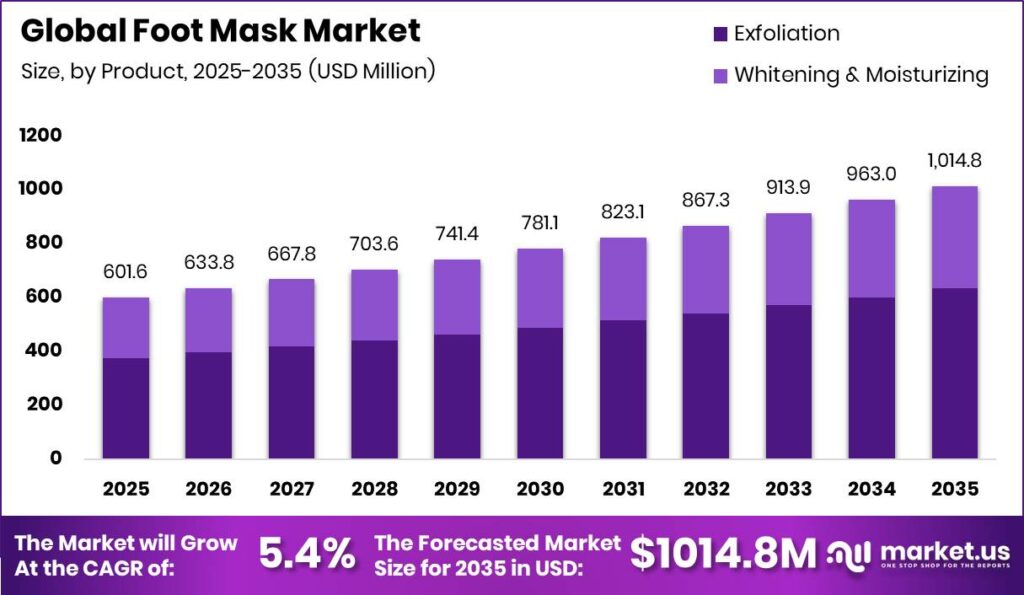
Global Foot Mask Market size is expected to be worth around USD 1,014.8 Million by 2035 from USD 601.6 Million in 2025, growing at a CAGR of 5.4% during the forecast period 2026 to 2035. The category sits inside the broader skin care and personal care industry. Foot masks deliver targeted exfoliation, hydration, and callus care through single application formats. This positions the product as an accessible entry point for at home foot treatment.
The market splits across product function, delivery form, mask material, and retail channel. Exfoliation masks and hydrating masks form the two core product pillars. Therefore, the structure rewards brands that match a clear benefit claim to a specific delivery format. Cotton, hydrogel, and bio cellulose materials define how each mask holds active ingredients against the skin. This design choice shapes both consumer experience and manufacturing cost.
Key Takeaways
- Global Foot Mask Market reached USD 601.6 Million in 2025 and heads toward USD 1,014.8 Million by 2035 at a CAGR of 5.4%.
- Exfoliation led the By Product segment with a 62.5% share, driven by viral foot peel demand.
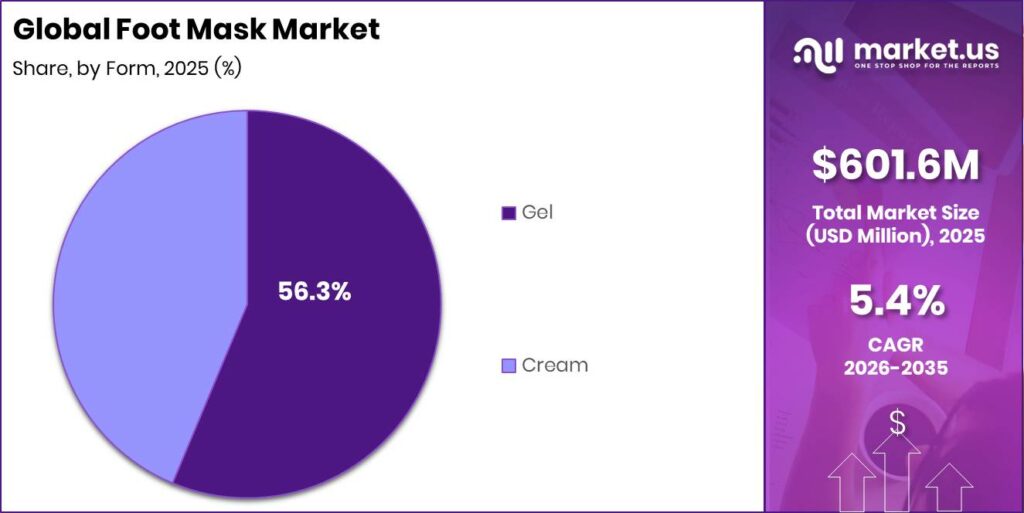
- Gel held a 56.3% share of the By Form segment through fast active delivery.
- Cotton led the By Material segment with a 41.2% share due to low unit cost.
- Hypermarkets and supermarkets captured a 31.7% share of the By Distribution Channel segment.
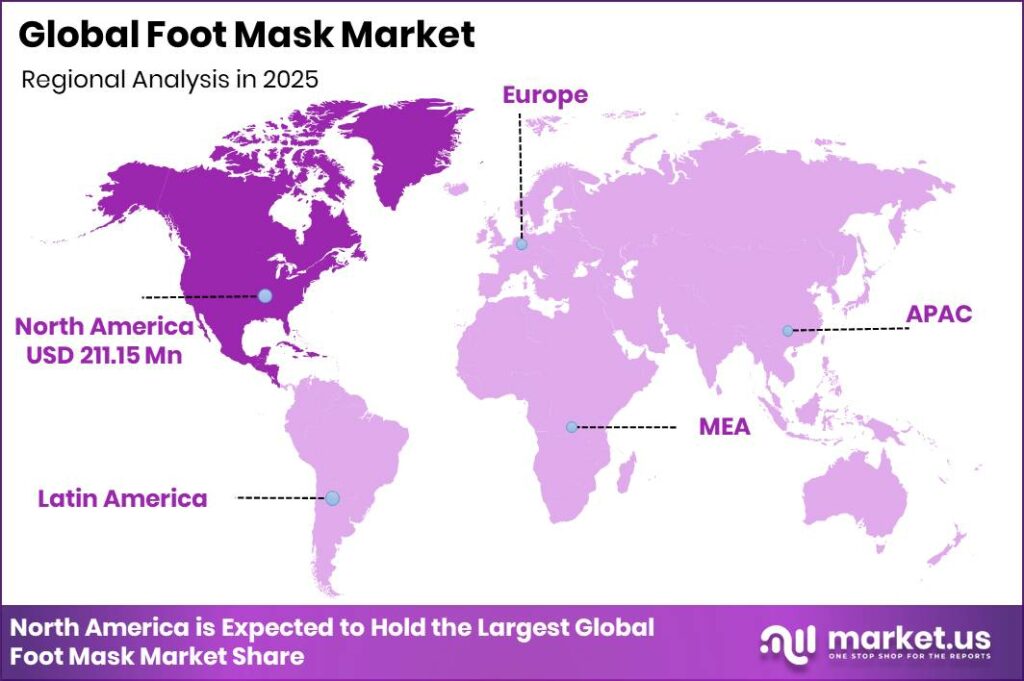
- North America dominated with a 35.1% share, valued at USD 211.15 Million.
Foot care products market demand shapes how governments treat topical exfoliant products. Regulators in the EU and the US set ingredient permitted lists that control AHA use in foot treatments. This means brands must file safety data before launch in these regions. As a result, compliance timelines directly gate how fast new foot masks reach shelves.
As per our research, skin care products held 41% of the global cosmetics market in 2022. This scale gives foot mask makers a large adjacent consumer base to convert. Consequently, brands that borrow skin care routines can pull existing buyers into foot care. The global cosmetics market itself reached USD 484 Billion in 2020, confirming a deep spending pool that funds category trial.
Consumer wellness spend feeds direct product demand across retail and online channels. In October 2025, PAUME launched its hydration mask range across 700 Ulta Beauty stores in the United States. This move signals that mainstream beauty retail now treats foot care as shelf worthy. Therefore, wider retail placement lowers discovery friction and pulls first time buyers into repeat purchase cycles.
Product Analysis
Exfoliation dominates with 62.5% due to viral foot peel booties.
In 2025, Exfoliation held a dominant market position in the By Product segment of Foot Mask Market, with a 62.5% share. Foot peel booties apply glycolic and lactic acid solutions under occlusion for 60 to 90 minutes. This means the format needs no professional pedicure to shed dense keratin. As a result, brands leading with visible peel demonstrations convert cautious first time buyers into repeat users faster.
Whitening and moisturizing masks form the fastest growing product line as buyers seek gentler daily care. A single 60 minute hydrogel bio mask application improved skin hydration and cut transepidermal water loss in healthy volunteers. This proves measurable benefit without aggressive acid exposure. Therefore, brands can position moisturizing masks as a low risk gateway that lifts trial among sensitive skin segments.
Consumer preference now rewards products that show clinical backing rather than marketing claims alone. A 28 day mask study recorded skin elasticity gains of 17.31% under Cutometer measurement. This gives makers a defensible efficacy story for premium pricing. Consequently, brands that fund short clinical trials can command higher shelf value against undifferentiated peel products.
Form Analysis
Gel dominates with 56.3% due to fast active ingredient delivery.
In 2025, Gel held a dominant market position in the By Form segment of Foot Mask Market, with a 56.3% share. Gel carriers hold acids and humectants close to the skin surface under a sealed bootie. This means the form maximizes contact time during the 30 to 90 minute occlusion window. As a result, gel formats deliver the peel effect buyers expect and reinforce category loyalty.
Cream masks serve buyers who want steady hydration rather than a dramatic peel event. Skin firmness improved by 16.18% after 28 days of repeated mask use in a clinical setting. This shows cream based routines build cumulative benefit over time. Therefore, brands can sell cream masks through subscription models that lift purchase frequency and customer value.
Product satisfaction data confirms that formulation choice drives measurable buyer preference. An oxygenating mask formulation scored 10.7% higher satisfaction in version F1 versus F2. This proves that small formula changes shift consumer sentiment. Consequently, form innovation gives makers a low cost lever to differentiate in a crowded gel dominated shelf.
Material Analysis
Cotton dominates with 41.2% due to low unit production cost.
In 2025, Cotton held a dominant market position in the By Material segment of Foot Mask Market, with a 41.2% share. Cotton booties suit high volume production at ex factory prices near USD 0.55 to 1.20 per unit. This means makers can hit mass market price points while keeping margin. As a result, cotton anchors the value tier that fuels first time category trial.
Hydrogel material serves the premium tier where barrier performance justifies higher pricing. An alginate hydrogel lipid nanodispersion mask cut transepidermal water loss after one 60 minute application. This confirms hydrogel improves skin barrier integrity fast. Therefore, brands can charge more for hydrogel masks by tying the material to proven hydration outcomes.
Bio cellulose ranks as the fastest growing material as buyers seek advanced conforming masks. Wearable foot booties need a 30 to 90 minute occlusion period to dissolve dense keratin before shedding begins. This structural need favors materials that seal actives tightly against skin. Others materials hold the remaining share collectively, filling niche and budget positions in the segment.
Distribution Channel Analysis
Hypermarkets and supermarkets dominate with 31.7% due to broad shopper reach.
In 2025, Hypermarkets and Supermarkets held a dominant market position in the By Distribution Channel segment of Foot Mask Market, with a 31.7% share. These outlets place foot masks alongside routine grocery and personal care buys. This means shoppers add masks to existing baskets without a special trip. As a result, mass retail placement drives impulse trial that specialty channels cannot match at scale.
Online channels rank as the fastest growing route as buyers discover products through social content. Foot peel demonstration videos on TikTok create a visible shedding process that drives direct product enquiry. This lowers the barrier between viewing and buying. Therefore, brands with peel ready formats can scale through creator commerce without heavy retail investment.
Specialty stores and convenience stores serve distinct buyer moments across the remaining channels. In October 2025, PAUME rolled out its treatment range online and across 700 Ulta Beauty stores. This shows specialty beauty retail actively courting foot care buyers. Convenience stores, specialty stores, and others hold the remaining share collectively, covering urgent and premium purchase needs.
Key Market Segments
By Product
- Exfoliation
- Whitening & Moisturizing
By Form
- Cream
- Gel
By Material
- Cotton
- Hydrogel
- Bio Cellulose
- Others
By Distribution Channel
- Specialty Stores
- Convenience Stores
- Hypermarkets & Supermarkets
- Online
- Others
Regional Analysis
North America Dominates the Foot Mask Market with a Market Share of 35.1%, Valued at USD 211.15 Million
North America led the Foot Mask Market with a 35.1% share worth USD 211.15 Million in 2025. Strong at home wellness spend and dense beauty retail drive this lead. This means brands find ready buyers and wide shelf access across the region. In February 2026, Dr. Scholl’s updated retail distribution for its self heating Epsom salt foot mask, deepening mainstream availability.
Asia Pacific ranks as the fastest growing region as K beauty culture normalizes multi step foot care. Korean formulators pioneered the foot peeling bootie format now selling worldwide. This gives regional makers a first mover product and export advantage. Therefore, brands investing in Asia Pacific production can serve both local demand and global peel mask supply.
Europe, the Middle East and Africa, and Latin America hold the remaining regional share together. In June 2026, Baby Foot launched a global brand refresh for its 60 minute exfoliation booties with new retail packaging. This signals rising category maturity across these secondary regions. As a result, established brands see room to lift shelf presence and premium positioning outside North America.
Key Regions and Countries
North America
- US
- Canada
Europe
- Germany
- France
- The UK
- Spain
- Italy
- Rest of Europe
Asia Pacific
- China
- Japan
- South Korea
- India
- Australia
- Rest of APAC
Latin America
- Brazil
- Mexico
- Rest of Latin America
Middle East and Africa
- GCC
- South Africa
- Rest of MEA
Market Dynamics
Market Opportunity Analysis - Underserved materials, channels, and regions open clear entry points for new foot mask players
Bio cellulose remains an underexploited material despite ranking as the fastest growing segment. Cotton holds 41.2% of the material segment, leaving advanced formats thinly served. This means premium buyers lack a strong conforming mask option. As a result, new entrants can claim the high performance tier before incumbents shift from low cost cotton production.
Online sits as the fastest growing channel while hypermarkets hold 31.7% of distribution. This gap shows physical retail still leads even as digital demand climbs. Therefore, digital native brands can capture share by owning search terms and creator commerce. Early online focus lets small players scale before mass retailers fully build their own e-commerce foot mask presence.
Asia Pacific ranks as the fastest growing region while North America holds 35.1% at USD 211.15 Million. This concentration shows demand outside North America stays underdeveloped. Consequently, brands entering Asia Pacific early can ride rising K beauty driven foot care adoption. First movers gain local production access and export leverage before global rivals commit regional supply.
Whitening and moisturizing masks grow fastest while exfoliation dominates at 62.5% of product share. This leaves the gentle care segment open for sensitive skin buyers. Instead of chasing the crowded peel space, entrants can own hydration positioning. Brands targeting this softer benefit reach cautious first time users that aggressive peel products often lose.
Technology and Innovation Landscape - Delivery systems and clinical measurement tools redefine foot mask efficacy claims
Self heating delivery marks a clear technology shift in the foot mask category. In February 2026, Dr. Scholl’s launched a self heating mylar bootie with Epsom salt and menthol. This design adds a sensory warming benefit beyond standard exfoliation. As a result, makers can differentiate on delivery experience and defend premium pricing against basic peel products.
Occlusion based delivery drives how actives dissolve keratin in wearable foot booties. The format needs a 30 to 90 minute sealed occlusion period before shedding begins. This engineering detail sets efficacy apart from open application masks. Therefore, brands optimizing bootie seal and fit can promise faster, more reliable peel results to buyers.
Clinical measurement systems now let brands prove benefit with hard data. Cutometer based evaluation recorded skin elasticity gains up to 17.31% after 28 days of use. This gives makers defensible numbers for marketing and regulatory files. Consequently, brands that adopt validated measurement tools convert clinical proof into a durable competitive advantage.
Formulation science shapes consumer satisfaction and repeat purchase intent. An oxygenating mask formula scored 10.7% higher satisfaction in one version over another. This shows small chemistry changes shift buyer sentiment measurably. Instead of relying on marketing alone, makers can iterate formulas to lift satisfaction and retention across the range.
Drivers
Korean beauty culture reset the foot mask from a niche pedicure item into a mainstream self care ritual. Social platforms amplified the change through time lapse peel videos of masks with glycolic acid at 10 to 20%. This visible shedding effect drives first time trial at accessible prices of USD 5 to 18 per treatment. As a result, brands with peel ready formats convert casual viewers into paying buyers.
Creator commerce reshaped how foot mask brands acquire customers and scale volume. A single viral post from a micro influencer can generate 5,000 to 40,000 unit enquiries within 48 to 72 hours. This cuts effective customer acquisition cost to USD 2 to 8 for suited products. Therefore, small brands with runs of 50,000 to 200,000 units now reach scale once needing mass retail.
| Driver | (~) % Impact on CAGR Forecast | Geographic Relevance | Impact Timeline |
|---|---|---|---|
| Social Media & K-Beauty Influenced Self-Care Culture Driving First-Time & Repeat Foot Mask Purchase | +1.80% | United States, United Kingdom, Australia, Germany, Canada, Brazil, Southeast Asia | Short term (≤ 2 years) |
| Rising At-Home Spa & Wellness Spend Replacing Professional Pedicure Services Among Cost-Conscious Urban Consumers | +1.20% | United States, Europe, Japan, South Korea, China, Australia | Short term (≤ 2 years) |
| Male Grooming Category Expansion Introducing Foot Care to Previously Untapped Male Consumer Segment | +0.75% | United States, United Kingdom, Germany, Japan, South Korea, China | Medium term (2–4 years) |
| Diabetic & Elderly Population Growth Increasing Medical-Adjacent Foot Hydration & Callus Care Demand | +0.62% | United States, Germany, Japan, Italy, India, China | Medium term (2–4 years) |
| Premiumisation & Clean Beauty Ingredient Trends Driving ASP Upgrades in Foot Mask Category | +0.48% | United States, Europe, Japan, South Korea, Australia, GCC | Short term (≤ 2 years) |
| E-Commerce & DTC Channel Expansion Lowering Category Discovery & Trial Friction for New Buyers | +0.38% | Global — most acute in United States, China, India, Southeast Asia, Latin America | Short term (≤ 2 years) |
Restraints
Divergent ingredient rules limit how strong foot mask makers can formulate in regulated markets. EU Regulation No. 1223/2009 caps glycolic acid in compliant foot peels near 10 to 14% versus 15 to 25% elsewhere. This means brands lose peel intensity in their largest value markets. As a result, formulation limits blunt the efficacy story that drives premium buyer conversion.
US rules add classification uncertainty that raises the cost of market entry. Products making drug claims may need OTC pathway studies costing USD 150,000 to 600,000 per product. This forces makers to soften claims or fund expensive trials. Therefore, dual market brands face 6 to 18 month launch delays and USD 25,000 to 80,000 yearly compliance cost per SKU.
| Restraint | (~) % Impact on CAGR Forecast | Geographic Relevance | Impact Timeline |
|---|---|---|---|
| EU Cosmetics Regulation & US FDA OTC Restrictions on AHA Concentrations & Ingredient Permitted Lists Constraining Formulation | -1.10% | European Union, United Kingdom, United States, Canada, Australia | Short term (≤ 2 years) |
| Consumer Skin Sensitivity & Adverse Reaction Reports Suppressing Trial Conversion Among Cautious Segments | -0.70% | Global — most acute in United States, United Kingdom, Germany, Australia | Short term (≤ 2 years) |
| Low Product Frequency of Use Limiting Repeat Purchase Rate & Annual Revenue Per Customer | -0.45% | Global | Short term (≤ 2 years) |
| Counterfeit & Sub-Standard Foot Mask Products on Online Marketplaces Eroding Brand Trust | -0.30% | United States, India, Southeast Asia, Latin America — open marketplace environments | Short term (≤ 2 years) |
Challenges
Low entry barriers let private label sellers flood the foot mask shelf and cut prices hard. Chinese OEMs supply white label booties at USD 0.55 to 1.20 per unit with orders of 5,000 to 10,000. This lets retailers undercut brands by 35 to 55% at retail. As a result, branded players must invest to defend consumer willingness to pay.
Marketplace price pressure compresses the margin pool that funds brand growth. Private label listings on Amazon rose from about 180 in 2020 to over 800 by 2024. This dragged branded gross margins from 58 to 68% down toward 44 to 56%. Therefore, brands need subscription models lifting use from 3 to 5 toward 6 to 9 times yearly.
| Challenge | (~) % CAGR Friction Drag | Geographic Relevance | Mitigation Horizon |
|---|---|---|---|
| Private Label & White-Label Margin Erosion in Foot Mask Category | -0.80% | United States, Europe, China, Australia — mature e-commerce beauty markets | Long term (≥ 4 years) |
| Single-Use Plastic Bootie Sustainability Perception & Packaging Regulation Friction | -0.62% | European Union, United Kingdom, Germany, France, Australia, Canada | Medium term (2–4 years) |
| Consumer Instruction Non-Compliance Reducing Efficacy & Repeat Purchase Intent | -0.42% | Global — most acute in first-time buyer markets with low category familiarity | Long term (≥ 4 years) |
| Active Ingredient Stability & Shelf-Life Management in AHA Formulations | -0.28% | Global — affects all temperature-variable supply chains in tropical & high-humidity markets | Long term (≥ 4 years) |
Opportunities
Medical adjacent positioning opens white space no major brand has claimed yet. The global diabetic population exceeded 537 million adults, and about 50% develop dry skin foot complications. This creates a large clinical care need beyond beauty buyers. As a result, a brand funding clinical trials can enter dermatologist recommended channels ahead of every rival.
Clinical positioning unlocks far higher pricing and repeat revenue than the beauty shelf allows. Medicated foot masks can command USD 18 to 38 per treatment, a 50 to 120% premium. This lifts repeat use to 8 to 16 times yearly versus 3 to 5 in beauty. Therefore, early movers investing USD 1.5 to 5 Million in trials can raise customer value by 180 to 320%.
| Opportunity | (~) % Potential CAGR Upside | Geographic Relevance | Execution Window |
|---|---|---|---|
| Medicated & Clinically Validated Foot Mask Positioning for Diabetic Foot Care & Dermatologist-Recommended Channels | +1.40% | United States, Germany, Japan, India, China, Italy, France | Long term (≥ 4 years) |
| Men’s Foot Care Subscription & Bundling with Athletic Recovery & Sports Performance Categories | +0.95% | United States, United Kingdom, Germany, Australia, South Korea, Japan | Medium term (2–4 years) |
| Professional Spa & Podiatry Clinic Wholesale Channel Development for Premium Institutional Supply | +0.72% | United States, Europe, GCC, Japan, Australia, South Korea | Medium term (2–4 years) |
| Biodegradable & Compostable Bootie Format Innovation Addressing Plastic Reduction Consumer & Regulatory Demand | +0.52% | European Union, United Kingdom, Germany, France, Australia, Canada | Long term (≥ 4 years) |
| Emerging Market Modern Trade Penetration — India, Southeast Asia & GCC as Underdeveloped Foot Mask Markets | +0.38% | India, Indonesia, Thailand, UAE, Saudi Arabia, Vietnam | Short term (≤ 2 years) |
Key Company Insights
L’Oréal S.A. holds a structural advantage through its deep skin care portfolio and global retail reach. The company can fund clinical validation that smaller foot mask brands cannot match. This lets it push premium exfoliation and hydration claims across regulated markets. However, its scale focus may leave niche foot peel formats open to agile challengers. Buyers gain trusted efficacy, while investors see stable margin backed by broad distribution across Skin Care Products Market channels.
Unilever PLC leverages its mass market personal care network to place foot masks in high traffic retail. Its supply scale supports low cost cotton formats that anchor value tier trial. This positions the company to win first time buyers through everyday grocery and supermarket presence. However, reliance on mass channels exposes it to private label price pressure. Investors gain broad reach, while the brand must defend premium share against low cost marketplace entrants.
Key Players
- L’Oréal S.A.
- Avon Products, Inc.
- Unilever PLC
- Kao Corporation
- Shiseido Company, Limited
- Johnson & Johnson
- TheFaceShop Co., Ltd.
- TONYMOLY Co., Ltd.
- The Body Shop International Limited
- The Procter & Gamble Company
- Sephora S.A.
- Beiersdorf Aktiengesellschaft (AG)
- Natura & Co Holding S.A.
- Amorepacific Corporation
- Innisfree Corporation
Recent Developments
- October 2025: PAUME expanded its retail footprint by launching its overnight hydration mask and treatment range online and across 700 Ulta Beauty storefronts in the United States.
- June 2026: Baby Foot announced a global brand refresh, moving its 60 minute Original Exfoliation and lavender scented peeling booties to sleek new retail packaging.
Geopolitical Impact Analysis
According to the WTO, global merchandise trade volume shifts directly affect foot mask supply chains built on Chinese OEM production. Rising US tariffs on Chinese consumer goods, some reaching 25%, raise landed cost for imported white label booties. This lifts per unit sourcing cost for brands relying on offshore contract fill. As a result, makers face pressure to diversify supply or absorb thinner margins on value tier products.
As reported by UNCTAD, global container shipping disruptions have extended transit times on key Asia to US lanes by roughly 10 to 14 days during peak rerouting. Freight rate spikes above 100% on some routes raise the delivered cost of polyethylene booties and hydrogel materials. This squeezes brands that hold thin inventory buffers. Therefore, foot mask makers must build regional stock and dual source materials to protect launch timelines and pricing stability.
Report Scope
| Report Features | Description |
|---|---|
| Market Value (2025) | USD 601.6 Million |
| Forecast Revenue (2035) | USD 1,014.8 Million |
| CAGR (2026-2035) | 5.4% |
| Base Year for Estimation | 2025 |
| Historic Period | 2020-2024 |
| Forecast Period | 2026-2035 |
| Report Coverage | Revenue Forecast, Market Dynamics, Market Opportunity Analysis, Technology and Innovation Landscape, Competitive Landscape, Recent Developments |
| Segments Covered | By Product (Exfoliation, Whitening & Moisturizing), By Form (Cream, Gel), By Material (Cotton, Hydrogel, Bio Cellulose, Others), By Distribution Channel (Specialty Stores, Convenience Stores, Hypermarkets & Supermarkets, Online, Others) |
| Regional Analysis | North America (US and Canada), Europe (Germany, France, The UK, Spain, Italy, and Rest of Europe), Asia Pacific (China, Japan, South Korea, India, Australia, and Rest of APAC), Latin America (Brazil, Mexico, and Rest of Latin America), Middle East and Africa (GCC, South Africa, and Rest of MEA) |
| Competitive Landscape | L’Oréal S.A., Avon Products Inc., Unilever PLC, Kao Corporation, Shiseido Company Limited, Johnson & Johnson, TheFaceShop Co. Ltd., TONYMOLY Co. Ltd., The Body Shop International Limited, The Procter & Gamble Company, Sephora S.A., Beiersdorf AG, Natura & Co Holding S.A., Amorepacific Corporation, Innisfree Corporation |
| Customization Scope | Customization for segments, region / country-level will be provided. Additional customization can be done based on requirements. |
| Purchase Options | We have three licenses to opt for: Single User License | Multi-User License (Up to 5 Users) | Corporate Use License (Unlimited User and Printable PDF) |





































