


Market Overview
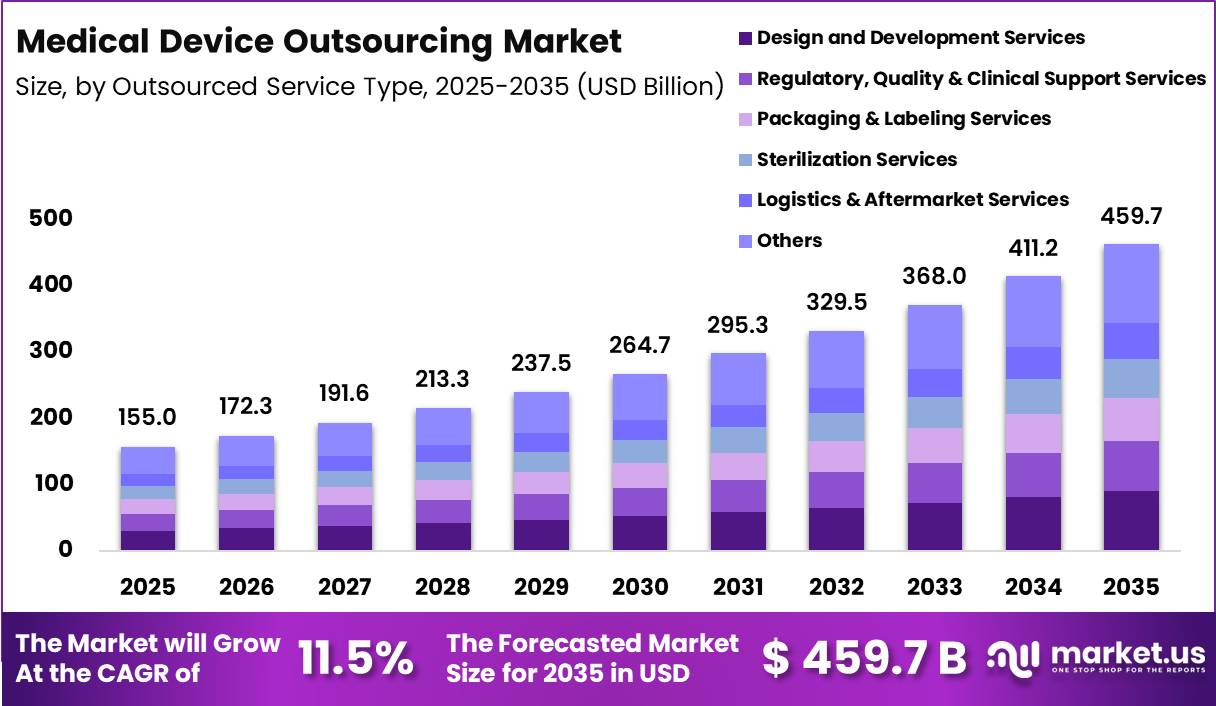
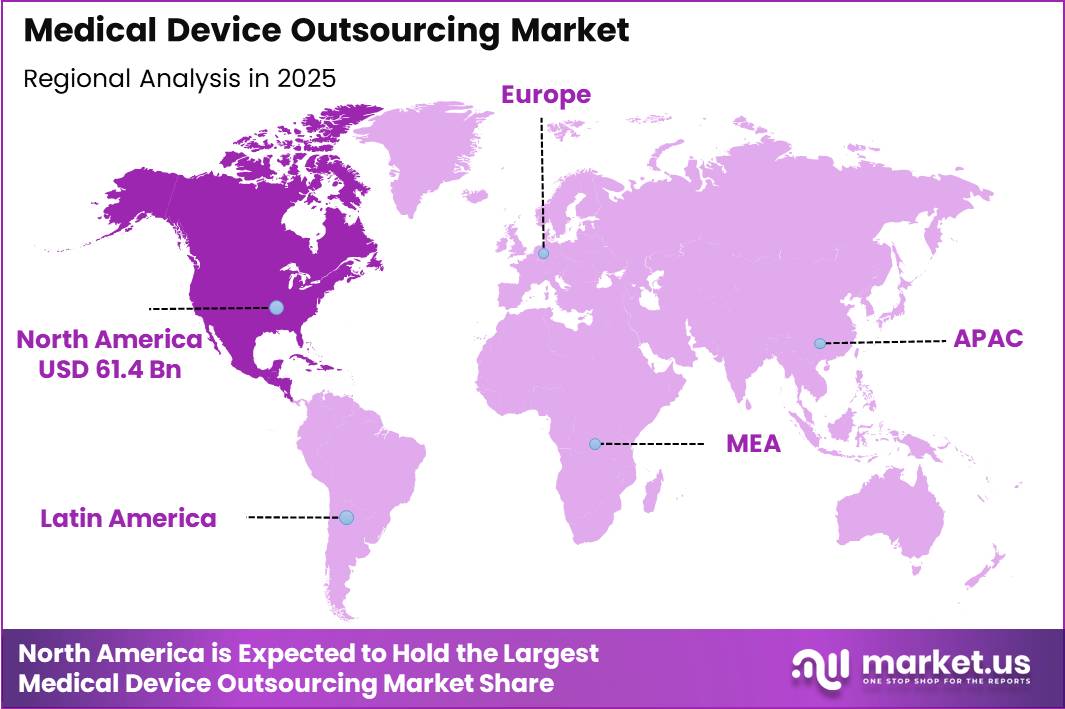
Global Medical Device Outsourcing Market size is expected to be worth around US$ 459.7 Billion by 2035 from US$ 155.0 Billion in 2025, growing at a CAGR of 11.5% during the forecast period from 2026 to 2035. In 2025, North America led the market, achieving over 39.6% share with a revenue of US$ 61.4 Billion.
The Medical Device Outsourcing Market is witnessing steady global expansion, supported by rising regulatory complexity, increasing demand for advanced medical technologies, and the need for cost-efficient manufacturing and compliance solutions. Outsourcing plays a key role across design, development, testing, regulatory affairs, and contract manufacturing, enabling medical device companies to accelerate innovation while maintaining safety and quality standards.
According to regulatory and industry evidence, the sector is significantly influenced by stringent frameworks such as the U.S. FDA Quality System Regulation (21 CFR Part 820) and the EU Medical Device Regulation (EU MDR 2017/745), both of which require extensive documentation, validation, and post-market surveillance. These evolving requirements are increasing the reliance on specialized external service providers for compliance support and quality assurance.
Globally, more than 2 million different medical devices are regulated across jurisdictions, ranging from simple consumables to complex implantable technologies, reflecting the scale and complexity of regulatory oversight. Healthcare authorities such as the World Health Organization (WHO) emphasize that robust regulatory systems are essential to ensure device safety, performance, and patient protection.
The market is further driven by rising healthcare expenditure, growing adoption of digital health technologies, and increased demand for minimally invasive and AI-enabled devices. Regulatory harmonization efforts, including alignment of ISO 13485 quality standards with FDA requirements, are also encouraging outsourcing adoption.
Overall, medical device outsourcing is becoming a critical strategy for OEMs to reduce operational burden, ensure compliance, and speed up global market access in an increasingly regulated healthcare environment.
Key Takeaways
- Market Size: Global Medical Device Outsourcing Market size is expected to be worth around US$ 459.7 Billion by 2035 from US$155.0 Billion in 2025.
- Market Share: The market is growing at a CAGR of 11.5% during the forecast period from 2026 to 2035.
- Outsourced service type: The Medical Device Outsourcing Market by outsourced service type is led by Design and Development Services, which accounted for 19.7% of the global market share in 2025.
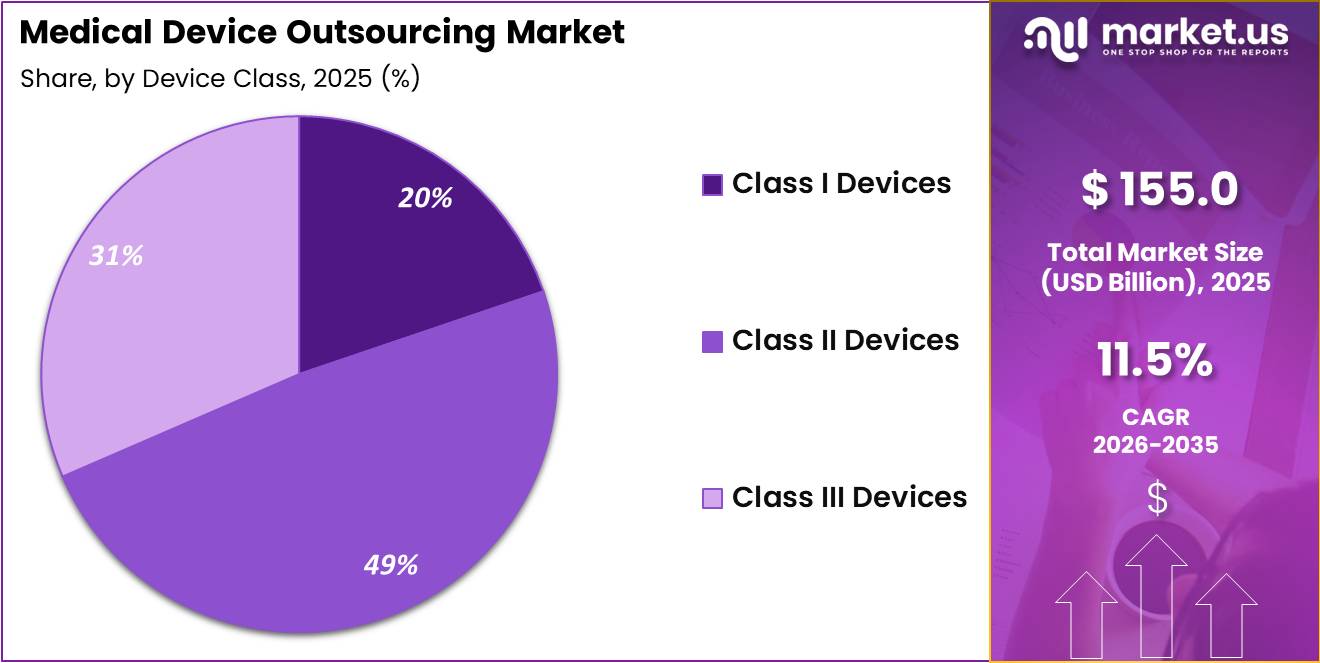
- Device class: The Class II devices segment held the largest share of the Medical Device Outsourcing Markett, accounting for 48.7% of total revenue in 2025.
- Device Type: Consumables dominate the device type segmentation with a 27.5% market share in 2025.
- Application: Cardiovascular applications dominate the market with a 30.4% share in 2025.
- Regional Analysis: In 2025, North America led the market, achieving over 39.6% share with a revenue of US$ 61.4 Billion.
Outsourced Service Type Analysis
Design and Development Services dominate the outsourced service type segment.
Design and Development Services dominate the outsourced service type segment with a 19.7% market share in 2025, driven by increasing demand for accelerated product innovation, early-stage prototyping, and integrated engineering support from OEMs.
Medical device manufacturers are increasingly relying on external partners to reduce development timelines and manage complex design requirements, especially for advanced diagnostic and minimally invasive devices. This segment benefits from strong adoption of end-to-end design partnerships that combine engineering, simulation, and regulatory alignment at early stages.
Regulatory, Quality & Clinical Support Services hold 16.4% share, reflecting rising global compliance complexity and stringent approval pathways across major markets. Packaging & Labeling Services account for 14.2%, supported by growing emphasis on traceability and patient safety requirements.
Sterilization Services represent 12.9%, driven by the need for infection control and reusable device compliance. Logistics & Aftermarket Services contribute 11.6%, as supply chain optimization and post-market surveillance become critical. The “Others” category, at 26.2%, includes niche outsourcing functions such as testing, validation, and specialized consulting, which collectively support operational efficiency across the value chain.
Device Class Analysis
Class II devices lead due to high commercial volume and balanced regulatory requirements supporting widespread outsourcing.
Class II devices dominate the device class segmentation with a 48.7% market share in 2025, primarily due to their widespread use in diagnostic equipment, infusion pumps, surgical instruments, and monitoring devices.
These devices require moderate regulatory control, which makes outsourcing highly attractive for manufacturers seeking to balance compliance requirements with cost efficiency and faster time-to-market. The complexity of Class II devices also drives demand for specialized support in design, validation, and regulatory documentation, strengthening outsourcing adoption.
Class III devices account for 31.5% share, representing high-risk, life-sustaining products such as implantable pacemakers and cardiovascular devices. Although this segment is highly regulated, outsourcing is growing due to increasing clinical trial requirements and advanced engineering needs.
Class I devices hold 19.8% share and generally involve lower complexity products with minimal regulatory burden, resulting in relatively lower outsourcing intensity compared to higher-risk categories. However, manufacturers still leverage outsourcing for scaling production and ensuring compliance in global markets.
Overall, the segmentation highlights a strong correlation between regulatory complexity and outsourcing demand, with Class II devices forming the most commercially active and balanced segment in the market.
Device Type Analysis
Consumables dominate driven by high-volume demand and continuous need for cost-efficient standardized production.
Consumables dominate the device type segmentation with a 27.5% market share in 2025, driven by high-volume production cycles, repeat usage demand, and strong dependence on outsourcing for manufacturing scalability and cost efficiency.
Products such as syringes, catheters, surgical disposables, and testing kits require consistent quality control and regulatory compliance, making outsourcing an essential strategy for OEMs. The recurring demand nature of consumables further strengthens long-term outsourcing partnerships.
Capital equipment represents a significant segment, supported by increasing demand for advanced imaging systems, diagnostic platforms, and surgical machinery that require complex engineering and precision manufacturing.
Implantable devices also contribute meaningfully due to rising adoption of cardiac, orthopedic, and neurostimulation implants, where specialized outsourcing is needed for biocompatibility testing and regulatory approval support. In Vitro Diagnostics (IVD) devices are growing steadily, driven by expanding diagnostic testing needs and personalized medicine trends.
The “Others” category includes emerging device categories and hybrid technologies that require flexible outsourcing capabilities. Overall, consumables remain dominant due to scale and repeatability, while advanced device categories are increasingly outsourcing high-value technical processes.
Application Analysis
Cardiovascular applications lead due to high disease burden and strong demand for advanced, life-saving medical technologies.
Cardiovascular applications dominate the market with a 30.4% share in 2025, driven by the high global burden of heart-related diseases and increasing adoption of advanced interventional and diagnostic devices.
Outsourcing in this segment is particularly strong due to the complexity of device design, stringent regulatory requirements, and continuous innovation in minimally invasive technologies such as stents, pacemakers, and cardiac monitoring systems. Manufacturers increasingly rely on external partners for engineering, clinical validation, and regulatory support to accelerate product development cycles.
Orthopedics and spine represent a major growth segment, supported by rising aging populations and increasing demand for joint reconstruction and spinal implants. Radiology applications also contribute significantly, driven by advancements in imaging technologies and AI-enabled diagnostic systems.
General medical devices form a broad category including hospital equipment, surgical tools, and monitoring systems, where outsourcing helps optimize production efficiency and compliance. The Other segment includes niche therapeutic and diagnostic applications with specialized outsourcing needs.
Overall, cardiovascular remains the most dominant application due to high disease prevalence and innovation intensity, while other segments steadily expand through increasing procedural volumes and technological advancements.
Key Market Segments
By Outsourced Service Type
- Design and Development Services
- Regulatory, Quality & Clinical Support Services
- Packaging & Labeling Services
- Sterilization Services
- Logistics & Aftermarket Services
- Others
By Device Class
- Class I Devices
- Class II Devices
- Class III Devices
By Device Type
- Consumables
- Capital Equipment
- Implantable Devices
- In Vitro Diagnostics (IVD) Devices
- Others
By Application
- Orthopedics and Spine
- Cardiovascular
- Radiology
- General Medical Devices
- Others
Opportunity
Cybersecurity compliance outsourcing.
This is an opportunity rather than a current driver because most baseline outsourcing revenue still comes from engineering transfer, component production, and cost arbitrage, whereas the next monetizable white space is the outsourcing of cybersecurity by design, SBOM generation, software maintenance evidence, and submission ready regulatory files for connected devices.
That white space expands as FDA cybersecurity expectations for premarket submissions and software transparency mature, creating a premium compliance services layer that many traditional device CMOs do not yet fully monetize.
By 2030, connected and software containing devices could reasonably represent 22% to 28% of outsourced new product introduction programs, and a specialist outsourcer that packages SBOM management, threat modeling, vulnerability remediation, and postmarket patch documentation could lift blended project ASPs by 8% to 12% and EBITDA margins by 250 to 400 basis points.
While reducing OEM submission cycle slippage by an estimated 2 to 4 months; the resulting attachable service TAM likely reaches the low single digit billions globally by the early 2030s, with the fastest monetization in the US, EU, and Japan where compliance burden and hospital cyber risk scrutiny are highest.
| Opportunity | (~) % Potential CAGR Upside | Geographic Relevance | Execution Window |
|---|---|---|---|
| Cybersecurity compliance outsourcing | +1.4% | North America core, EU, Japan | Short term (≤ 2 years) |
| Nearshore resilient manufacturing hubs | +1.9% | US, Mexico, EU CEE, ASEAN | Short term (≤ 2 years) |
| Home-care device platform outsourcing | +2.1% | North America, EU, developed APAC | Medium term (2-4 years) |
| LMIC value-engineered device lines | +1.6% | India, Africa, Southeast Asia, LATAM | Medium term (2-4 years) |
| Sterile and implantables roll-up M&A | +1.7% | North America, Western Europe | Medium term (2-4 years) |
| Outcome-based lifecycle service models | +1.3% | US, EU, selected APAC | Long term (≥ 4 years) |
Drivers
FDA QMSR and ISO 13485 alignment raising compliance outsourcing.
The FDA’s Quality Management System Regulation became effective on 2 February 2026 and replaced the old QSIT centered inspection approach with a new compliance program aligned substantially to ISO 13485:2016, while explicitly preserving FDA authority to inspect management review, quality audits, and supplier audit reports.
That matters commercially because many OEMs, especially mid sized innovators and venture backed device firms, do not want to rebuild internal documentation architecture, supplier qualification systems, CAPA discipline, and audit readiness across every product family at once; instead, they are concentrating demand into outsourced partners that already operate ISO 13485 based systems, validated supplier controls, and inspection ready traceability.
In practical unit economic terms, this shifts outsourcing from “build to print assembly” toward bundled quality services such as design transfer, process validation, complaint trending support, supplier quality engineering, and remediation programs, raising revenue per outsourced project as well as contract duration.
The CAGR uplift is material because the regulation compresses the timing of internal compliance investments into 2026, and once OEMs qualify a compliant external manufacturer, switching costs become high due to revalidation expense, DHF/DMR linkage, and audit continuity requirements, locking in multiyear outsourced revenue streams.
| Driver | (~) % Impact on CAGR Forecast | Geographic Relevance | Impact Timeline |
|---|---|---|---|
| FDA QMSR and ISO 13485 alignment raising compliance outsourcing | +1.7% | North America core, EU follow-through, APAC export hubs | Short term (≤ 2 years) |
| EU MDR/IVDR and EUDAMED deadlines accelerating external regulatory-ready production | +1.5% | EU core, UK adjacency, Switzerland, APAC exporters | Short term (≤ 2 years) |
| OEM margin pressure shifting fixed manufacturing cost to variable outsourcing models | +1.9% | North America core, Western Europe, APAC scale bases | Medium term (2-4 years) |
| Device complexity in minimally invasive, wearable, and connected platforms favoring specialist partners | +2.1% | North America, EU, Japan, South Korea, China premium corridors | Medium term (2-4 years) |
| Sterile, cleanroom, and validation-heavy capacity bottlenecks boosting CDMO share | +1.6% | US, EU, Singapore, Malaysia, Costa Rica, Mexico | Short to medium term (≤ 4 years) |
| Tariff risk and regionalized supply chains driving dual-sourcing and nearshoring | +1.3% | US-Mexico corridor, EU-Central Europe, ASEAN spill-over | Medium term (2-4 years) |
Challenges
Multi jurisdictional quality burden.
Fragmented global regulation forces medical device outsourcers to maintain overlapping but non identical quality systems that materially increase non value added effort, with many large CDMOs now running 3–5 concurrent quality frameworks to satisfy FDA (QSR/QMSR), EU MDR/IVDR, PMDA, and UKCA requirements, producing audit workloads that can consume 12–18% of quality headcount capacity annually in inspections, CAPA follow up, and document remediation.
For multi site networks with 10–20 facilities, the number of external audits and regulatory inspections typically exceeds 40–60 events per year, lifting compliance labor costs by an estimated 15–25% versus a single jurisdiction baseline and elongating design transfer and validation timelines by 4–8 months for Class II and 6–12 months for Class III devices, effectively pushing out revenue realization and clipping the achievable market CAGR by roughly 1.2% points.
Operationally, duplicated device history records, region specific labeling and UDI logic, and heterogenous sterilization documentation add 5–10% scrap and rework risk on cross region batches, while complex change control chains can delay engineering changes or supplier substitutions by 90–180 days, limiting responsiveness to field issues and inflation shocks.
To navigate this, leading MDO players are investing in global QMS harmonization with single digital QMS backbones, standardized global work instructions, and central regulatory affairs hubs; these programs often cost 2–3% of annual revenue over 3–5 years but can cut audit findings by 30–40%, reduce CAPA recurrence by more than 50%, and compress design to launch cycles enough to recapture 0.5–0.7 percentage points of lost growth over the long term.
| Challenge | (~) % CAGR Friction Drag | Geographic Relevance | Mitigation Horizon |
|---|---|---|---|
| Multi-jurisdictional quality burden | -1.2% | US, EU, Japan, UK hubs | Long term (≥ 4 years) |
| Supply chain rerouting & tariffs | -1.0% | North America, EU, Mexico, China | Medium term (2-4 years) |
| Advanced manufacturing talent gap | -0.9% | North America, EU, high-cost APAC | Long term (≥ 4 years) |
| Capacity constraints in complex devices | -0.8% | US, EU, Costa Rica, Malaysia | Medium term (2-4 years) |
| Cybersecurity & data integrity overhead | -0.7% | Global connected-device clusters | Long term (≥ 4 years) |
| Fragmented digital integration with OEMs | -0.6% | Global multi-site CDMOs | Medium term (2-4 years) |
Restraints
EU MDR and global regulatory drag.
The implementation of EU MDR, with most legacy MDD certificates expiring between 2024 and 2027, is forcing OEMs and their outsourced manufacturing partners to re allocate 150–250 basis points of revenue into incremental regulatory, clinical, and documentation work, effectively crowding out new outsourcing awards and delaying volume ramps by 12–24 months for many small and mid cap device companies.
At an operational level, stricter clinical evidence requirements are expanding the number of devices requiring prospective clinical data, pushing per device clinical validation budgets up by an estimated 20–30% versus pre MDR baselines and extending submission lead times by 6–9 months, which directly compresses the near term outsourcing opportunity pipeline, particularly in Class IIb and Class III implants.
Notified body bottlenecks, with some bodies reporting double digit percentage increases in application queues, are forcing OEMs to prioritize lifecycle extensions and change notifications over net new design transfers, reducing the annualized RFQ flow to contract manufacturers by an estimated 10–15% through 2027 compared with demand driven potential.
While parallel tightening of FDA expectations around human factors, cybersecurity, and real world evidence adds 3–6 months to US submission pathways for more complex electromechanical and software driven devices.
Strategically, this regulatory drag results in CapEx deferrals at CMOs—where 20–30% of planned greenfield and brownfield investments in Europe are being sequenced later in the decade—and raises the economic hurdle rate for tooling and automation projects, as OEMs demand break even payback periods under 3–4 years to compensate for uncertain approval windows, thereby shaving an estimated 2.2% points from the otherwise structurally attractive CAGR of outsourced medical manufacturing over the medium term.
| Restraint | (~) % Impact on CAGR Forecast | Geographic Relevance | Impact Timeline |
|---|---|---|---|
| EU MDR and global regulatory drag | -2.2% | EU, UK, North America, global OEMs | Medium term (2-4 years) |
| Supply chain and component volatility | -1.9% | North America, EU, APAC corridors | Short–Medium term (≤ 3 years) |
| Labor, QA, and compliance cost inflation | -1.6% | North America core, EU, nearshore LATAM | Medium–Long term (≥ 3 years) |
| Capacity constraints in high-complexity CMOs | -1.4% | North America, EU, advanced APAC | Short–Medium term (≤ 4 years) |
| Data, cybersecurity, and software validation burden | -1.3% | US, EU, Japan, South Korea | Medium–Long term (≥ 4 years) |
| Pricing pressure and OEM insourcing reversals | -1.1% | Global OEMs, especially top 50 | Medium term (2-4 years) |
Regional Analysis
North America Leads Global Revenue Share in 2025.
In 2025, North America led the Medical Device Outsourcing Market, accounting for over 39.6% share and generating revenue of approximately US$ 61.4 Billion. The region’s dominance is supported by a highly advanced healthcare infrastructure, strong presence of leading medical device manufacturers, and widespread adoption of outsourcing services for design, manufacturing, regulatory support, and testing.
Increasing demand for cost-efficient production and strict regulatory compliance requirements further strengthen the outsourcing ecosystem in the region. Additionally, continuous innovation and early adoption of advanced technologies such as AI-driven design, automation, and precision manufacturing contribute to North America’s leadership position.
Europe remains the second-largest region in the Medical Device Outsourcing Market, driven by strong regulatory frameworks, established medical technology clusters, and increasing collaboration between manufacturers and contract service providers. Growth in the region is further supported by rising demand for high-quality compliant outsourcing solutions and advancements in digital health technologies.
Asia-Pacific is emerging as the fastest-growing region due to expanding manufacturing capabilities, lower production costs, increasing clinical trials activity, and growing investments from global medtech companies. Countries such as China, India, and Japan are witnessing significant expansion in contract manufacturing and testing services. Latin America and Middle East Africa show steady gradual growth trajectory expansion.
Key Regions and Countries
North America
- The US
- Canada
Europe
- Germany
- France
- The U.K.
- Italy
- Spain
- Russia & CIS
- Rest of Europe
Asia Pacific
- China
- India
- Japan
- South Korea
- ASEAN
- Australia & New Zealand
- Rest of Asia Pacific
Middle East & Africa
- GCC
- South Africa
- Rest of Middle East & Africa
Latin America
- Brazil
- Mexico
- Rest of Latin America
Key Player Analysis
The Medical Device Outsourcing Market is moderately consolidated with strong dominance of global CROs, testing firms, and contract manufacturers. Leading players such as Charles River Laboratories International, Inc., Thermo Fischer Scientific Inc., Eurofins Scientific, IQVIA, and Wuxi Apptec drive the competitive landscape through integrated end-to-end services including preclinical testing, clinical research, regulatory consulting, and contract manufacturing.
These companies benefit from global infrastructure, advanced capabilities, and long-term partnerships with medtech firms. Other significant contributors include Intertek Group PLC, SGS SA, and North American Science Associates, Inc., which strengthen quality assurance and regulatory testing services across regions.
Specialized service providers such as Accellent Inc., Cadence Inc., Benchmark Electronic Inc., Providien LLC, Sterigenics International LLC, Toxikon, INC., Pace Analytical Services LLC., American Preclinical Services, and West Pharmaceuticals Services Inc. further diversify the competitive ecosystem with niche manufacturing, sterilization, and analytical solutions.
Competitive strategies in the market focus on R&D investments, technological innovation, automation, and geographic expansion. Players increasingly emphasize digital integration, compliance efficiency, and scalable manufacturing networks to reduce time-to-market for medical devices.
Strategic collaborations, mergers, and acquisitions are also common to expand service portfolios and strengthen global reach. The market is highly innovation-driven, with firms competing on quality, regulatory expertise, and capabilities.
Top Key Players
- Intertek Group PLC
- Accellent Inc.
- American Preclinical Services
- Benchmark Electronic Inc.
- Cadence Inc.
- Charles River Laboratories International, Inc.
- Eurofins Scientific
- SGS SA
- IQVIA
- North American Science Associates, Inc.
- Pace Analytical Services LLC.
- Providien LLC
- Sterigenics International LLC
- Thermo Fischer Scientific Inc.
- Toxikon, INC.
- West Pharmaceuticals Services Inc.
- Wuxi Apptec
Recent Developments
- In March 2025, NAMSA completed the acquisition of WuXi AppTec’s U.S. medical device testing business. The integration expanded NAMSA’s global testing infrastructure and brought additional laboratory capacity to serve more than 4,000 medical device manufacturers worldwide. The acquisition enhances outsourcing capabilities in biological safety testing, extractables and leachables testing, and regulatory support services.
- In February 2025, Medical Manufacturing Technologies expanded its medical device outsourcing footprint through the acquisition of GenX Medical. The acquisition strengthened its capabilities in tubing and custom extrusion components, supporting demand from device OEMs seeking specialized manufacturing partners for complex components.
- In January 2025, Integer Holdings Corporation completed the acquisition of Precision Coating to strengthen its medical device outsourcing capabilities. The $152 million acquisition added specialized coating technologies including fluoropolymer coatings, anodic coatings, ion treatment solutions, and laser processing capabilities. The deal supports Integer’s strategy of expanding vertically integrated manufacturing solutions for complex medical devices, particularly in implantable and patient-critical applications.
- In February 2025, Medical Manufacturing Technologies expanded its medical device outsourcing footprint through the acquisition of GenX Medical. The acquisition strengthened its capabilities in tubing and custom extrusion components, supporting demand from device OEMs seeking specialized manufacturing partners for complex components.
Report Scope
| Report Features | Description |
|---|---|
| Market Value (2025) | US$ 155.0 Billion |
| Forecast Revenue (2035) | US$ 459.7 Billion |
| CAGR (2026-2035) | 11.5% |
| Base Year for Estimation | 2025 |
| Historic Period | 2020-2024 |
| Forecast Period | 2026-2035 |
| Report Coverage | Revenue Forecast, Market Dynamics, Competitive Landscape, Recent Developments |
| Segments Covered | By Outsourced Service Type (Design and Development Services, Regulatory, Quality & Clinical Support Services, Packaging & Labeling Services, Sterilization Services, Logistics & Aftermarket Services, Others), By Device Class (Class I Devices, Class II Devices, Class III Devices), By Device Type (Consumables, Capital Equipment, Implantable Devices, In Vitro Diagnostics (IVD) Devices, Others), By Application (Orthopedics and Spine, Cardiovascular, Radiology, General Medical Devices, Others) |
| Regional Analysis | North America – The US, Canada; Europe – Germany, France, U.K., Italy, Spain, Russia & CIS, Rest of Europe; Asia Pacific – China, India, Japan, South Korea, ASEAN, Australia & New Zealand, Rest of Asia Pacific; Middle East & Africa – GCC, South Africa, Rest of Middle East & Africa; Latin America – Brazil, Mexico, Rest of Latin America |
| Competitive Landscape | Intertek Group PLC, Accellent Inc., American Preclinical Services, Benchmark Electronic Inc., Cadence Inc., Charles River Laboratories International, Inc., Eurofins Scientific, SGS SA, IQVIA, North American Science Associates, Inc., Pace Analytical Services LLC., Providien LLC, Sterigenics International LLC, Thermo Fischer Scientific Inc., Toxikon, INC., West Pharmaceuticals Services Inc., Wuxi Apptec |
| Customization Scope | Customization for segments, region/country-level will be provided. Moreover, additional customization can be done based on the requirements. |
| Purchase Options | We have three licenses to opt for: Single User License, Multi-User License (Up to 5 Users), Corporate Use License (Unlimited User and Printable PDF) |





































