


Global Food Enzymes Market Size, Share, And Industry Analysis Report By Source (Microbial Enzymes, Plant Derived Enzymes, Animal Derived Enzymes), By Enzyme Type (Carbohydrases, Proteases, Lipases, Others), By Application (Bakery, Dairy, Beverages, Confectionery and Sweeteners, Others), By Region and Companies - Industry Segment Outlook, Market Assessment, Competition Scenario, Trends, and Forecast 2025-2034
- Published date: December 2025
- Report ID: 171385
- Number of Pages: 244
- Format:
-
keyboard_arrow_up
Quick Navigation
Report Overview
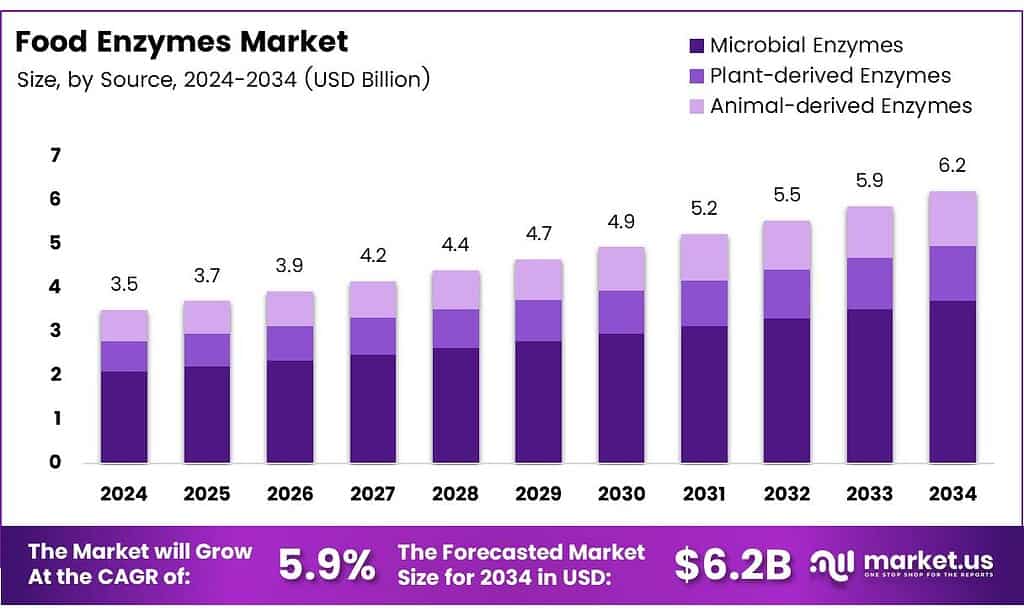
The Global Food Enzymes Market size is expected to be worth around USD 6.2 billion by 2034, from USD 3.5 billion in 2024, growing at a CAGR of 5.9% during the forecast period from 2025 to 2034.
The food enzymes market focuses on natural proteins used during food processing to enhance texture, taste, shelf life, and overall production efficiency across baking, dairy, beverages, and functional foods. These enzymes support consistent product quality while helping manufacturers reduce processing time, lower energy consumption, and optimize raw material use, making them essential cost-efficient processing aids aligned with clean-label expectations in modern food manufacturing.
The market benefits from expanding processed food consumption and demand for premium nutrition products. Moreover, urbanization and busy lifestyles push manufacturers toward enzyme-enabled solutions that simplify formulations. Consequently, enzymes supporting bakery softness, dairy digestion, and beverage clarity are seeing sustained commercial traction.
Opportunities are emerging as food companies reformulate products using recognizable and functional ingredients. Enzymes derived from microbial and plant sources align well with clean-label positioning. In addition, innovation around non-GMO, allergen-free, and heat-stable enzymes opens new application areas in plant-based foods and protein alternatives.
- Consumer behavior data strongly reinforces these trends. According to IFIC, 63% of U.S. adults say ingredients moderately influence purchases, while 64% actively choose foods with clean ingredients. This behavior directly supports enzyme adoption, as enzymes replace synthetic additives without altering familiar food formats.
Ingredient simplicity as a decisive factor. In ADM, 69% of consumers prefer simple, recognizable ingredients, and 66% seek the shortest ingredient lists. IFIC also reports that clean foods are defined as “not artificial” by 22%, “organic” by 16%, “fresh” by 15%, “nutritious” by 14%, and “natural” by 14%. These preferences reinforce enzyme-driven reformulation strategies.
Key Takeaways
- The Global Food Enzymes Market is projected to grow from USD 3.5 billion in 2024 to USD 6.2 billion by 2034, registering a 5.9% CAGR during 2025–2034.
- Microbial Enzymes dominate the market by source, accounting for a leading share of 72.5% due to high efficiency and scalable production.
- Carbohydrases hold the largest share at 47.3%, driven by strong demand from baking, brewing, and starch processing applications.
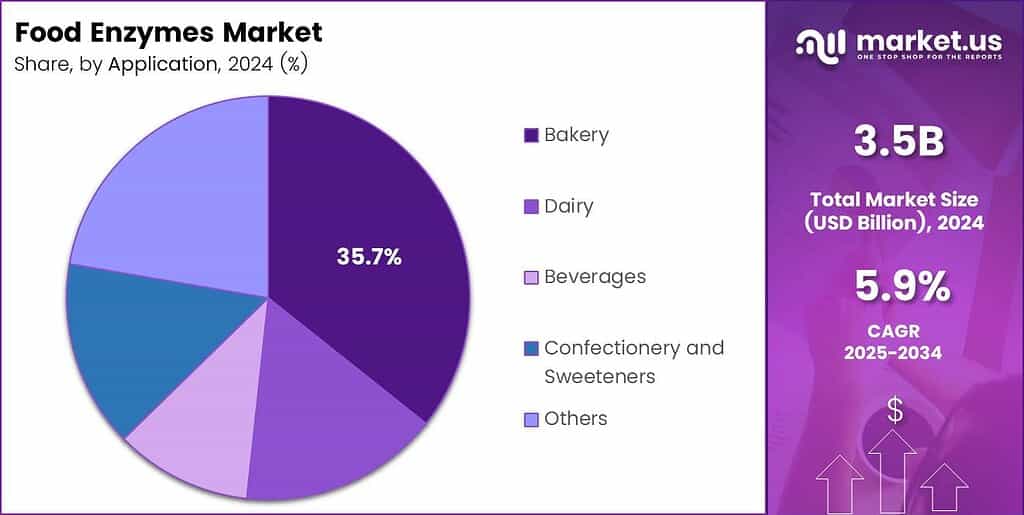
- The Bakery Segment leads application-wise with a market share of 35.7%, supported by demand for improved texture, shelf life, and processing efficiency.
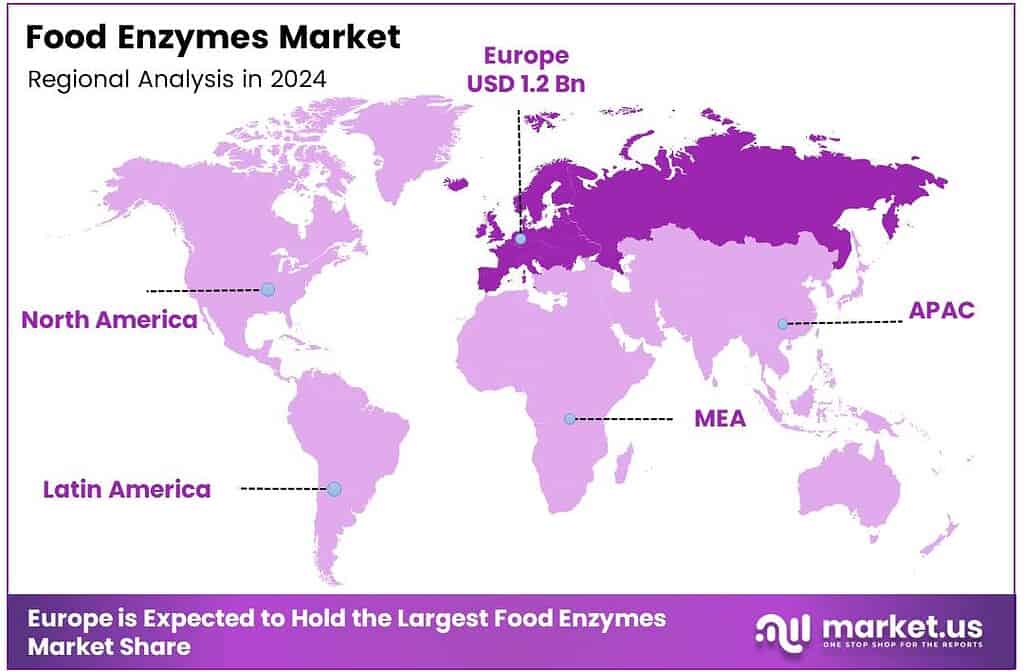
- Europe is the leading regional market, capturing 34.7% share and valued at USD 1.2 billion in 2024.
By Source Analysis
Microbial Enzymes dominate with 72.5% due to their high efficiency, scalability, and consistent performance across food processing applications.
In 2024, Microbial Enzymes held a dominant market position in the By Source Analysis segment of the Food Enzymes Market, with a 72.5% share. These enzymes are widely adopted because they deliver stable activity, support large-scale fermentation, and align well with modern clean-label production needs.
Plant-derived Enzymes continue to gain attention as consumers prefer naturally sourced ingredients. These enzymes are commonly used in fruit processing, beverages, and specialty foods. Although adoption is growing, variability in yield and higher extraction costs limit their wider industrial penetration.
Animal-derived Enzymes maintain a niche presence, mainly in traditional dairy and meat processing applications. However, ethical concerns, regulatory limitations, and shifting consumer preferences toward plant-based alternatives have reduced their broader market appeal over time.
By Enzyme Type Analysis
Carbohydrases lead with 47.3% as they play a central role in improving texture, sweetness, and processing efficiency.
In 2024, Carbohydrases held a dominant market position in the By Enzyme Type Analysis segment of the Food Enzymes Market, with a 47.3% share. These enzymes are essential in baking, brewing, and starch conversion, helping manufacturers enhance yield and product consistency.
Proteases are widely used for protein modification, flavor development, and texture improvement. They support applications in dairy, meat, and bakery products. Their ability to improve digestibility keeps demand steady across both industrial and specialty food formulations.
Lipases play an important role in fat modification and flavor enhancement. They are commonly used in cheese, bakery, and confectionery products. While their application scope is narrower, their functional importance supports stable adoption in value-added foods.
By Application Analysis
Bakery applications dominate with 35.7% due to high demand for improved texture, shelf life, and production efficiency.
In 2024, Bakery held a dominant market position in the By Application Analysis segment of the Food Enzymes Market, with a 35.7% share. Enzymes support dough handling, volume enhancement, and freshness, making them essential in large-scale bakery operations.
Dairy applications rely on enzymes for fermentation, flavor development, and lactose management. These solutions help producers improve product consistency while meeting growing demand for digestive-friendly and premium dairy offerings. Beverages use enzymes to enhance clarity, stability, and extraction efficiency.
From fruit juices to alcoholic drinks, enzymes support smoother processing and better sensory quality without altering natural ingredient profiles. Confectionery and Sweeteners benefit from enzymes that support sugar conversion and texture control. These applications help manufacturers meet demand for refined taste and consistent quality across candies and syrups.
Key Market Segments
By Source
- Microbial Enzymes
- Plant-Derived Enzymes
- Animal-Derived Enzymes
By Enzyme Type
- Carbohydrases
- Proteases
- Lipases
- Others
By Application
- Bakery
- Dairy
- Beverages
- Confectionery and Sweeteners
- Others
Emerging Trends
Advances in Biotechnology and Sustainability Shape Market Trends
One major trending factor in the food enzymes market is the use of advanced biotechnology. Modern fermentation and precision enzyme engineering improve performance and stability. This allows enzymes to work effectively under wider processing conditions.
- The Food and Agriculture Organization, global production of plant-based foods crossed USD 29 billion, driven by proteins from soy, peas, and pulses. The European Commission’s Horizon Europe initiative allocated EUR 95 million in 2024 for bio-based food innovation, including enzyme-enabled processing efficiency.
Sustainability is another strong trend. Food companies aim to reduce energy use, water consumption, and food waste. Enzymes support these goals by increasing yields and lowering processing temperatures, helping manufacturers meet sustainability targets.
Drivers
Rising Demand for Clean-Label and Efficient Food Processing Drives Market Growth
Food enzymes are widely used because food makers want cleaner labels and better processing efficiency. Consumers increasingly read ingredient lists and prefer simple, familiar components. Enzymes help manufacturers reduce additives while still achieving the same texture, taste, and shelf life. This makes them attractive for bakery, dairy, and beverage producers.
- Enzymes also improve production efficiency. They shorten processing time, lower energy use, and reduce raw material waste. Enzymes help dough rise faster, improve cheese yield, and stabilize beverages. The International Dairy Federation reported that enzymatic lactose conversion now supports more than 75% of industrial lactose-free milk processing in advanced markets, helping brands meet rising intolerance concerns.
In addition, food safety regulations encourage controlled and standardized processing. Enzymes support predictable reactions, helping manufacturers meet quality and compliance standards. Together, clean-label demand, efficiency gains, and processed food growth strongly drive the food enzymes market.
Restraints
High Development Costs and Regulatory Complexity Limit Market Expansion
One major restraint in the food enzymes market is the high development cost. Creating new enzyme formulations requires advanced research, fermentation facilities, and long testing cycles. This increases expenses, especially for smaller companies trying to enter the market.
- The United States Department of Agriculture reported that ultra-processed foods account for 57% of total daily calorie intake in the U.S. food system. The International Association of Plant Bakers noted that enzyme-assisted formulations reduced baking waste by 18% in industrial plants, directly improving profitability and sustainability.
Regulatory approval is another challenge. Food enzymes must meet strict safety and labeling rules before commercial use. Approval processes vary by region and often take years. This slows product launches and increases compliance costs for manufacturers.
Storage and handling requirements also create limitations. Enzymes are sensitive to temperature and moisture, which can affect activity and shelf life. Maintaining proper conditions adds logistics and operational costs, especially in developing markets.
Growth Factors
Expansion of Functional Foods Creates New Growth Opportunities
Growth opportunities in the food enzymes market are strongly linked to functional and health-focused foods. Enzymes play a key role in improving digestibility, reducing sugar, and enhancing nutritional profiles. This supports demand in functional dairy, plant-based foods, and fortified beverages.
- Plant-based and alternative protein products offer another opportunity. Enzymes help improve texture, flavor, and protein availability in meat and dairy alternatives. Enzyme usage is expected to rise. Enzymes also reduce resource use. The International Energy Agency reported that enzyme-based food processing can lower thermal energy demand by 12–20% in starch and sugar conversion processes, directly cutting emissions.
Emerging markets also present strong growth potential. Rapid urbanization and rising income levels increase the consumption of packaged foods. Local manufacturers are gradually adopting enzymes to improve efficiency and product consistency.
Regional Analysis
Europe Dominates the Food Enzymes Market with a Market Share of 34.7%, Valued at USD 1.2 billion
Europe leads the food enzymes market due to its strong focus on food quality, clean-label processing, and sustainable manufacturing practices. In 2024, the region accounted for a dominant share of 34.7%, with the market valued at USD 1.2 billion, supported by advanced food processing standards. Strict food safety regulations and early adoption of enzyme-based processing solutions continue to strengthen regional demand.
North America represents a mature and innovation-driven market for food enzymes, supported by large-scale food processing industries. Growing demand for processed and convenience foods is encouraging manufacturers to use enzymes for efficiency and consistency. The region also benefits from strong consumer awareness around ingredient transparency and functional food benefits.
Asia Pacific is witnessing rapid growth in the food enzymes market due to expanding food production capacity and urban consumption patterns. Rising populations and increasing demand for packaged foods are driving enzyme adoption across bakery and beverage segments. Improving cold-chain infrastructure and modernization of food processing facilities are also contributing to market expansion.
The Middle East and Africa region is gradually adopting food enzymes as food processing industries evolve. Growth is supported by increasing imports of processed foods and rising local manufacturing initiatives. Enzymes are gaining attention for their role in improving shelf life and production efficiency. Although still emerging, the region presents long-term opportunities as food security and industrial food processing gain importance.
Key Regions and Countries
North America
- US
- Canada
Europe
- Germany
- France
- The UK
- Spain
- Italy
- Rest of Europe
Asia Pacific
- China
- Japan
- South Korea
- India
- Australia
- Rest of APAC
Latin America
- Brazil
- Mexico
- Rest of Latin America
Middle East & Africa
- GCC
- South Africa
- Rest of MEA
Key Players Analysis
In 2024, Novonesis stands out as a scale player in food enzymes, with a clear push toward higher-performance solutions that help manufacturers improve yield, texture, and process consistency. From an analyst lens, its strength is the ability to move innovations from lab to large industrial customers quickly, especially where bakeries and beverage plants want more reliable performance with fewer process disruptions.
For DSM-Firmenich, the 2024 story is about pairing enzyme functionality with broader taste, nutrition, and reformulation needs. The company is well-positioned when brands ask for cleaner labels and better sensory outcomes without sacrificing throughput. Its portfolio approach also helps it sell into multiple categories through the same customer relationships.
In 2024, Kerry Group plc benefits from being close to food formulators and brand teams, not only plant operations. Its enzyme activity is typically tied to application know-how—helping customers solve problems like softness retention in baked goods or stability in drinks. That “problem-solving” positioning can protect margins better than commodity-style offerings.
Meanwhile, BASF SE brings a process and industrial mindset that fits large-scale customers looking for predictable performance, supply reliability, and compliance readiness. From a market viewpoint, BASF’s advantage is operational discipline and the ability to integrate enzymes into broader ingredient and process portfolios, which can make it harder for smaller suppliers to displace.
Top Key Players in the Market
- Novonesis
- DSM-firmenich
- Kerry Group plc
- BASF SE
- Kemin Industries Inc
- Amano Enzyme Inc
- Biocatalysts Ltd
- Associated British Foods plc
- Advanced Enzyme Technologies Ltd
- International Flavors & Fragrances Inc. (IFF)
Recent Developments
- In 2025, DSM-Firmenich launched MaxirenEVO, a next-generation coagulant enzyme for cheese manufacturing. It improves texture, taste, yield, and processing flexibility by targeting specific casein proteins, supporting higher yields and sustainable production.
- In 2024, Kerry acquired LactoSens biosensor technology for rapid lactose detection, improving process efficiency and regulatory compliance in food manufacturing. Kerry manufactures enzyme products addressing challenges in taste, texture, nutrition, operational efficiency, and sustainability across food and beverage sectors.
Report Scope
Report Features Description Market Value (2024) USD 3.5 Billion Forecast Revenue (2034) USD 6.2 Billion CAGR (2025-2034) 5.9% Base Year for Estimation 2024 Historic Period 2020-2023 Forecast Period 2025-2034 Report Coverage Revenue Forecast, Market Dynamics, Competitive Landscape, Recent Developments Segments Covered By Source (Microbial Enzymes, Plant Derived Enzymes, Animal Derived Enzymes), By Enzyme Type (Carbohydrases, Proteases, Lipases, Others), By Application (Bakery, Dairy, Beverages, Confectionery and Sweeteners, Others) Regional Analysis North America (US and Canada), Europe (Germany, France, The UK, Spain, Italy, and Rest of Europe), Asia Pacific (China, Japan, South Korea, India, Australia, and Rest of APAC), Latin America (Brazil, Mexico, and Rest of Latin America), Middle East & Africa (GCC, South Africa, and Rest of MEA) Competitive Landscape Novonesis, DSM-Firmenich, Kerry Group plc, BASF SE, Kemin Industries Inc., Amano Enzyme Inc., Biocatalysts Ltd, Associated British Foods plc, Advanced Enzyme Technologies Ltd, International Flavors & Fragrances Inc. (IFF) Customization Scope Customisation for segments, region/country-level will be provided. Moreover, additional customisation can be done based on the requirements. Purchase Options We have three licenses to opt for: Single User License, Multi-User License (Up to 5 Users), Corporate Use License (Unlimited Users and Printable PDF) 
-
-
- Novonesis
- DSM-firmenich
- Kerry Group plc
- BASF SE
- Kemin Industries Inc
- Amano Enzyme Inc
- Biocatalysts Ltd
- Associated British Foods plc
- Advanced Enzyme Technologies Ltd
- International Flavors & Fragrances Inc. (IFF)
Our Clients

- 171385
- December 2025






