Report Overview
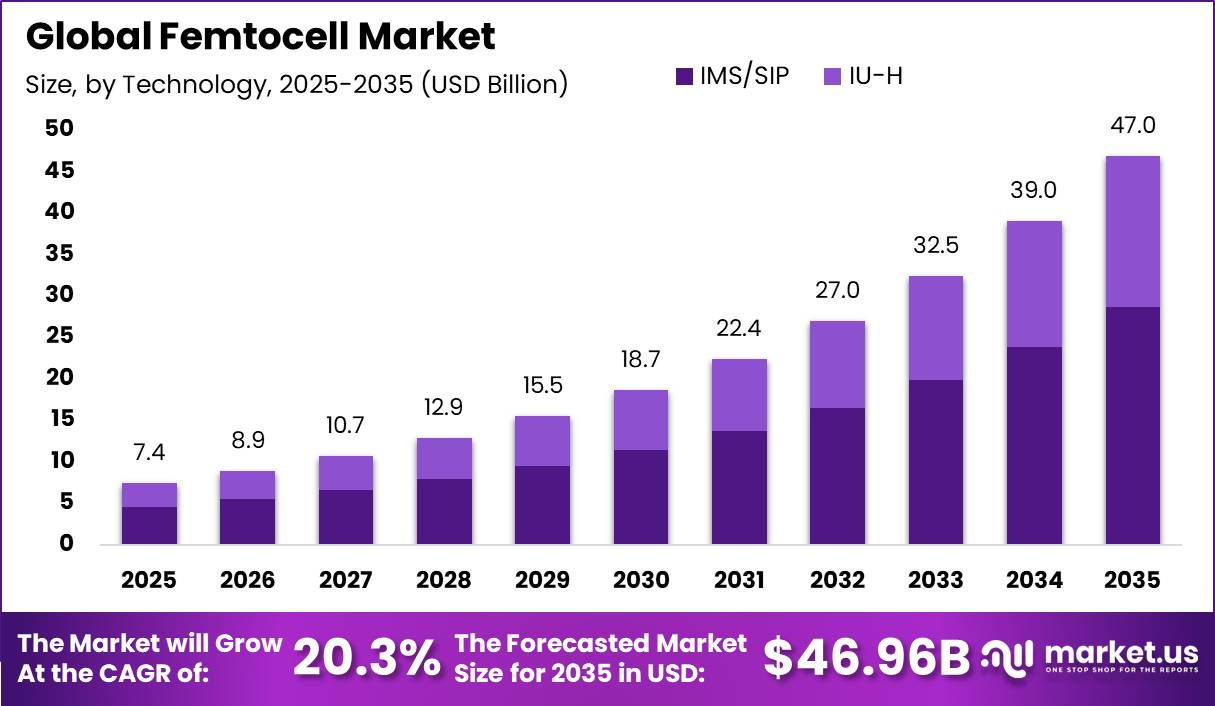
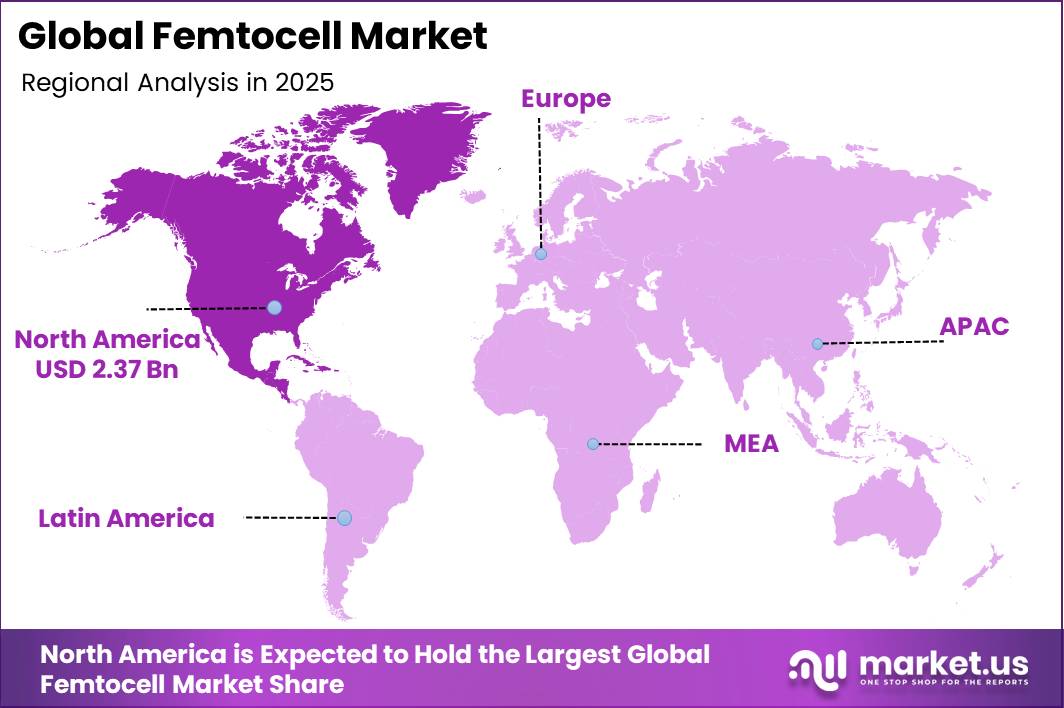
In 2025, the Global Femtocell Market was valued at USD 7.4 billion. The market is projected to grow at a CAGR of 20.3% during 2026–2035, reaching approximately USD 46.9 billion by 2035. North America dominated the global market in 2025, accounting for more than 32% of the total market share and generating approximately USD 2.3 billion in revenue.
Market growth is mainly supported by rising mobile data use, increasing internet access, and the need for stronger indoor cellular coverage. According to the ITU, nearly 6 billion people, representing about 74% of the global population, are now online, compared with 60% in 2020. This indicates that more than 1.3 billion new users came online within 5 years.
Global mobile-cellular subscriptions also exceeded 9.2 billion in 2025, while mobile broadband subscriptions reached nearly 99 per 100 inhabitants. With mobile data traffic expected to triple by 2030, telecom operators are increasingly using femtocells to improve indoor connectivity and reduce pressure on macro networks.
The FCC has authorized more than USD 18 billion for rural broadband development, while the Rural Digital Opportunity Fund provides another USD 20.4 billion for underserved areas. In addition, global fixed and mobile broadband connections increased from 3.4 billion in 2014 to 9.4 billion by the end of 2024, strengthening the need for reliable indoor network solutions such as femtocells.
Key Takeaway
- The Femtocell Market valued at USD 7.4 billion in 2025, projected to reach USD 46.9 billion by 2035 at a 20.3% CAGR.
- The IMS/SIP segment was led by technology with a 61.1% share, supported by widespread VoLTE deployment.
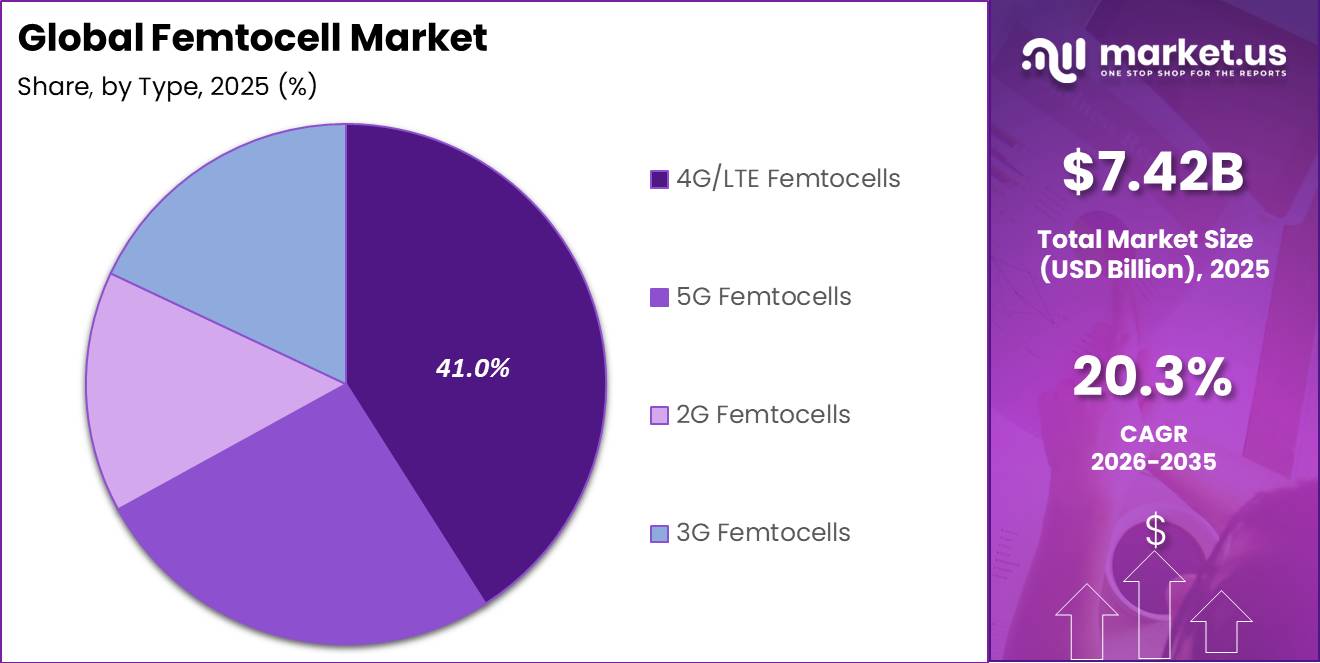
- 4G/LTE femtocells held a dominant 41% share by type, while 5G femtocells are the fastest-growing segment.
- Residential femtocells led by end users with a 42.5% share; enterprise femtocells are the fastest-growing segment.
- Indoor femtocells are dominated by applications with a 76% share, while outdoor femtocells are the fastest-growing segment.
- North America led the market in 2025 with a 32% share and USD 2.3 billion in revenue.
Market Statistics and Data Insights
- ITU estimates that approximately 6 billion people, or 74% of the global population, were using the internet in 2025. This was up from 60% in 2020, meaning around 1.3 billion additional people came online within five years.
- Global mobile-cellular subscriptions reached 9.2 billion in 2025, equivalent to 112 subscriptions per 100 people. Active mobile-broadband subscriptions reached 99 per 100 people.
- Mobile broadband represented 89% of all mobile subscriptions in 2025, compared with less than 50% in 2015. This confirms the major shift from basic voice connectivity toward data-heavy mobile services.
- Around 4.7 billion people, equal to 58% of the world’s population, used mobile internet on their own device in 2024. Around 200 million people became new mobile-internet users during the year.
- Approximately 3.1 billion people, or 38% of the world’s population, lived within mobile-broadband coverage but did not use mobile internet. Only around 4% of the global population remained outside mobile-broadband coverage.
- Global mobile data traffic reached approximately 146 EB per month in 2025, compared with 123 EB per month in 2024. Smartphone traffic alone reached around 143 EB per month.
- Nokia reports that in many telecom markets, as much as 80% of total mobile traffic originates indoors. This directly supports demand for indoor radios, small cells, and femtocells rather than relying only on outdoor macro towers.
- In the United States, 41% of workers reported working from home at least some of the time in 2024. Around 18% worked entirely from home, and 22% followed a hybrid arrangement.
- By the end of Q1 2026, 2,003 organizations across 88 countries were deploying at least one private LTE or 5G network with a contract value above €100,000; another 178 deployments were valued between €50,000 and €100,000. These enterprise networks are important deployment environments for indoor femtocells and small cells.
- ITU reported that 5G covered 55% of the world’s population in 2025, while 4G remained available to 93%; overall, 96% of the global population had access to at least a 3G-or-higher network. These figures show the large active cellular base that indoor femtocells can extend coverage inside coverage-challenged buildings.
By Technology
The IMS/SIP segment dominated the Femtocell Market with a 61.1% share, supported by its wide use as a standard architecture for delivering voice, data, and multimedia services over IP networks. According to the GSA, 375 operators across 156 countries were investing in VoLTE, while 320 operators had launched or were deploying commercial VoLTE networks across 138 countries as of May 2025.
GSMA data also indicates that VoLTE and Vo5G connections have exceeded 5 billion globally, accounting for nearly 60% of total mobile connections. IMS/SIP enables important functions such as call setup, session management, and multimedia communication, allowing femtocells to connect smoothly with telecom operators’ core networks.
As mobile operators continue replacing older circuit-switched systems with IP-based infrastructure, demand for IMS/SIP-enabled femtocells is increasing. Their strong compatibility with modern 4G and 5G networks makes them suitable for residential, enterprise, and rural applications, supporting the segment’s leading position in the global market.
By Type
The 4G/LTE femtocells segment held a dominant 41% market share, mainly because LTE continues to support a large part of global mobile communication. Mobile broadband now represents around 89% of all mobile subscriptions worldwide, compared with less than 50% in 2015.
However, only about 36% of these mobile broadband subscriptions have moved to 5G, showing that a large user base still depends on 4G/LTE networks. This keeps LTE femtocells important for improving indoor coverage, reducing network congestion, and providing a cost-effective solution for homes and enterprises.
At the same time, 5G femtocells are the fastest-growing segment as operators expand next-generation networks. Global 5G connections exceeded 2.7 billion by the end of 2025 and are expected to contribute nearly USD 1 trillion to the global economy by 2030. However, 5G coverage remains uneven, reaching around 66% in urban areas but only 40% in rural locations.
By End User
The residential femtocells segment dominated the Femtocell Market with a 42.5% market share, supported by the growing need for reliable indoor connectivity at home. In the U.S., Census data shows that 15.1% of the workforce now works from home, compared with only 5.2% in 2019.
The Federal Reserve also reports that around 41% of workers spend at least part of their working week remotely. This shift has increased household demand for stable mobile signals for video meetings, voice calls, cloud applications, and other online activities. Residential femtocells help improve indoor coverage by using existing broadband connections to strengthen cellular service.
Meanwhile, enterprise femtocells are the fastest-growing segment, driven by increasing connectivity requirements across offices, warehouses, retail stores, and other commercial facilities. The World Bank reports that global mobile network coverage has reached around 98% of the population.
Businesses are therefore under greater pressure to provide similarly reliable connectivity inside buildings, where walls, equipment, and building materials can weaken outdoor mobile signals. Enterprise femtocells help close these indoor coverage gaps while supporting a growing number of employees, connected devices, and business applications.
By Application
The indoor femtocells segment dominated the Femtocell Market with a 76% market share, mainly due to the rising need for reliable mobile coverage inside buildings. Global building floor area reached approximately 273 billion square metres in 2024, increasing by 1.7% during the year, while residential buildings accounted for around 77% of the total floor space.
Materials such as concrete, steel, and insulated walls can weaken signals from outdoor macro towers, making indoor femtocells an effective solution for homes, offices, and commercial buildings. Industry data also shows that indoor small-cell deployments reached around 5.6 million units globally, compared with about 2.7 million outdoor units, highlighting the stronger demand for indoor coverage solutions.
Meanwhile, outdoor femtocells are the fastest-growing segment, supported by network densification and expanding 5G deployment. In the U.S., outdoor small-cell nodes reached approximately 452,200 units in 2022. These systems are increasingly deployed across streets, transport hubs, public areas, and dense urban locations, where shorter-range 5G signals require additional network points to maintain stable coverage and capacity.
Key Market Segments
By Technology
- IMS/SIP (IP Multimedia Subsystem/Session Initiation Protocol)
- IU-H (User Equipment in Home)
By Type
- 2G Femtocells
- 3G Femtocells
- 4G/LTE Femtocells
- 5G Femtocells
By End User
- Residential
- Enterprises
- Public Spaces
By Application
- Indoor
- Outdoor
Geopolitical Impact Analysis
The Femtocell Market is facing rising supply-chain pressure because production depends on rare earth magnets, gallium, germanium, semiconductor chips, and copper. China controls more than 90% of global gallium and germanium output and around 91% of rare earth refining. Export restrictions reduced unwrought gallium shipments to almost zero through 2025, contributing to a 365% increase in European gallium prices and a 400% rise in germanium prices.
In Q1 2025, antimony and germanium shipments also declined by 57% and 39% year over year, respectively. The IEA estimates that around USD 6.5 trillion of annual downstream electronics production remains exposed to concentrated critical-mineral supply, while global critical-mineral investment declined by 9% in 2025.
Trade costs are also increasing, with U.S. reciprocal tariffs ranging from 10% to 41%, a 40% penalty on transshipped goods, a 25% Section 232 tariff on advanced semiconductors from January 2026, and 50% tariffs on Chinese semiconductors and copper. The EU secured a 15% tariff cap, compared with a previously proposed 30% rate.
Logistics disruptions are adding further pressure. Red Sea container volumes fell nearly 30%, while Suez Canal traffic, which historically handled about 12% of global trade, declined around 37% year over year and remained nearly 70% below 2023 levels through 2025. Cape of Good Hope rerouting adds around 7–14 days, while Shenzhen-to-Northern-Europe shipping now takes about 38–44 days, increasing costs and lead times for femtocell components.
Regional Analysis
North America dominated the Femtocell Market with a 32% share, generating approximately USD 2.3 billion in 2025. The region benefits from mature LTE and 5G infrastructure, strong mobile usage, and growing demand for reliable indoor network coverage across residential and commercial locations.
Government investment is also supporting regional market growth. The FCC has authorized more than USD 18 billion for rural broadband expansion, while the Rural Digital Opportunity Fund provides an additional USD 20.4 billion for underserved areas. In addition, around 15.1% of the U.S. workforce works from home, increasing demand for stable indoor mobile connectivity.
Europe is the fastest-growing region, supported by the European Commission’s Digital Decade 2030 goals for gigabit connectivity and full 5G coverage across populated areas. EU 5G household coverage increased from 89.0% in 2023 to 94.3% in 2024, representing a 6.0% year-over-year increase. In 2025, EU27 fixed connectivity coverage reached 98.0%, while 5G coverage expanded to 96.8% of households.
However, mid-band 5G coverage remains lower at 74.8%, while rural 5G coverage stands at 87.9%, creating opportunities for femtocell deployment. The European Parliament estimates that at least EUR 148 billion in public and private investment will be required to achieve the region’s connectivity targets.
Key Regions and Countries
North America
- US
- Canada
Europe
- Germany
- France
- The UK
- Spain
- Italy
- Rest of Europe
Asia Pacific
- China
- Japan
- South Korea
- India
- Australia
- Rest of APAC
Latin America
- Brazil
- Mexico
- Rest of Latin America
Middle East & Africa
- GCC
- South Africa
- Rest of MEA
Market Dynamics
Drivers
| Driver | (~) % CAGR | Geographic Relevance | Impact Timeline |
|---|---|---|---|
| Enterprise indoor 5G coverage mandates | +4.2% | North America, Europe | Short term (2 years or less) |
| Rural broadband subsidy disbursement | +3.1% | North America | Short term (2 years or less) |
| Hybrid work-driven residential data demand | +2.8% | Global | Medium term (2 to 4 years) |
| VoLTE-to-IMS core migration by carriers | +2.4% | Asia Pacific, Europe | Medium term (2 to 4 years) |
| Building floor area expansion in emerging markets | +1.9% | Asia Pacific, Middle East | Long term (4 years or more) |
Enterprise indoor 5G coverage mandates
Regulatory pressure for universal 5G access is supporting femtocell adoption, particularly under the EU Digital Decade 2030 targets. EU household 5G coverage increased from 89.0% in 2023 to 94.3% in 2024, encouraging enterprises to treat indoor connectivity as essential infrastructure rather than optional spending.
This shift could shorten enterprise sales cycles by around 15%–20%, while broadband funding of more than USD 18 billion can help reduce deployment costs. Carrier support may lower effective per-node costs by roughly 8%–10%, while RFP-to-deployment timelines have reportedly fallen from around 9 months to less than 6 months in regulated markets.
Restraints
| Restraint | (~) % CAGR | Geographic Relevance | Impact Timeline |
|---|---|---|---|
| Rare earth and RF component export controls | -3.5% | Global, China-dependent supply | Short term (2 years or less) |
| Semiconductor tariff escalation | -2.6% | North America, China | Short term (2 years or less) |
| Chipset vendor platform discontinuation | -1.8% | Global | Medium term (2 to 4 years) |
| High interest-rate CapEx deferral by carriers | -1.4% | Europe, North America | Short term (2 years or less) |
Rare earth and RF component export controls
China’s tighter export controls on rare earths, gallium, and germanium have increased supply costs for femtocell RF and antenna components. European gallium prices rose by about 365%, while germanium prices increased nearly 400% through 2025. Export volumes of antimony and germanium also fell by 57% and 39%, respectively, in early 2025.
These shortages could raise femtocell bill-of-materials costs by around 12%–18% and reduce OEM gross margins by roughly 200–300 basis points. Component qualification and related CapEx may also be delayed by 6–9 months, while non-Chinese refining capacity still accounts for less than 10% of global output, limiting near-term supply diversification.
Challenges
| Challenge | (~) % CAGR | Geographic Relevance | Mitigation Horizon |
|---|---|---|---|
| Red Sea shipping rerouting delays | -1.6% | Asia Pacific to Europe corridor | Medium term (2 to 4 years) |
| Telecom RF engineering talent shortage | -1.3% | North America, Europe | Long term (4 years or more) |
| Multi-standard interoperability testing complexity | -1.1% | Global | Medium term (2 to 4 years) |
| Rural mid-band spectrum coverage gaps | -0.9% | Europe, emerging markets | Long term (4 years or more) |
Red Sea shipping rerouting delays
Continued Red Sea disruptions have reduced container shipping volumes by nearly 30%, while Suez Canal transit levels remained around 70% below 2023 levels through 2025. Rerouting shipments around the Cape of Good Hope can add about 7–14 days to Asia-Europe delivery times for femtocell hardware.
These delays can increase landed inventory costs by around 4%–6% and require OEMs to hold an extra 30–45 days of buffer stock. This can tie up cash equal to roughly 2%–3% of quarterly revenue, pushing manufacturers toward dual sourcing and shorter freight contract cycles.
Opportunities
| Opportunity | (~) % CAGR | Geographic Relevance | Execution Window |
|---|---|---|---|
| Private enterprise 5G-Advanced femtocell bundling | +3.4% | North America, Asia Pacific | Medium term (2 to 4 years) |
| Rural gigabit fund co-financed rollout | +2.7% | Europe, emerging markets | Medium term (2 to 4 years) |
| AI-driven network self-optimization software upsell | +2.1% | Global | Long term (4 years or more) |
| Non-China rare earth refining capacity investment | +1.5% | North America, Europe | Long term (4 years or more) |
Private enterprise 5G-Advanced femtocell bundling
Bundling femtocell hardware with private 5G-Advanced network-slicing subscriptions creates a new revenue opportunity, as fewer than 15% of eligible mid-sized enterprises are estimated to have adopted indoor coverage-as-a-service models by 2026. This leaves a large portion of the enterprise market still untapped.
Moving from one-time hardware sales to recurring subscription models could improve OEM gross margins by around 800–1,000 basis points. Software and analytics services can carry margins of about 40%–55%, compared with only 15%–20% for hardware. Bundled multi-year contracts could also reduce customer acquisition costs by roughly 20%, improving long-term revenue visibility and profitability.
Key Players Analysis
The Femtocell Market is led by large telecom infrastructure companies with strong technology portfolios and high R&D spending. Tier-1 players include Nokia, Ericsson, Cisco Systems, Qualcomm, and Huawei. Nokia reported EUR 19.8 billion in net sales in 2025, while its Network Infrastructure business generated EUR 7.6 billion, compared with EUR 6.2 billion in 2024.
The company also invested around EUR 4.9 billion in R&D and recorded 3% year-over-year sales growth. Ericsson’s Networks business generated SEK 151.01 billion in FY2025, while adjusted EBITA reached SEK 31.2 billion and organic sales increased 2%. Cisco’s Networking business represented 49.9% of total revenue and generated USD 28.3 billion in FY2025, although revenue declined 3% year over year.
Tier-2 companies such as Corning, CommScope, and Vodafone are also strengthening their market presence. Corning’s Optical Communications revenue increased 35% to USD 6.2 billion in FY2025, while net income rose 71% to USD 1.05 billion. CommScope reported USD 1.6 billion in Q3 2025 revenue, up 51%, while Access Network Solutions revenue increased 77% to USD 338 million.
Vodafone reported EUR 20.3 billion in European mobile service revenue in FY2026 and served around 278.7 million mobile customers across the group, supporting continued demand for indoor network solutions.
Top Key Players in the Market
- Nokia Corporation
- Samsung Electronics Co., Ltd.
- Cisco Systems, Inc.
- Qualcomm Incorporated
- Airvana Inc.
- CommScope Inc.
- Fujitsu Limited
- ZTE Corporation
- Netgear Inc.
- Huawei Technologies Co., Ltd.
- Aricent Inc.
- Vodafone Group Plc
- Telefonaktiebolaget LM Ericsson
- Corning Incorporated
- China Mobile Ltd.
Recent Developments
- In 2025, on January 31, Amphenol Corporation completed the acquisition of CommScope’s Outdoor Wireless Networks (OWN) and Distributed Antenna Systems (DAS) businesses for approximately USD 2.1 billion in cash. The acquired businesses provide mobile network infrastructure, including small-cell, antenna, and indoor connectivity solutions. At the time the deal was announced, the businesses were expected to generate around USD 1.2 billion in full-year 2024 sales with EBITDA margins of approximately 25%.
- In 2025, on August 3, CommScope entered into a definitive agreement to sell its Connectivity and Cable Solutions (CCS) business to Amphenol for approximately USD 10.5 billion in cash. The transaction strengthened Amphenol’s position in fiber, cable, broadband, data-center, and communications-network connectivity and was initially expected to close in the first half of 2026.
Report Scope
| Report Features | Description |
|---|---|
| Market Value (2025) | USD 7.42 Billion |
| Forecast Revenue (2035) | USD 46.96 Billion |
| CAGR (2026-2035) | 20.3% |
| Base Year for Estimation | 2025 |
| Historic Period | 2020-2024 |
| Forecast Period | 2026-2035 |
| Report Coverage | Revenue Forecast, Market Dynamics, Competitive Landscape, Recent Developments |
| Segments Covered | By Technology: (IMS/SIP (IP Multimedia Subsystem/Session Initiation Protocol), IU-H (User Equipment in Home)), By Type: (2G Femtocells, 3G Femtocells, 4G/LTE Femtocells, 5G Femtocells), By End User: (Residential, Enterprises, Public Spaces), By Application: (Indoor, Outdoor) |
| Regional Analysis | North America – US, Canada; Europe – Germany, France, The UK, Spain, Italy, Rest of Europe; Asia Pacific – China, Japan, South Korea, India, Australia, Singapore, Rest of APAC; Latin America – Brazil, Mexico, Rest of Latin America; Middle East & Africa – GCC, South Africa, Rest of MEA |
| Competitive Landscape | Nokia Corporation, Samsung Electronics Co., Ltd., Cisco Systems, Inc., Qualcomm Incorporated, Airvana Inc., CommScope Inc., Fujitsu Limited, ZTE Corporation, Netgear Inc., Huawei Technologies Co., Ltd., Aricent Inc., Vodafone Group Plc, Telefonaktiebolaget LM Ericsson, Corning Incorporated, China Mobile Ltd. |
| Customization Scope | Customization for segments, region/country-level will be provided. Moreover, additional customization can be done based on the requirements. |
| Purchase Options | We have three licenses to opt for: Single User License, Multi-User License (Up to 5 Users), Corporate Use License (Unlimited Users and Printable PDF) |