


Global Facial Hair Care Wipes Market Size, Share, Growth Analysis By Product Type (Cleansing Wipes, Moisturizing Wipes, Anti-Itch Wipes, Fragrance Wipes, Others), By Ingredient Type (Natural, Synthetic, Organic, Others), By Application (Personal Use, Professional Use), By Distribution Channel (Online Stores, Supermarkets/Hypermarkets, Specialty Stores, Others), By Region and Companies - Industry Segment Outlook, Market Assessment, Competition Scenario, Statistics, Trends and Forecast 2026-2035
- Published date: Mar 2026
- Report ID: 182304
- Number of Pages: 354
- Format:
-
keyboard_arrow_up
Quick Navigation
Report Overview
Global Facial Hair Care Wipes Market size is expected to be worth around USD 6.0 Billion by 2035 from USD 3.2 Billion in 2025, growing at a CAGR of 6.6% during the forecast period 2026 to 2035.
Facial hair care wipes are portable, pre-moistened grooming products designed to cleanse, condition, and refresh beards and mustaches. They serve men who maintain facial hair as part of a structured grooming routine. The convenience format — single-use, travel-ready, no water required — makes them a natural fit for busy urban professionals and travelers.
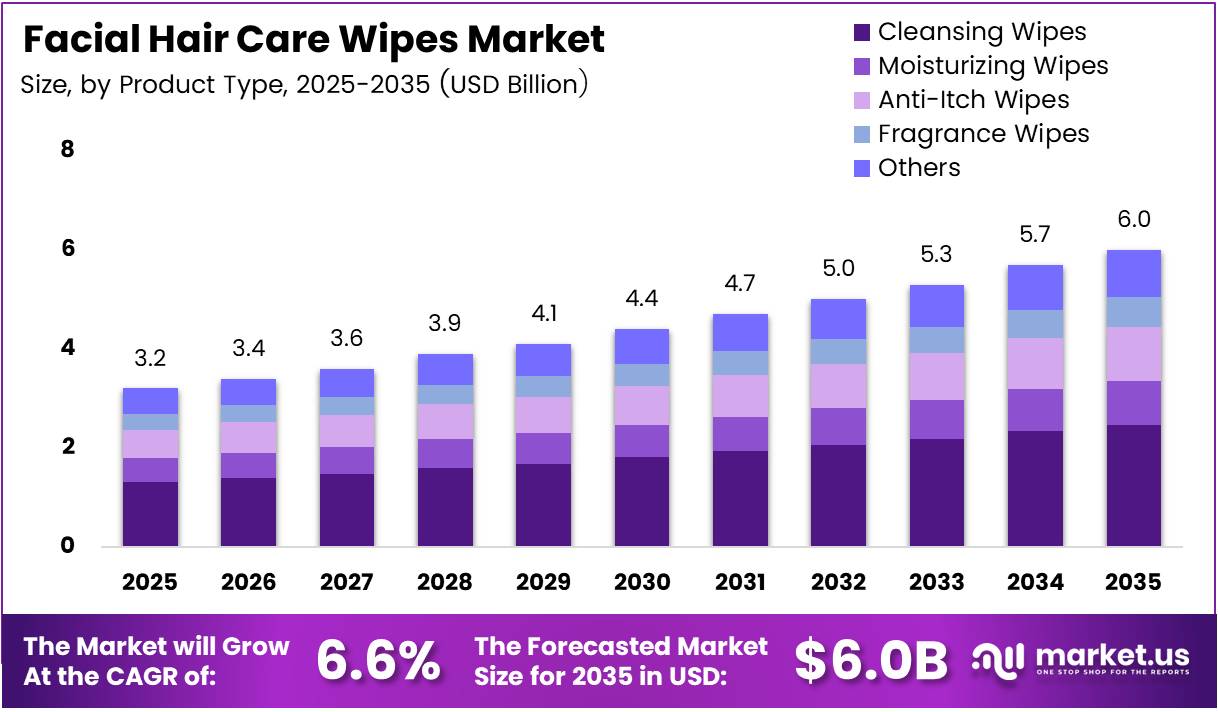
The market spans four product types: cleansing, moisturizing, anti-itch, and fragrance wipes. Ingredient positioning ranges from synthetic formulations to natural and organic blends. Distribution runs through online stores, supermarkets, specialty grooming retailers, and other channels. Personal use dominates demand, with professional grooming settings representing a smaller but growing share.
Beard and mustache culture has moved from niche to mainstream across North America, Europe, and parts of Asia Pacific. This cultural shift created sustained retail demand for beard-specific products that go beyond basic shaving. Wipes occupy a distinct position: they address hygiene, conditioning, and fragrance in a single-use format that traditional beard oils and washes cannot replicate for on-the-go use.
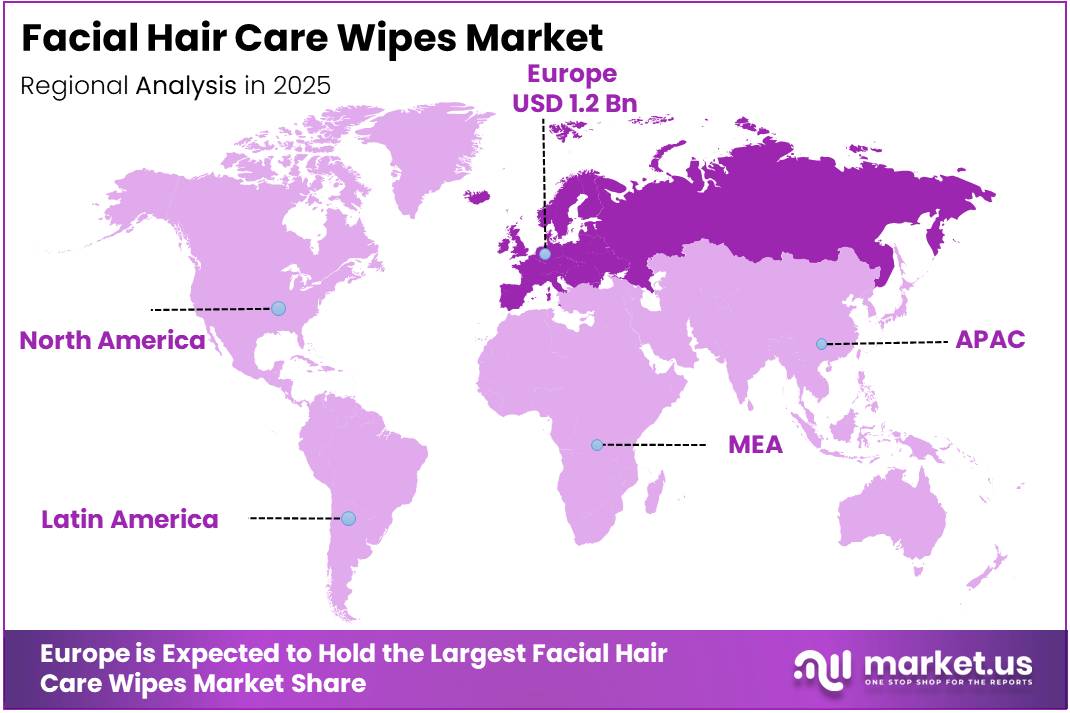
Europe leads the global market with a 38.3% share, valued at USD 1.2 Billion. This reflects the region’s mature male grooming retail infrastructure, premium product preferences, and early adoption of beard care as a personal care category. North America and Asia Pacific follow, with the latter showing faster uptake as disposable incomes rise and urban grooming habits develop.
According to New York Post, 68% of U.S. men report caring more about their appearance now than they did five years ago. This behavioral shift signals a structural change — not a trend cycle — in how men allocate personal care spending. For brands in the facial hair care wipes segment, this translates directly into larger addressable audiences and higher repeat purchase rates.
According to New York Post, 56% of U.S. men say they now spend more time on grooming than they did a few years ago. This data point matters because time investment correlates with product experimentation — consumers who spend more time grooming are more likely to trial new format products like facial hair wipes, making them a receptive audience for category expansion.
Key Takeaways
- The Global Facial Hair Care Wipes Market was valued at USD 3.2 Billion in 2025 and is forecast to reach USD 6.0 Billion by 2035.
- The market grows at a CAGR of 6.6% during the forecast period 2026 to 2035.
- By Product Type, Cleansing Wipes dominate with a 41.3% share in 2025.
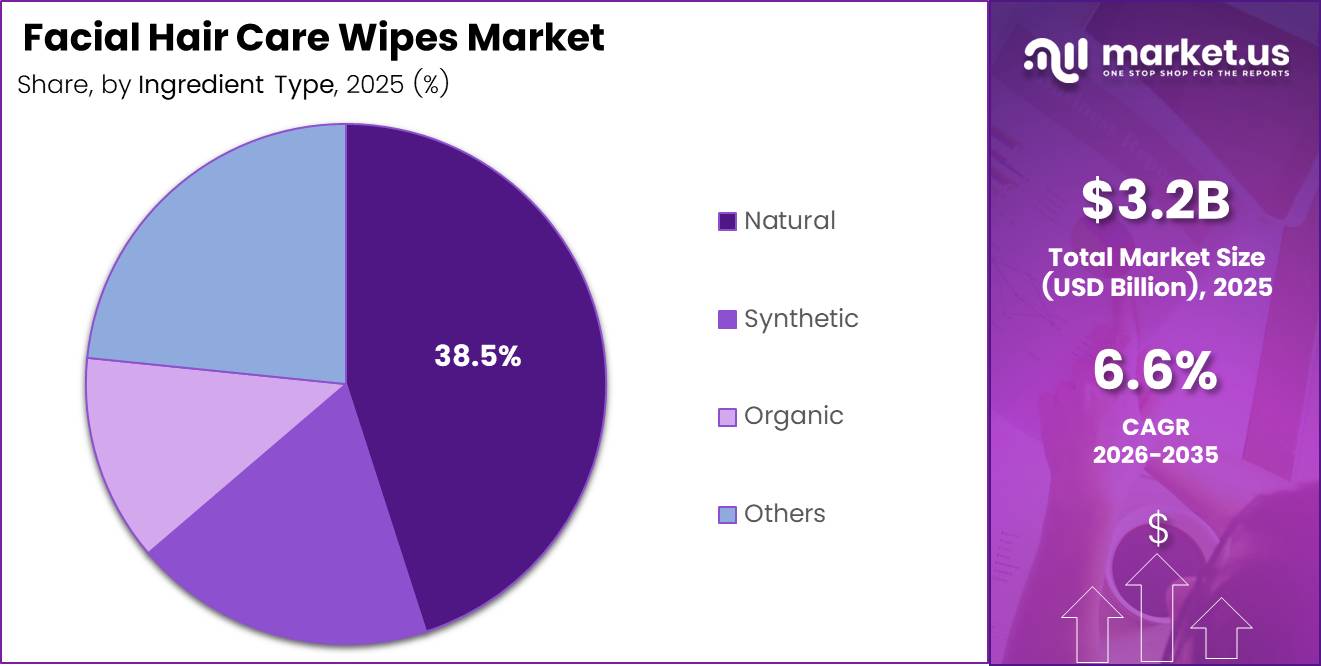
- By Ingredient Type, Natural ingredient wipes lead with a 38.5% share.
- By Application, Personal Use holds a dominant 87.2% share of the market.
- By Distribution Channel, Supermarkets/Hypermarkets account for 36.1% of sales.
- Europe dominates regional demand with a 38.3% share, valued at USD 1.2 Billion.
Product Type Analysis
Cleansing Wipes dominate with 41.3% due to daily beard hygiene necessity.
In 2025, Cleansing Wipes held a dominant market position in the By Product Type segment of the Facial Hair Care Wipes Market, with a 41.3% share. Daily beard cleansing removes trapped food, pollutants, and skin debris — a functional need that other wipe formats do not address. This utility-first positioning drives consistent repeat purchase, making cleansing the anchor product type in most grooming portfolios.
Moisturizing Wipes serve as the premium upgrade within the wipe format, targeting men who experience beard dryness and skin flakiness beneath facial hair. Consumers who adopt moisturizing wipes typically have longer beards and higher grooming engagement, which correlates with higher spend per transaction. This segment benefits as the average grooming routine grows more multi-step among committed beard wearers.
Anti-Itch Wipes address a specific pain point that discourages many men from growing facial hair — the early-stage itch phase. By solving this barrier, anti-itch wipes actively expand the addressable market beyond existing beard growers to men attempting to grow beards for the first time. This positions the sub-segment as both a retention and acquisition tool for the category.
Fragrance Wipes differentiate through sensory appeal rather than functional skin benefit, targeting men who prioritize how their beard smells alongside how it looks. The sub-segment competes with beard sprays and grooming sprays, but the portable wipe format gives it a convenience edge in travel and gym use cases. Positioning around scent premium can support higher price-point strategies.
Others in this segment capture emerging hybrid formulations — including exfoliating wipes and cooling wipes — that brands test before committing to full product lines. While small in current share, this bucket signals where product innovation is heading: toward more targeted, skin-condition-specific wipe formats that deepen category engagement beyond basic cleansing.
Ingredient Type Analysis
Natural ingredient wipes dominate with 38.5% due to consumer demand for skin-safe formulations.
In 2025, Natural ingredient wipes held a dominant market position in the By Ingredient Type segment of the Facial Hair Care Wipes Market, with a 38.5% share. Men with facial hair often have sensitive underlying skin, making ingredient transparency a purchasing factor rather than a marketing preference. Natural formulations — free from parabens, sulfates, and synthetic fragrance — convert hesitant buyers who would otherwise avoid wipe formats entirely.
Synthetic ingredient wipes remain commercially important because they deliver consistent performance at lower production cost, allowing brands to compete at accessible price points in supermarket and mass-retail channels. The cost efficiency of synthetic formulas supports higher promotional frequency and broader SKU distribution, keeping this segment competitive despite the premium narrative around natural alternatives.
Organic wipes occupy the highest price tier within the ingredient spectrum, targeting health-conscious consumers who apply the same certified ingredient standards to personal care as they do to food. This segment grows as organic certification becomes a credible differentiator in specialty grooming retail and direct-to-consumer channels, where buyers can verify claims more easily than in mass retail.
Others in ingredient classification include hybrid blends — such as organic-synthetic combinations — and emerging biotech-derived ingredients like fermentation-based actives. These formulations are typically tested through limited launches in direct-to-consumer channels before scaling. They represent the next wave of ingredient differentiation as natural and organic positioning becomes more crowded.
Application Analysis
Personal Use dominates with 87.2% due to self-directed daily grooming behavior.
In 2025, Personal Use held a dominant market position in the By Application segment of the Facial Hair Care Wipes Market, with an 87.2% share. According to Global Cosmetic Industry, 96% of men buy grooming products for themselves, not for others — confirming that self-motivated grooming behavior drives this category’s purchase dynamics. This makes product discovery and brand loyalty highly personal, with less influence from gift or third-party purchasing patterns.
Professional Use encompasses barbershops, grooming studios, and spa services that incorporate beard wipes into client service protocols. Though currently a minority share, professional use carries strategic value: it builds brand exposure among consumers who may not yet purchase independently. Professional adoption functions as a sampling and trial channel, converting awareness into retail purchase behavior over time.
Distribution Channel Analysis
Supermarkets/Hypermarkets dominate with 36.1% due to high footfall and impulse purchase behavior.
In 2025, Supermarkets/Hypermarkets held a dominant market position in the By Distribution Channel segment of the Facial Hair Care Wipes Market, with a 36.1% share. Mass retail placements capture impulse buyers who encounter wipes alongside other grooming essentials at shelf. The physical trial opportunity — picking up and examining a product — reduces the hesitation that online purchases of unfamiliar formats can create, supporting first-time conversion at scale.
Online Stores represent the fastest-expanding sales channel for facial hair care wipes, driven by direct-to-consumer brand models that bypass traditional retail margins. According to New York Post, the average U.S. man now follows approximately seven steps in his daily grooming routine — a behavior pattern that supports subscription-format purchasing online, where multi-product bundles and auto-replenishment programs are commercially viable.
Specialty Stores — including dedicated grooming retailers and barbershop supply outlets — serve high-engagement consumers who prioritize product expertise over price. These buyers typically carry the highest spend-per-visit of any channel and are disproportionately receptive to premium and organic wipe formats. For brands targeting the upper tier, specialty distribution strengthens brand equity alongside volume.
Others in distribution include gym retail points, airport duty-free outlets, and convenience stores — locations that directly serve the on-the-go use case that defines the wipe format. Placement in fitness and travel environments aligns product positioning with actual usage occasions, reinforcing the convenience narrative and reaching consumers at the moment of need.
Key Market Segments
By Product Type
- Cleansing Wipes
- Moisturizing Wipes
- Anti-Itch Wipes
- Fragrance Wipes
- Others
By Ingredient Type
- Natural
- Synthetic
- Organic
- Others
By Application
- Personal Use
- Professional Use
By Distribution Channel
- Online Stores
- Supermarkets/Hypermarkets
- Specialty Stores
- Others
By Region
- North America
- Europe
- Asia Pacific
- Latin America
- Middle East & Africa
Drivers
Beard Culture Normalization and the Demand for Portable, Daily-Use Grooming Formats
Mainstream beard culture shifted male grooming from a functional routine to a deliberate personal care practice. Men who maintain facial hair require dedicated products that address cleanliness, conditioning, and skin health beneath the beard. This behavioral shift — not a product trend — creates consistent, recurring demand that sustains the wipes category across price points and retail channels.
Urban consumers increasingly prioritize convenience in personal care. The demand for on-the-go grooming products reflects lifestyle constraints — commuting, travel, gym schedules — where traditional wash-and-rinse beard care is impractical. Wipes solve this specifically: no water, no rinse, single-use. According to New York Post, 51% of U.S. men now spend more money on grooming than they did a few years ago, confirming that willingness to pay for convenient formats is a real and measurable market force.
The expansion of men’s personal care product lines by major consumer goods brands brought facial hair care wipes into mainstream retail distribution. In June 2024, Duke Cannon Supply Co. partnered with Planet Fitness to place custom-branded grooming wipes across over 2,300 gym locations in the U.S. — a strategic move that simultaneously validated the on-the-go use case and placed the format directly in front of fitness-conscious male consumers at the moment of post-workout grooming need.
Restraints
Established Beard Care Alternatives and Environmental Disposal Concerns Limit Category Penetration
Facial hair care wipes compete directly against an established ecosystem of beard-specific products — washes, shampoos, conditioners, and oils — that many committed beard growers already use. For this segment of the male grooming audience, adding wipes requires a perceived incremental benefit, not just convenience. Without a strong differentiator, wipes risk being treated as an occasional supplement rather than a regular purchase.
Environmental concerns around single-use disposable products create a structural barrier for the wipes category. Consumers aware of microplastic contamination and non-biodegradable waste patterns increasingly scrutinize single-use personal care formats. This scrutiny is most acute among the same urban, health-conscious demographic that drives premium beard care spending — meaning the category’s core audience is also its most environmentally skeptical buyer group.
The combination of product substitution risk and sustainability pressure sets a ceiling on penetration rates, particularly in markets where environmental regulation of single-use products is active. Brands that fail to address biodegradability and ingredient sourcing face accelerating headwinds in retail listings, especially in European markets where policy pressure on disposable personal care products continues to tighten around packaging and material standards.
Growth Factors
Organic Formulations, E-Commerce Expansion, and Emerging Market Adoption Open New Revenue Channels
Demand for alcohol-free, dermatologically tested, and organic beard wipes creates a product development pathway that commands higher retail prices and stronger brand loyalty. Sensitive skin positioning reduces switching behavior because consumers who find a tolerated formula are reluctant to experiment. In September 2024, Beardbrand launched its Travel Essentials Kit featuring biodegradable beard wipes — a move that directly addressed both the sustainability restraint and the premium organic opportunity in a single product launch.
Direct-to-consumer e-commerce removes geographic constraints on brand reach and allows specialized grooming brands to build subscriber bases that generate predictable revenue. According to Global Cosmetic Industry, 56% of U.S. male consumers spend between $26 and $100 per month on personal care products. This spend level supports subscription models and multi-SKU bundles, both of which are structurally easier to execute online than through conventional retail.
Asia Pacific and Latin America represent the clearest geographic expansion opportunity for established brands. Rising disposable incomes, growing urban male populations, and increasing social media penetration are accelerating grooming product adoption in markets where male personal care retail was historically underdeveloped. Early-mover positioning in these regions — through e-commerce and distributor partnerships — can establish brand loyalty before category competition intensifies.
Emerging Trends
Biodegradable Materials, Multi-Functional Formats, and Influencer-Driven Discovery Reshape the Wipes Category
Eco-friendly facial hair care wipes represent the most commercially significant product development direction in the segment. Brands that achieve credible biodegradable certification gain access to sustainability-sensitive retail channels and premium pricing tiers. According to worldmetrics.org, 38% of men globally have purchased a new grooming product in the past six months — a purchase rate that signals active product experimentation and creates real commercial volume for new eco-format launches.
Multi-functional beard wipes — products that cleanse, condition, and deliver fragrance in a single application — reduce the consumer’s need for multiple products in their beard care routine. This format compression improves convenience and justifies a premium price against single-function alternatives. In March 2024, Every Man Jack introduced a Sensitive Skin Beard Wipes line with hypoallergenic formulations, demonstrating that multi-benefit positioning and skin safety can be combined in a commercially viable product.
Social media grooming influencers now function as the primary product discovery channel for a significant share of male personal care buyers. Travel-friendly, individually packed wipes photograph and film well — they are inherently content-compatible products that generate organic social visibility. Brands that design packaging and use occasions around content creation, not just shelf appeal, hold a structural advantage in influencer-driven discovery environments.
Regional Analysis
Europe Dominates the Facial Hair Care Wipes Market with a Market Share of 38.3%, Valued at USD 1.2 Billion
Europe commands a 38.3% share of the global market, valued at USD 1.2 Billion. The region’s mature male grooming retail infrastructure, high per-capita personal care spending, and strong premium product preferences establish it as the global benchmark for beard care product adoption. Western European markets — particularly the UK, Germany, and France — set formulation and packaging standards that influence product development elsewhere.
North America Facial Hair Care Wipes Market Trends
North America ranks as the second-largest regional market, supported by a well-established men’s personal care retail sector and high e-commerce penetration. U.S. consumers show strong willingness to trial new grooming formats, and gym culture reinforces the on-the-go use case that defines the wipes format. Direct-to-consumer brand growth in the U.S. has intensified category competition while expanding total market volume.
Asia Pacific Facial Hair Care Wipes Market Trends
Asia Pacific holds strong growth potential as urbanization and rising incomes shift male grooming habits in China, India, and Southeast Asia. Social media penetration accelerates product discovery in markets where modern male personal care retail is still developing. International brands entering early through e-commerce channels position themselves ahead of anticipated category formalization across this region.
Latin America Facial Hair Care Wipes Market Trends
Latin America presents an underpenetrated opportunity for portable grooming products, particularly in Brazil and Mexico where urban male consumer spending on personal care is rising. The region’s younger demographic profile and growing middle class align with the consumer profile driving beard care adoption globally. E-commerce and pharmacy retail channels offer the most viable entry paths for international brands.
Middle East and Africa Facial Hair Care Wipes Market Trends
The Middle East and Africa region shows early-stage adoption, with GCC countries leading due to high-income urban populations and strong cultural traditions of beard maintenance. Premium product acceptance in GCC markets makes this sub-region a viable target for high-margin wipe formats. South Africa represents the continent’s most developed personal care retail environment, offering a regional entry point for brands building African market presence.
Key Regions and Countries
North America
- US
- Canada
Europe
- Germany
- France
- The UK
- Spain
- Italy
- Rest of Europe
Asia Pacific
- China
- Japan
- South Korea
- India
- Australia
- Rest of APAC
Latin America
- Brazil
- Mexico
- Rest of Latin America
Middle East & Africa
- GCC
- South Africa
- Rest of MEA
Key Company Insights
Procter & Gamble (Gillette) holds a structural advantage in the facial hair care wipes segment through its existing mass-retail distribution infrastructure and the Gillette brand’s deep penetration among male personal care consumers. Its scale enables shelf dominance in supermarket and hypermarket channels — the leading distribution segment — while cross-promotion with shaving and grooming product lines lowers customer acquisition costs for wipe category entry.
Beardbrand positions itself as a premium, identity-led grooming brand targeting men who treat beard care as a lifestyle investment rather than a hygiene task. This positioning supports higher price points and direct-to-consumer economics. The brand’s September 2024 launch of its Travel Essentials Kit with biodegradable beard wipes demonstrates an ability to align product innovation with both sustainability demand and the travel/portability use case — differentiating it from mass-market competitors on multiple dimensions simultaneously.
Manscaped built its market presence through aggressive digital marketing and subscription commerce, establishing a loyal consumer base across male body grooming before extending into beard care adjacent categories. Its direct-to-consumer model generates first-party consumer data that competitors relying on retail intermediaries cannot replicate. This data advantage informs product development and promotional timing in ways that strengthen long-term retention against premium brand alternatives.
The Art of Shaving operates at the ultra-premium end of the male grooming market, where product efficacy, ingredient sourcing, and brand heritage command significant price premiums. Its retail presence through specialty stores and barber-affiliated channels reaches high-engagement beard care consumers who are the most receptive audience for premium wipe formats. However, its narrower distribution footprint limits volume scale compared to mass-market players in the same category.
Key Players
- Procter & Gamble (Gillette)
- Beardbrand
- Manscaped
- The Art of Shaving
- Old Spice
- Jack Black
- Burt’s Bees
- Nivea
- Cremo Company
- L’Oréal
Recent Developments
- November 2025 — GCPL acquired Mumbai-based men’s grooming brand Muuchstac in an all-cash deal, strengthening its personal care portfolio with a brand that holds established consumer recognition in India’s fast-growing urban male grooming segment. This acquisition signals rising institutional confidence in men’s grooming as a long-term strategic category in emerging markets.
- June 2024 — Duke Cannon Supply Co. partnered with Planet Fitness to distribute custom-branded grooming wipes across more than 2,300 gym locations in the U.S., placing the product directly within the on-the-go use case and reaching millions of fitness-focused male consumers who represent the core beard wipes buyer profile at scale.
Report Scope
Report Features Description Market Value (2025) USD 3.2 Billion Forecast Revenue (2035) USD 6.0 Billion CAGR (2026-2035) 6.6% Base Year for Estimation 2025 Historic Period 2020-2024 Forecast Period 2026-2035 Report Coverage Revenue Forecast, Market Dynamics, Competitive Landscape, Recent Developments Segments Covered By Product Type (Cleansing Wipes, Moisturizing Wipes, Anti-Itch Wipes, Fragrance Wipes, Others), By Ingredient Type (Natural, Synthetic, Organic, Others), By Application (Personal Use, Professional Use), By Distribution Channel (Online Stores, Supermarkets/Hypermarkets, Specialty Stores, Others) Regional Analysis North America (US and Canada), Europe (Germany, France, The UK, Spain, Italy, and Rest of Europe), Asia Pacific (China, Japan, South Korea, India, Australia, and Rest of APAC), Latin America (Brazil, Mexico, and Rest of Latin America), Middle East & Africa (GCC, South Africa, and Rest of MEA) Competitive Landscape Procter & Gamble (Gillette), Beardbrand, Manscaped, The Art of Shaving, Old Spice, Jack Black, Burt’s Bees, Nivea, Cremo Company, L’Oréal Customization Scope Customization for segments, region/country-level will be provided. Moreover, additional customization can be done based on the requirements. Purchase Options We have three licenses to opt for: Single User License, Multi-User License (Up to 5 Users), Corporate Use License (Unlimited User and Printable PDF)  Facial Hair Care Wipes MarketPublished date: Mar 2026add_shopping_cartBuy Now get_appDownload Sample
 -
-
- Procter & Gamble (Gillette)
- Beardbrand
- Manscaped
- The Art of Shaving
- Old Spice
- Jack Black
- Burt's Bees
- Nivea
- Cremo Company
- L'Oréal
Our Clients

- 182304
- Mar 2026






