


Report Overview
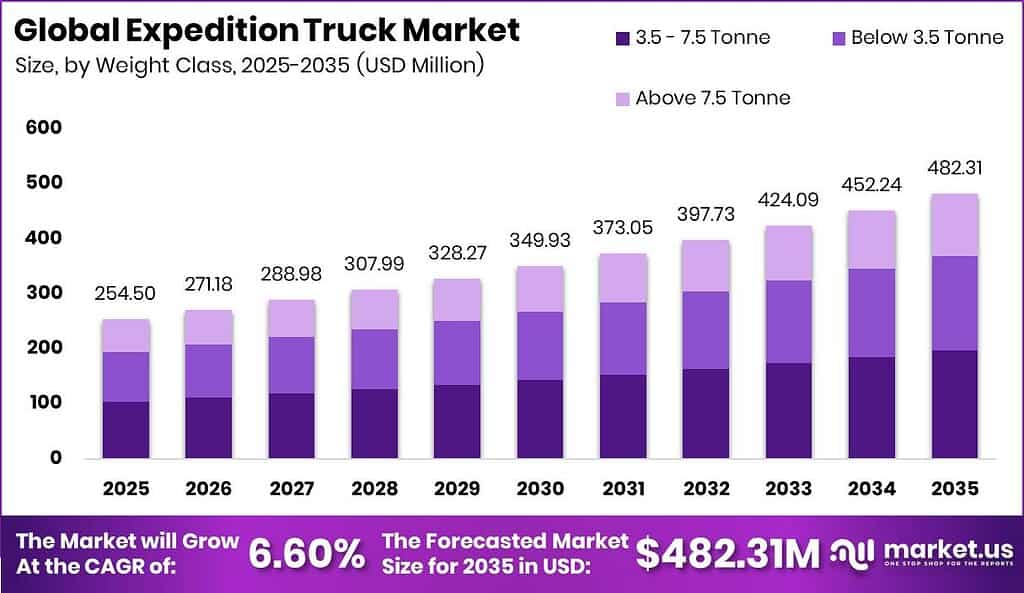
Global Expedition Truck Market size is expected to be worth around USD 482.31 Million by 2035 from USD 254.50 Million in 2025, growing at a CAGR of 6.6% during the forecast period 2026 to 2035. This trajectory reflects a market doubling in value within a single decade. Investors entering now face a window where production volumes remain low but unit values are high, creating strong margin potential before the segment scales.
The Expedition Truck Market covers purpose-built and heavily modified vehicles designed for extended self-sufficient travel across remote and extreme terrain. The market spans a range of weight classes, drivetrain configurations, vehicle types, and end-user applications. Products range from overland-capable light trucks to full heavy-duty expedition platforms built on commercial chassis. Buyers include private adventurers, commercial tour operators, and military and rescue agencies.
Key Takeaways
- The Global Expedition Truck Market was valued at USD 254.50 Million in 2025 and is forecast to reach USD 482.31 Million by 2035.
- The market is growing at a CAGR of 6.6% during the forecast period 2026 to 2035.
- By Weight Class, the 3.5–7.5 Tonne segment dominates with a 41.00% share.
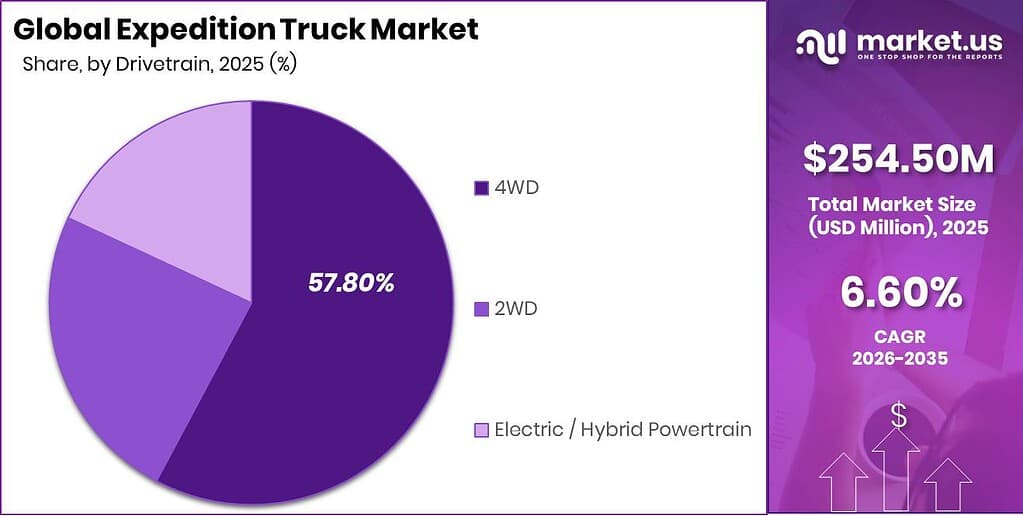
- By Drivetrain, 4WD holds the largest share at 57.80%.
- By Type, Overland Vehicles lead with a 40.00% share.
- By End User, Personal / Adventure Tourism accounts for 65.00% of demand.
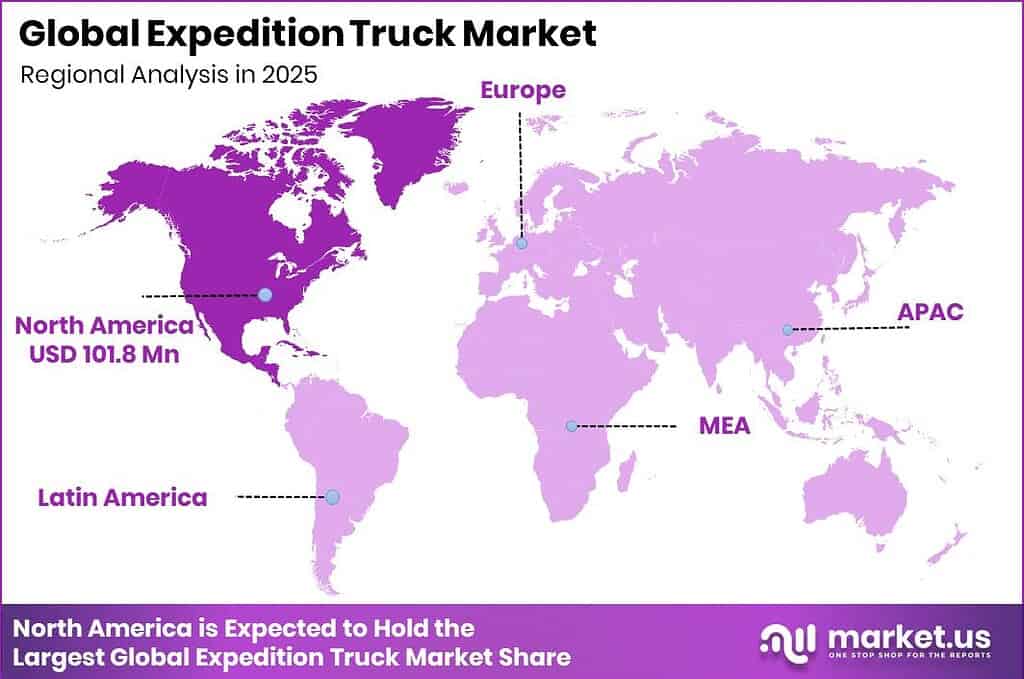
- North America is the dominant region with a 40.00% market share, valued at USD 101.80 Million in 2025.
As per our research, the EarthRoamer SX carries a base price of USD 1,045,000 and reaches approximately USD 1.1 Million when fully customized. This pricing signals that the top tier of the expedition truck market operates closer to bespoke luxury vehicles than to conventional commercial trucks. Manufacturers who can rationalize costs through modular platforms will reach a far wider buyer base than those relying solely on one-off custom builds.
According to Market.us data, overlanding participation in the United States is projected to surpass 12 Million people in 2025, up from around 8 Million in 2024, a year-on-year increase of roughly 50%. This participation surge directly expands the addressable buyer pool for purpose-built expedition trucks. As per our research, 6 out of 10 industry suppliers expect the overlanding market to grow between 10% and 25% over the next five years, reinforcing the commercial case for scaling production capacity now.
Figures from Market.us show that EU heavy vehicle registrations above 3.5 tonnes fell by approximately 6.2% in 2025 to around 307,460 units. This contraction limits the pool of donor chassis available for expedition truck conversions in Europe. Builders who secure long-term supply agreements with chassis manufacturers will hold a structural cost advantage over rivals who purchase donor vehicles on the open market at spot prices.
Type Analysis
Overland Vehicles dominate with 40.00% due to modular design meeting diverse terrain needs.
In 2025, Overland Vehicles held a dominant market position in the By Type segment of the Expedition Truck Market, with a 40.00% share. This segment includes both Soft-Shell and Hard-Shell configurations, giving buyers flexibility in habitat weight and insulation. The EarthRoamer LTi, a leading Hard-Shell example, carries 100 gallons of onboard fresh water and 920 amp-hours of lithium-ion battery storage, enabling extended off-grid operation without resupply. Builders offering integrated energy and water systems command premium pricing and repeat buyer loyalty.
Class A Motorhome-style expedition trucks represent the fastest-growing sub-type, driven by buyers seeking residential-grade living standards in extreme environments. These platforms combine heavy-duty off-road chassis with full-height habitats and integrated utility systems. The EarthRoamer LTi is built on a Ford F-550 4WD chassis using a 6.7-liter turbo diesel rated at 330 horsepower. This powertrain provides the towing and gross vehicle weight capacity needed to support fully loaded expedition habitats exceeding several tonnes. Builders who standardize on proven commercial chassis reduce certification risk and shorten lead times.
Truck Campers, which include Slide-in Campers and Pop-up Campers, serve buyers who want expedition capability without a permanently modified base vehicle. The slide-in format allows a standard pickup bed to accept a removable living unit, reducing total ownership cost. According to the Recreation Vehicle Industry Association, truck camper shipments have remained a consistent segment of the North American RV market across multiple production cycles, reflecting stable demand from buyers who prioritize versatility over permanence. This segment provides entry-level price points that attract first-time expedition buyers before they upgrade to dedicated builds.
Weight Class Analysis
3.5–7.5 Tonne dominates with 41.00% due to optimal chassis versatility across expedition applications.
In 2025, the 3.5–7.5 Tonne segment held a dominant market position in the By Weight Class segment of the Expedition Truck Market, with a 41.00% share. Vehicles in this range balance off-road mobility with payload capacity sufficient for fully equipped living quarters and extended fuel reserves. The Arctic Trucks AT44, a representative platform in this class, carries a permanent fuel tank of 280 liters with up to 800 liters of additional capacity on deck or trailer, totaling up to 1,080 liters. This fuel endurance makes the segment commercially attractive for operators running polar and remote-terrain logistics contracts.
Vehicles below 3.5 tonnes serve buyers who prioritize low weight and road-legal simplicity over maximum payload. These platforms typically use light commercial or consumer pickup bases and accept smaller habitat modules. The Arctic Trucks AT44 demonstrates how even a mid-size polar platform achieves 300 mm of ground clearance and tire pressures as low as 2 psi, delivering flotation over soft snow without requiring a heavier chassis. Manufacturers targeting this sub-segment benefit from wider donor-vehicle availability and lower base-build costs compared with the 3.5–7.5 tonne tier.
Vehicles above 7.5 tonnes represent the fastest-growing sub-segment and target operators who require heavy-duty off-grid capability for military, disaster response, and commercial expedition use. These platforms typically use class 6 to class 8 commercial truck chassis and support habitat modules with full residential utilities. According to UNIDO industrial output data, global commercial truck chassis production for class 6 and above has remained above 2 Million units annually in recent periods, sustaining a broad supply base for heavy expedition builds. Builders who establish preferred supplier relationships with chassis OEMs can reduce lead times and manage costs more effectively than spot-market buyers.
Drivetrain Analysis
4WD dominates with 57.80% due to proven all-terrain traction in expedition-critical conditions.
In 2025, 4WD held a dominant market position in the By Drivetrain segment of the Expedition Truck Market, with a 57.80% share. Four-wheel-drive systems remain the standard specification for serious expedition builds because they deliver torque to all four wheels simultaneously in low-traction environments. The Arctic Trucks AT44 polar platform uses a part-time transfer case with a 2.6:1 low-range ratio, paired with a 3.0-liter diesel producing 171 horsepower and 360 Nm of torque. This drivetrain combination allows polar operators to cover more than 3 times the daily distance of belt vehicles while consuming 5 times less fuel, delivering a decisive operational cost advantage.
2WD platforms capture the entry-level and road-biased portion of the expedition truck buyer base, where operators prioritize highway efficiency over off-road capability. These platforms suit commercial tour operators running established routes on graded tracks rather than virgin terrain. According to the U.S. Department of Transportation Federal Highway Administration, rear-wheel-drive commercial truck configurations remain the dominant format in North American freight operations, confirming broad chassis availability and lower acquisition cost for 2WD expedition builds. Buyers in this sub-segment represent a volume opportunity for builders who offer turnkey conversion packages on standard commercial bases.
Electric and Hybrid Powertrain configurations represent the fastest-growing drivetrain sub-segment as energy independence and emissions compliance become purchasing criteria for both private and institutional buyers. The EarthRoamer LTi integrates 920 amp-hours of lithium-ion battery storage charged by rooftop solar, allowing all vehicle systems to operate independently of the diesel engine during static off-grid periods. According to IEA data, global electric light commercial vehicle sales reached over 280,000 units in 2023 and have continued to rise, establishing a growing technology supply chain that expedition builders can draw on for battery and power management components. Builders who invest in hybrid architecture now will face lower integration costs as component prices decline.
End User Analysis
Personal / Adventure Tourism dominates with 65.00% due to rising consumer appetite for self-sufficient remote travel.
In 2025, Personal / Adventure Tourism held a dominant market position in the By End User segment of the Expedition Truck Market, with a 65.00% share. Private buyers in this segment invest in expedition trucks as long-term travel platforms replacing multiple annual travel expenditures. The EarthRoamer LTi, a flagship personal-use platform, carries a final build cost in the range of USD 820,000 to USD 830,000, reflecting the depth of customization buyers are willing to fund for true autonomy. Builders who offer financing structures alongside custom builds will convert more qualified leads into completed orders.
Commercial Tour Operators represent a structurally important buyer cohort that generates recurring fleet replacement demand. These operators run expedition vehicles commercially across fixed remote routes in Africa, South America, and Central Asia. According to the World Tourism Organization, international tourist arrivals to emerging destination regions have recovered to pre-pandemic levels and continue to rise, expanding the commercial case for purpose-built tour operator fleets. Operators in this segment require chassis standardization for parts interchangeability and serviceability, which favors builders with established dealer or service networks over fully bespoke one-off manufacturers.
Military and Rescue buyers represent the fastest-growing end-user sub-segment, encompassing Disaster Response Vehicles and Search and Rescue Vehicles. These buyers acquire expedition trucks through government procurement programs with defined technical specifications and multi-unit contracts. According to the Stockholm International Peace Research Institute, global military expenditure reached USD 2.44 Trillion in 2023, with logistics and mobility platforms representing a consistent allocation within defense budgets. Builders who obtain relevant military certification and participate in government tender processes gain access to contract volumes that dwarf individual private sales and provide revenue stability across economic cycles.
Key Market Segments
By Weight Class
- Below 3.5 Tonne
- 3.5–7.5 Tonne
- Above 7.5 Tonne
By Drivetrain
- 4WD
- 2WD
- Electric / Hybrid Powertrain
By Type
- Overland Vehicles
- Soft-Shell Overland Vehicles
- Hard-Shell Overland Vehicles
- Class A Motorhome-style
- Truck Campers
- Slide-in Campers
- Pop-up Campers
By End User
- Personal / Adventure Tourism
- Commercial Tour Operators
- Military & Rescue
- Disaster Response Vehicles
- Search & Rescue Vehicles
Regional Analysis
North America Dominates the Expedition Truck Market with a Market Share of 40.00%, Valued at USD 101.80 Million
North America holds the largest regional share of the Expedition Truck Market at 40.00%, equivalent to USD 101.80 Million in 2025. This dominance reflects the region’s large and mature overlanding culture, extensive network of unpaved public lands, and high consumer purchasing power for premium off-road vehicles. The United States drives the majority of regional demand, supported by a dense ecosystem of specialty builders, aftermarket suppliers, and expedition-focused media. Brands operating with established North American distribution hold a structural advantage that new entrants will struggle to replicate quickly.
Europe represents the fastest-growing regional market, driven by caravan and motorhome culture evolving toward more rugged expedition-capable formats. In April 2025, Bliss Mobil showcased a new 8-foot expedition unit for the Toyota Land Cruiser and its 20-foot Mercedes-Benz Arocs 6×6 expedition truck at the OCA St. Gallen exhibition, signaling active product expansion within the European market. European buyers tend to favor heavier, longer-range platforms suited to transcontinental travel. Builders who localize their chassis sourcing and certification processes for EU type-approval requirements will convert European interest into confirmed orders faster than those relying on North American certification pathways.
Key Regions and Countries
North America
- US
- Canada
Europe
- Germany
- France
- The UK
- Spain
- Italy
- Rest of Europe
Asia Pacific
- China
- Japan
- South Korea
- India
- Australia
- Rest of APAC
Latin America
- Brazil
- Mexico
- Rest of Latin America
Middle East and Africa
- GCC
- South Africa
- Rest of MEA
Market Dynamics
Market Opportunity Analysis - Standardized platforms and institutional buyers offer the clearest near-term revenue upside.
The Personal / Adventure Tourism segment holds 65.00% of end-user demand but concentrates purchasing power among a narrow high-net-worth buyer cohort willing to spend USD 820,000 or more per unit. This concentration creates fragility for builders dependent on a small number of annual orders. Builders who develop mid-tier configurations priced below USD 500,000 could access the next tier of buyer without cannibalizing their flagship margins, opening a structurally underserved price band within the dominant end-user segment.
The Military and Rescue sub-segment is the fastest-growing end-user category and remains largely untapped by civilian expedition truck builders. Government procurement programs offer multi-unit contracts and defined replacement cycles that provide revenue predictability absent from private custom builds. Builders who invest in obtaining relevant military type certifications now position themselves ahead of a procurement wave that follows rising global defense spending. This sub-segment rewards early movers with long-term contract lock-in rather than one-time sales.
The Above 7.5 Tonne weight class is the fastest-growing size segment but currently serves the smallest share of the market. Heavy-duty expedition platforms for commercial and institutional operators require significant chassis investment and engineering depth that most small builders cannot support. This creates an opening for mid-size builders to partner with commercial truck chassis OEMs on co-developed expedition variants, sharing certification costs while accessing a buyer base with higher unit volumes than the private-client market.
The Electric and Hybrid Powertrain drivetrain sub-segment is the fastest-growing configuration but carries the smallest current installed base. Buyers in this segment include environmentally regulated operators, urban-adjacent tourism companies, and military units subject to emissions restrictions on base. Builders who develop hybrid expedition platforms now will hold proprietary technical knowledge at a point when competitor capabilities remain limited, enabling them to set pricing benchmarks and capture early institutional contracts before the segment becomes competitive.
Technology and Innovation Landscape - Energy autonomy, digital customization, and hybrid powertrains define the next competitive frontier.
The EarthRoamer LTi integrates 920 amp-hours of lithium-ion battery storage with a rooftop solar array, enabling all onboard systems to operate independently of the diesel engine during stationary off-grid periods. This energy architecture eliminates the need for a separate generator and reduces noise and fuel consumption during extended static camp. Builders who adopt integrated solar-battery systems as a standard specification rather than an option will differentiate their platforms in a buyer segment that values operational self-sufficiency above all other features.
In 2025, Action Mobil expanded its digital customer engineering process by implementing advanced 3D vehicle planning technology, allowing buyers to visualize and configure their expedition trucks before production begins. This capability reduces design-iteration cycles, cuts pre-production engineering cost, and gives buyers greater confidence in their specification choices before committing to seven-figure investments. Builders who invest in digital configuration tools gain a competitive advantage in the sales process by shortening the time between initial inquiry and signed purchase order.
The EarthRoamer LTi fuel system pairs a 55-gallon auxiliary tank with a 40-gallon primary tank through an automatic transfer system, delivering a combined diesel capacity of 95 gallons that extends operational range without manual intervention. This passive fuel management approach reduces operator workload in remote environments and lowers the risk of running the primary tank dry. Builders who engineer seamless auxiliary-to-primary fuel transfer into standard platform specifications will gain favor among buyers who prioritize operational reliability over cost optimization.
Electric and Hybrid Powertrain configurations are advancing as a defined sub-segment rather than a concept experiment, driven by institutional buyers subject to emissions regulations and private buyers seeking fuel-cost reduction on extended tours. Arctic Trucks data shows that even conventional diesel expedition platforms can operate at 5 times the fuel efficiency of belt vehicles when tire pressure and drivetrain selection are optimized. This efficiency benchmark sets a performance bar that hybrid powertrains must meet or exceed to justify their higher acquisition cost in buyer value assessments.
Drivers
Overlanding participation in the United States is projected to reach more than 12 Million people in 2025, up from around 8 Million in 2024, a year-on-year increase of roughly 50%. About 2.9 Million Americans already identify as overlanders, and 6 out of 10 suppliers expect the market to grow between 10% and 25% over the next five years. This participation surge converts directly into higher demand for purpose-built expedition platforms, supporting an estimated +2.4% contribution to the baseline CAGR of 6.6%.
| Driver | (~) % Impact on CAGR Forecast | Geographic Relevance | Impact Timeline |
|---|---|---|---|
| Surging overlanding participation and outdoor travel demand | +2.4% | North America, Europe | Medium term (2–4 years) |
| Growth in motorhome and caravan registrations | +1.6% | Europe | Medium term (2–4 years) |
| Expansion of off‑road vehicle segment | +1.3% | Global | Medium term (2–4 years) |
| Lifestyle shift toward long‑distance self‑sufficient travel | +0.9% | North America, Europe | Long term (≥ 4 years) |
Restraints
Registrations of vehicles over 3.5 tonnes in the European Union fell by approximately 6.2% in 2025, following a decline of around 6.3% in 2024, bringing total EU heavy goods vehicle registrations to roughly 307,460 units. Including the UK, Switzerland, Norway, and Iceland, the broader European market recorded around 371,240 registrations in 2025, down about 5.4%. This contraction limits the pool of suitable donor chassis for expedition truck builds, subtracting an estimated -2.1% from the baseline CAGR of 6.6%.
High upfront build and customization costs restrain accessible demand across North America and Europe. Entry-level expedition builds in the 3.5–7.5 tonne class require significant chassis, fabrication, and systems investment before the first unit reaches a buyer. Fuel-cost sensitivity adds a further barrier for long-range expedition operators, particularly at current diesel price levels across European markets. Together these cost pressures subtract a combined estimated -2.5% from the market’s attainable growth ceiling, concentrating near-term volume among high-net-worth private buyers and institutional procurement programs.
| Restraint | (~) % Impact on CAGR Forecast | Geographic Relevance | Impact Timeline |
|---|---|---|---|
| Declining new heavy‑truck registrations in core regions | -2.1% | Europe | Short term (≤ 2 years) |
| High upfront build and customization costs | -1.5% | North America, Europe | Medium term (2–4 years) |
| Fuel‑cost sensitivity for long‑range expedition use | -1.0% | Global | Short term (≤ 2 years) |
Challenges
Expedition trucks must combine high ground clearance, heavy-duty suspension, and off-road tires with highway performance and road safety compliance. European leisure vehicle data shows that more than 221,000 new motorhomes and caravans were registered across Europe in 2024, a rise of roughly 5.2% versus 2023. This reflects buyer preference for comfort-oriented formats over rugged expedition builds. Meeting both off-road and on-road requirements adds engineering and certification complexity, applying an estimated friction drag of -1.5% on attainable growth above the baseline CAGR of 6.6%.
Regulatory compliance for modified heavy vehicles adds cost and time to every expedition truck program. Builders must navigate type-approval processes, axle load limits, and emissions standards across multiple jurisdictions, particularly in Europe where standards vary by country and vehicle class. Supply-chain complexity for specialized expedition components such as portal axles, custom suspension kits, and integrated power systems further extends production timelines. These two challenges collectively exert an estimated combined drag of -2.4% on maximum attainable CAGR, making supply-chain consolidation a key strategic lever for competitive builders.
| Challenge | (~) % CAGR Friction Drag | Geographic Relevance | Mitigation Horizon |
|---|---|---|---|
| Balancing off‑road capability with highway comfort and safety | -1.5% | Global | Long term (≥ 4 years) |
| Regulatory compliance for modified heavy vehicles | -1.3% | North America, Europe | Medium term (2–4 years) |
| Supply‑chain complexity for specialized expedition components | -1.1% | Global | Medium term (2–4 years) |
Opportunities
Overlanding participation in the United States is set to rise from around 8 Million participants in 2024 to more than 12 Million in 2025. Industry associations report more than a decade of steady North American overland industry growth, followed by several years of double-digit expansion. Suppliers expect the overlanding market to grow between roughly 10% and 25% over the next five years. Designing expedition trucks as purpose-built overland platforms rather than one-off customs could add approximately +2.8% upside to the baseline CAGR of 6.6% through standardized production and wider distribution.
Cross-over designs between expedition trucks and premium motorhomes present a second commercial opening, capable of adding an estimated +2.2% to attainable CAGR by targeting European buyers who want off-road capability without sacrificing living standards. Accessory and retrofit packages for existing heavy-duty trucks represent a third revenue stream, offering builders recurring aftermarket sales to an installed base that grows with each completed expedition build. Early movers who build scalable retrofit programs will establish service-revenue streams that provide income between new-build project cycles.
| Opportunity | (~) % Potential CAGR Upside | Geographic Relevance | Execution Window |
|---|---|---|---|
| Purpose‑built overland truck platforms aligned with fast‑growing participation | +2.8% | North America, Europe | Medium term (2–4 years) |
| Cross‑over designs between expedition trucks and premium motorhomes | +2.2% | Europe, North America | Medium term (2–4 years) |
| Accessory and retrofit packages for existing heavy‑duty trucks | +1.7% | Global | Long term (≥ 4 years) |
Key Company Insights
Global Expedition Vehicles (GXV) positions itself at the premium end of the expedition truck market through fully bespoke builds on proven heavy-duty chassis. Its approach targets buyers who prioritize engineering depth over production speed, creating a defensible niche against volume-oriented competitors. This strategy generates high per-unit revenue but limits output scale, leaving GXV exposed if modular-platform builders successfully reduce their price points and attract mid-market buyers currently priced out of the segment.
EarthRoamer LLC commands the upper tier of the North American personal expedition market with builds priced from USD 820,000 to over USD 1,045,000 depending on model and specification. The 2025 Krug Expedition Bedrock XT2 enters this price band at USD 690,000 base and up to USD 850,000 fully optioned, signaling direct competition for the same high-net-worth buyer pool. EarthRoamer’s established brand recognition and North American service infrastructure give it a retention advantage, but price proximity to rivals means it cannot rely on cost positioning alone.
Key Players
- Global Expedition Vehicles (GXV)
- EarthRoamer LLC
- Bliss Mobil
- Unicat GmbH
- Action Mobil Reisemobile GmbH
- Krug Expedition
- Bimobil
- EarthCruiser Overland Vehicles
- Tembo 4×4
- Gekkotruck
Recent Developments
- June 2026: EarthCruiser marked its 18th anniversary by launching the EarthCruiser BSC expedition platform, developed in partnership with OVP to expand its premium overland vehicle lineup following the company’s prior operational restructuring.
- 2026: EarthCruiser resumed active development of premium overland platforms through its collaboration with Overland Vehicle Systems (OVP), with a strategic focus on new expedition vehicle offerings targeting the North American market.
Geopolitical Impact Analysis
As reported by the WTO, global goods trade volumes contracted by approximately 1.2% in 2023 due to geopolitical fragmentation and supply chain rerouting, with trade-restrictive measures among G20 nations reaching a record high. Steel and aluminum tariffs, particularly the United States Section 232 tariffs of 25% on steel imports, directly increase chassis fabrication costs for expedition truck builders sourcing structural materials internationally. Builders reliant on cross-border steel supply face margin compression that producers with domestic sourcing or long-term fixed-price contracts are better positioned to absorb.
Data from the IMF indicates that global commodity price volatility has remained elevated, with diesel fuel prices in Europe averaging over 40% above their 2019 baseline through 2023 and into 2024 due to energy market disruption from the Russia-Ukraine conflict. Expedition truck buyers who undertake long-range diesel-dependent travel in Europe and Central Asia face structurally higher operating costs as a result. This pressure accelerates buyer interest in hybrid and extended-range fuel systems, benefiting builders who have already invested in 95-gallon-class or larger integrated fuel architectures that reduce refueling frequency in high-cost or low-availability regions.
Report Scope
| Report Features | Description |
|---|---|
| Market Value (2025) | USD 254.50 Million |
| Forecast Revenue (2035) | USD 482.31 Million |
| CAGR (2026-2035) | 6.6% |
| Base Year for Estimation | 2025 |
| Historic Period | 2020-2024 |
| Forecast Period | 2026-2035 |
| Report Coverage | Revenue Forecast, Market Dynamics, Market Opportunity Analysis, Technology and Innovation Landscape, Competitive Landscape, Recent Developments |
| Segments Covered | By Weight Class (Below 3.5 Tonne, 3.5–7.5 Tonne, Above 7.5 Tonne), By Drivetrain (4WD, 2WD, Electric / Hybrid Powertrain), By Type (Overland Vehicles [Soft-Shell, Hard-Shell], Class A Motorhome-style, Truck Campers [Slide-in, Pop-up]), By End User (Personal / Adventure Tourism, Commercial Tour Operators, Military and Rescue [Disaster Response, Search and Rescue]) |
| Regional Analysis | North America (US and Canada), Europe (Germany, France, The UK, Spain, Italy, and Rest of Europe), Asia Pacific (China, Japan, South Korea, India, Australia, and Rest of APAC), Latin America (Brazil, Mexico, and Rest of Latin America), Middle East and Africa (GCC, South Africa, and Rest of MEA) |
| Competitive Landscape | Global Expedition Vehicles (GXV), EarthRoamer LLC, Bliss Mobil, Unicat GmbH, Action Mobil Reisemobile GmbH, Krug Expedition, Bimobil, EarthCruiser Overland Vehicles, Tembo 4×4, Gekkotruck |
| Customization Scope | Customization for segments, region / country-level will be provided. Additional customization can be done based on requirements. |
| Purchase Options | We have three licenses to opt for: Single User License | Multi-User License (Up to 5 Users) | Corporate Use License (Unlimited User and Printable PDF) |





































